

Fjord Arkitekter Builds a Geothermally Heated Pine Cabin in the Forests North of Oslo
Mylla Winter Cabin pairs vacuum-oiled pine cladding and near-passive-house performance with a quiet footprint in Nordmarka's snow country.


Nordmarka stretches north from Oslo like a deep breath: dense forest, granite outcrops, cross-country ski trails that can deliver you to the city center in an hour. It is also the kind of landscape that punishes architectural ego. Anything too angular, too white, too demonstrably 'designed' looks absurd against a spruce canopy in January. Fjord Arkitekter understood this when they set out to build Mylla Winter Cabin, a 120-square-meter retreat completed in 2023. The result is a building whose defining quality is restraint: pine walls that will grey into the forest over a few seasons, geothermal heating that leaves no visible chimney stack, and an elongated plan that follows the contour of the site rather than imposing a shape on it.
What makes the cabin worth studying is not its humility alone but the precision behind it. Every material choice and spatial decision serves a double purpose, combining thermal performance with sensory warmth. The cabin hits near-passive-house standards without resorting to the sealed-box aesthetic that label often implies. Instead, floor-to-ceiling glazing floods the living spaces with low winter sun while the plan's narrow cross-section ensures every room has a relationship with the outdoors. It is, in short, a building that works hard and looks effortless.
Pine Skin, Spruce Lining
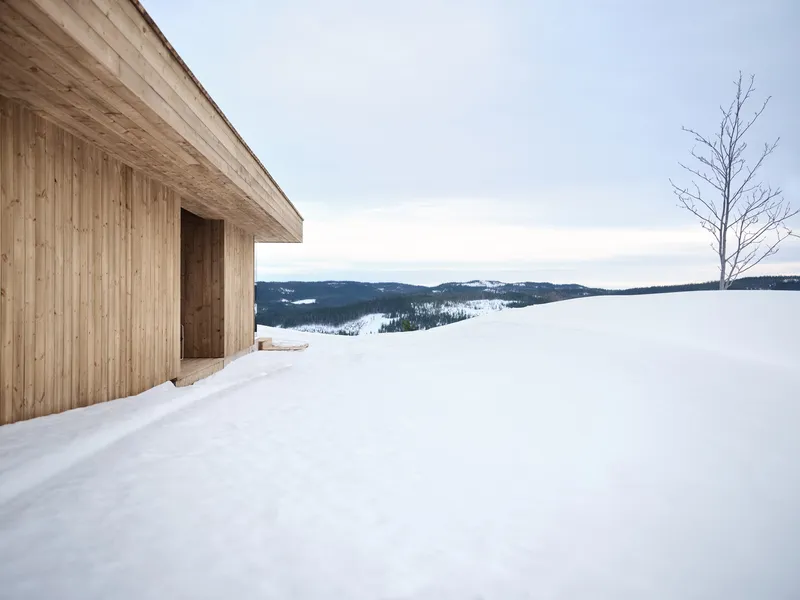
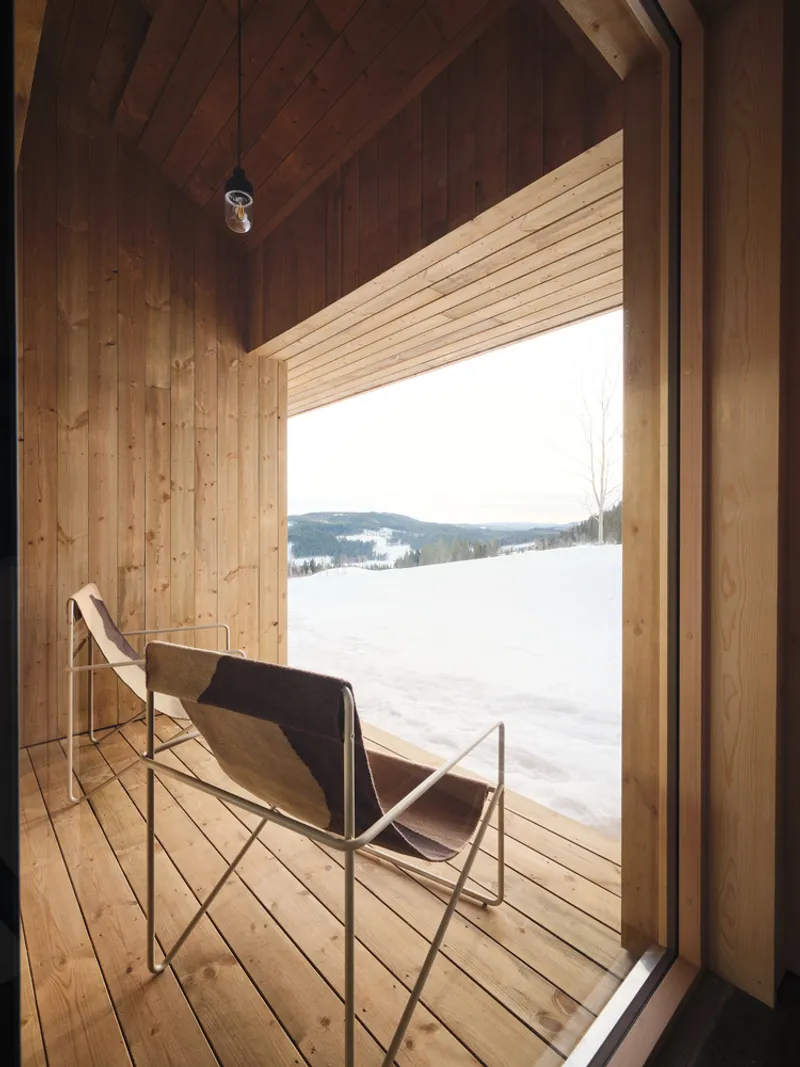
The exterior cladding is pine treated with the Norwegian Møre Royal technique, a process in which the timber is vacuum-cooked in oil to build weather resistance deep into the grain. It is a regional method that sidesteps the petrochemical preservatives common elsewhere, and it comes with a built-in time signature: the wood shifts from honey gold to a silvered patina as seasons pass, slowly dissolving the boundary between building and birch trunk. The recessed entry is carved from this same timber shell, creating a sheltered threshold that mediates between freezing air and warm interior.
Step outside and the timber deck extends the living space into the snow. A canvas sling chair framed by the wide window opening is the kind of detail that reads as casual but reveals how carefully the architects choreographed views. Every opening is positioned so that the seated eye meets the horizon rather than a neighbouring roofline.
The Long Plan and Its Logic

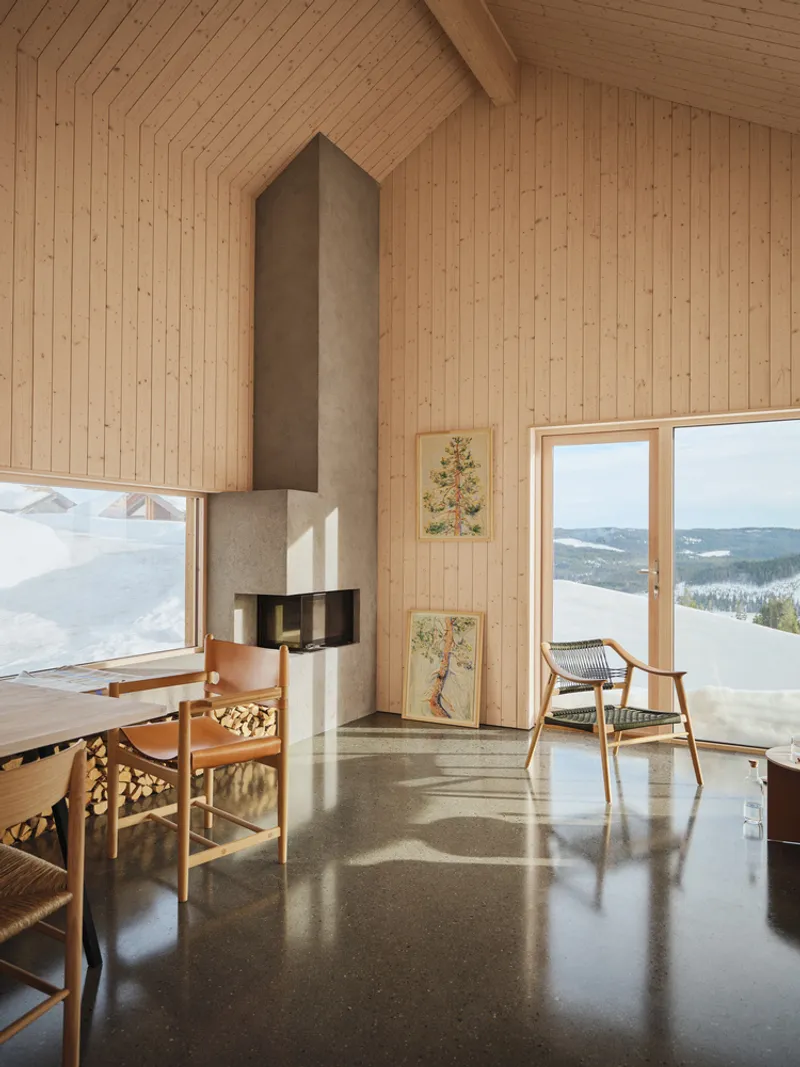
Fjord Arkitekter chose an elongated, narrow plan that separates bedrooms from communal areas by sheer distance rather than heavy partitions. The ground floor runs from the entry hall through kitchen and dining to a living room anchored by a grey fireplace chimney and flanked by glazing on two sides. Bedrooms sit at the far end, buffered from social noise. Upstairs, a loft accommodates an office and additional sleeping quarters, reached by a staircase the architects describe as an 'integral piece of furniture' rather than mere circulation.
Ceiling heights shift throughout the sequence. The dining zone rides beneath a vaulted spruce ceiling that amplifies the sense of volume, while the loft compresses overhead, creating the snug proportions you expect in a cabin bedroom. These transitions give the 120-square-meter plan a spatial richness that belies its modest footprint.
Concrete, Spruce, and Thermal Mass

Polished concrete covers the ground floor, serving as both finish and thermal battery. Warmed by the geothermal system running below, the slab stores and releases heat slowly, smoothing out the temperature swings that come with a climate where winter nights routinely drop well below freezing. The loft swaps concrete for oiled spruce underfoot, a warmer surface for bare feet and a signal that the upper level is for rest rather than gathering.
Interior walls and ceilings throughout are varnished spruce from Bergene Holm, a Norwegian supplier. The varnish brings out the grain without sealing it into a glassy sheen, letting the wood feel tactile and alive. Combined with low afternoon sun streaming through the vaulted ceiling, the effect is luminous rather than glossy.
Kitchen as Social Anchor

The kitchen island, finished in a muted green that provides the cabin's only strong colour note, sits directly beneath the vaulted ceiling's peak. Pendant lights drop on long cords to define the work surface without cluttering the volume overhead. It is a deliberate move: in a cabin used primarily for winter weekends, the kitchen doubles as the social centre, and placing it under the tallest point of the roof gives it a generosity that a galley layout would not.
Adjacent shelving is wall-mounted timber with horizontal slat details, holding ceramic bowls and kitchen objects in a way that reads more like a display than storage. The detailing is simple, almost repetitive, yet it reinforces the cabin's commitment to craft without ornament. Nothing here is decorative in isolation; everything earns its place through use.
Geothermal Heating and Near-Passive Performance
Relying exclusively on geothermal energy for heating is a bold choice in a climate that demands serious thermal output. It works here because the envelope is tight: the near-passive-house standard means minimal heat loss, while the concrete slab and compact volume reduce the energy demand that the ground-source system has to meet. There is no backup wood stove, no electric baseboard. The grey chimney visible in the living room is a flue for occasional atmosphere, not a lifeline.
The large windows on two sides of the living room are not just scenic. In winter, even low-angle Nordic sun contributes meaningful solar gain to a well-insulated envelope, and the narrow plan ensures that light penetrates deep into the interior. It is passive design in the literal sense: the building's shape does much of the work before any mechanical system kicks in.
Why This Project Matters
Norwegian cabin culture, or hyttekultur, is one of the most active proving grounds for residential sustainability in Europe. Thousands of new cabins go up each year, and the cumulative impact of their material choices and energy systems is enormous. Mylla Winter Cabin demonstrates that a high-performance envelope and renewable heating can coexist with the warmth, tactility, and connection to landscape that make a cabin feel like a cabin rather than a demonstration unit.
Fjord Arkitekter's contribution is not a radical formal gesture but a careful calibration of old and new. Vacuum-oiled pine is a centuries-old treatment applied with contemporary precision. Geothermal heating is mature technology deployed with enough insulation to let a modest borehole do the job. The elongated plan nods to traditional Norwegian longhouse proportions while serving a modern program of remote work and weekend escape. None of these decisions grab headlines individually, but together they compose a building that will age well, heat cheaply, and disappear gracefully into the forest that surrounds it.
Mylla Winter Cabin by Fjord Arkitekter. Location: Nordmarka, Oslo, Norway. Area: 120 m². Year: 2023. Photography by Einar Aslaksen.
About the Studio
Share Your Own Work on uni.xyz
If projects like this are the kind of work you want to make, uni.xyz is a place to publish your own, find collaborators, and enter design competitions.



Popular Articles
Popular articles from the community


Co-life: Sustainable Architecture for Age-Friendly Community Living
Co-life reimagines sustainable architecture for seniors through courtyards, rammed earth, shared gardens, and spaces designed for belonging.

Hill & Cross Opera: Sculptural Opera House Architecture Shaped by Tallinn’s Landscape and Identity
Hill & Cross Opera reimagines opera house architecture in Tallinn through its sculptural hill, civic plaza, glass wave and a luminous cross.

The Earth Pod: 3D Printed Homes for Resilient Refugee Communities
The Earth Pod reimagines refugee housing through 3D printed homes made from clay, combining resilience, self-sufficiency, and rapid shelter.

Co-Life: Senior Housing Design That Reconnects Older Adults With the City
Co-Life reimagines senior housing design through healing gardens, shared streets, workshops, and a sustainable community across generations.

Similar Reads
You might also enjoy these articles


Hodi-Mandai Geram
Project Function: Preservation and revitalization of the Intangible heritage and socio-spatial identity of the Hodi by Housing, Cultural Memory Center, Sacred Grove, landscape, local tourism economy


Olio Towers: A Mid-Rise for Performers That Fuses Housing, Rehearsal, and Stage
Located blocks from Houston's Theater District, this modular tower stacks living units around a central performance atrium.

Oasis: Modular Green Housing Carved into Dhaka's Urban Fabric
A shortlisted Plugin Housing entry reclaims unauthorized settlements in Dhaka with stepped concrete volumes, green roofs, and ventilation-driven design.

Black Hole: A Floating Megastructure for the Post-Physical Era
Emiliano Mazzarotto envisions a spherical, self-scaling arena where e-sports, digital hotels, and holographic stadiums replace traditional public space.


Explore Architecture Competitions
Discover active competitions in this discipline



Challenge to reimagine the Iron Throne


Photograph architecture without architects


Illustrate the lost glory of Angkor Wat - Render Challenge


Design challenge to reuse E-waste
Comments (0)
Please login or sign up to add comments
No comments yet. Be the first to comment!