

Chen Donghua Architects Weave a Campus of Lightweight Canopies into a Dense Nanhai Neighborhood
A primary school renovation in Foshan, China replaces rigid boundaries with tensile membranes, perforated screens, and open-air learning landscapes.


Most school renovations in Chinese cities follow a predictable script: tear down what is old, pour new concrete, clad it in tile, move on. Chen Donghua Architects refused that script at Nanhai Primary School in Foshan. Instead of replacing the existing buildings, the studio threaded a network of tensile canopies, steel pergolas, and perforated screens through the campus, turning leftover gaps between structures into the most active spaces on site. The result is less a single building than a connective tissue of shade, air, and light that knits classrooms, sports fields, and parking zones into one continuous public ground.
What makes the project genuinely interesting is its refusal to separate infrastructure from pedagogy. Every structural move, whether a folded plate roof over a carport or a glass bridge linking two teaching blocks, doubles as a lesson in material honesty and environmental response. The campus breathes. Perforated metal lets wind through while blocking direct sun. Translucent membranes turn parking lots into shaded plazas. Nothing here is decorative; everything works. In a subtropical climate where heat and rain dominate the school calendar, that pragmatism is the most generous design gesture possible.
Tensile Landscapes
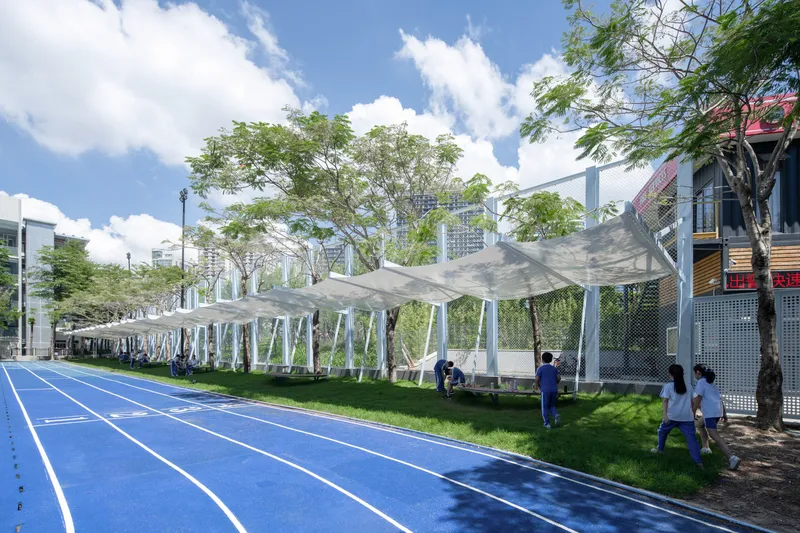
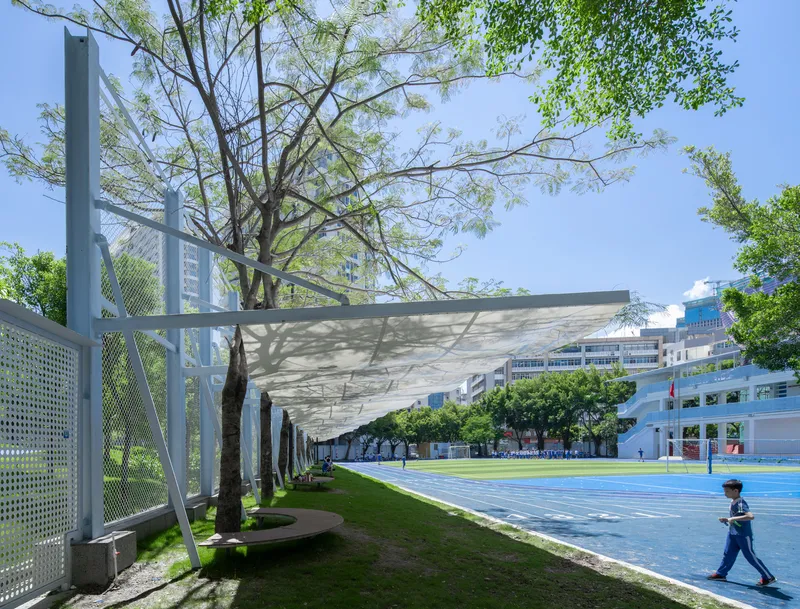
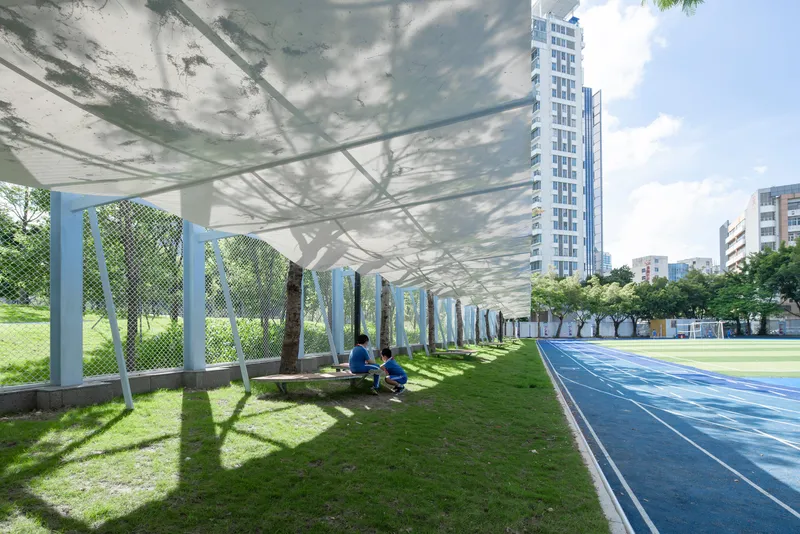
The campus's most visible intervention is a family of tensile fabric canopies that stretch between white steel columns along the running track and courtyard edges. These are not decorative sails pinned to a facade for effect. They are carefully tensioned membranes that create microclimates beneath them: cooler by several degrees, shaded yet bright, open to breezes on every side. Students gather, sit, and play beneath structures that feel closer to landscape than architecture.
Chen Donghua treats the canopies as a kit of parts. Some are flat, pulled taut between masts. Others curve into saddle shapes that channel rainwater to specific collection points. Existing trees puncture through the fabric, their trunks becoming structural participants rather than obstacles. The shadow patterns they cast on the grass below shift throughout the day, offering a kind of natural clock that children can read intuitively.
Perforated Boundaries
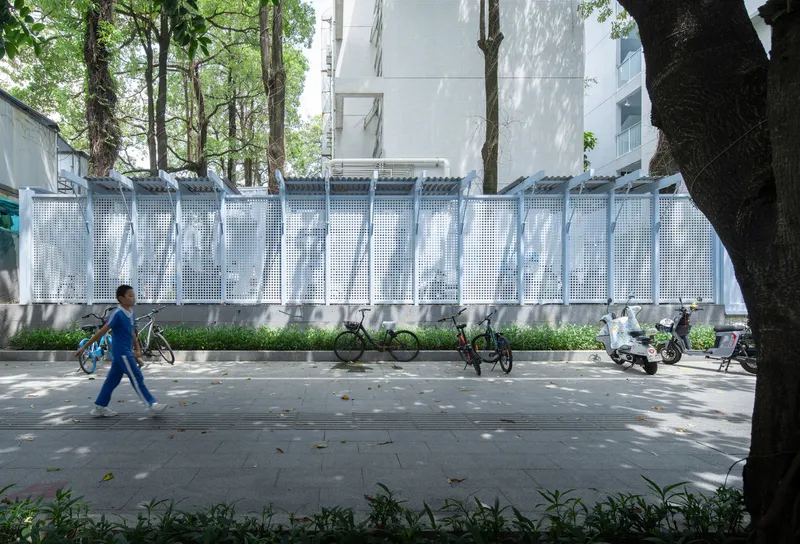
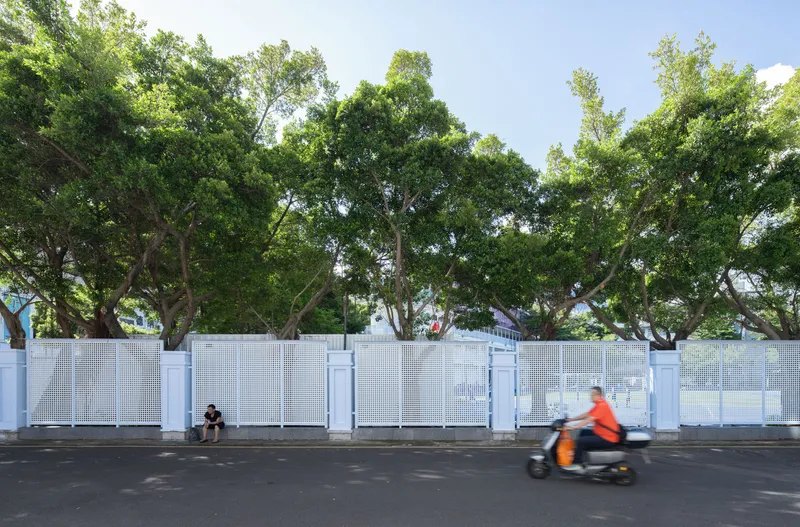
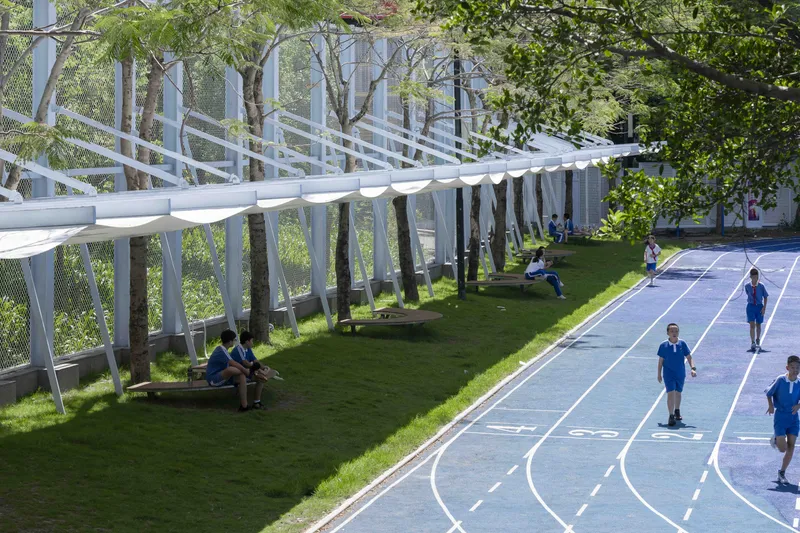
A school campus in a dense neighborhood must negotiate a tricky tension: it needs security without isolation, enclosure without opacity. The perforated metal screen walls that line the campus perimeter solve this neatly. From the street, passersby see movement and greenery behind the panels. From inside, students see the city without feeling exposed. The screens filter light into soft, pixelated patterns and let humid air pass through, reducing the heat island effect that solid walls would amplify.
The same material language extends inward. Corridor railings, sports hall walls, and courtyard dividers all use variations of punched or expanded metal, creating visual continuity across very different program zones. The consistency is not monotonous because the perforation scale changes with context: finer at eye level for privacy, coarser overhead for ventilation.
The Roof as Public Room
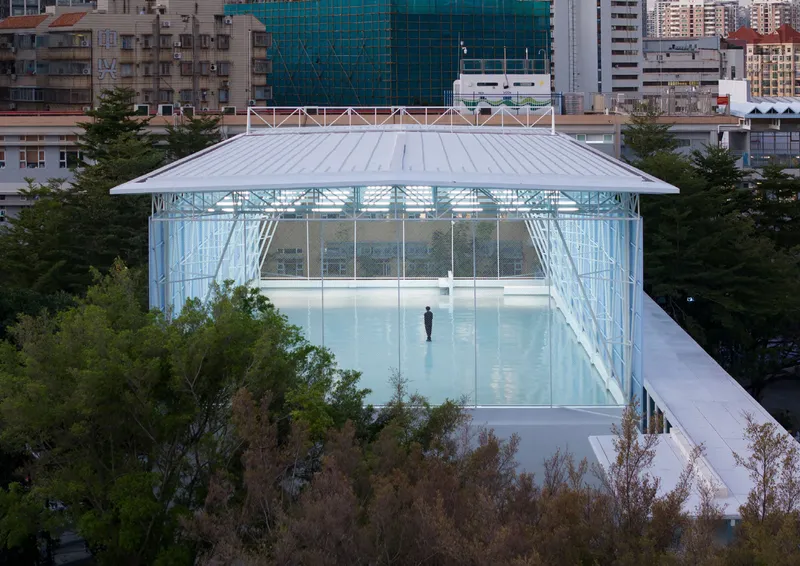
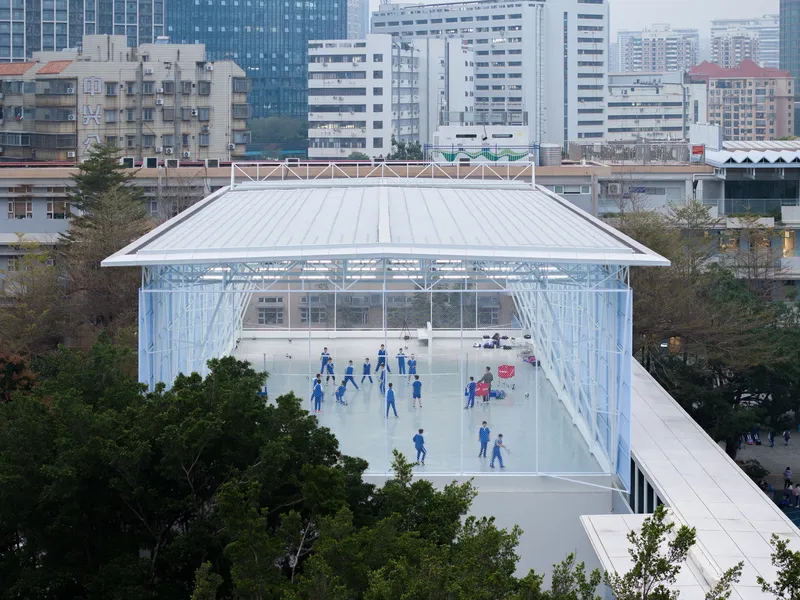
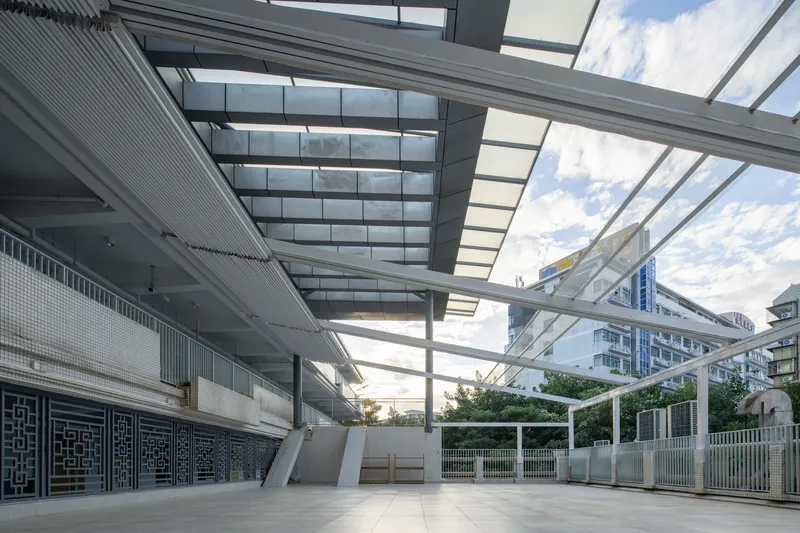
Rooftops in subtropical school campuses are usually dead zones: waterproofed, fenced off, forgotten. Here, a glass-enclosed pavilion sits atop one of the teaching blocks, framed by a standing-seam metal roof and open on all sides. It functions as an assembly hall, a performance space, and a weather-protected terrace with views over the sports fields and the city beyond. The retractable glass and steel canopy allows the space to be fully open in mild weather or sealed during monsoon downpours.
The choice to place the most generous communal room at the top of the campus, rather than burying it in a ground-floor hall, signals a clear priority. The best light, the best air, and the best views go to the students, not to administrators or storage.
Bridges, Corridors, and Circulation as Space
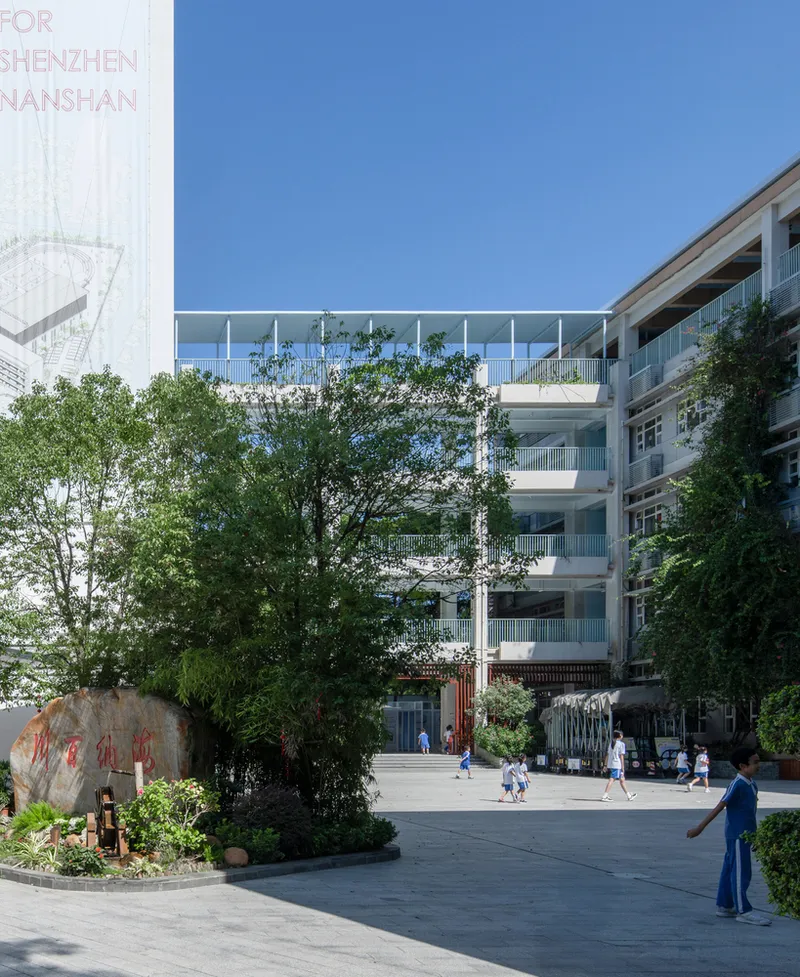
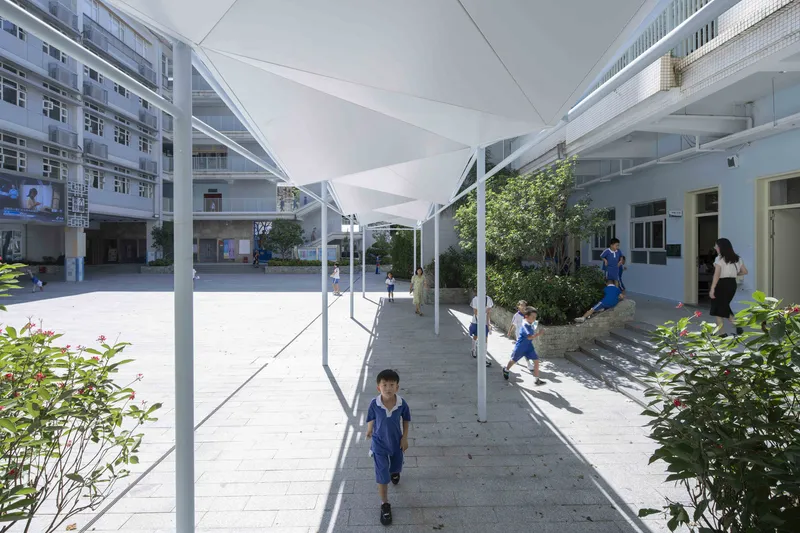
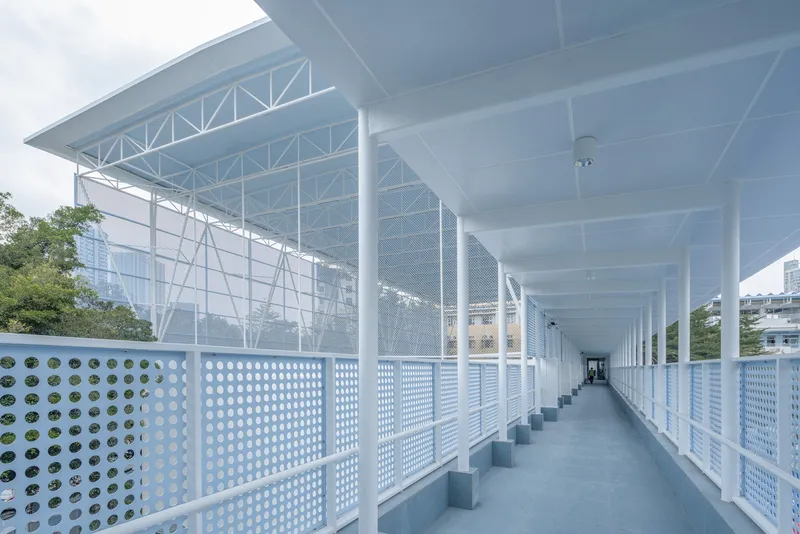
Connecting existing buildings without demolishing them requires creativity in the gaps. Glass walkway bridges span between blocks above planted courtyards, giving students covered routes between classrooms while preserving the tree canopy below. At ground level, covered walkways with exposed truss roofs and translucent canopies run along building edges, turning what would normally be bare corridors into semi-outdoor rooms where students linger between classes.
The zigzag exterior staircases and corrugated metal railings give circulation a visual energy that most schools suppress. Movement is visible. You can see children going up, coming down, crossing over. The campus reads as alive, not because of any graphic treatment, but because the architecture makes its own activity legible.
A Library Built for Browsing
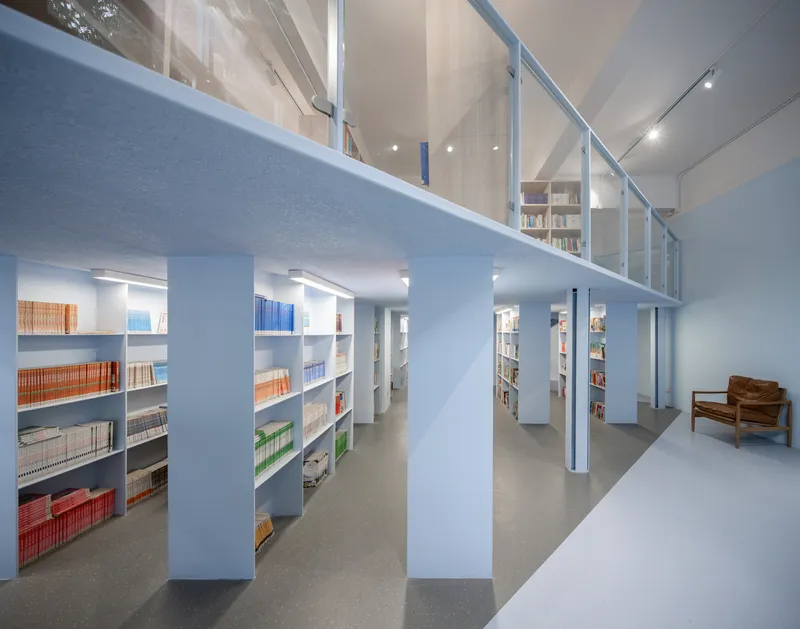
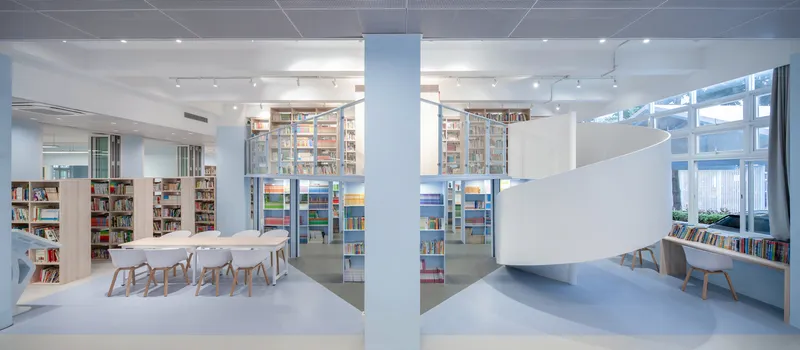
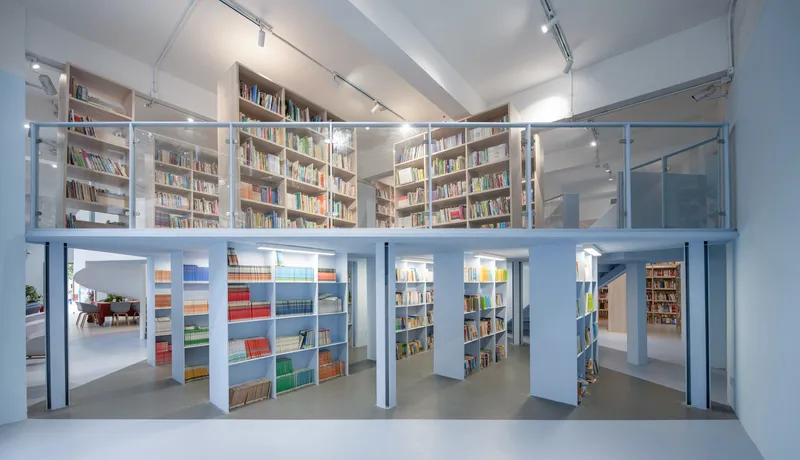
The library occupies a diamond-shaped volume with a double-height reading room, mezzanine bookshelves, and a white helical staircase that connects the levels. Pale blue shelving racks define the ground floor, creating aisles that feel open rather than labyrinthine. Clerestory windows along the ceiling wash the upper walls with daylight, keeping the interior bright without exposing books to direct sun.
There is a deliberate informality here. The communal tables are generous, the sightlines between levels are clear, and the mezzanine railing is glass so that children on the upper level can see the activity below. It is a space designed for browsing, not just retrieval, which is exactly what a primary school library should encourage.
Sports Infrastructure in the Open Air
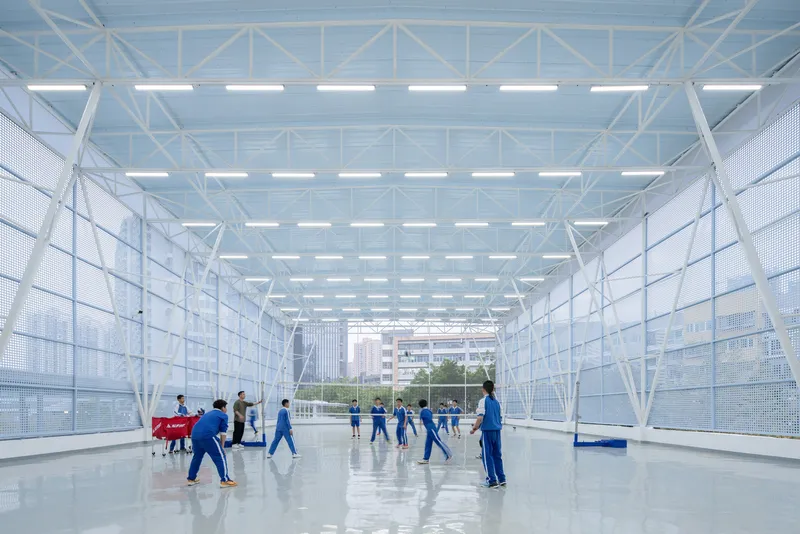
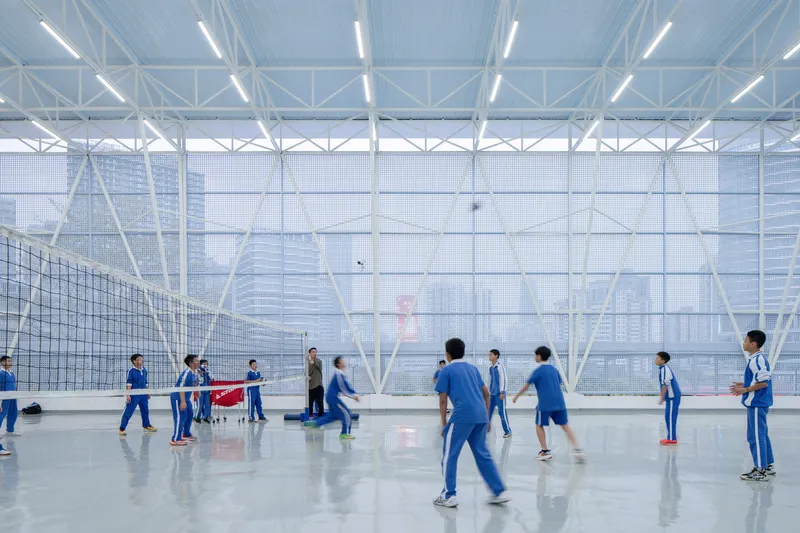
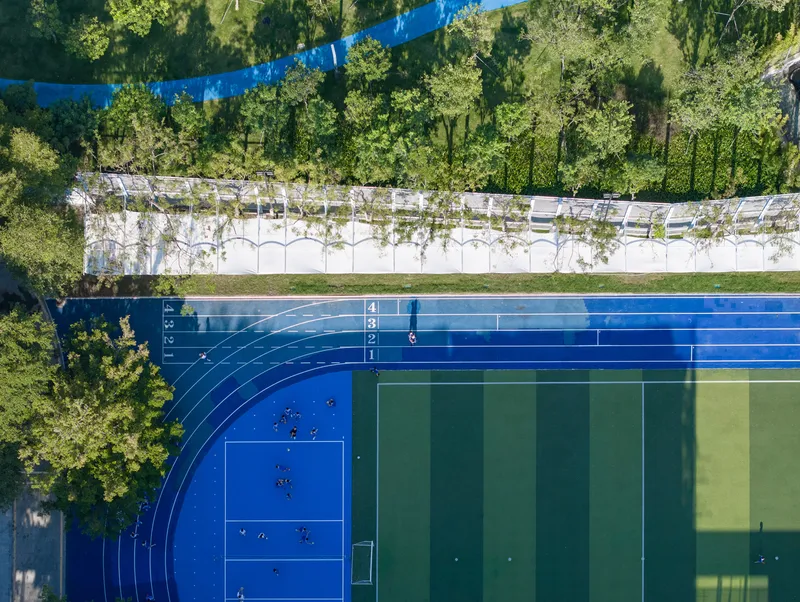
The sports facilities range from enclosed courts with perforated mesh walls to open fields bordered by white pergolas and climbing vines. The indoor courts use linear ceiling lights and translucent wall panels that diffuse glare while keeping the space well lit for volleyball and badminton. Outside, the blue running track and tennis courts sit in the center of the campus, visible from nearly every building, reinforcing physical activity as a core part of daily life rather than a peripheral afterthought.
The pergola structures along the field edges do double duty. They support climbing plants that will eventually provide biological shade, and they mark a soft boundary between athletic and garden zones. It is infrastructure that matures over time, becoming more effective as the vines grow.
Parking as Architecture
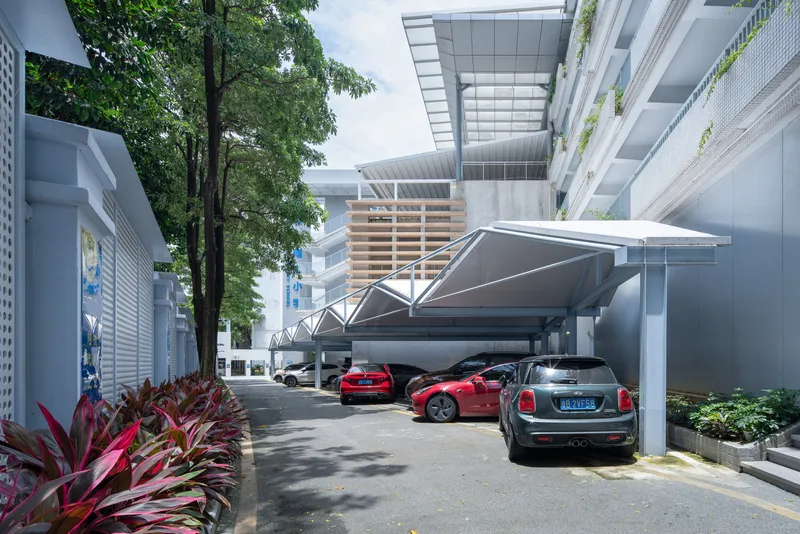
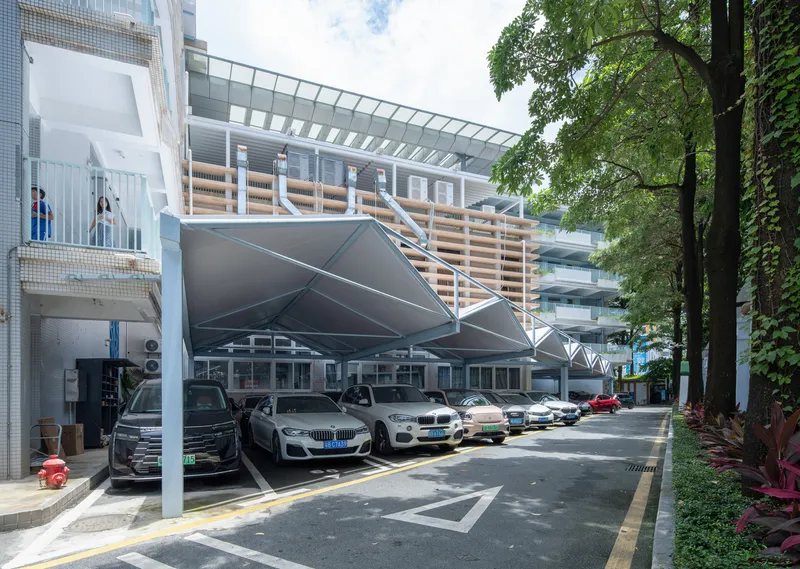
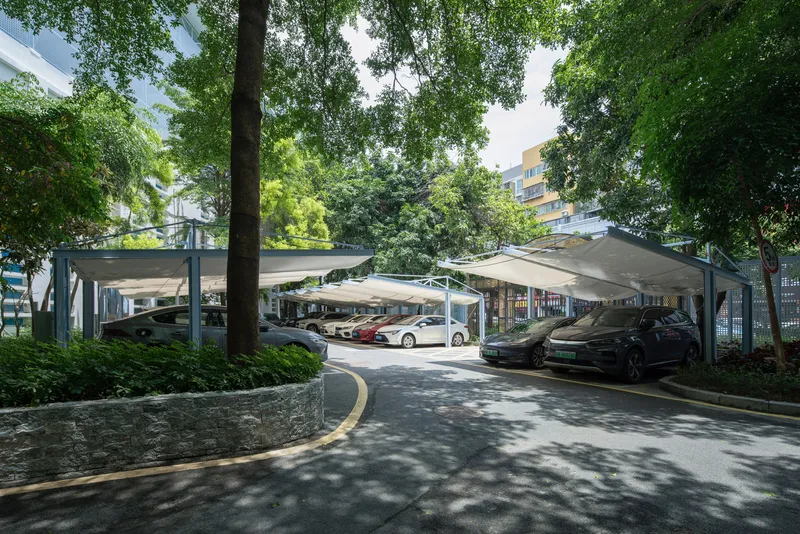
In most school projects, parking is an embarrassment to be hidden. Here, Chen Donghua treats it as another opportunity for structural expression. Folded metal canopies with faceted geometry cover car bays, their angular forms echoing the kite-like shapes of the tensile canopies elsewhere on campus. Timber screening panels, climbing vines, and dappled tree shade soften what could easily have been a bleak asphalt lot.
The fabric shade canopies over additional parking bays extend the same material palette as the main campus structures, reinforcing visual unity from the school gate to the farthest service zone. It is a small decision that reflects a bigger principle: every square meter of a campus teaches something, even the ones where you park a car.
Plans and Drawings
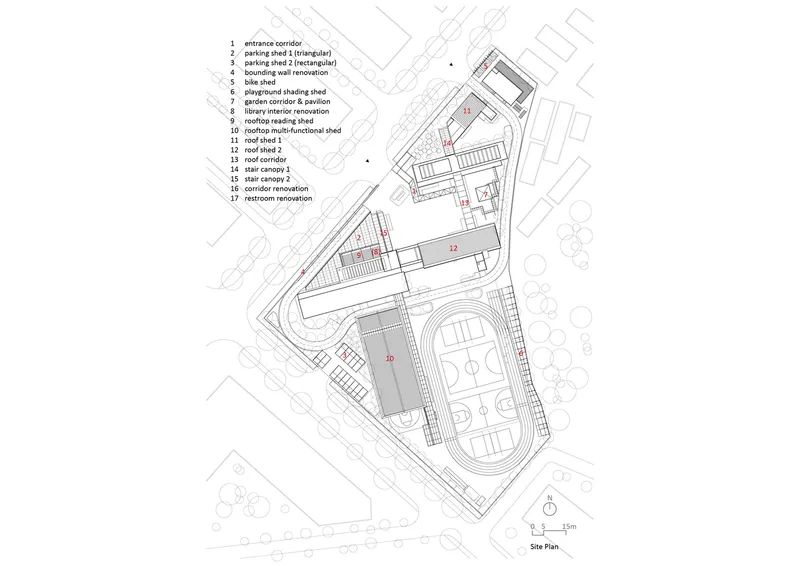
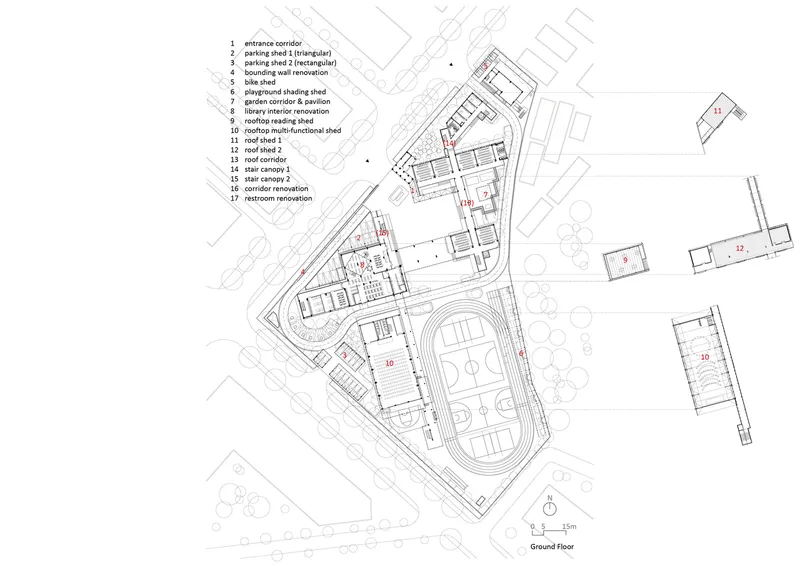
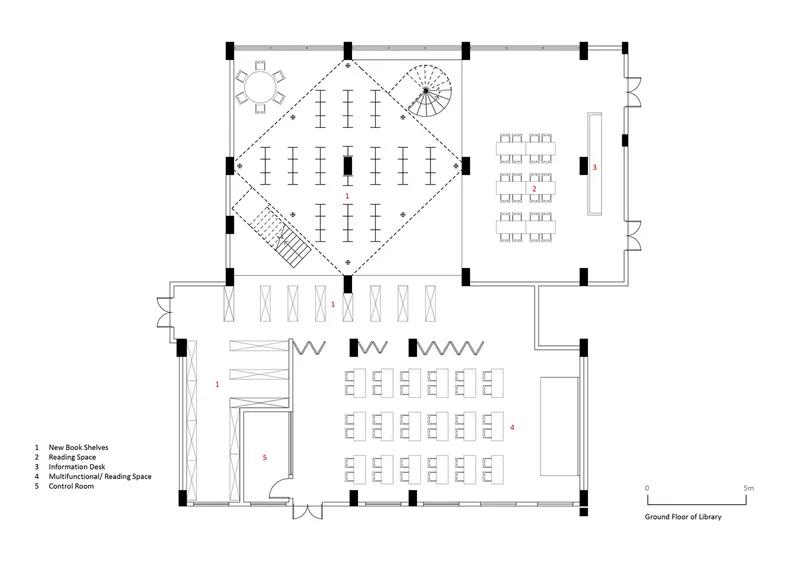
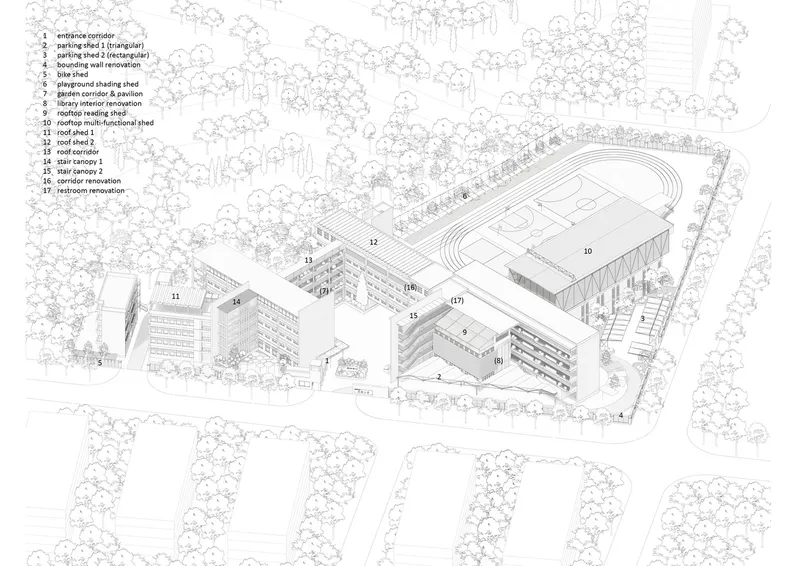
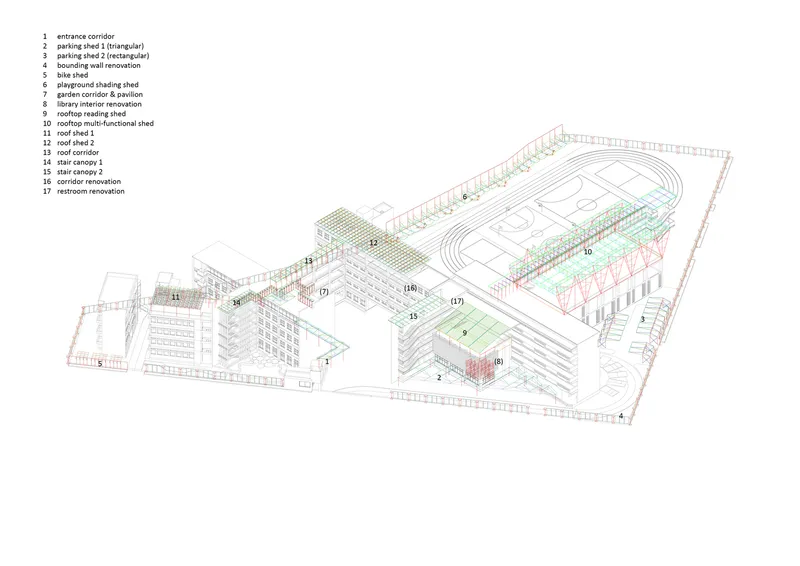
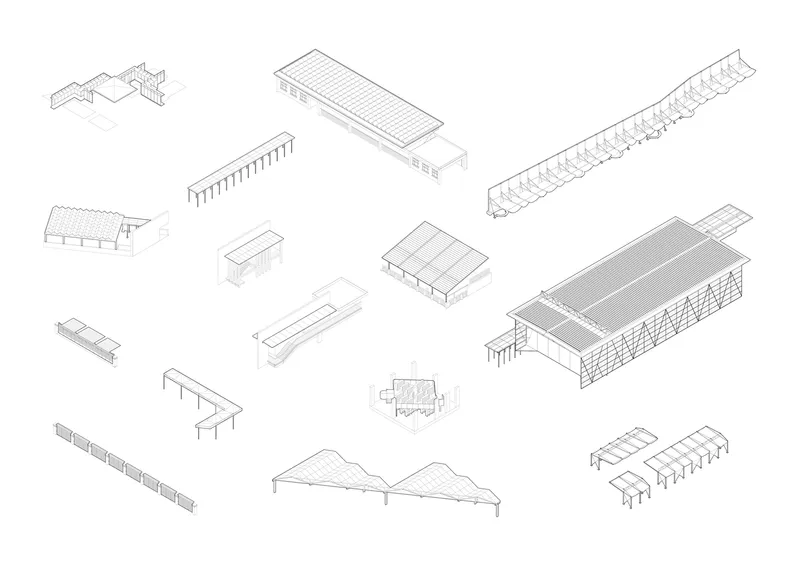
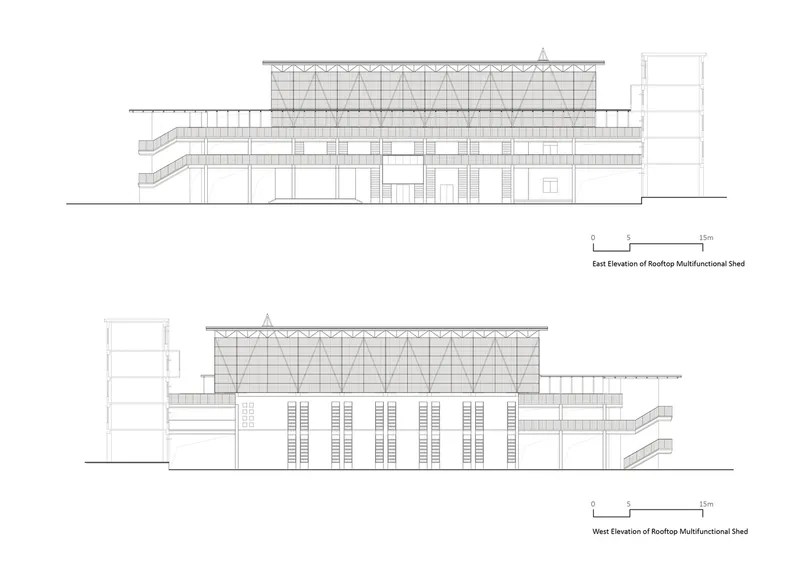
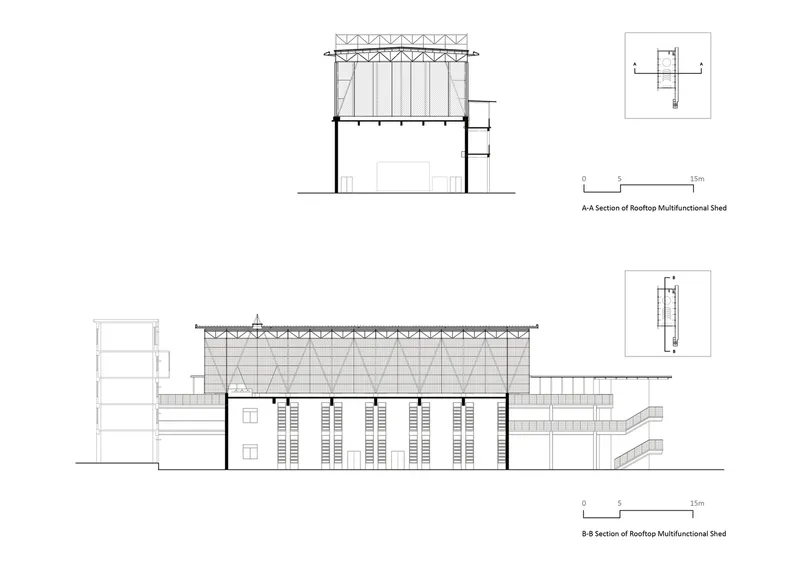
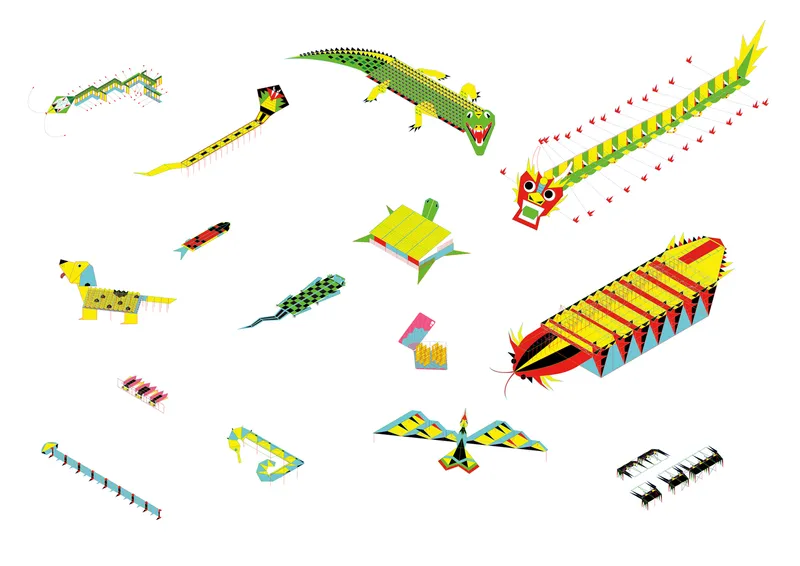
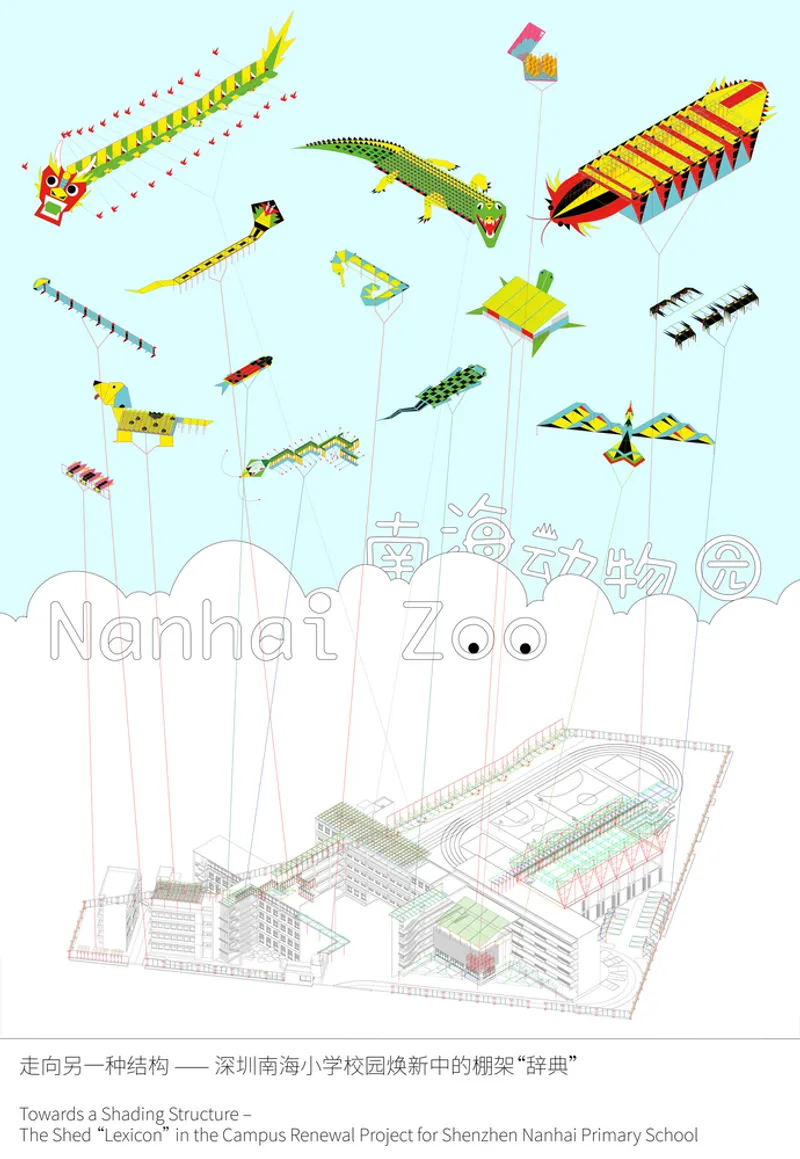
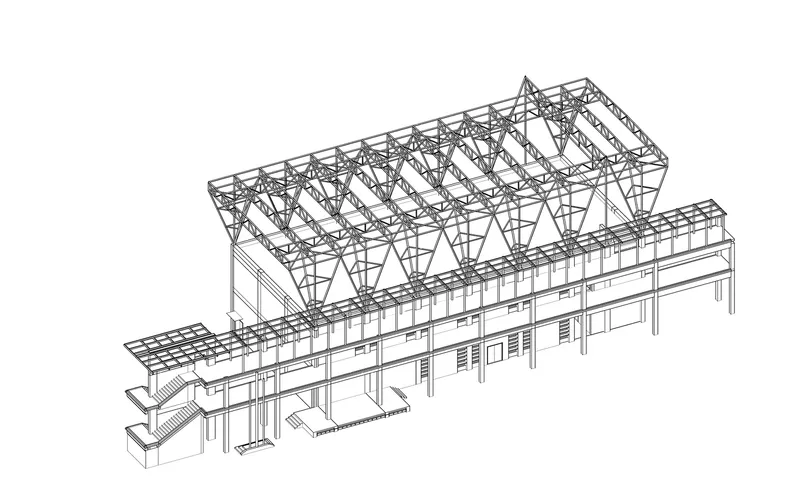
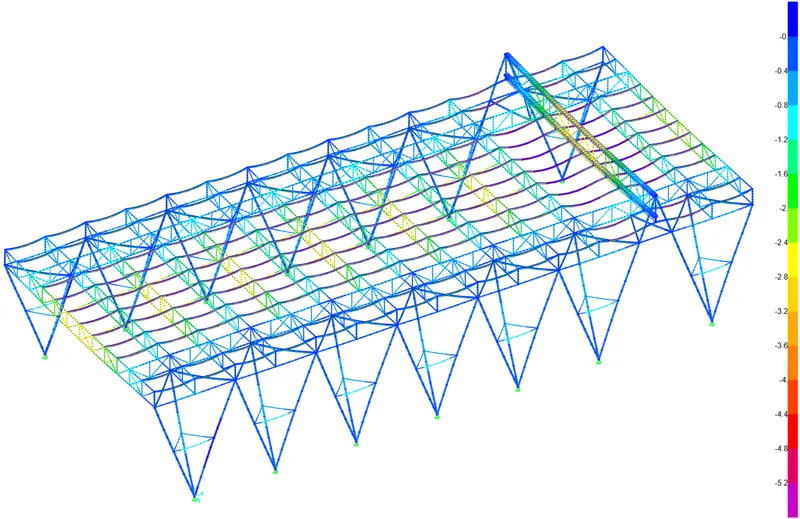
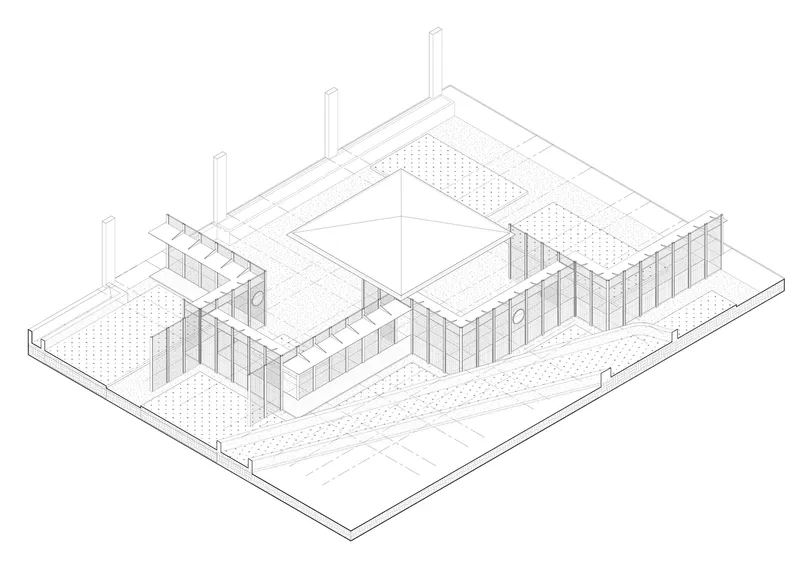
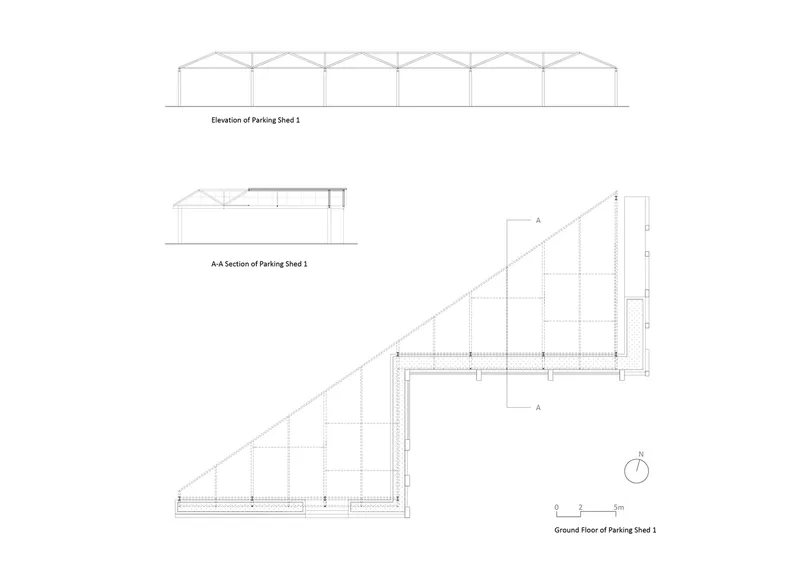
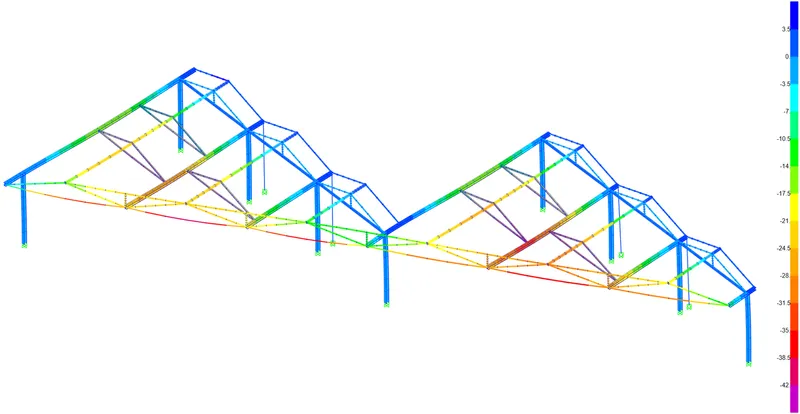
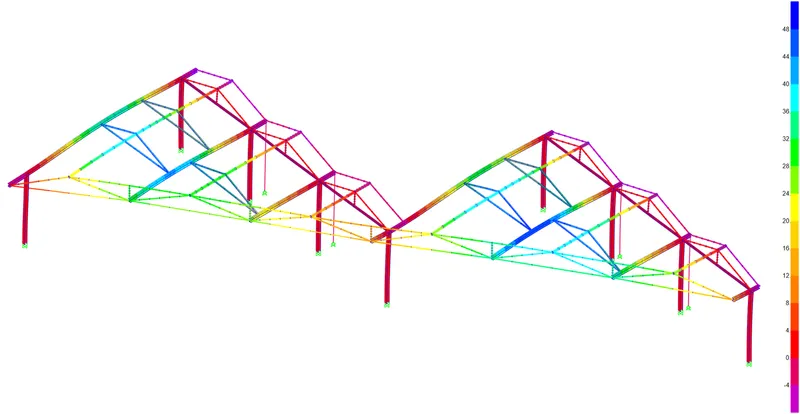
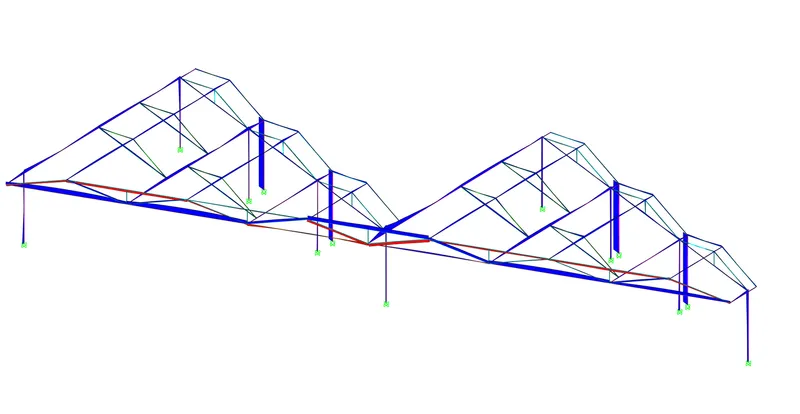
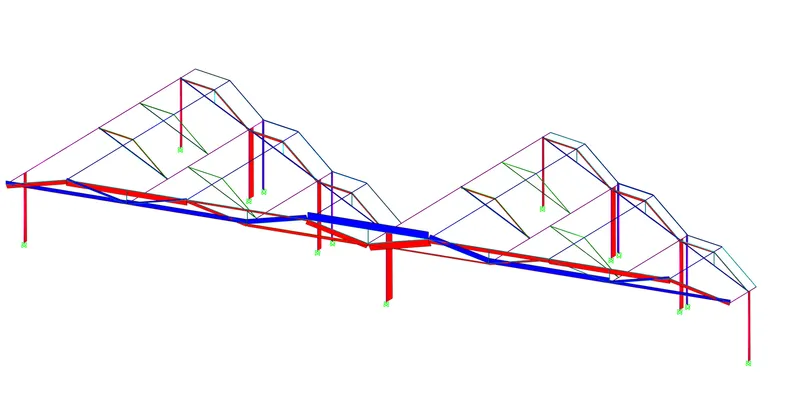
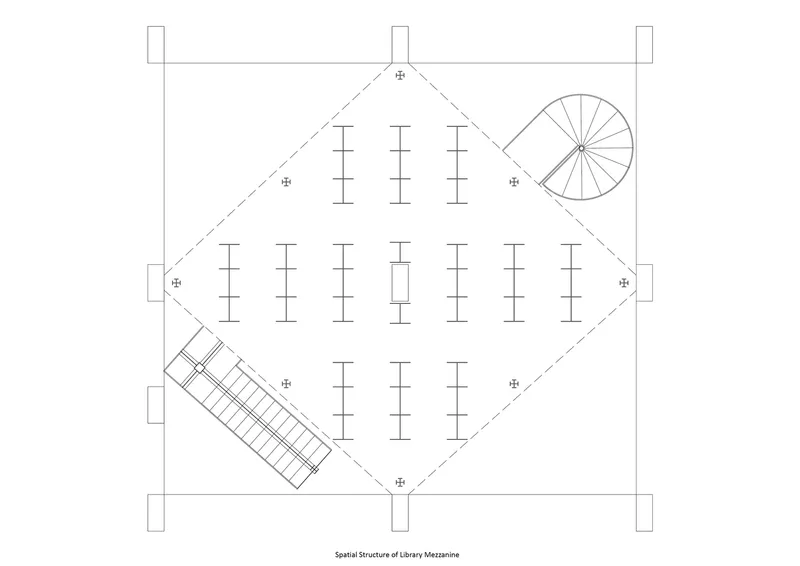
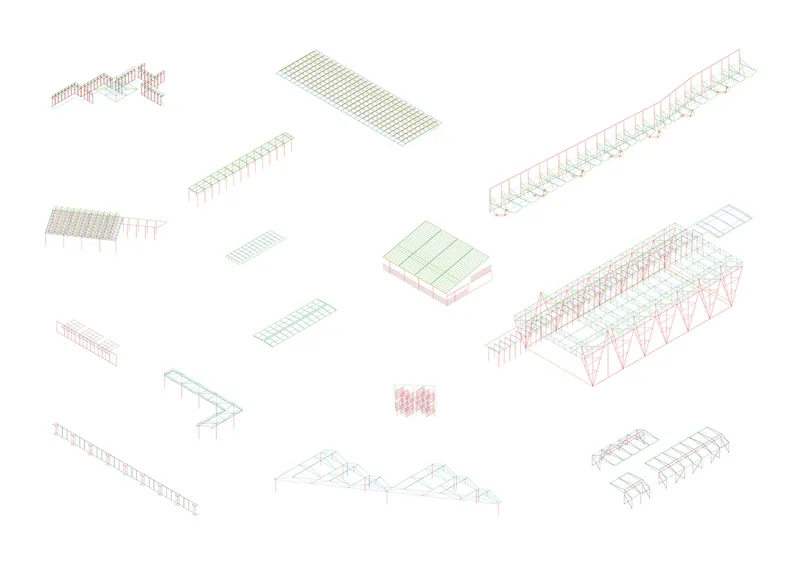
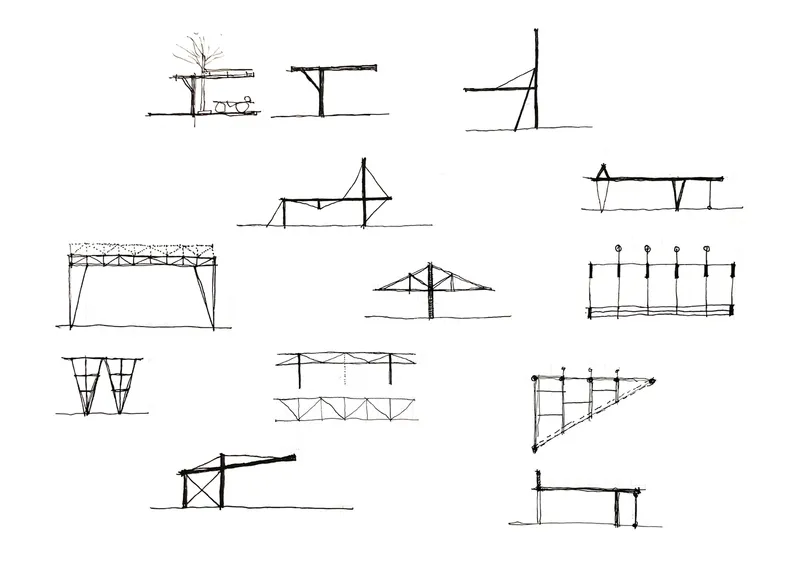
The drawings reveal how the campus is organized around the central sports field as a clearing, with teaching blocks, the library, and service buildings arrayed along an irregular perimeter dictated by the existing urban grain. Exploded axonometrics show the structural logic clearly: color-coded trusses, primary columns, and bracing systems are separated into distinct layers so that each canopy reads as a distinct structural organism rather than a monolithic shell. The section drawings confirm the ventilation strategy, with raised truss roofs pulling hot air upward and perforated walls admitting cross breezes at occupied levels.
The conceptual diagrams tracing the canopy forms back to kite studies are revealing. They suggest that the design process began not with building volumes but with the behavior of thin surfaces in wind, an approach that privileges lightness and flexibility over mass. The structural analysis diagrams, with their color-coded stress zones, demonstrate that these delicate-looking forms are rigorously engineered, each member sized to its actual loading condition.
Why This Project Matters
Nanhai Primary School matters because it proves that renovation does not have to mean replacement. By working with existing structures and filling the voids between them with lightweight, climate-responsive interventions, Chen Donghua Architects achieved a campus that feels entirely new without the material waste, cost, or disruption of demolition. The project is a model for the hundreds of aging school campuses across southern China that need upgrading but cannot afford, literally or ecologically, to start from scratch.
More broadly, the project reframes what school architecture can prioritize. Rather than monumental facades or branded identities, the design invests in shade, airflow, and connectivity: the invisible qualities that determine whether children actually want to be outside. In a climate where heat drives everyone indoors to air conditioning, creating outdoor spaces that are genuinely comfortable is an act of environmental and pedagogical ambition. That ambition, executed with structural precision and material restraint, makes this one of the most thoughtful school projects we have seen in recent years.
Nanhai Primary School Renovation by Chen Donghua Architects. Located in Foshan, Guangdong, China. Photography by Siming Wu.
About the Studio
Share Your Own Work on uni.xyz
If projects like this are the kind of work you want to make, uni.xyz is a place to publish your own, find collaborators, and enter design competitions.


Popular Articles
Popular articles from the community


LT2A and OPEN Architectes Thread a Brick and Glass High School Through a Wooded Belgian Campus
In Braine-l'Alleud, a 3,000 m² wing for Collège Cardinal Mercier pairs pale brick with a glazed colonnade, deferring to a small chapel and a dense wood.

David Macias Steps a Doorless Stone and Plaster House Down a Tropical Colombian Hillside
In the humid hills of Colombia, Threshold House replaces the front door with an open void and terraces its 850 m² down the slope instead of fighting it.

Cube Design Draws an Ecological Corridor Between Two Shenzhen Hills with the Nankai Building
Beside Shenzhen's container docks, the Nankai Building pairs stacked balconies with a climbing green screen to connect two hillsides across its height.

U.GA Architects Wraps an Oval Rooftop Pool in Curved Board-Formed Concrete on Busan's Jeollidan-gil
In Busan's Jeonpo-dong, a 454 m² mixed-use block stacks a neighborhood facility, guest rooms and an oval rooftop pool inside spiraling concrete walls.

Similar Reads
You might also enjoy these articles


Hodi-Mandai Geram
Project Function: Preservation and revitalization of the Intangible heritage and socio-spatial identity of the Hodi by Housing, Cultural Memory Center, Sacred Grove, landscape, local tourism economy


Olio Towers: A Mid-Rise for Performers That Fuses Housing, Rehearsal, and Stage
Located blocks from Houston's Theater District, this modular tower stacks living units around a central performance atrium.

Oasis: Modular Green Housing Carved into Dhaka's Urban Fabric
A shortlisted Plugin Housing entry reclaims unauthorized settlements in Dhaka with stepped concrete volumes, green roofs, and ventilation-driven design.

Black Hole: A Floating Megastructure for the Post-Physical Era
Emiliano Mazzarotto envisions a spherical, self-scaling arena where e-sports, digital hotels, and holographic stadiums replace traditional public space.

Explore Educational Building Competitions
Discover active competitions in this discipline

Challenge to design public laboratory

Challenge to reimagine the Iron Throne

Photograph architecture without architects

Illustrate the lost glory of Angkor Wat - Render Challenge
Comments (0)
Please login or sign up to add comments
No comments yet. Be the first to comment!