

Nanjing Jiangbei Civic Center by MENG Architects: A Futuristic Urban Parlor Blending Tradition, Innovation & Nature
Zhejiang University’s “Two Institutes” in Quzhou blends research, innovation, and sustainability within a dynamic, open campus rooted in nature.


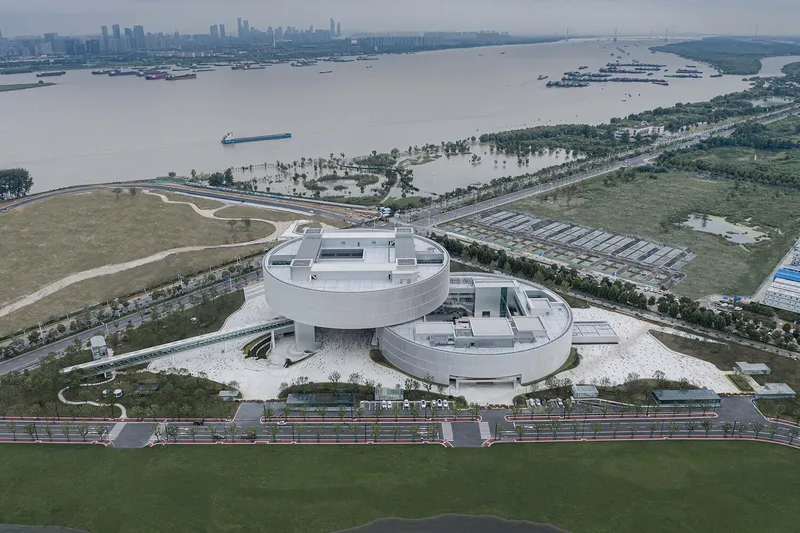
Located in the heart of Nanjing’s transformative Jiangbei New District, the Nanjing Jiangbei Civic Center by MENG Architects stands as a landmark of architectural innovation and cultural integration. With a sprawling area of 75,614 square meters, the civic hub redefines the urban fabric, serving as a multifunctional space for civic, cultural, and community engagement. Completed in 2020, this iconic project merges contemporary architecture with traditional Chinese garden design, symbolizing a bridge between the city’s rich heritage and its forward-looking vision.

A Vision Rooted in Urban Transformation
Established in 2015, the Jiangbei New District is a critical strategic node in China’s Yangtze River Economic Belt. The Civic Center occupies a prime site along Dingshan Street and Binjiang Avenue, at the foot of Laoshan Mountain and facing the Yangtze River. As a key project within the district’s Central Business and Social Area, it acts as a “gateway” landmark, visually and spatially connecting natural landscapes with the evolving skyline of Nanjing's north bank.
Design Philosophy: A Civic Treasure Box
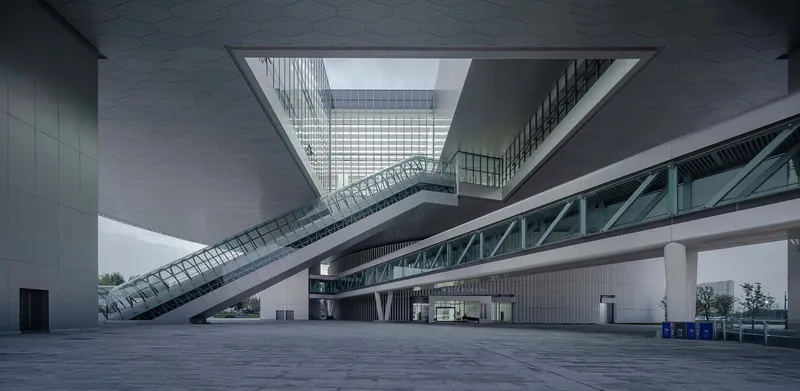
Inspired by the metaphor of a “slowly opening treasure box,” the design features two massive circular volumes — each 104 meters in diameter and 16 meters tall. These stacked cylindrical forms unfold to invite the public into a multifunctional space that balances civic services, cultural experiences, and urban vitality.
The lower circle houses essential services such as public affairs, children’s science education, art exhibits, and creative workshops, while the upper level contains the Urban Planning Exhibition Hall, elevated via an impressive 16-meter-high escalator. This layered approach ensures spatial variety and vertical zoning of public and cultural functions.


Landscape Integration and Human-Centered Design
MENG Architects skillfully softened the rigid triangular site boundaries by integrating a flowing urban park that transitions seamlessly from the riverscape to the civic space. Natural slopes, meandering pathways, and green terraces dissolve the 3-meter elevation difference between the riverbank and site, creating a barrier-free public environment.
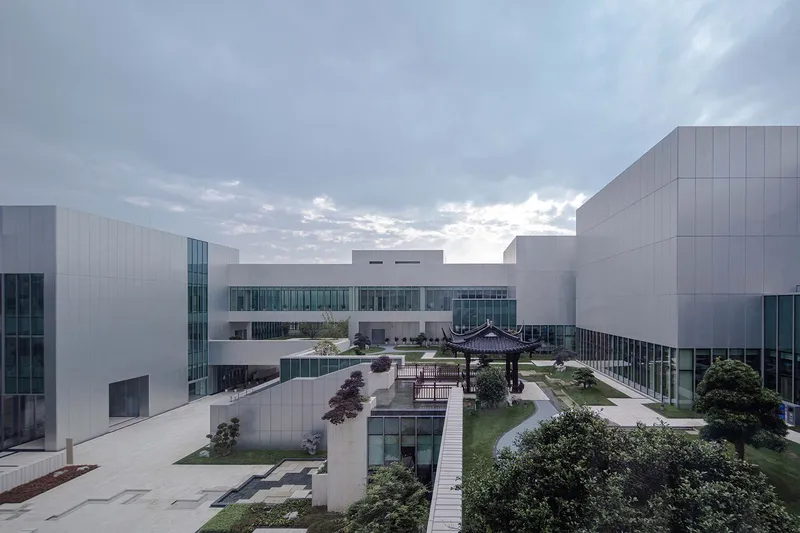
An Oriental multi-level garden forms the inner heart of the complex, filled with bridges, water features, and tree-covered pavilions. This garden links to an open courtyard, accessible from all directions and ideal for informal social interaction. Together, the garden and courtyard reimagine the civic space as both a modern amenity and an evocation of classical Chinese landscapes.


Technological Innovation & Structural Prowess
The project pushed the boundaries of construction engineering in China, becoming the first to implement super-weight, large-diameter, rigid-flexible steel truss lifting technology. It also pioneered hydrostatic leveling for dynamic process monitoring. The unique façade — a patented aluminum louver system — integrates solar shading, floodlighting, and a digital media curtain wall, all while achieving a pure white and dreamlike finish that reinforces the “treasure box” metaphor.

Creating a Living Civic Tapestry
Every aspect of the Civic Center encourages exploration and interaction. From streets and alleys to courtyards and exhibition spaces, the center evokes the layered scenes of the ancient Chinese scroll painting Along the River During the Qingming Festival, bringing its energy into three dimensions. Visitors move organically through the spaces — walking, gathering, learning — surrounded by visual cues of both modernity and tradition.
This spatial composition promotes year-round use with commercial, food & beverage, and retail spaces in the underground level, connected via sunken plazas that offer daylight and airflow. The result is a vibrant civic marketplace that contrasts the cold austerity of traditional public buildings.

All the photographs are works of Haohao Xu


Popular Articles
Popular articles from the community

Extended Shell: Retrofitting Kolkata's Balconies as Living Urban Thresholds
A modular retrofit system recovers the social and environmental intelligence of Kolkata's historic verandas for contemporary Park Street residents.

Temporary Home for Dogs: A Reversed Zoo Rethinks Animal Shelter Architecture
In Bucharest, a sinuous corridor and freed landscape flip the logic of containment, designing a shelter that works to make itself unnecessary.

The Amber Palace Opera: A Geological Fiction Surfaces on Tallinn's Baltic Waterfront
Pierre Brillard reimagines a Baltic legend as a public landscape, opera house, and waterfront promenade rooted in Tallinn's coastal identity.
Tsunami Convergenics: Turning Catastrophic Ocean Forces into Underwater Housing Infrastructure
A speculative underwater settlement off the coast of Onagawa, Japan, treats tsunamis and typhoons as energy sources rather than threats.

Similar Reads
You might also enjoy these articles


Hodi-Mandai Geram
Project Function: Preservation and revitalization of the Intangible heritage and socio-spatial identity of the Hodi by Housing, Cultural Memory Center, Sacred Grove, landscape, local tourism economy


Olio Towers: A Mid-Rise for Performers That Fuses Housing, Rehearsal, and Stage
Located blocks from Houston's Theater District, this modular tower stacks living units around a central performance atrium.

Oasis: Modular Green Housing Carved into Dhaka's Urban Fabric
A shortlisted Plugin Housing entry reclaims unauthorized settlements in Dhaka with stepped concrete volumes, green roofs, and ventilation-driven design.

Black Hole: A Floating Megastructure for the Post-Physical Era
Emiliano Mazzarotto envisions a spherical, self-scaling arena where e-sports, digital hotels, and holographic stadiums replace traditional public space.

Explore Zhejiang University Of Tech Competitions
Discover active competitions in this discipline

Challenge to reimagine the Iron Throne

Photograph architecture without architects

Illustrate the lost glory of Angkor Wat - Render Challenge

Bring back Drive In's
Comments (0)
Please login or sign up to add comments
No comments yet. Be the first to comment!