
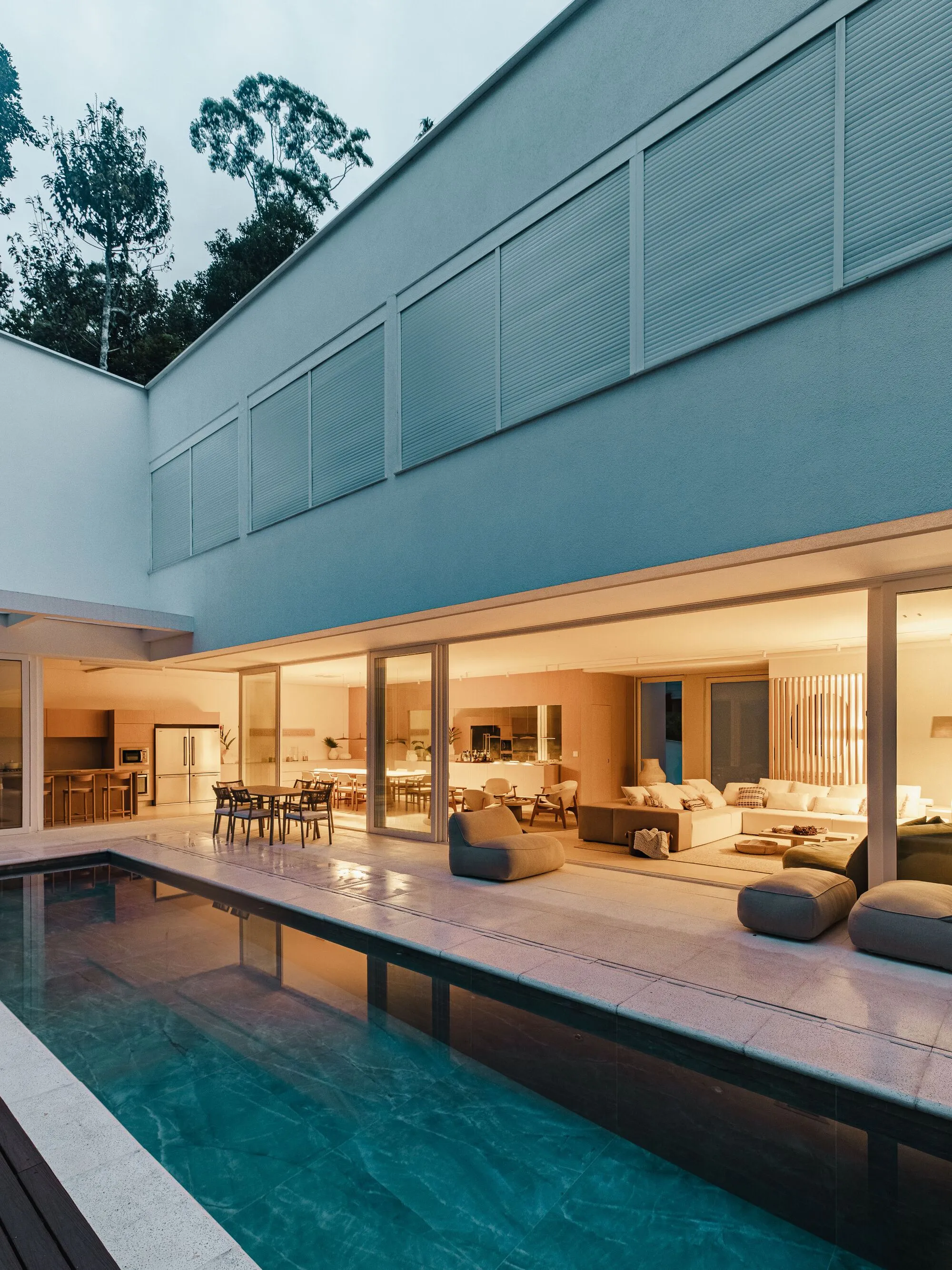
Nati Minas and Studio Rework a Modernist Retreat Inside Brazil's Atlantic Forest
A 750-square-meter renovation in Guarujá respects existing modernist bones while weaving the house deeper into its protected landscape.


Renovating a modernist house is a fraught exercise. Too much intervention and the original logic dissolves; too little and the project becomes mere maintenance. At Casa Iporanga, Nati Minas and Studio found a third path: an attentive reworking that preserves the formal language the clients fell in love with while recalibrating how the house meets its extraordinary site, an environmentally protected stretch of the Atlantic Forest on the coast of Guarujá, Brazil.
What makes the project compelling is not a single dramatic gesture but an accumulation of careful decisions. Timber screens, decked walkways, and generous glazing do not impose a new identity on the building. Instead, they sharpen its original proposition: a white, cantilevered volume hovering above a tropical slope, porous enough to let the forest in but disciplined enough to hold its own against it. The result, completed in 2026, is a 750-square-meter house that reads as both preserved artifact and contemporary refuge.
A White Volume in the Canopy
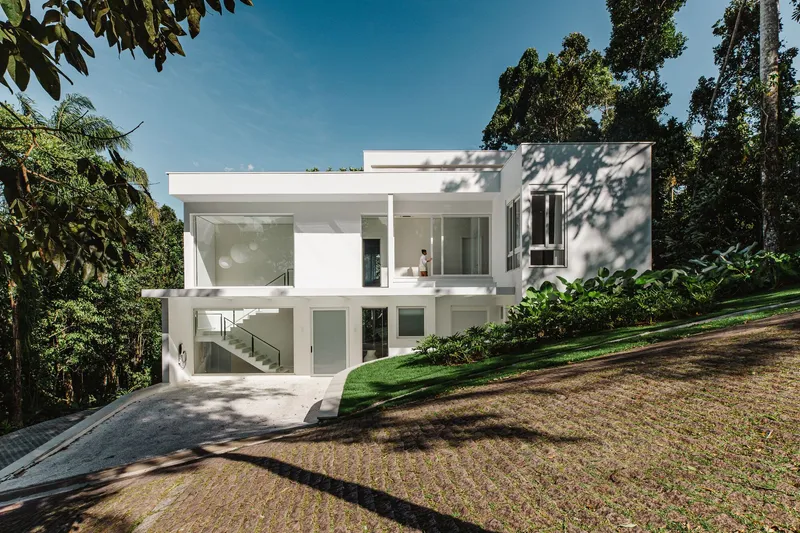
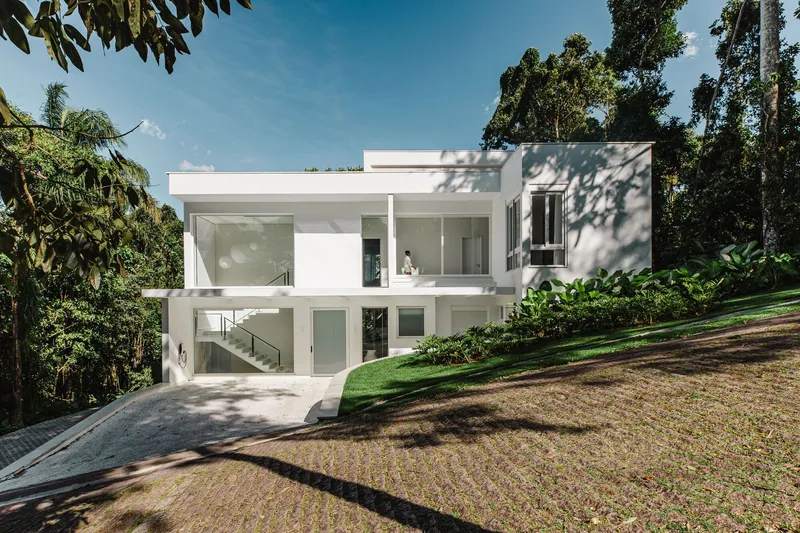
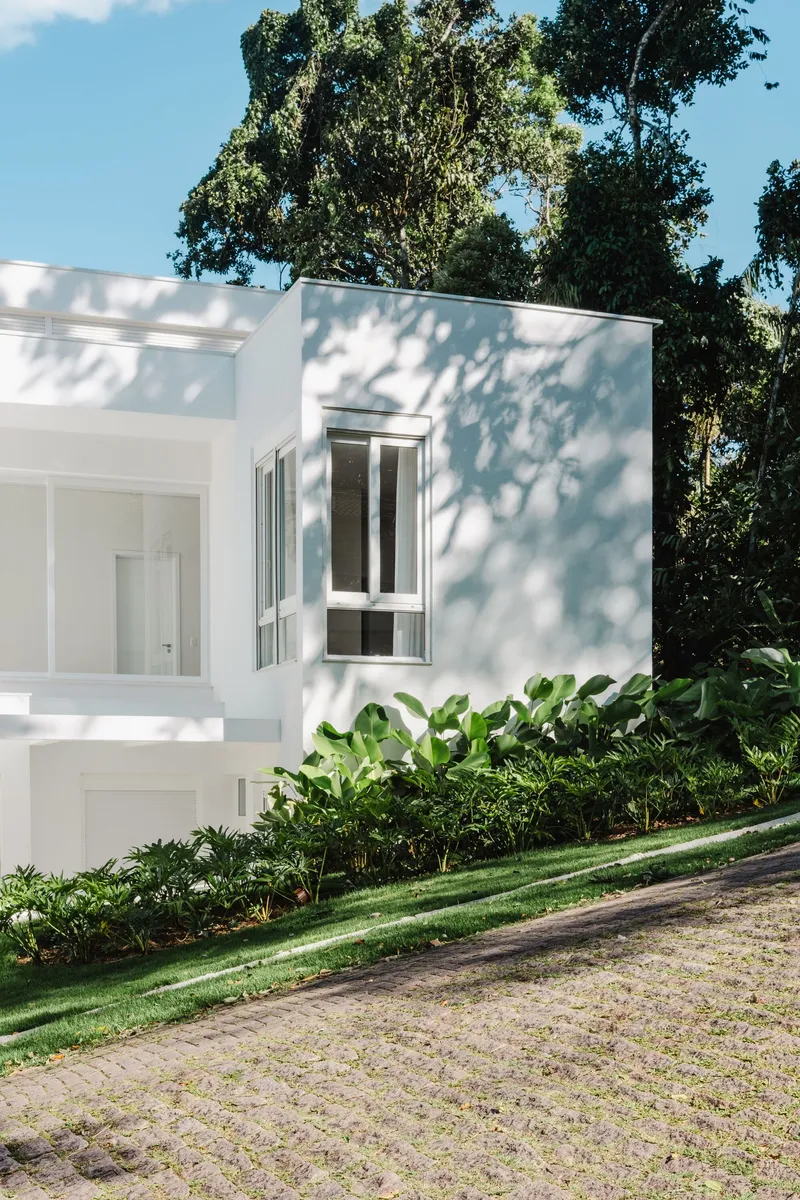
The house announces itself as a clean, white-rendered two-story volume set into a sloping garden. Tall palms and dense canopy frame the facade on every side, so the building never feels like an imposition on the land. Afternoon shadows from surrounding trees paint the walls with shifting patterns, an effect the architects clearly anticipated by keeping surfaces unadorned and letting the landscape do the decorating.
The decision to maintain the existing modernist envelope was strategic. Guarujá's protected Atlantic Forest zone places strict limits on construction footprint and material clearing. By working within the original shell, Nati Minas and Studio sidestepped the bureaucratic and ecological costs of a ground-up build while gaining the spatial framework of a house already tested against the site's steep topography and humid climate.
Cantilever and Glass at Dusk
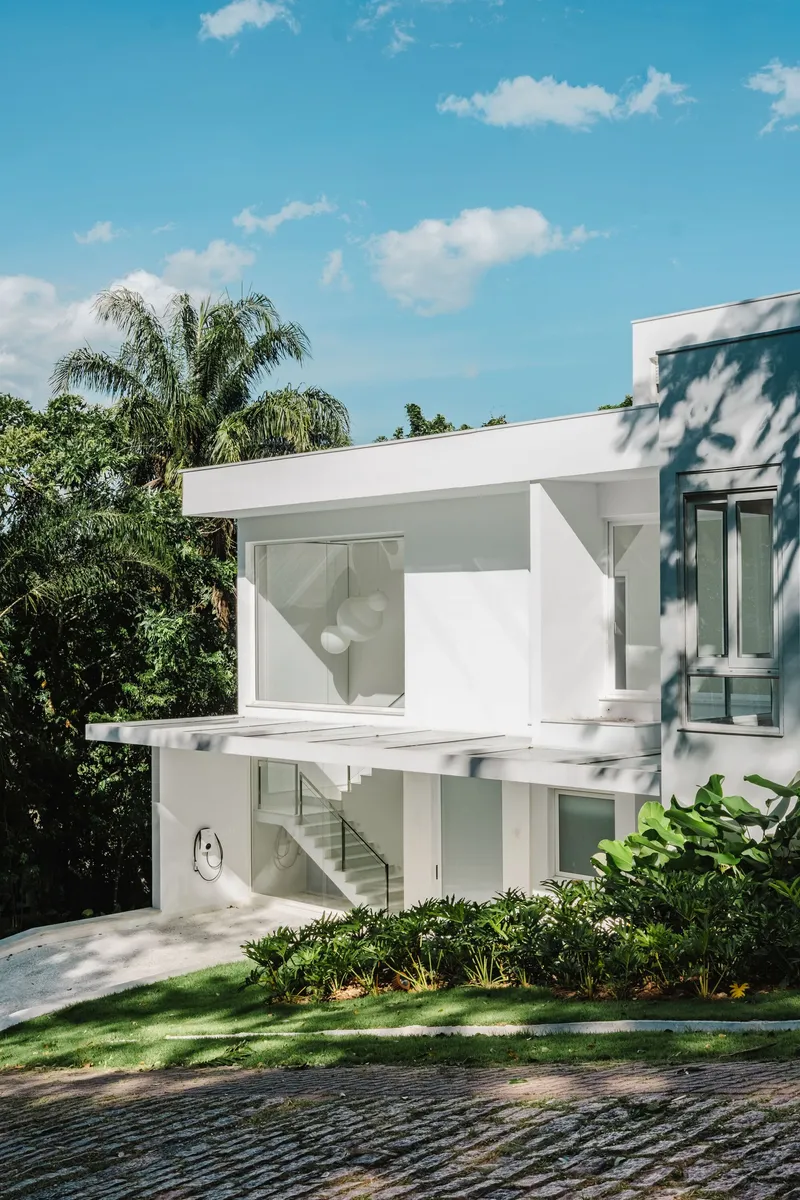
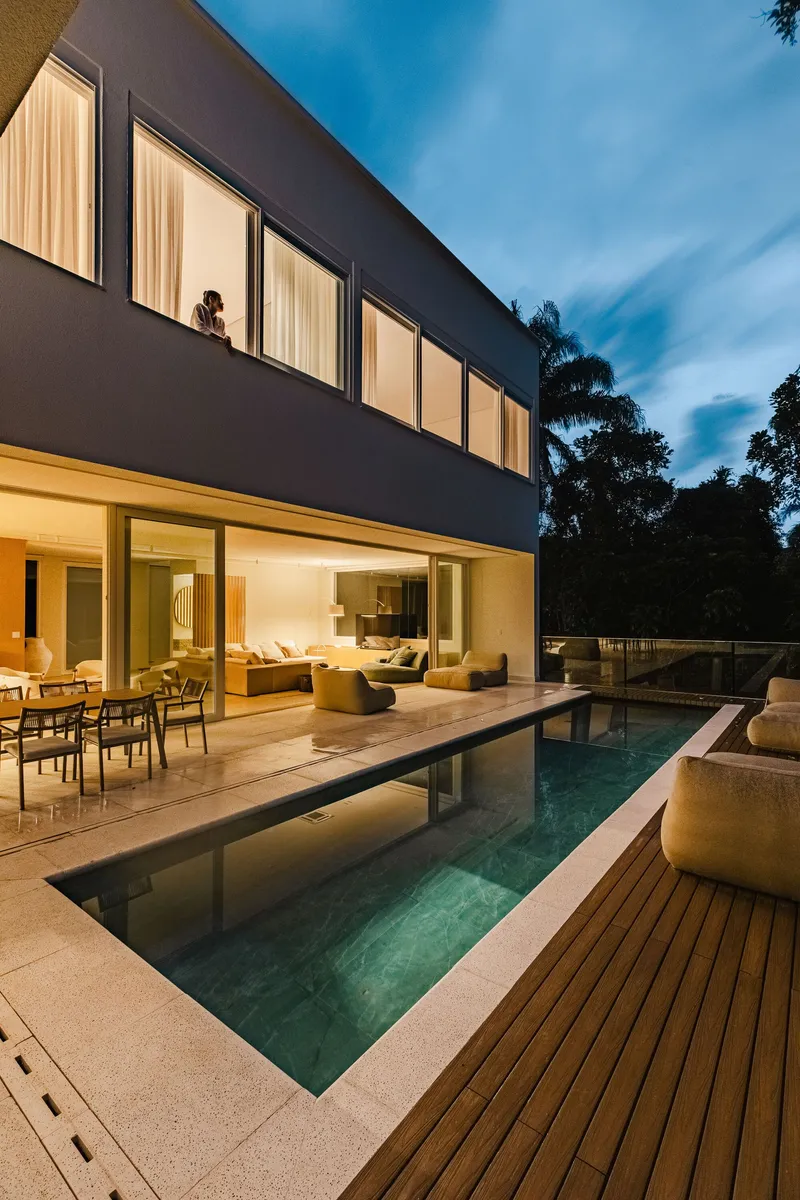
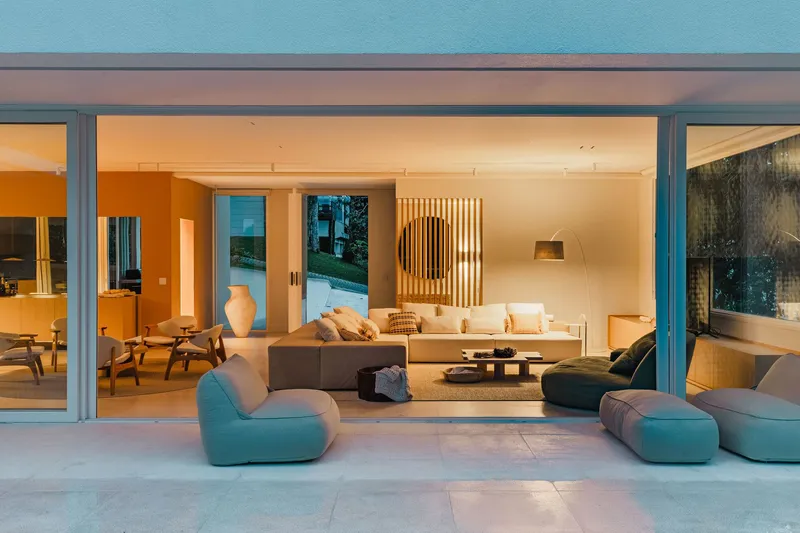
The upper volume cantilevers outward with full-height glazing that reveals the interior staircase and living spaces to anyone approaching from below. At dusk, the house inverts: warm artificial light turns the glass walls into lanterns, and figures moving through the upper floor become silhouettes against the sky. It is a classic modernist trick, transparency as spectacle, but here it is grounded by the forest backdrop rather than a manicured suburban lawn.
The interplay between solid rendered walls and floor-to-ceiling glass is the building's primary compositional tool. Opaque faces handle privacy and structure while glazed ones dissolve the boundary between inside and out. The architects appear to have selectively enlarged or replaced certain openings, most notably in the living areas, pushing the porosity of the original design further without undermining its geometry.
Timber Screens and Interior Warmth
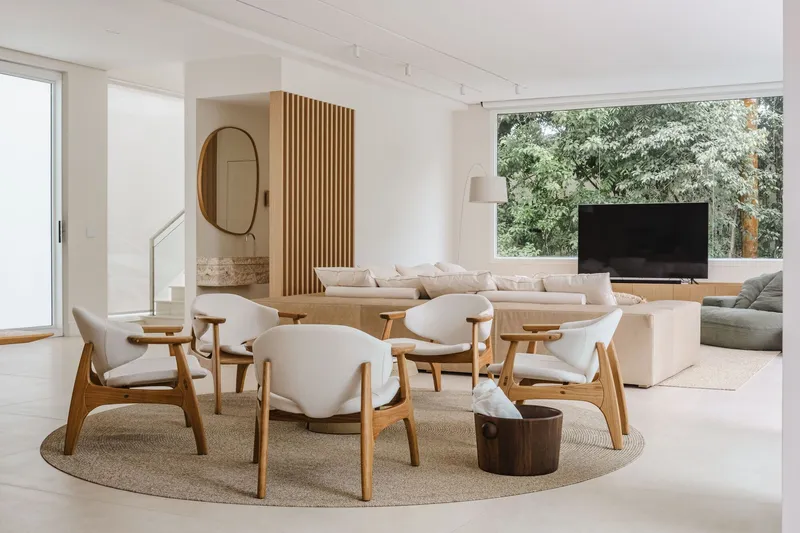
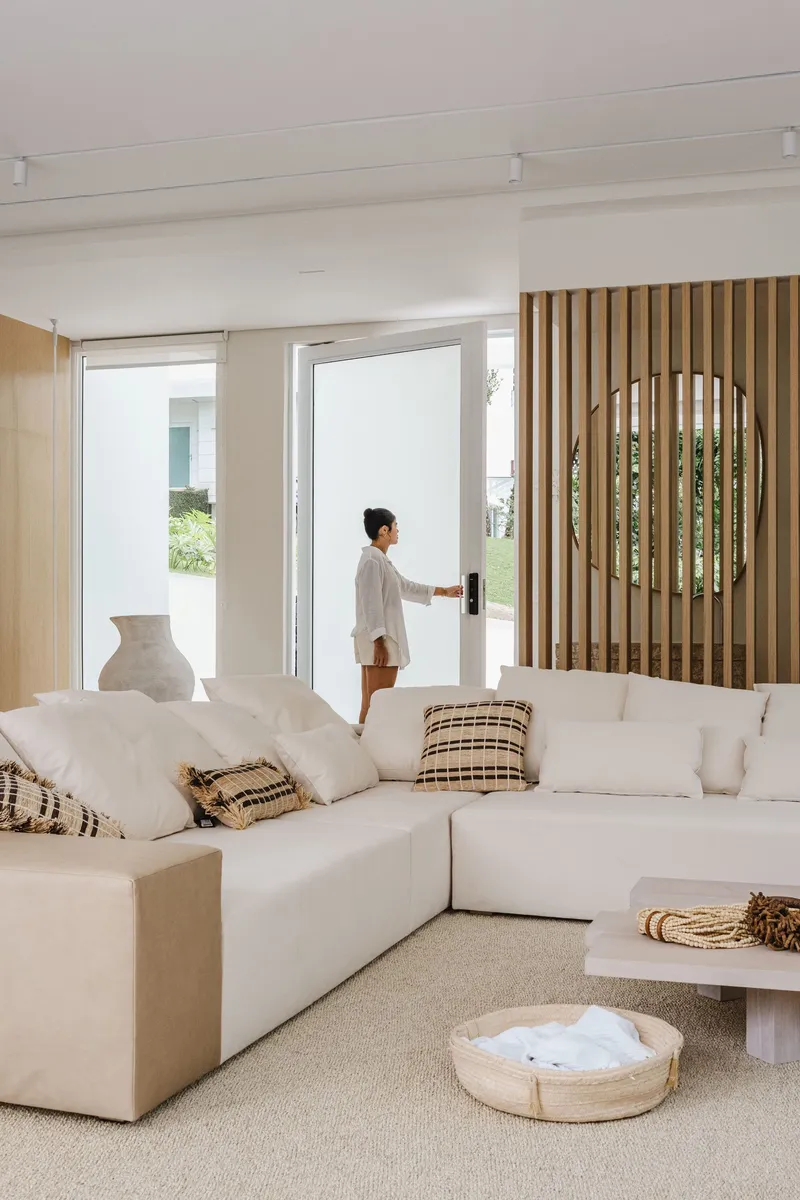
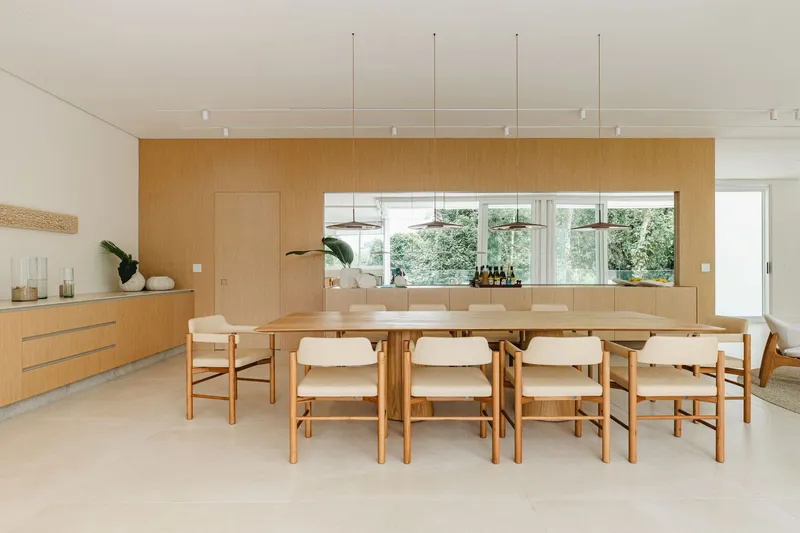
Inside, timber is the consistent counterpoint to the white modernist shell. Vertical slatted screens divide the open-plan living zone into dining and lounge areas without closing them off. These screens filter sightlines and light, creating a gradient of privacy that shifts as you move through the plan. The wood also connects to the landscape vocabulary: surrounded by trunk-dense forest, the interior reads as an extension of the canopy rather than a sealed domestic box.
A long dining table set against a paneled wall with a horizontal slot window is one of the house's strongest moments. The framed view of greenery functions like a painting that changes by the hour, and the timber surface around it absorbs the reflected green light, warming the entire room. It is a detail that rewards attention: a single horizontal cut doing the work that an entire glass wall would elsewhere.
Kitchen as Social Core
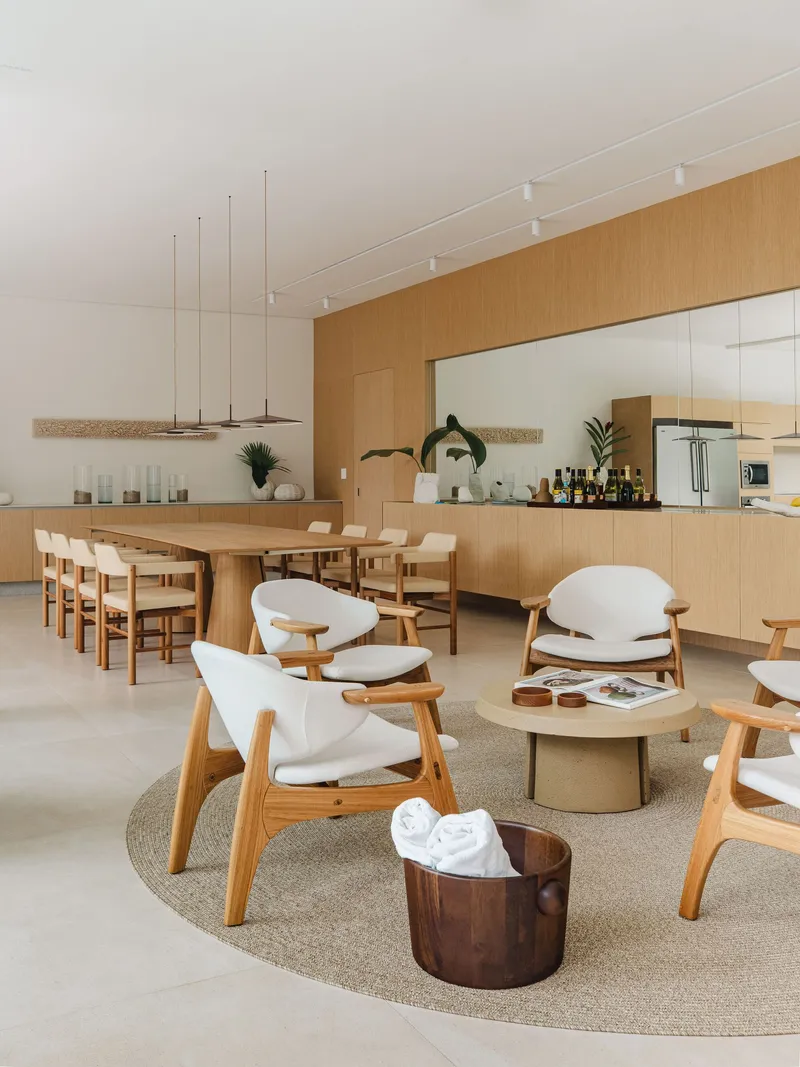
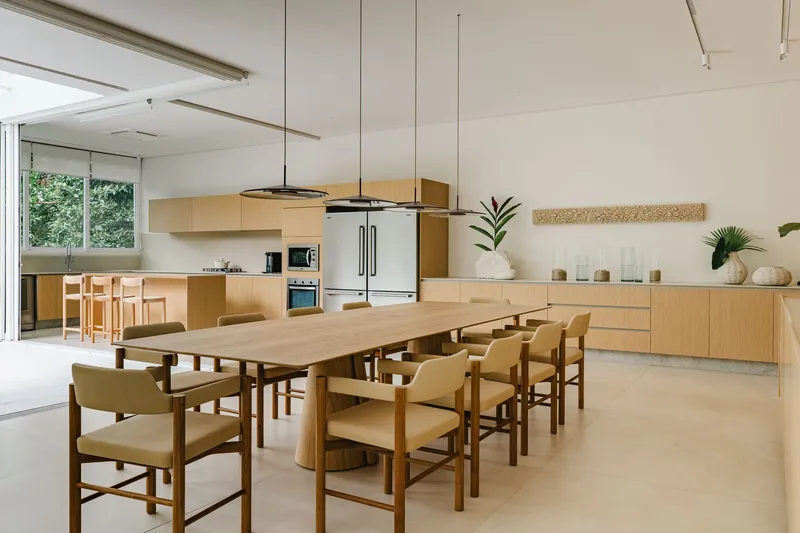
The combined kitchen and dining area sits at the social heart of the plan. Timber cabinetry runs along the back wall, grounded by a mirrored backsplash that doubles the perceived depth of the room and bounces garden light into its center. A circular pendant fixture anchors the dining zone, its soft geometry a deliberate contrast to the linear cabinetry and track lighting elsewhere.
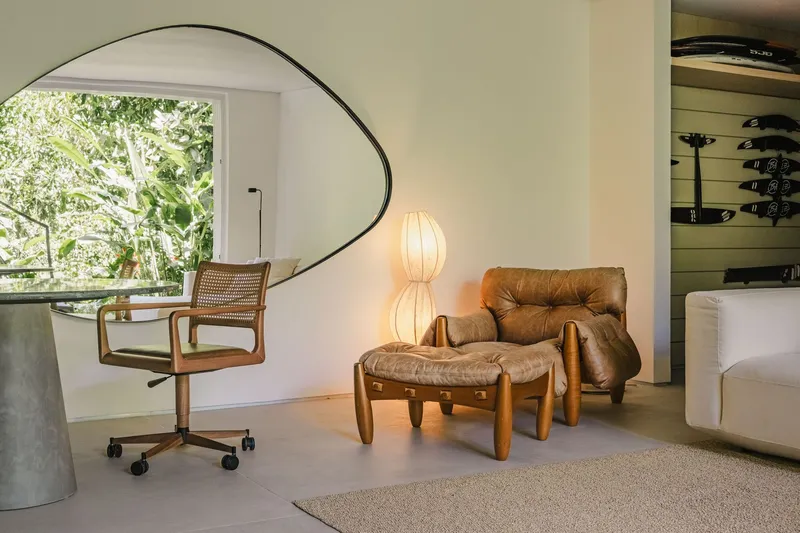
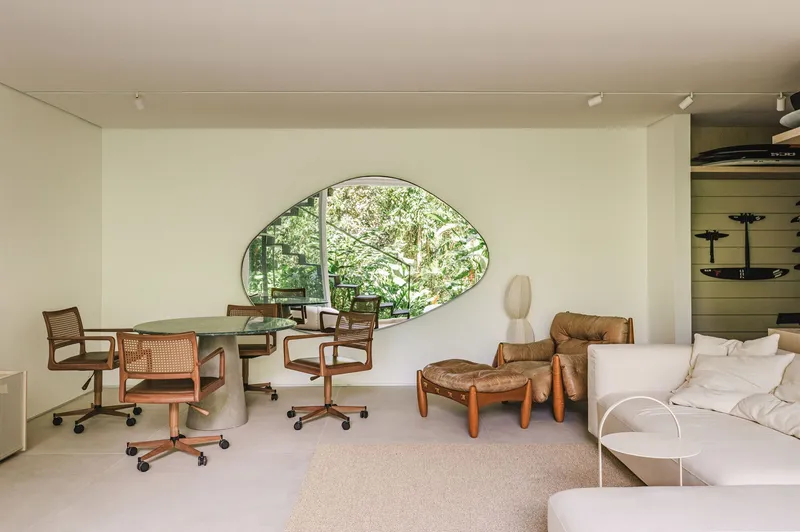
Adjacent, a corner lounge with a leather chair and an oversized circular mirror plays the same doubling trick at a more intimate scale. The mirror reflects foliage from the opposite window, so even when you face away from the garden, the green is present. These moments suggest a design team that thought carefully about every seated position, not just the plan as an abstraction.
Pool Terrace and Forest Edge
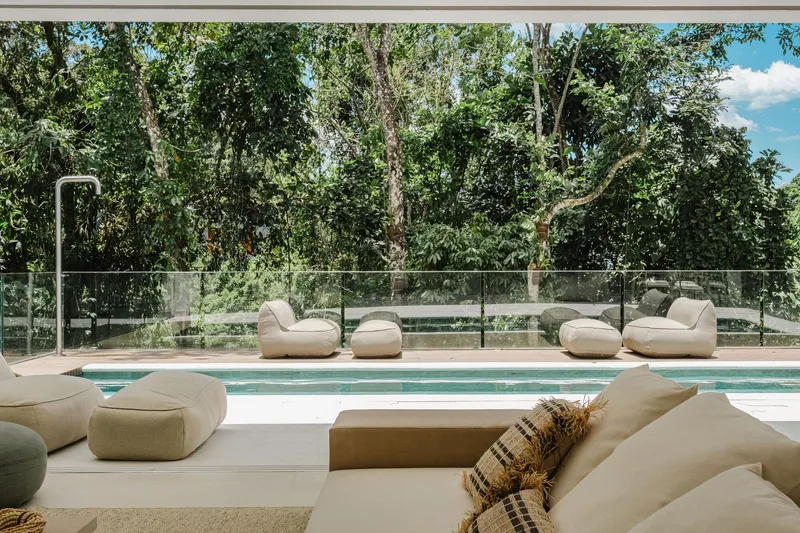
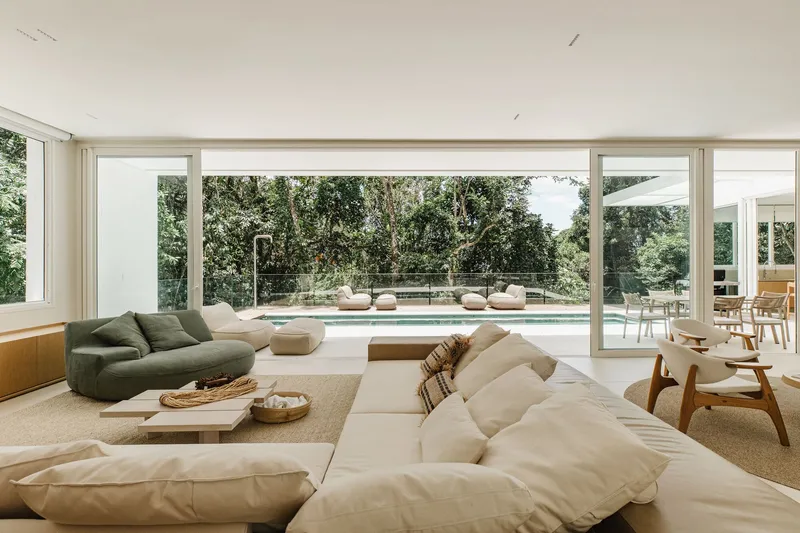
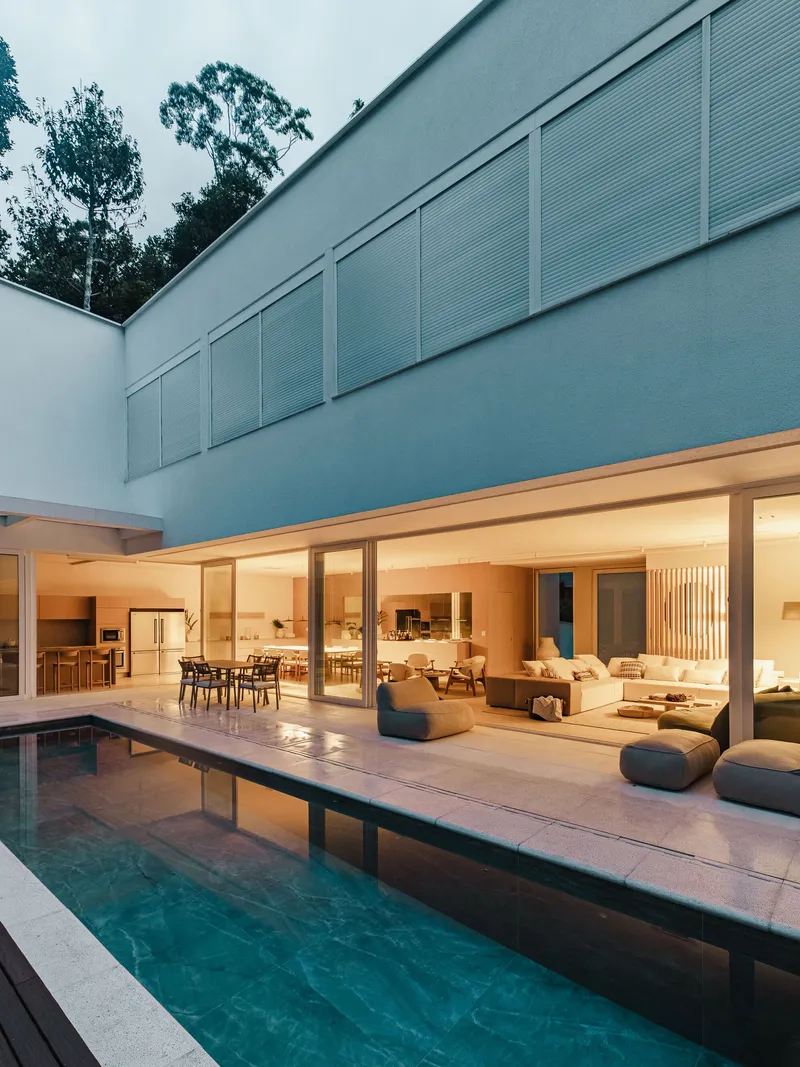
The swimming pool occupies a terrace that mediates between the house's rigid geometry and the forested hillside dropping away beyond. A glass balustrade keeps the edge invisible, so the water plane appears to merge with the distant canopy. The pool terrace also serves as an outdoor living room: seating groups sit comfortably beneath the overhang of the upper floor, shaded from direct sun but open to the panorama.
Seen from inside the living room through floor-to-ceiling glass, the pool reads as an intermediate landscape element, a still rectangle of water between the furnished interior and the wild hillside. This layering of controlled and uncontrolled nature gives the house its particular character. You are always aware of the forest, always separated from it by exactly one transparent threshold.
Pathways Through the Slope
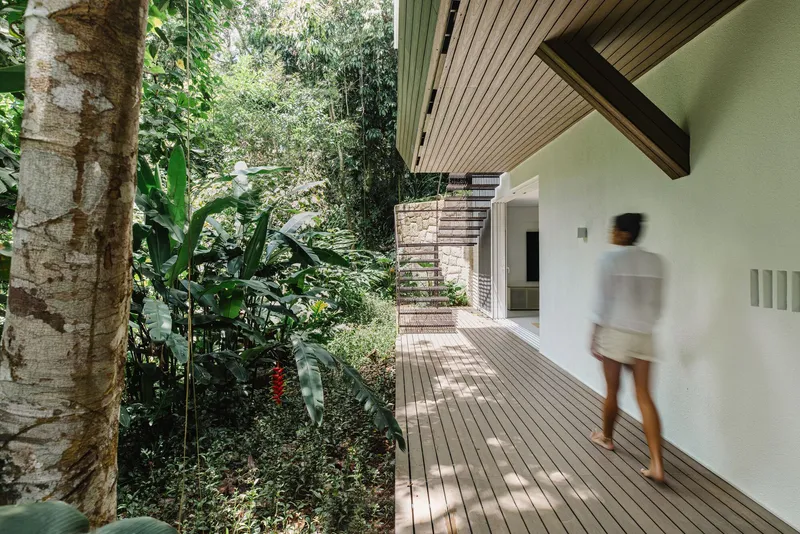
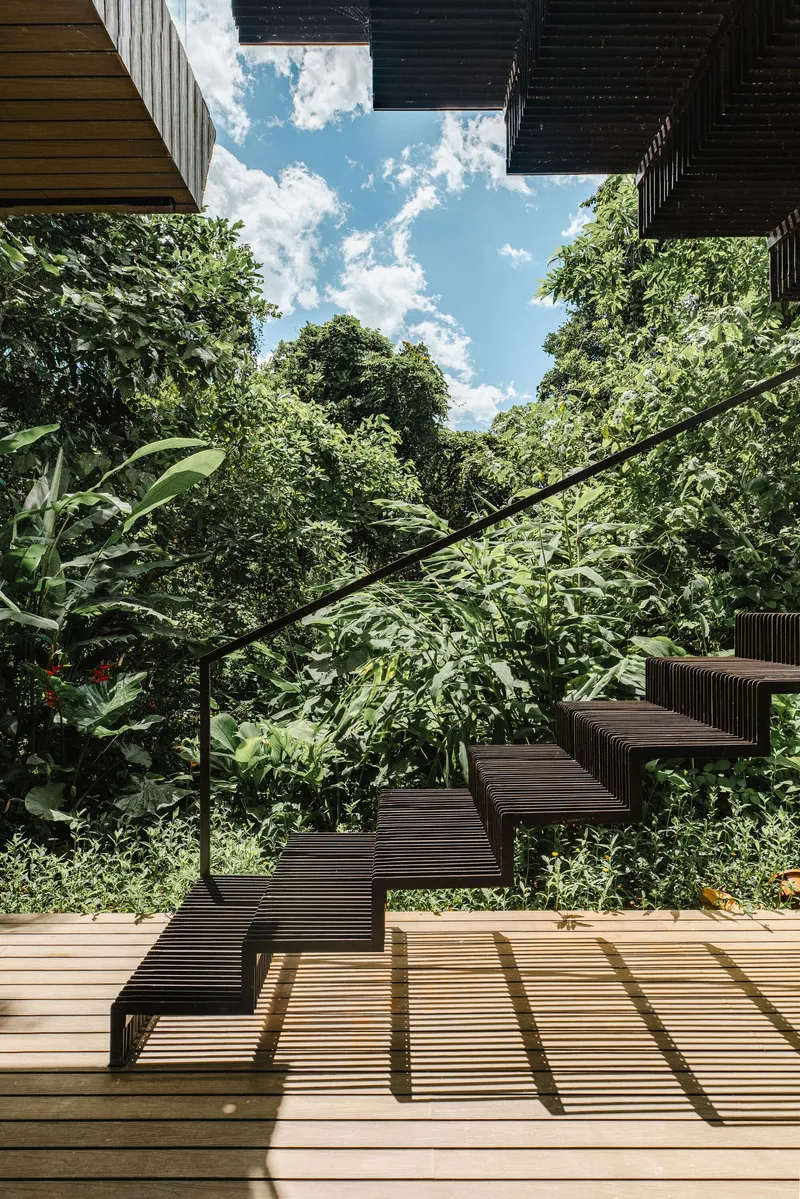
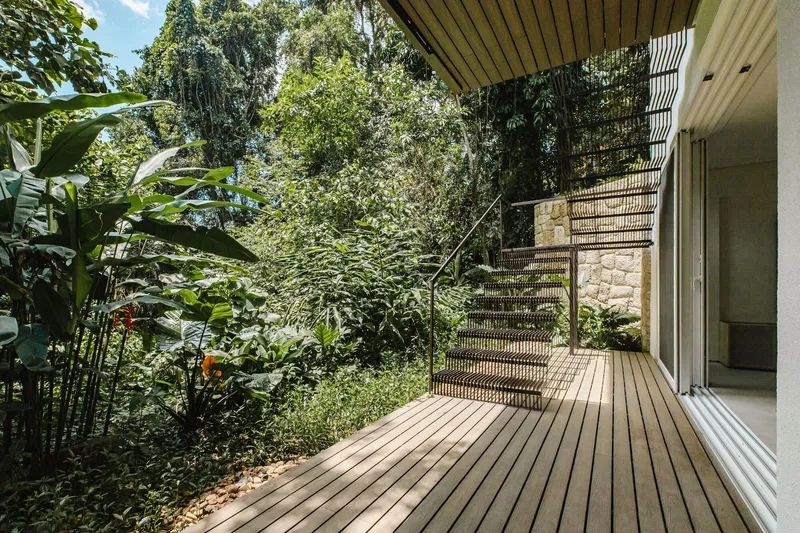
Timber-decked walkways and stairs navigate the steep terrain between the house and the surrounding garden. A slatted ceiling overhang runs parallel to one path, its linear rhythm contrasting with the organic shapes of planted beds below. Elsewhere, a perforated metal staircase climbs through banana leaves and tropical canopy, arriving at the upper garden as if emerging from a jungle floor.
These exterior circulation elements are some of the project's strongest contributions. The original modernist house likely treated the slope as a problem to be overcome; here, it becomes an experience to be savored. Each path introduces a sequence of shade, light, and fragrance that prepares you for the interior. It is landscape architecture in service of architecture, a distinction that matters.
Bedrooms and the Organic Window
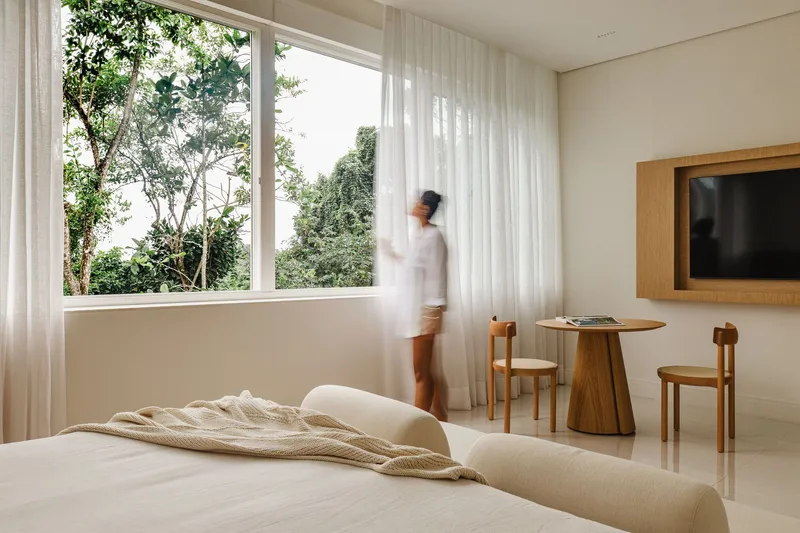
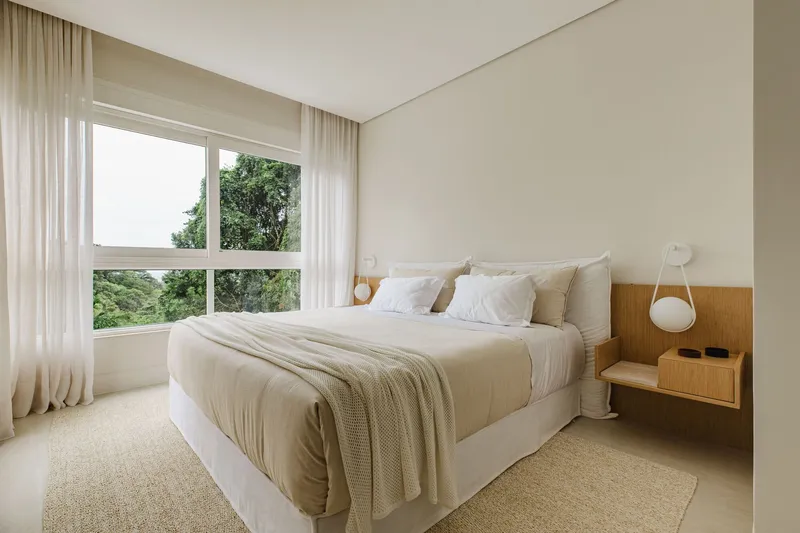
Upper-level bedrooms are quieter rooms, deliberately restrained. Timber headboard panels and horizontal strip windows keep the focus on the vegetation pressing close outside. Sheer curtains filter the strong coastal light into a diffuse glow, and the effect is of sleeping inside a treehouse rather than a conventional bedroom. The scale is intimate after the generosity of the public spaces below.
The most unexpected detail in the entire house appears on the ground level: an organic-shaped window cut into a white wall, revealing dense vegetation beyond. It is a clear departure from the modernist vocabulary that governs every other opening. Whether original or introduced by the renovation, it operates as a controlled moment of surrealism, a reminder that the forest outside does not conform to orthogonal logic and that the house, occasionally, should acknowledge that fact.
Plans and Drawings
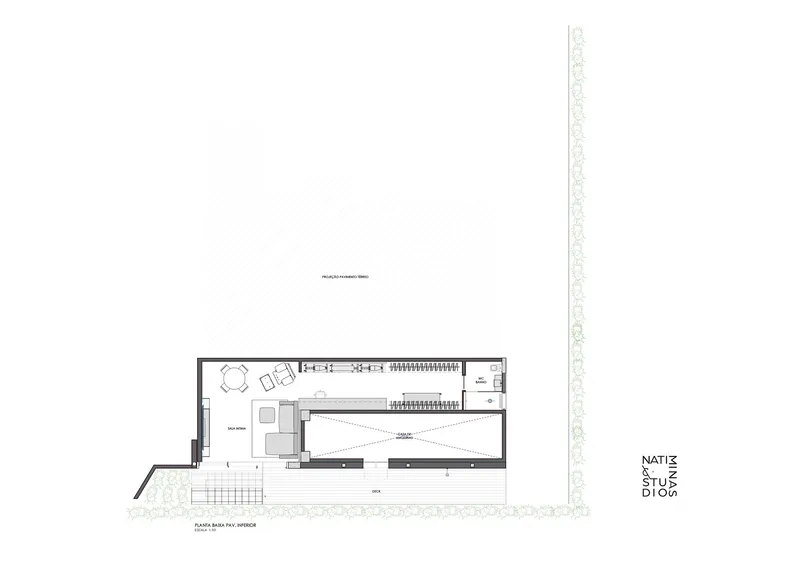
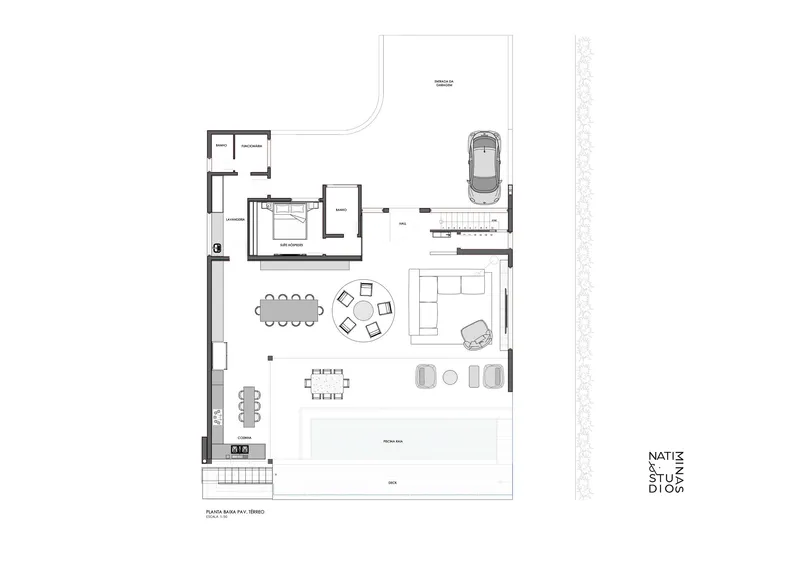
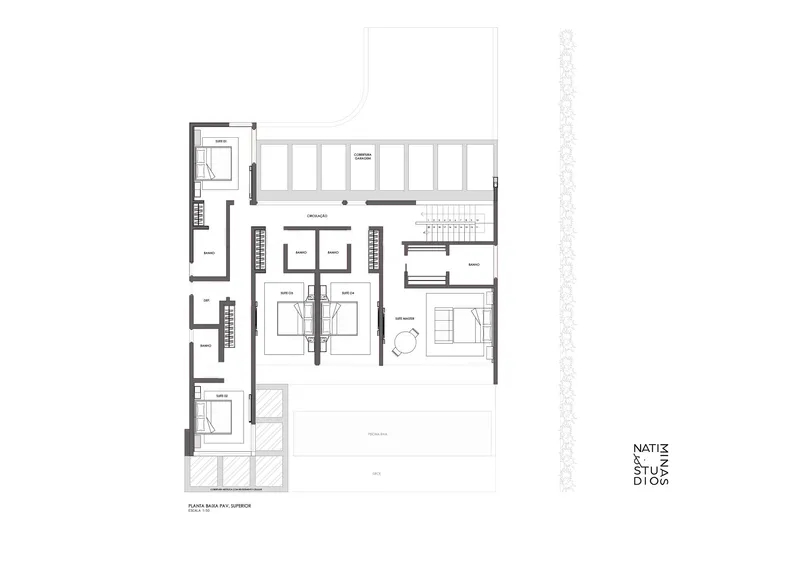
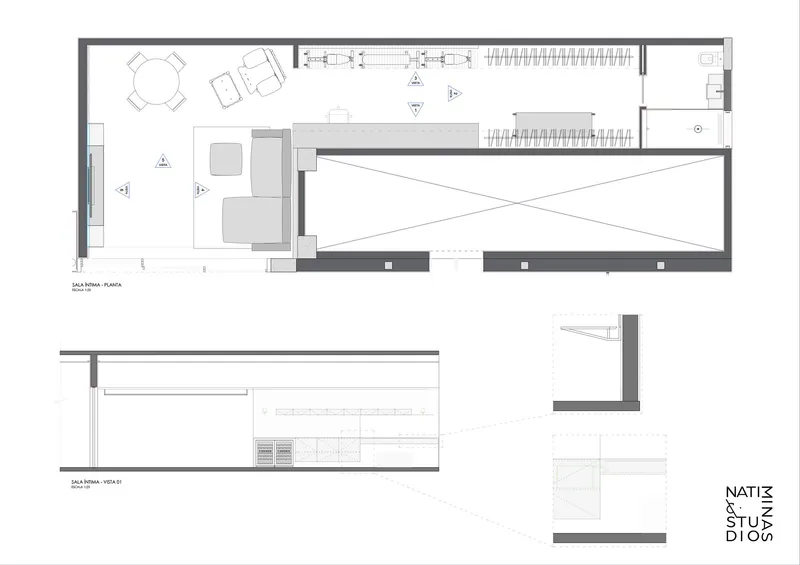
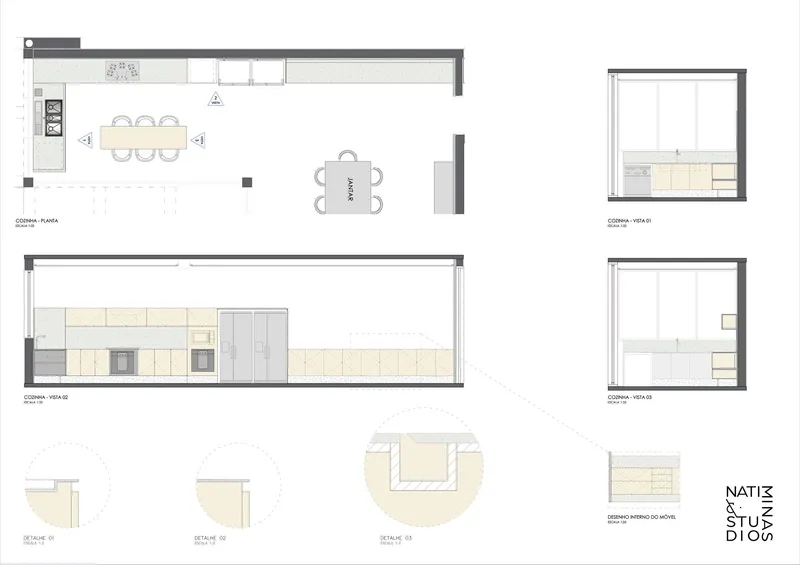
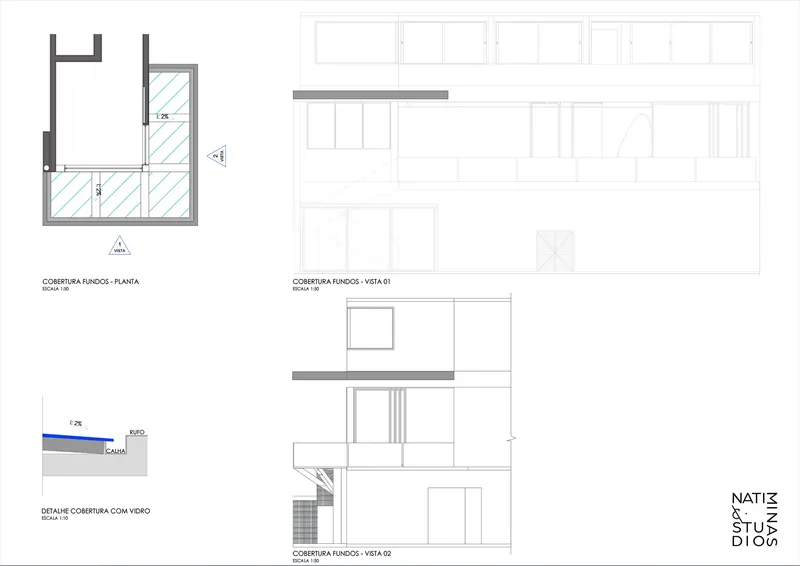
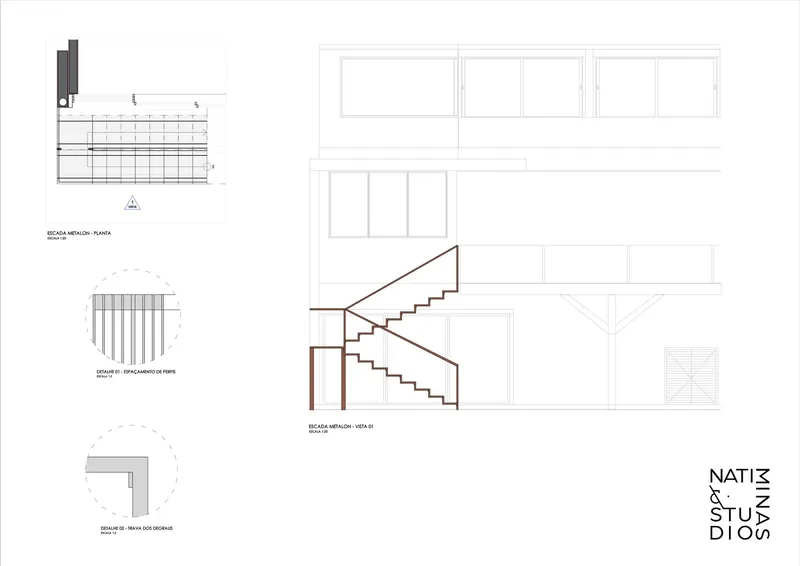
The plans confirm what the photographs suggest: a compact, clearly zoned layout organized around a central stairwell. The ground floor opens generously toward the pool and terrace, with living, dining, and kitchen flowing into one another. The upper floor clusters bedrooms and bathrooms around the same stair core, each room oriented to capture a different slice of the forest canopy. Garage and storage volumes are tucked into the slope at grade, invisible from the garden side.
Elevation and detail drawings reveal a level of care in joinery and finish that the photographs alone can only hint at. Kitchen sections show the relationship between timber and tile surfaces; staircase details document the metal railing profile and tread edge conditions. The roof terrace plan, with its glazed pool enclosure, suggests a third outdoor living zone above the main body of the house, an amenity that extends the usable footprint without increasing the building's ground-level impact on the protected site.
Why This Project Matters
Casa Iporanga is a lesson in restraint within a context that rewards it. Brazil's Atlantic Forest is one of the most biodiverse and most threatened ecosystems on the planet, and any construction within its boundaries carries real ecological weight. By choosing renovation over demolition, Nati Minas and Studio avoided the material and carbon costs of a new build while gaining a structure whose modernist clarity is enhanced, not diluted, by their interventions. The timber screens, expanded glazing, and landscape pathways are additive moves that deepen the dialogue between building and site without breaking the formal contract of the original design.
For architects working in protected landscapes, the project offers a useful precedent. It demonstrates that environmental sensitivity and spatial ambition are not opposites. You can make a house feel more open, more connected to its surroundings, and more materially refined without extending its footprint or stripping its character. That the result also happens to be a genuinely desirable place to live is the part that tends to get lost in sustainability narratives. Here, it stays firmly in view.
Iporanga House by Nati Minas and Studio, Guarujá, Brazil. 750 m², completed 2026. Photography by Miti Sameshima.
About the Studio
Share Your Own Work on uni.xyz
If projects like this are the kind of work you want to make, uni.xyz is a place to publish your own, find collaborators, and enter design competitions.



Popular Articles
Popular articles from the community


Lunar Spiral: Space Architecture Shaped by the Mathematics of the Universe
Lunar Spiral reimagines space architecture through Fibonacci geometry, lunar regolith, levitating habitats, and self-sustaining Moon living.

Riyadh For All: Intergenerational Urban Design for Active Aging in Rabat
Riyadh For All reimagines urban design in Rabat with intergenerational co-living, adaptive courtyards, and Moroccan cultural exchange today.

The Ocean Hive: Sustainable Architecture for a Self-Sufficient Civilization at Sea
The Ocean Hive imagines sustainable architecture at sea, where modular habitats, algae, wave power and ocean waste sustain a growing colony.

Co-Life: Senior Housing Design That Reconnects Older Adults With the City
Co-Life reimagines senior housing design through healing gardens, shared streets, workshops, and a sustainable community across generations.


Similar Reads
You might also enjoy these articles

Bao Huynh Watercolor Atelier: A Serene Art Retreat in Hội An
Bao Huynh Watercolor Atelier in Hội An blends multifunctional art spaces, sustainable design, local materials, and family-friendly living in a serene environment.

Atelier Macri Concept Store Interior Design by CASE-REAL
Atelier Macri store features a "ko" counter, walnut wood details, cork displays, blending retail, gallery, and seamless customer experiences.

Manuel Vargas Izquierdo Stadium and High-Performance Sports Center: Architectural Excellence in Jalpa de Méndez
The Manuel Vargas Izquierdo Stadium blends sustainable design, inclusive sports facilities, and cultural-inspired architecture, revitalizing Jalpa de Méndez’s public spaces.

KAKR Buluh Awar Hall: Revitalizing Community and Ecology Through Bamboo Architecture
Community built bamboo hall revitalizes Buluh Awar village, empowering youth, restoring ecology, celebrating vernacular craftsmanship through sustainable architecture and culture.



Comments (0)
Please login or sign up to add comments
No comments yet. Be the first to comment!