

Museum of Natural History: A Stepped Landform That Bows to Delhi's Heritage Sightlines
Manisha Nimesh's thesis turns a museum into an extruded landform, where a continuous ramp threads galleries, courtyards and heritage views into one walk.


Most museums ask visitors to leave the city at the door. This one asks them to keep walking. Conceived as a terraced landform rather than a sealed object, the proposal treats a natural history museum as an extension of the street: a sloping, permeable ground plane where circulation becomes exhibition and the line between building and landscape is deliberately blurred. Its argument is simple and overdue. If urban life has distanced people from natural systems, then a museum about nature should not be another box. It should feel like terrain.
The thesis project by Manisha Nimesh sits within one of the most culturally loaded precincts in the city, bordered by Pragati Maidan, the National Science Centre, Purana Qila and the Zoological Park. Despite that address, the site had suffered from low footfall and weak pedestrian links. Nimesh frames the museum as a regenerative intervention, one that fuses built form, landscape and public movement, and responds to protected heritage and tight urban constraints instead of overriding them.
A Missing Link Between Four Cultural Landmarks
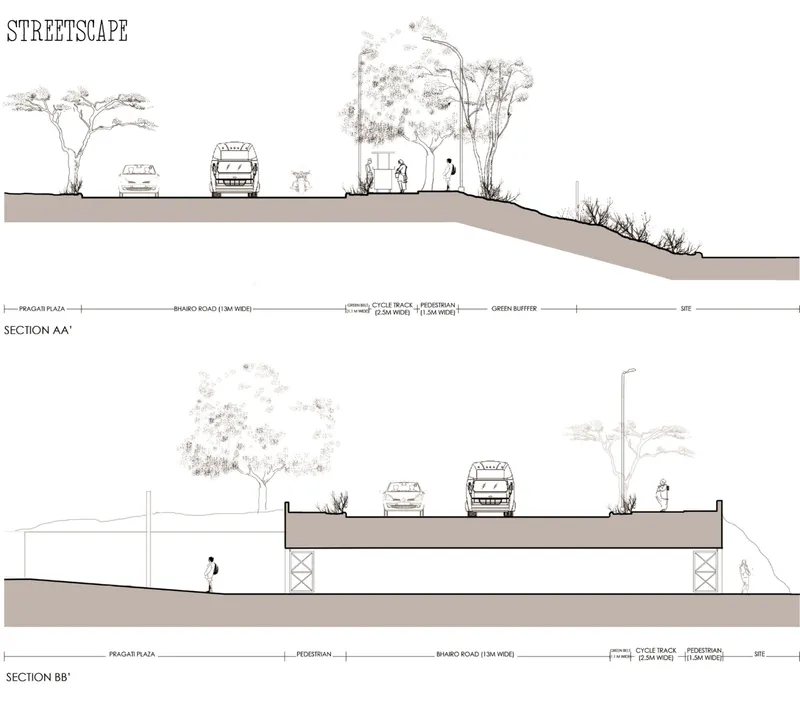
The first move is urban, not architectural. Nimesh reads the site as a gap in a chain of institutions and reworks it as a connector, stitching the surrounding landmarks together through a structured public plaza and a pedestrian network. Edges that once turned their backs on passersby are activated, and visual as well as physical links are pulled through the site so that it begins to behave like a node in the city's learning ecosystem.
This is the right priority. A museum in this location will only succeed if people arrive at it on foot, drifting in from the science centre or the zoo. By designing the approach before the galleries, the project earns its public role rather than assuming it.
Stepping Down So the Monuments Can Be Seen
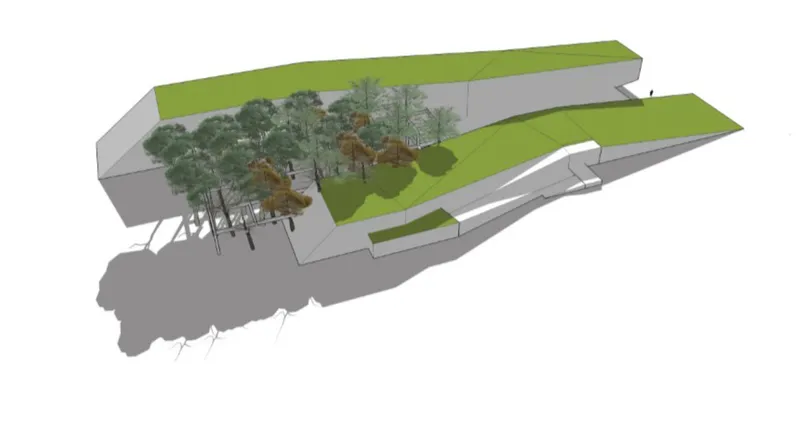
Protected heritage structures and strong visual axes toward the nearby mosque and historic monuments shape the massing more than any formal ambition. The built form steps and lowers wherever those sightlines pass, keeping views to the mosque uninterrupted. Restraint here is a design tool: height is spent only where it costs the skyline nothing.
What lifts the strategy beyond compliance is how the architecture then stages the heritage. Narrow corridors, gradual reveals and controlled vistas turn the monuments into moments within a curated route. The visitor does not simply see the mosque; they arrive at it visually, framed by the museum's own edges.
Strips of Building Rising From the Ground

The museum is conceived as an extruded landform, with sloping ramps and terraced volumes lifting out of the site. The ground does not stop where the building starts; public movement flows up and across multiple levels as though the plaza had simply been folded upward.
Crucially, Nimesh breaks this landform into distinct strips that sort public, semi-public and private zones. The fragmentation avoids the weight of a monolith, opens gaps for light and passage, and makes the plan legible: you can read the gradient of access in the massing itself. It is an efficient way to reconcile a porous public ground with the controlled spaces any working museum needs.
The Ramp as Gallery, Route and Viewing Deck
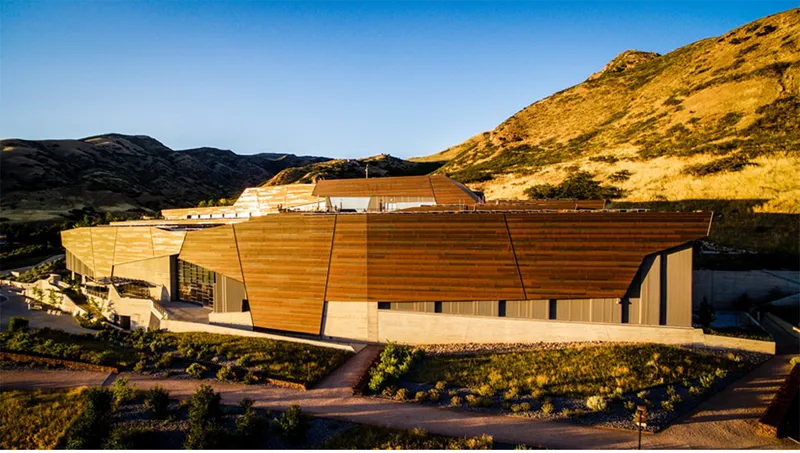
At the centre of the scheme runs a continuous ramp that serves as both circulation and exhibition space. It links the public plaza to galleries, courtyards, workshops and panoramic decks, so that moving through the building is itself the curriculum. Bridges, overlooks and resting points punctuate the route, offering shifting perspectives on exhibits, courtyards and the surrounding greenery.
The ramp has a long lineage in museum design, and its risk is monotony. Nimesh counters that by treating it as a sequence of pauses rather than a single incline: each bridge or overlook is a reason to stop, look back and reorient. Circulation stops being dead space between rooms and becomes the museum's main narrative thread.
Three Courts, Three Degrees of Openness
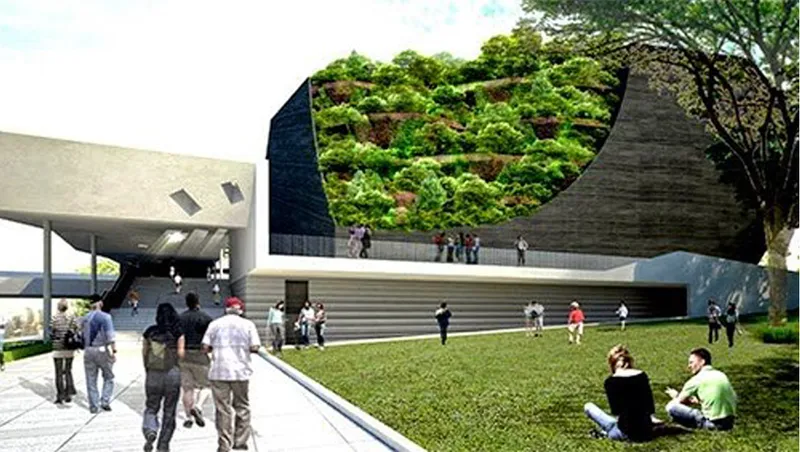
The open spaces follow a clear hierarchy. A large public plaza acts as a welcoming forecourt for neighbouring communities and institutions. The central courtyard, densely planted and visible from multiple levels, is the emotional core where the relationship between people and nature is made literal. A sunlit winter court supports year-round activity and connects directly to the zoo entrance.
Each court calibrates enclosure differently, moving from civic openness to planted interiority to climatic comfort. Together they ensure nature is never confined to display cases. The building is always partly outdoors, and the exhibits are always seen against living vegetation.
Why This Project Matters
Much student work on museums fixates on a striking envelope. This thesis instead starts with the city: footfall, pedestrian routes, protected sightlines and the institutions next door. The architecture follows from those constraints, and the result is a building that strengthens its context instead of competing with it. That order of operations is a lesson in itself.
The project also makes a convincing case that a natural history museum's message can be spatial before it is curatorial. A landform you can climb, a ramp that teaches as you walk and courtyards thick with planting all communicate reconnection with nature more directly than any gallery label. Nimesh's proposal shows how heritage sensitivity and public generosity can be the same design move.
View the Full Project
About the Designers
Designer: Manisha Nimesh
Enter a Design Competition on uni.xyz
uni.xyz runs architecture and design competitions year-round that reward proposals with spatial conviction and real site intelligence.
Project credits: Museum of Natural History by Manisha Nimesh.


Popular Articles
Popular articles from the community


The Amber Palace Opera: A Geological Fiction Surfaces on Tallinn's Baltic Waterfront
Pierre Brillard reimagines a Baltic legend as a public landscape, opera house, and waterfront promenade rooted in Tallinn's coastal identity.
Cloaked Colonization: A Mobile Underwater Habitat That Moves Like a Fish
Micah Abaya's shortlisted EHC Pacific entry reimagines ocean settlement as a dispersed network of self-sustaining architectural organisms.

Tsunami Convergenics: Turning Catastrophic Ocean Forces into Underwater Housing Infrastructure
A speculative underwater settlement off the coast of Onagawa, Japan, treats tsunamis and typhoons as energy sources rather than threats.

Faces of the Soviet Avant-Garde: Turning Moscow's Street Names into an Open-Air Museum
A network of sculptural installations across a Moscow residential district transforms forgotten architect names into spatial encounters with cultural memor

Similar Reads
You might also enjoy these articles

Maya Harvest: A Cacao Resort Village Rooted in Mayan Tradition and Local Craft
Situated within a Tabasco cacao plantation, this shortlisted resort proposal merges vernacular materials with hands-on cultural immersion.
Harmonia: A River-Shaped Community That Grows Over Decades in Boa Vista
Curved pathways and modular grid structures along the Branco River create a phased settlement designed to evolve from 2030 to 2050.
The Architecture of Bathing: A Mughal Hammam Reimagined Across the Yamuna
Charlotte May's honorable mention entry for The Black Taj reinterprets Agra's bathing rituals through red sandstone, water, and framed views of the Taj Mah
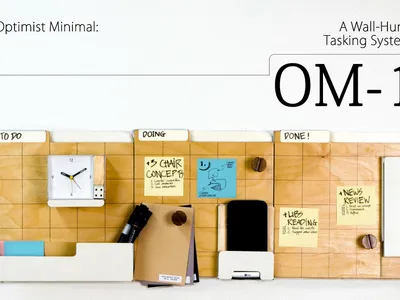
Om-1: A Wall-Hung System That Moves Your Workspace Off the Desk
Modular plywood boards, magnetic pegs, and utility elements migrate clutter from the horizontal surface to the vertical plane.

Comments (0)
Please login or sign up to add comments
No comments yet. Be the first to comment!