

Natural Island: Urban Farming and Market Life Fused Under a Rolling Green Canopy
Sergei Boranov's Nine Elms proposal layers wholesale markets, farm laboratories, and housing beneath a continuous agricultural landscape.


What if a wholesale market could double as a working farm? Natural Island takes a 31.6-acre site in London's Nine Elms and folds agriculture, commerce, and housing into a single curvilinear megastructure. The result is a building that refuses to choose between productive landscape and urban infrastructure, instead becoming both at once.
Designed by Sergei Boranov, the project is sited between Kirtling Street and Thessaly Road, close to a metro station, within a district undergoing rapid transformation. Working within a 24-meter height limit and 30% ground coverage cap, Boranov proposes an algorithmically driven masterplan that stacks underground parking, product processing, administration, co-working spaces, farm laboratories, and residential units for farmers beneath a continuous green roof. The ambition is total: food security, community integration, and ecological performance addressed through a single architectural gesture.
A Roof That Farms: Continuous Landscape Over Modular Volumes
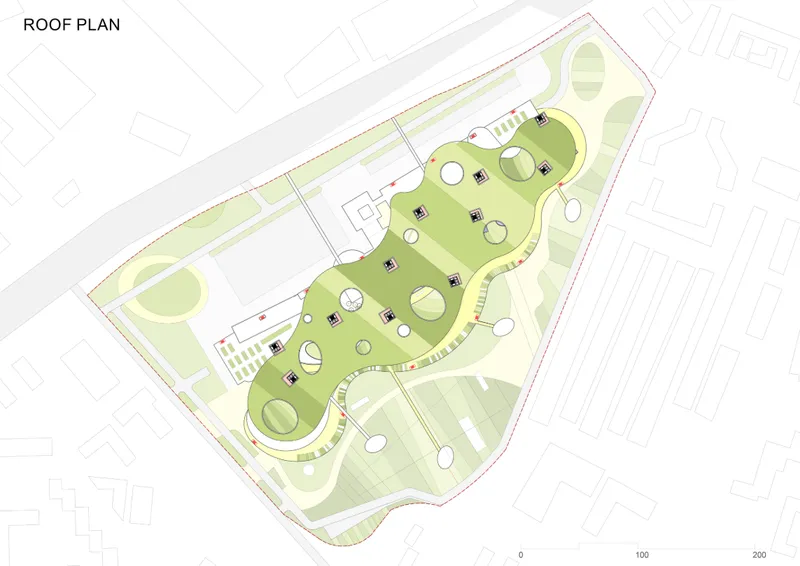

The roof plan reveals the project's most striking move: a series of undulating green surfaces punctuated by circular elements that function as skylights and vertical circulation cores. Rather than treating the roof as leftover space, Boranov turns it into the project's primary productive surface, with farming terraces flowing outward from these openings. The wave-like profile softens the mass of what is, underneath, a substantial wholesale market and logistics operation.
The site plan makes the organizational logic legible through color-coded zones. The warehouse-market area occupies the portion nearest truck access, while a dedicated green zone is reserved for agricultural activity. Round-trip road connections serve both Kirtling Street and Thessaly Road, separating goods logistics from pedestrian and cyclist movement. Underground parking handles visitor and employee vehicles, with dedicated truck parking adjacent to the wholesale market to keep heavy traffic off the green zones entirely.
Plastic Green Structure: Commerce Absorbed by Landscape
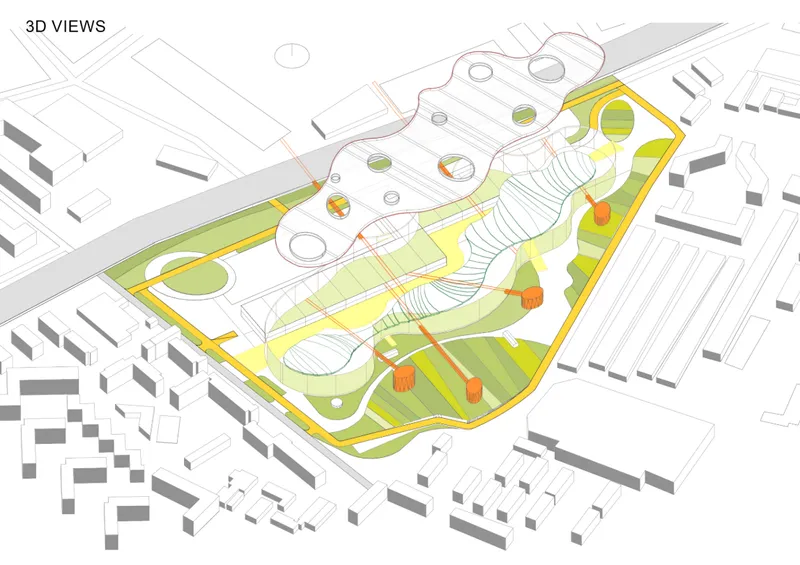
The axonometric drawing places Natural Island within its surrounding urban context, and the contrast is immediate. Where Nine Elms is defined by orthogonal residential towers and gridded streets, Boranov's proposal reads as a topographic anomaly: a rolling, organic form that appears to have been carved rather than constructed. The design introduces what Boranov calls a "plastic green structure" that wraps around the wholesale market functions, absorbing their visual and environmental impact. Elevated bridges connect different zones of the site, turning circulation into a spatial experience rather than a corridor.
The multi-level landscape strategy is key here. Green spaces do not sit on top of the building like a token amenity; they flow from street level into the inner farm area, dissolving the boundary between public realm and productive interior. The effect is a hybrid environment where shoppers browsing the market, researchers in the farm laboratories, and residents heading home occupy overlapping spatial territories.
Sectional Logic: From Underground Parking to Farming Terraces

The section and elevation drawings reveal the vertical stacking that makes the programme viable. Underground parking forms the base layer, freeing the ground plane for market and processing activities. Above that, administrative and co-working spaces occupy the mid-levels, while farm laboratories and residential properties for farmers sit closest to the rooftop landscape. The section cuts confirm that the curvilinear roofline is not decorative but structural in its programmatic logic: it creates varied ceiling heights that correspond to the different functional needs below, from double-height warehouse bays to intimate residential units.
The elevation drawings emphasize the building's horizontal character. Even at its maximum 24-meter height, Natural Island reads as a landscape rather than a building, its long profile evoking the image Boranov intends: an island of nature floating within the urban fabric. Green roofs, multi-level farming platforms, and public open spaces create what the designer describes as a symbiotic relationship between people and their environment, where architecture actively participates in ecological and social well-being rather than merely housing it.
Why This Project Matters
Urban farming proposals often fall into one of two traps: they either treat agriculture as a rooftop afterthought or they abandon architectural ambition in favor of pure infrastructure. Natural Island avoids both by integrating food production into the building's fundamental formal and organizational logic. The curvilinear structure is not a shape applied to a box; it is the direct expression of a programme that requires continuous gradients between indoor market space and outdoor growing platforms. The inclusion of farm laboratories and a co-working center oriented toward agricultural start-ups suggests that this is not just a building but an economic ecosystem designed to sustain itself.
Boranov's proposal raises a provocative question for Nine Elms, a district that has overwhelmingly prioritized luxury residential towers. What if the most valuable thing you could build on a 31.6-acre site is not more apartments but a piece of productive landscape? By embedding wholesale markets, processing facilities, research labs, and farmer housing within a single green megastructure, Natural Island argues that density and agriculture are not opposites. They can be the same project.
View the Full Project
About the Designers
Designer: Sergei Boranov
Enter a Design Competition on uni.xyz
uni.xyz runs architecture and design competitions year-round that reward proposals with spatial conviction and real site intelligence.
Project credits: Natural Island by Sergei Boranov.


Popular Articles
Popular articles from the community


graciastudio Turns a Viewless Tijuana Lot Inward Around a Courtyard of Concrete, Timber and Trees
In Tijuana, Jorge Gracia's GA2 House stacks a timber-clad private floor over exposed concrete and replaces a missing view with a planted interior patio.

David Ortega Stacks a Two-Story Mexico City Penthouse Around a Steel Stair and a Pergola-Shaded Roof Terrace
In Colonia Roma, a 300 m² penthouse uses oak joinery, a planted steel stair and a slatted roof pergola to make a new-build apartment feel like a house.


Manzana Morphosis: Stretching Barcelona's Grid into a Living Landscape for 2050
A radical reworking of the Eixample manzana turns density into a tool for generous public space, vertical ecology, and environmental performance.

Aquadapt: An Underwater Habitat That Rewrites Its Rooms by the Hour
Curved modules ring the seabed while one shell shifts from breakfast room to cinema, farm and football pitch as residents' needs change.

Similar Reads
You might also enjoy these articles
Aquadapt: An Underwater Habitat That Rewrites Its Rooms by the Hour
Curved modules ring the seabed while one shell shifts from breakfast room to cinema, farm and football pitch as residents' needs change.

Play: Fragments of Their World: Remembered Architecture Rebuilt as a Modular Playground for Refugee Camps
Tom Gardner abstracts domes, arches and towers from the homelands of displaced families into a kit of child-scaled play parts for camp settlements.
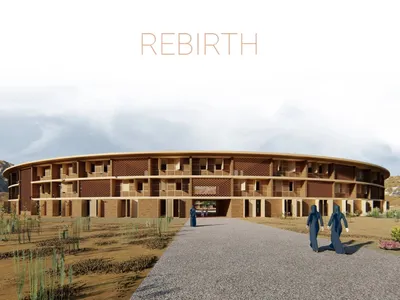
REBIRTH: A Circular Settlement Where Afghan Widows and Their Children Rebuild Life Together
A shortlisted Resile entry turns the circle into a protective ring of timber and brick, gathering homes, classrooms and gardens around a shared landscape.
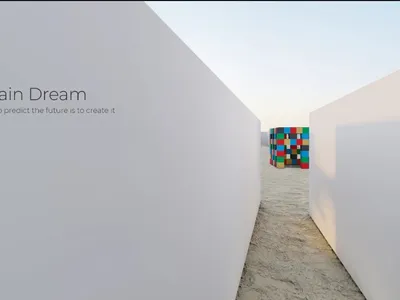
The Main Dream: A Recycled Plastic Kit That Lets Refugee Children Build Their Own Playground
Thirty-centimetre interlocking cubes that connect on three axes turn play into construction, letting children author the spaces they occupy.

Explore Green Roof Competitions
Discover active competitions in this discipline

Challenge to reimagine the Iron Throne

Photograph architecture without architects

Illustrate the lost glory of Angkor Wat - Render Challenge

Design challenge to reuse E-waste
Comments (0)
Please login or sign up to add comments
No comments yet. Be the first to comment!