
Neelesh Chopda Architecture Builds a Rammed Earth Retreat in a 12-Acre Mango Orchard
A 1,800 sq. ft. bungalow in Betul, India, revives a forgotten craft to root a Mumbai family's retreat in the soil beneath it.

There is something quietly radical about a house that smells like the ground it stands on. Fragrance of Earth, designed by Neelesh Chopda Architecture LLP and led by architect Darshan Jana, is a 1,800 sq. ft. bungalow perched on a natural mound inside a sprawling mango orchard in Betul, Madhya Pradesh. The clients, based in Mumbai, wanted a retreat they could return to on the land where their fruit trees grow. The architects gave them walls made from that very land: rammed earth, compacted layer by layer from locally sourced soil, a technique once common in the region but nearly extinct.
What makes the project worth paying attention to is not the material choice alone but the way it reorganizes the relationship between house and site. The bungalow does not sit on the orchard so much as it participates in it. A black hipped roof recedes into the skyline, rammed earth walls shift tone with the changing light, and courtyards pull the landscape into the plan. The house is modest in size but ambitious in its commitment to locality, from the soil in the walls to the craftsmen who learned the technique during construction and carried it back to their own villages.
A Pavilion in the Orchard
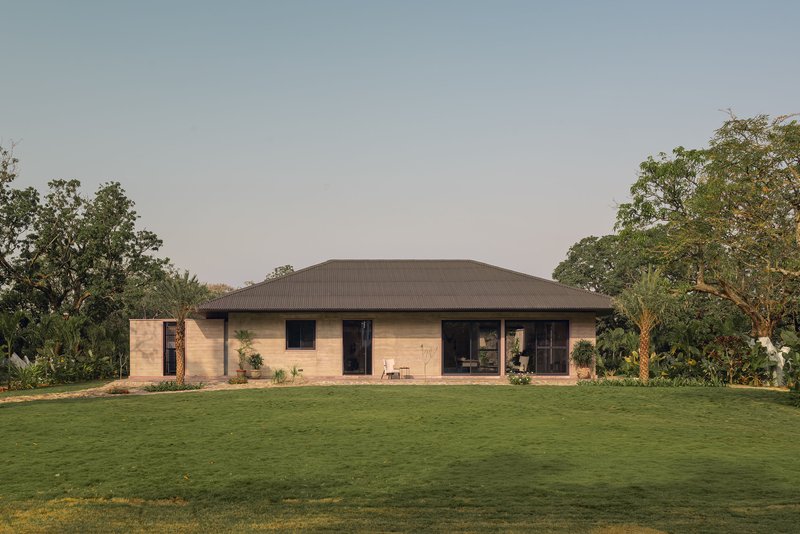
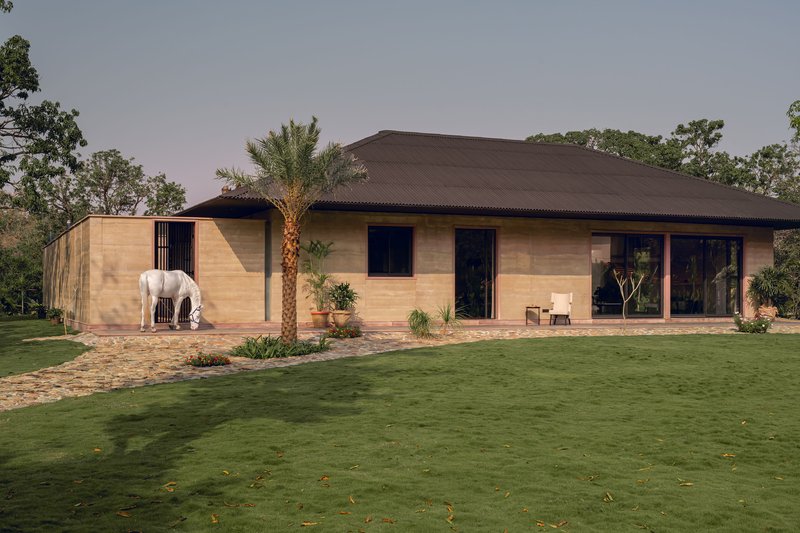
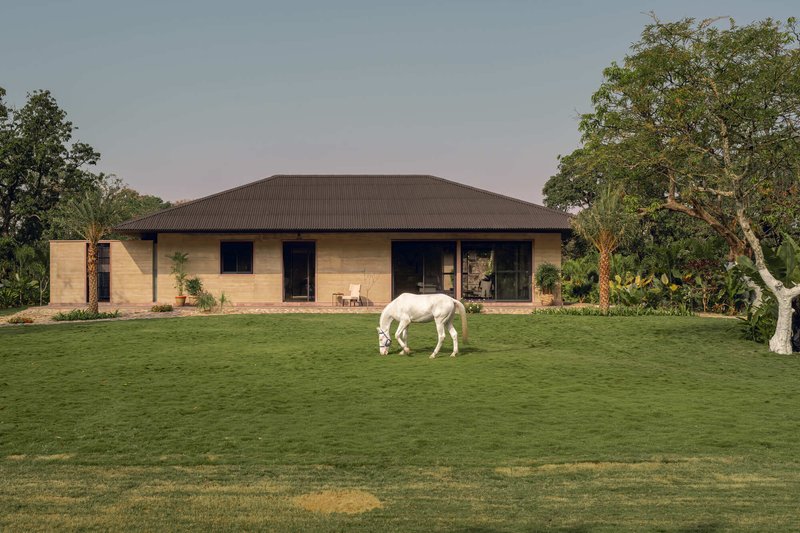
From the outside, the house reads as a low, grounded pavilion. Its black corrugated metal roof slopes gently, keeping the profile well below the mango canopy. The rammed earth walls, with their horizontal striations and mineral color shifts, register more as geology than as architecture. At dusk the building nearly disappears into its surroundings, which is precisely the intention: the dark roof reduces visual glare and lets the form recede. A white horse grazing on the manicured lawn only reinforces the sense that this is a landscape first and a building second.
The 12-acre site gives the architects room to breathe. Rather than centering the house or carving out a formal approach, they positioned the bungalow along the elevated rear edge of the site, taking advantage of the natural mound. The result is a subtle separation between the domestic world and the working orchard, achieved without fences or walls.
Rammed Earth as Revival
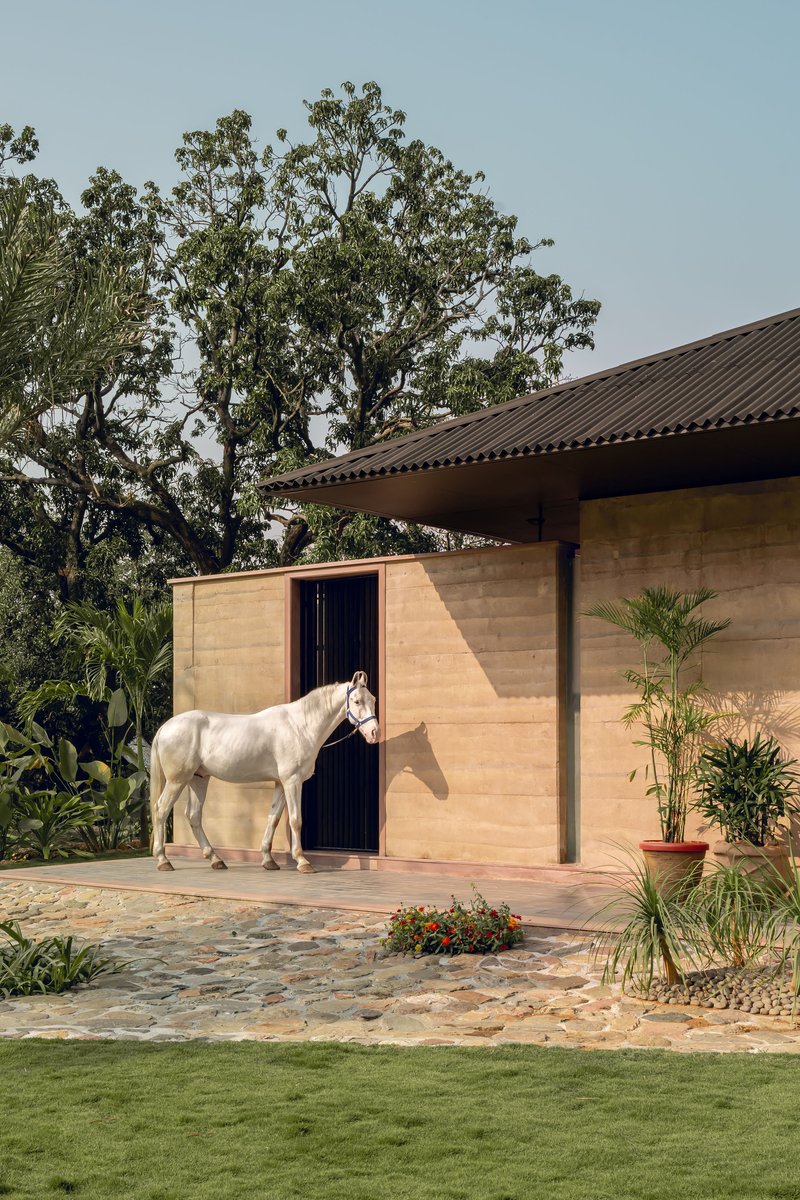
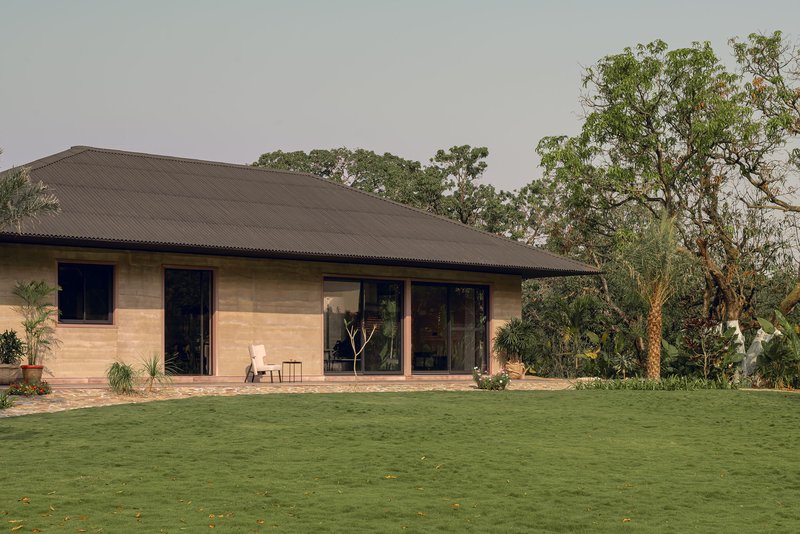
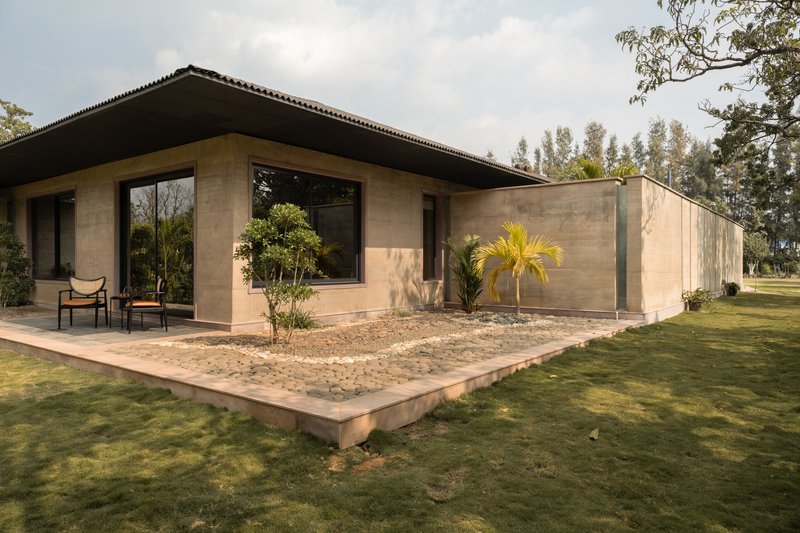
The rammed earth walls deserve close reading. Each one is formed from layers of compacted local soil, and the resulting surface carries visible strata: bands of warm ochre, rust, and clay that shift in response to daylight. The technique is historically rooted in the region but had been gradually abandoned in favor of concrete and brick. Neelesh Chopda's team trained local craftsmen in the nuances of soil composition, layering, and compaction. Several of those workers have since applied the knowledge in their own villages, turning a single house project into a quiet act of cultural recovery.
The material does more than look good. Rammed earth's thermal mass absorbs heat during the day and releases it slowly at night, a critical advantage in Betul's hot climate. Combined with expansive sliding glass doors that invite cross-ventilation, the house maintains comfort without relying heavily on mechanical systems. The walls are structure and insulation and ornament all at once.
Courtyards That Mediate
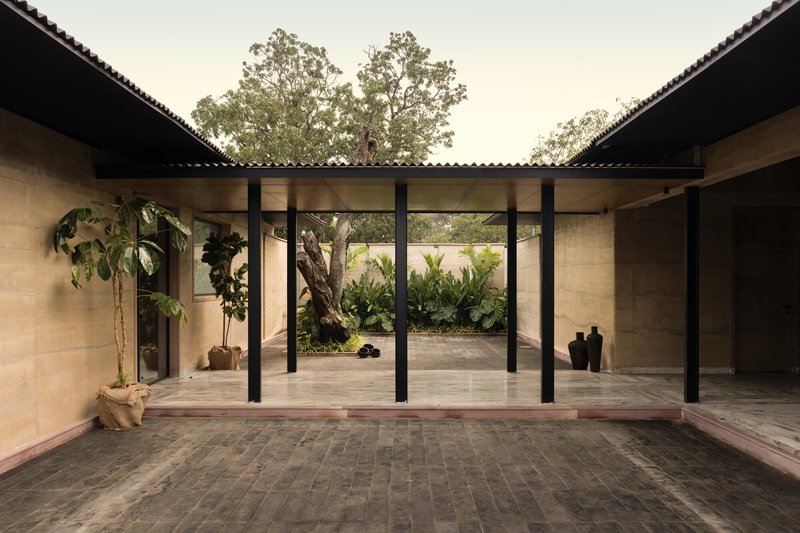
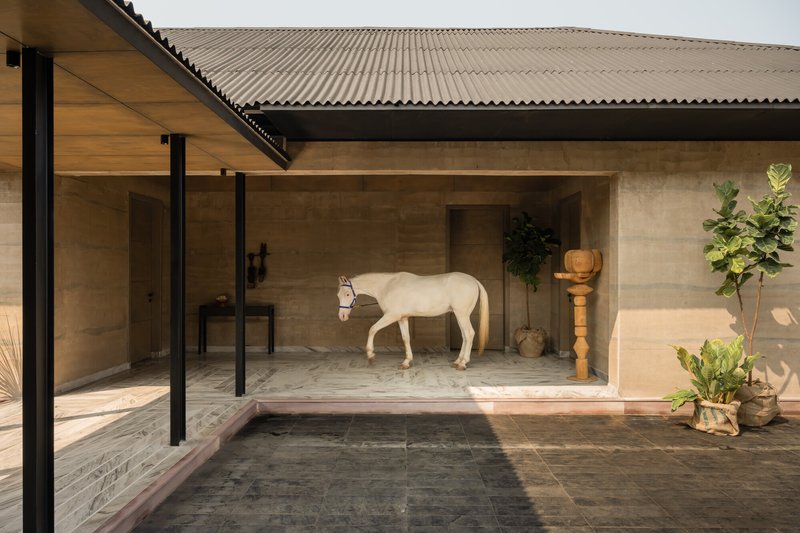
The plan is organized around two interior courtyards that do the heavy lifting of spatial choreography. One, lined with herringbone stone paving and low platform seating, creates a shaded social zone framed by rammed earth walls. The other, visible through glass walls and black steel columns, is planted with greenery and serves as a breezeway connecting the bedrooms to the common areas. These are not decorative voids. They regulate airflow, introduce daylight deep into the plan, and create a gradient between the fully enclosed and the fully open.
The courtyard passage is especially effective. Three bedrooms are positioned along the rear, connected to the living core by a covered walkway with a corrugated roof and slender steel columns. The passage mediates between private and shared zones without corridors, keeping sightlines generous and movement intuitive. You always know where you are relative to the garden.
The Vaulted Interior
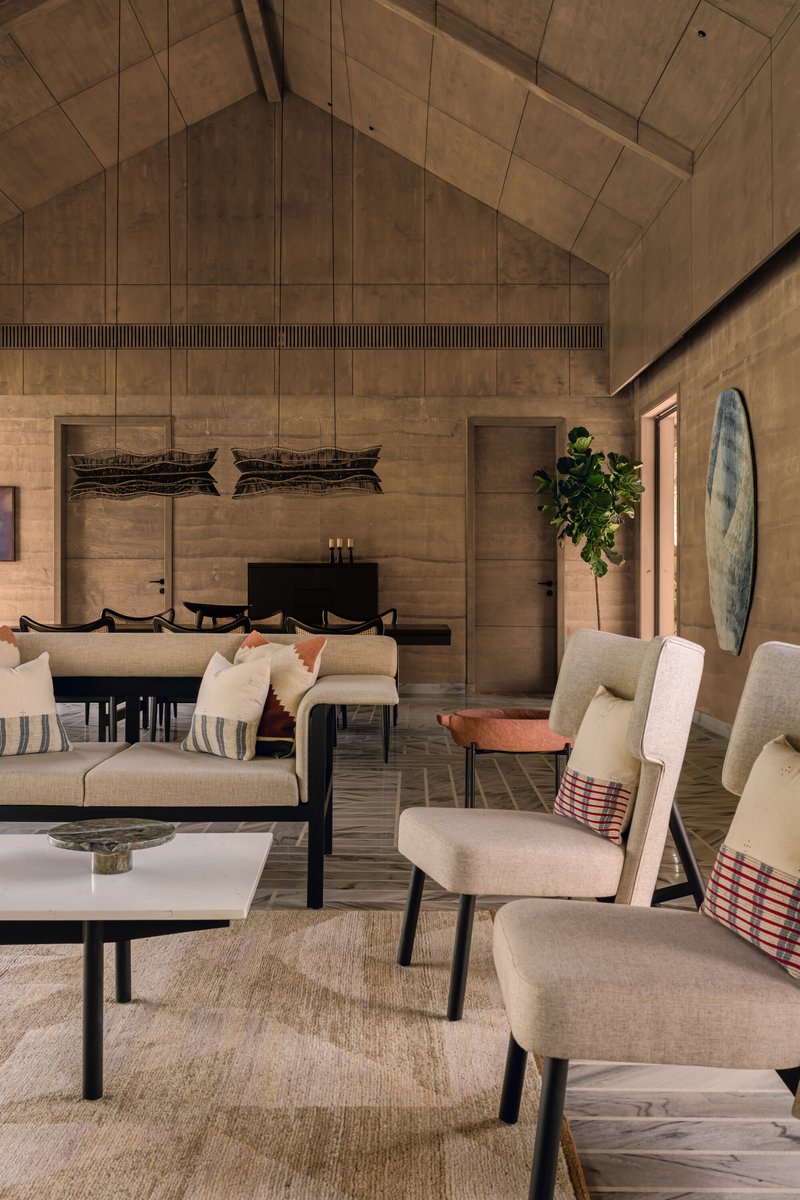
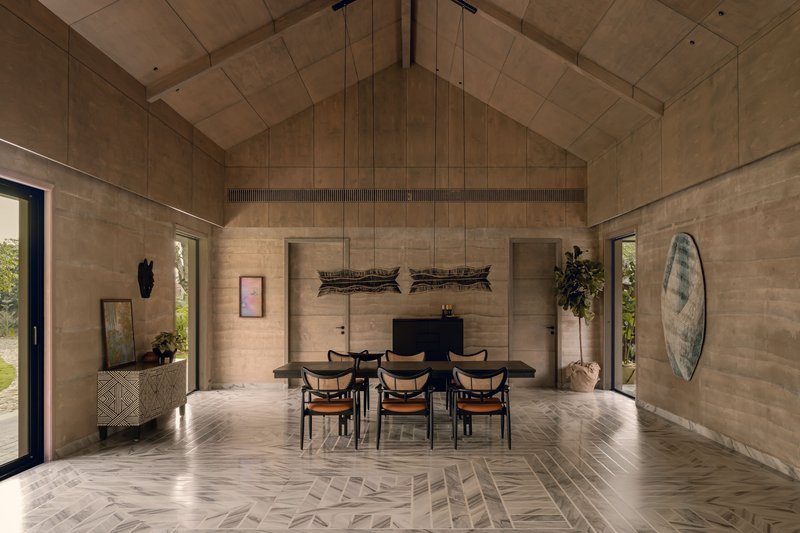
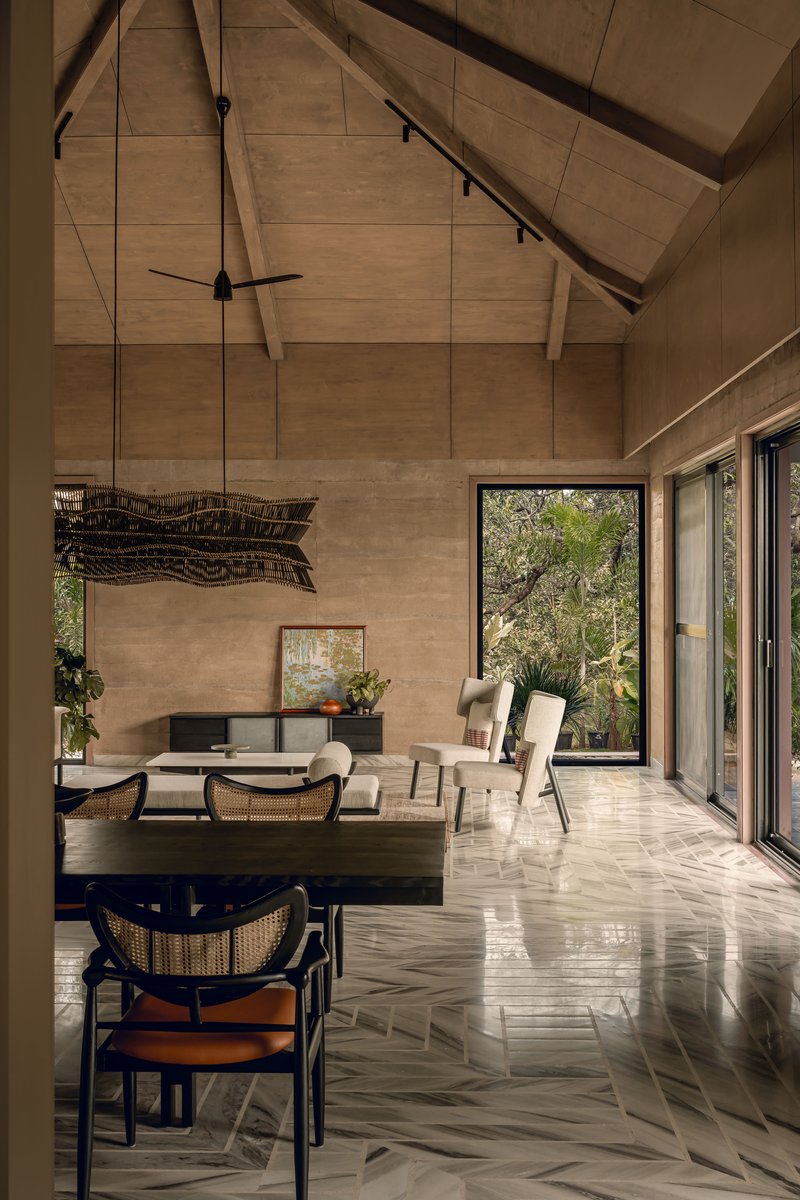
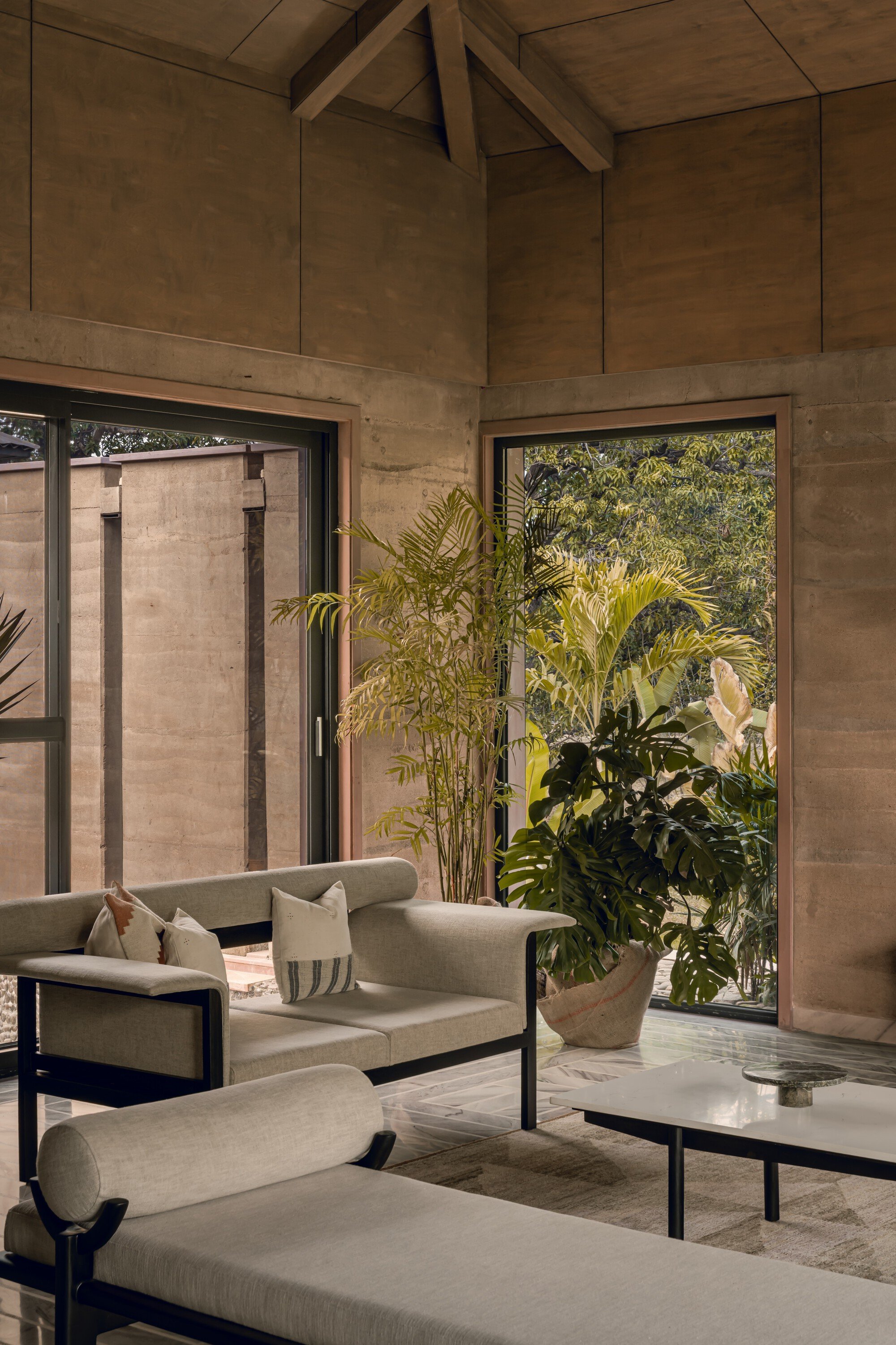
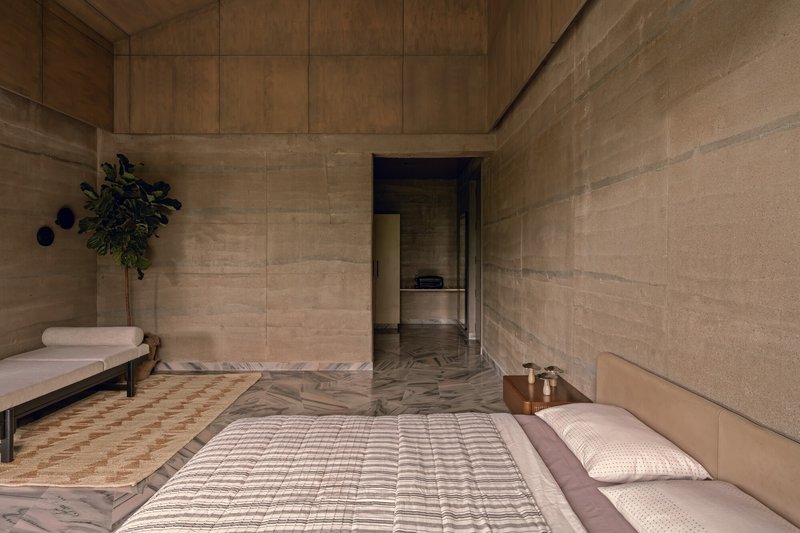
Inside, the pitched roof translates into vaulted timber ceilings that give the modest floor plan a sense of generous volume. Exposed timber trusses and wood-paneled soffits warm the interior, contrasting with the cool mineral tones of the rammed earth walls and the striated marble herringbone flooring. Living, dining, and kitchen spaces gather at the center of the plan, forming a single social hub that benefits from ceiling height and natural light in equal measure.
The material palette is restrained but tactile. Reclaimed wood, marble, rammed earth, and glass: nothing competes. The herringbone floor pattern adds texture without fuss, and the vaulted ceiling panels in the dining room capture and diffuse afternoon light in a way that makes the room feel much larger than its footprint suggests.
Private Rooms, Open Views
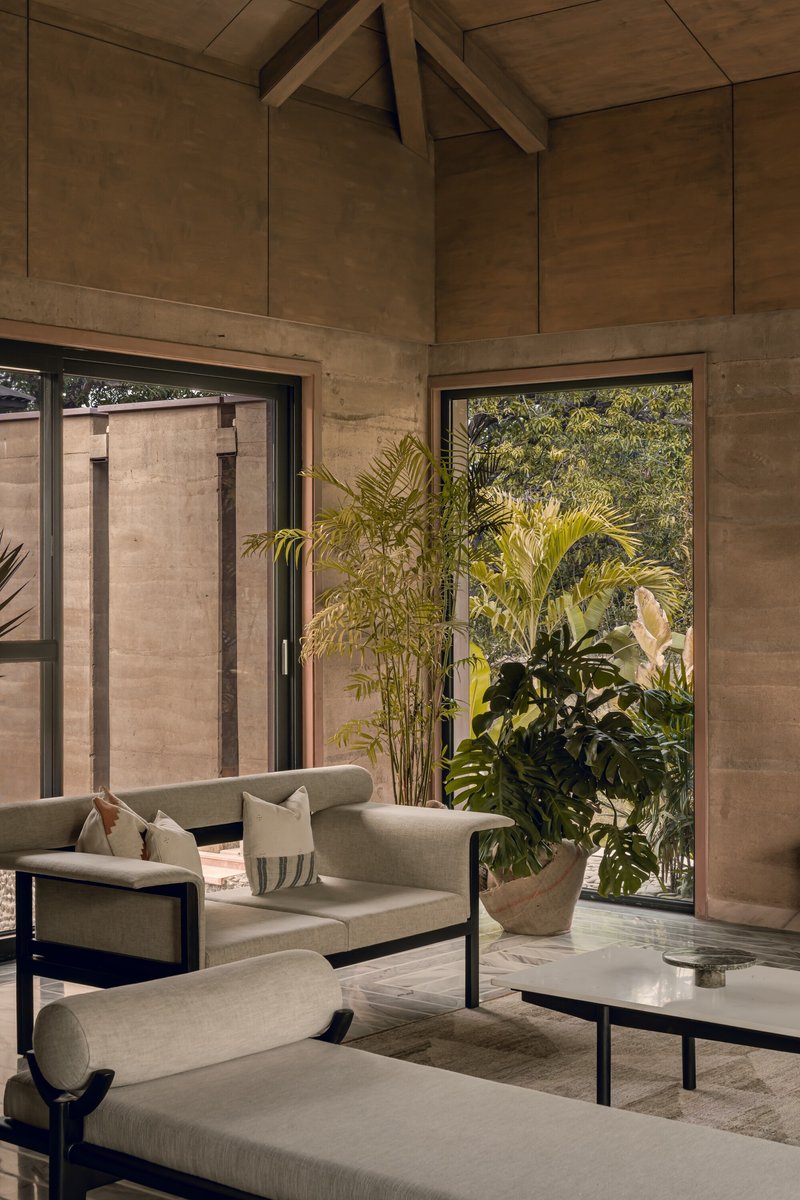
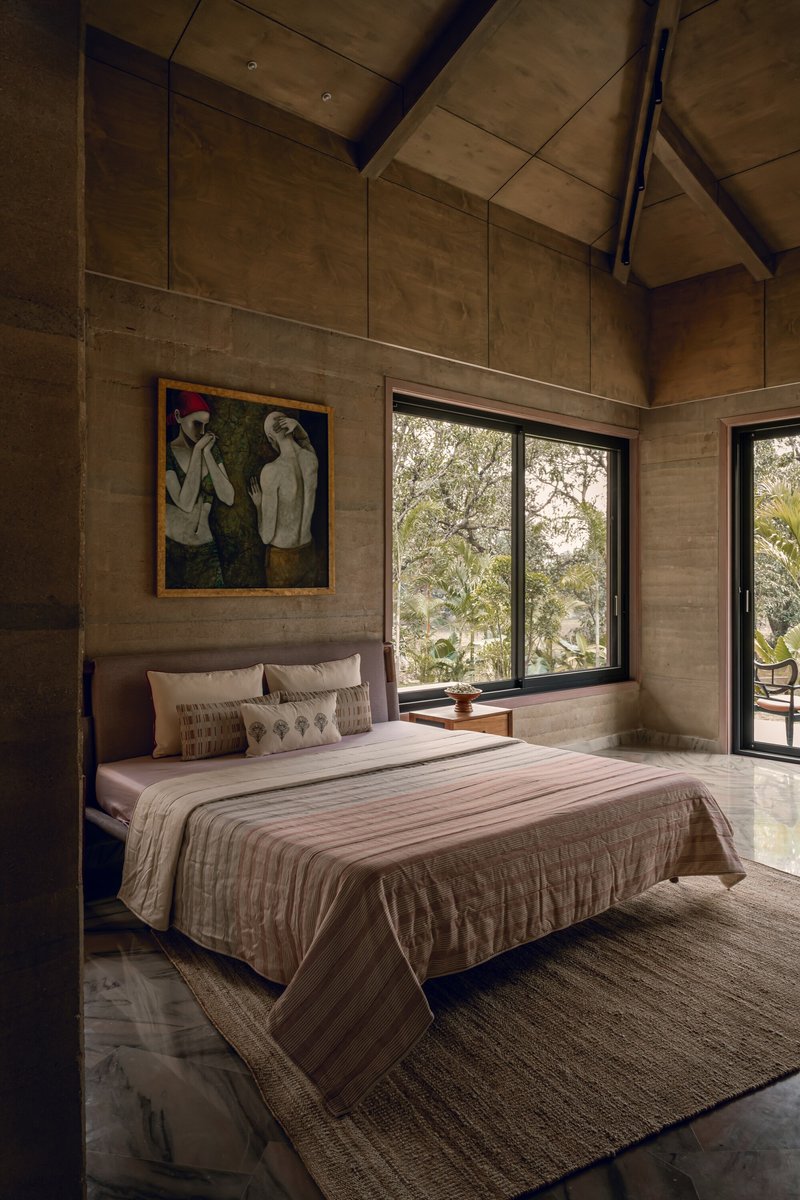
The double-height living room anchors the public side of the house with floor-to-ceiling glazing that frames the garden like a slow-moving painting. Exposed timber ceiling trusses overhead give the space a structural honesty that feels earned rather than styled. In the bedrooms, the same vocabulary appears in quieter form: vaulted plywood ceilings, rammed earth accent walls, and black-framed glazing that opens onto the tree canopy. Each bedroom is its own small pavilion, connected but distinct.
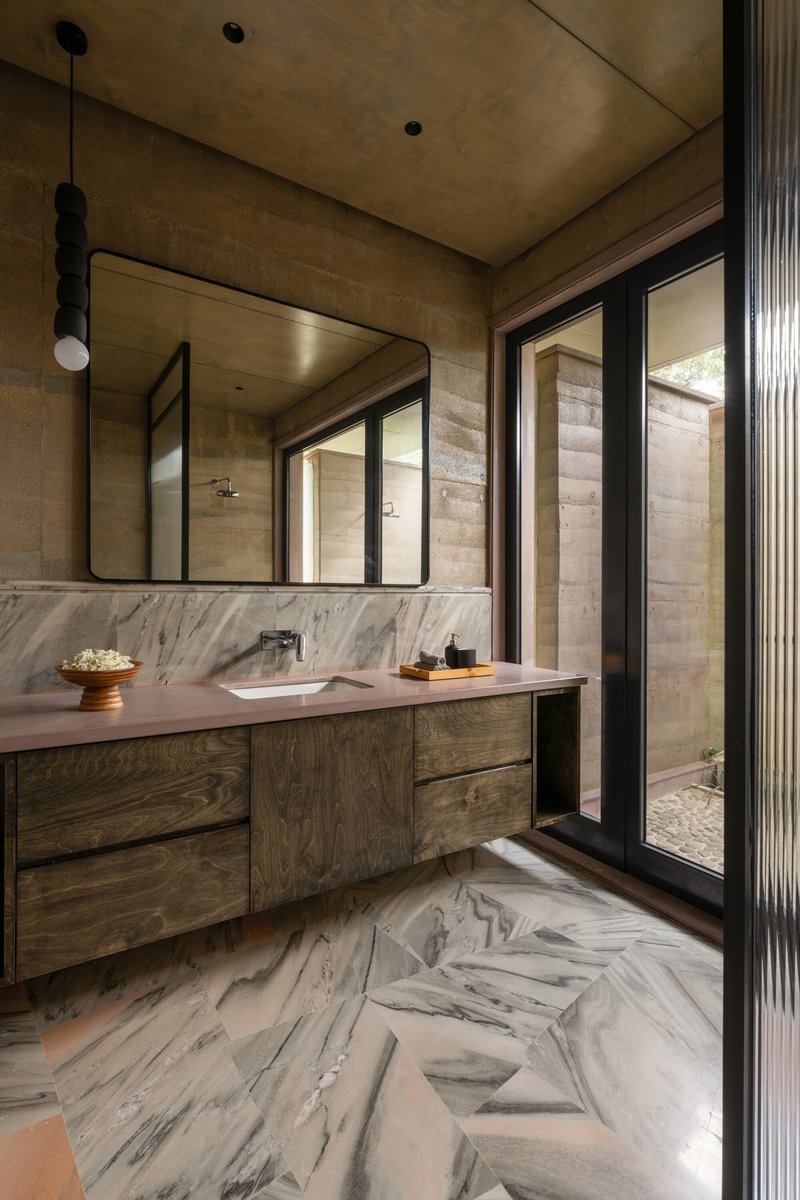
The bathroom, with its marble cladding, timber vanity, and glass door opening directly onto a courtyard, captures the house's ethos in miniature. Even the most private room maintains a visual connection to the landscape. Nothing is sealed off. The boundary between inside and outside is negotiated, not enforced.
Plans and Drawings
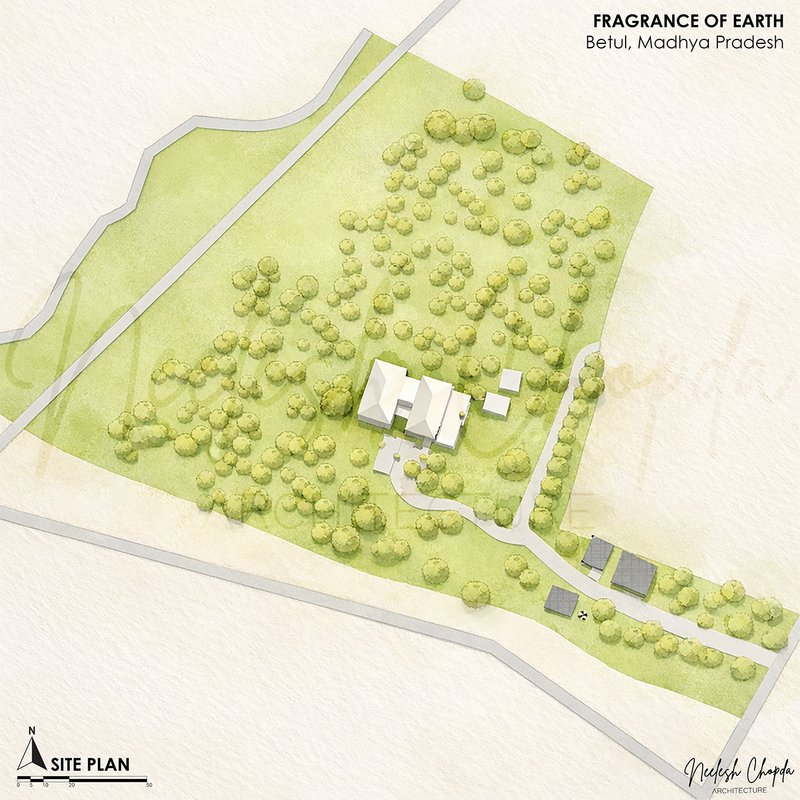
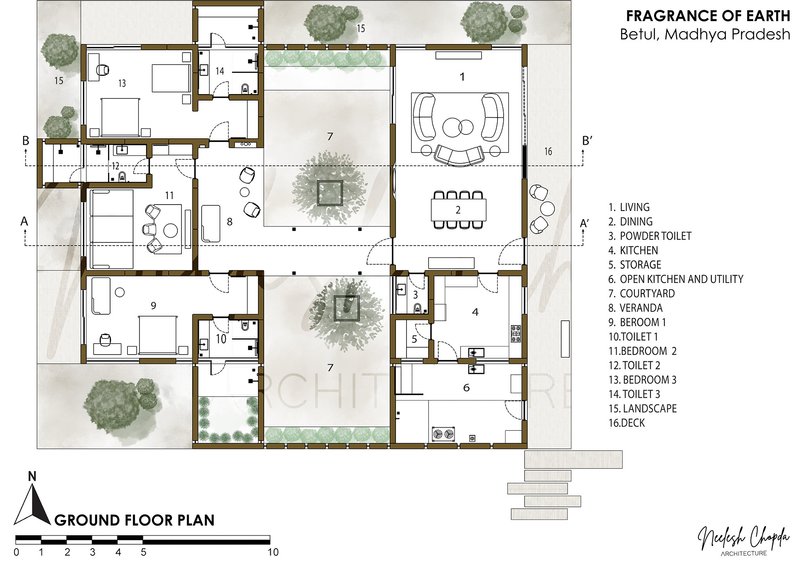
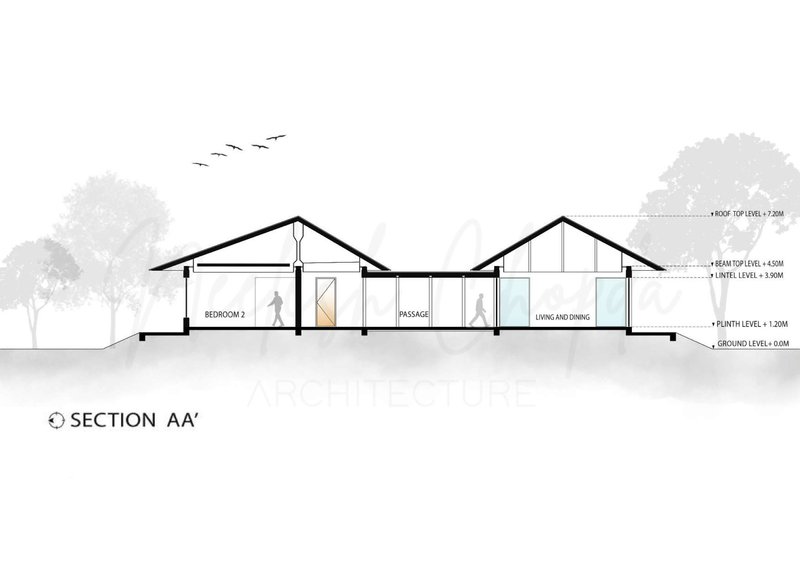
The site plan reveals the house's position within a dense web of fruit trees, accessible from winding roads but set well back from them. The ground floor plan confirms the dual-courtyard strategy: living and dining spaces organize around two planted voids, with bedrooms extending along the rear edge. The section drawing shows how the pitched roof volumes connect through a breezeway, creating a rhythm of high and low spaces that modulates the experience as you move through the house.
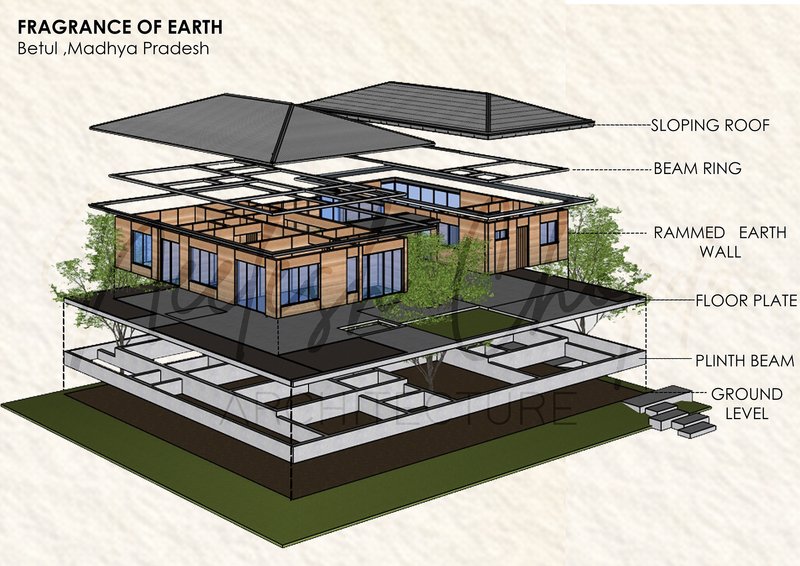
The exploded axonometric is particularly revealing. It breaks the building into legible layers: the sloping roof, the rammed earth walls, and the plinth beam that anchors the whole assembly to the ground. The drawing makes clear that the house is conceived as a series of stacked systems, each one performing structurally and climatically. There is no ornamental layer applied over a hidden frame. What you see is what holds the building up.
Why This Project Matters
Fragrance of Earth is not trying to prove that rammed earth can look contemporary. It already does. What the project demonstrates, more interestingly, is that material choices have social consequences. By investing in a construction technique that required local workers to learn new skills rooted in old knowledge, the house became a vehicle for craft revival. That several of those workers have since carried the technique to their own villages is an outcome no rendering could have predicted and no sustainability checklist would capture.
At a moment when Indian domestic architecture is saturated with imported finishes and air-conditioned interiors, this small bungalow in a mango orchard makes a case for specificity. The soil is local. The climate strategy is passive. The roof disappears. The walls teach. If the best architecture leaves behind more than it takes, Fragrance of Earth leaves behind a skill set that outlasts the building itself.
Fragrance of Earth House by Neelesh Chopda Architecture LLP, lead architect Darshan Jana. Located in Betul, India. 1,800 sq. ft. Completed in 2026. Photography by Noaidwin Sttudio.
About the Studio
Share Your Own Work on uni.xyz
If projects like this are the kind of work you want to make, uni.xyz is a place to publish your own, find collaborators, and enter design competitions.




Popular Articles
Popular articles from the community

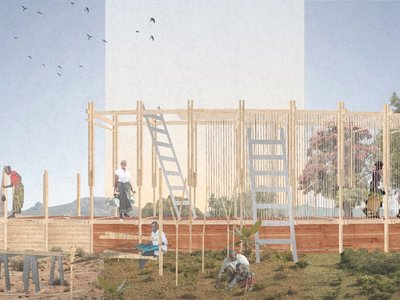
Healing Façade: Sustainable Architecture for Reforestation, Community, and Sacred Ecology in Ethiopia
Healing Façade reimagines sustainable architecture as a living wall that restores soil, catches water and renews Ethiopia's forest churches.
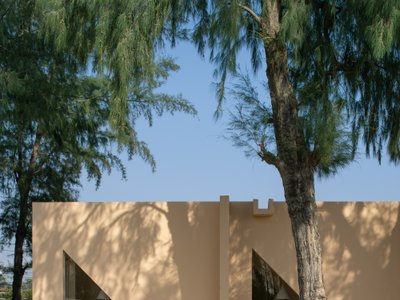
Pinto Builds a Faceless Pavilion Beneath Casuarina Trees on Thailand's Rayong Coast
SON Restaurant refuses a front door or a back wall, treating all four facades equally in a 260-square-meter brick and stucco grid.
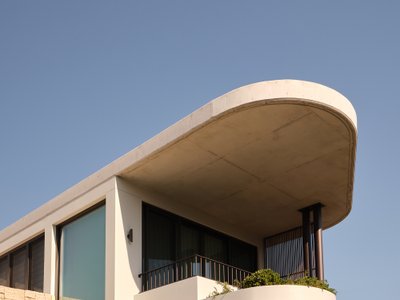
Stanton Architects Sculpts a Curving Family Home into Sydney's Inner West Fabric
Five Dock House uses cantilevers, curved concrete, and layered courtyards to carve out privacy on a tight suburban lot in Sydney.
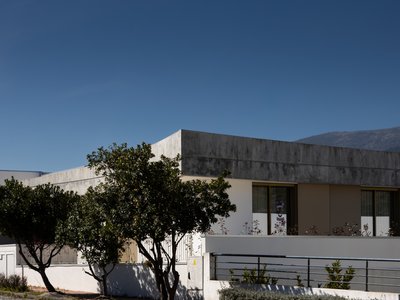
PLATAFORMArq Folds a Concrete Roof Over the Portuguese Mountains in House #474
A 220-square-meter residence in Teixoso, Portugal, wraps board-formed concrete into an angular canopy that frames the Serra da Estrela foothills.


Similar Reads
You might also enjoy these articles

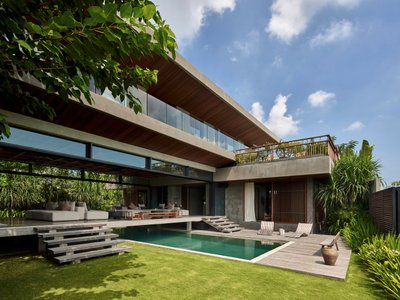
Freebird Residence by Alexis Dornier: A Tropical Modernist Sanctuary in Bali
Floating living pavilion above pool anchors H-shaped tropical villa, blending Japanese minimalism, sustainable strategies, lush landscape, and sculptural interiors.
127af Flips a Tiny Bagnolet Rowhouse Upside Down with a Handcrafted Roof Extension
A 55-square-meter terraced house on the edge of Paris gains a luminous upper living floor through lightweight timber and steel.
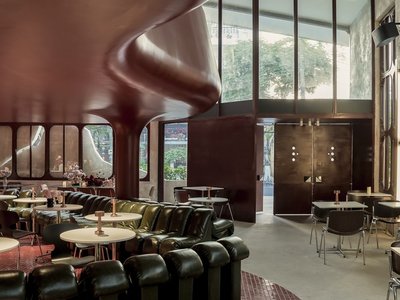
1.61 Design Workshop Wraps a 600-Square-Meter Café in Vietnam in Sculptural Burgundy Drama
Reden Café & Bistro pairs a helical staircase, mosaic floors, and deep red interiors to rethink Vietnamese hospitality space.

The Unbound Brain: A School Shaped by Cognitive Architecture
Cylindrical learning pods radiate like neurons from a central cortex, turning the floor plan into a spatial model of human thought.


Explore Installations Competitions
Discover active competitions in this discipline




The Global Benchmark for Architecture Dissertation Awards


Challenge to design a portable theatre


Challenge to design a portable music platform


Challenge to design an open learning module for the elderly
Comments (0)
Please login or sign up to add comments
No comments yet. Be the first to comment!