
Bangkok Project Studio Builds a Giant Lantern from Steel Tubes and Zinc for Thailand's Wonderfruit Festival
The Neramit Town-Hall Pavilion in Chonburi Province turns standard construction materials into a zero-waste, climate-responsive gathering space.


A town hall for a festival that runs around the clock needs to work harder than most buildings. It has to shelter hundreds of people from tropical rain and sun, adapt to talks, performances, and loose social gathering, and do all of this without permanent foundations or wasteful construction. For the Wonderfruit Festival at The Fields at Siam Country Club outside Pattaya, Bangkok Project Studio, led by Boonserm Premthada, answered with the Neramit Town-Hall Pavilion: a single 30 by 30 meter triangular roof made entirely from standard 100mm square steel tubes and corrugated zinc sheets. The structure is moveable, recyclable, and generated virtually zero construction waste.
What makes this project genuinely interesting is its philosophical premise. Premthada calls it non-architecture, a term he uses not as provocation but as a design framework. Non-architecture is simple to create, affordable, locally made, compatible with local climate and terrain, and above all, common. The gable roof is the most ordinary building form in rural Thailand. Rather than rejecting that ordinariness, Premthada amplifies it, proving that a pavilion assembled from catalog-standard steel can be both structurally ambitious and culturally legible.
One Roof That Does Everything
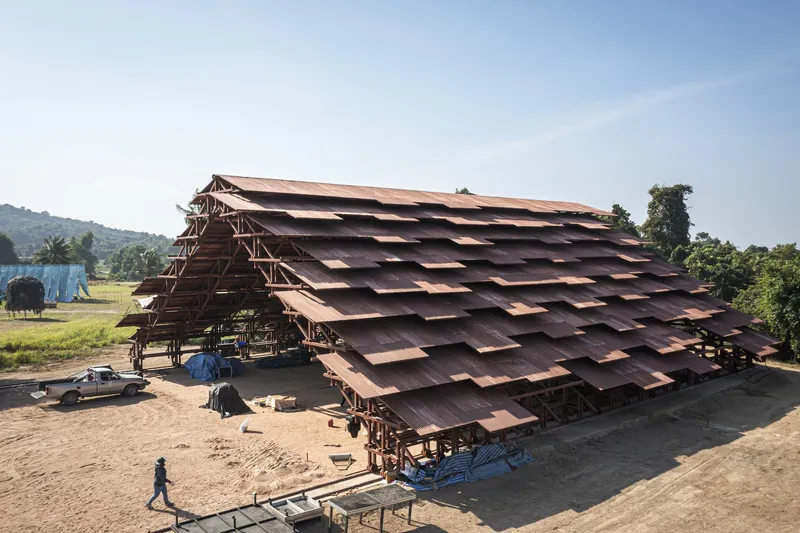
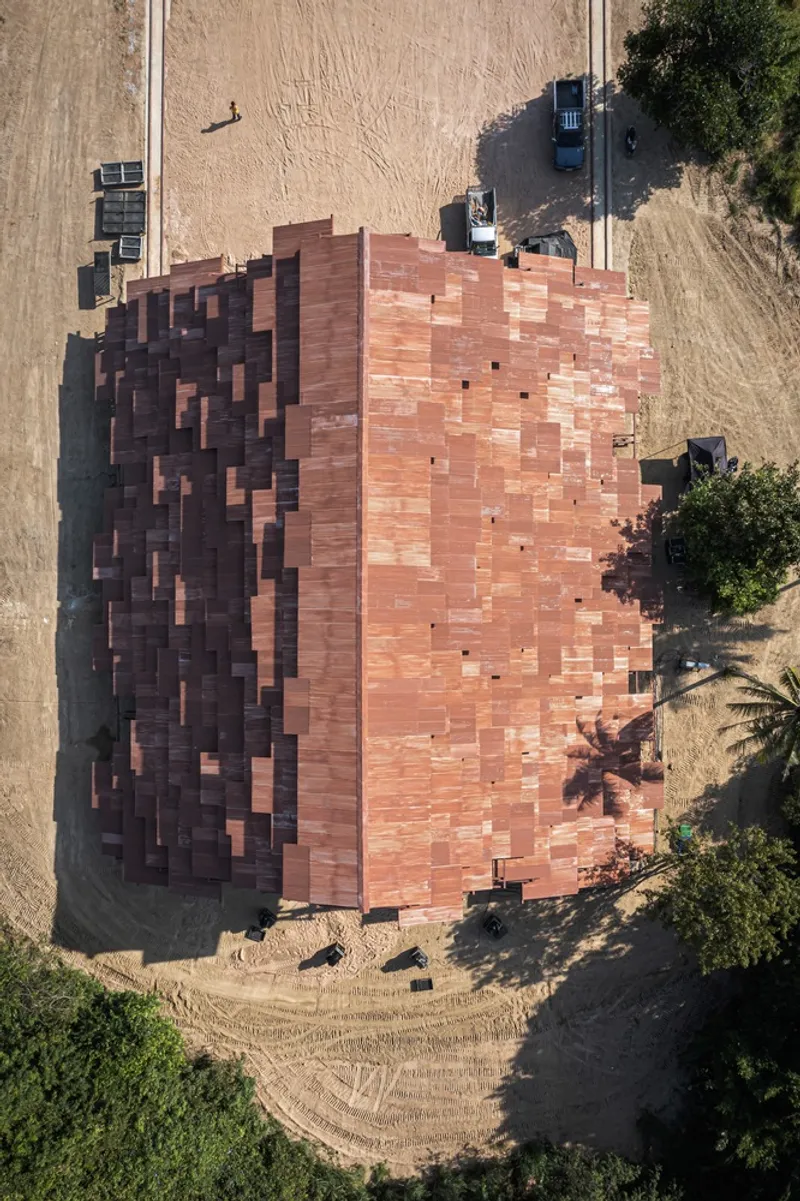
The Neramit Pavilion is, in the most literal sense, just a roof. There are no walls, no enclosed rooms, no partitions. The triangular canopy spans 900 square meters of open ground, and every functional distinction between inside and outside is determined by the roof's profile and the user's position beneath it. During the festival the space shifts from a performance venue to a lounge to a lecture hall, all without any reconfiguration of the structure itself. The roof is the architecture.
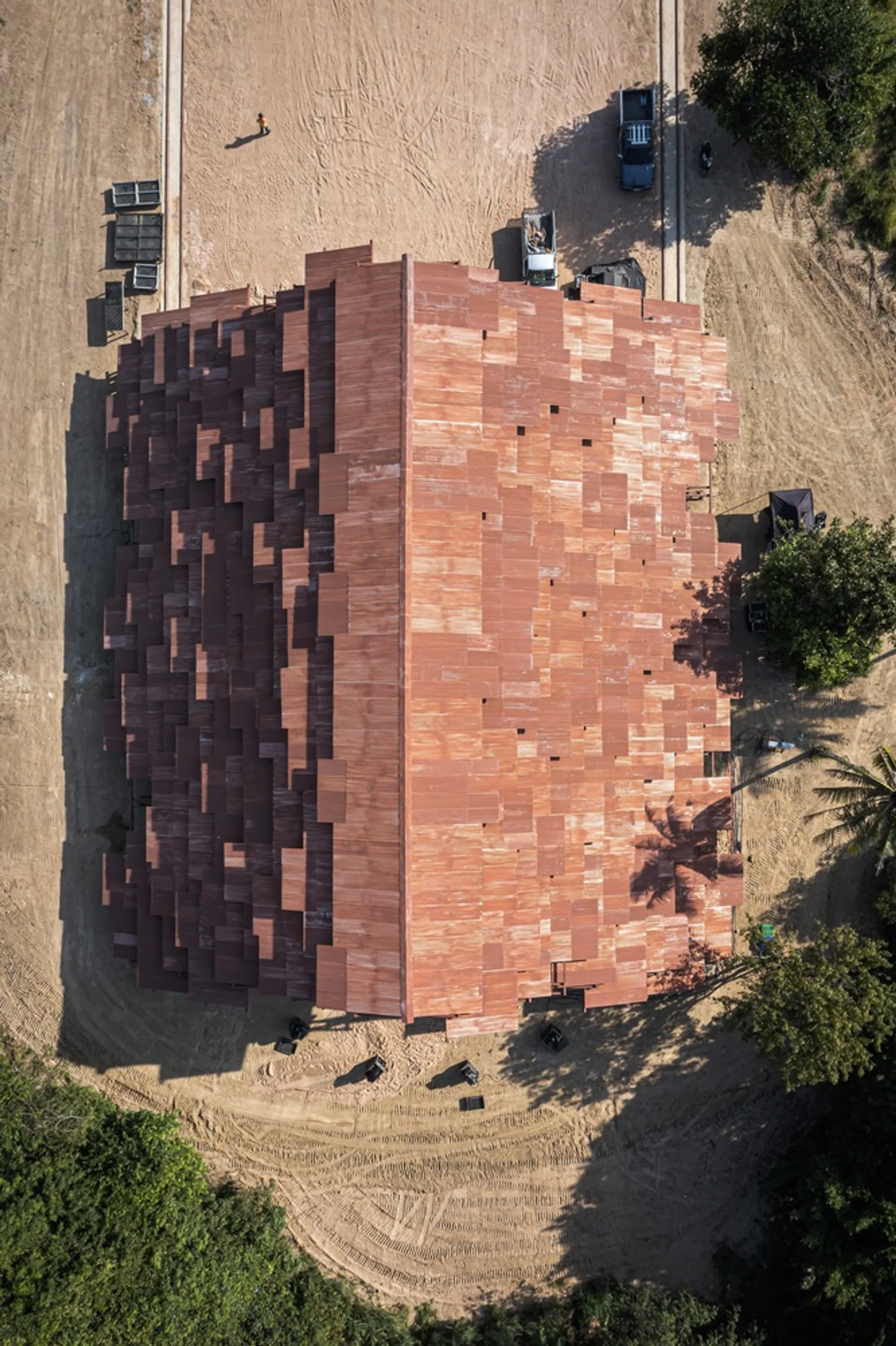
From above, the stepped geometry of the cladding is immediately legible. The corrugated zinc sheets are laid in overlapping tiers with deliberately uneven edges. Those protruding ends are not a cosmetic choice: they break up falling rainwater before it can splash sideways into the occupied zone below. The result is a canopy that functions simultaneously as roof, wall, and rain screen, collapsing three conventional building elements into one surface.
The Structural Logic of Standard Steel
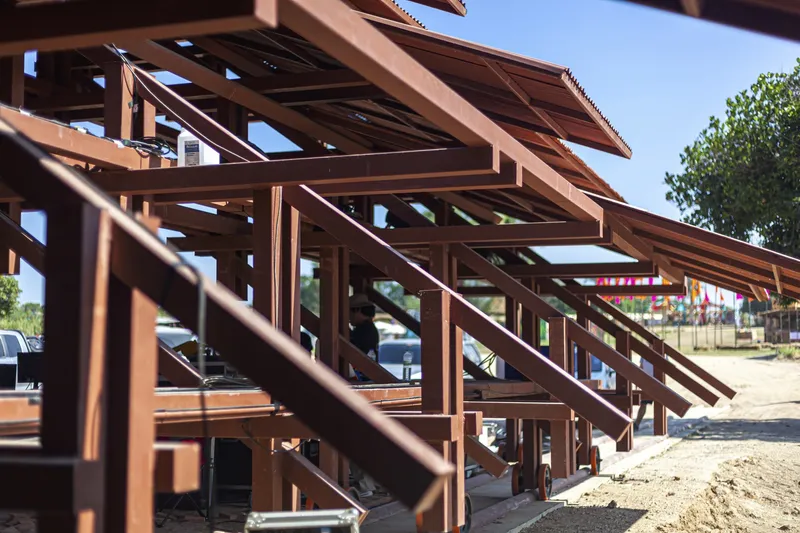
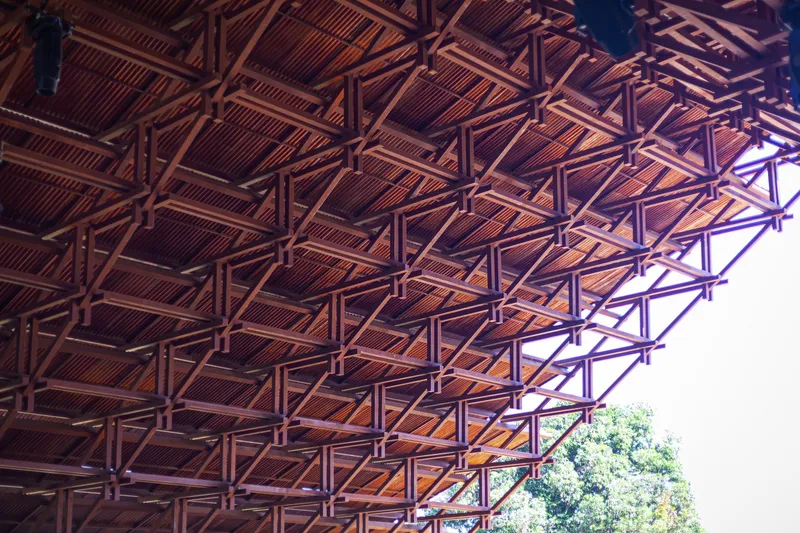
Every steel tube in this pavilion is 100mm x 100mm x 6 meters long, a dimension available off the shelf at any Thai steel supplier. Premthada designed the entire structural system around this single module, integrating full tube lengths wherever possible and repurposing any offcuts as connection details. The approach eliminates fabrication waste at the source, which is a far more effective sustainability strategy than recycling waste after the fact.
The triangular frame achieves its load-bearing capacity through optimized gravity paths and carefully detailed joints rather than material over-specification. Up close, the bracing patterns reveal an honest expression of force: diagonal members stiffen the cantilevered edges, while the primary trusses carry the zinc cladding in wide, shallow spans. There is no cladding or finish hiding the steel. What you see is what holds the roof up.
Climate as a Design Partner
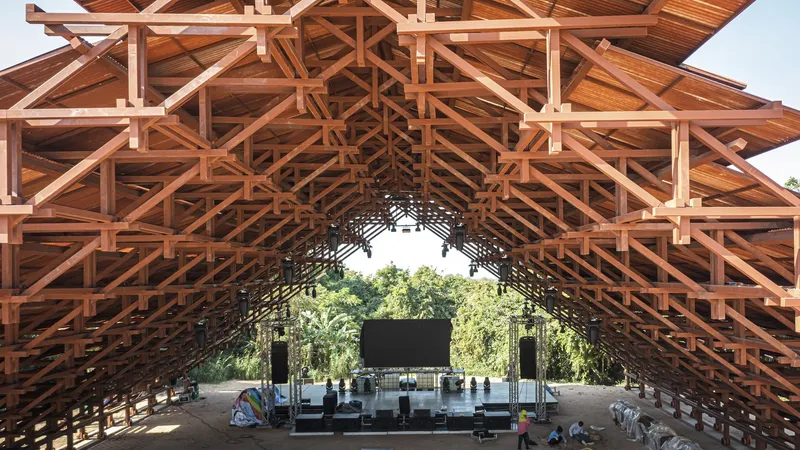
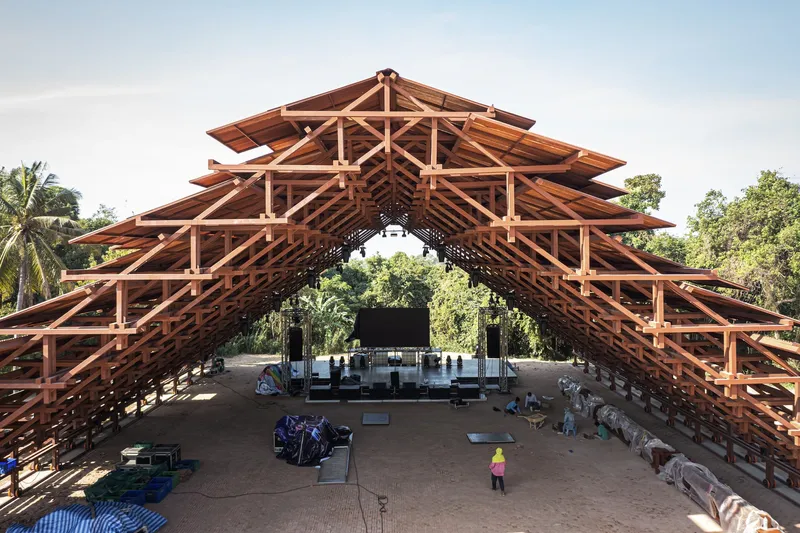
Under tropical conditions, ventilation matters more than insulation. The Neramit Pavilion's open sides allow cross breezes to pass freely through the gathering space, while the gaps between zinc panels create a permeable ceiling that draws warm air upward and out. During the day, sunlight slips through those gaps and lands on the ground in layered patterns, giving the interior a dappled quality that shifts with the sun's angle. The effect is closer to sitting under a forest canopy than under a conventional roof.
At night the relationship inverts. Interior light from the festival rises through the same gaps and turns the entire pavilion into a glowing lantern visible across the flat landscape. It is one of those rare moments where a passive climate strategy produces an equally powerful visual identity, day and night, without any additional design effort.
Texture and Materiality at the Edge
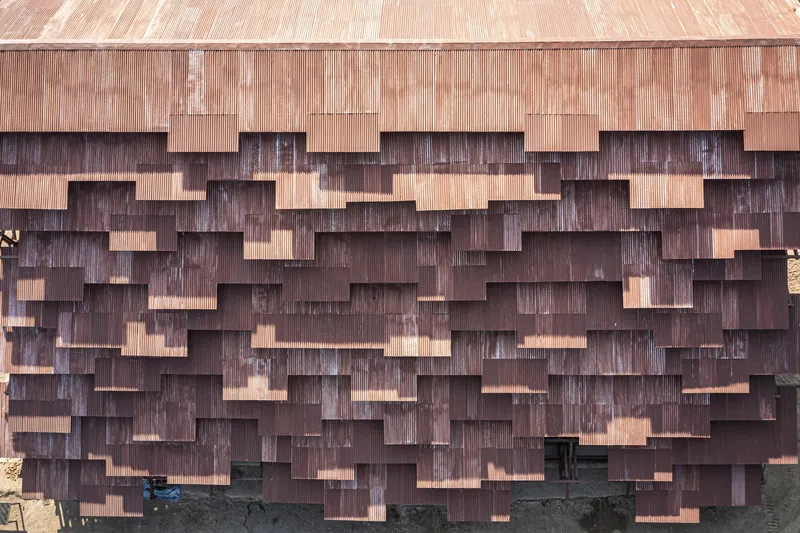
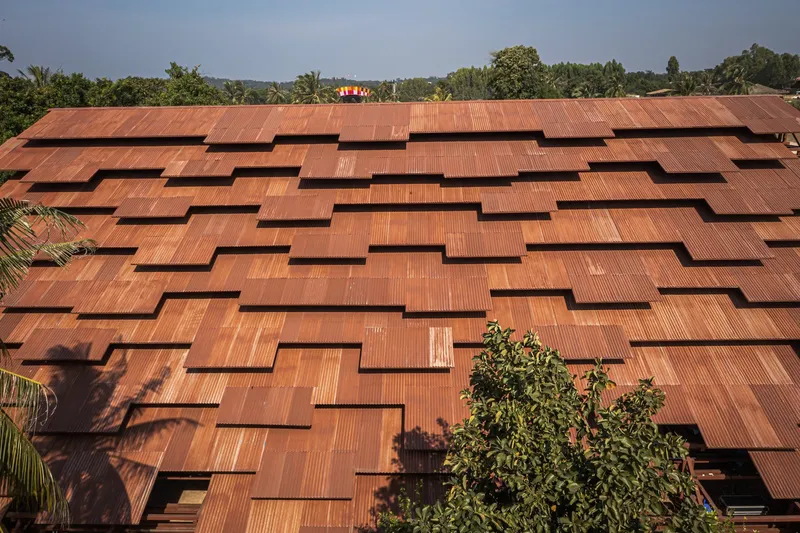
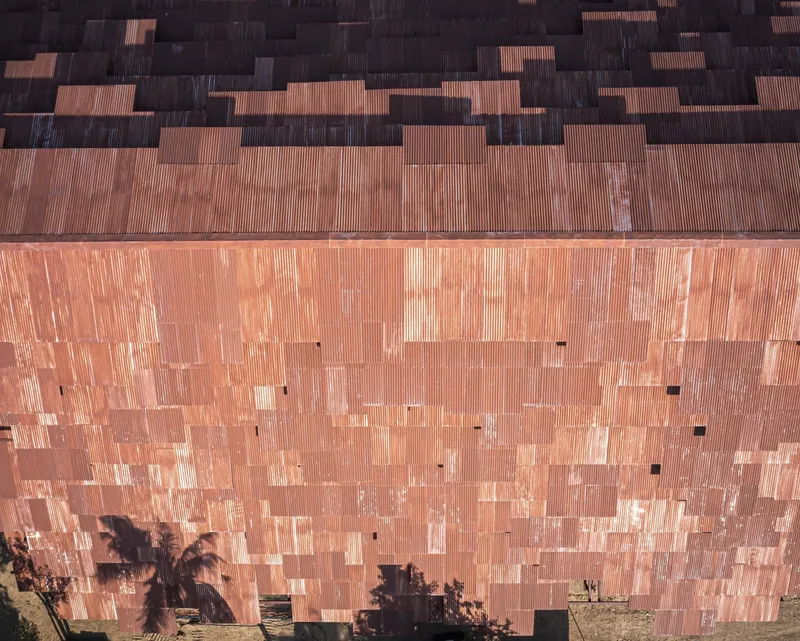
The stepped cladding panels deserve attention beyond their rain-management role. Seen from the side, the offset depths create a textured facade that catches shadow differently at every hour. The zinc weathers quickly in humid Thai air, developing a patina that blurs the boundary between new construction and aged material. This is a deliberate alignment with the non-architecture thesis: the building should look like it belongs, not like it just arrived.
Alongside the metallic surface, earthen and brick textures appear at the ground plane, grounding the pavilion in the materiality of its rural surroundings. The contrast between the warm, irregular surface of terracotta and the industrial regularity of zinc and steel is productive rather than jarring. It underscores the idea that non-architecture does not reject modern materials; it simply refuses to let them dominate.
A Gathering Space Without Walls
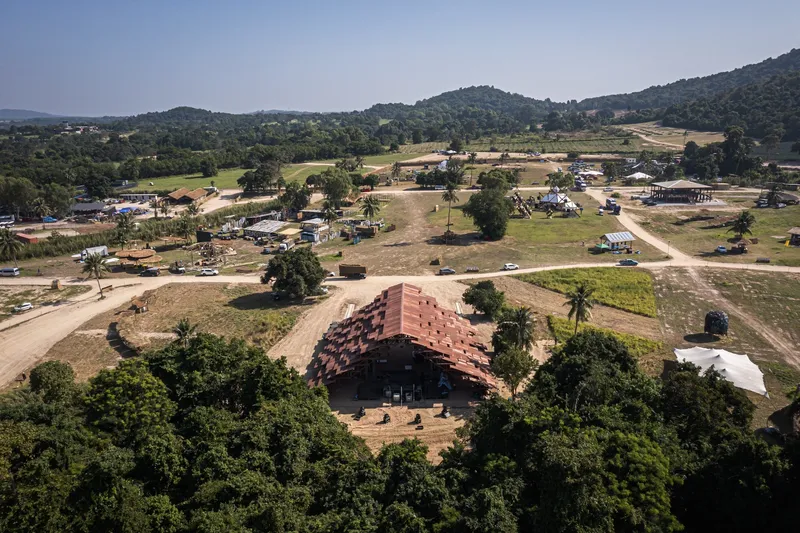
Seen from above within its landscape of palms and open fields, the pavilion reads as a modest intervention: a single sheltering gesture set down on flat ground. There is no grand entrance, no threshold ceremony, no hierarchy of rooms. People drift in and out as they please, which is exactly the point. Wonderfruit operates 24 hours a day during its run, and the town hall needs to accommodate that rhythm without the friction of doors, corridors, or programmed zones.
The moveable roof structure also means the pavilion is not permanently bound to this site. It can be dismantled, transported, and reassembled, a lifecycle that extends its sustainability argument well beyond material choice. Steel is fully recyclable, zinc is durable and lightweight, and the modular tube dimensions make replacement straightforward. Non-architecture, in this reading, is architecture that plans for its own afterlife.
Why This Project Matters
Sustainability in architecture is too often a checklist of certifications and high-tech systems layered onto conventional designs. The Neramit Town-Hall Pavilion takes a fundamentally different position. It starts with the cheapest, most common materials available, designs the geometry to eliminate waste from those materials, and lets the climate do the work that mechanical systems usually handle. There is no green technology here, just intelligent design decisions that add up to a genuinely low-impact structure.
Boonserm Premthada's concept of non-architecture is not anti-design. It is a rigorous argument that the most sustainable building is often the most ordinary one, executed with precision. By centering the project on a rural gable roof and industrial steel, Bangkok Project Studio demonstrates that spectacle and humility are not opposites. The Neramit Pavilion is both a glowing festival landmark and a quiet manifesto for doing more with less.
Neramit Town-Hall Pavilion, designed by Bangkok Project Studio (Boonserm Premthada). Located in Tambon Bang Lamung, Chonburi Province, Thailand, at The Fields at Siam Country Club Pattaya. 900 m². Completed 2022. Photography by Spaceshift Studio.
About the Studio
Share Your Own Work on uni.xyz
If projects like this are the kind of work you want to make, uni.xyz is a place to publish your own, find collaborators, and enter design competitions.



Popular Articles
Popular articles from the community


Riyadh For All: Intergenerational Urban Design for Active Aging in Rabat
Riyadh For All reimagines urban design in Rabat with intergenerational co-living, adaptive courtyards, and Moroccan cultural exchange today.

The Musturak Paradise: Senior Living Architecture for a Connected Future in Temara, Morocco
The Musturak Paradise reimagines senior living architecture in Temara via private homes, social spaces, culture, community, and shared care.

Lunar Spiral: Space Architecture Shaped by the Mathematics of the Universe
Lunar Spiral reimagines space architecture through Fibonacci geometry, lunar regolith, levitating habitats, and self-sustaining Moon living.

Co-life: Sustainable Architecture for Age-Friendly Community Living
Co-life reimagines sustainable architecture for seniors through courtyards, rammed earth, shared gardens, and spaces designed for belonging.


Similar Reads
You might also enjoy these articles


Hodi-Mandai Geram
Project Function: Preservation and revitalization of the Intangible heritage and socio-spatial identity of the Hodi by Housing, Cultural Memory Center, Sacred Grove, landscape, local tourism economy


Olio Towers: A Mid-Rise for Performers That Fuses Housing, Rehearsal, and Stage
Located blocks from Houston's Theater District, this modular tower stacks living units around a central performance atrium.

Oasis: Modular Green Housing Carved into Dhaka's Urban Fabric
A shortlisted Plugin Housing entry reclaims unauthorized settlements in Dhaka with stepped concrete volumes, green roofs, and ventilation-driven design.

Black Hole: A Floating Megastructure for the Post-Physical Era
Emiliano Mazzarotto envisions a spherical, self-scaling arena where e-sports, digital hotels, and holographic stadiums replace traditional public space.


Explore Architecture Competitions
Discover active competitions in this discipline


Challenge to design a portable theatre

Challenge to design a portable music platform

Challenge to design an open learning module for the elderly


Challenge to reimagine the Iron Throne
Comments (0)
Please login or sign up to add comments
No comments yet. Be the first to comment!