

New Age Stadium: A Sunken Sports Arena with a Transformer Floor and Parametric Canopy
A shortlisted Staydium 2020 entry dissolves the monumental stadium into landscape, stacking sports surfaces on hydraulic platforms beneath a unifying roof.


What if a stadium didn't rise from the earth like an iron giant but sank into it, replacing concrete monumentality with a palm-lined public ground sheltered under a single parametric canopy? The New Age Stadium abandons the fortress logic that has defined sports architecture for over a century. Instead of isolating 90 minutes of spectacle inside a monofunction shell, the proposal treats the entire venue as a daily destination: part plaza, part amusement park, part cultural hub, with a hydraulic transformer floor that swaps between football, basketball, tennis, and volleyball at the push of a button.
Designed by Samin Ghasemzadeh and Armin Farshad, the project was shortlisted in the Staydium 2020 competition, which challenged entrants to rethink what a stadium could become when it is no longer defined by a single sport or a single event day. Their response strips away visual and symbolic weight, replacing mass with porosity and monumentality with human-scale spatial experience.
A Canopy That Descends, Not a Monument That Looms
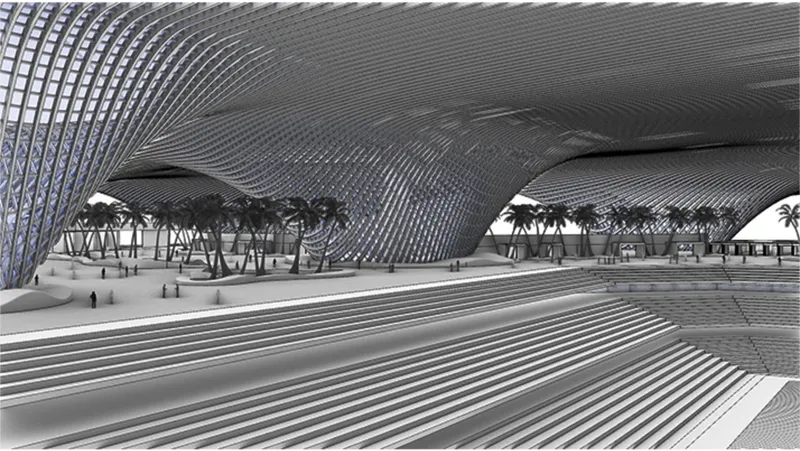

The interior views reveal the design's central gesture: a ribbed, undulating roof canopy that hovers over a sunken public ground rather than enclosing it. Structural ribs fan outward in rhythmic intervals, creating a latticed vault whose diamond-patterned openings filter daylight across a striped plaza floor dotted with clusters of palm trees. Figures walk, gather, and converse beneath the canopy at a scale that feels closer to a covered park than a conventional stadium concourse. The transparency and curvature of the roof serve a dual role: they allow passive ventilation and solar orientation to work as environmental strategies while generating an emotive sense of shared enclosure.
By pushing the programme below grade and letting the roof become the building's primary readable element, Ghasemzadeh and Farshad invert the typical stadium section. The spectator is no longer climbing stairs to reach a bowl perched above a parking plinth. Instead, the ground plane is continuous, the canopy is welcoming, and the athletic functions are revealed only once you descend into them.
Parametric Roof as Landscape, Not Object

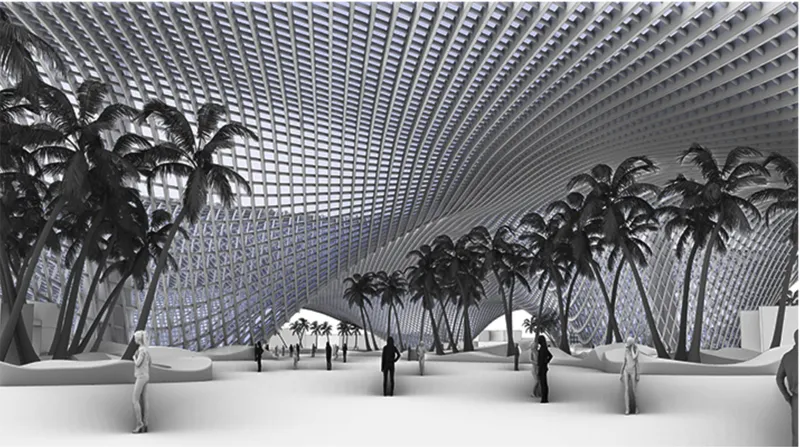
Pulled back to a longer view, the roof reads less as a building and more as a constructed topography. Its undulating profile rises and dips across the site, spanning over sunken plazas and garden zones without ever asserting a singular façade. Palm tree clusters punch through openings in the canopy, blurring the boundary between architecture and landscape. The parametric geometry is not decorative; it organizes structural loads along curved paths while generating varied ceiling heights that differentiate zones of activity below.
The designers describe the roof as a visual metaphor for togetherness, its highs and lows representing the range of human experience converging under one shared identity. That symbolism lands more convincingly because the structure actually performs: its curvature channels airflow, its perforations manage solar gain, and its span eliminates interior columns that would otherwise interrupt sightlines to the playing surfaces below.
Stacked Surfaces: The Hydraulic Transformer Floor
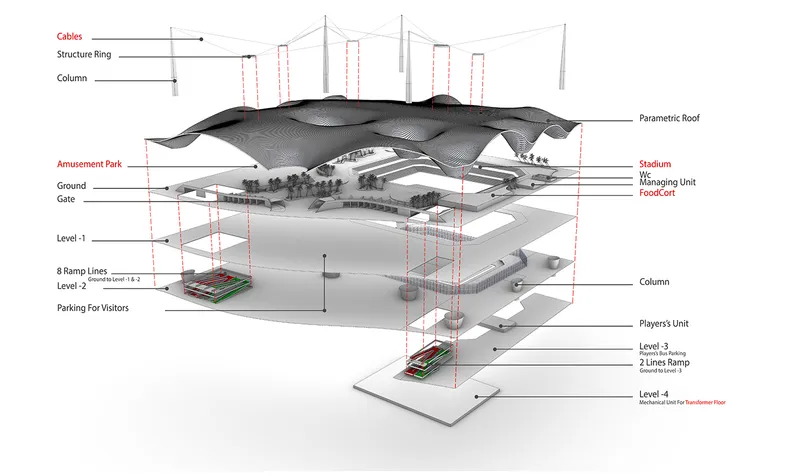
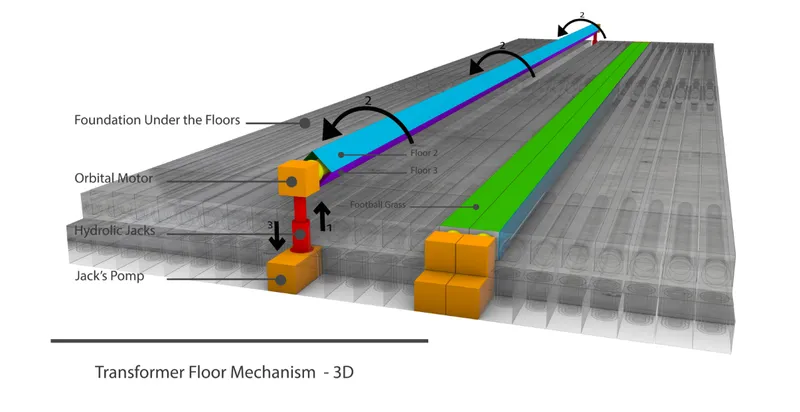
The axonometric drawing peels the stadium apart layer by layer, from parking levels at the base through spectator tiers up to the parametric roof. What sits between those layers is the project's most technically ambitious idea: a transformer floor system composed of stacked playing surfaces, each tailored for a different sport. Hydraulic jacks and orbital motors raise, lower, and interchange these platforms so the venue can shift from a football pitch to a basketball court to a tennis or volleyball configuration without manual intervention. The three-dimensional mechanism diagram makes the engineering legible, showing how each surface nests within the next when not in use.
The economic argument is straightforward. A stadium that hosts four sports instead of one justifies its footprint across far more days of the year. But the spatial argument is just as compelling: by eliminating the need for separate venues, the transformer floor reduces the total built area a city must dedicate to sports infrastructure, freeing land for the public programmes (amusement parks, food courts, exhibitions, nature zones) that the designers wrap around the stadium's perimeter. Multiple ramps and entrances distribute circulation evenly, ensuring that the venue functions as a continuous public environment rather than a choke-point on event days.
Why This Project Matters
Stadium design has been stuck in a feedback loop of escalating scale: bigger roofs, more seats, heavier structures, all justified by a handful of marquee events per year. Ghasemzadeh and Farshad's proposal breaks that loop by asking what a stadium owes to a city on the other 350 days. Their answer, a sunken multi-sport ground beneath a porous public canopy, redistributes value from spectacle to everyday life. The transformer floor is not gimmickry; it is a direct response to the waste embedded in single-use sports infrastructure.
As a shortlisted Staydium 2020 entry, the New Age Stadium sits at the conceptual end of the feasibility spectrum, but the questions it raises are immediately practical. How much urban land do we dedicate to buildings that are empty most of the time? Can mechanical adaptability replace architectural redundancy? And can a stadium be generous enough to function as a park, a market, and a cultural venue without losing its identity as a place of competition? The project suggests that the answer to all three is yes, provided architecture is willing to trade monumental presence for spatial intelligence.
View the Full Project
About the Designers
Designers: Samin Ghasemzadeh, Armin Farshad
Enter a Design Competition on uni.xyz
uni.xyz runs architecture and design competitions year-round that reward proposals with spatial conviction and real site intelligence.
Project credits: New Age Stadium" concept by Samin Ghasemzadeh, Armin Farshad Staydium 2020 (uni.xyz).




Popular Articles
Popular articles from the community


The Ocean Hive: Sustainable Architecture for a Self-Sufficient Civilization at Sea
The Ocean Hive imagines sustainable architecture at sea, where modular habitats, algae, wave power and ocean waste sustain a growing colony.

Co-Life: Senior Housing Design That Reconnects Older Adults With the City
Co-Life reimagines senior housing design through healing gardens, shared streets, workshops, and a sustainable community across generations.

Play: Fragments of Their World
Familiar architecture becomes modular playground design, creating safe spaces where displaced children can learn, connect, imagine and play.

Lunar Spiral: Space Architecture Shaped by the Mathematics of the Universe
Lunar Spiral reimagines space architecture through Fibonacci geometry, lunar regolith, levitating habitats, and self-sustaining Moon living.


Similar Reads
You might also enjoy these articles

Day and Night Park: A Time-Based Urban Newsstand in Beijing
A temporary urban newsstand in Beijing blending travel, light, and reading through poetic colors, compact form, and community-focused design.

Modernist Patio Renovation in El Masnou, Barcelona by Oliver Segura Arquitectura + Cebrià Arquitectura
Modernist patio renovation blending tradition and innovation with a movable pool, leveled floors, and Catalan materials in El Masnou.

Alto Residencial Coop: Cooperative Housing Development in Santiago de Compostela by Carbajo Barrios Arquitectos
A linear cooperative housing complex blending white volumes and perforated metal façades, enhancing community living, natural light, privacy, and urban integration.
Vil Genis School by BPA ARCHITECTURE – Massy, France
Vil Genis School in Massy, France, features sustainable design, south-facing classrooms, community integration, accessible spaces, and modern educational architecture.


Explore Sports Architecture Competitions
Discover active competitions in this discipline



Challenge to design a barrier free sports center


Challenge to design an outdoor ice-rink and park
Comments (0)
Please login or sign up to add comments
No comments yet. Be the first to comment!