
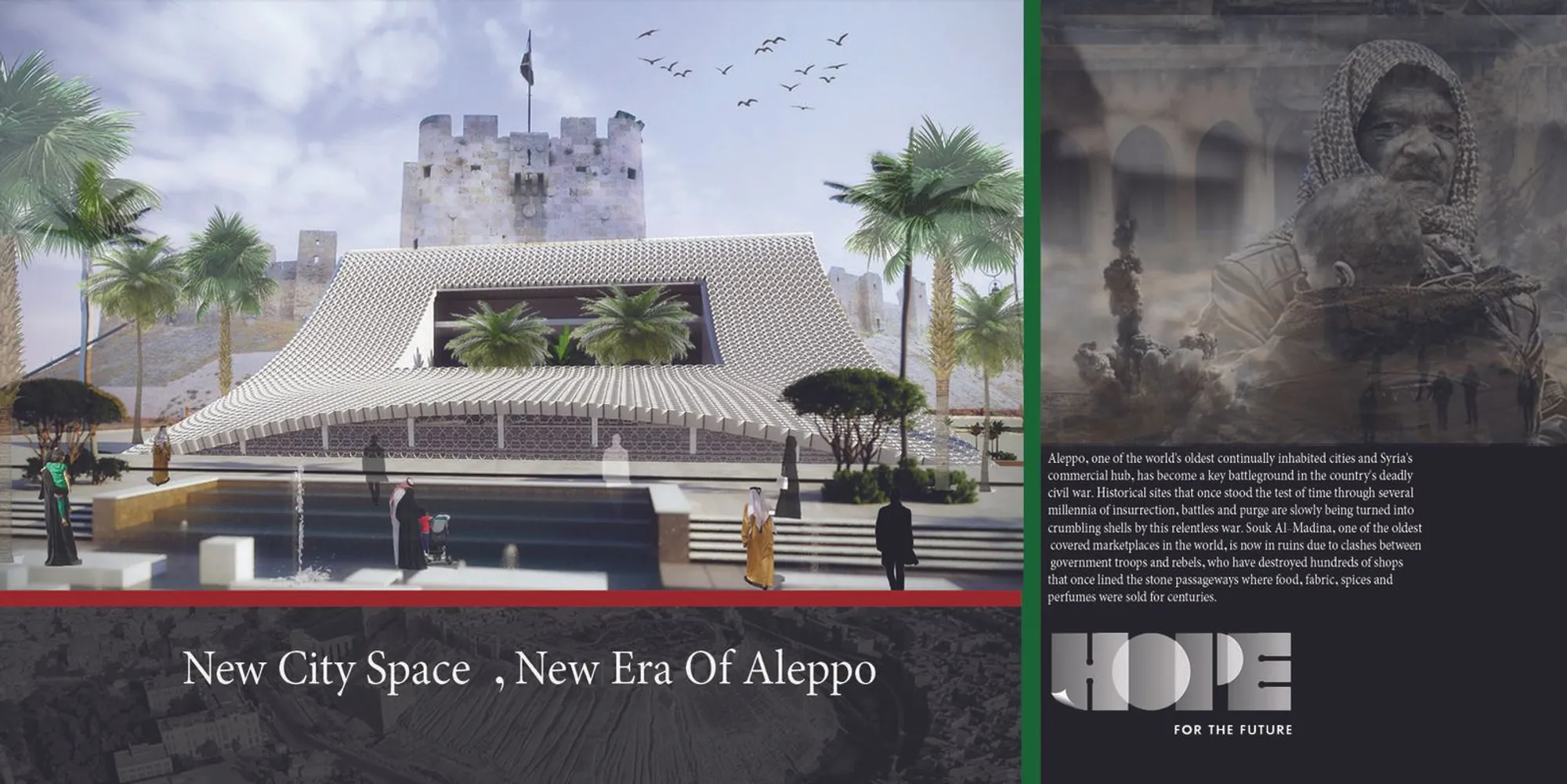
New City Space: Rebuilding Aleppo Through Architecture That Remembers
A parametric courtyard structure in Aleppo reinterprets Islamic geometry and civic gathering to heal a city scarred by conflict.


Aleppo was once called the twin of Vienna, a city so rich in trade, culture, and architectural density that its souks and courtyards defined an entire civilization's spatial imagination. Years of war reduced that legacy to rubble, fragmenting not just buildings but the identity of the people who lived among them. When a city is ruined, its inhabitants are wounded with it. Reconstruction, then, cannot be a matter of pouring concrete back into craters. It requires architecture that acknowledges scars while framing a view toward what comes next.
"New City Space, New Era of Aleppo" is a proposal by Ehsan Nazarzadeh, Faezeh Soleimani, Masoud Nimehfrosh, and Mahsa Yousefpour that positions a contemporary civic landmark at the heart of a wounded city. Rather than erasing the past or imitating it wholesale, the design creates a contemplative threshold: a space where memory, culture, and aspiration intersect inside a building that is at once monument, marketplace, and sanctuary.
A Perforated Shell That Filters Loss Into Light
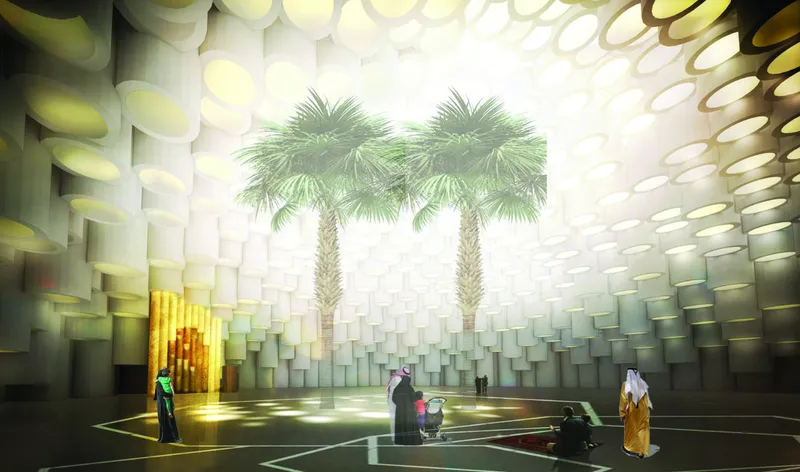
The building's defining gesture is its parametric-inspired envelope, a rhythmic perforated skin drawn from Islamic geometric traditions but projected into a distinctly contemporary register. Seen from the interior courtyard, the effect is immediate and visceral: sunlight passes through the patterned ceiling and walls, casting dappled, shifting patterns across pixelated stone surfaces and the trunks of palm trees rooted in the atrium floor. The interplay of shadow and illumination is not decorative. It is a direct spatial metaphor for a city navigating the space between loss and renewal, darkness and clarity.
Cylindrical light wells punctuate the interior volume, casting soft columns of natural light that lend the courtyard a quality somewhere between mosque and garden. Palm trees anchor the space as living elements, transforming the atrium into a sanctuary that contrasts sharply with the damaged urban fabric outside. The designers describe an elevated central opening as a "window to tomorrow," framing the sky above and inviting visitors to look upward and ahead. It is a simple gesture, but one that turns the roof into a piece of civic optimism.
A Cubic Volume Holding a Garden at Its Core
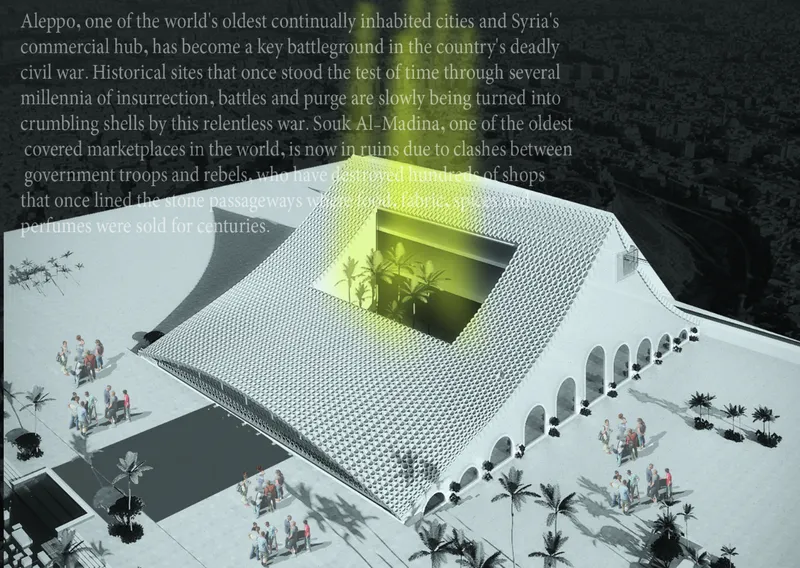
From above, the project reads as a solid cubic mass with its heart carved out. The aerial view reveals the planted courtyard at the center, ringed by the perforated shell that gives the building its identity. The massing strategy is deliberate: a compact, recognizable volume that can hold its own as an urban landmark without resorting to spectacle. The perforated skin wraps the entire structure, unifying facade, roof, and interior envelope into a single continuous surface. Inside that enclosure, the palm-filled courtyard operates as a communal living room for the city, open to the sky and bathed in filtered light.
The design's urban ambition extends beyond the building's footprint. Terraces, open plazas, shaded walkways, and landscaped zones surround the structure, inviting pedestrian movement and daily public use. The designers explicitly echo the historic vitality of Souk Al-Madina by integrating markets, gathering areas, and flexible circulation into the surrounding ground plane. The building is not a sealed monument. It is a connective platform intended to reweave the social fabric that conflict tore apart.
An Arcade of Arches Rooted in Regional Memory
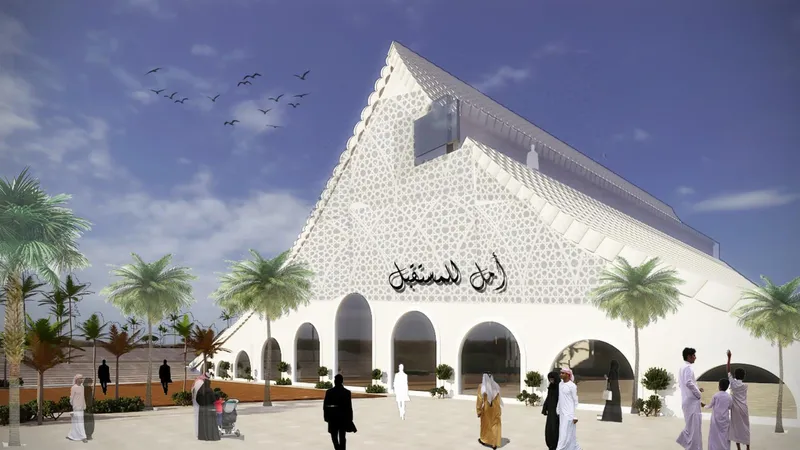
At ground level, the building meets the street through an arched arcade shaded by palm trees, a typology deeply embedded in Middle Eastern and North African urban traditions. The white perforated facade rises above, its pointed roofline adding a vertical accent that nods to both Islamic architecture and the city's historic skyline of minarets and citadel walls. The choice of a light, white surface is significant: it signals newness and hope without pretending the destruction did not happen. The porosity of the skin, visible even at this scale, ensures the boundary between interior and exterior remains porous, a threshold rather than a barrier.
The arcade invites people in before they have consciously decided to enter, blurring the line between public sidewalk and civic interior. Shaded walkways and the cool shadows cast by the perforated facade create microclimatic comfort in a hot, arid context, making the building's edges habitable throughout the day. The designers understand that restoring social life in a post-conflict city requires not just grand gestures but generous, welcoming thresholds where daily encounters can resume.
Why This Project Matters
Post-conflict reconstruction too often defaults to one of two modes: nostalgic replication of what was lost, or tabula rasa modernization that ignores everything that came before. This proposal refuses both. By grounding a contemporary parametric language in the geometric and spatial traditions of Islamic architecture, the designers create a building that is legibly of Aleppo without pretending the last decade did not happen. The perforated courtyard typology, the souk-like public edges, the palm-anchored atrium: each element draws on local memory while asserting that the future is already under construction.
What makes the work by Nazarzadeh, Soleimani, Nimehfrosh, and Yousefpour genuinely resonant is its insistence that architecture can address emotional reconstruction, not just physical. The central hall bathed in warm light, the sky framed through the roof opening, the dappled shadows moving across stone walls throughout the day: these are spatial experiences designed to foster introspection, unity, and a renewed sense of belonging. In a city where identity itself was fragmented by war, a building that offers both civic gathering and personal contemplation is not a luxury. It is a necessity.
View the Full Project
About the Designers
Designers: Ehsan Nazarzadeh, Faezeh Soleimani, Masoud Nimehfrosh, Mahsa Yousefpour
Enter a Design Competition on uni.xyz
uni.xyz runs architecture and design competitions year-round that reward proposals with spatial conviction and real site intelligence.
Project credits: New City Space, New Era of Aleppo by Ehsan Nazarzadeh, Faezeh Soleimani, Masoud Nimehfrosh, Mahsa Yousefpour.




Popular Articles
Popular articles from the community


Co-life: Sustainable Architecture for Age-Friendly Community Living
Co-life reimagines sustainable architecture for seniors through courtyards, rammed earth, shared gardens, and spaces designed for belonging.

Conexión: Biophilic Design Reimagines High-Rise Living in Hong Kong
Conexión reimagines high-rise living in Hong Kong through biophilic design, green facades, shared spaces, daylight, water and nature within.

The Ocean Hive: Sustainable Architecture for a Self-Sufficient Civilization at Sea
The Ocean Hive imagines sustainable architecture at sea, where modular habitats, algae, wave power and ocean waste sustain a growing colony.

Play: Fragments of Their World
Familiar architecture becomes modular playground design, creating safe spaces where displaced children can learn, connect, imagine and play.

Similar Reads
You might also enjoy these articles

Lunar Spiral: Space Architecture Shaped by the Mathematics of the Universe
Lunar Spiral reimagines space architecture through Fibonacci geometry, lunar regolith, levitating habitats, and self-sustaining Moon living.
The Main Dream: Modular Architecture for Play, Learning, and Community
A modular playground turns recycled plastic into adaptable spaces where refugee children can play, build, learn, and reconnect.
Play: Fragments of Their World
Familiar architecture becomes modular playground design, creating safe spaces where displaced children can learn, connect, imagine and play.

Wadi Rum Observatory: Desert Architecture Designed for the Night Sky
Wadi Rum Observatory turns desert architecture into a quiet instrument for astronomy, hiding research spaces under Jordan's starlit terrain.

Comments (0)
Please login or sign up to add comments
No comments yet. Be the first to comment!