
The MAAK Builds a Crèche in Cape Town's Rest Valley That Doubles as Civic Architecture
A community preschool in an informal settlement near Cape Town uses brick, breeze block, and green steel to anchor a neighborhood.

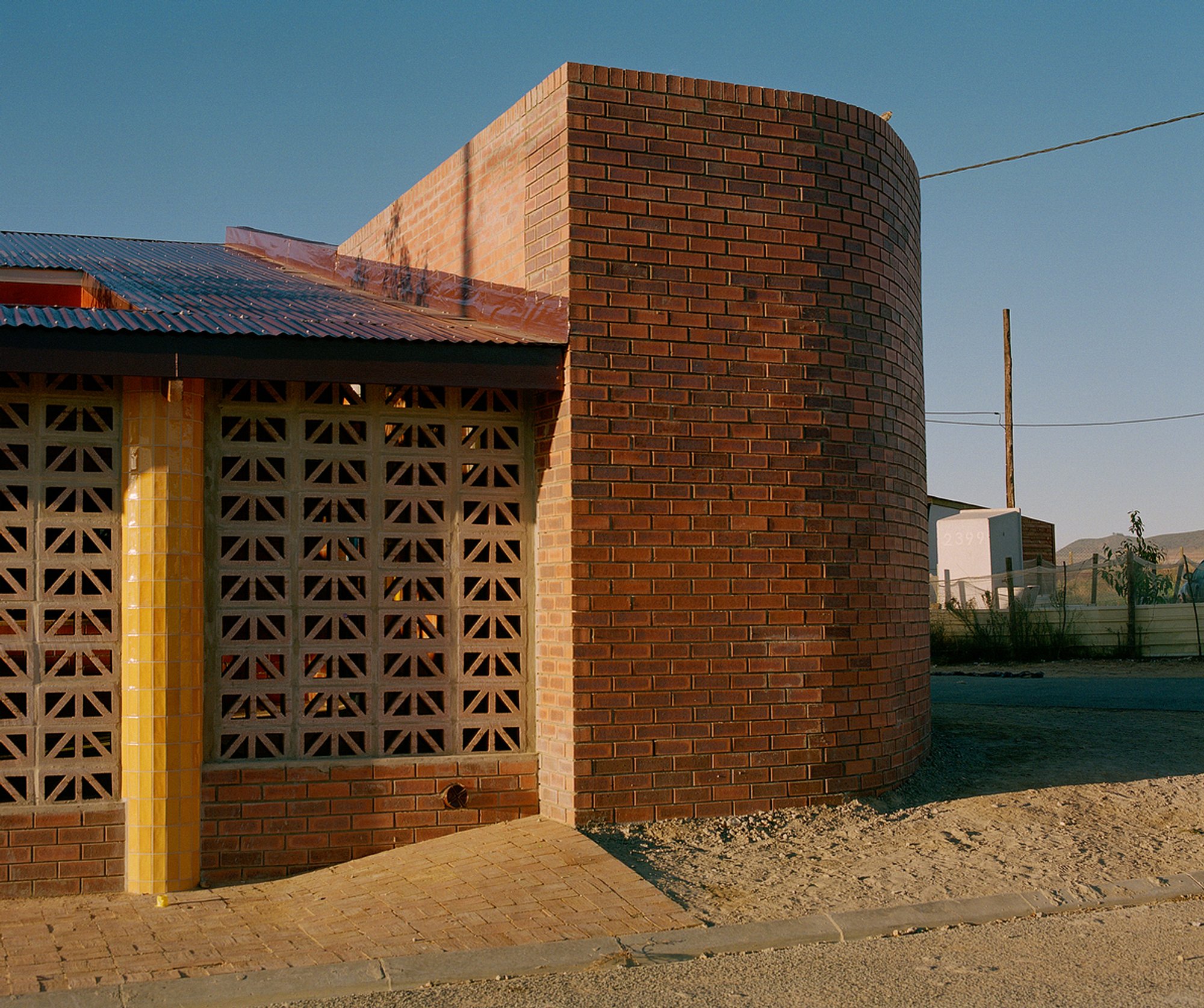
In the informal settlements along the fringes of Cape Town, architecture that serves children is rarely architecture at all. It is usually a corrugated metal room, a converted container, a space defined by what was available rather than what was intended. The New Rest Valley Crèche, designed by The MAAK, refuses that script. It is a proper building: brick walls, steel trusses, breeze block screens, a cylindrical tower, a courtyard with a climbing frame. It looks like it was designed, which in this context is a radical statement.
What makes the project genuinely interesting is not just its solidity but the way it negotiates between civic ambition and material economy. The MAAK draws from a palette that is both cheap and legible: common brick laid with care, decorative breeze block used as ornament and environmental filter, corrugated roofing reframed by exposed timber structure. The building reads as both familiar to its neighborhood and distinct from it, a piece of institutional architecture that earns its authority through craft rather than budget.
A Street Presence Built from Ordinary Materials
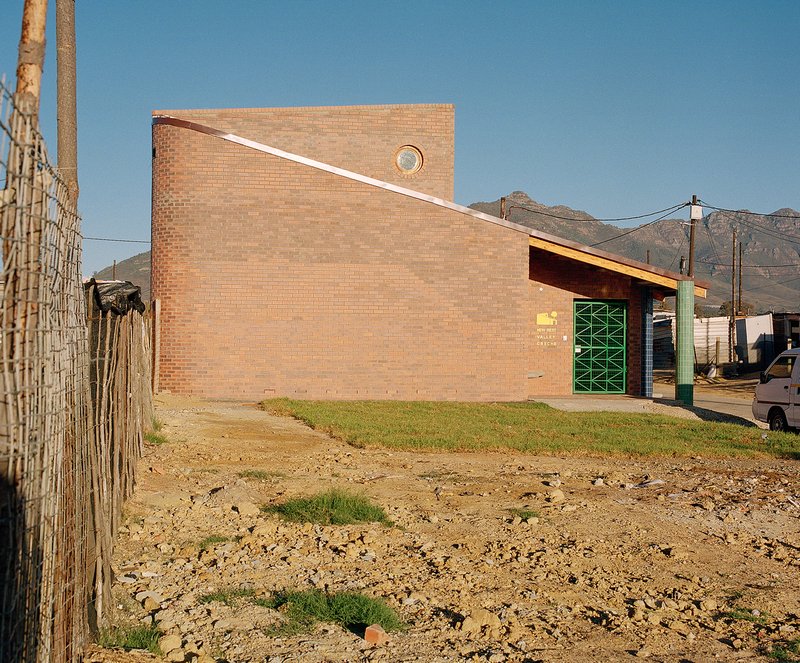
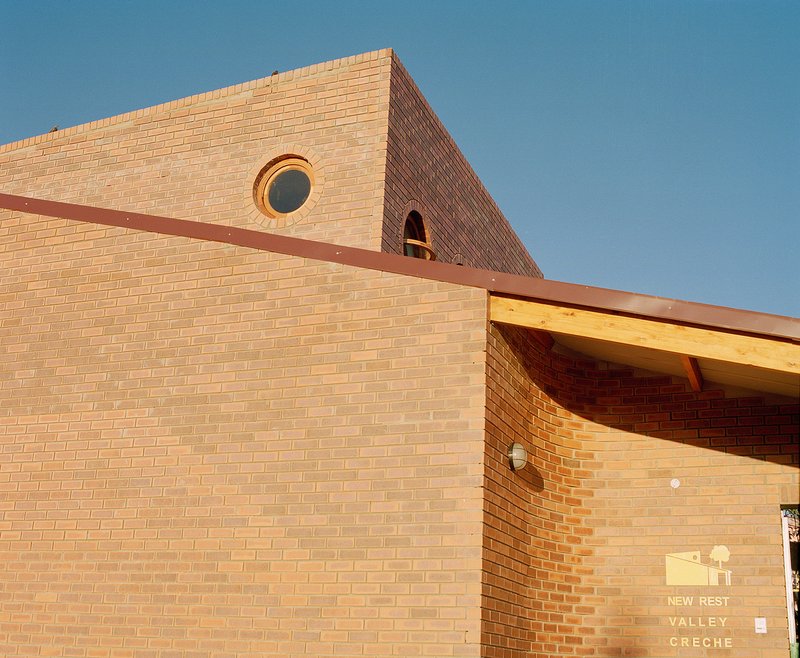
The street facade presents a brick gable punctuated by a circular window, a form so elemental it could be a child's drawing of a building. That simplicity is the point. The gable end and the round opening give the crèche an immediate identity on a streetscape dominated by improvised structures. A cantilevered steel eave in green extends the roof past the brick wall, providing shade and signaling the entrance without any signage.
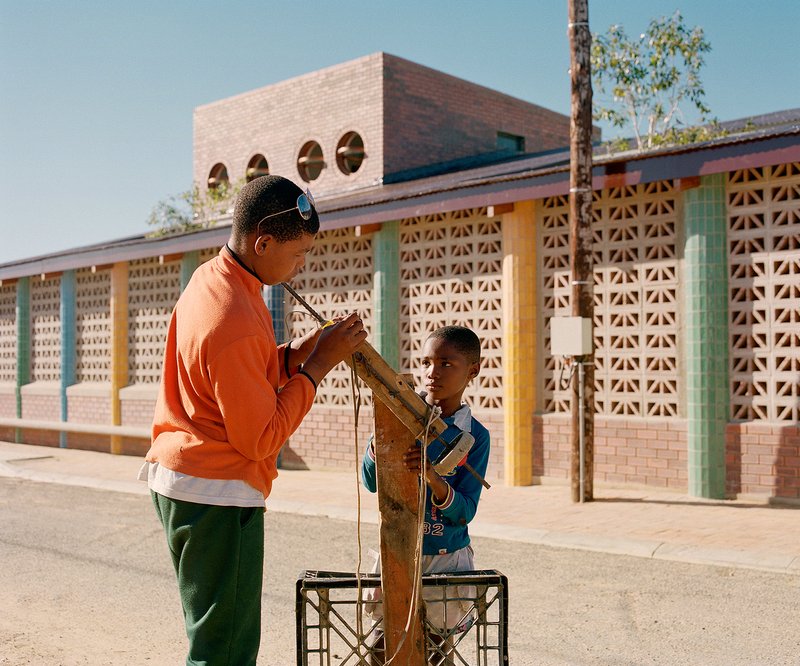
Flanking the main volume, decorative breeze block panels serve as boundary walls and light filters. Two children stand at ease beside one of these screens in a moment that reveals the building's scale: it is compact, human, not institutional in the bureaucratic sense. The breeze blocks themselves do double duty, allowing ventilation while creating a patterned surface that enriches what could have been a blank perimeter wall.
The Threshold as Gathering Space
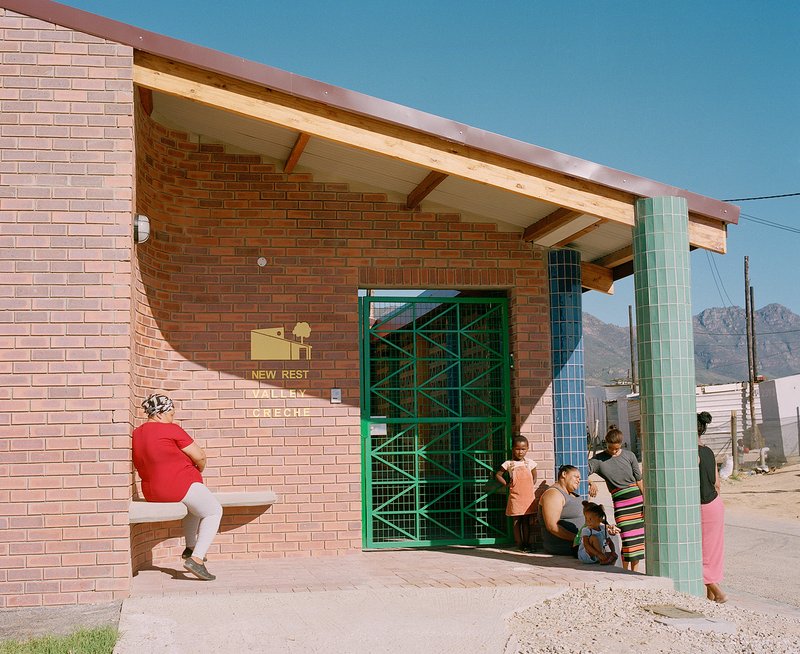
The entrance porch is generous for a building this size. Exposed timber rafters span between brick piers, and a green steel door marks the threshold. Community members gather under the overhang in a way that suggests this zone is already functioning as a social space, not just a transition from outside to inside. For a crèche, where parents drop off and pick up children twice a day, this kind of covered, semi-public space is essential infrastructure.
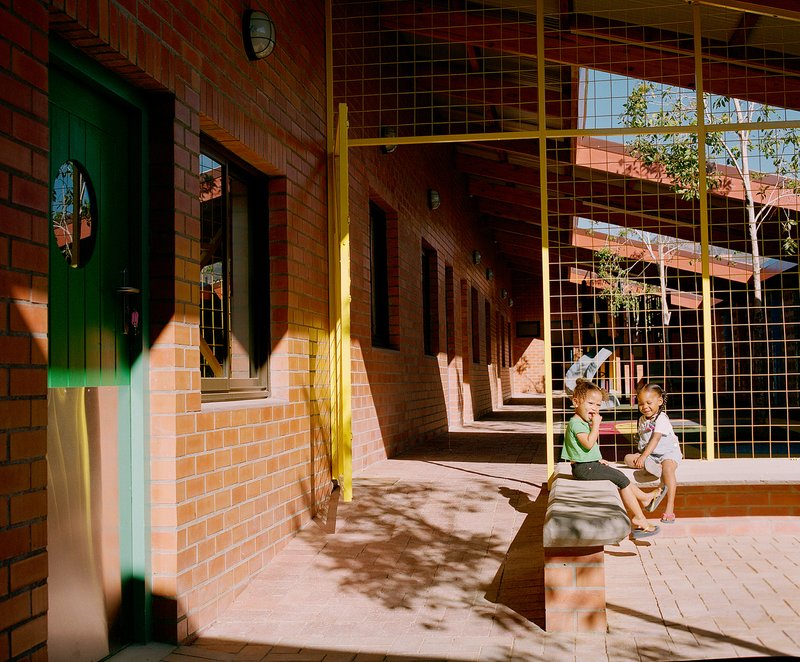
A covered walkway extends along one side of the building, brick columns carrying a green steel frame that casts long afternoon shadows onto the paving. The colonnade serves circulation but also creates a protected outdoor room for children, a shaded corridor that connects interior spaces while remaining open to air and light.
The Courtyard and the Tower
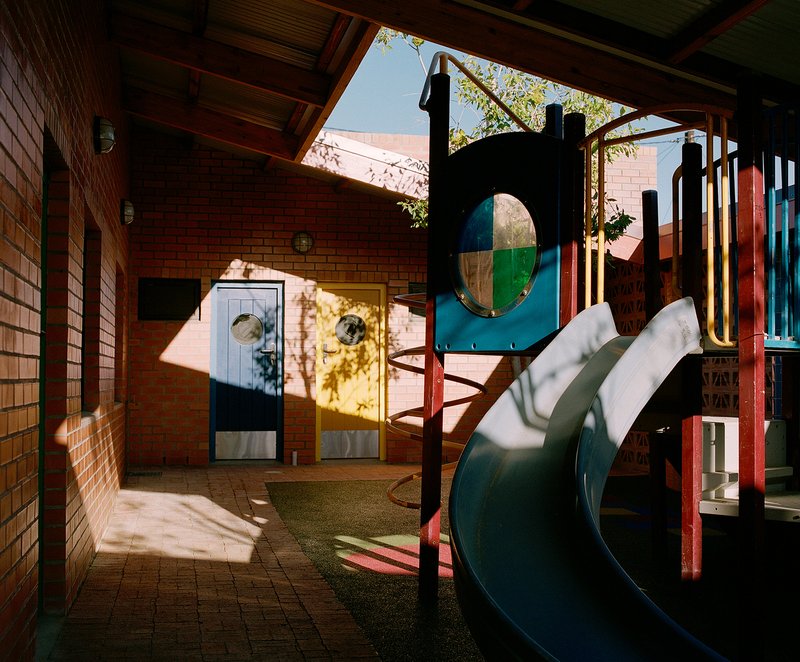
At the heart of the plan sits a courtyard with a play structure: a slide, a climbing frame, and dappled sunlight filtering through exposed steel roof trusses above. This is the engine of the building. Every classroom opens onto this space, and its partial enclosure by the crèche's wings creates a controlled environment where children can play without being on the street.
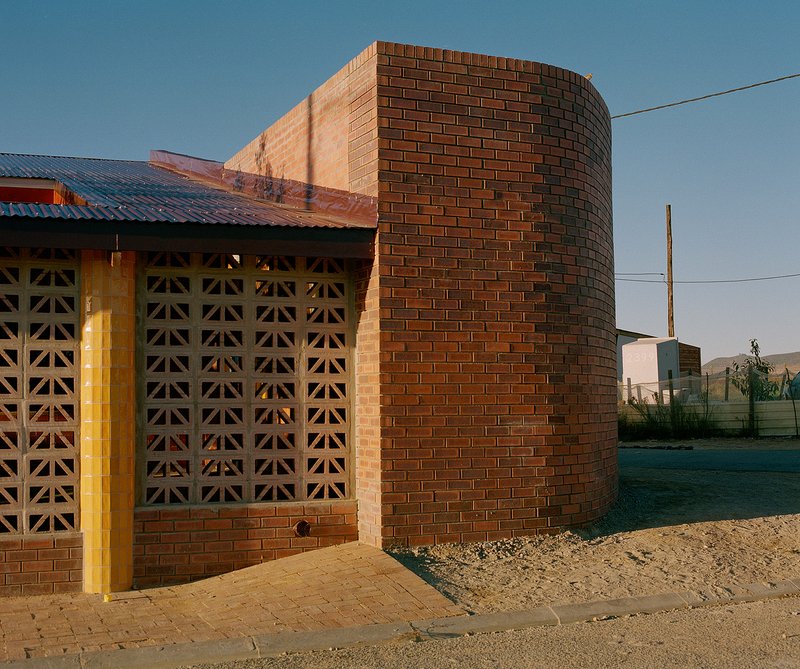
The cylindrical brick tower is the building's most distinctive formal gesture. Adjoining a low wing with breeze block panels, it reads as a landmark in a landscape that has almost none. Whether it houses a stair, a storage room, or a reading nook is less important than what it does for the skyline: it says this is a place that matters. The combination of the tower and the breeze block panels creates a silhouette that is unmistakably intentional, a building that announces its presence in late afternoon light.
Classrooms That Work with Less
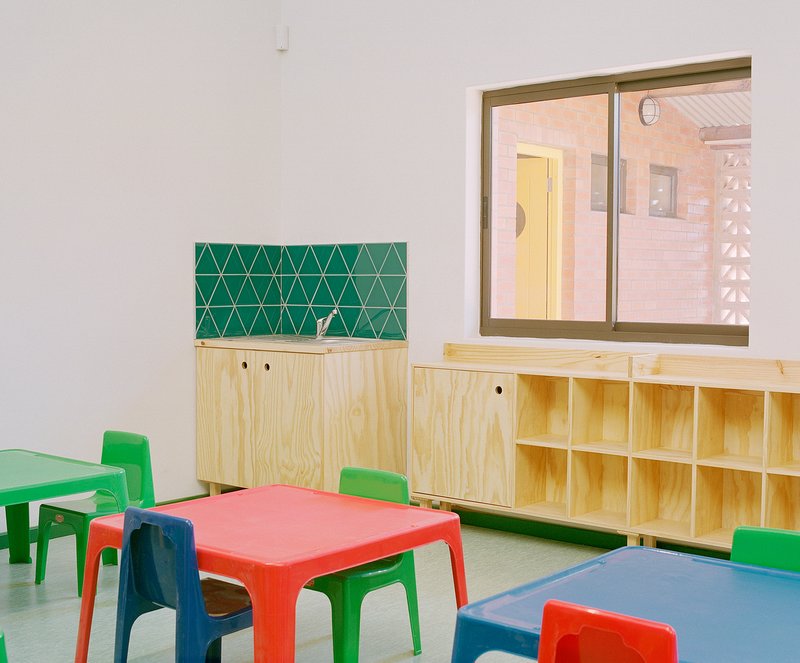
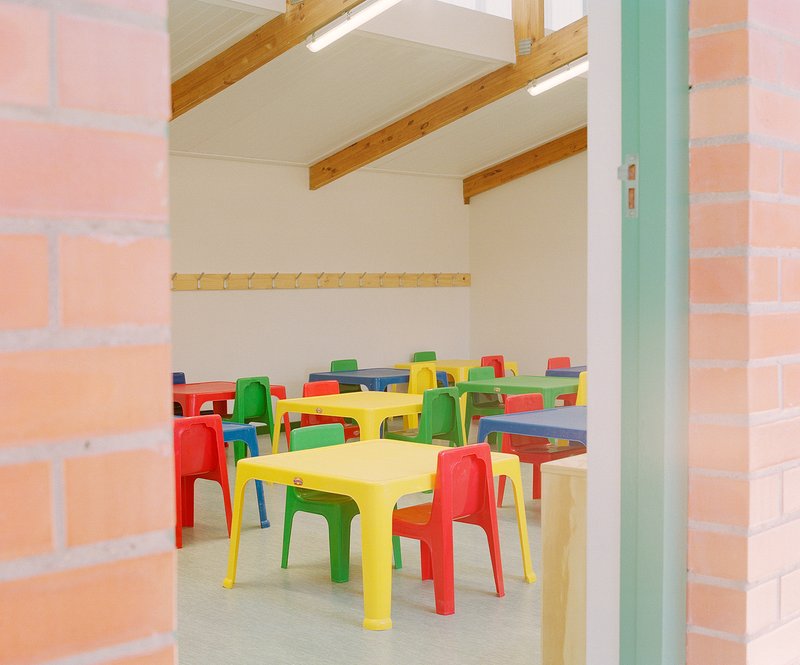
Inside, the classrooms operate on a principle of honest construction and selective color. One room features plywood storage units along the walls and a green triangular tile backsplash that functions as both a durable surface and visual stimulation. Colorful plastic chairs provide the furniture, inexpensive and replaceable. Another space opens up under exposed timber beams, yellow tables surrounded by red and green chairs, a warm room that gets its character from structure rather than decoration.
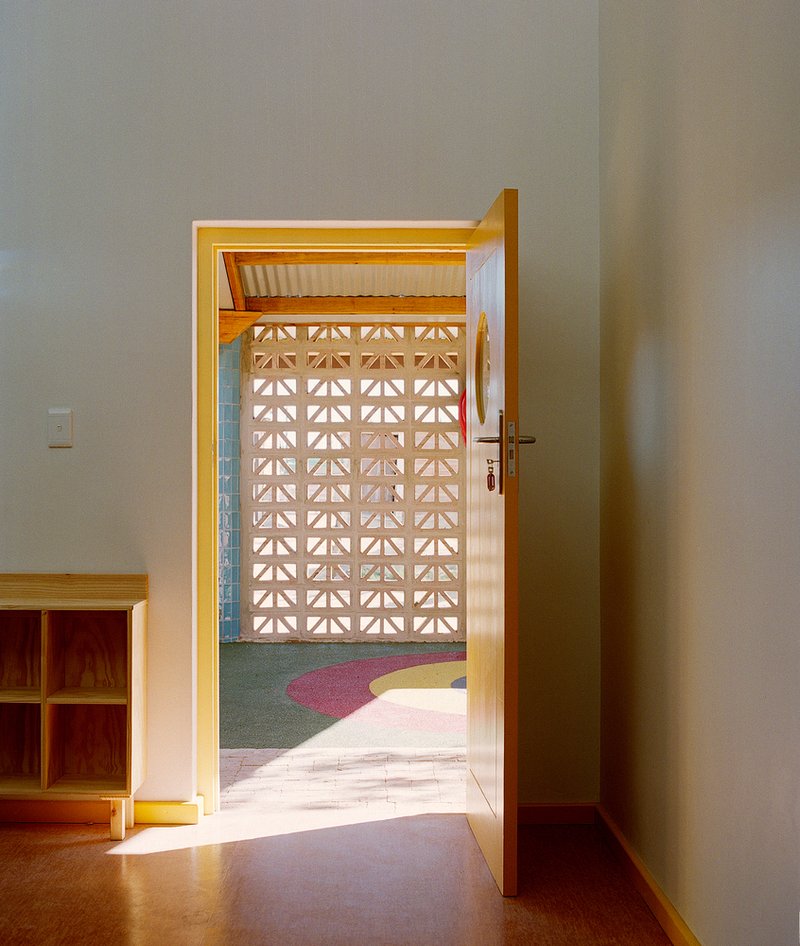
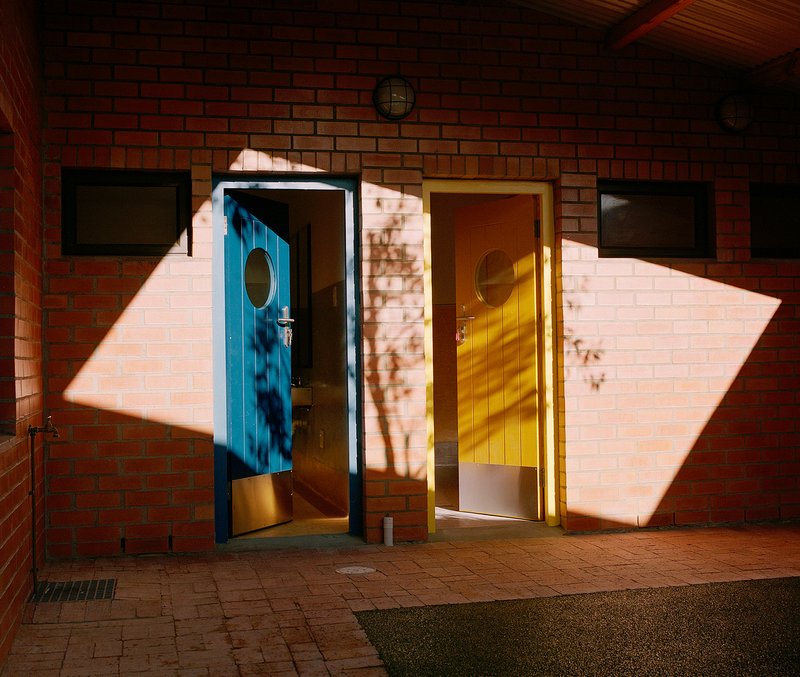
Doorways are painted in vivid blues and yellows beneath timber soffits, creating moments of intense color that help small children navigate the building. The framed view through one doorway toward a patterned breeze block screen captures the project's essential strategy: layering simple, affordable elements to produce spatial depth and visual richness that far exceed the cost of the materials involved.
Context and Contrast
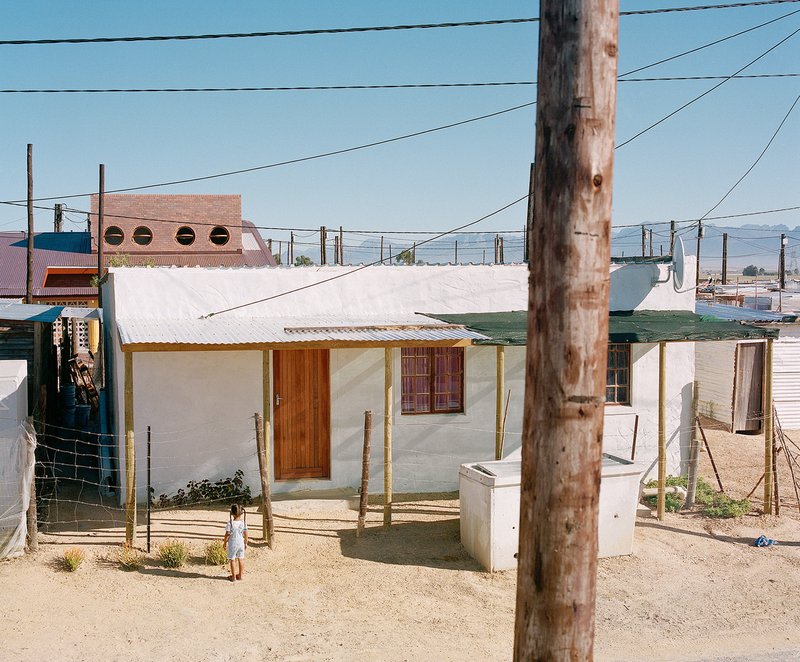
A photograph of the surrounding settlement puts the crèche in sharp relief. A small corrugated metal roof dwelling, a fenced yard, a child standing in the foreground: this is the everyday reality from which the crèche emerges. The building does not pretend to solve the housing crisis that surrounds it, but it does demonstrate what considered design can achieve when directed at a community's most vulnerable members.
The distant mountains visible behind the brick gable remind us that this is the Western Cape, a region of extraordinary natural beauty and extreme spatial inequality. The crèche sits at the intersection of those two realities, a compact building that takes its setting seriously enough to face the street with a proper facade and frame the mountain view through a circular window.
Why This Project Matters
The New Rest Valley Crèche matters because it proves that civic architecture does not require a civic budget. The MAAK has built a building that functions as a landmark, a school, and a community gathering point using brick, breeze block, corrugated metal, timber, and steel, materials available at any builders' merchant in the region. The design intelligence is in the composition: how these materials are combined, proportioned, and colored to create something that feels permanent and cared for.
In a context where early childhood education often happens in structures that communicate expendability, this building communicates investment. Not in the financial sense, though someone obviously funded it, but in the deeper sense of telling a community's children that their place of learning deserves walls, windows, a tower, a courtyard, and a front door painted green. That message, delivered through architecture, is worth more than the bricks it is built from.
New Rest Valley Crèche by The MAAK, Cape Town, South Africa. Photography by Kent Andreasen.
About the Studio
Share Your Own Work on uni.xyz
If projects like this are the kind of work you want to make, uni.xyz is a place to publish your own, find collaborators, and enter design competitions.




Popular Articles
Popular articles from the community

Bernardes Arquitetura Stretches a Timber Roof Along a Reservoir's Edge in Minas Gerais
Dam House in Itaúna lets a sweeping wooden canopy dissolve the boundary between hillside terrain and open water.
HCCH Studio Wraps a Shanghai High-Rise Office in Curved Walls of Translucent Glass
A 1,000 square meter fit-out in Lujiazui replaces the typical tech-office palette with layered glass, micro-cement, and quiet rigor.

20 Most Popular Office Building Projects of 2025
From biophilic workspaces in India to net-positive energy offices in New Delhi, 20 office building projects that defined architecture in 2025.
Fausto Terán and Toro Fuse Japanese Craft with Mexican Tradition in a Lakeside Retreat
Nakamura House pairs Shou-Sugi-Ban charred pine with handmade clay tile at the foot of Atlangatepec Lagoon in Mexico.


Similar Reads
You might also enjoy these articles
Olio Towers: A Mid-Rise for Performers That Fuses Housing, Rehearsal, and Stage
Located blocks from Houston's Theater District, this modular tower stacks living units around a central performance atrium.
Oasis: Modular Green Housing Carved into Dhaka's Urban Fabric
A shortlisted Plugin Housing entry reclaims unauthorized settlements in Dhaka with stepped concrete volumes, green roofs, and ventilation-driven design.

Black Hole: A Floating Megastructure for the Post-Physical Era
Emiliano Mazzarotto envisions a spherical, self-scaling arena where e-sports, digital hotels, and holographic stadiums replace traditional public space.
Compact & Sustainable Living in Piraeus: A Four-Level Family Home Built Around Light and Air
A narrow townhouse in one of Greece's densest port cities uses a central atrium and passive strategies to house three generations under one roof.
Explore Architecture Competitions
Discover active competitions in this discipline




The International Standard for Design Portfolios


The Global Benchmark for Architecture Dissertation Awards


The Global Benchmark for Graduation Excellence


Challenge to design public laboratory
Comments (0)
Please login or sign up to add comments
No comments yet. Be the first to comment!