
Nghia-Architect Spirals a Da Nang Townhouse Around a Courtyard Core Built from Old Boats
Maison TT folds three generations of family life into 75 square meters using recycled fishing boat timber and origami logic in central Vietnam.


Da Nang is a city caught between two clocks. One ticks to the rhythm of courtyard houses, fishing harbors, and multigenerational routines. The other races forward with land speculation, motorbike traffic, and concrete infill. Maison TT by Nghia-Architect sits squarely at the intersection, compressing three generations of a single family into 75 square meters of townhouse while refusing to surrender the spatial generosity that makes traditional Da Nang homes livable.
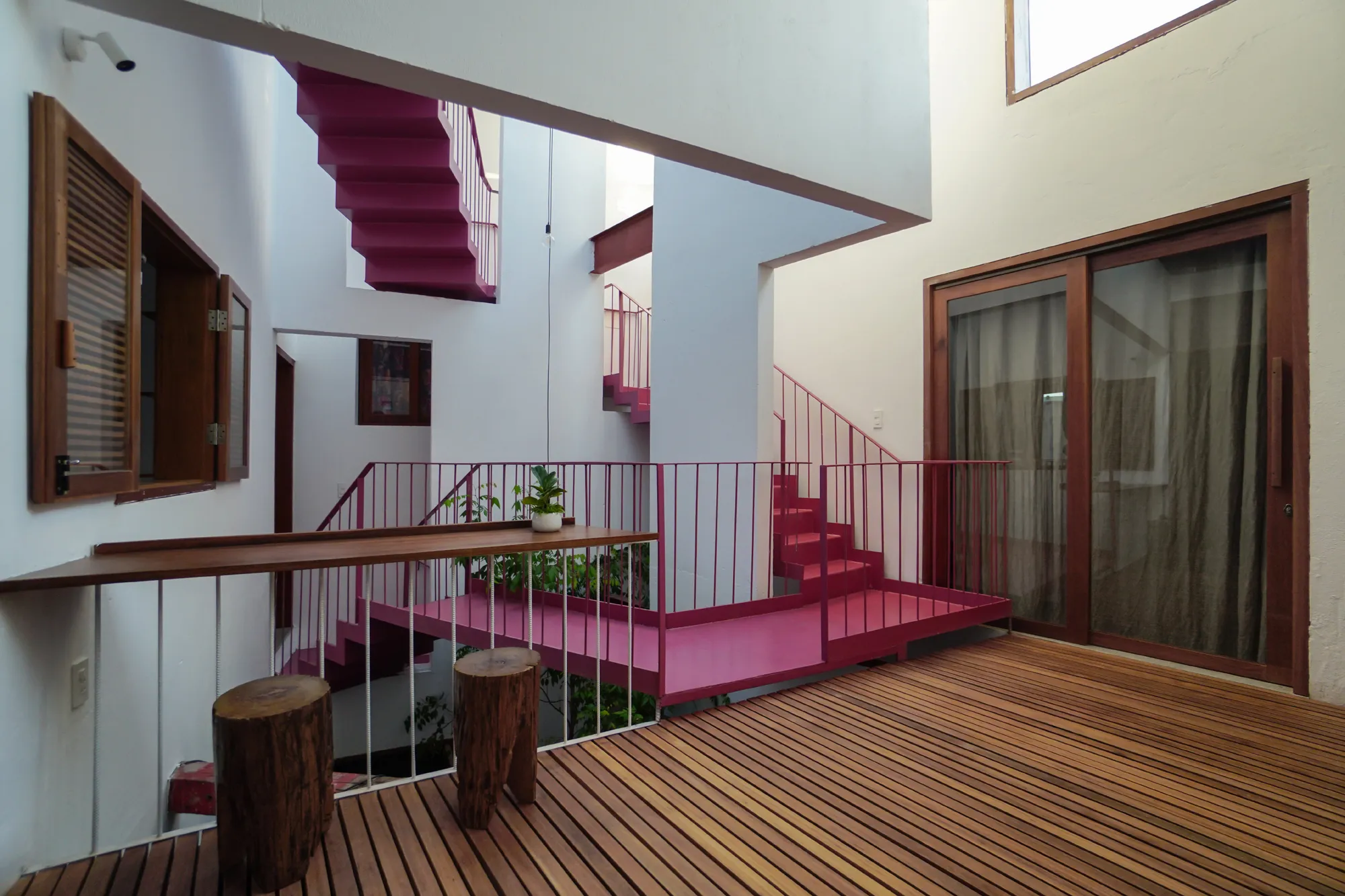
What makes the project genuinely interesting is not the tight footprint but the structural conceit that organizes it: a spiraling core wall that swirls inward and upward, with every room, stair, and walkway attached to it like leaves on a stem. The kitchen and dining area anchor the ground level beneath a skylight, and all circulation radiates outward from that shared center. It is a townhouse that reads more like a vertical garden pavilion than a stack of floor plates, and its boldest material move, cladding significant surfaces in timber salvaged from decommissioned fishing boats, turns a budget constraint into cultural storytelling.
The Spiral at the Core
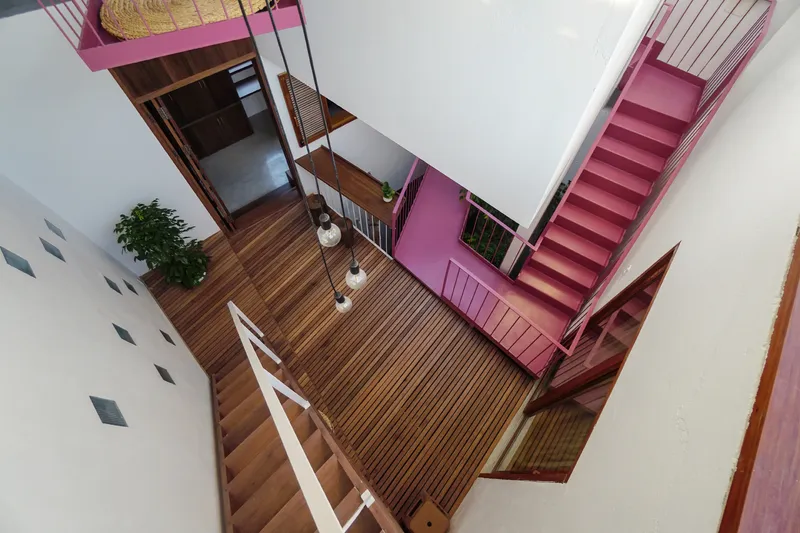
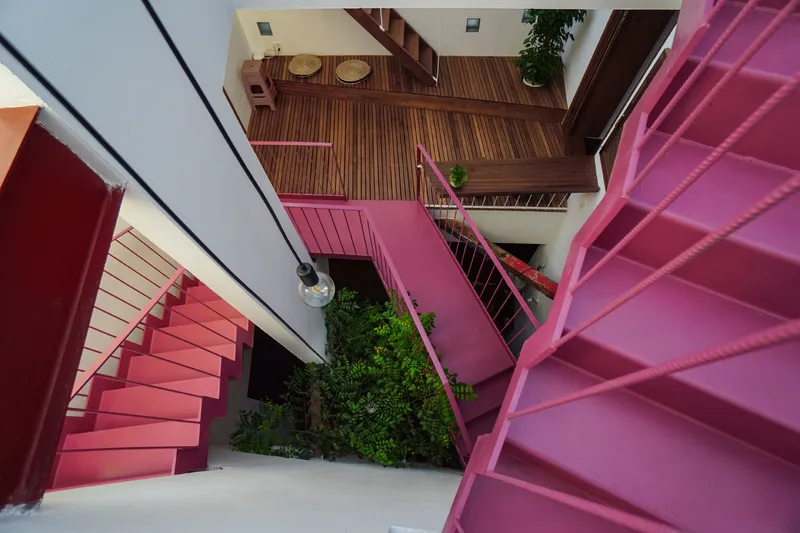
Seen from above, the logic is clear. Pink steel staircases zigzag around a central void, connecting timber-decked platforms at half levels rather than full stories. The spiral is not decorative geometry; it is the load-bearing diagram of the house, a core wall that every bedroom, bathroom, and communal space plugs into. Traffic paths interweave rather than stack, which means you rarely walk in a straight line but always pass through the planted courtyard's sightlines.
The result is a house that feels significantly larger than its 75 square meters. By refusing the conventional corridor-and-room layout of a Vietnamese shophouse, Nghia-Architect generates spatial depth through section rather than plan. Each half-level shift reframes the courtyard tree, the sky, and the faces of family members on other floors.
Living in Pink Steel
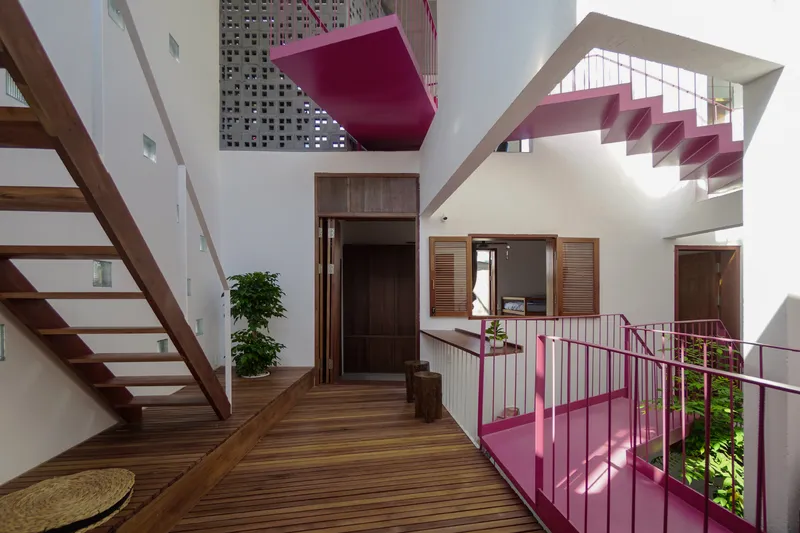
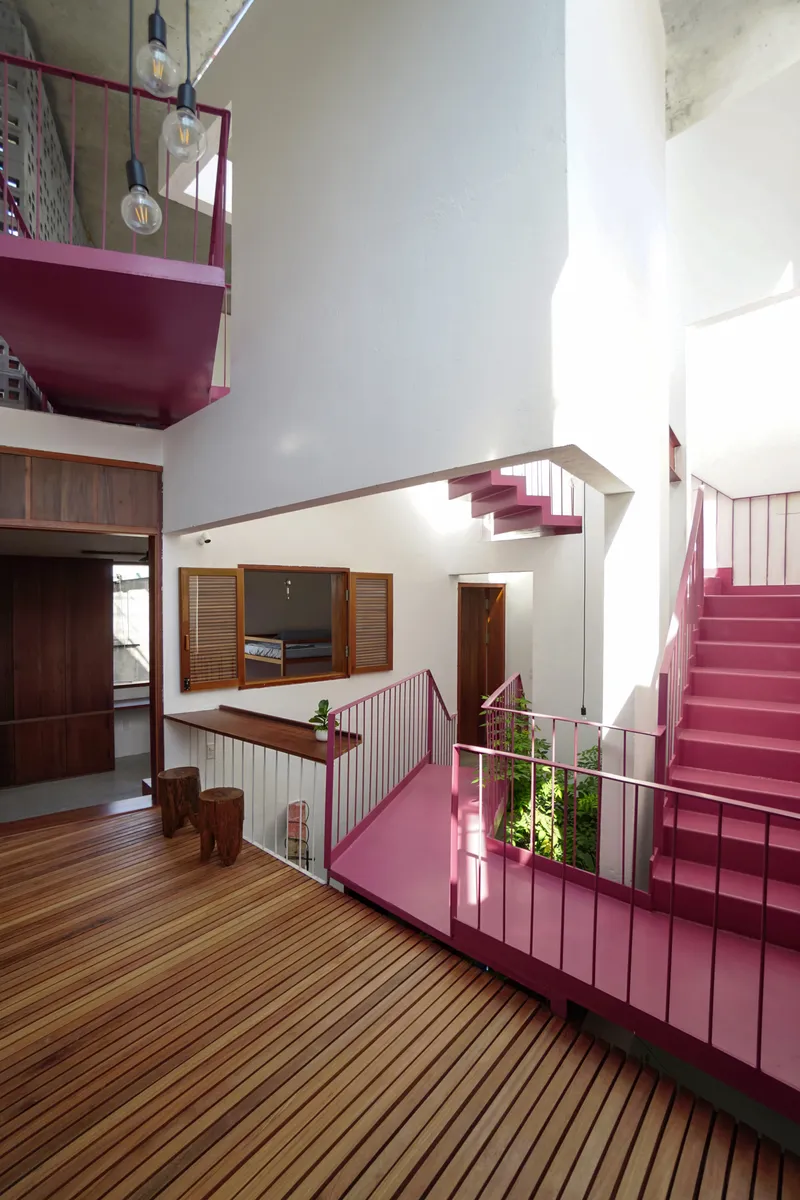
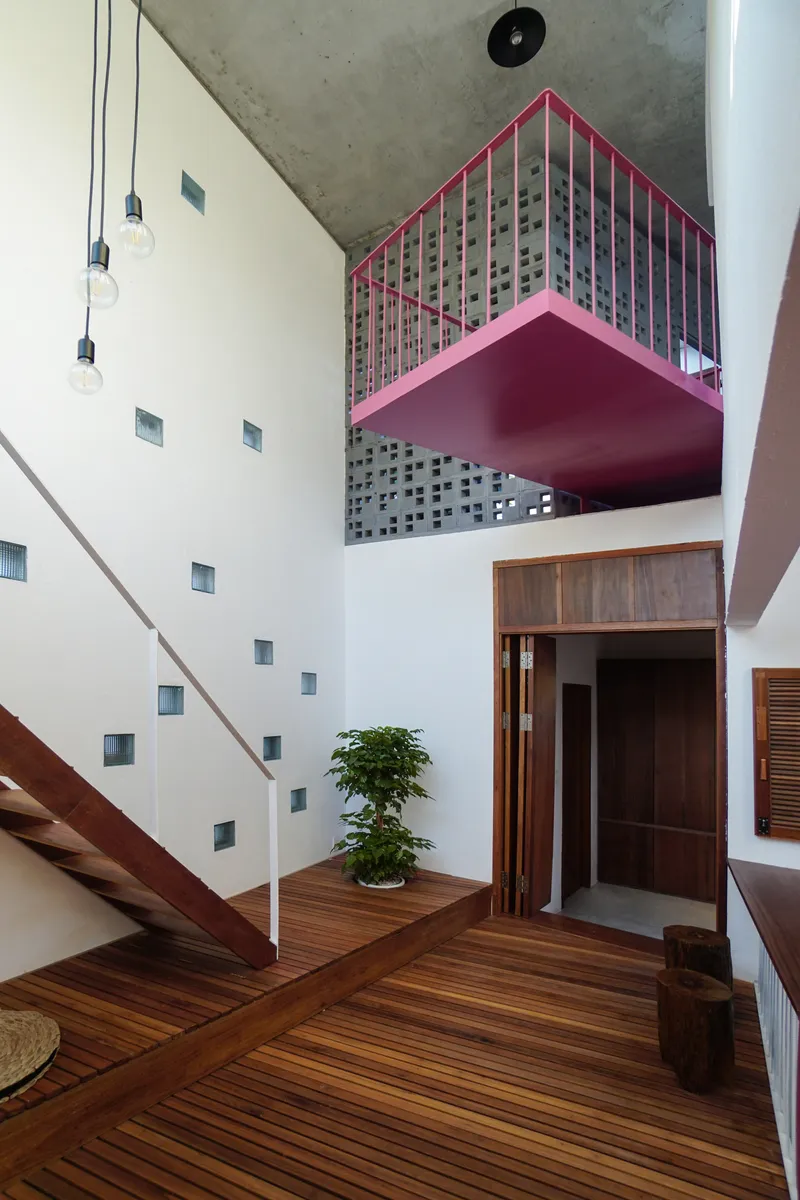
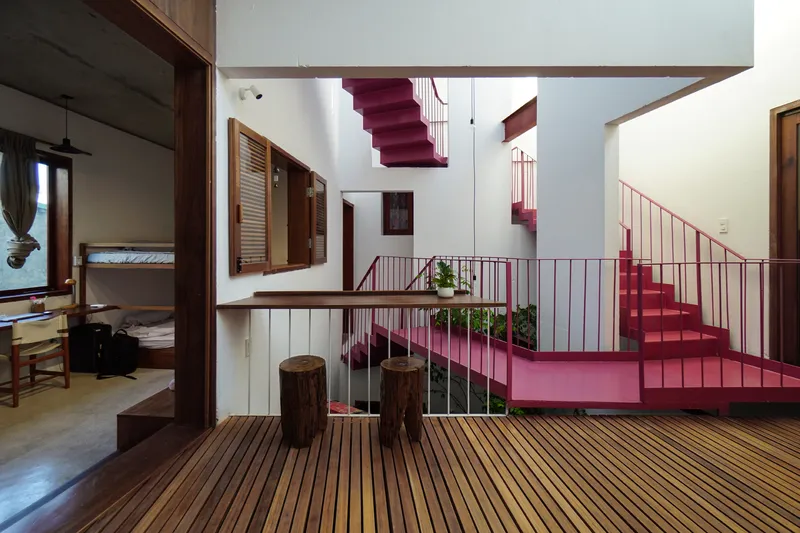
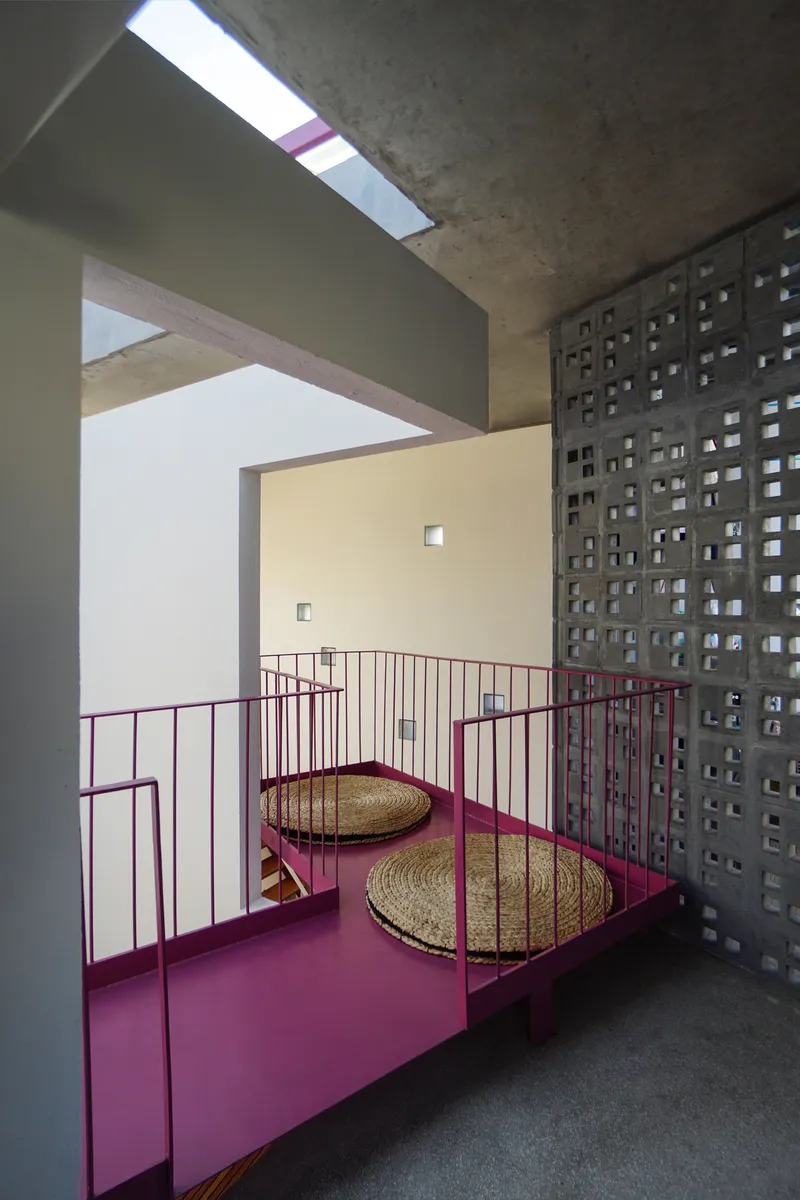
The staircase system is the most photographed element for good reason: it functions simultaneously as structure, circulation, balcony, and furniture. Cantilevered pink steel landings double as reading nooks, and the perforated metal walkways overhead filter light down to the ground floor dining area. The color choice is neither arbitrary nor merely playful. Against the warm tones of timber flooring and the green of interior planting, the pink reads as a deliberate accent that keeps the eye moving vertically.
There is an honesty to leaving the steel connections exposed. Bolted flanges and welded brackets are visible throughout, giving the interior a workshop quality that pairs well with the recycled boat timber elsewhere. Nothing is polished to the point of preciousness, which suits a house built for children and an elderly grandmother.
Courtyard as Climate Machine
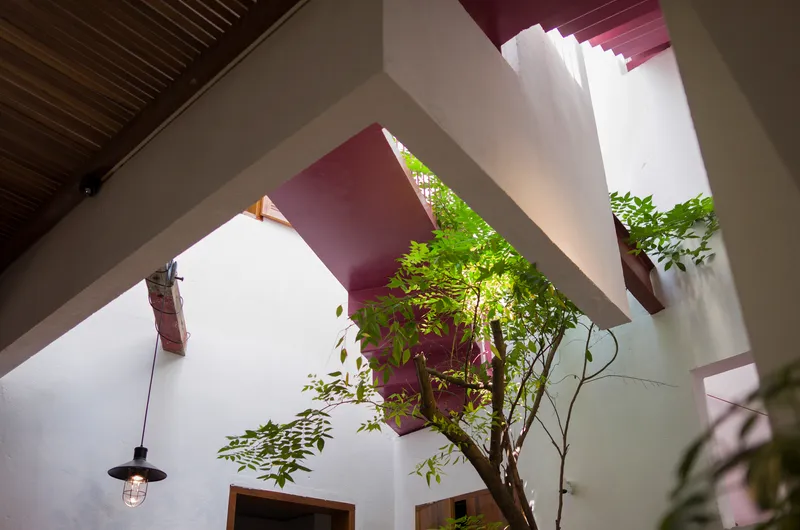
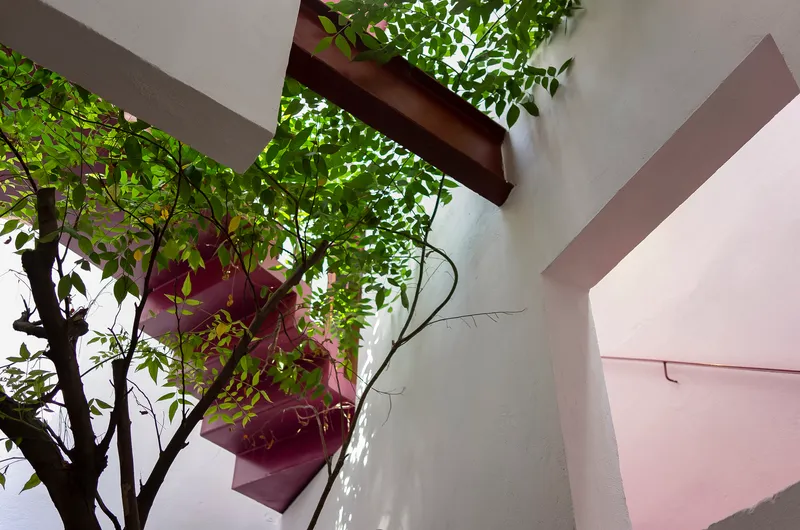
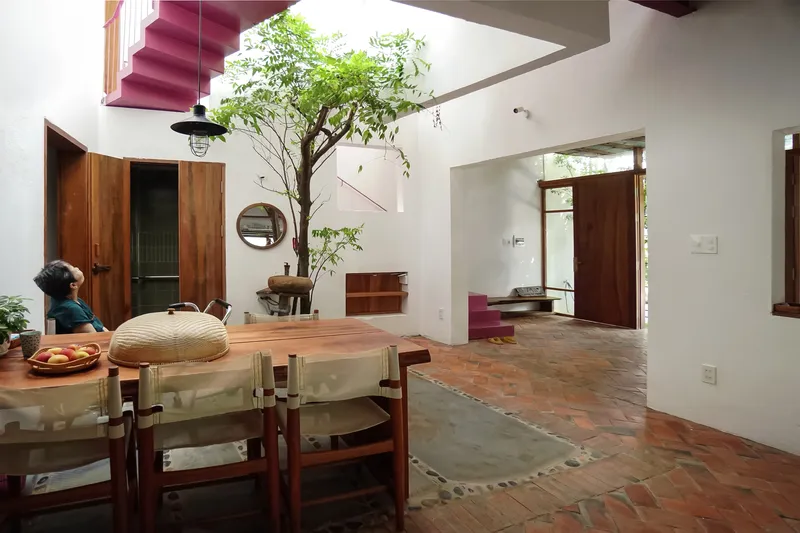
Central Vietnam's coastal climate is punishing: humid summers, typhoon rains, and a sun angle that bakes south-facing walls. The internal courtyard, a typological inheritance from traditional Da Nang houses, does serious environmental work here. A tree planted at the base of the void grows upward through multiple levels, its canopy distributing shade while its transpiration cools passing air. A skylight overhead completes the stack effect, drawing hot air up and out while pulling cooler air through ground-level openings.
The kitchen sits directly beneath this skylight, making the most communal room in the house also the best lit and best ventilated. It is a smart inversion of the typical townhouse hierarchy, where kitchens are banished to the rear. Here, cooking is literally at the heart of the building's environmental strategy.
Recycled Boat Timber and Material Memory

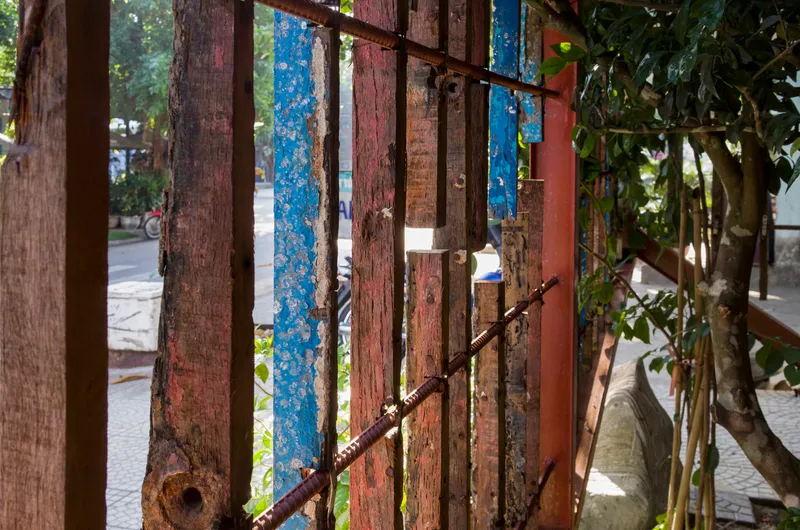
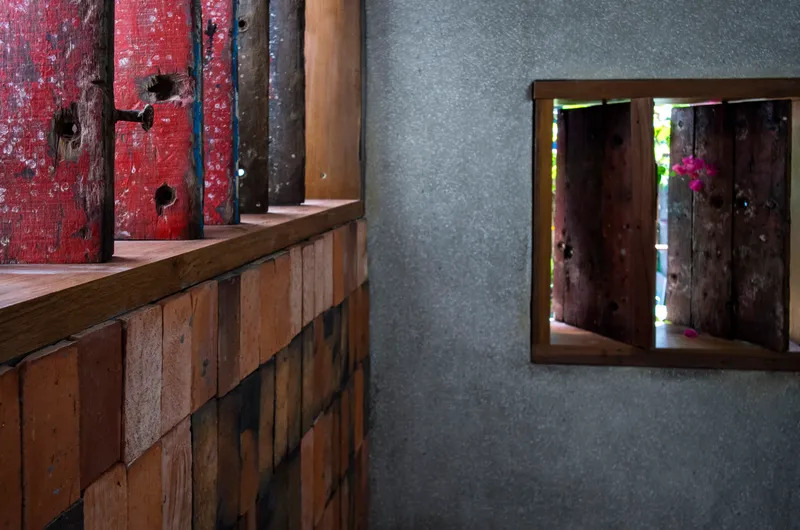
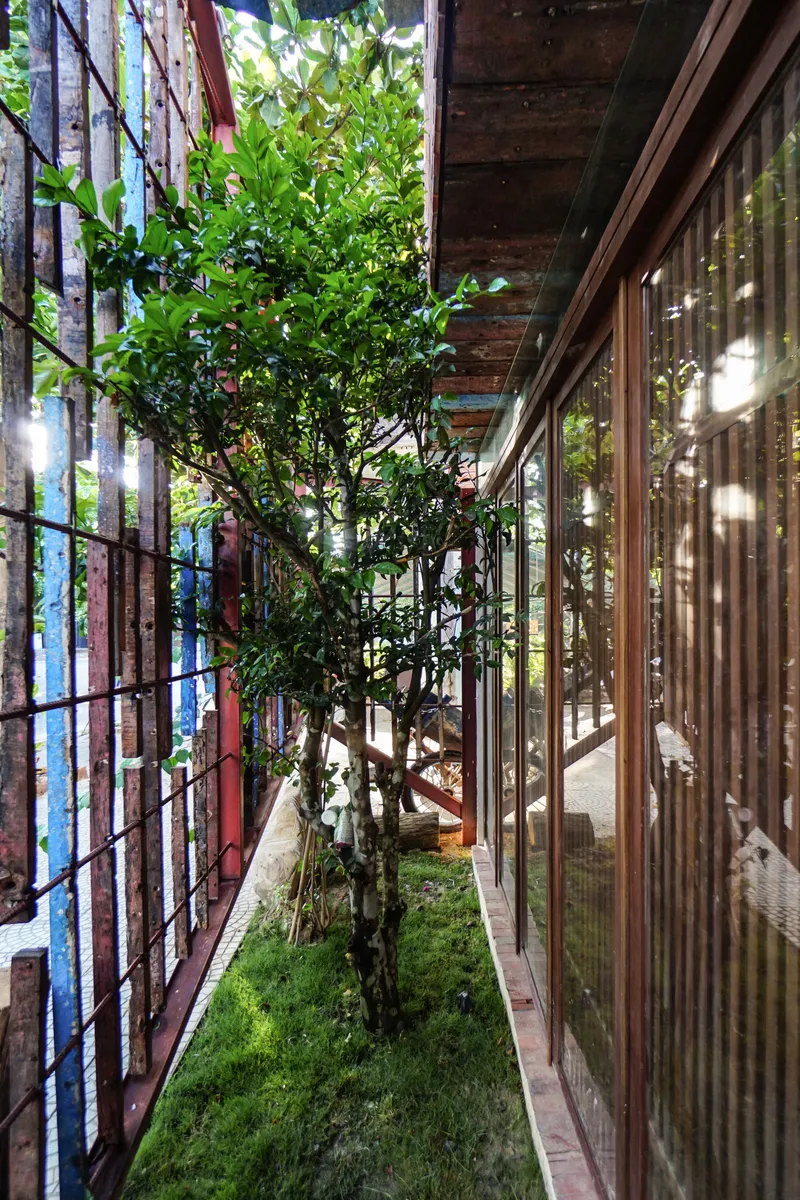
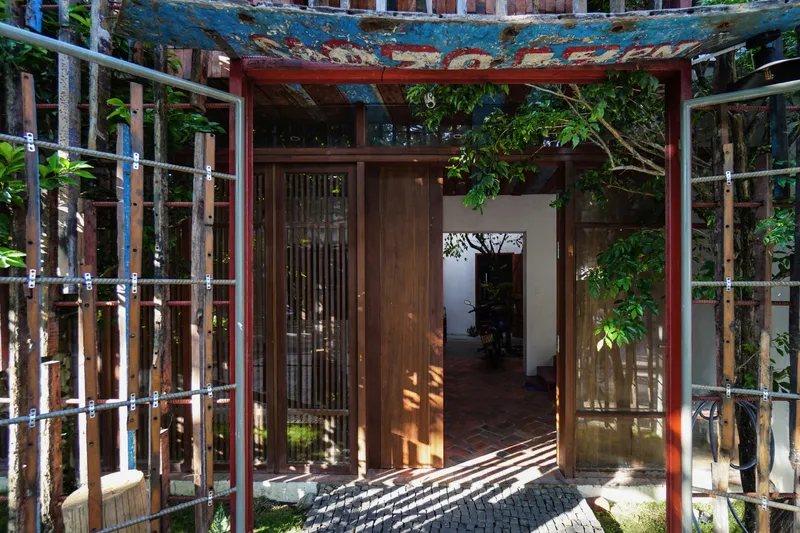
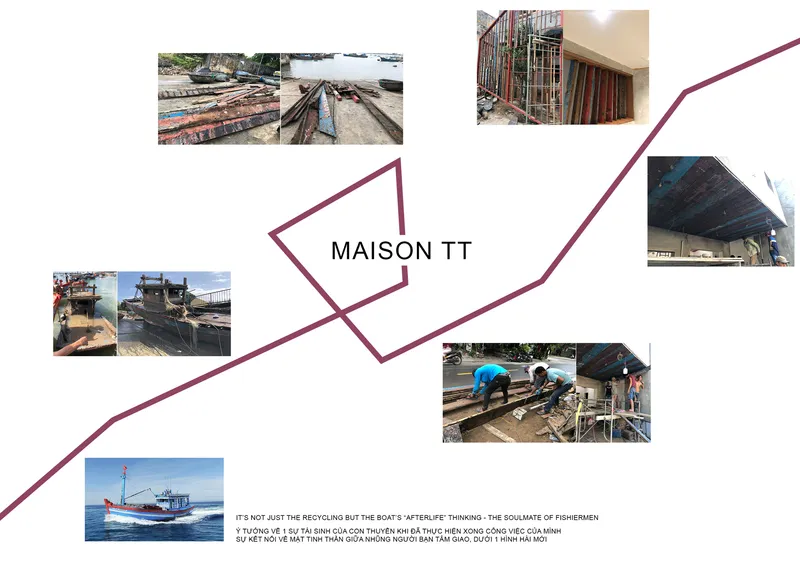
The project's most culturally loaded decision is its use of wood salvaged from decommissioned fishing boats. Da Nang's waterfront is littered with hulls that have reached the end of their working life, and Nghia-Architect sourced planks from these vessels to clad interior screens, ceilings, and counter surfaces. The timber arrives with paint residue, nail holes, and the warping of decades at sea. None of that is sanded away.
The gesture is more than sustainable material reuse. It anchors the house to the maritime economy that built the neighborhood in the first place. A family whose city is rapidly erasing its own waterfront identity now lives inside fragments of that identity. The collage of blue, green, and weathered natural tones on the timber screens changes color and character with the light, giving each wall a depth that new materials simply cannot replicate.
The Street Face
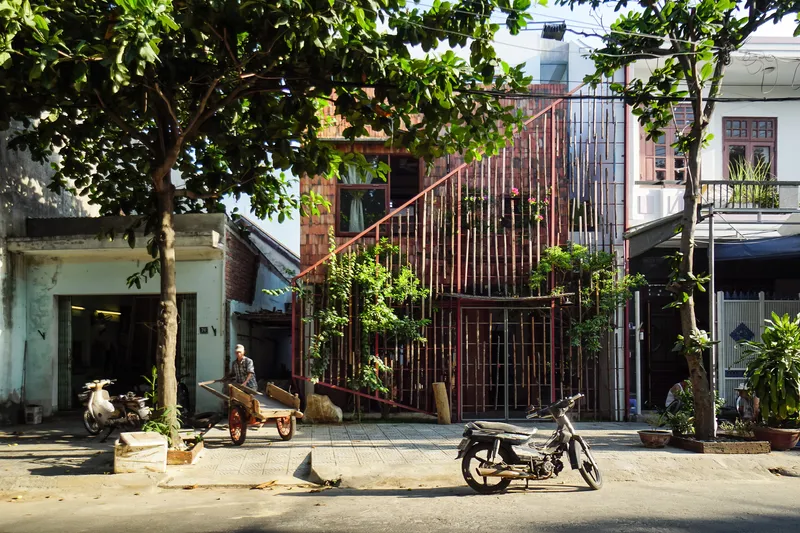
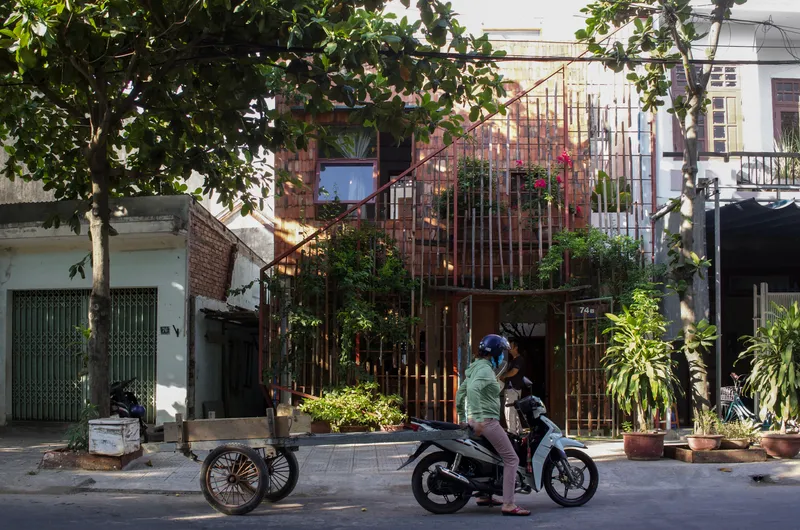
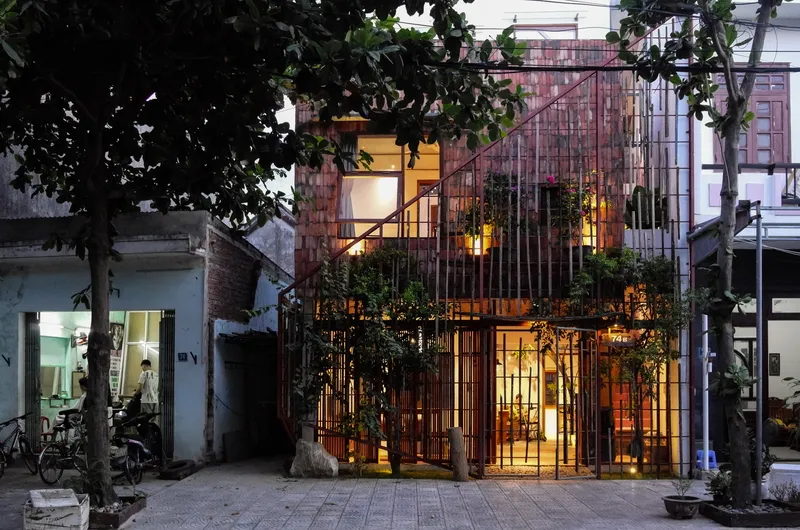
From the street, Maison TT presents a screen of vertical metal rods layered with climbing plants and cantilevered planter boxes. The facade is deliberately restrained, almost anonymous among its neighbors, which is the correct reading for a townhouse in a dense urban row. Privacy is achieved through layering rather than opacity: passersby on motorbikes see green and filtered light but never a clear view into the interior.
At night the strategy inverts. The illuminated interior glows through the rod screen, turning the house into a lantern. The planted terraces read as horizontal bands of shadow against the warm light behind, creating a layered elevation that changes from hour to hour without any architectural gimmickry.
Three Generations in Section
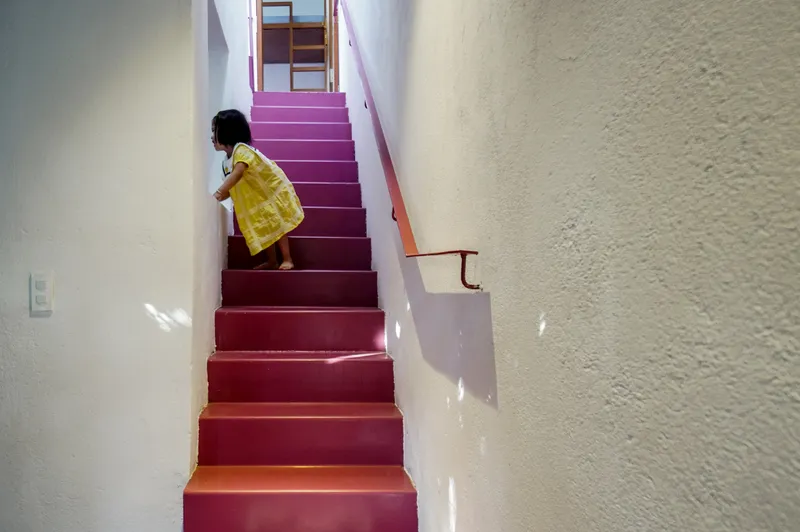
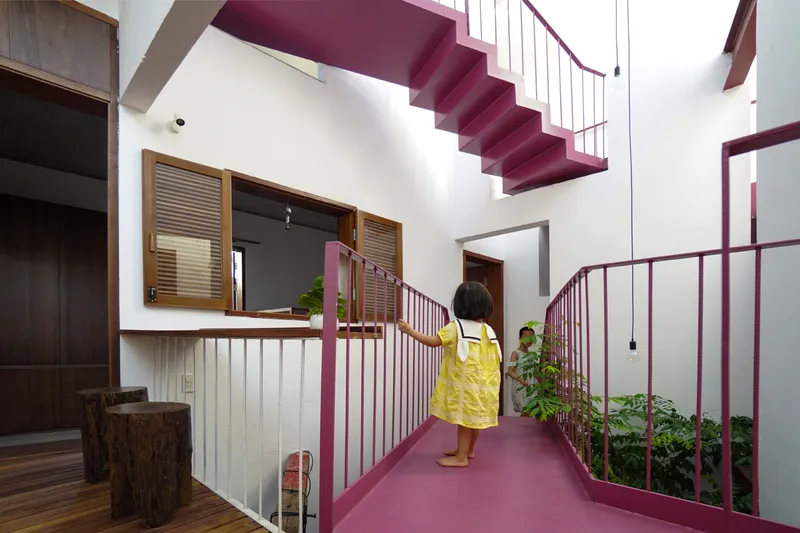
Designing for a young couple, two children, and an elderly mother on a 75-square-meter footprint requires the section to do what the plan cannot. The half-level organization gives each family member a degree of acoustic and visual separation without isolating anyone behind closed doors. A child climbing the stairs is always within earshot of the kitchen. The grandmother's space on the lower levels avoids steep ascents. A rooftop altar and library provide quiet retreat at the top of the spiral.
The woven floor cushions on a pink steel landing, visible beneath a concrete breeze block wall and skylight, capture the attitude perfectly. This is a house where formality dissolves into casual inhabitation, where a structural platform becomes a place to sit, read, or nap. Architecture and furniture blur into one system.
Origami Logic and Folded Space
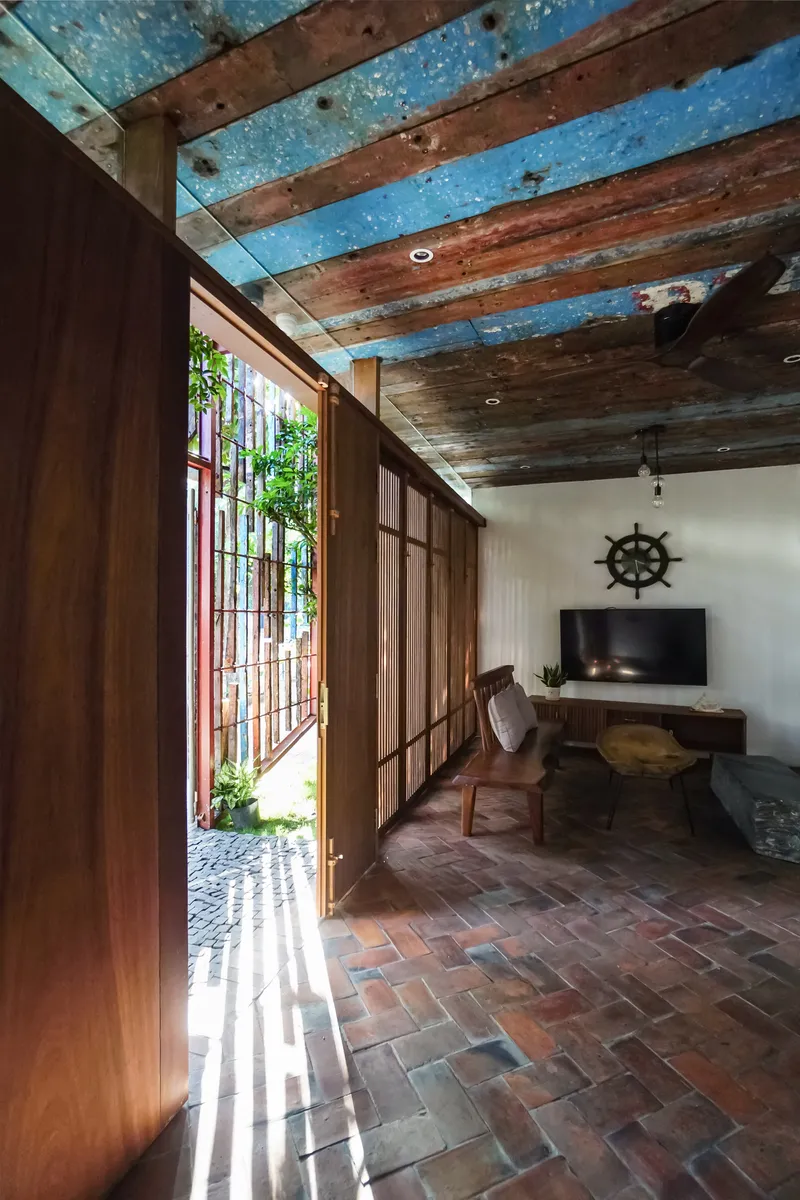
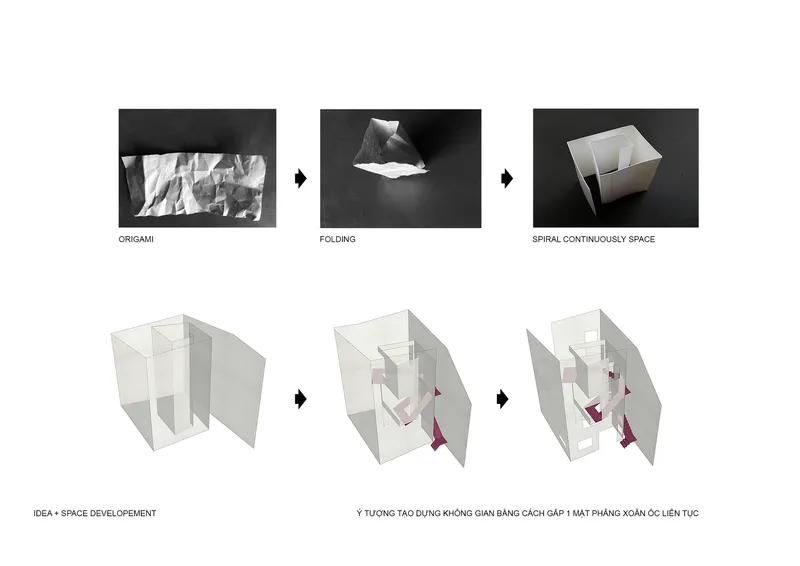
Nghia-Architect explicitly references Japanese origami as a conceptual driver, and the connection is more than metaphorical. Walls fold at unexpected angles, pulling rooms closer to or further from the courtyard core. The plan geometry is not orthogonal; diagonal lines create pockets of space that would not exist in a conventional grid layout. This folding is what allows the house to feel expansive despite its modest area, because no two views align in the same way.
The origami reference also nods to the deep cultural exchange between Hoi An, Da Nang, and Japan, a trading relationship centuries old that left lasting imprints on local architecture. Maison TT does not mimic Japanese forms but absorbs a principle of spatial economy that resonates with both traditions.
Plans and Drawings
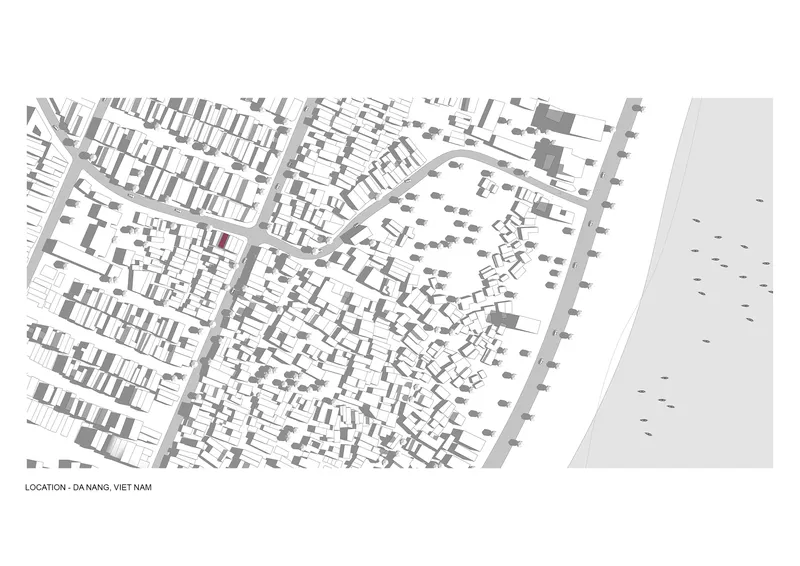
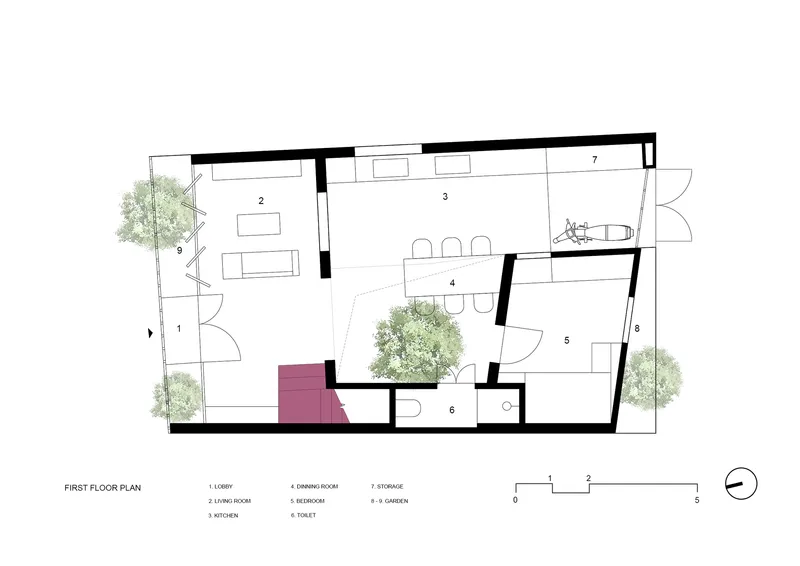
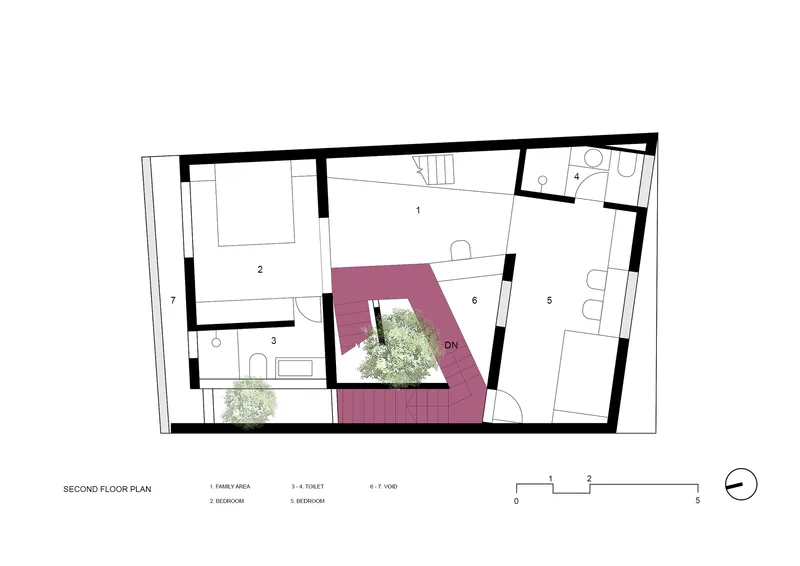
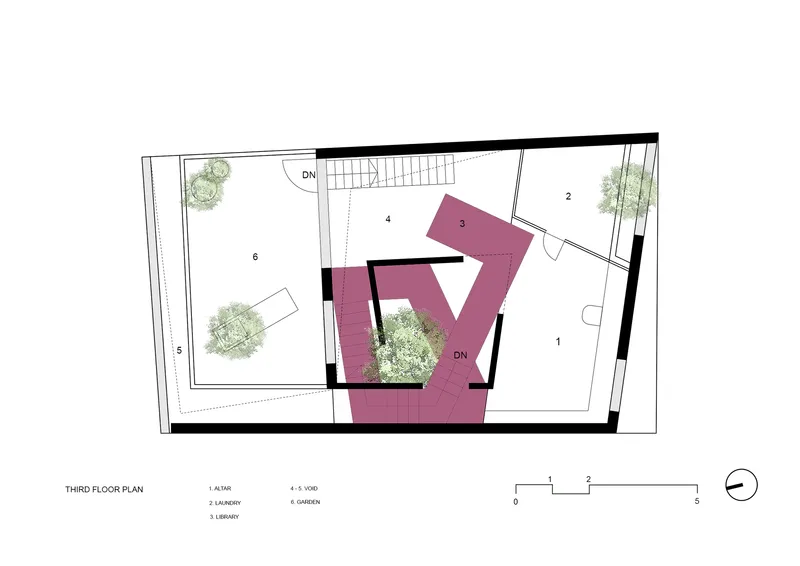
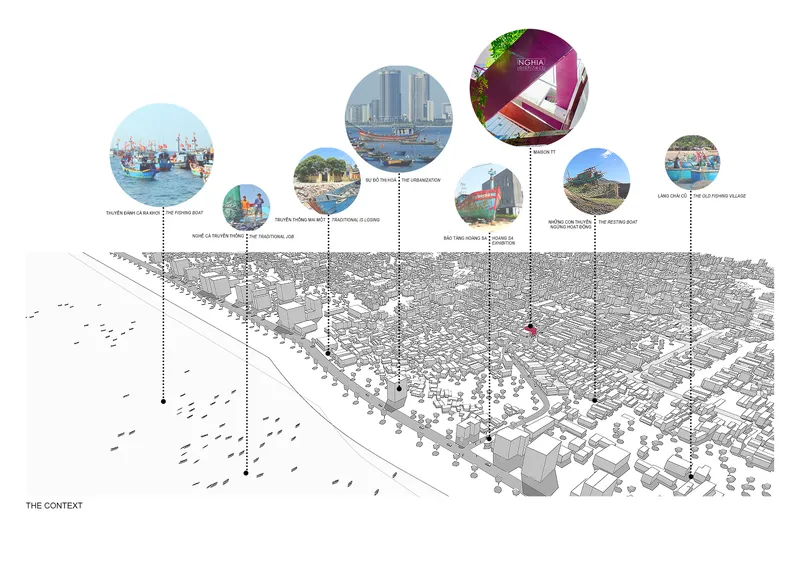
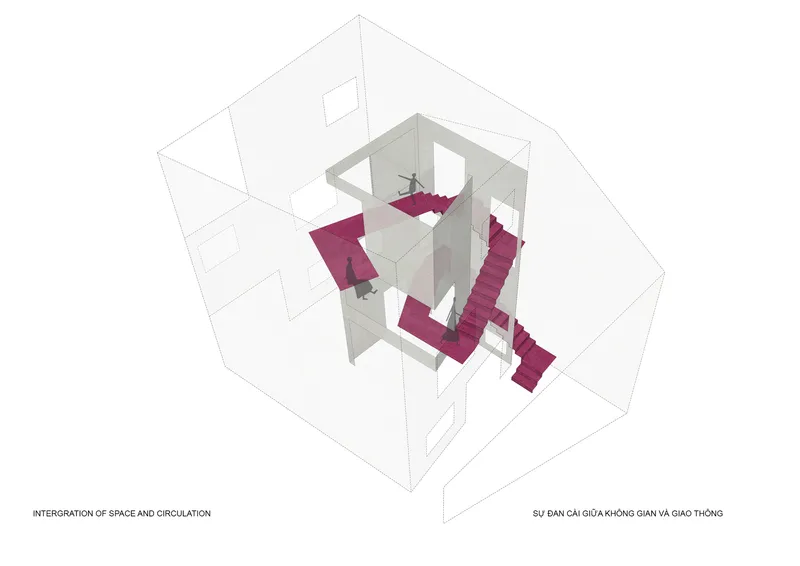
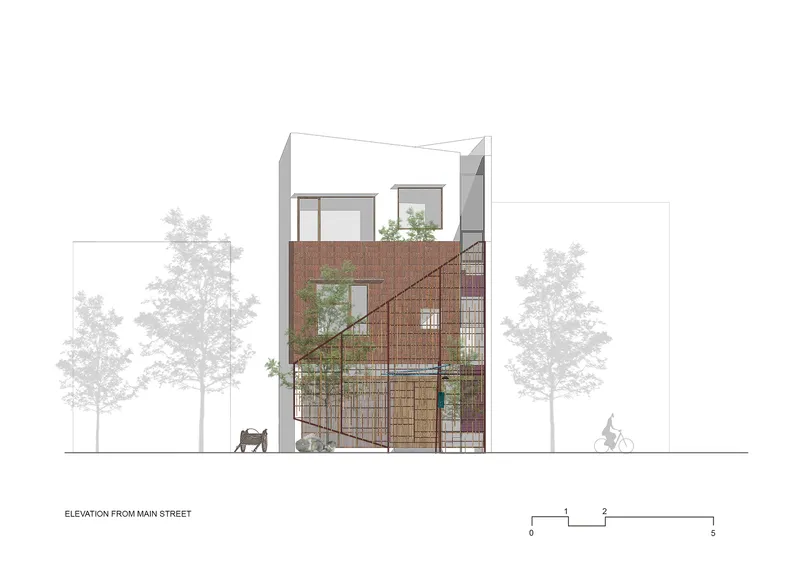
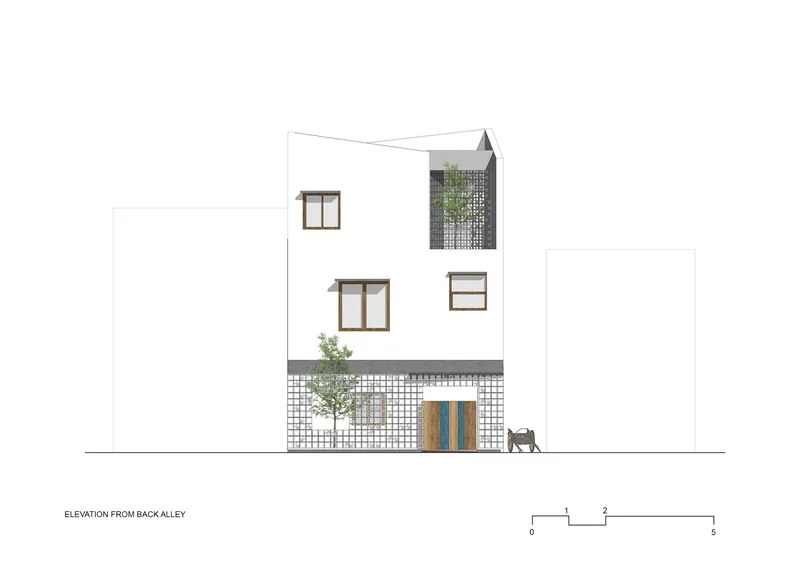
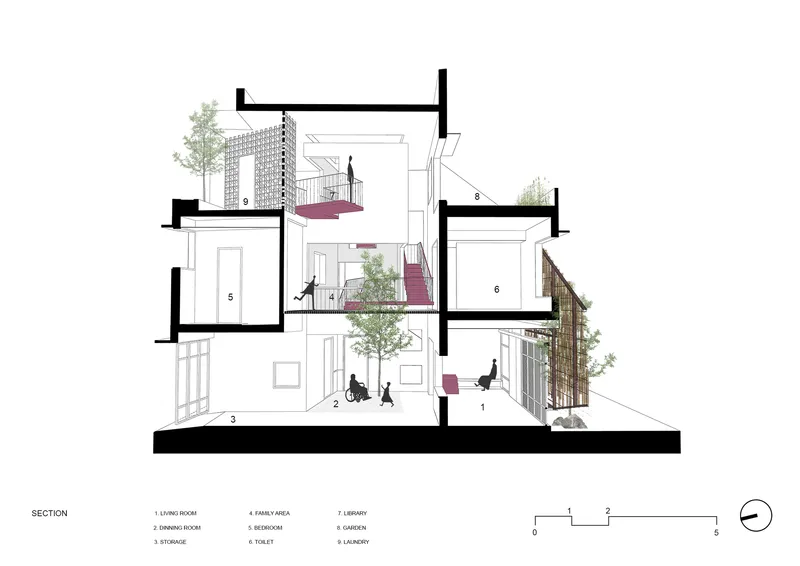
The site plan reveals just how compressed the urban fabric is: Maison TT occupies a sliver in a dense block bordered by a waterfront promenade, the last thread connecting the neighborhood to its harbor origins. The floor plans at each level show rooms wrapping tightly around the central void, with the staircase carving a continuous diagonal through the section. The axonometric cutaway is perhaps the most revealing drawing, exposing the zigzagging magenta stair as a single unbroken circulation spine from ground to roof.
The conceptual diagrams tracing folded paper studies to interior volumes and mapping reclaimed boat timber to the angled plan geometry make explicit what the built house implies: every formal decision has a material and cultural rationale behind it. The section drawing, with its planted trees growing through the void and a figure in a wheelchair at ground level, confirms that accessibility and environmental performance were designed into the core structure from the start.
Why This Project Matters
Maison TT matters because it treats the Vietnamese townhouse not as a limitation but as a vehicle for spatial invention. Where most infill projects in rapidly developing cities like Da Nang stack rooms and call it housing, Nghia-Architect spirals program around a courtyard, folds walls off axis, and recycles the literal material of the city's disappearing maritime culture into its domestic surfaces. The result is a house that performs better than its neighbors environmentally while carrying more cultural weight than a building of its size has any right to.
It also demonstrates that multigenerational living does not require large floor areas. It requires thoughtful section design, shared spaces that genuinely draw people together, and a willingness to let circulation be more than a corridor. At 75 square meters, Maison TT houses five people across three generations with daylight, ventilation, privacy, and a tree growing through its center. That is not a compromise. That is architecture doing its job.
Maison TT by Nghia-Architect, lead architect Nguyen Tuan Nghia. Located in Da Nang, Vietnam. 75 m². Completed in 2020. Photography by Nguyen Tuan Nghia.
About the Studio
Share Your Own Work on uni.xyz
If projects like this are the kind of work you want to make, uni.xyz is a place to publish your own, find collaborators, and enter design competitions.




Popular Articles
Popular articles from the community


Hill & Cross Opera: Sculptural Opera House Architecture Shaped by Tallinn’s Landscape and Identity
Hill & Cross Opera reimagines opera house architecture in Tallinn through its sculptural hill, civic plaza, glass wave and a luminous cross.

Conexión: Biophilic Design Reimagines High-Rise Living in Hong Kong
Conexión reimagines high-rise living in Hong Kong through biophilic design, green facades, shared spaces, daylight, water and nature within.

The Earth Pod: 3D Printed Homes for Resilient Refugee Communities
The Earth Pod reimagines refugee housing through 3D printed homes made from clay, combining resilience, self-sufficiency, and rapid shelter.

Play: Fragments of Their World
Familiar architecture becomes modular playground design, creating safe spaces where displaced children can learn, connect, imagine and play.


Similar Reads
You might also enjoy these articles

Bao Huynh Watercolor Atelier: A Serene Art Retreat in Hội An
Bao Huynh Watercolor Atelier in Hội An blends multifunctional art spaces, sustainable design, local materials, and family-friendly living in a serene environment.

Atelier Macri Concept Store Interior Design by CASE-REAL
Atelier Macri store features a "ko" counter, walnut wood details, cork displays, blending retail, gallery, and seamless customer experiences.

Manuel Vargas Izquierdo Stadium and High-Performance Sports Center: Architectural Excellence in Jalpa de Méndez
The Manuel Vargas Izquierdo Stadium blends sustainable design, inclusive sports facilities, and cultural-inspired architecture, revitalizing Jalpa de Méndez’s public spaces.

KAKR Buluh Awar Hall: Revitalizing Community and Ecology Through Bamboo Architecture
Community built bamboo hall revitalizes Buluh Awar village, empowering youth, restoring ecology, celebrating vernacular craftsmanship through sustainable architecture and culture.

Explore Architecture Competitions
Discover active competitions in this discipline



Challenge to reimagine the Iron Throne


Photograph architecture without architects


Illustrate the lost glory of Angkor Wat - Render Challenge


Design challenge to reuse E-waste
Comments (0)
Please login or sign up to add comments
No comments yet. Be the first to comment!