
Tribeira Arquitetura Builds a Philosophy Professor's Life Story into an 883 sq ft Brasília Apartment
Three cities, one thinker, and a renovation in Brasília that turns personal biography into architectural material.


A philosophy professor who has lived in São Paulo, Fribourg, and Brasília walks into an 883 square foot apartment and asks his architects to make it feel like all three cities at once. That is not a setup for a joke. It is the brief that Tribeira Arquitetura, led by André Oliveira, Manuela Galvão, and Rodrigo Gimenes, received for the Nietzsche Apartment, a residential renovation completed in 2022 in the Brazilian capital. The result is a compact dwelling where every material choice carries a specific geographic and intellectual reference, none of it accidental.
What makes this project worth studying is not the literary conceit itself but how literally the architects commit to it. The organic-shaped concrete dining table nods to Niemeyer's Copan Building in São Paulo. The pale yellow doors recall Fribourg's pastel historic center. The black hydraulic floor tiles echo the dark ground planes of Brasília's modernist pilotis. These are not vague mood-board associations. They are traceable decisions that give the apartment a density of meaning unusual for a space this size, and they coexist with genuinely smart spatial moves: stripping back layers to reveal original structure, restoring buried parquet, and opening the plan to let cross-ventilation do its work.
Concrete Revealed, Not Applied
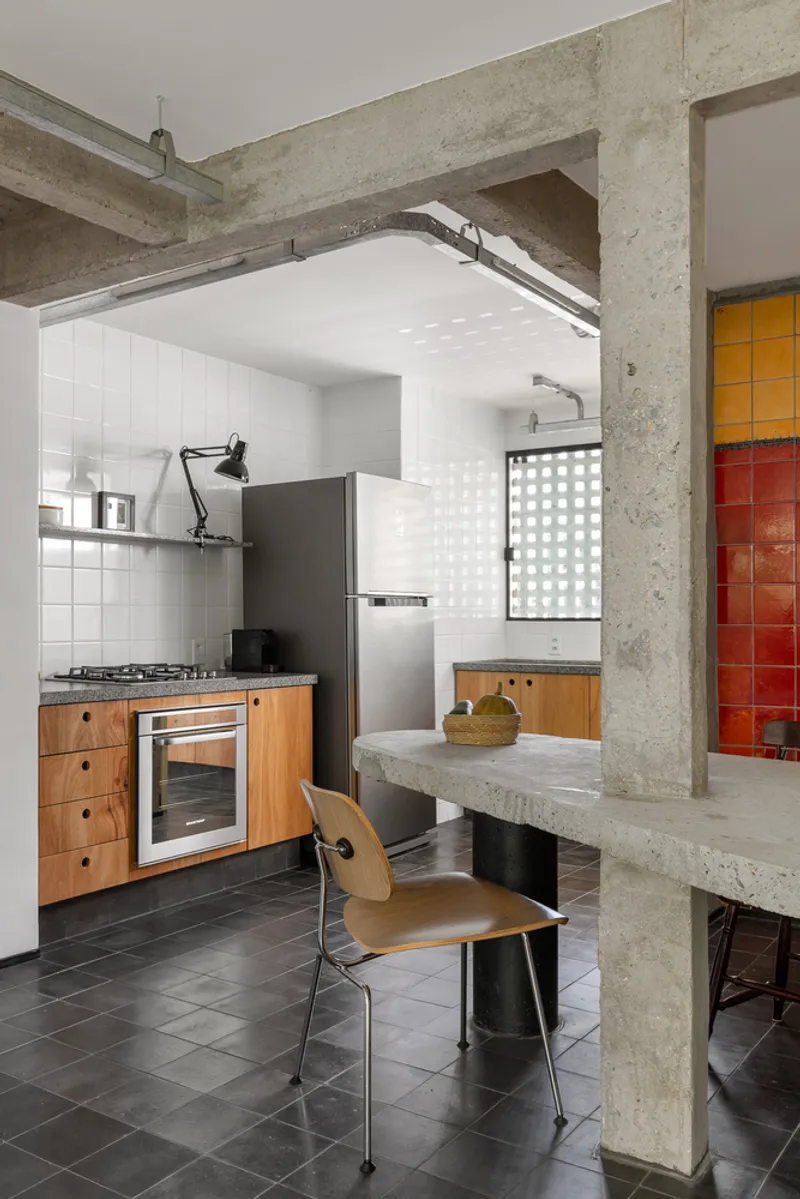
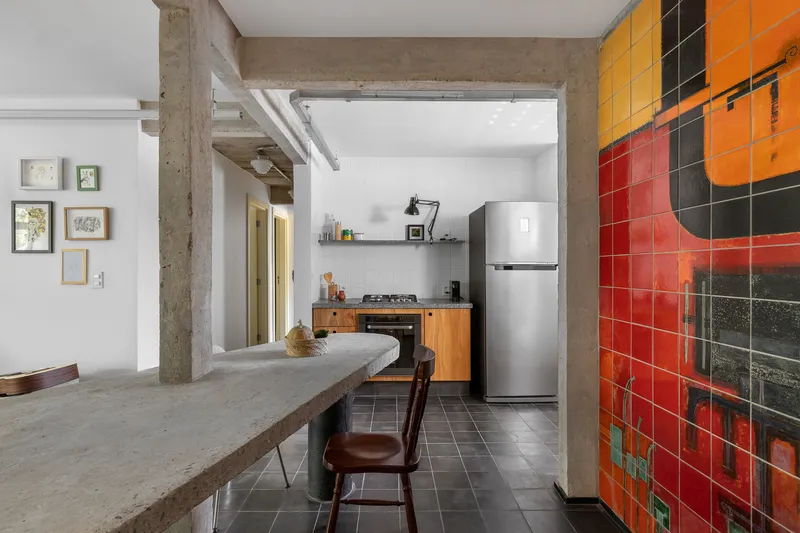
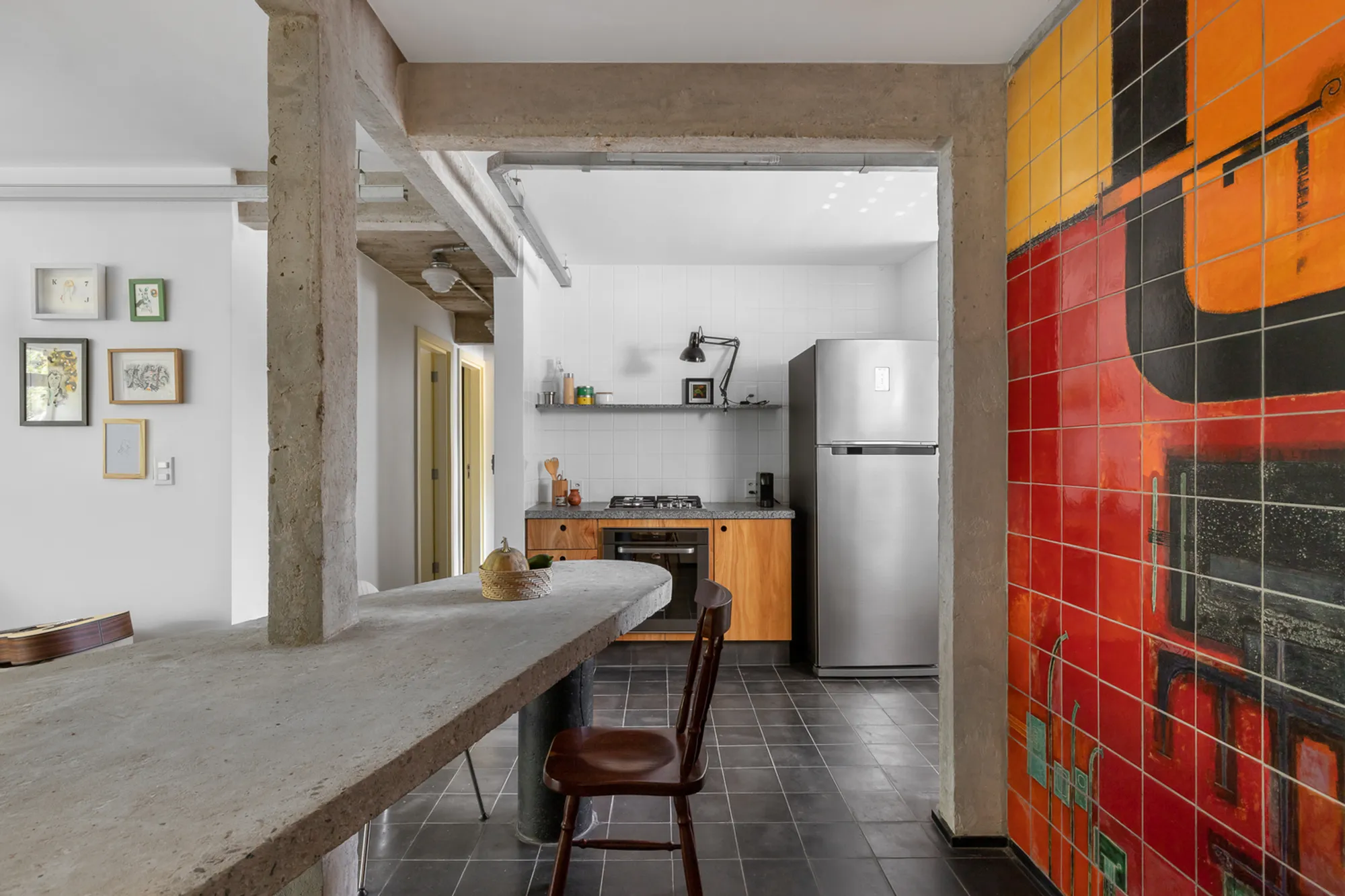
The most dramatic gesture in the renovation was demolishing the wall between kitchen and living area, a move that exposed the apartment's original concrete structure: beams, columns, and cobogós that had been hidden behind previous finishes. Tribeira did not clad these elements or treat them as embarrassments. They left them raw, letting the rough texture of the concrete establish the apartment's tonal center. A pair of exposed columns was repurposed as supports for a custom concrete dining table whose curved form references Niemeyer's sinuous São Paulo landmark.
The timber cabinetry and white tile backsplash in the kitchen read as warm, secondary layers laid against this concrete skeleton. The effect is honest without being punishing. You feel the building's bones, but the space never tips into cold industrial territory, thanks to the wood grain and the shock of color on the accent wall behind the counter.
The Symphony of Fire
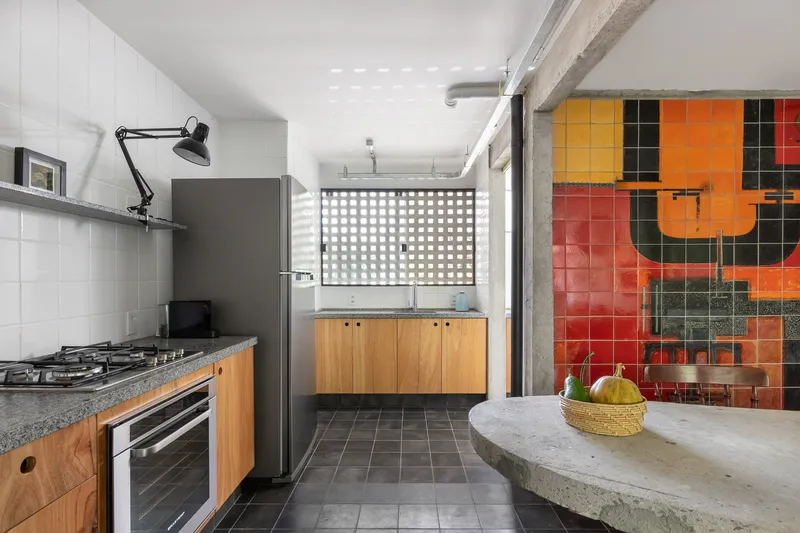
The custom tile panel by local artist Marco Rodrigues is the apartment's most visually aggressive element, and it earns its place. Titled "The Symphony of Fire," the glazed composition of orange, red, and black abstract forms occupies the kitchen wall like a painting that has been absorbed into the architecture. Its colors are warm and percussive, reflecting the client's passion for music while breaking the otherwise restrained palette of concrete, timber, and white.
Positioning the panel in the kitchen rather than the living room was a deliberate choice. It transforms a utilitarian zone into the apartment's emotional center, the place where the professor cooks, eats, and hosts. The concrete beams overhead and the dark tile floor below frame it like a stage. The potted plants and timber furniture in the adjacent living area provide visual relief, preventing the intensity from becoming exhausting.
Parquet Recovered, Identity Preserved
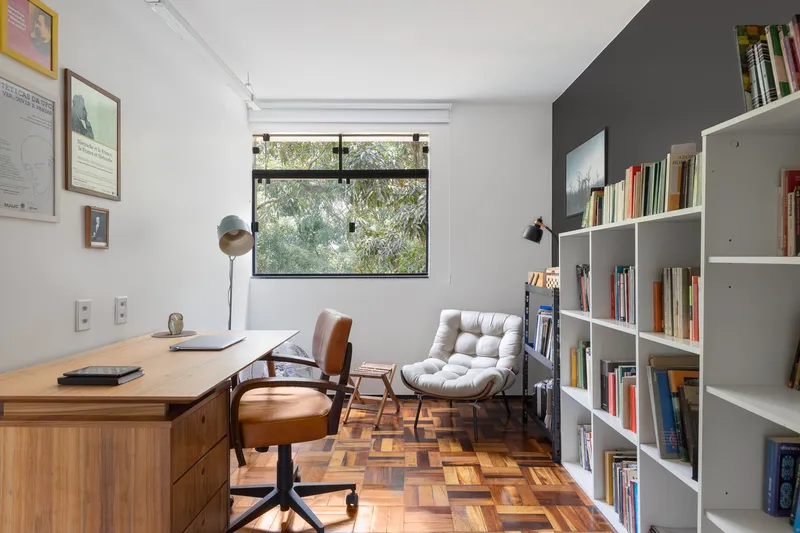
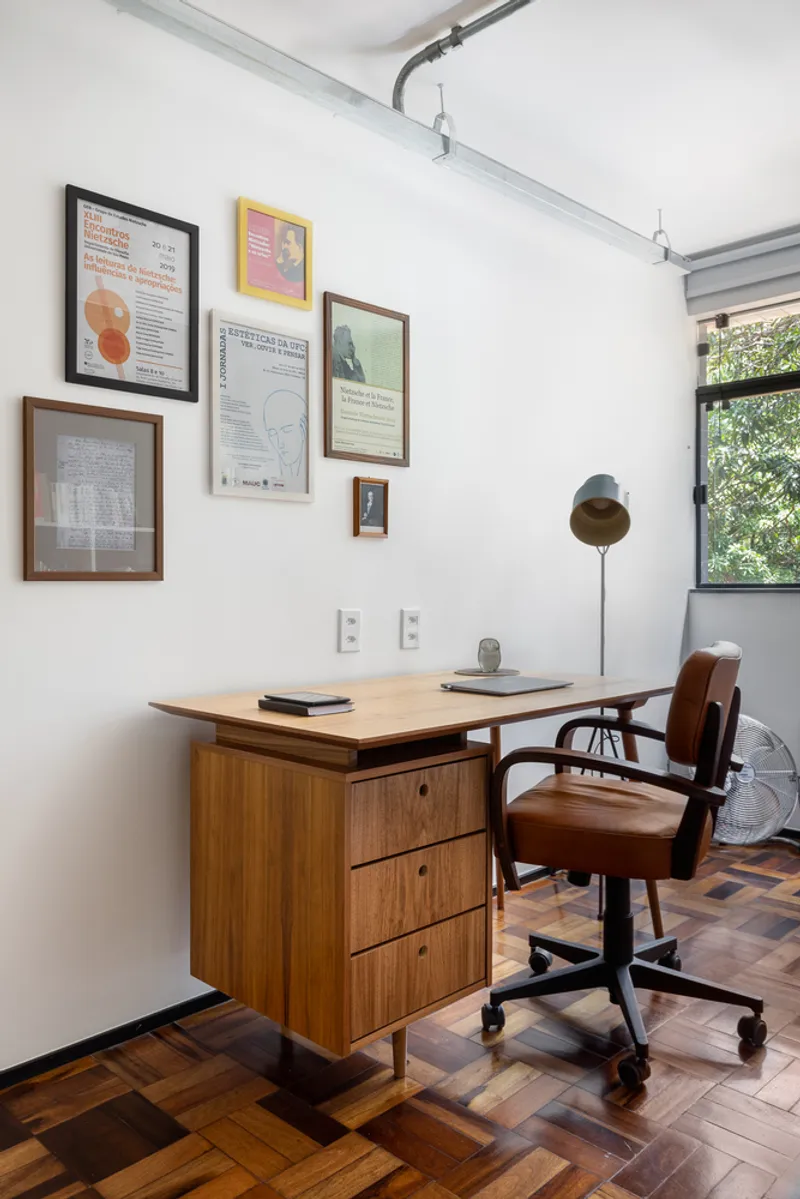
Beneath a floating floor installed by a previous owner, the architects found the apartment's original wooden parquet. Rather than replacing it with something new, Tribeira carefully restored and revitalized the existing material. The result is a floor with patina, warmth, and a connection to the building's history that no new product could replicate. It runs through the private rooms and the home office, establishing a clear material boundary between the intimate zones and the social areas, where black hydraulic tile takes over.
The home office, visible in these images, shows the parquet at its best: anchoring a simple timber desk, white shelving, and a gallery wall of framed prints. The room is modest in size but specific in character. Window views to foliage outside pull green into the composition without any effort.
Yellow Doors and the Fribourg Connection
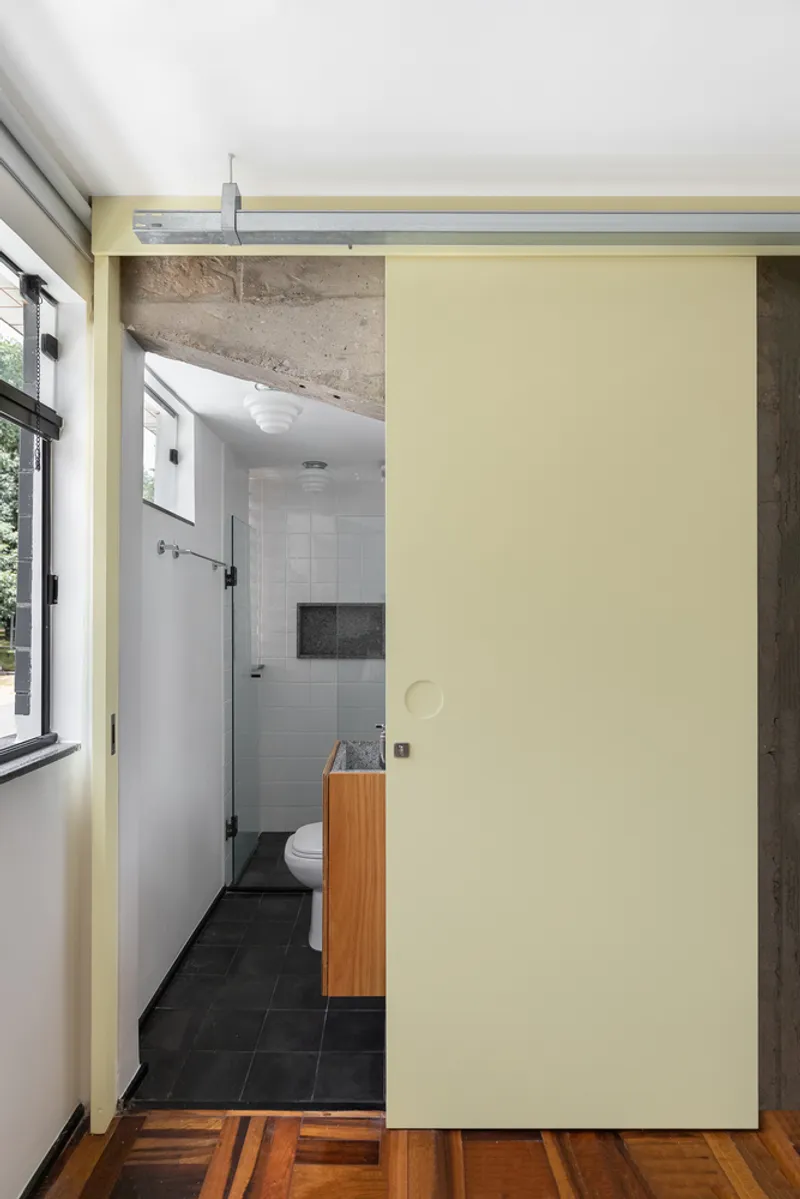
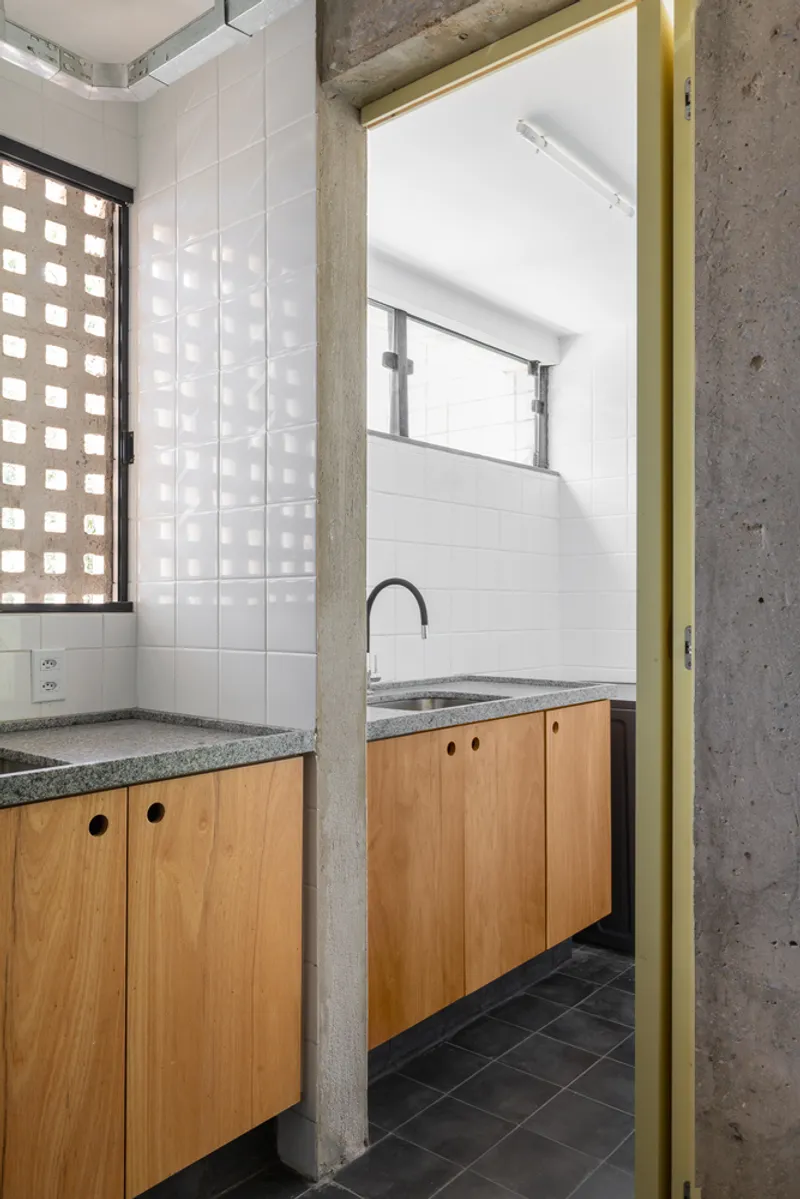
The pale yellow sliding doors are among the subtlest references in the project, and they work precisely because they do not announce themselves. Inspired by the pastel-colored facades of Fribourg's historic center, where the client once lived, the doors add a soft chromatic warmth to the circulation spaces. They slide open to reveal bathrooms where exposed concrete ceilings meet white tile walls, another instance of the renovation's strategy of layering new finishes against revealed structure.
The bathroom thresholds are framed by exposed concrete columns, giving even these small rooms a sense of architectural weight. The perforated block windows (cobogós) provide filtered daylight and ventilation, solving a practical problem with a material that is itself deeply embedded in Brazilian modernist tradition. Nothing here is decorative for its own sake.
Private Rooms, Quiet Material Logic
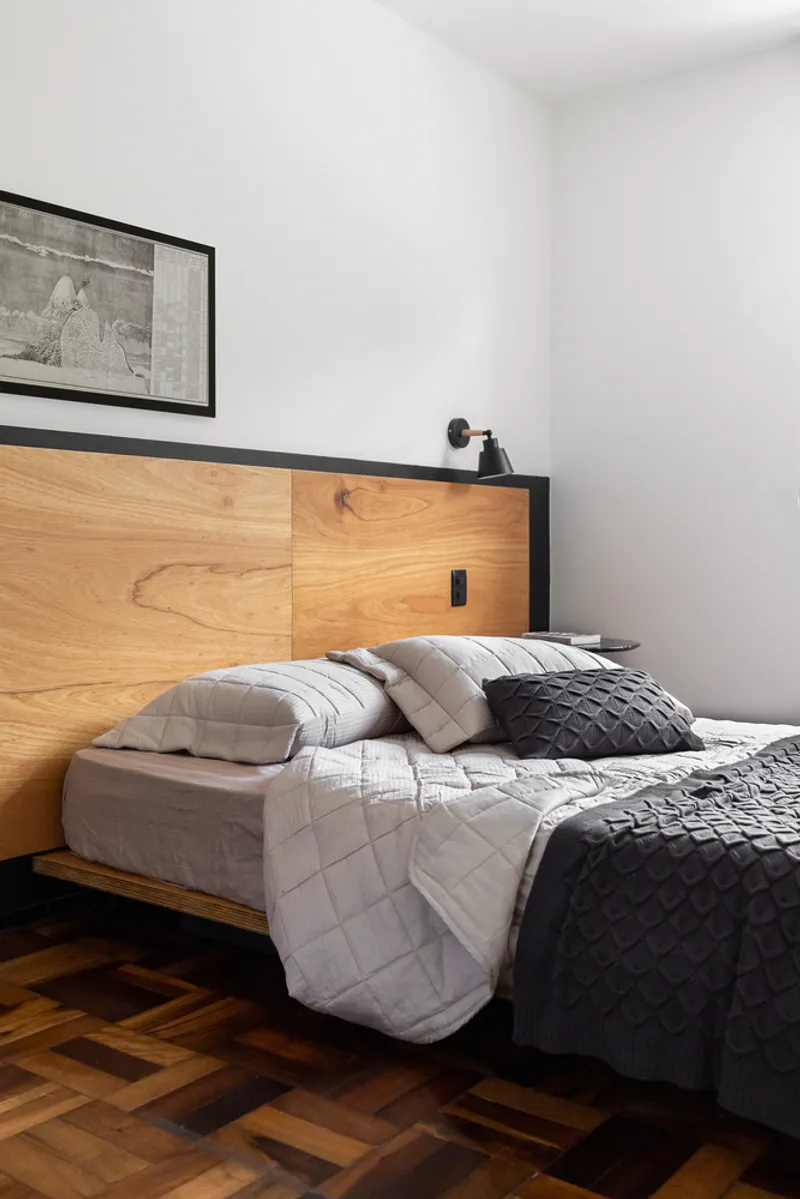
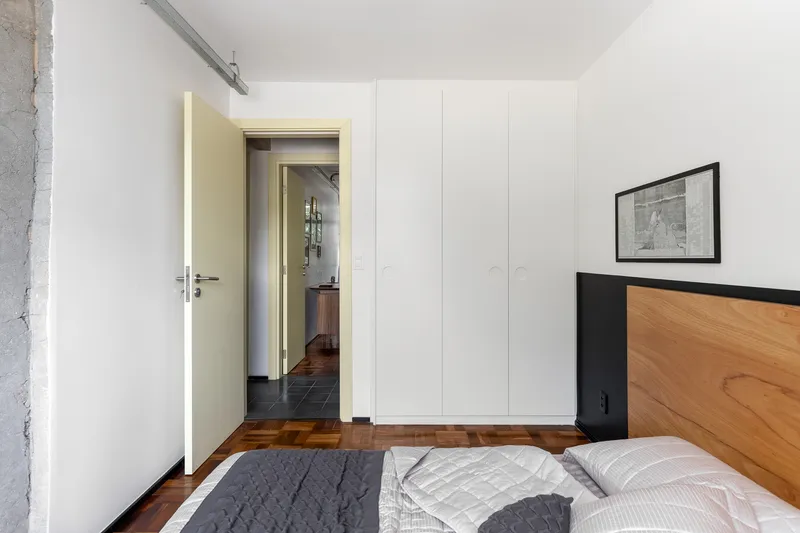
The bedroom suite is the project's calmest zone. A timber headboard with integrated lighting runs the width of the wall, providing a functional and visual anchor for the room. Grey bedding, white built-in wardrobes, and the restored parquet floor keep the palette deliberately restrained. The view through to a dark-tiled corridor in one image shows how the material transitions are handled: timber gives way to black tile at the threshold, marking the shift from private to social without a door slam.
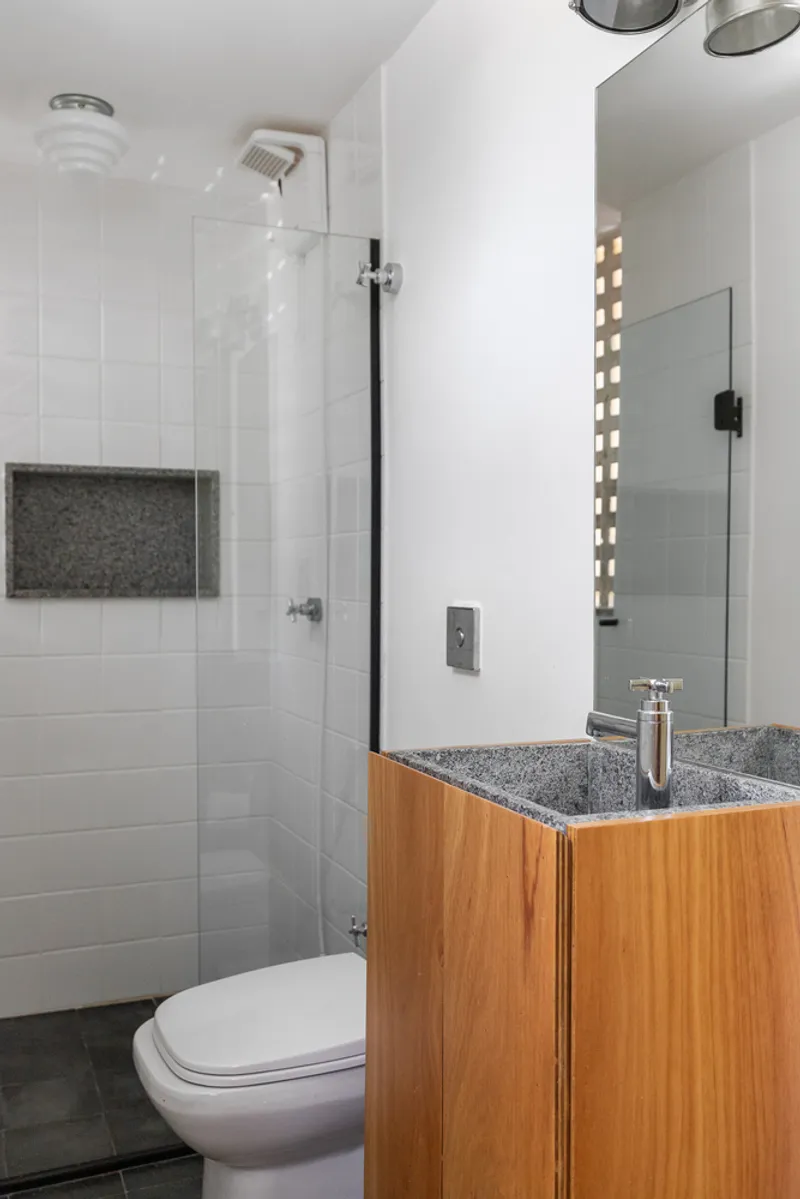
The compact bathroom pairs white subway tile with a terrazzo-topped timber vanity and a glass block light well, a combination that feels considered rather than trendy. Tribeira understood that in an apartment this size, the bathrooms cannot be afterthoughts. They receive the same material attention as the public spaces, scaled down but never simplified.
Living with Objects, Living with Ideas
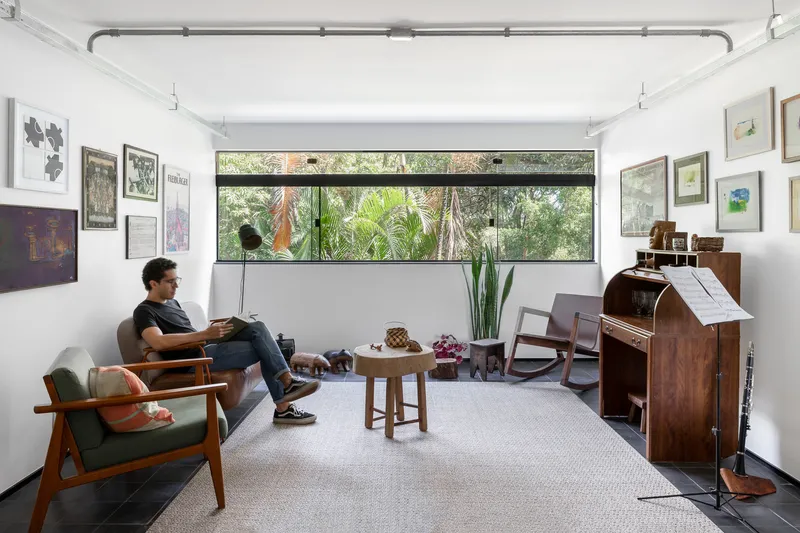
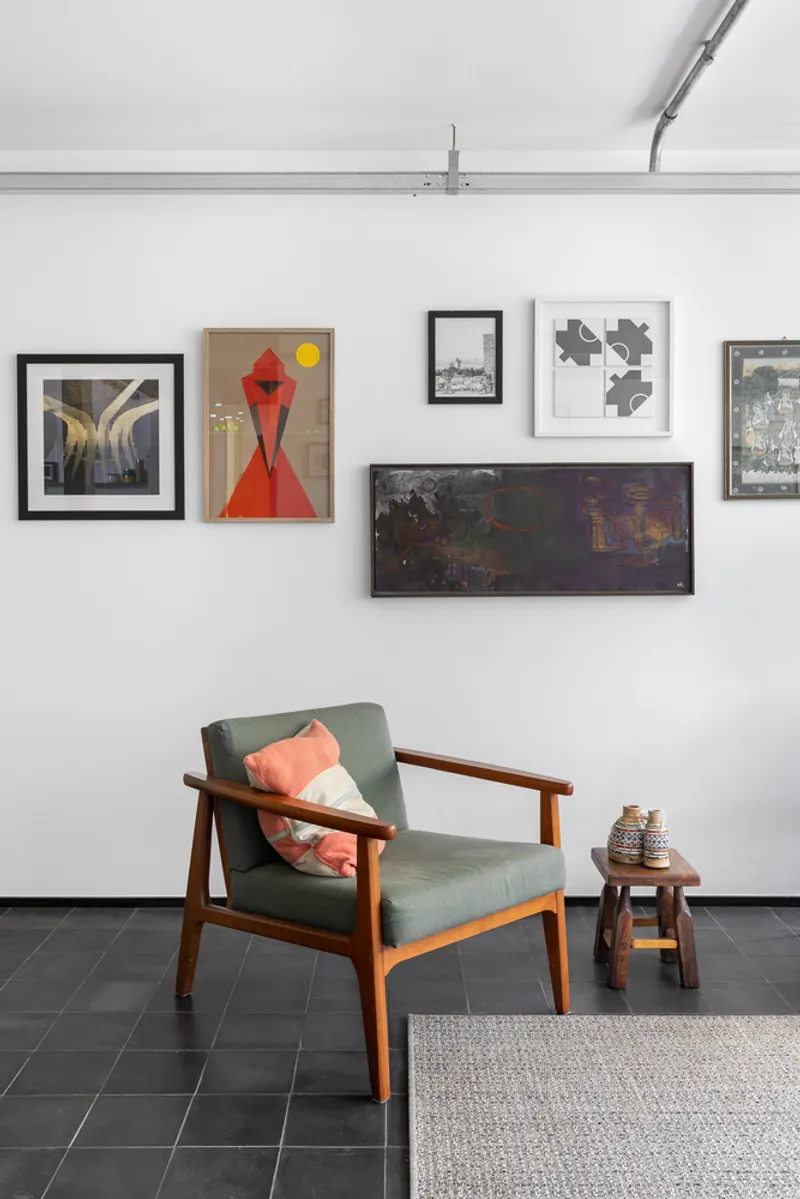
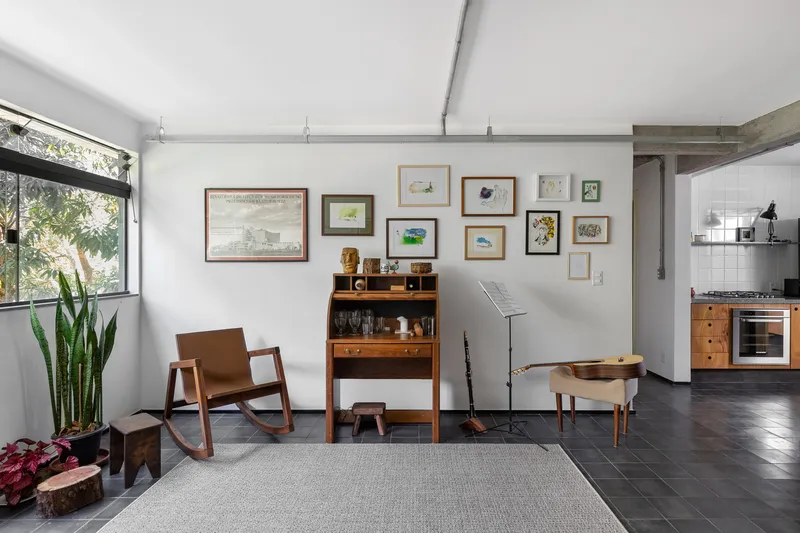
The living area is designed as a stage for the professor's curated collection of furniture, art, and books. The salon-hung artwork on a white wall above a timber armchair, the dark tile floor providing a grounding contrast, the horizontal window framing garden views: these are compositions that serve the objects as much as the inhabitant. Tribeira gave the client a background architecture, one that recedes where the collection needs to speak and asserts itself where structure demands acknowledgment.
The midcentury armchair visible in the corner window shot is not incidental. The client's furniture is Brazilian modern, and the apartment's material palette of concrete, timber, and tile was calibrated to receive it. The black hydraulic floor tiles in the social areas act like a plinth, giving each piece definition against a dark, uniform ground.
Why This Project Matters
Narrative-driven design is easy to dismiss as gimmick. A client says they love Nietzsche and their architect puts a quote on the wall. That is not what happened here. Tribeira took a biography, broke it into places and ideas, and translated those into material and spatial decisions that can be read by anyone who pays attention but never overpower the room. The São Paulo concrete, the Fribourg yellow, the Brasília tile: each reference is embedded in a functional element, not appliquéd onto a surface. The apartment works as a home first and a story second.
At 883 square feet, the Nietzsche Apartment also demonstrates that meaningful renovation does not require large canvases. Stripping a floating floor to find original parquet, removing a wall to reveal a concrete frame, commissioning a local artist for a tile mural: these are modest interventions with outsized returns. They demand attention and care rather than budget. For architects working on compact residential projects, this is a useful case study in how specificity of intent can elevate ordinary square footage into something genuinely personal.
Nietzsche Apartment by Tribeira Arquitetura (André Oliveira, Manuela Galvão, Rodrigo Gimenes). Brasília, Brazil. 883 sq ft. Completed 2022. Photography by Júlia Tótoli.
About the Studio
Share Your Own Work on uni.xyz
If projects like this are the kind of work you want to make, uni.xyz is a place to publish your own, find collaborators, and enter design competitions.




Popular Articles
Popular articles from the community


Lunar Spiral: Space Architecture Shaped by the Mathematics of the Universe
Lunar Spiral reimagines space architecture through Fibonacci geometry, lunar regolith, levitating habitats, and self-sustaining Moon living.

Play: Fragments of Their World
Familiar architecture becomes modular playground design, creating safe spaces where displaced children can learn, connect, imagine and play.

Hill & Cross Opera: Sculptural Opera House Architecture Shaped by Tallinn’s Landscape and Identity
Hill & Cross Opera reimagines opera house architecture in Tallinn through its sculptural hill, civic plaza, glass wave and a luminous cross.

The Musturak Paradise: Senior Living Architecture for a Connected Future in Temara, Morocco
The Musturak Paradise reimagines senior living architecture in Temara via private homes, social spaces, culture, community, and shared care.

Similar Reads
You might also enjoy these articles


Hodi-Mandai Geram
Project Function: Preservation and revitalization of the Intangible heritage and socio-spatial identity of the Hodi by Housing, Cultural Memory Center, Sacred Grove, landscape, local tourism economy


Olio Towers: A Mid-Rise for Performers That Fuses Housing, Rehearsal, and Stage
Located blocks from Houston's Theater District, this modular tower stacks living units around a central performance atrium.

Oasis: Modular Green Housing Carved into Dhaka's Urban Fabric
A shortlisted Plugin Housing entry reclaims unauthorized settlements in Dhaka with stepped concrete volumes, green roofs, and ventilation-driven design.

Black Hole: A Floating Megastructure for the Post-Physical Era
Emiliano Mazzarotto envisions a spherical, self-scaling arena where e-sports, digital hotels, and holographic stadiums replace traditional public space.


Explore Architecture Competitions
Discover active competitions in this discipline



Challenge to reimagine the Iron Throne


Photograph architecture without architects


Illustrate the lost glory of Angkor Wat - Render Challenge


Design challenge to reuse E-waste
Comments (0)
Please login or sign up to add comments
No comments yet. Be the first to comment!