
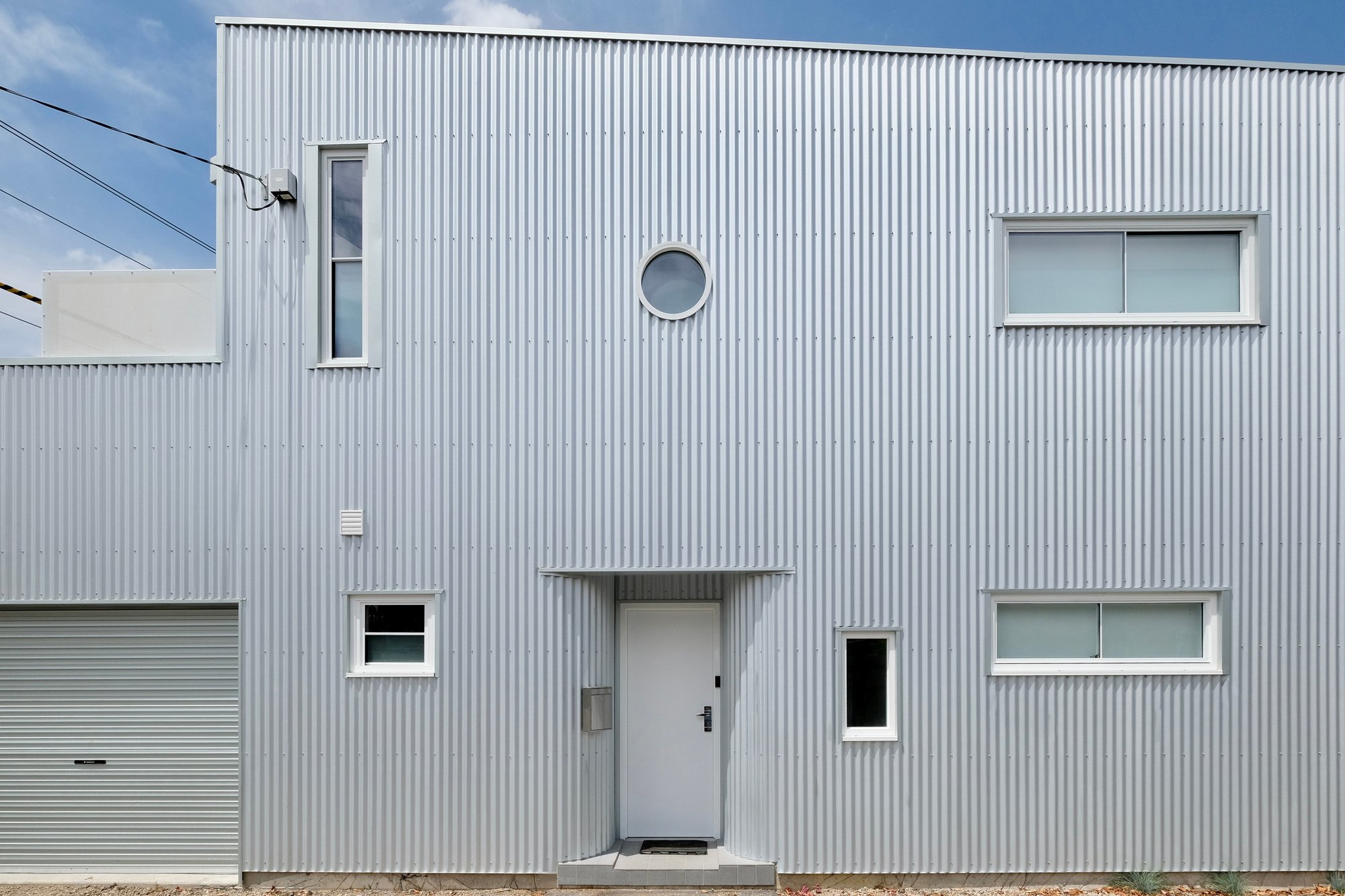
Nigel Grigg Architects Wraps a Melbourne Studio Garage in Corrugated Metal on a Triangular Lot
A sharp triangular site behind an Edwardian timber house gets a new studio garage apartment clad entirely in ribbed metal.

Melbourne's inner suburbs are full of leftover parcels, the odd-shaped scraps that remain after a century of subdivision and lane creation. Around the Bend, designed by Nigel Grigg Architects, takes one such triangular remnant behind an early-1900s Edwardian timber house and gives it a second life as a studio garage apartment. Completed in 2022, the 280-square-metre project is technically an extension, but it reads as an entirely independent building: a taut, corrugated metal volume that turns the geometry of its site into a virtue rather than a constraint.
What makes the project worth studying is how it treats an inherently awkward condition with directness. There is no attempt to disguise the angular boundaries or smooth the building into a conventional box. Instead, the plan follows the lot lines, bending around them, and the facades express that logic with a matter-of-fact material palette. The result is a building that feels both precise and casual, like it has always belonged to this particular cobblestone lane.
A Metal Skin for a Laneway Building
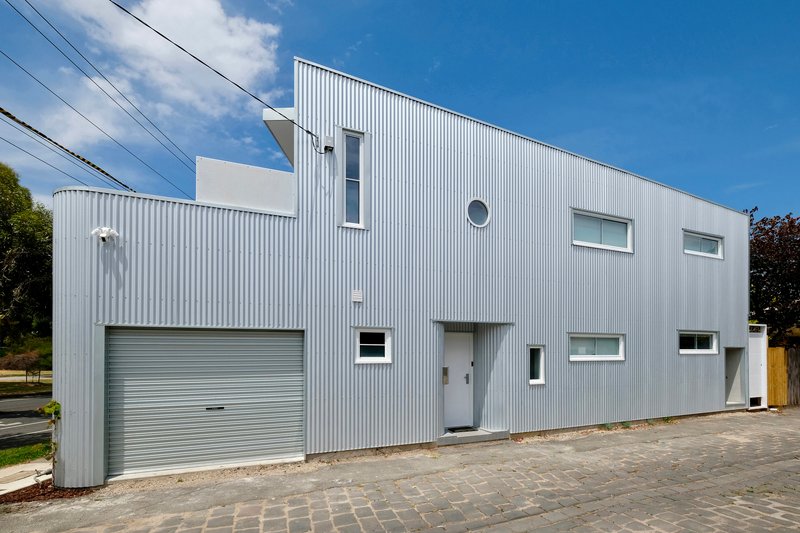
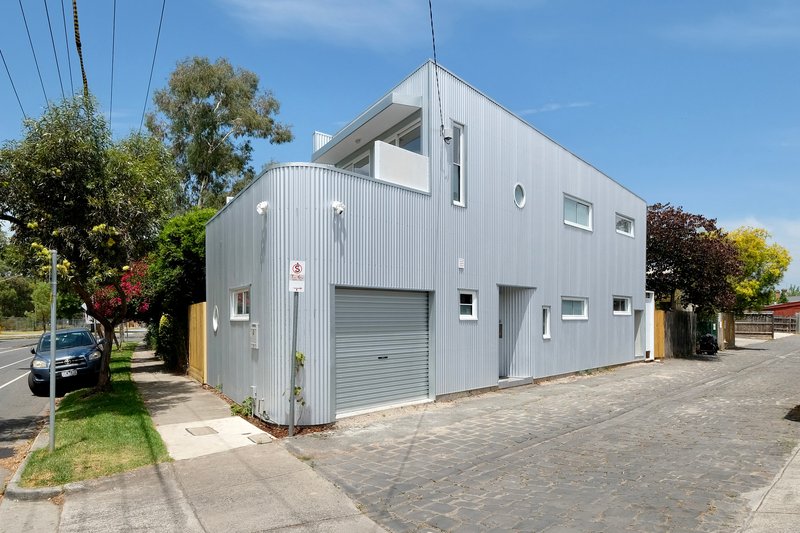
The corrugated metal cladding is the first thing you notice, and it does a lot of work. White ribbed panels wrap the entire volume, giving it a uniform industrial character that sits comfortably alongside the garages, fences, and service buildings typical of Melbourne's rear laneways. The roll-up garage door reinforces the utilitarian tone: this is a building that does not pretend to be anything other than what it is.
Yet the cladding is handled with care. Panel joints are clean, and the vertical ribs create a fine-grained texture that shifts with the light. From the cobblestone driveway, the building reads as a single monolithic surface punctuated by openings, a strategy that keeps the massing calm even as the plan shifts direction to follow the lot's irregular edges.
Scattered Openings and a Porthole
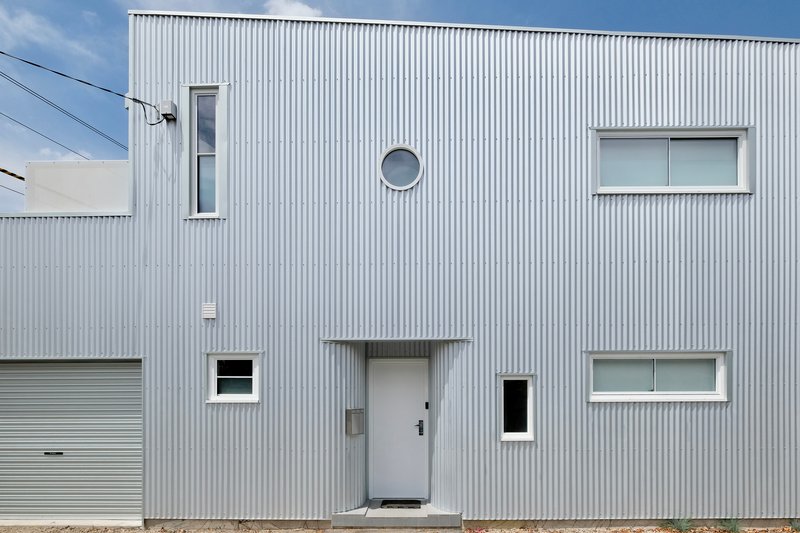
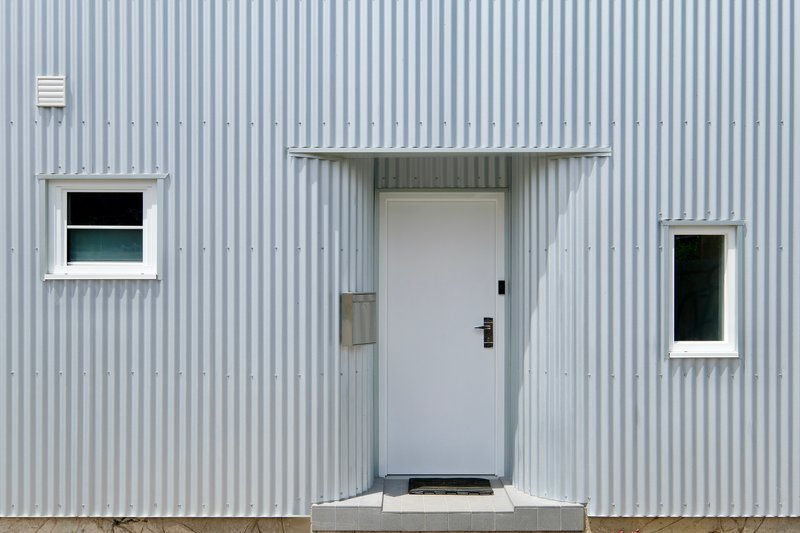
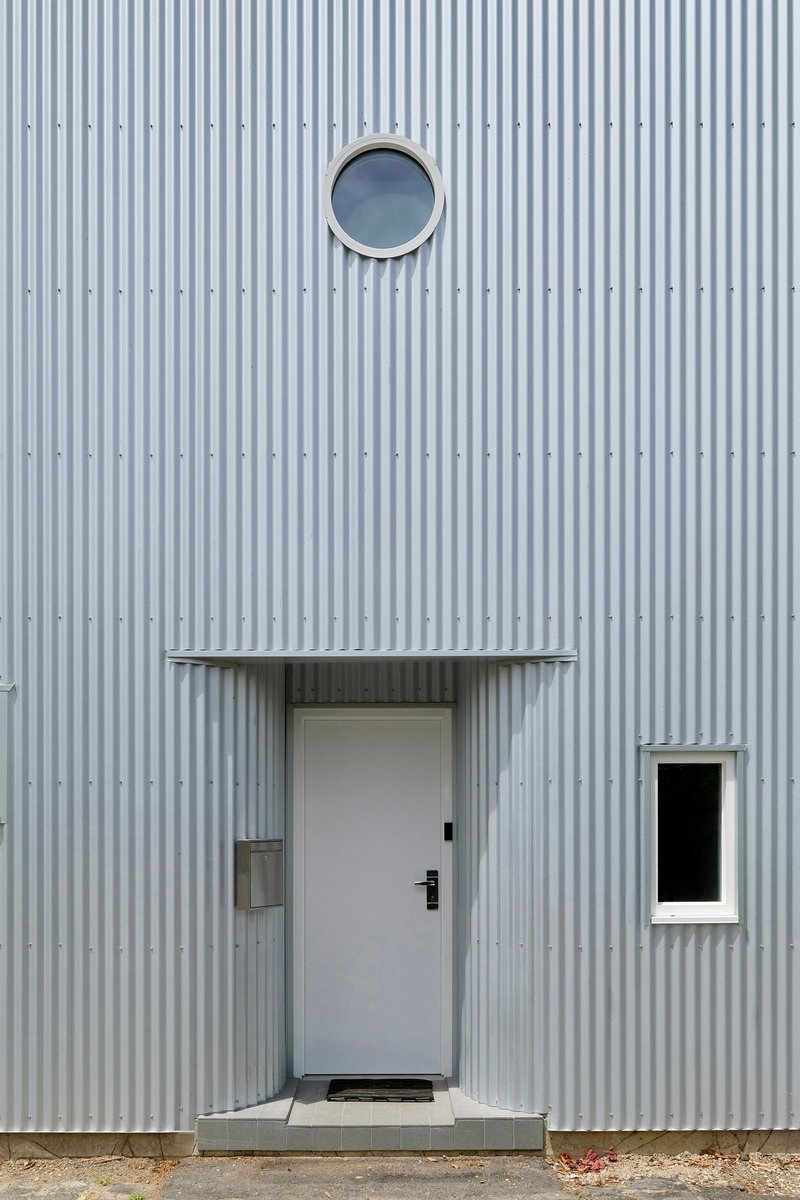
The fenestration strategy is deliberately playful. Windows of different sizes and shapes, rectangular slots, square punches, and a single circular porthole, are scattered across the facades without the kind of rigid alignment you would expect on a residential project. The porthole beside the entry door is the most memorable gesture, giving the front face a focal point and a hint of nautical character that suits a metal-clad building on a tight urban lot.
Each opening appears to respond to a specific interior need rather than an external compositional grid. The effect is informal but controlled. A canopy over the entry door provides just enough shelter, and the flanking square windows frame the threshold without ceremony.
Navigating the Triangular Site
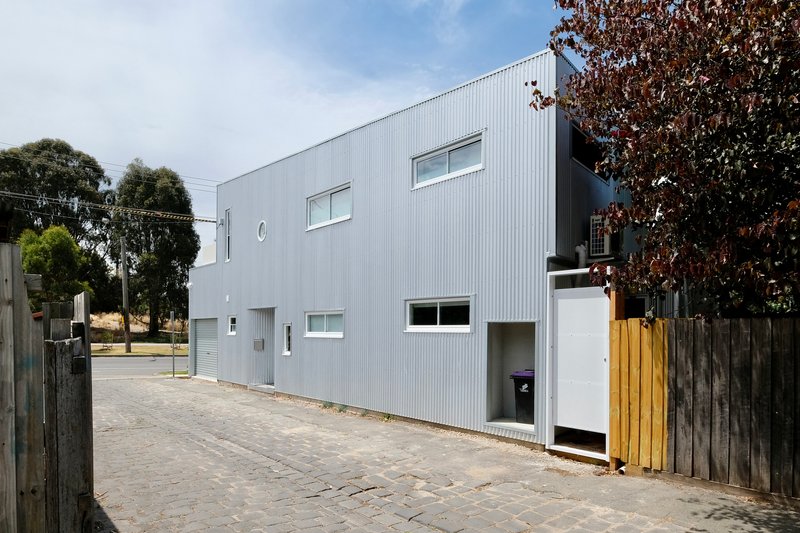
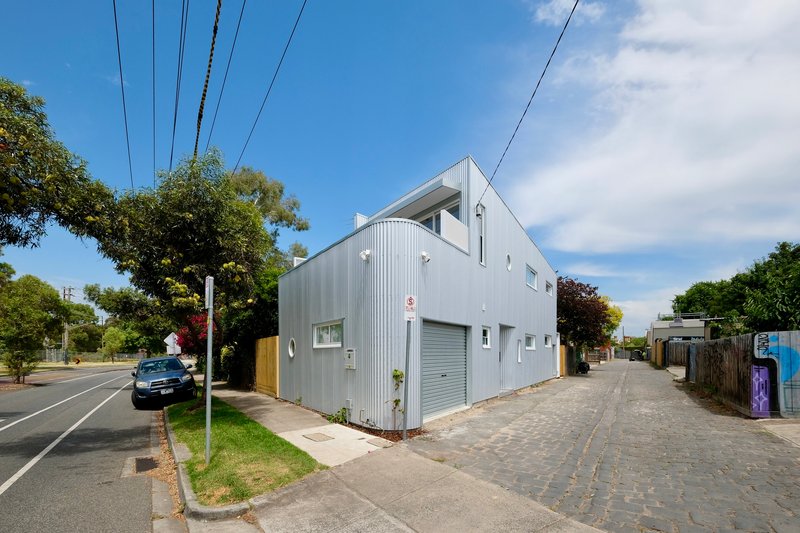
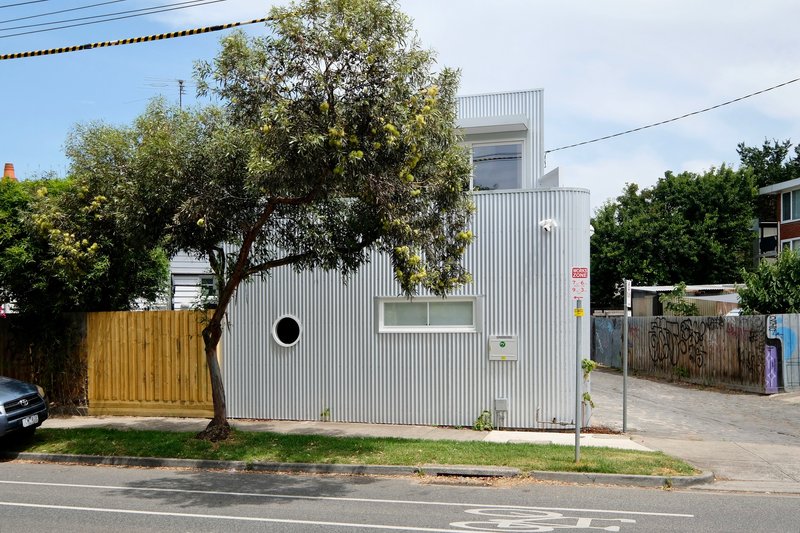
Walking around the building reveals how the plan accommodates the site's angular boundaries. The side elevations are not parallel; they converge as the lot narrows, and the corrugated cladding simply follows, wrapping each facet without fuss. Timber fences mediate between the new metal volume and the neighbouring properties, softening the boundary condition where needed.
The circular window and horizontal slot on the side facade suggest a room that benefits from borrowed light filtered through a mature tree. It is a small detail, but it shows how the architect calibrated each opening to the specific view or light condition available on that edge of the lot. On a triangular site, no two facades face the same way, and the design acknowledges that fact rather than fighting it.
Fitting Into the Streetscape
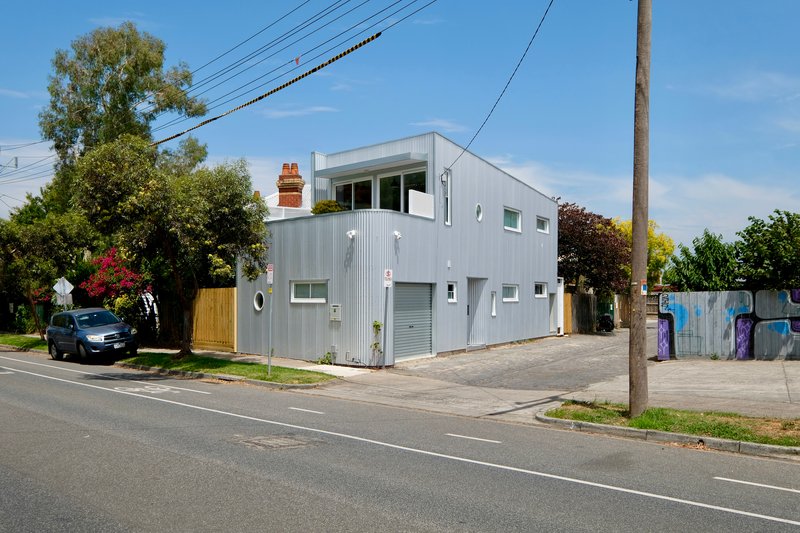
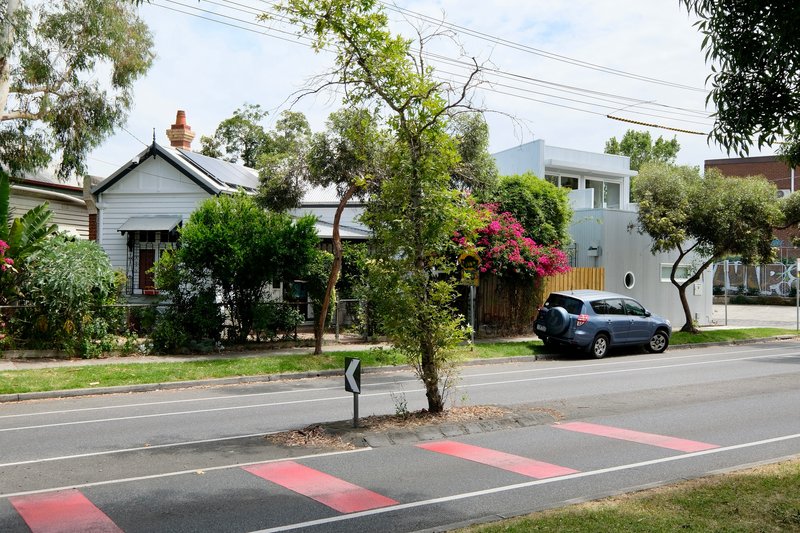
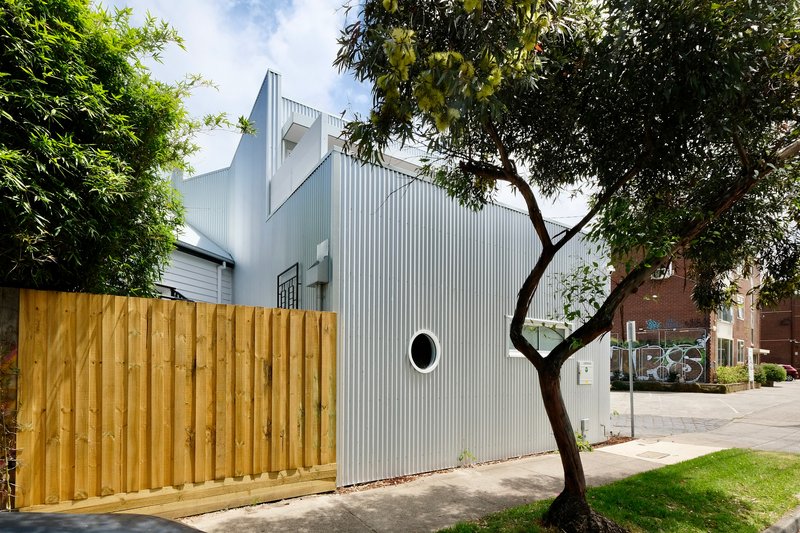
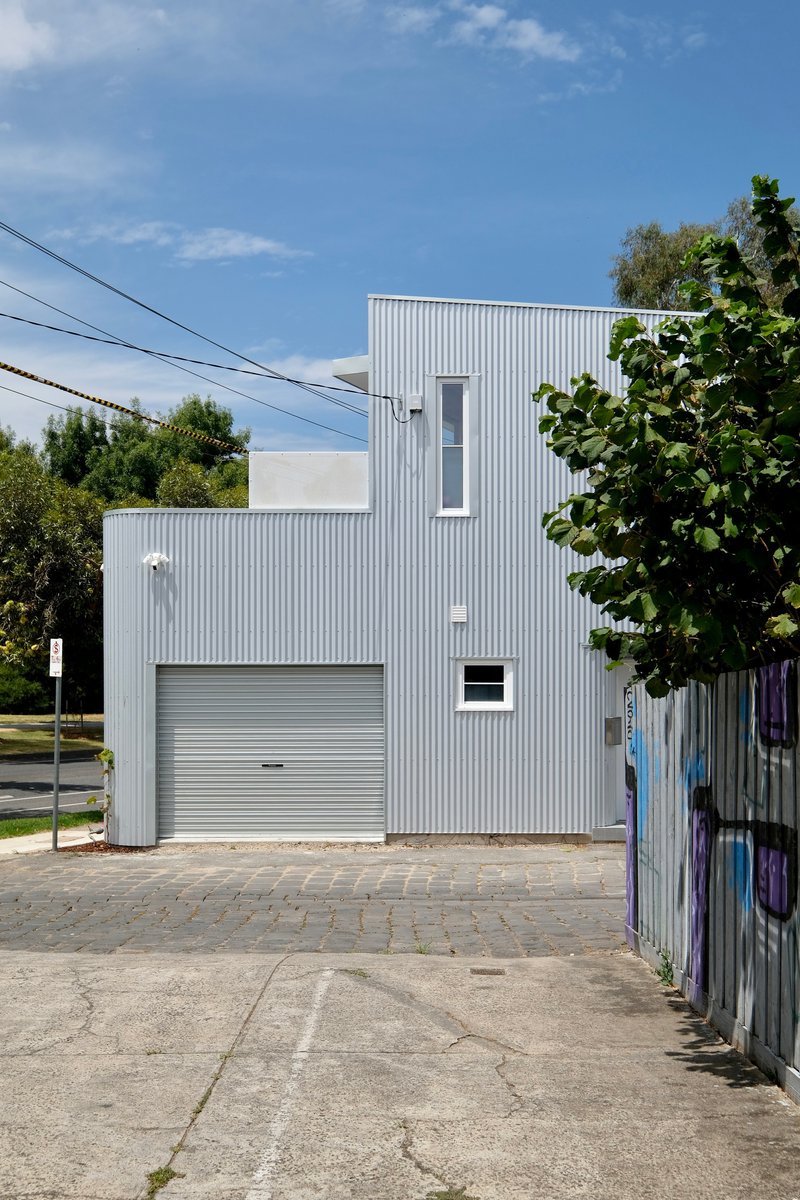
From the street, the two-storey corrugated volume holds its own among the traditional pitched-roof houses and established trees that define this part of Melbourne. A rooftop terrace and chimney break the profile, giving the building a domestic silhouette despite its industrial cladding. The scale is respectful: it does not tower over its neighbours, and its white finish keeps it visually light.
The rear view through a timber fence, with an overhanging eucalyptus casting dappled shadows on the metal, is perhaps the most revealing image. It shows the building as its neighbours actually experience it: a clean, quiet presence behind the foliage, more shed than statement. That restraint is precisely what allows the project to coexist with the heritage fabric around it.
Plans and Drawings
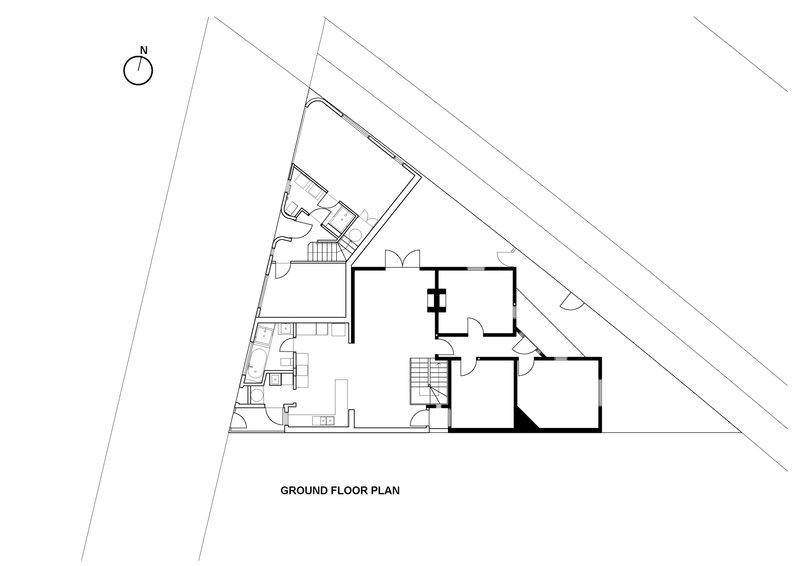
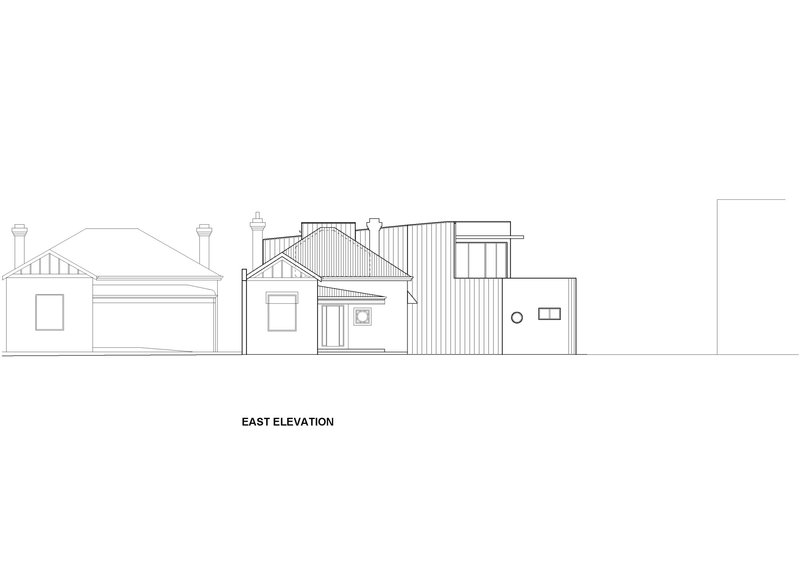
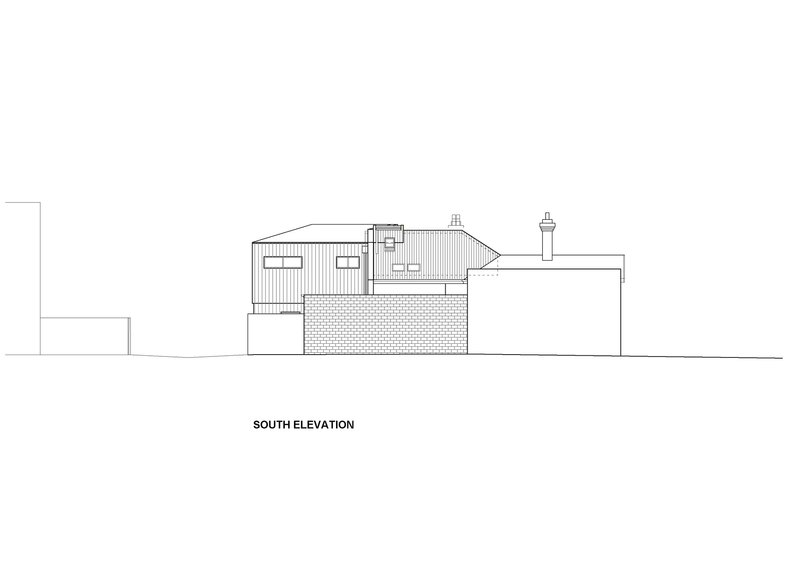
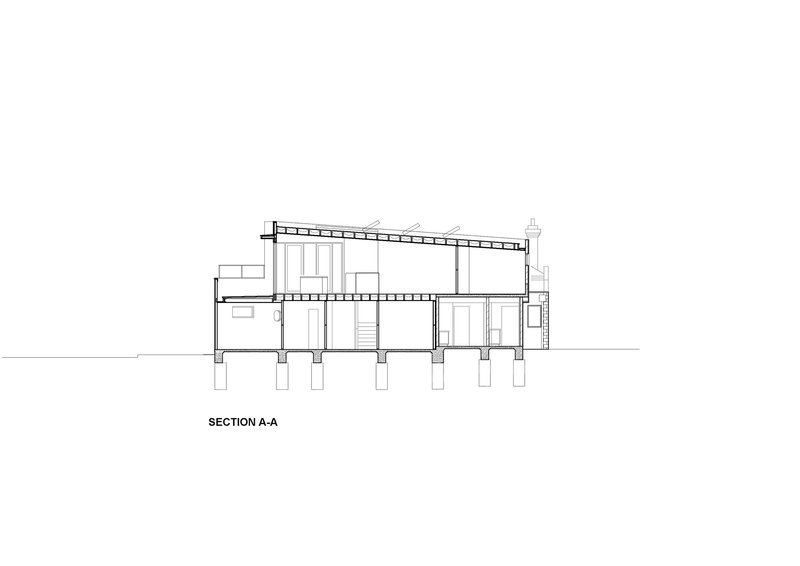
The ground floor plan confirms what the exterior suggests: rooms are arranged around a central stair core, and the plan bends to follow the angular site boundaries. There is no wasted corridor space; circulation is compact and the stair acts as the hinge around which the program pivots. The plan is essentially a wedge, widening at one end and tapering at the other, and the architect has distributed rooms to take advantage of the wider portion while keeping services in the narrow zone.
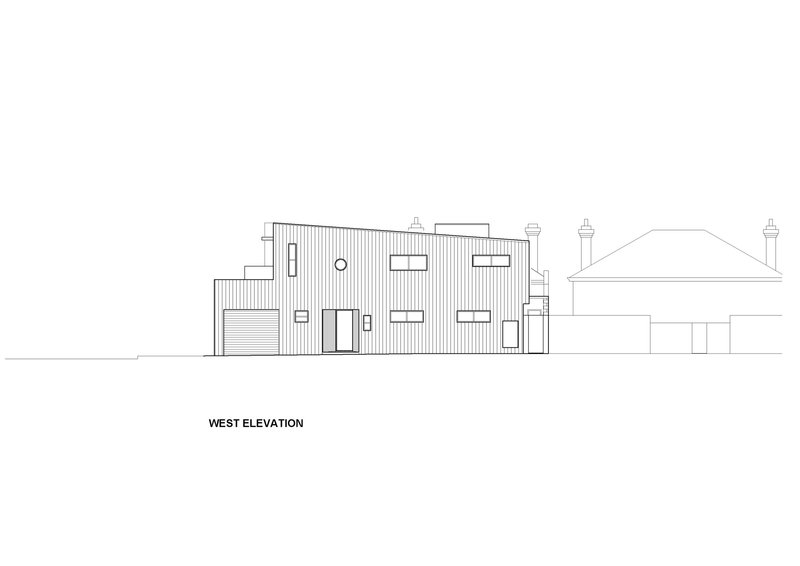
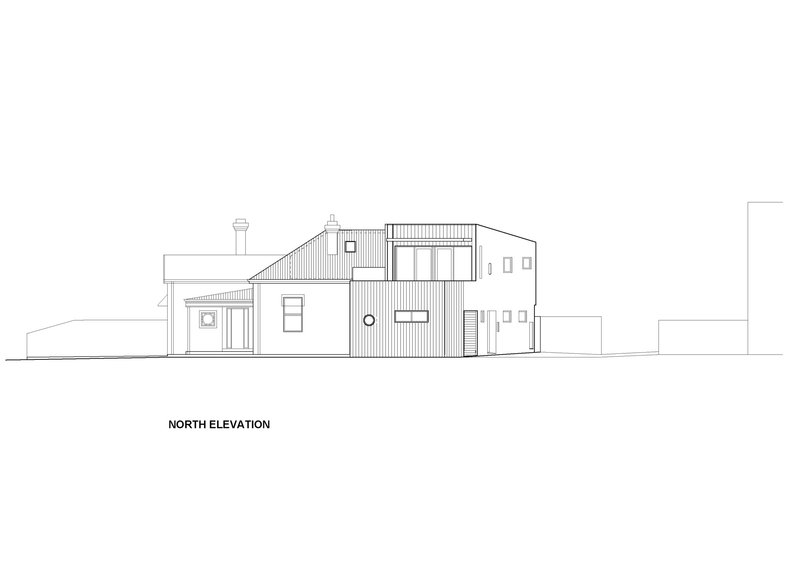
The elevation drawings reveal the relationship between the new building and the existing Edwardian house. The west elevation shows the corrugated cladding stepping down to meet the older pitched-roof structure, while the east elevation illustrates how the new volume negotiates with adjacent heritage gable roofs. The section is particularly instructive: timber framing is visible within, and the building sits on raised foundation piers, a strategy that keeps the floor level above grade and ventilates the underside, a sensible response to Melbourne's climate and the realities of building on a constrained urban lot.
Why This Project Matters
Around the Bend is not trying to reinvent the laneway building. Its value lies in its clarity: one material, one structural idea, one plan logic that follows the site without compromise. In a city where rear-lot development is increasingly common, the project offers a template for how to build densely without producing buildings that feel cramped or apologetic. The corrugated cladding is honest, the openings are purposeful, and the massing respects its context.
More broadly, the project is a reminder that difficult sites reward architects who work with constraints rather than against them. A triangular lot forces decisions that a rectangular one does not, and those decisions, the angled walls, the off-grid windows, the compact stair core, give the building its character. Nigel Grigg Architects has produced a small building that is larger than its footprint in terms of ideas about how to inhabit the leftover spaces of an established city.
Around the Bend by Nigel Grigg Architects. Melbourne, Australia. 280 m². Completed 2022. Photography by Nigel Grigg.
About the Studio
Share Your Own Work on uni.xyz
If projects like this are the kind of work you want to make, uni.xyz is a place to publish your own, find collaborators, and enter design competitions.




Popular Articles
Popular articles from the community

Francisco Cadau Converts a 1970s Corner House in Campana into Four Compact Dwellings
A light steel-and-timber upper volume lands on a brick base, turning a single Argentine home into a tectonic study in railroad vernacular.
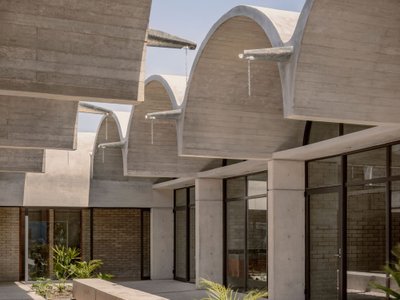
Kiltro Polaris and JC Arquitectura Line Up Six Barrel Vaults for a Health Center in Rural Mexico
A raw concrete clinic in Escárcega, Campeche, uses courtyards between structural bays to ventilate, light, and cool every room naturally.
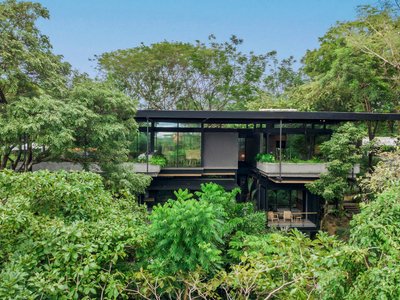
Studio Saxe Cantilevers a Seismic-Proof Jungle House Over the Costa Rican Canopy
Raintree House in Nosara perches on a forested hilltop, merging prefabricated steel structure with local craft and bioclimatic logic.
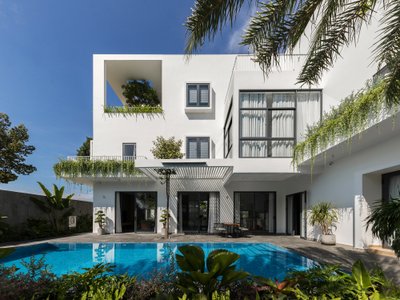
Story Architecture Wraps a Multigenerational Villa Around a Pool in Vietnam
An L-shaped house near Ho Chi Minh City balances privacy and togetherness through voids, skylights, and planted terraces.


Similar Reads
You might also enjoy these articles

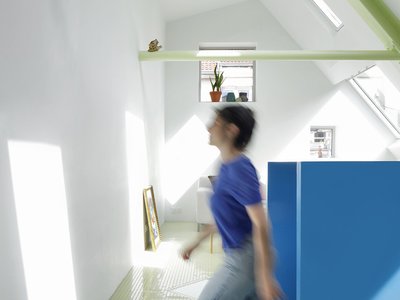
127af Flips a Tiny Bagnolet Rowhouse Upside Down with a Handcrafted Roof Extension
A 55-square-meter terraced house on the edge of Paris gains a luminous upper living floor through lightweight timber and steel.
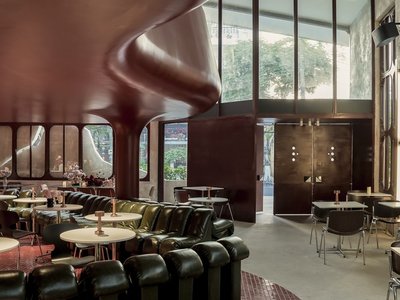
1.61 Design Workshop Wraps a 600-Square-Meter Café in Vietnam in Sculptural Burgundy Drama
Reden Café & Bistro pairs a helical staircase, mosaic floors, and deep red interiors to rethink Vietnamese hospitality space.

The Unbound Brain: A School Shaped by Cognitive Architecture
Cylindrical learning pods radiate like neurons from a central cortex, turning the floor plan into a spatial model of human thought.
Revival Vernacular Architecture: Rammed Earth Settlements for the Sahara
A modular desert community in Mauritania that fuses passive cooling techniques with earthen construction and local craftsmanship.


Explore Housing Competitions
Discover active competitions in this discipline




The Global Benchmark for Architecture Dissertation Awards


Challenge to design mud housing for contemporary communities
Comments (0)
Please login or sign up to add comments
No comments yet. Be the first to comment!