

Nine Elms Food Park: Where Urban Agriculture Becomes Architecture
A layered building system in London that grows, processes, and serves food within a single modular architectural framework.


What if a building could feed its neighborhood? Not metaphorically, through community spirit, but literally: vegetables on the roof, hydroponics on the walls, a market on the ground floor, and a restaurant one level up. The Nine Elms Food Park collapses the entire food cycle into a single architectural framework, from seed germination to composting, with research labs, dormitories, and a food museum woven in between. It is a building that functions less like a structure and more like an organism.
Designed by Yujie Cui and Matthew Hirsch, the Nine Elms Food Park is a conceptual project that confronts the growing disconnect between urban populations and their food sources. Sited in London's Nine Elms district, the proposal merges sustainable architecture with productive landscape, arguing that cities can be self-reliant if their buildings are designed as living systems rather than static enclosures.
Rooftop Canopies and Raised Beds as Public Space
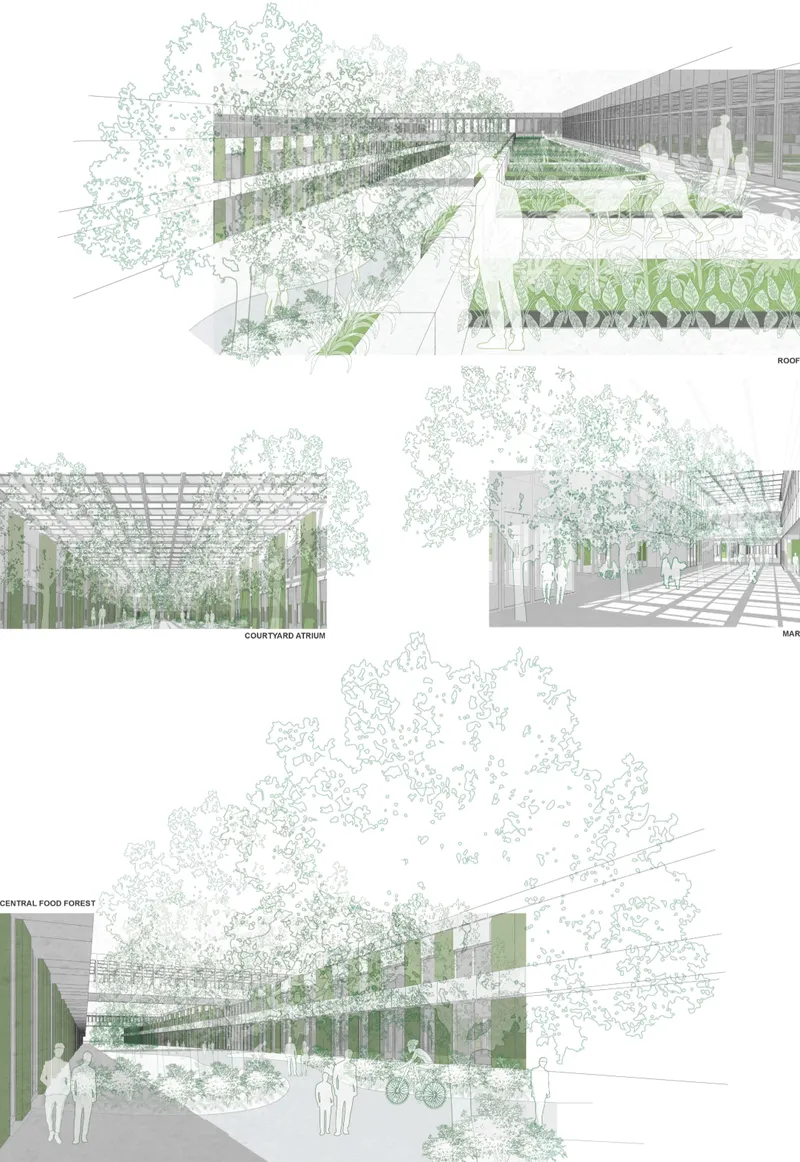
The perspective renderings reveal the park's most publicly visible gesture: rooftop gardens where raised planting beds sit beneath mature tree canopies, with visitors moving freely among productive landscapes. These are not ornamental green roofs tucked out of sight. They are activated public spaces where food cultivation becomes a social activity. Vegetables, fruits, grains, and flowers are grown at this level, turning the building's fifth facade into its most programmatically rich surface.
The design treats the rooftop as an extension of the park itself, blurring the boundary between landscape and architecture. Visitors are encouraged to participate in farming, attend culinary workshops, or simply walk through botanical gardens. It reframes the act of growing food as a form of recreation, not labor.
A Food Forest Embedded in Ecological Section
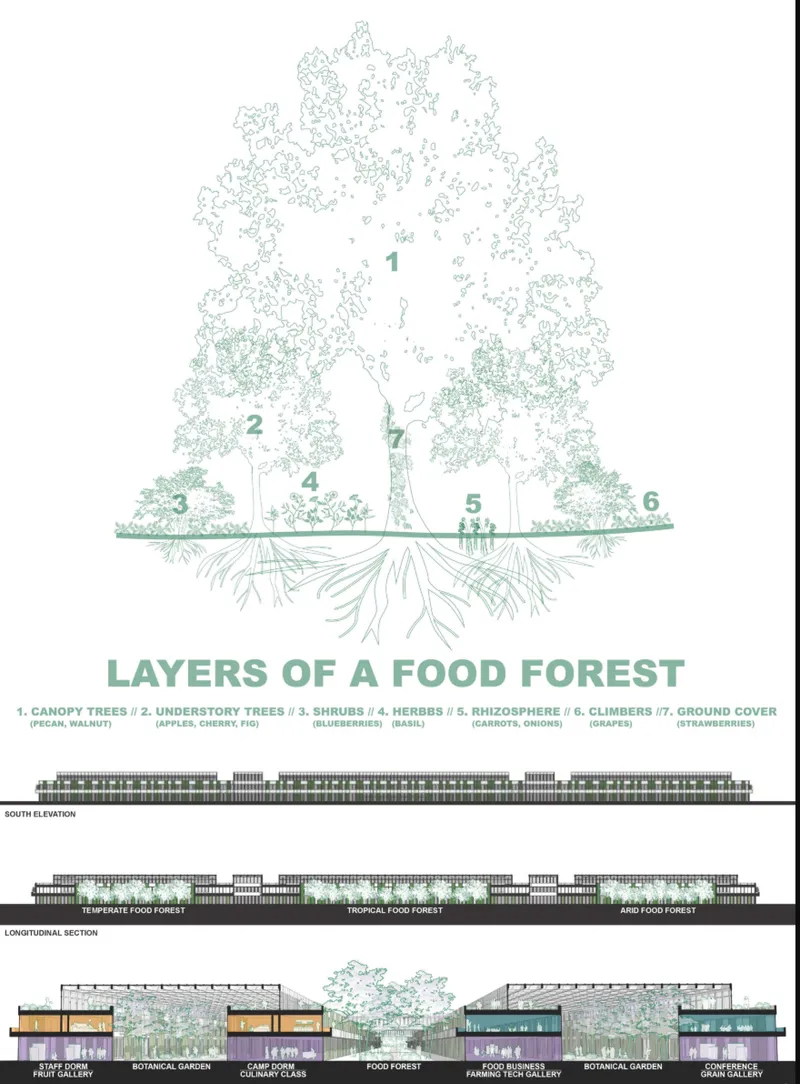
One of the project's most compelling conceptual moves is its integration of a food forest: a multi-layered ecosystem modeled on natural forest structure but composed entirely of edible species. The section and diagram drawings break this down with precision. Canopy trees like pecan and walnut form the uppermost layer. Below them, understory trees including apple, cherry, and fig provide mid-height production. Shrubs such as blueberries, herbs like basil, root crops including carrots and onions, climbers like grapes, and ground covers such as strawberries complete the vertical stacking.
The intelligence here lies in treating biodiversity as a design strategy rather than an afterthought. Each layer serves a productive and ecological function, ensuring food diversity while maintaining soil health and supporting pollination. The food forest operates as a resilient system that can sustain itself with minimal external inputs, a principle that the designers extend into the architecture itself.
Modular Components That Scale and Adapt

The axonometric assembly diagram reveals the project's structural logic: a modular system built from prefabricated parts that can be reconfigured depending on context. Green roofs accommodate intensive or extensive farming. Vertical hydroponic walls and vine walls attach to facades. Potted green walls provide space-efficient cultivation for tighter conditions. The building is not a fixed object but a kit of parts, designed to evolve with community needs and to be replicated in different urban settings worldwide.
This modularity is the project's most pragmatic contribution. Urban agriculture proposals often struggle with scalability, remaining site-specific prototypes. By designing adaptive food modules that clip onto a structural framework, Cui and Hirsch propose an architecture that is genuinely transferable. The system could theoretically be deployed at different densities and in different climates, adjusting its agricultural components while maintaining its core organizational logic.
Programmatic Layering: From Greenhouse to Restaurant
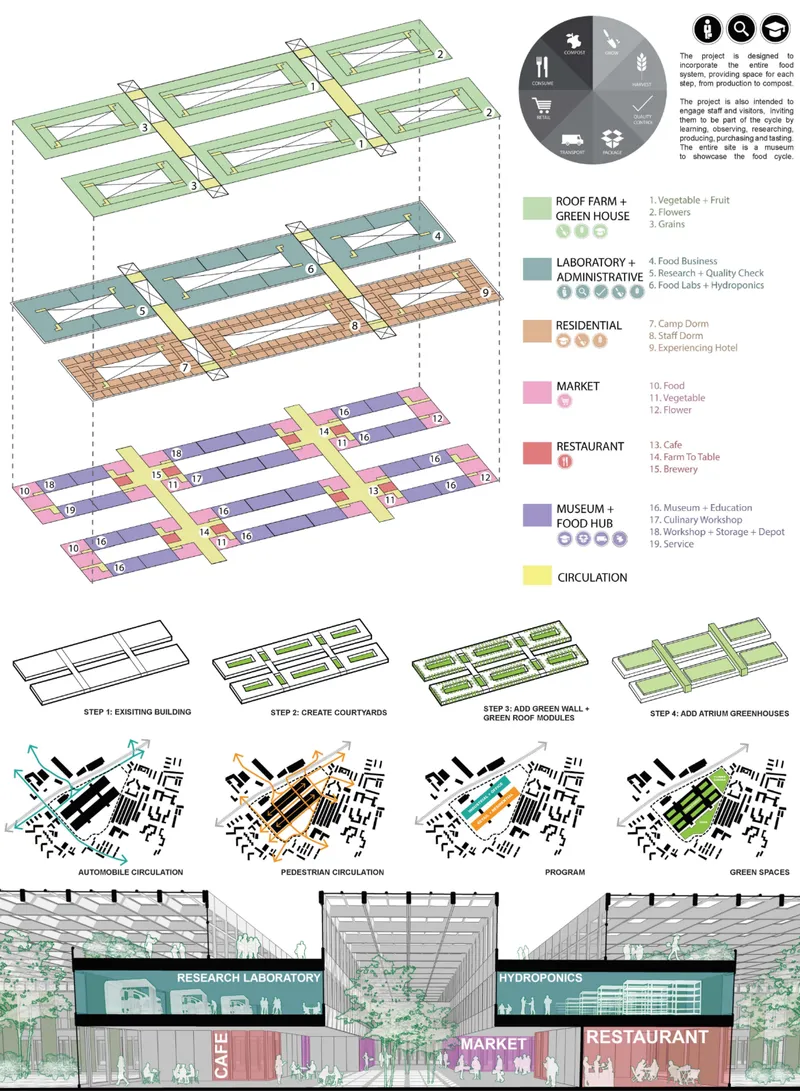
The exploded axonometric drawing lays bare the full programmatic ambition of the project. Greenhouses and rooftop farms occupy the top levels. Laboratories and research hubs, where food quality checks, hydroponics experiments, and food business incubation take place, sit below. Residential zones provide staff dormitories and experiential hotel rooms for visitors who want to immerse themselves in the food cycle. Markets and restaurants at lower levels create a direct, physical connection between production and consumption. Museums and food hubs round out the educational layer, showcasing everything from production methods to composting processes.
The stacking is deliberate: gravity moves food downward from growth to processing to plate, while knowledge and experience move visitors upward through increasingly immersive agricultural environments. Every floor reinforces a singular narrative about where food comes from and how architecture can make that origin story visible and participatory.
Why This Project Matters
The Nine Elms Food Park succeeds because it refuses to treat urban agriculture and architecture as separate disciplines that merely share a site. Instead, the food system is the architecture. The walls grow things. The roofs produce crops. The section is organized by harvest logic as much as by structural engineering. In a discipline that often relegates sustainability to a checklist of certifications, this project embeds ecological thinking into the spatial DNA of the building.
As cities confront climate change, population growth, and food insecurity simultaneously, the work of Cui and Hirsch offers a provocative counter-narrative: that density and self-reliance are not contradictions. A building can house people, educate communities, grow food, conduct research, and compost waste within a single modular framework. That is not utopian thinking. It is systems thinking applied to architecture, and it points toward a future where the most resilient buildings are also the most productive ones.
View the Full Project
About the Designers
Designers: Yujie Cui, Matthew Hirsch
Enter a Design Competition on uni.xyz
uni.xyz runs architecture and design competitions year-round that reward proposals with spatial conviction and real site intelligence.
Project credits: Nine Elms Food Park by Yujie Cui, Matthew Hirsch.




Popular Articles
Popular articles from the community


The Earth Pod: 3D Printed Homes for Resilient Refugee Communities
The Earth Pod reimagines refugee housing through 3D printed homes made from clay, combining resilience, self-sufficiency, and rapid shelter.
AL-JANNAH: Sustainable Architecture and Permaculture for Afghan Widows
AL-JANNAH uses sustainable architecture and permaculture to create resilient oasis of housing, learning, work and renewal for Afghan widows.

Riyadh For All: Intergenerational Urban Design for Active Aging in Rabat
Riyadh For All reimagines urban design in Rabat with intergenerational co-living, adaptive courtyards, and Moroccan cultural exchange today.

Hill & Cross Opera: Sculptural Opera House Architecture Shaped by Tallinn’s Landscape and Identity
Hill & Cross Opera reimagines opera house architecture in Tallinn through its sculptural hill, civic plaza, glass wave and a luminous cross.


Similar Reads
You might also enjoy these articles

Bao Huynh Watercolor Atelier: A Serene Art Retreat in Hội An
Bao Huynh Watercolor Atelier in Hội An blends multifunctional art spaces, sustainable design, local materials, and family-friendly living in a serene environment.

Atelier Macri Concept Store Interior Design by CASE-REAL
Atelier Macri store features a "ko" counter, walnut wood details, cork displays, blending retail, gallery, and seamless customer experiences.

Manuel Vargas Izquierdo Stadium and High-Performance Sports Center: Architectural Excellence in Jalpa de Méndez
The Manuel Vargas Izquierdo Stadium blends sustainable design, inclusive sports facilities, and cultural-inspired architecture, revitalizing Jalpa de Méndez’s public spaces.

KAKR Buluh Awar Hall: Revitalizing Community and Ecology Through Bamboo Architecture
Community built bamboo hall revitalizes Buluh Awar village, empowering youth, restoring ecology, celebrating vernacular craftsmanship through sustainable architecture and culture.

Comments (0)
Please login or sign up to add comments
No comments yet. Be the first to comment!