
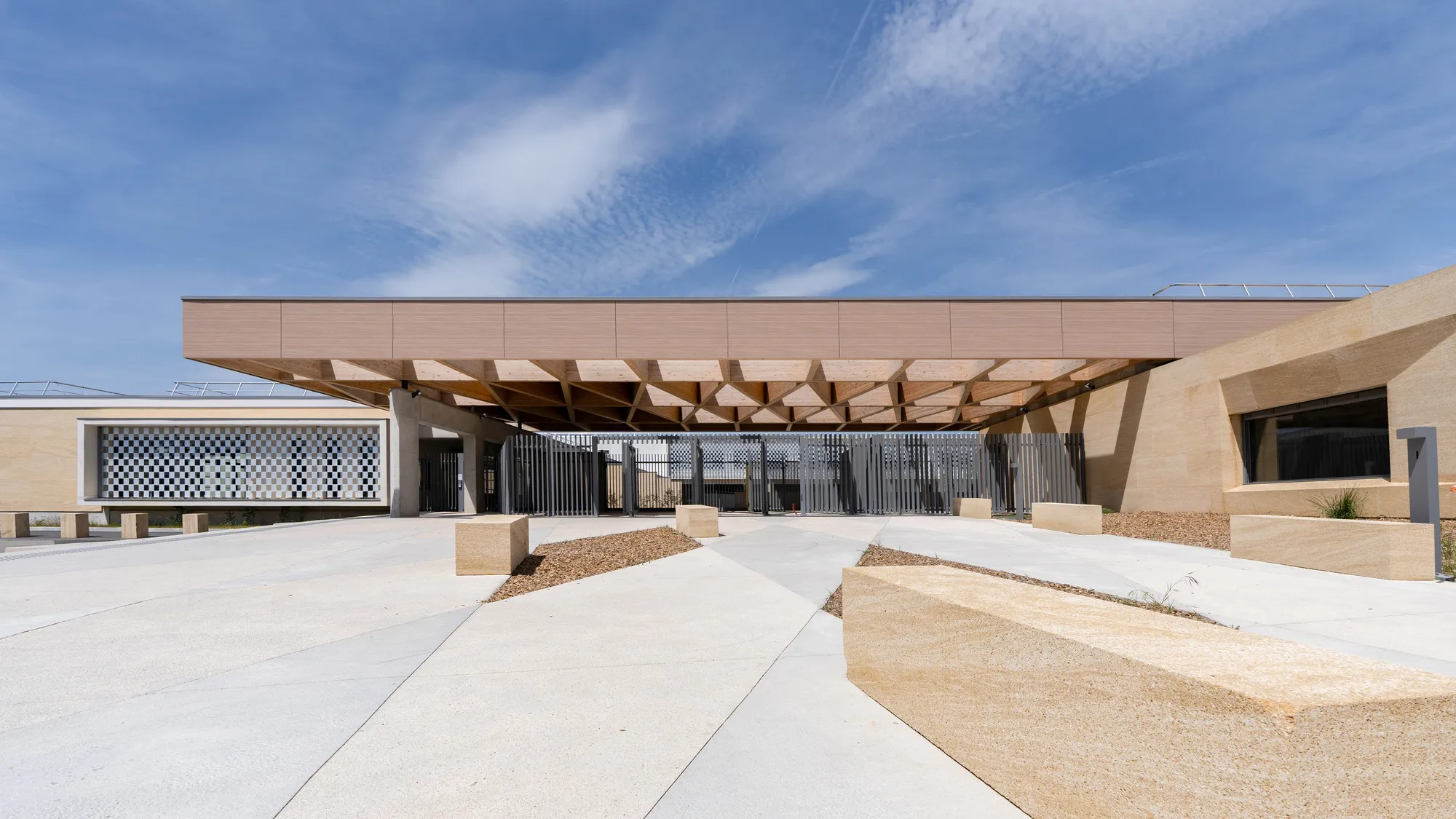
NM2A Builds a Flood-Ready Middle School in Southern France Using Rice Straw and Local Stone
Voltaire College in Remoulins replaces an aging campus with a bioclimatic school raised on pilotis above a hundred-year floodplain.


Designing a school for 720 students is already a complex brief. Designing one in a flood zone, in a seismic region, on the footprint of a demolished sixty-year-old campus, using materials sourced almost entirely within an eight-kilometer radius, and doing it all without air conditioning: that is the brief NM2A took on in Remoulins. Voltaire College, completed in 2023, sits near the Pont du Gard in southern France, and it treats every constraint as an organizing principle rather than an obstacle.
What makes this project genuinely interesting is its refusal to resolve those constraints through expensive engineering. Instead, NM2A absorbed them into the architecture itself. The building is raised on pilotis so floodwaters can pass beneath it. Its walls are stone quarried from Vers Pont du Gard, its roof framed in Douglas timber from the Jura, and its insulation made from rice straw and rice husks harvested in the Camargue. The school produces more energy than it consumes, earning BEPOS Effinergie E3C1 certification. It won the Grand Prix du Jury at the Trophées de la Construction in 2022. And it looks, from the courtyard, like a building that has always belonged here.
Lifted Off the Ground


Eighty percent of the building is elevated on pilotis, a structural decision driven entirely by hydraulic reality. Remoulins sits on a floodplain, and two separate numerical models confirmed that the school's design would have no impact on water levels, flood propagation, or flow dynamics on surrounding parcels. The primary structure uses low-carbon concrete with seismic bracing that connects columns and beams to resist shearing. From the outside, the cantilevered upper volumes and the open ground plane read as a deliberate gesture of lightness, but the real story is pragmatic: the building gets out of the water's way.
Beneath the elevated mass, a 2,600-square-meter courtyard functions as a protected outdoor commons. Landscaped swales surround it, forming retention basins that double as cooling zones in summer. A second, larger retention basin of roughly 3,300 cubic meters lies under the administration and teaching buildings, with an additional 1,500-cubic-meter landscape basin to the south. The school is, in effect, an island. Students walk on dry ground above a carefully engineered water management system.
Local Stone, Regional Timber, Camargue Rice
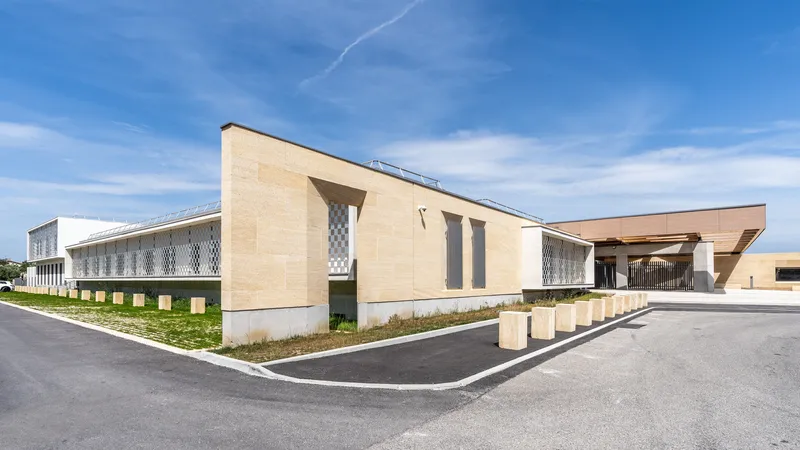

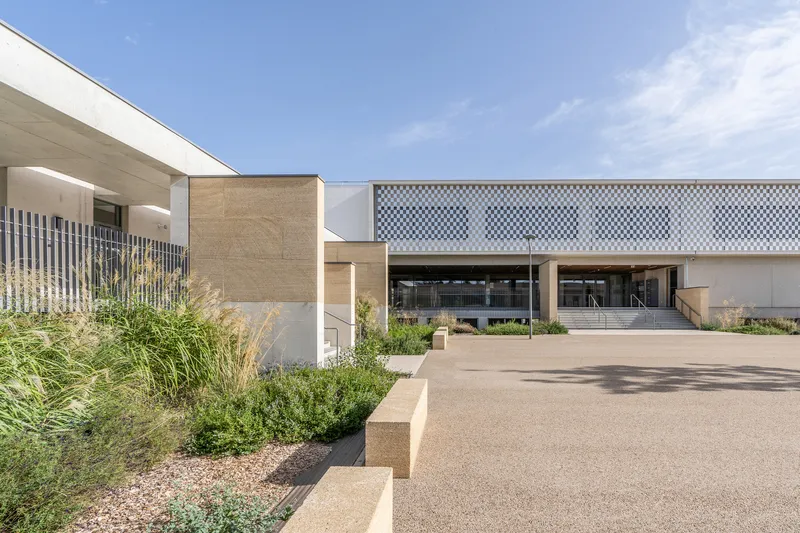
NM2A sourced the building's primary materials from within a tight geographic circle. The stone comes from the Vers Pont du Gard quarry, less than eight kilometers from the site. The concrete plant is equally close. Douglas timber from the Jura region forms the roof framing, while timber frame envelopes wrap the teaching buildings. But the most unusual material choice is the insulation: rice straw and rice husks from the Camargue, packed into roof panels and wall assemblies. It is a genuinely frugal material palette that reads as warm, earthy, and specific to the Occitanie region.
The facades reflect this material logic clearly. Beige masonry walls at the base give way to perforated metal screens above, with rhythmic punched window openings between. The screens filter direct sunlight while maintaining views and airflow. There is nothing flashy about the exterior, and that is the point. The building communicates restraint.
Timber Canopy and the Threshold


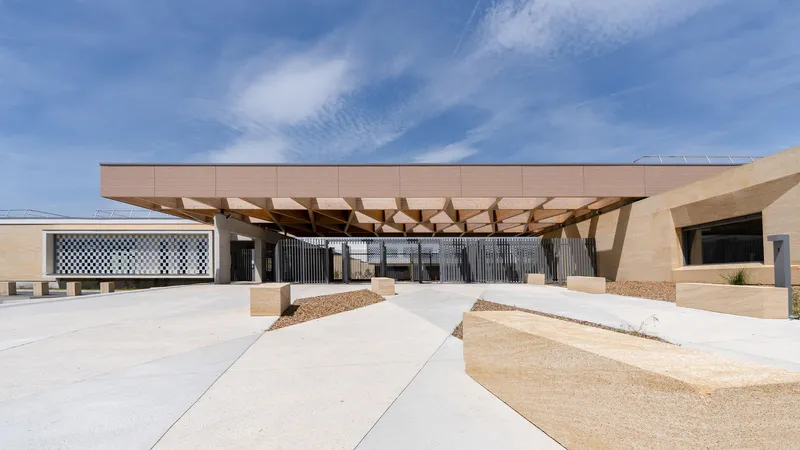
The entrance sequence is handled by a large laminated wood canopy supported on angled timber columns. It creates a generous shaded threshold between the parking area and the school's interior street. The canopy is both a practical shade device and a civic gesture, signaling arrival without monumental formality. Vertical black metal screening elements beneath the roof cast rhythmic shadows that shift with the sun, animating what could have been a static covered space.
The decision to invest architectural attention at the entrance pays off because it sets expectations for the interior. You arrive under timber, walk through filtered light, and already understand that this is a building shaped by climate rather than by image.
The Interior Street and Circulation
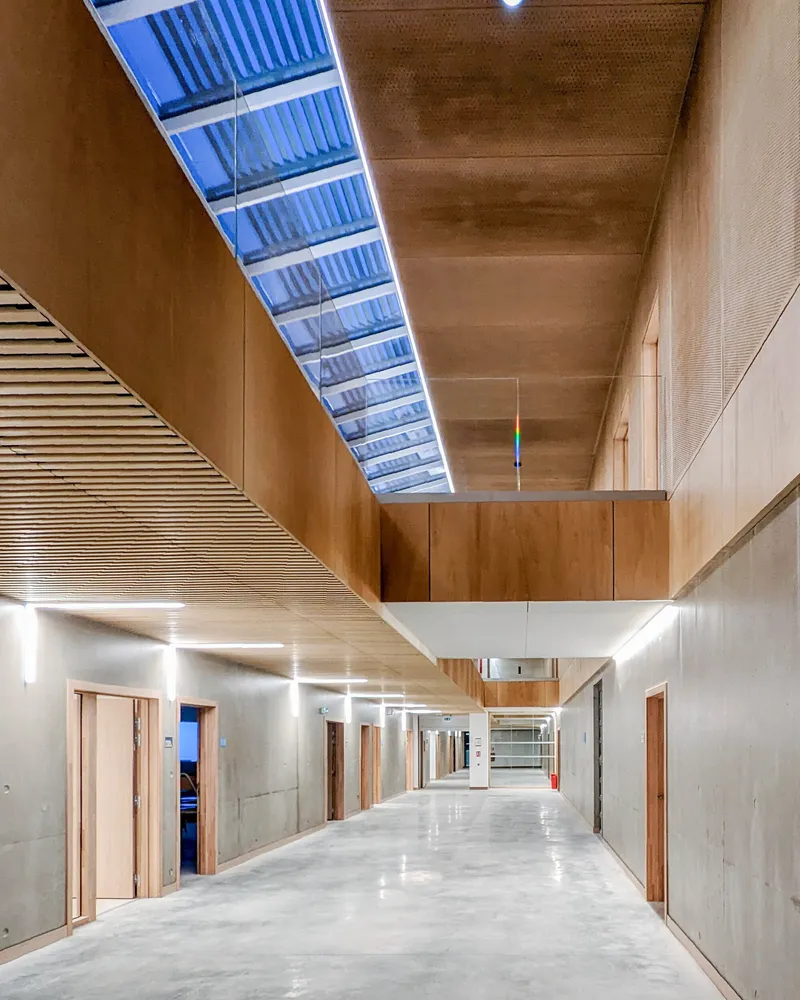


Inside, a naturally lit interior street connects the school's program zones. The double-height corridor features perforated timber ceiling panels and a linear skylight that pulls daylight deep into the plan. Polished concrete floors reflect overhead light, amplifying the effect. On the upper level, glazed balustrades allow visual connection down to the ground floor, and glazed bridge openings span the voids to link the wings. The whole circulation system is designed to feel open and legible, a quality that matters enormously in a school serving 720 adolescents.
Exterior walkways, or coursives, supplement the interior corridor, giving students covered outdoor routes around the courtyard. The timber soffits overhead and concrete parapets along the edges create a layered experience of inside and outside, always with a view to the planted courtyard below.
Courtyard as Cooling Engine
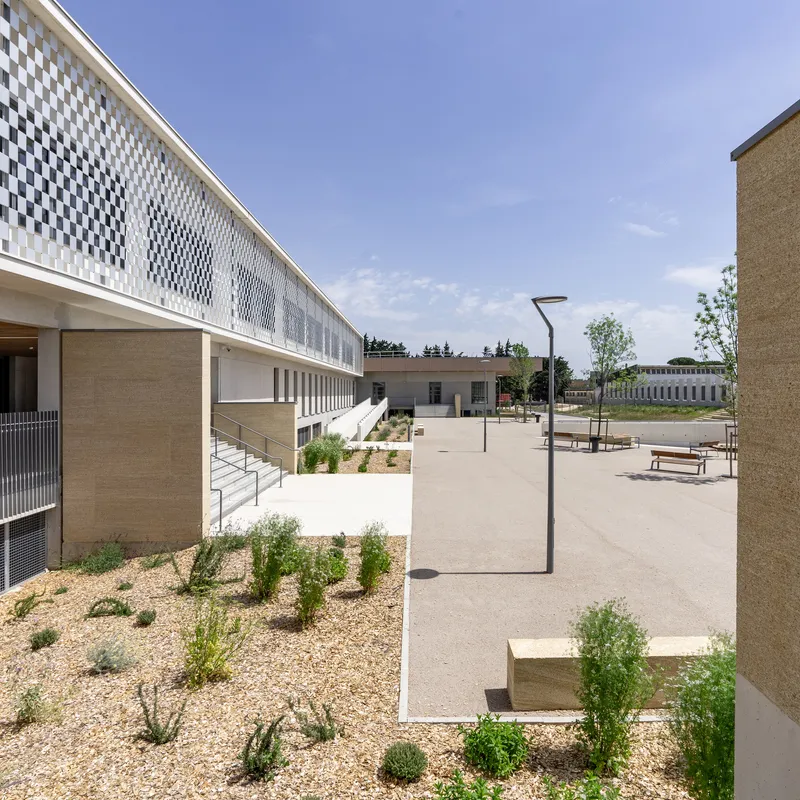
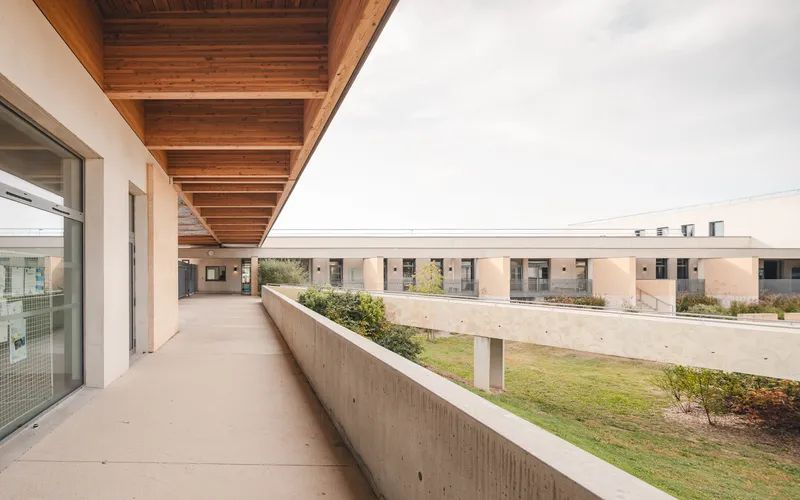

The 2,600-square-meter central courtyard is not decorative. It is the school's primary passive cooling device. Gravel-mulched planting beds between concrete paved areas absorb and release moisture, while the swale-formed retention basins that ring the space provide evaporative cooling during hot months. Combined with 141 aluminum tilt-and-turn windows fitted with solar control double glazing, the design achieves summer comfort without air conditioning. In a region where temperatures regularly push past 35°C, that is a significant claim, and it earned the school Gold-level Bâtiment Durable Occitanie certification.
Ninety-nine kilowatt-peak photovoltaic panels on the teaching building roof handle electricity generation, with partial self-consumption. The combination of no mechanical cooling, on-site energy production, and a super-insulated envelope pushes the school past net-zero into positive-energy territory.
Teaching Spaces and the Dining Hall

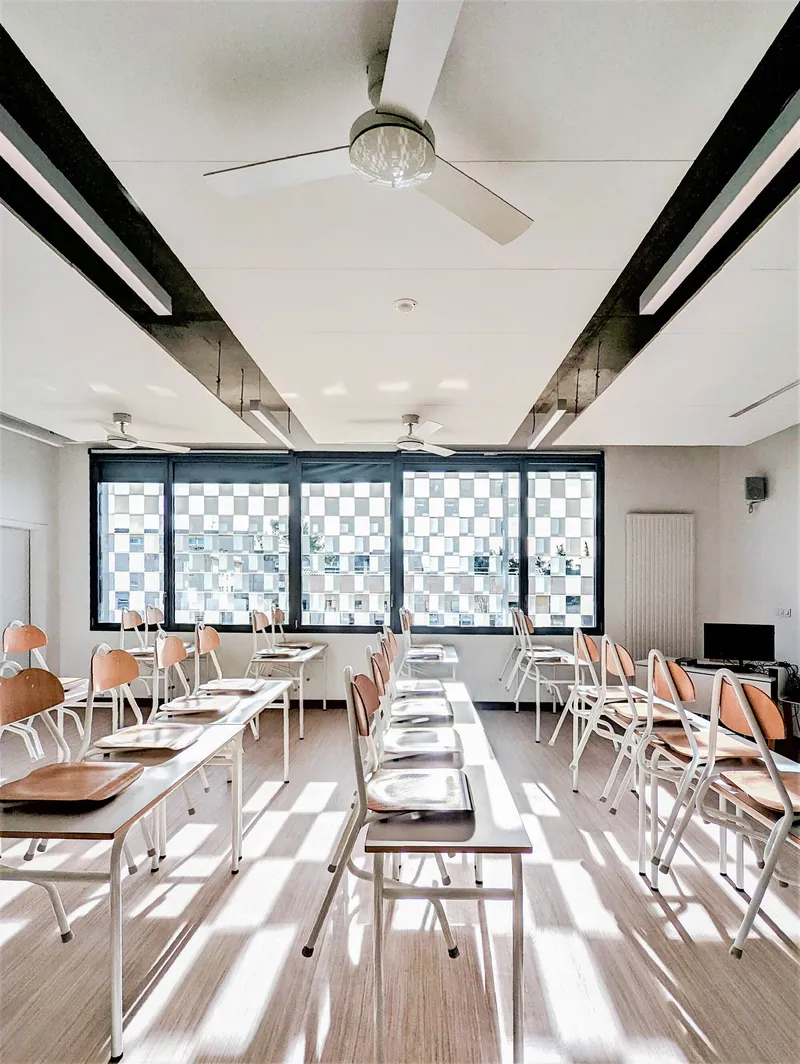

The classrooms are clear and functional. Laboratory spaces feature white workbenches, linear ceiling fixtures, and suspended equipment rails that keep the floor plan flexible. There is no attempt at architectural spectacle in these rooms; daylight enters through controlled openings, acoustics are managed by timber panels, and finishes are durable without being institutional.
The dining hall is the most expressive interior space. Checkered glass windows filter daylight into a warm wash across pale timber floors. A slatted timber ceiling adds texture overhead, and a perforated white service counter runs along one wall. White metal chairs keep the room light and easy to clean. It reads as a space designed for the specific social rituals of a French school lunch, not as a multi-purpose hall forced into cafeteria duty.
The Library

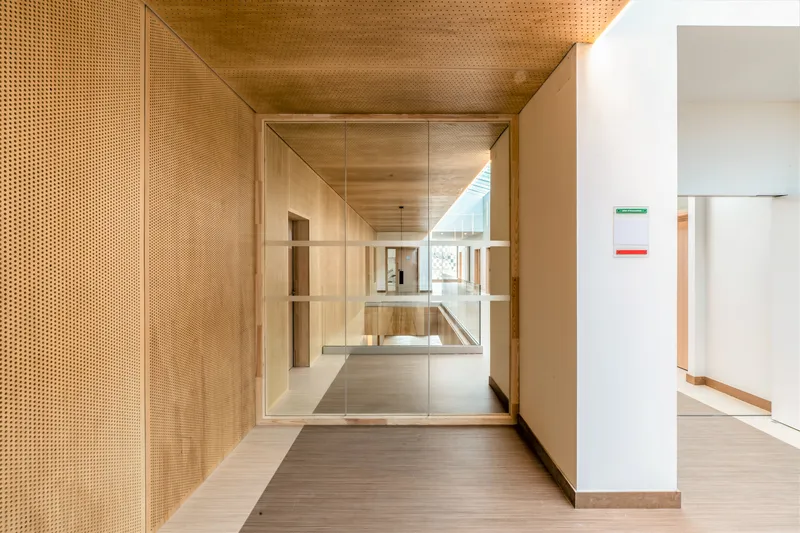
The CDI, or Centre de Documentation et d'Information, occupies a corner where perforated timber wall and ceiling linings create a warm acoustic enclosure. A curved white neon light installation hovers above a timber desk stacked with magazines, providing a playful focal point in an otherwise quiet space. Glass walls maintain visual transparency to adjacent corridors, keeping the library connected to the life of the school while offering the acoustic separation students need to concentrate.
Plans and Drawings
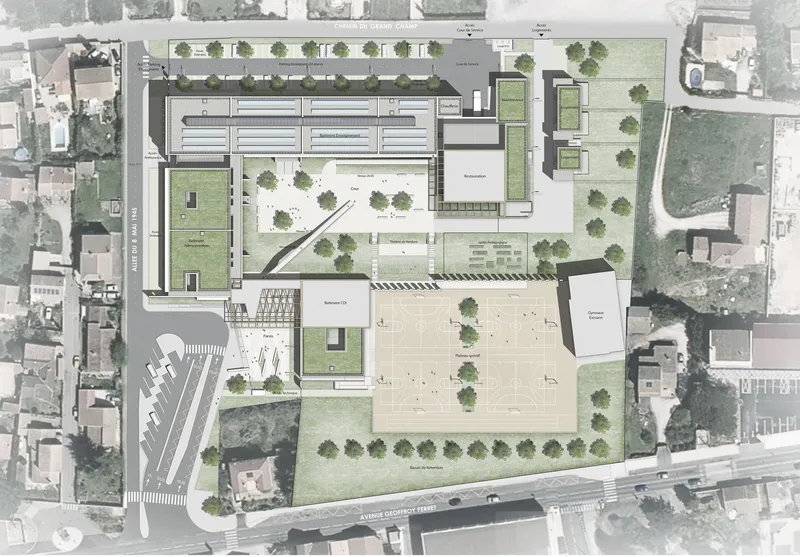


The site plan reveals the school's L-shaped footprint wrapping the central courtyard, with the southern edge of the parcel given over to the larger landscape retention basin. Floor plans show a clear organizational logic: classrooms line the outer edges, the interior street runs through the center, and the patio courtyard anchors everything. Detail sections illustrate how the insulated wall assembly integrates window systems, rice husk insulation, and the floor slab connection, confirming that the material ambitions are carried through to the construction detail level. BIM Level 2 was used from the competition phase onward, an approach still relatively uncommon in French public school projects of this scale.
Why This Project Matters
Voltaire College matters because it demonstrates that extreme site constraints can produce better architecture, not just compliant architecture. The flood zone forced the building onto pilotis, which created a generous shaded courtyard. The frugality mandate pushed the team toward rice straw insulation and local stone, which gave the building its texture and identity. The no-air-conditioning ambition demanded a serious courtyard, serious glazing strategy, and serious ventilation design, all of which made the interiors more pleasant to inhabit. Constraint after constraint became a design generator.
For architects working on public educational buildings, particularly in climate-stressed regions, this project offers a clear proof of concept. You can build a 5,586-square-meter positive-energy school for 720 students in a flood zone without importing exotic materials or relying on mechanical systems, and the result can be spatially generous, materially honest, and award-winning. NM2A did not invent a new typology. They simply took every local condition seriously and let the building emerge from the answers.
Voltaire College, designed by NM2A, Remoulins, France. 5,586 m². Completed 2023. Photography by NM2A.
About the Studio
Share Your Own Work on uni.xyz
If projects like this are the kind of work you want to make, uni.xyz is a place to publish your own, find collaborators, and enter design competitions.



Popular Articles
Popular articles from the community


The Earth Pod: 3D Printed Homes for Resilient Refugee Communities
The Earth Pod reimagines refugee housing through 3D printed homes made from clay, combining resilience, self-sufficiency, and rapid shelter.

Co-Life: Senior Housing Design That Reconnects Older Adults With the City
Co-Life reimagines senior housing design through healing gardens, shared streets, workshops, and a sustainable community across generations.

The Musturak Paradise: Senior Living Architecture for a Connected Future in Temara, Morocco
The Musturak Paradise reimagines senior living architecture in Temara via private homes, social spaces, culture, community, and shared care.

Conexión: Biophilic Design Reimagines High-Rise Living in Hong Kong
Conexión reimagines high-rise living in Hong Kong through biophilic design, green facades, shared spaces, daylight, water and nature within.
Similar Reads
You might also enjoy these articles

Bao Huynh Watercolor Atelier: A Serene Art Retreat in Hội An
Bao Huynh Watercolor Atelier in Hội An blends multifunctional art spaces, sustainable design, local materials, and family-friendly living in a serene environment.

Atelier Macri Concept Store Interior Design by CASE-REAL
Atelier Macri store features a "ko" counter, walnut wood details, cork displays, blending retail, gallery, and seamless customer experiences.

Manuel Vargas Izquierdo Stadium and High-Performance Sports Center: Architectural Excellence in Jalpa de Méndez
The Manuel Vargas Izquierdo Stadium blends sustainable design, inclusive sports facilities, and cultural-inspired architecture, revitalizing Jalpa de Méndez’s public spaces.
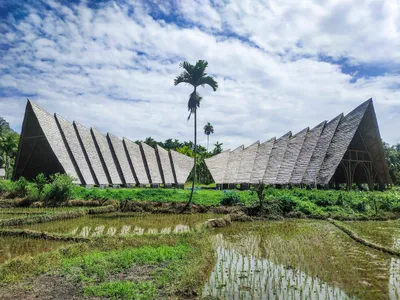
KAKR Buluh Awar Hall: Revitalizing Community and Ecology Through Bamboo Architecture
Community built bamboo hall revitalizes Buluh Awar village, empowering youth, restoring ecology, celebrating vernacular craftsmanship through sustainable architecture and culture.





Comments (0)
Please login or sign up to add comments
No comments yet. Be the first to comment!