

De Kovel Architecten and Studio AAAN Build a Noise-Buffering Housing Edge in Rotterdam
Fifty-four dwellings in Kralingen East use parking strategy and masonry craft to turn a highway boundary into a calm, green neighborhood.


Living next to a highway is usually a compromise. De Kovel Architecten and Studio AAAN decided to make it the organizing principle. Their NN Kralingen Housing, completed in 2022 on the eastern edge of Rotterdam's Kralingen district, treats 54 dwellings not just as homes but as acoustic infrastructure, stretching a continuous ribbon of terraced houses along the highway to shield the neighborhood behind it. The result is a 15,200 m² development where noise mitigation, parking logistics, and landscape continuity converge into a single coherent plan.
What makes the project genuinely interesting is how it refuses to separate the pragmatic from the architectural. The parking strategy determines the urban design. The noise strategy determines the section. And the material palette, a light hand-moulded brick with white cementation, gives the whole scheme a surprisingly delicate character for something that is, functionally, a wall against the A16. It is a project where every constraint is legible in the architecture, and none of them read as a limitation.
Two Typologies, Two Problems
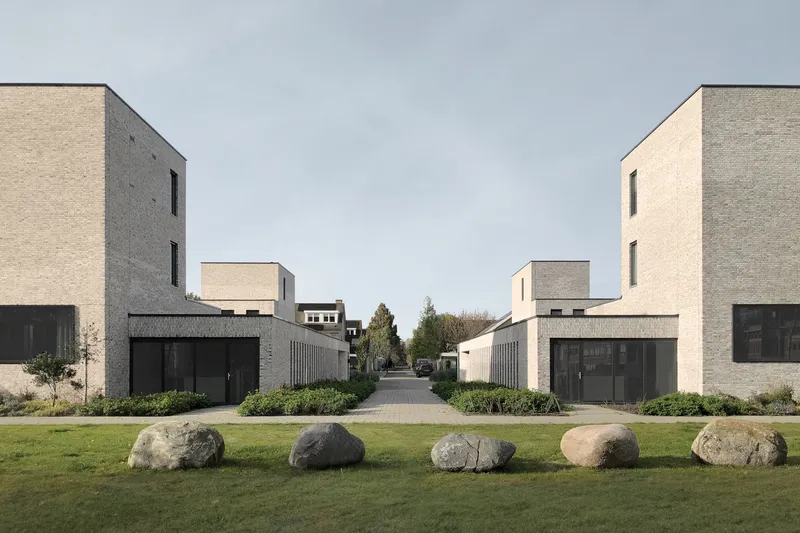
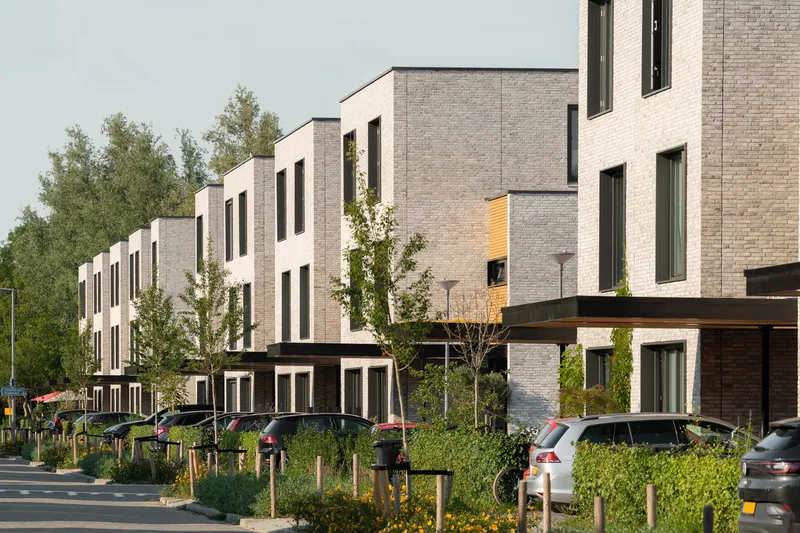
The site has a split personality. On the east side, facing the highway and the water, 31 terraced houses form a continuous ribbon that doubles as a noise barrier. On the neighborhood side, 23 semi-detached houses pick up the typology already established across the street, connecting the new development to the existing fabric of Kralingen East. The two typologies address two fundamentally different conditions with two distinct spatial strategies, yet the shared material language holds them together as a single project.
The terraced houses along Kralingse Zoom push secondary functions, bedrooms, bathrooms, storage, toward the noise-affected facade, reserving the quieter living floors for large panoramic windows overlooking the canal and greenery. It is a classic noise-mitigation section, but the care in the window placement and facade composition keeps it from feeling defensive.
Parking as Urban Design
Parking is rarely celebrated as a design move, but here it is the leading factor in the urban plan. The 31 terraced houses sit above a semi-sunken basement that absorbs all resident parking, freeing the front side entirely from cars. The result is a traffic-free green zone along the water, a generous public face that would have been impossible with surface lots or individual garages. On the neighborhood side, the semi-detached houses use carports, a lighter solution that matches the lower density and the existing streetscape conventions.
Visitor parking is tucked into green lots between the houses rather than along the street edge. It is a small detail, but it keeps the public realm continuous and pedestrian. The landscape design, by MAAK Space, extends the green structure of the ring canal through the site, reinforcing the connection to the broader landscape network that defines this part of Rotterdam.
Masonry with Precision
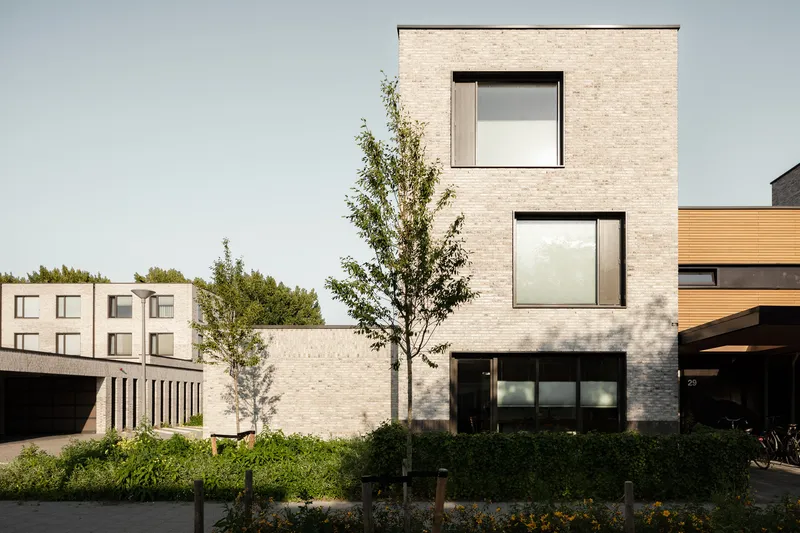
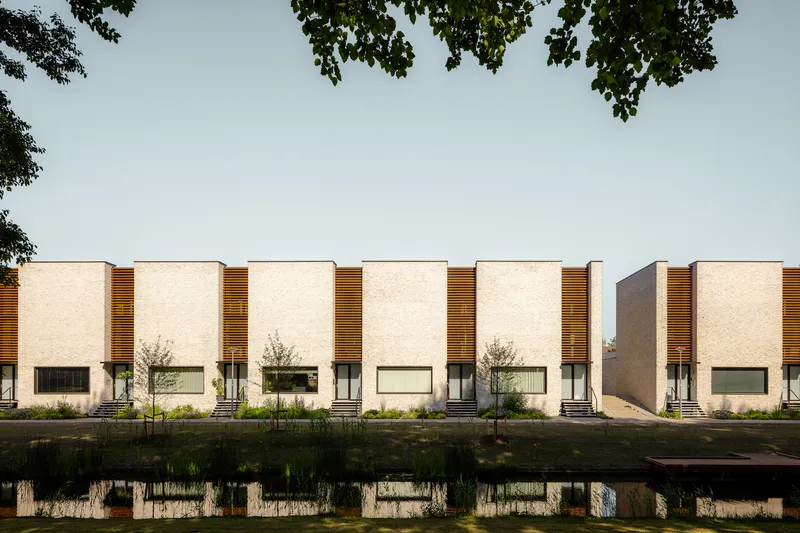
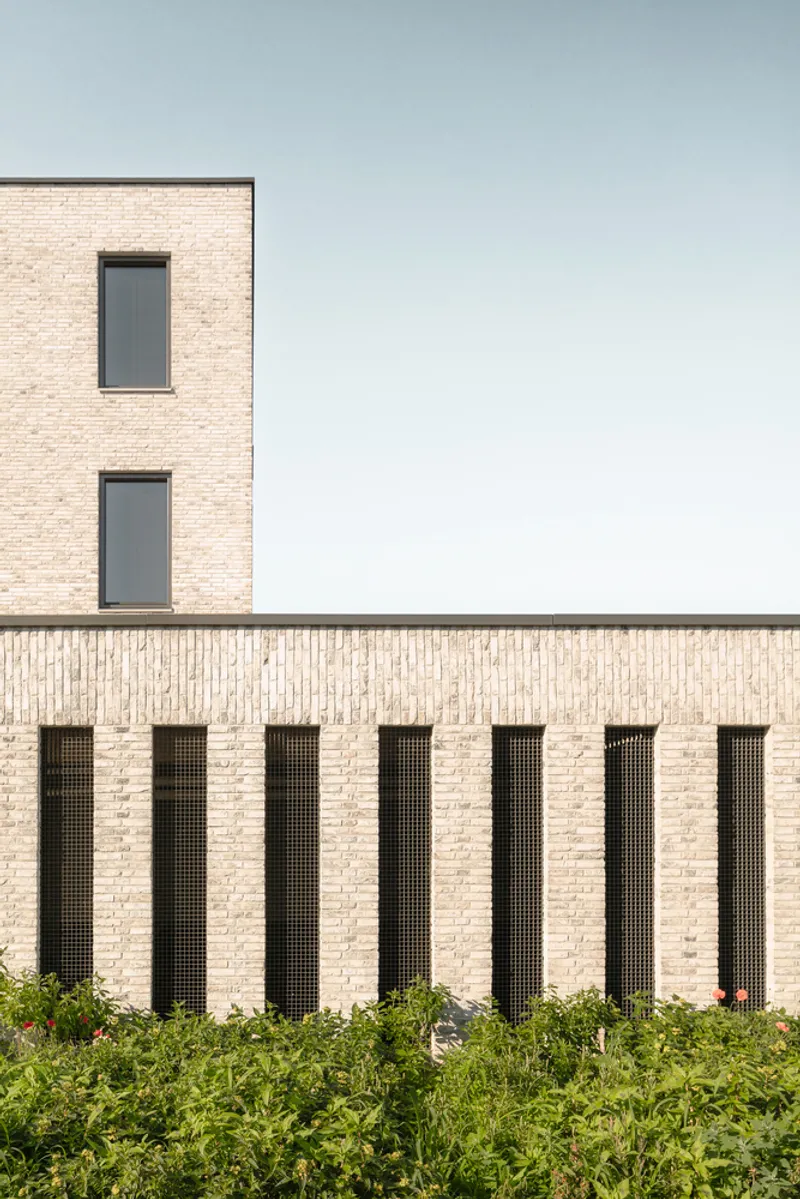
The identity of the project sits almost entirely in its brick surfaces. Light, hand-moulded bricks from the Façade Beek factory in Limburg give the facades a soft, slightly irregular texture that catches light differently across the day. White cementation in the joints amplifies this effect, lending the walls a chalky luminosity that photographs well but must be even better in person. Against the dark grey window frames, the palette is restrained and precise.
Large masonry surfaces dominate, with openings placed carefully rather than rhythmically. The architects resist the temptation to punch windows in regular grids, opting instead for compositions that respond to interior function: larger openings where views and light are needed, minimal apertures where privacy and noise reduction take priority. Recessed surfaces receive wooden cladding, introducing warmth and a finer grain that breaks the scale of the brick volumes without undermining their solidity.
Thresholds and Staircases
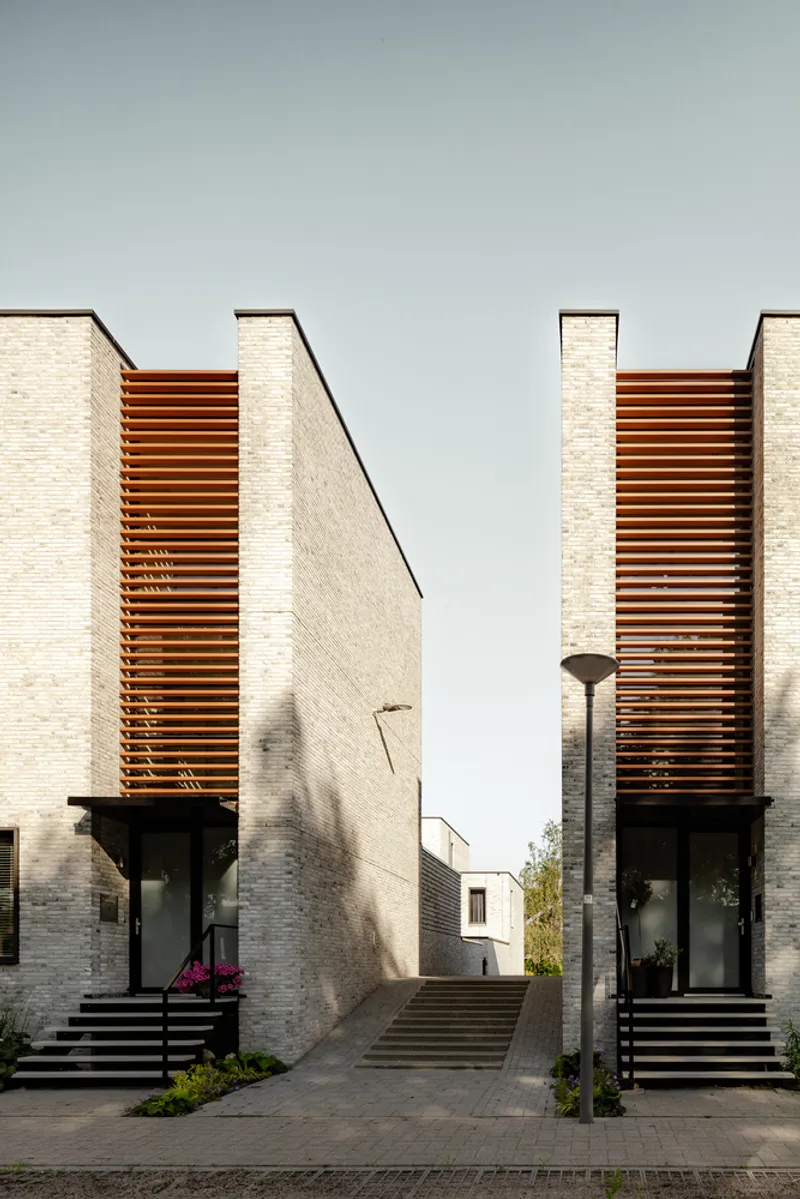
The semi-sunken basement creates an unexpected consequence: entrances to the terraced houses sit above street level, accessed by external metal staircases. These outdoor stairs give each entrance a civic quality, a stoop-like threshold between public and private that is more generous than a standard front door at grade. Flanked by vertical timber slat screens, the staircases become a defining feature of the street-facing elevation, adding rhythm and depth to what could have been a flat wall of brick.
The timber screens also serve a practical role, providing privacy for the entries while allowing air and light through. They introduce a layer of fine-grained materiality between the robust masonry and the domestic interior, a transition zone that signals arrival without sealing anything off.
Quiet Sustainability
Every house in the development carries green roofs and solar panels, and the entire scheme is connected to the district heating network. These are not headline-grabbing gestures but baseline commitments, the kind of integrated sustainability that should be unremarkable in 2022 housing but often isn't. The green roofs, in particular, do double duty: managing stormwater while contributing to the ecological corridor along the canal.
Nesting spaces for swifts are built into the end facades, a small but telling detail that reflects a broader attitude toward the site as habitat rather than just buildable land. Combined with the landscape strategy, which extends the ring canal's green belt through the development, the project operates at an ecological scale larger than its own footprint.
Why This Project Matters
NN Kralingen Housing is not a spectacle. It does not photograph as a single iconic image, and its most important moves, the noise section, the buried parking, the ecological continuity, are all things you understand through the plan rather than the lens. That is precisely what makes it a valuable reference. It demonstrates how to build dense, market-rate housing on a compromised site without surrendering quality, comfort, or public space.
De Kovel Architecten and Studio AAAN show that when constraints are taken seriously, they generate architecture. The highway demanded a buffer, and the buffer became a building typology. The cars demanded space, and the parking solution liberated the ground plane. The noise demanded a strategy, and the strategy shaped the plan. Every decision feeds forward. The result is a neighborhood edge that feels intentional, generous, and built to last.
NN Kralingen Housing, Rotterdam, Netherlands. Designed by De Kovel Architecten and Studio AAAN. 15,200 m². Completed 2022. Photographs by Herman de Kovel and Sebastian van Damme.
About the Studio
Share Your Own Work on uni.xyz
If projects like this are the kind of work you want to make, uni.xyz is a place to publish your own, find collaborators, and enter design competitions.




Popular Articles
Popular articles from the community


The Ocean Hive: Sustainable Architecture for a Self-Sufficient Civilization at Sea
The Ocean Hive imagines sustainable architecture at sea, where modular habitats, algae, wave power and ocean waste sustain a growing colony.
EW PARK: Sustainable Architecture Reimagines the Future of Urban Parking
EW PARK reimagines city parking as a modular wooden tower combining automation, solar energy, electric mobility, and adaptable urban design.

Co-life: Sustainable Architecture for Age-Friendly Community Living
Co-life reimagines sustainable architecture for seniors through courtyards, rammed earth, shared gardens, and spaces designed for belonging.

Conexión: Biophilic Design Reimagines High-Rise Living in Hong Kong
Conexión reimagines high-rise living in Hong Kong through biophilic design, green facades, shared spaces, daylight, water and nature within.


Similar Reads
You might also enjoy these articles


Hodi-Mandai Geram
Project Function: Preservation and revitalization of the Intangible heritage and socio-spatial identity of the Hodi by Housing, Cultural Memory Center, Sacred Grove, landscape, local tourism economy


Olio Towers: A Mid-Rise for Performers That Fuses Housing, Rehearsal, and Stage
Located blocks from Houston's Theater District, this modular tower stacks living units around a central performance atrium.

Oasis: Modular Green Housing Carved into Dhaka's Urban Fabric
A shortlisted Plugin Housing entry reclaims unauthorized settlements in Dhaka with stepped concrete volumes, green roofs, and ventilation-driven design.

Black Hole: A Floating Megastructure for the Post-Physical Era
Emiliano Mazzarotto envisions a spherical, self-scaling arena where e-sports, digital hotels, and holographic stadiums replace traditional public space.


Explore Housing Competitions
Discover active competitions in this discipline



Challenge to reimagine the Iron Throne


Photograph architecture without architects


Illustrate the lost glory of Angkor Wat - Render Challenge


Design challenge to reuse E-waste
Comments (0)
Please login or sign up to add comments
No comments yet. Be the first to comment!