

NOMAL and ONJIUM Housing Studio Reimagine the Korean Hanok as a Misty Hotel in Gyeongju
Two L-shaped timber houses wrap courtyards near an ancient Silla Dynasty forest, channeling cloud and mist into architecture.


The name Muuun translates loosely to "the place where mist and cloud befriend," and that is not just poetic license. Sited near the Samreung forest in Gyeongju, a coastal city in southern South Korea long celebrated for its fog-draped landscapes and Silla Dynasty ruins, this 143 square meter hotel by NOMAL and ONJIUM Housing Studio treats atmosphere as building material. Two L-shaped houses form interlocking courtyards that frame views east toward the historic sites of Najeong and Namsan, compressing the experience of wandering through a misty forest into a sequence of translucent screens, gravel paths, and open timber frames.
What makes Muuun worth studying is its refusal to treat the hanok as a museum piece. The architects researched a range of traditional Korean houses without pledging allegiance to any single canon of preservation or reinterpretation. The result is a building that feels ancient and alien at the same time: clay plaster floors, grey Korean color paper on walls and ceilings, hemp cloth layered behind sliding doors, yet no nostalgic mimicry. It is a surrealist hotel that happens to be built from the vocabulary of Korean domestic tradition.
Two L-Shapes, Two Courtyards
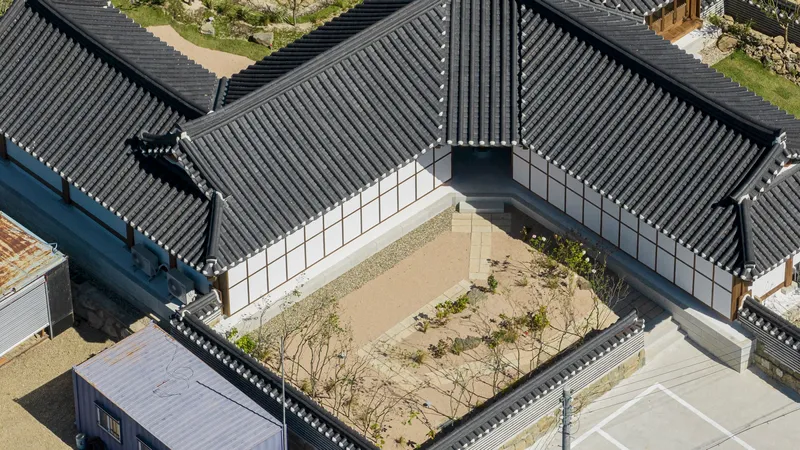
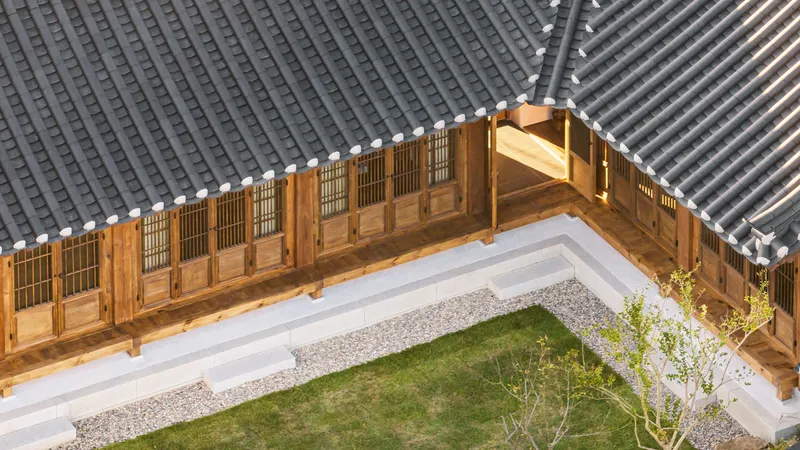
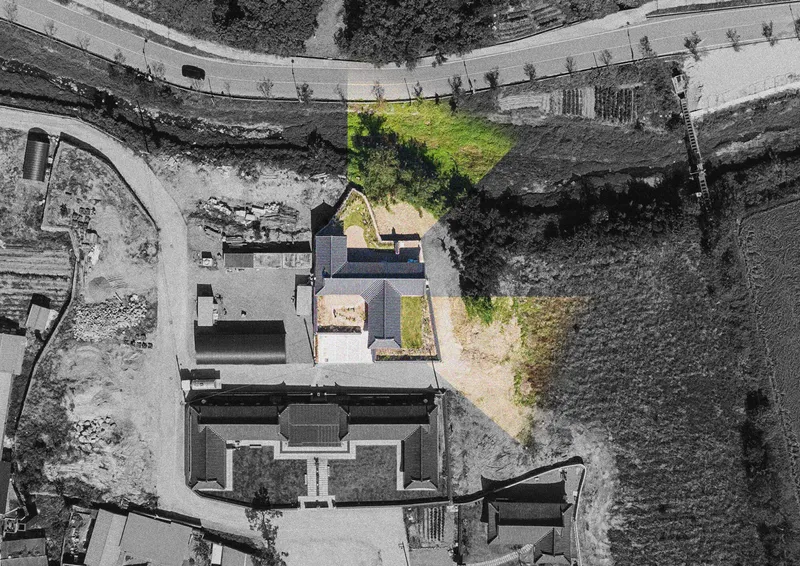
The plan is deceptively simple. Two L-shaped volumes interlock to create a pair of courtyards: one to the south serving as the entrance court, and one to the north that references the birth myth of Park Hyeokgeose, the legendary founder of the Silla Kingdom. The first entrance curves at 45 degrees between the two houses, an angular threshold that immediately breaks the grid and signals that this is not a conventional hanok compound. Each unit meets at its inner corner, placing the living room near the door and the bedroom at the far end, a gradient from public to deeply private.
From above, the cross-shaped roofscape reads as a dark mineral landscape punctuated by green pockets and gravel. The courtyards are not decorative leftovers; they are the organizational logic of the entire building, directing light, air, and views while walling off neighbors and roads with solid facades where privacy demands it.
Screens and Silhouettes
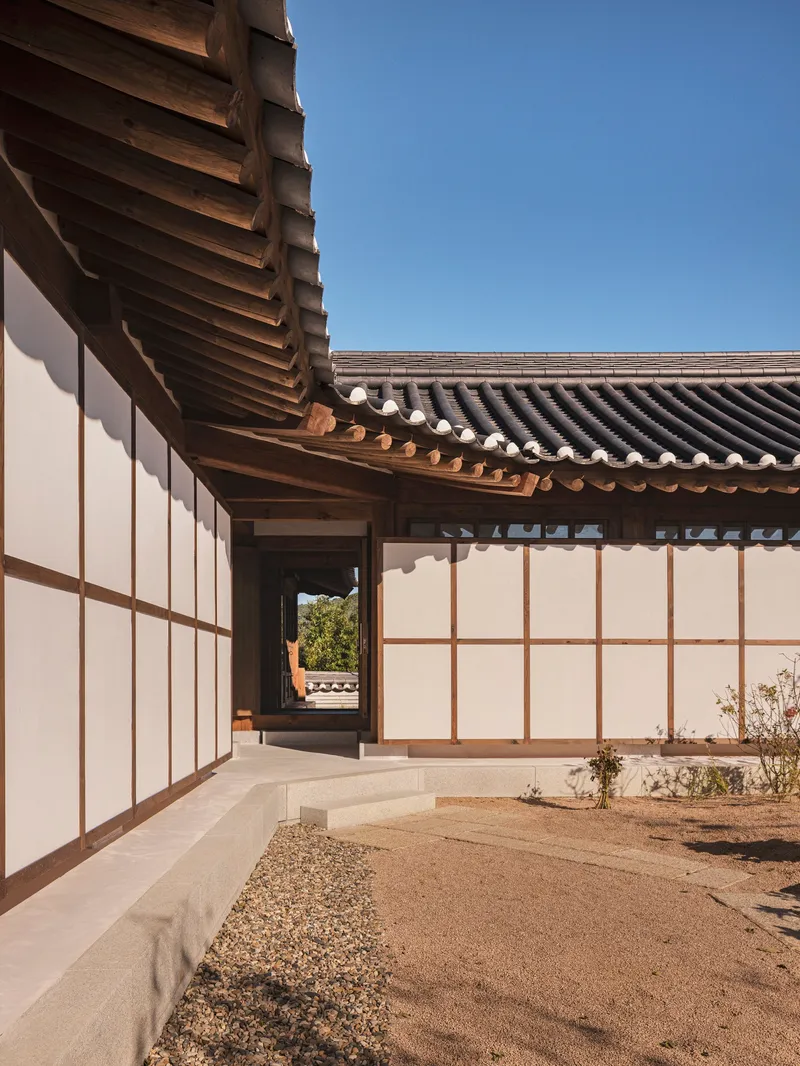
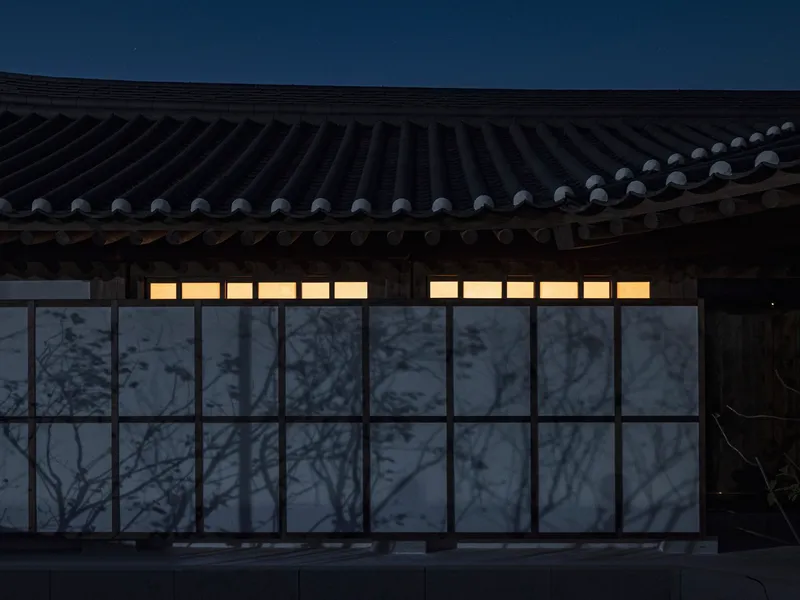
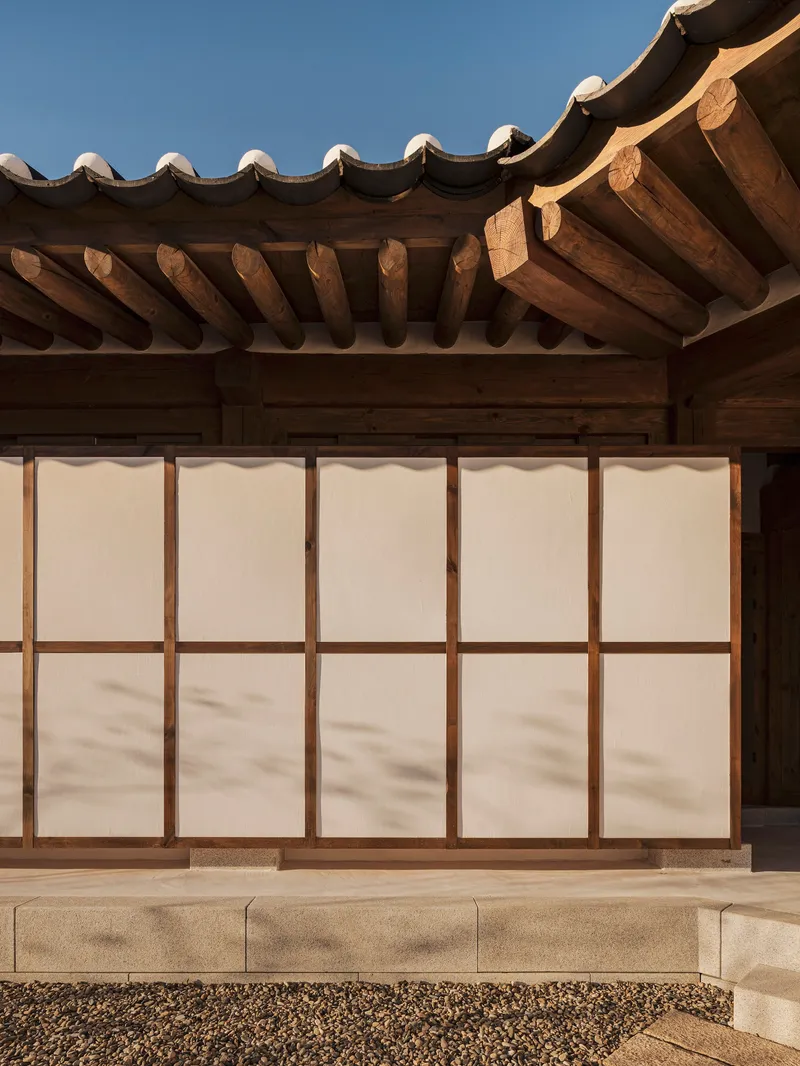
The defining material gesture is the layered translucent screen. Korean paper and hemp cloth are stretched across timber frames in multiple layers, each with different opacity, so that sliding one panel past another changes the quality of light filtering into the room. The architects describe this as producing the image of mist and cloud, and they are right: at dusk, the screens glow from within, reducing tree branches and courtyard plantings to soft silhouettes. The effect is not decorative. It is atmospheric engineering.
Small windows at the top of walls handle ventilation, while the main walls open generously toward the garden. The privacy gradient is sharp: closed and opaque toward the road, translucent and layered toward the courtyard, fully open toward the private garden at the back. Every surface mediates between inside and outside with a different degree of porosity.
The Courtyard at Dusk
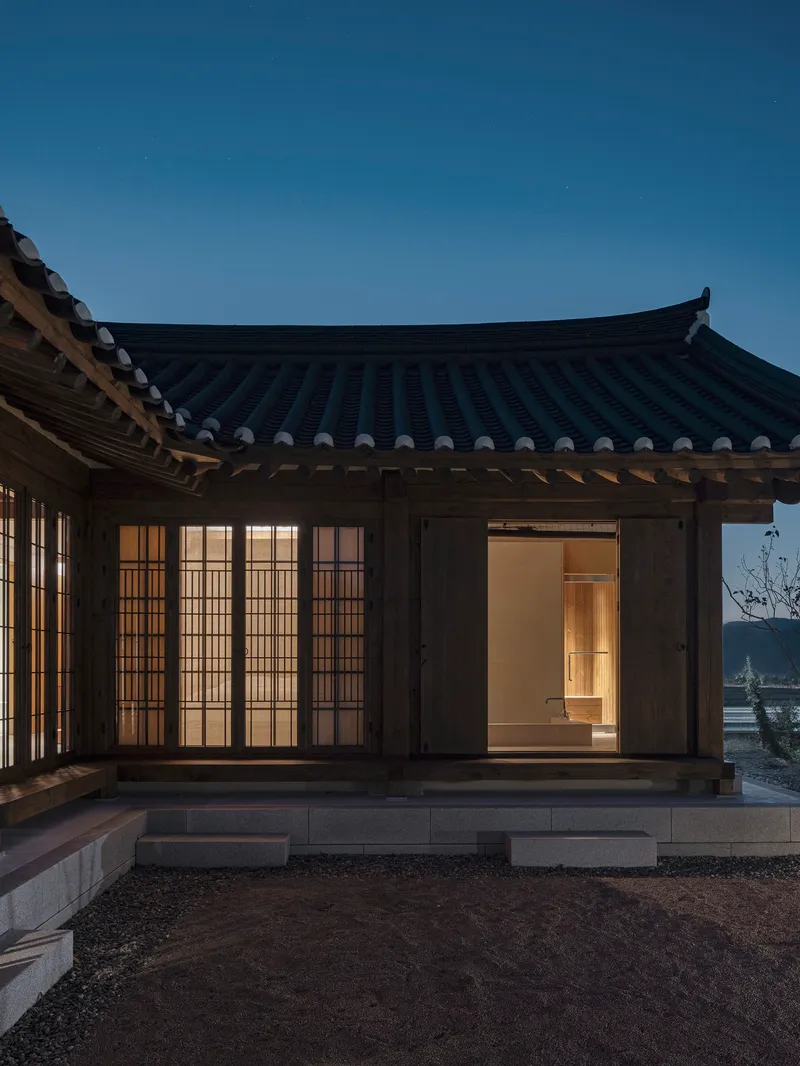
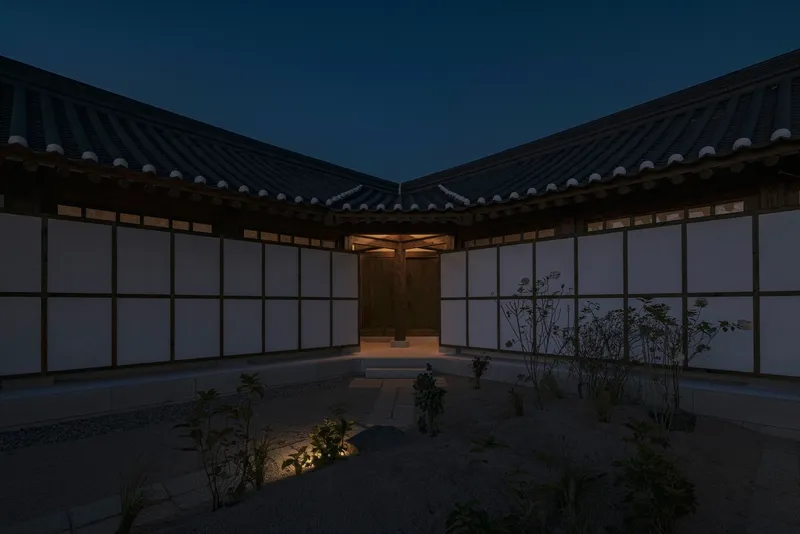
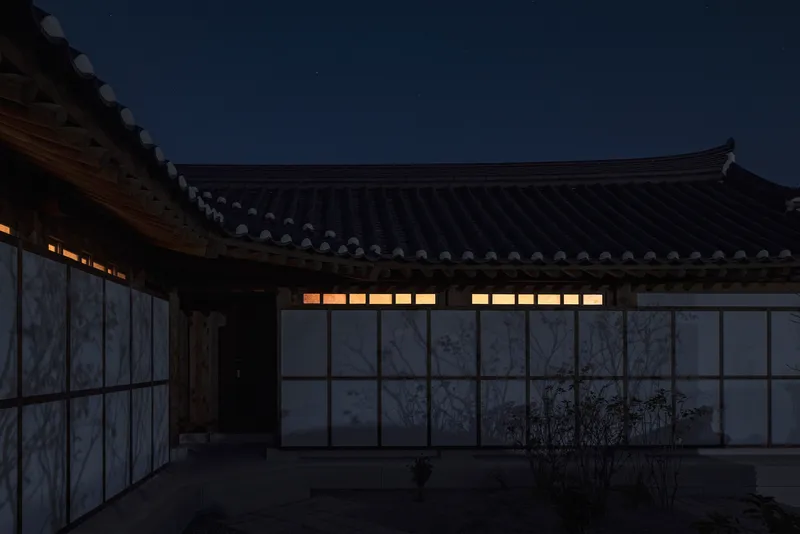
Muuun's courtyards transform dramatically after sunset. The translucent gridded screens become lanterns, casting warm light onto gravel paths and planted beds. The curved tile rooflines, which during the day register as heavy ceramic masses, become silhouetted profiles against the twilight sky. The clerestory windows above the screen walls create a luminous band that lifts the roof visually, making the eaves appear to float.
The dusk imagery is not incidental. A hotel like this trades on the quality of arrival, and Muuun stages arrival as a passage from the ordinary world into something hushed and hallucinatory. The 45-degree entry, the gravel underfoot, the overlapping rooflines converging at corners: every element conspires to slow the guest down.
Timber Structure as Interior Landscape
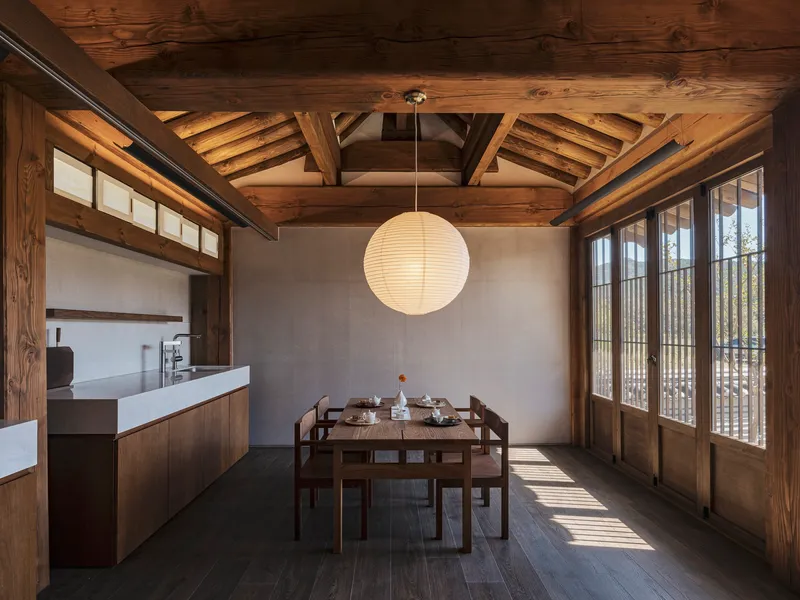
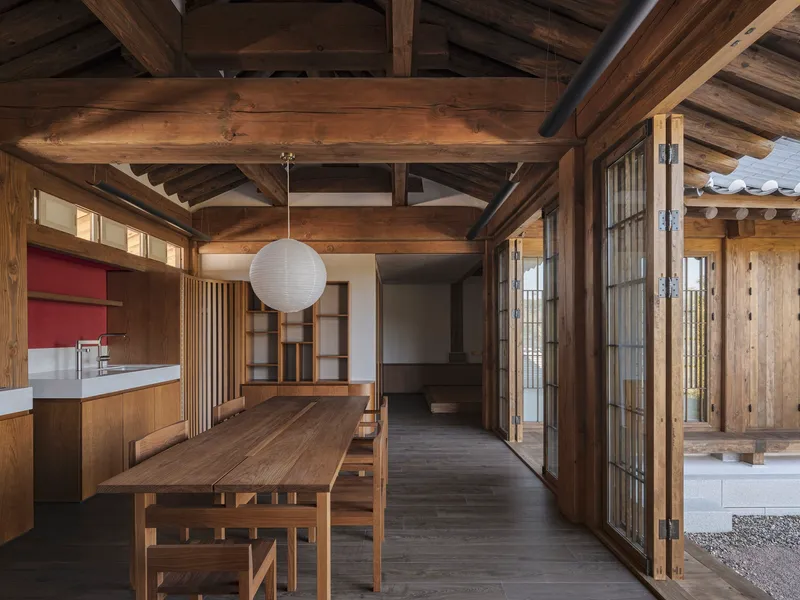
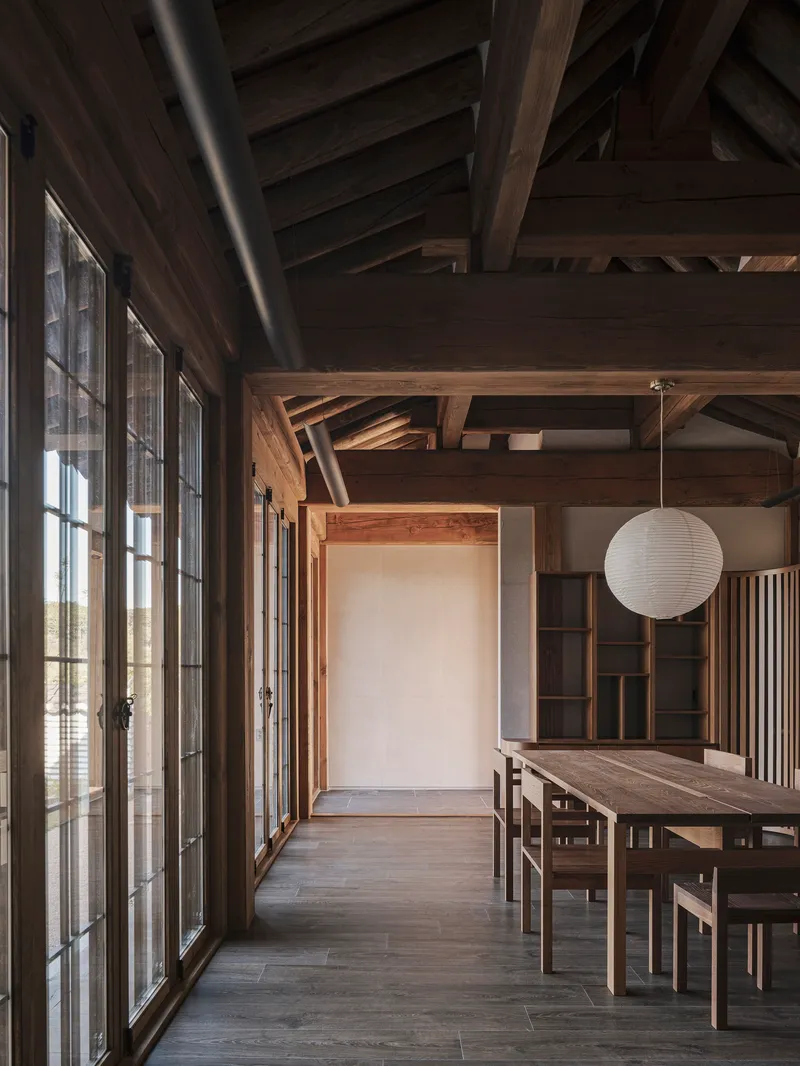
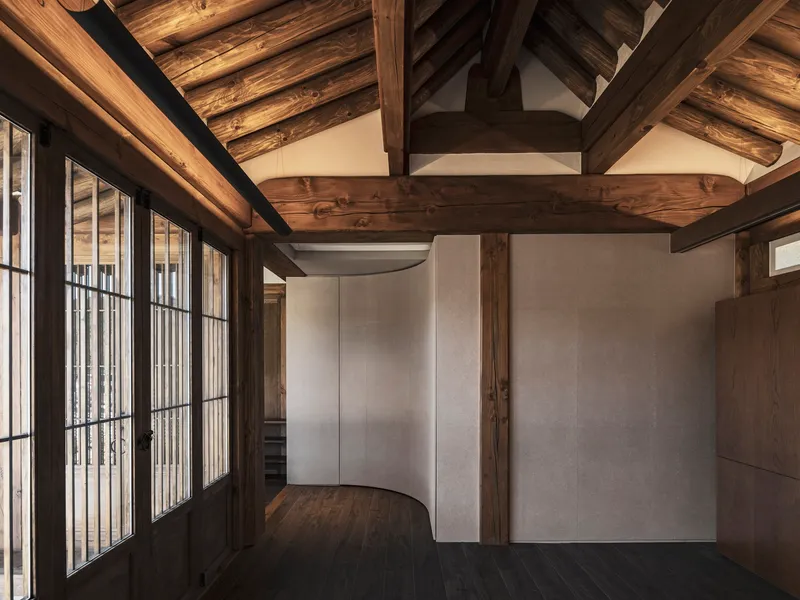
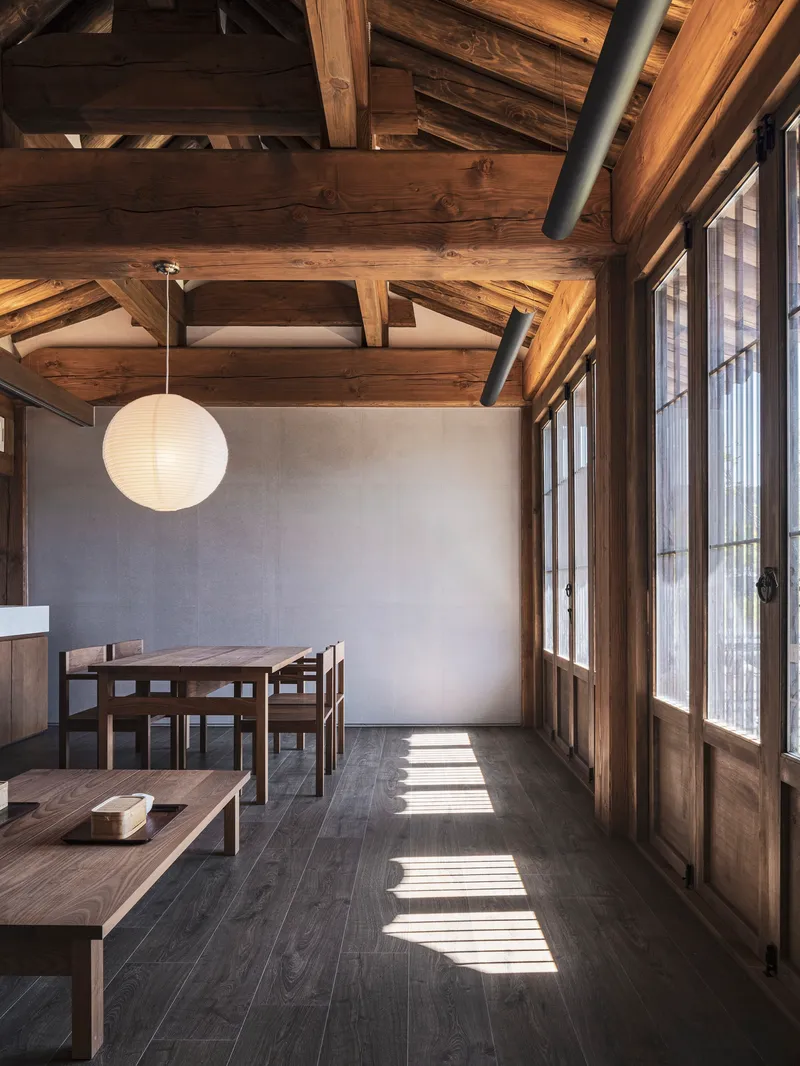
Inside, exposed timber post-and-beam construction does the heavy lifting, both structurally and visually. Rafters, purlins, and ceiling beams are left bare, their rhythm creating a cadence overhead that organizes the open-plan living and dining spaces below. A paper globe pendant hangs from the ridge in the dining area, its soft glow competing with afternoon sunlight that streams through the screen doors and casts grid shadows across the dark timber floors.
The kitchen backsplash, a deep red, is one of the few moments of saturated color in the entire project and reads as a deliberate punctuation mark against the restrained palette of grey paper, warm timber, and white plaster. Shelving is integrated into the timber frame rather than applied to the wall, reinforcing the idea that the structure itself is the furniture.
Floor Levels and the Sedentary Tradition
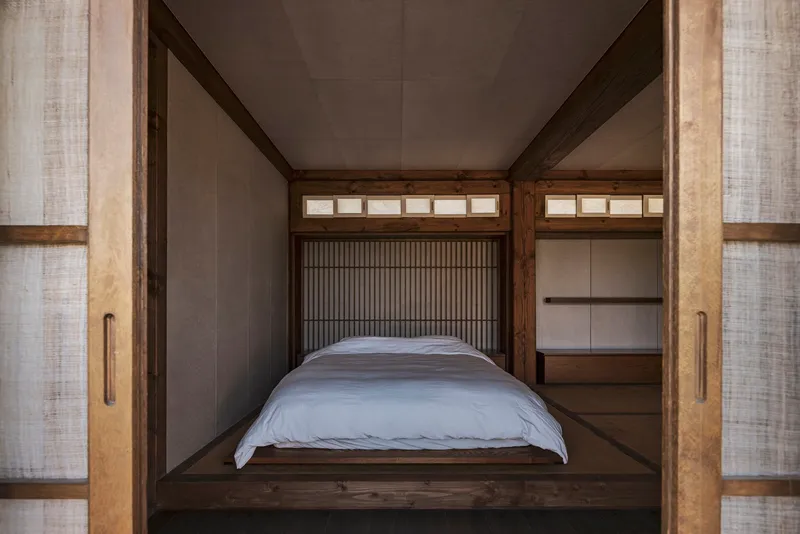
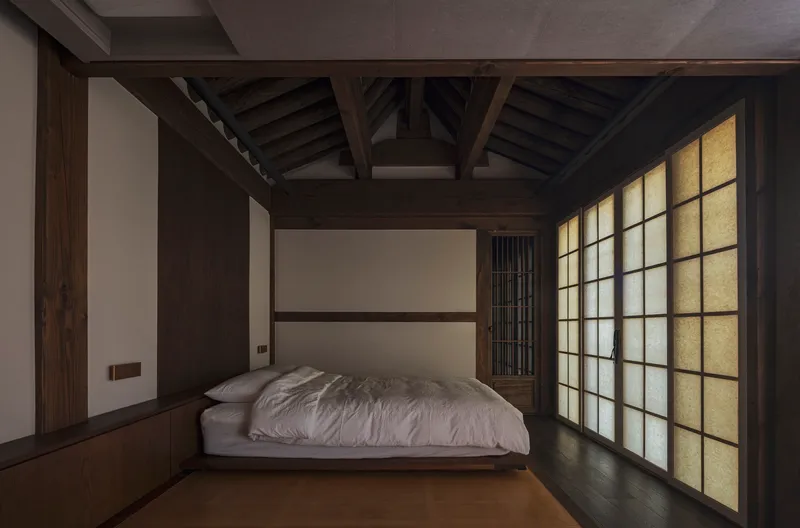
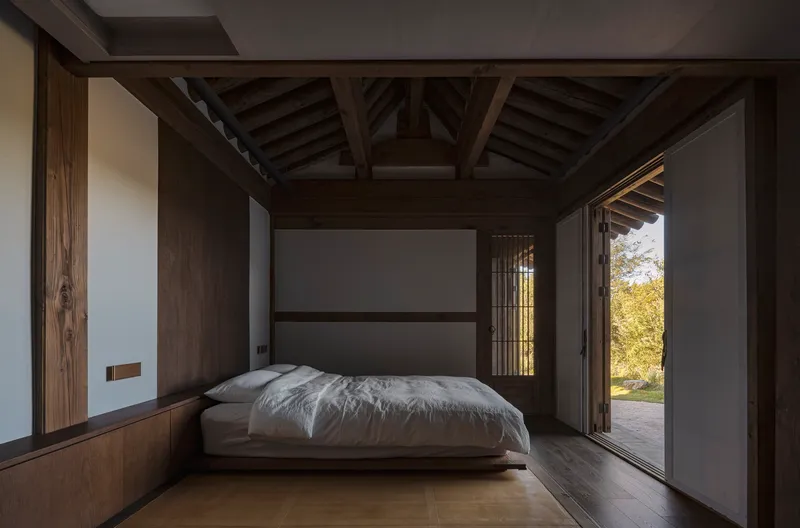
Traditional hanok design accommodates a sedentary lifestyle: sitting, eating, and sleeping happen on the floor. Muuun preserves this by splitting each unit into two distinct floor levels. The living and dining zones sit on regular wooden base flooring, while the bedrooms are elevated on a higher platform finished with clay plaster and linoleum treated with bean oil, a traditional material that is warm underfoot and ages beautifully. The level change is subtle but decisive, marking the bedroom as a place apart.
Platform beds are framed by timber posts with vertical slat screens and translucent sliding panels, creating a room-within-a-room effect. At night, backlit paper screens cast a soft amber glow through the bedroom, collapsing the boundary between wall and light source. The folding glass doors at the garden side can be thrown open entirely, letting the hillside and lawn become an extension of the sleeping space.
The Modern Well
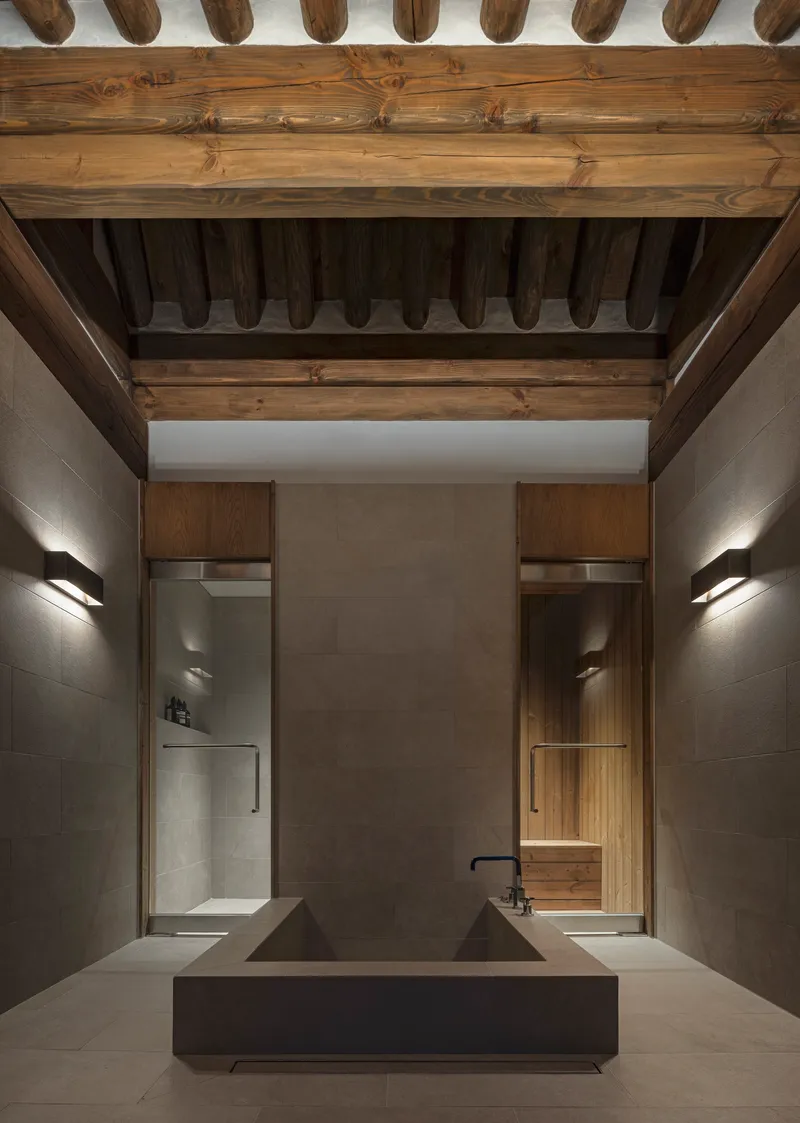
At the far end of each house, beyond the bedroom, the bathtub occupies a space with a high ceiling and wide doors that can convert the room from interior bath to open-air pavilion. The architects call this a modern well, inspired by the local myth that Park Hyeokgeose was bathed in a well at birth. The exposed wood structure is left visible here, framing the bather in a cage of timber that connects the most intimate moment of the stay to the oldest material in the building.
The double concrete basin in the bathroom sits beneath exposed ceiling beams, flanked by wall sconces that cast upward light into the rafters. It is one of the few moments where the project lets a contemporary material, poured concrete, stand alongside the traditional palette without apology. The curved partition walls nearby, bending beneath the post-and-beam structure, introduce a rare organic geometry that softens the orthogonal discipline of the plan.
Threshold and Entry

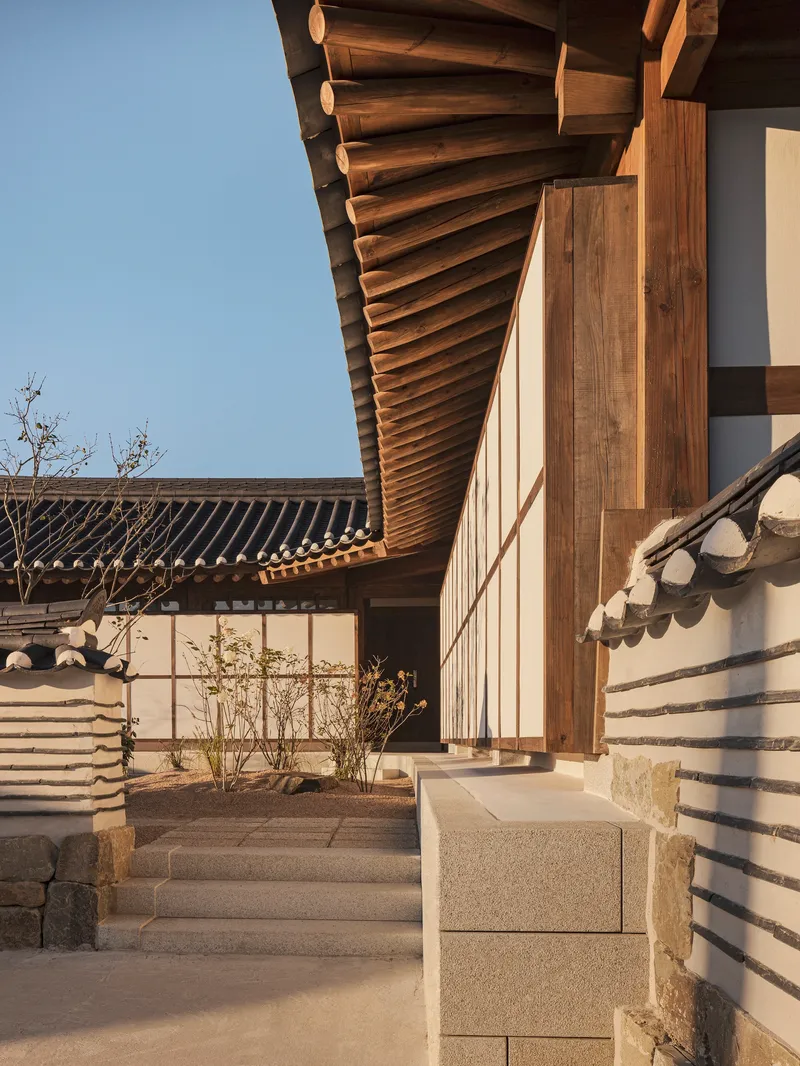
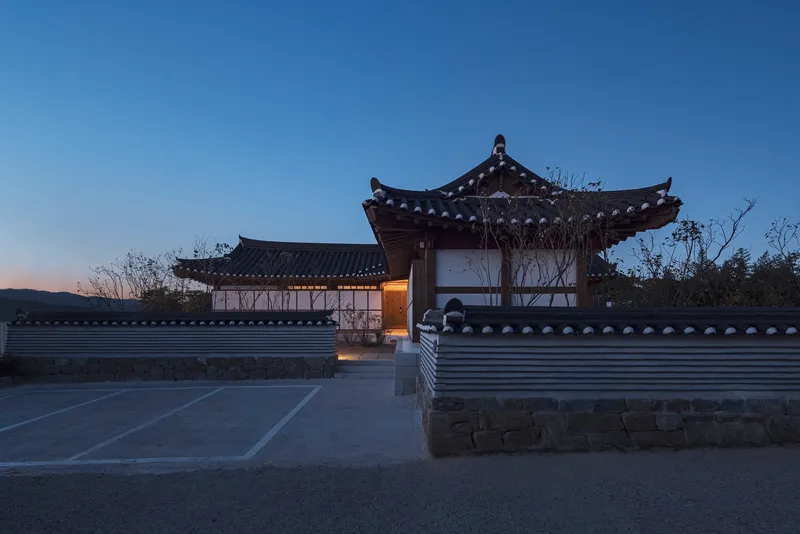
The approach sequence is carefully controlled. From the street, the building presents stone walls, white plaster, and the sweeping profiles of curved tile roofs, a composed facade that gives almost nothing away. Stone steps lead down into the courtyard, where exposed timber rafters and planted beds replace the solidity of the exterior with warmth and texture. The winter view, with bare trees silhouetted against the sunset and timber pavilions glowing behind their screens, is arguably the project's most compelling image: a building that becomes more legible, not less, as the landscape strips itself bare.
Plans and Drawings
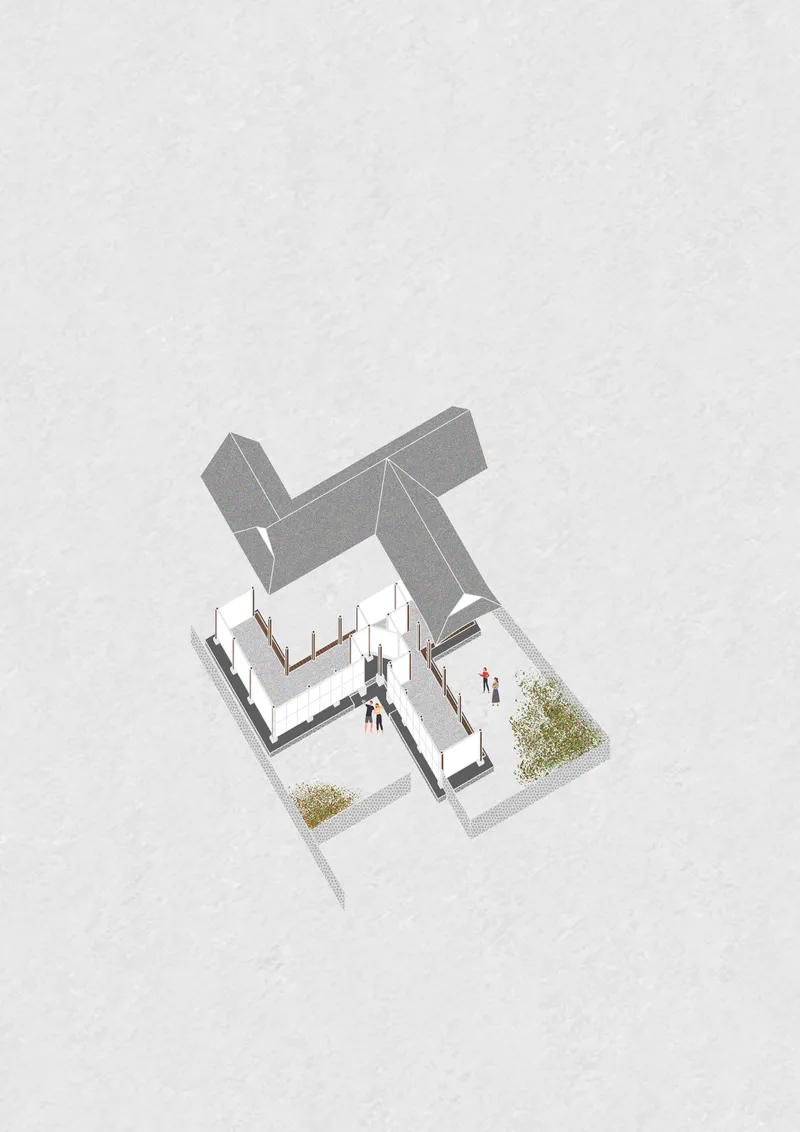
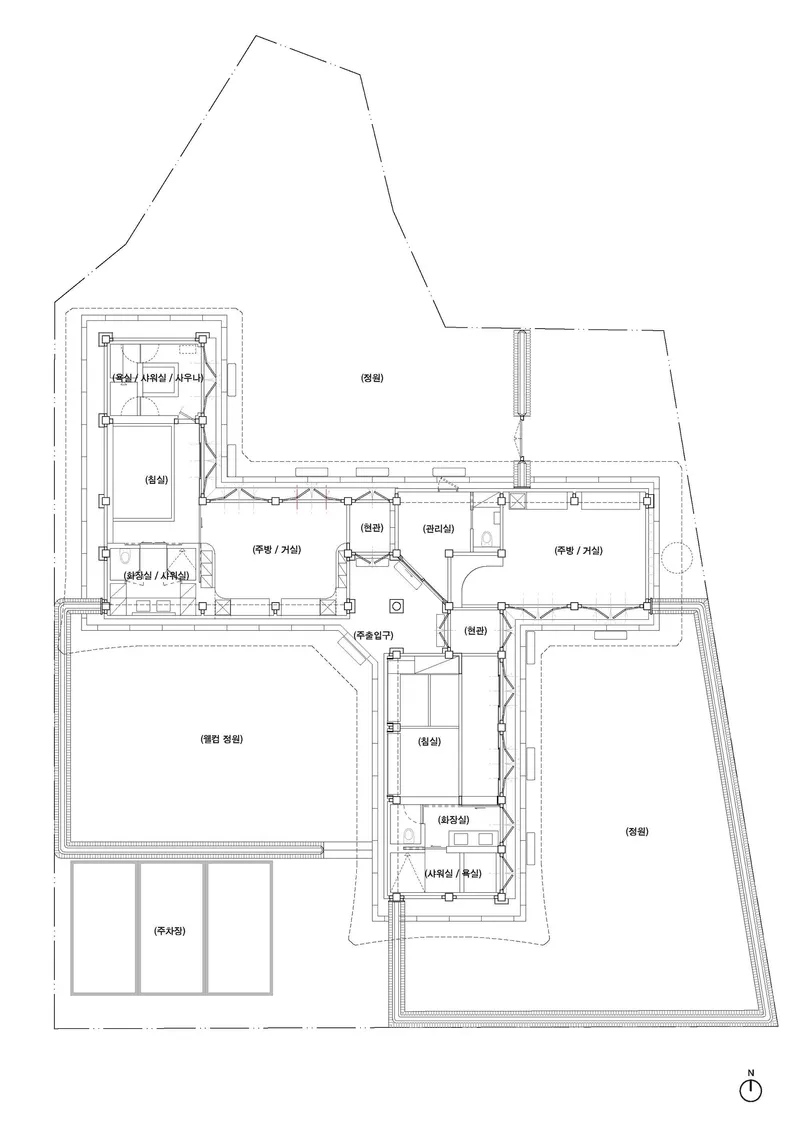


The axonometric drawing reveals what photographs cannot: the precise geometry of the two L-shaped units and the way their courtyard spaces interlock to form a cross-shaped circulation core at the center. The floor plan confirms the gradient from public to private within each unit, with the living room anchoring the inner corner and the bedroom pushed to the far end. The roof plan, with its striped patterns indicating the tiled surfaces, shows how the gabled projections create sheltered eaves at each courtyard edge.
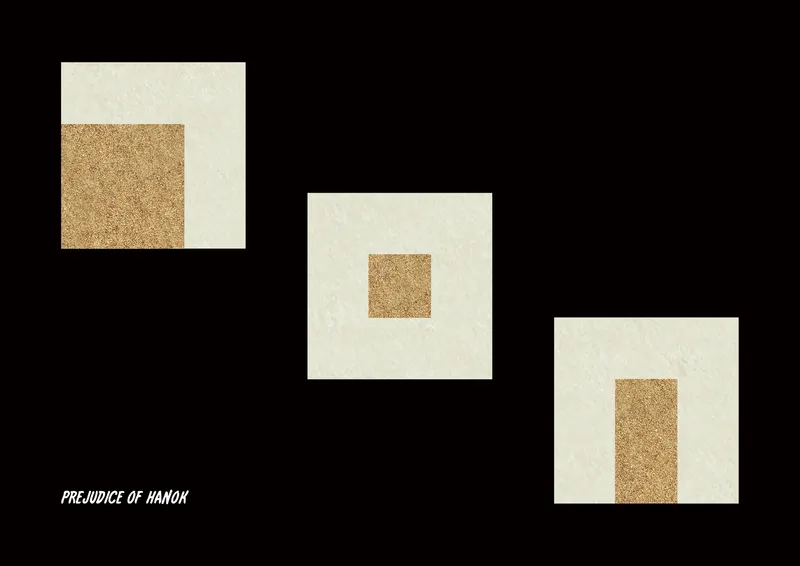
The material diagrams are worth noting. One shows the relationship between the white volumes and the dark green textured surfaces, likely representing the interplay of plaster walls and planted courtyard ground. The other presents sample tiles with cork or aggregate insets, hinting at a material research process that extended well beyond off-the-shelf specification. These are the drawings of architects who understand that a hanok is a system, not a style.
Why This Project Matters
Muuun Hotel matters because it demonstrates that traditional building systems can absorb contemporary programs without betraying either the tradition or the program. A boutique hotel is a demanding brief: it must deliver comfort, novelty, and a sense of place simultaneously. By grounding the project in hanok principles (floor-level living, layered screen walls, courtyard organization, natural material palettes) while introducing modern plumbing, concrete, and operable glass, NOMAL and ONJIUM Housing Studio prove that the hanok is a living technology, not a relic.
More broadly, the project is a case study in atmospheric design. The mist-and-cloud concept is not a branding exercise layered on top of the architecture; it is embedded in every material decision, from the translucent hemp cloth screens to the gravel courtyards that blur the line between landscape and building. In a hospitality market saturated with minimalist boxes and nostalgic reconstructions, Muuun carves out a third position: rigorous, strange, and deeply rooted in its place.
Muuun Hotel by NOMAL and ONJIUM Housing Studio. Gyeongju-si, South Korea. 143 m². Completed 2022. Photography by Choi Yong Joon.
About the Studio
Share Your Own Work on uni.xyz
If projects like this are the kind of work you want to make, uni.xyz is a place to publish your own, find collaborators, and enter design competitions.


Popular Articles
Popular articles from the community


LT2A and OPEN Architectes Thread a Brick and Glass High School Through a Wooded Belgian Campus
In Braine-l'Alleud, a 3,000 m² wing for Collège Cardinal Mercier pairs pale brick with a glazed colonnade, deferring to a small chapel and a dense wood.

Architekt Andreas Gruber Scatters 23 Dark Timber Chalets Across a South Tyrolean Forest Edge
In Molini di Tures, Amonti Chalets breaks a resort into a hamlet of gabled timber houses, with parking, storage and services pushed into the slope.

Juan García Correa, John González and Claudia Rueda Sink a Circular Amphitheater into a Manizales Engineering Building
On the La Nubia campus in Manizales, Colombia, the S1 Building folds labs and offices into a hillside of ramped lawns that double as a campus route.

U.GA Architects Wraps an Oval Rooftop Pool in Curved Board-Formed Concrete on Busan's Jeollidan-gil
In Busan's Jeonpo-dong, a 454 m² mixed-use block stacks a neighborhood facility, guest rooms and an oval rooftop pool inside spiraling concrete walls.

Similar Reads
You might also enjoy these articles


LAVA Architecten Gives Vocational Education a Sawtooth-Roofed Face on a Mechelen School Campus
In Mechelen, Belgium, a 2,053 m² STEM school on a 6×6 m grid turns workshops and classrooms into rooms that can be rearranged as teaching changes.

KEMA Studio Turns a Derelict Marvila Attic into a 60 m² Lighthouse Apartment Above Lisbon
In Lisbon's Marvila district, a rebuilt roof, four skylights and two plywood volumes turn an unlivable attic into a bright home facing the Tagus.

Pixel Gardens: One Repeated Module Stacked Into a Terraced Social Housing Tower for Famagusta
Salem Bader's shortlisted housing tower builds a vertical neighbourhood from one repeated module, offsetting units to carve terraces, light and air.

Bao Huynh Watercolor Atelier: A Serene Art Retreat in Hội An
Bao Huynh Watercolor Atelier in Hội An blends multifunctional art spaces, sustainable design, local materials, and family-friendly living in a serene environment.

Comments (0)
Please login or sign up to add comments
No comments yet. Be the first to comment!