
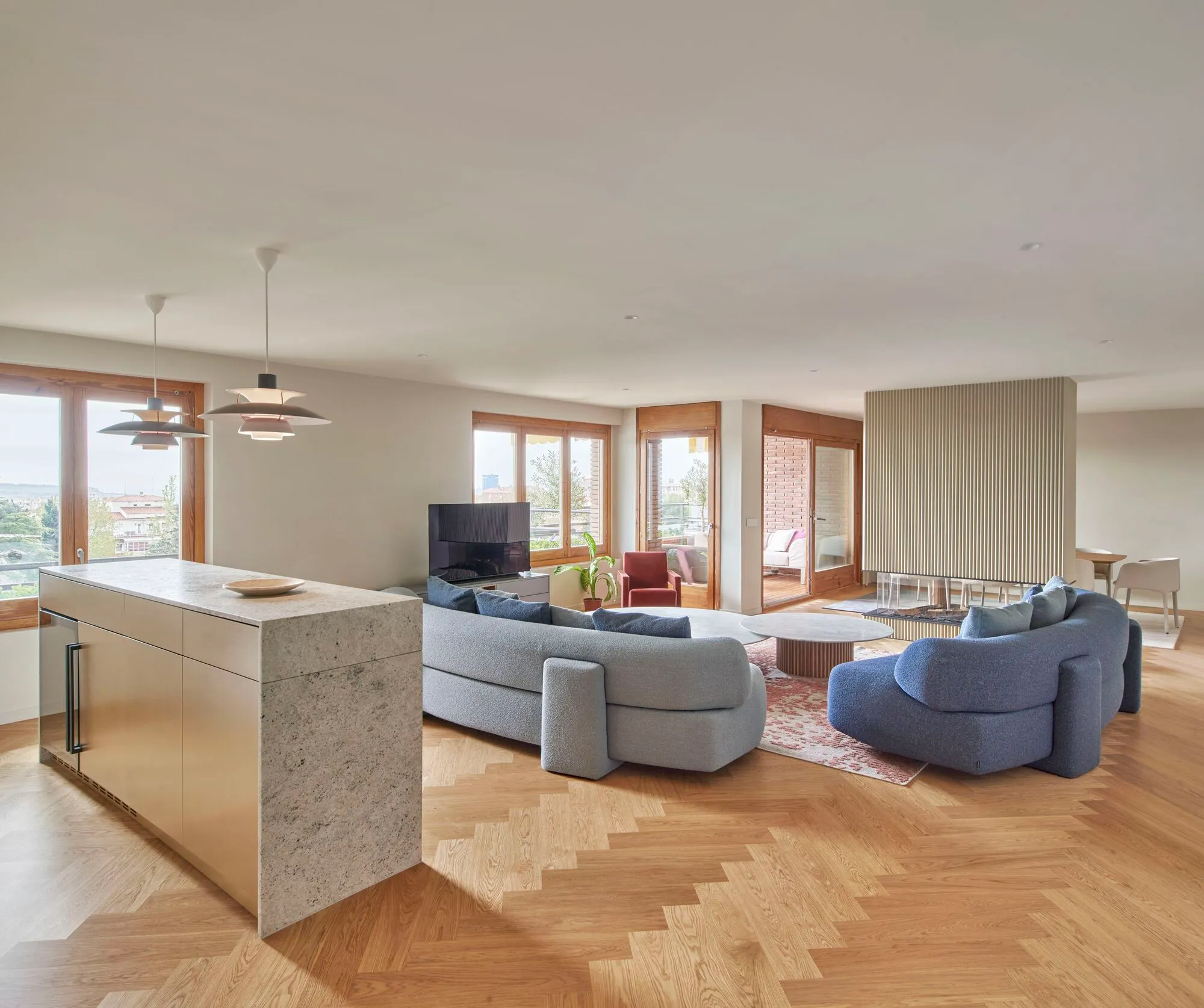
NOMO STUDIO Dismantles a Façade to Slide a Marble Table into a 1970s Barcelona Penthouse
A 240 m² penthouse in Barcelona sheds its dated layout for fluid, corridor-free living organized around monolithic anchors.


Some renovation stories start with demolition. This one starts with a crane. To install a 180 cm diameter marble table in a single unbroken piece, NOMO STUDIO had to physically unmount a section of the building's façade. It is a detail that tells you everything about the ambition of this project: nothing here was going to be compromised, least of all the materials.
The apartment, a penthouse in a classic Barcelona building, had gone untouched since its construction in the 1970s. Partner-in-Charge Alicia Casals and Project Leader Karl Johan Nyqvist gutted the entire plan and reassembled it without corridors. What emerged is a 240 m² residence where day areas flow into one large, breathing space and private rooms ring the perimeter, each one en-suite. The organizing principle is not walls but objects: a hovering fireplace, a granite bar, marble tables, and detached wardrobes that act as soft boundaries. Circulation floats around these monolithic anchors rather than being funneled through hallways.
The Fireplace as Fulcrum
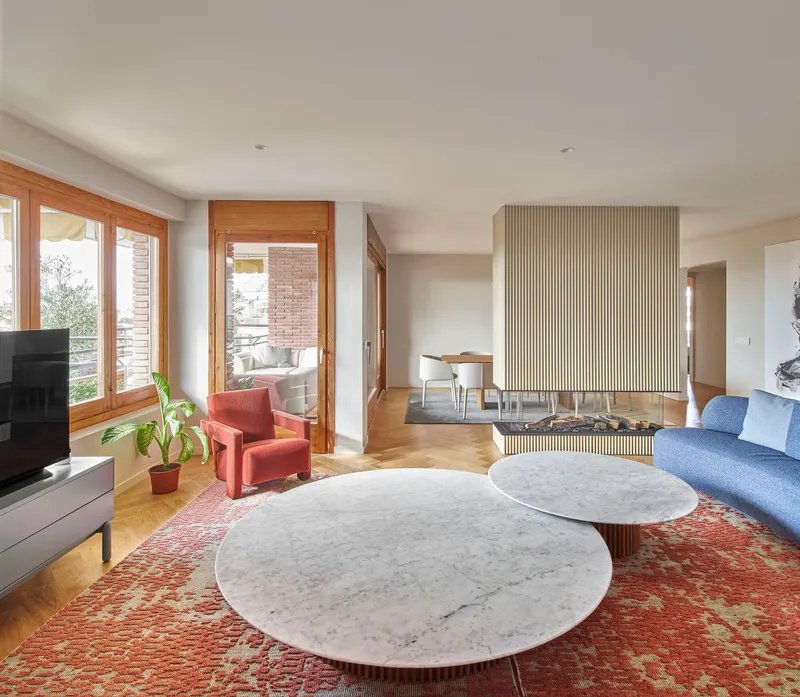
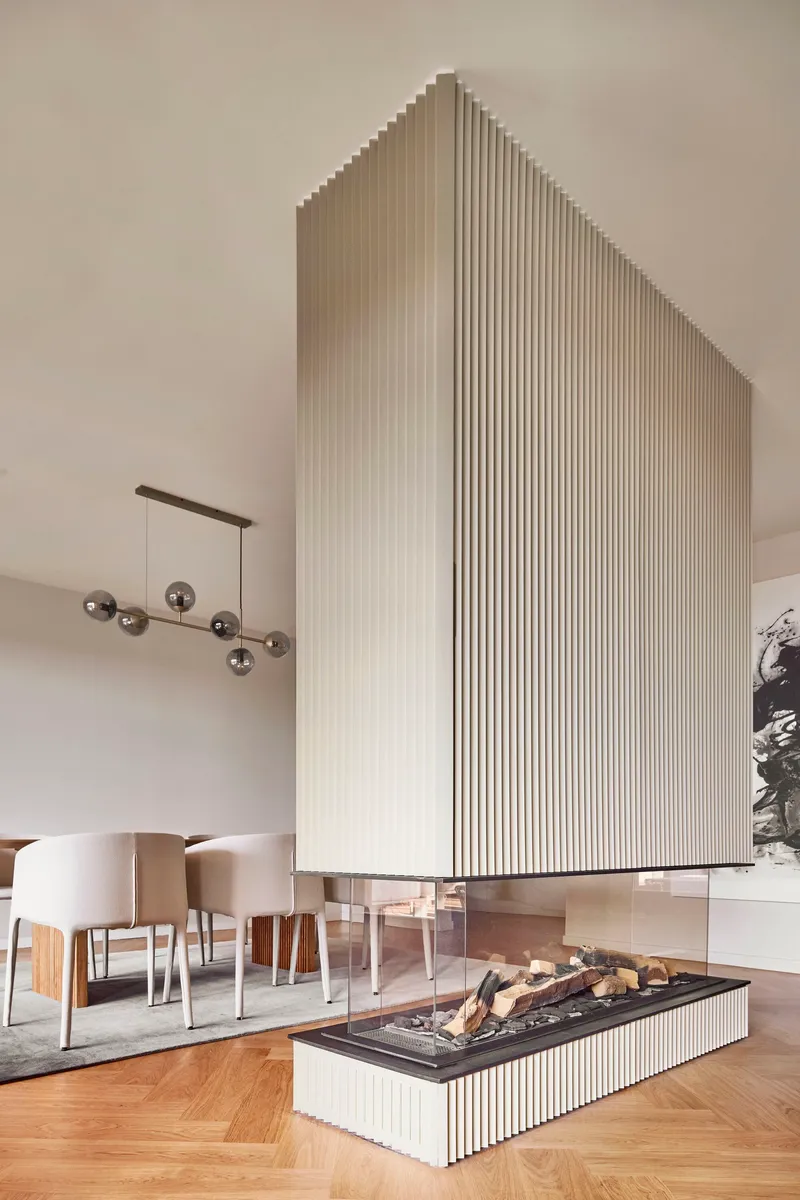
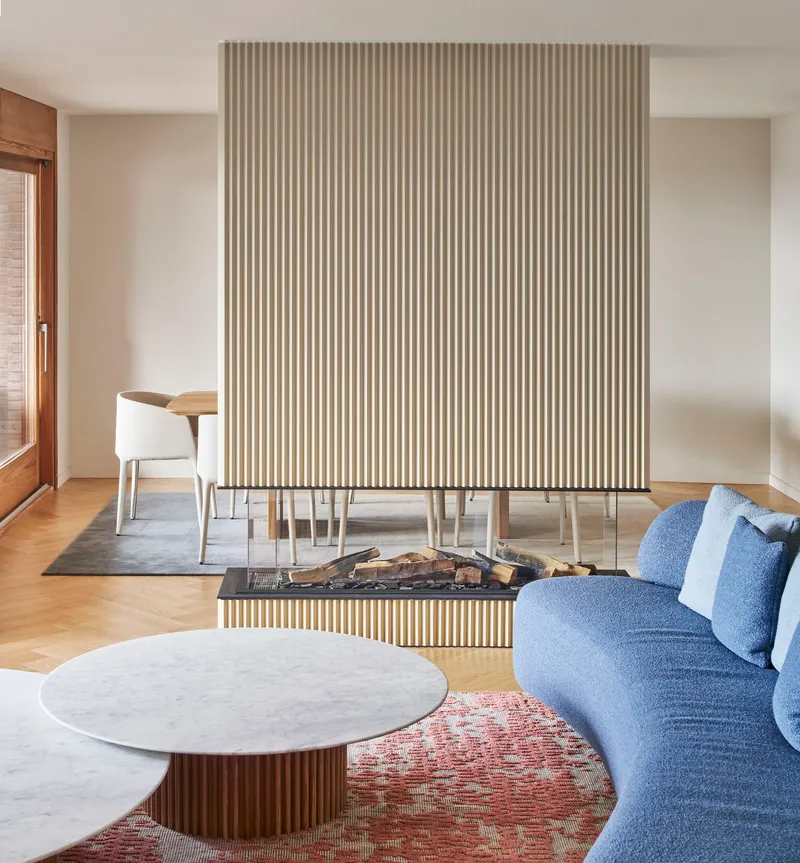
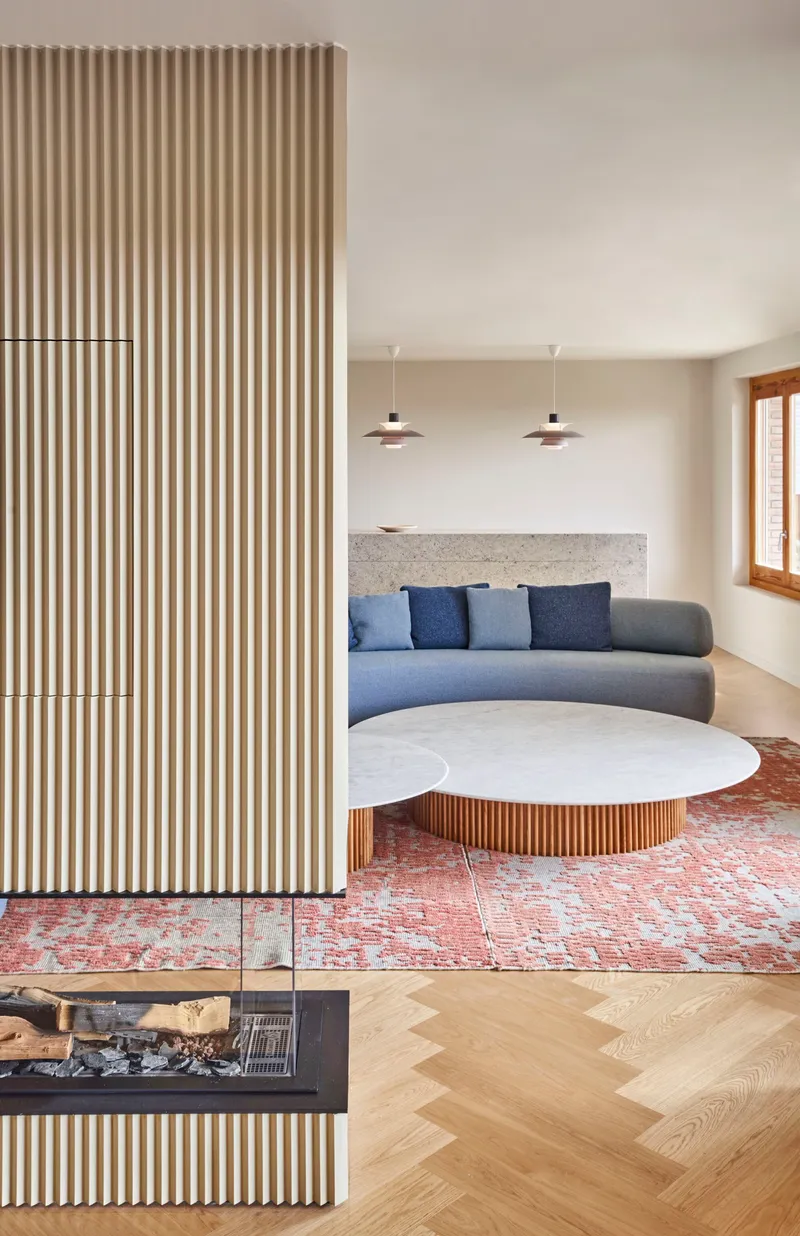
The vertically fluted fireplace column is the apartment's gravitational center. Suspended above a black hearth with stacked firewood below, it reads as both sculptural object and functional heat source. Its ribbed texture picks up light differently throughout the day, lending the living room a quality that shifts from warm in the morning to deeply shadowed by late afternoon.
NOMO STUDIO positions the fireplace not against a wall but as a freestanding element that you can walk around. It separates the dining zone from the seating area without closing either one off, and a bronze pendant lamp overhead reinforces the sense that this is a distinct place within the larger open plan. The curved sofa wraps partially around it, creating an intimate pocket in what could otherwise feel like an undifferentiated loft.
Corridor-Free Living
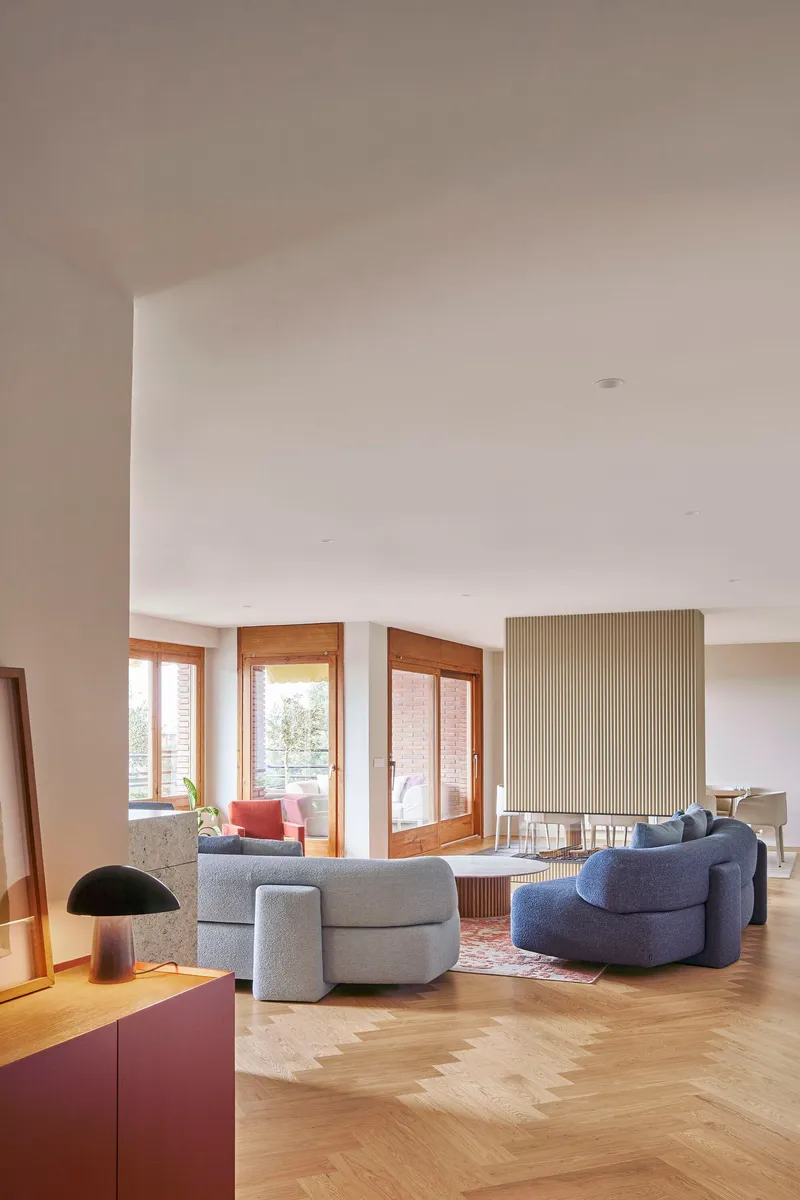
The original 1970s layout almost certainly used a central hallway to distribute rooms. That hallway is gone. In its place, NOMO STUDIO strings together a sequence of interrelated atmospheres, each one defined by a piece of furniture or a material shift rather than a doorframe. The fluted timber partition wall that appears in the living room is a recurring motif: it screens without enclosing, letting light spill across the herringbone oak floor in long afternoon streaks.
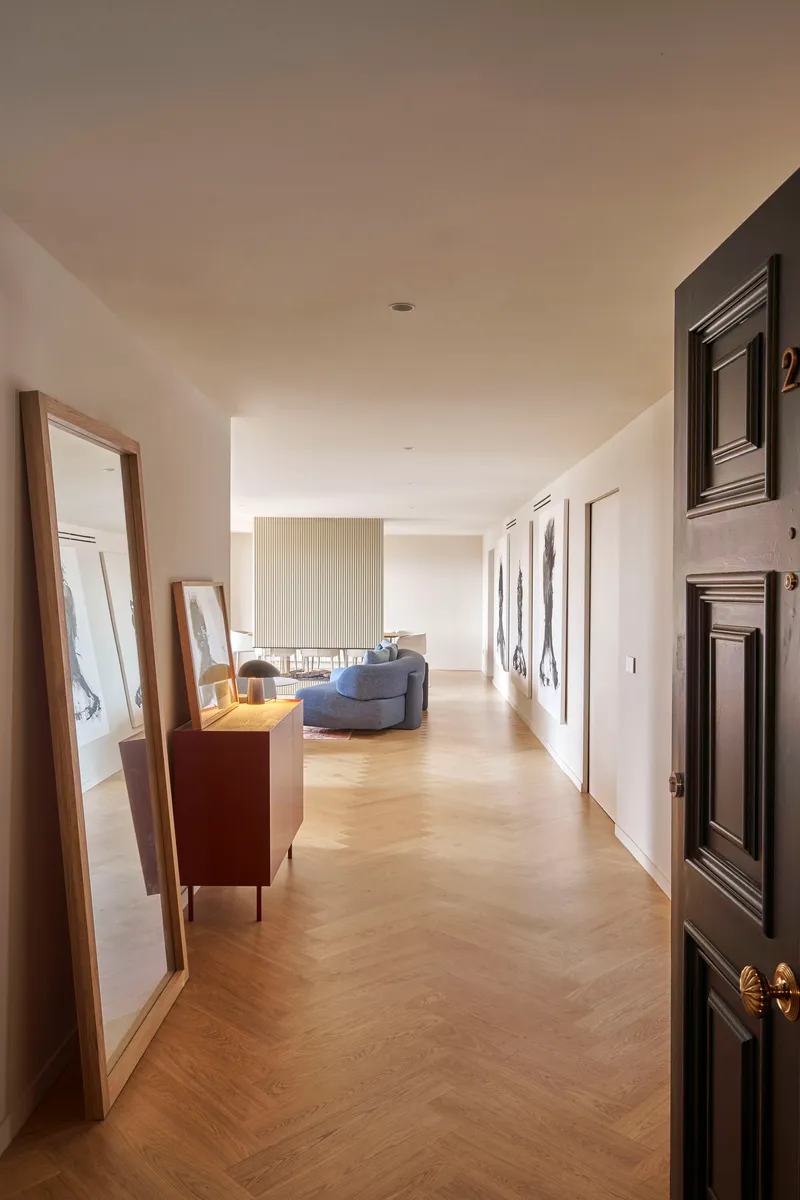
The lone corridor that survives, visible in the chevron-floored passage toward the bedrooms, functions less as a hallway and more as a gallery. Framed artwork lines the walls, and the view terminates in a seating area rather than a dead end. It is a small move, but it signals the overall philosophy: every linear meter of this apartment should reward the person walking through it.
Kitchen as Landscape
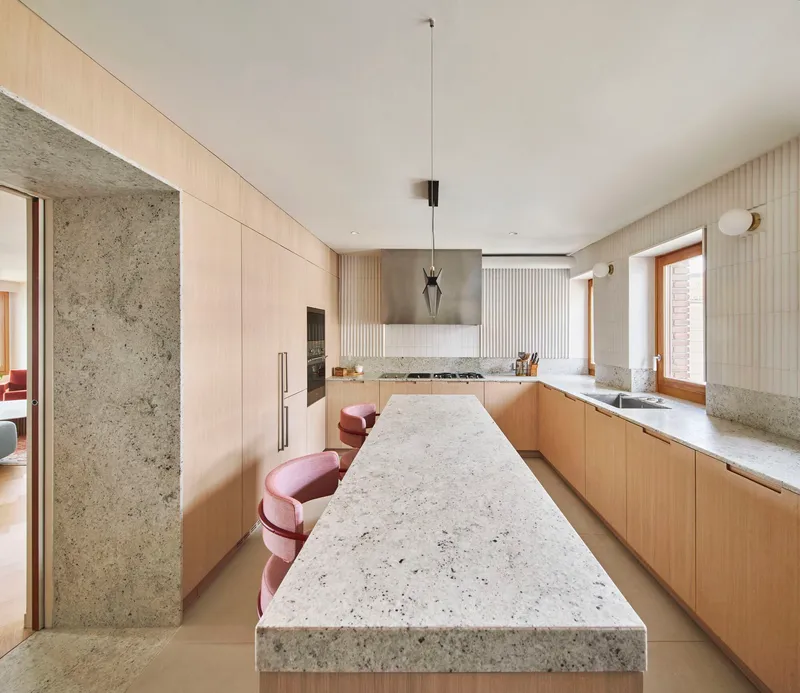
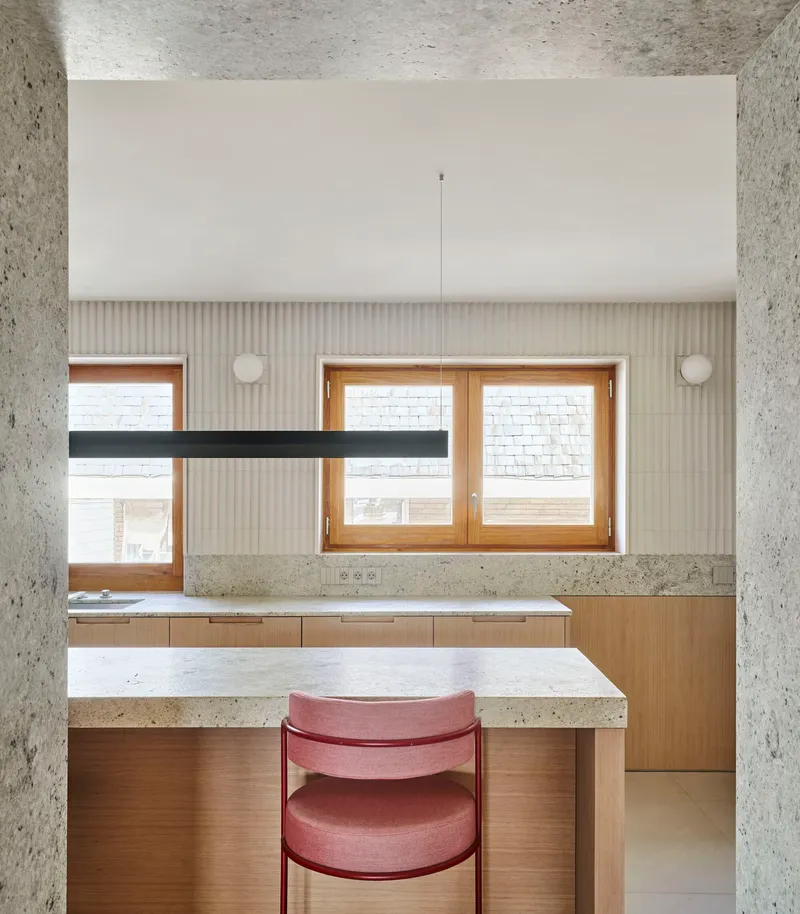
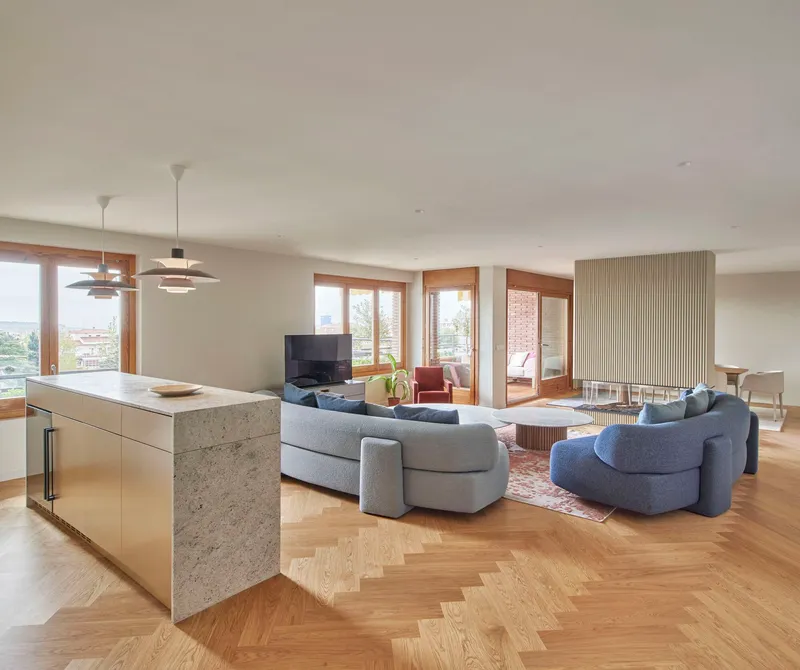
The kitchen is not tucked away. It stretches along one side of the day area, anchored by a terrazzo island that doubles as the apartment's social bar. Oak cabinetry, fluted wall panels, and a stainless steel range hood keep the palette disciplined, while the terrazzo countertop provides the kind of visual texture that reads as geological rather than decorative. From the island, the timber-framed windows pull in a panorama of Barcelona's rooftops, making the act of cooking feel oddly civic.
Those original wooden window frames were preserved from the 1970s build, a decision that grounds the new interiors in the building's history. Against the crisp terrazzo and contemporary cabinetry, the slightly weathered timber reads as inherited rather than installed. It is one of the project's smartest choices: letting the old frame contain the new content.
The Master Suite and Its Soft Partitions
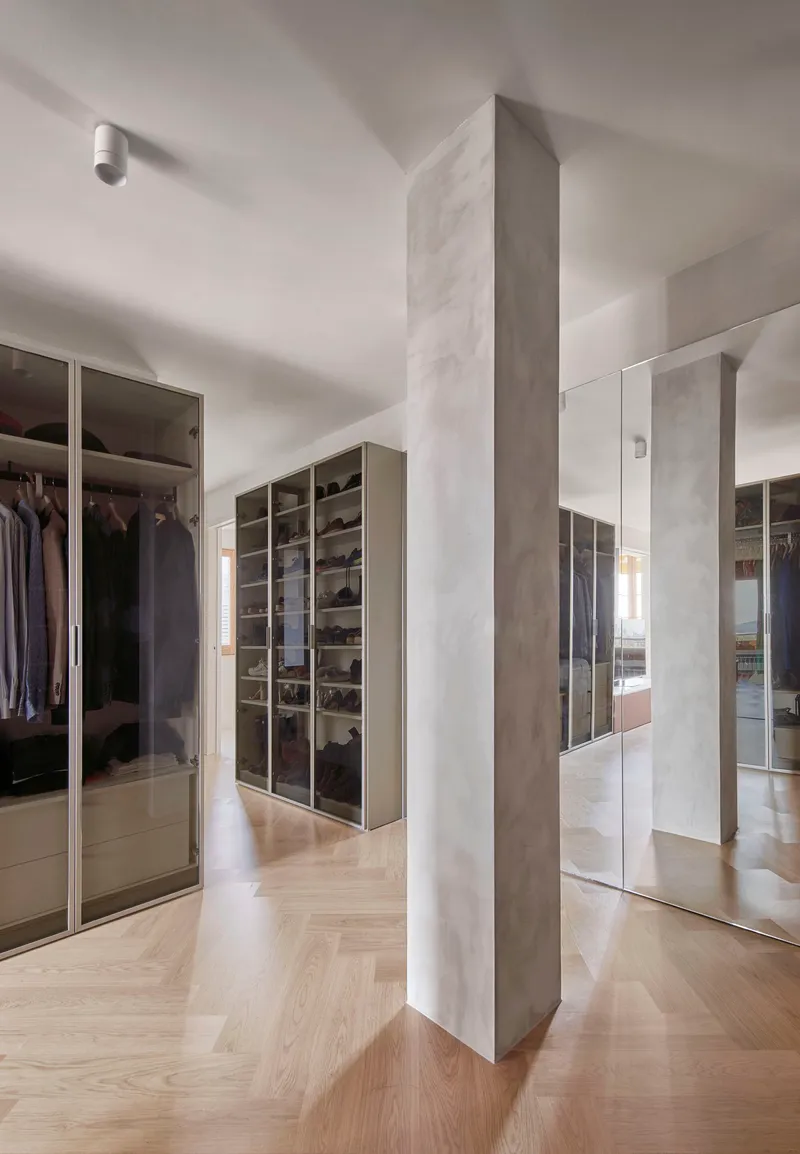
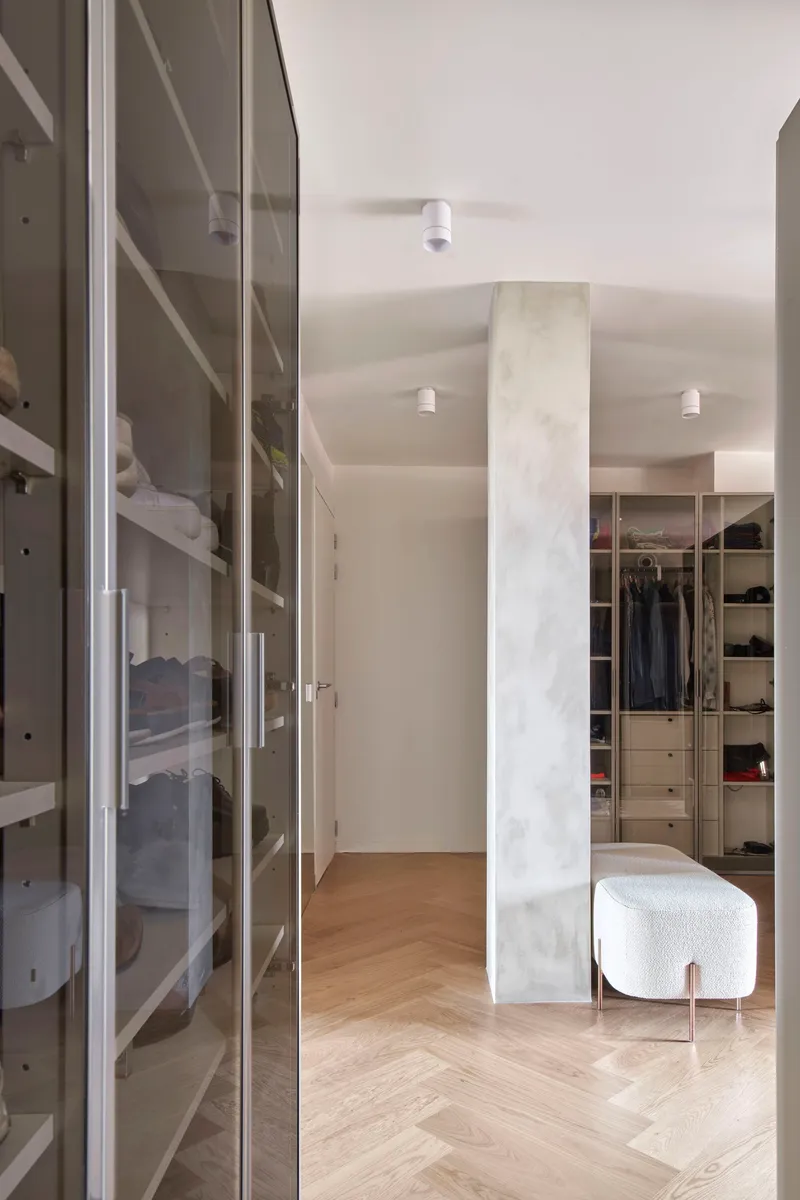
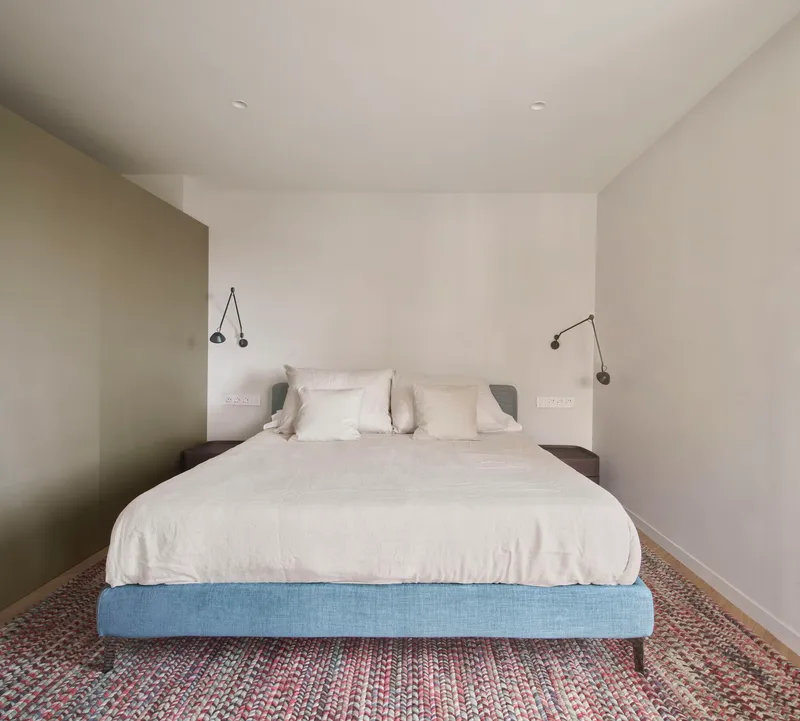
The master bedroom is not really a room. It is a constellation of functions: sleeping, dressing, and working, all laid out in an open-plan configuration structured by detached wardrobes and sliding partitions. The dressing room, with its floor-to-ceiling mirrored wardrobes and freestanding terrazzo-clad column, feels like a separate destination within the suite. Herringbone oak flooring runs continuously underfoot, stitching the zones together.
The walk-in closet, with glass-fronted storage and a white upholstered ottoman, is treated with the same material care as the public rooms. There is no drop in ambition when the door closes. The blue upholstered platform bed, paired with articulated wall-mounted reading lamps, is restrained enough to let the architecture breathe. Custom-designed pivot elements throughout the suite allow the occupant to reconfigure the space daily, closing off the bedroom for sleep or opening it completely for light.
Work Niches and Retreats
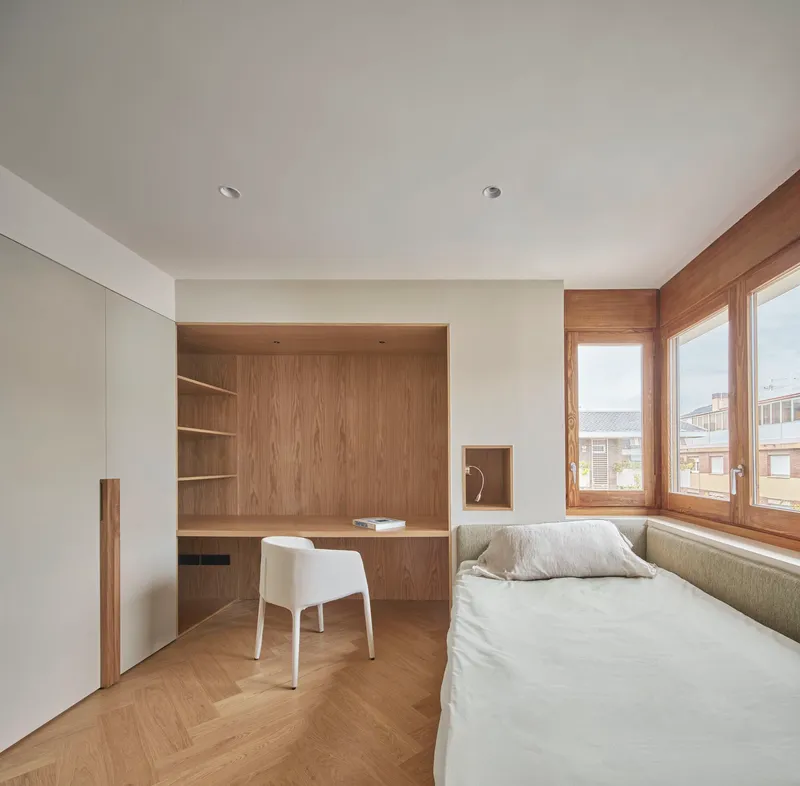
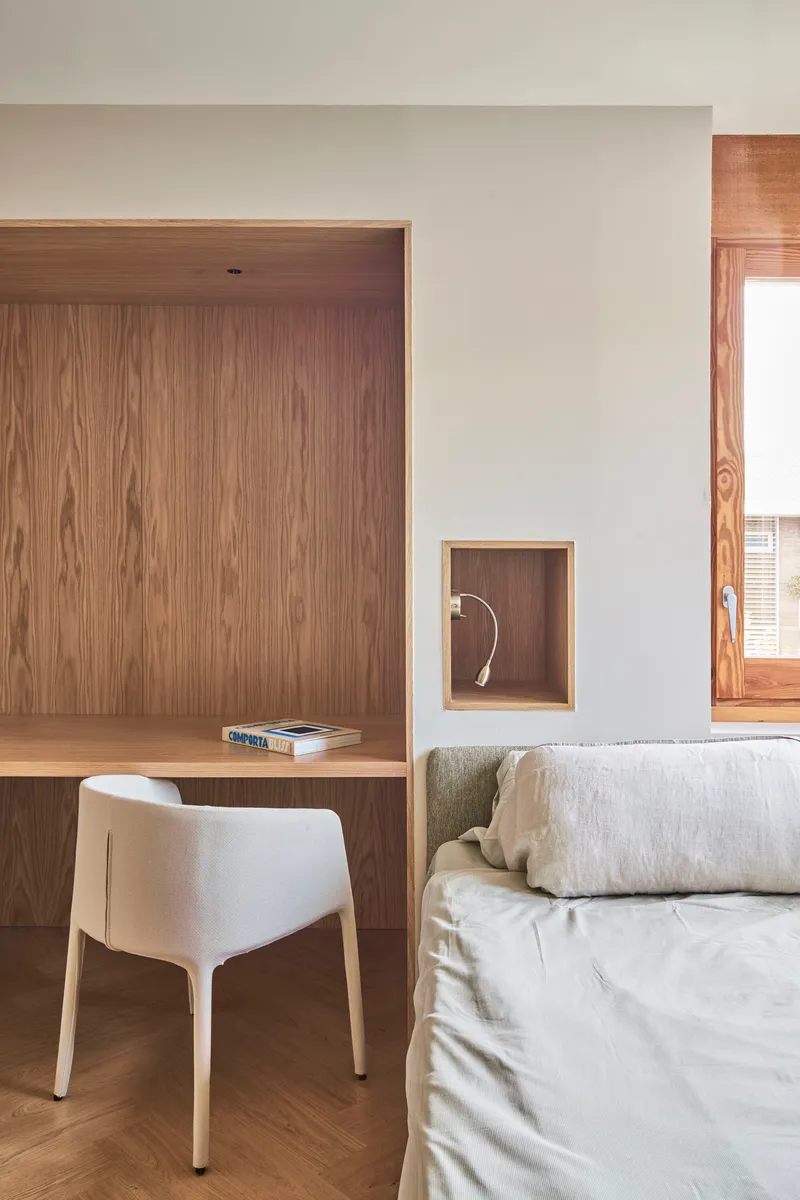
NOMO STUDIO carved out a series of desk alcoves that feel built into the walls like cabinetry. The oak-lined alcove in the bedroom, paired with an upholstered window seat, turns a leftover bay into a genuinely comfortable workspace. The walnut desk alcove, with its square display niche, offers a darker, more focused atmosphere. Neither one is large, and that is the point: these are places for concentration, not conference calls.
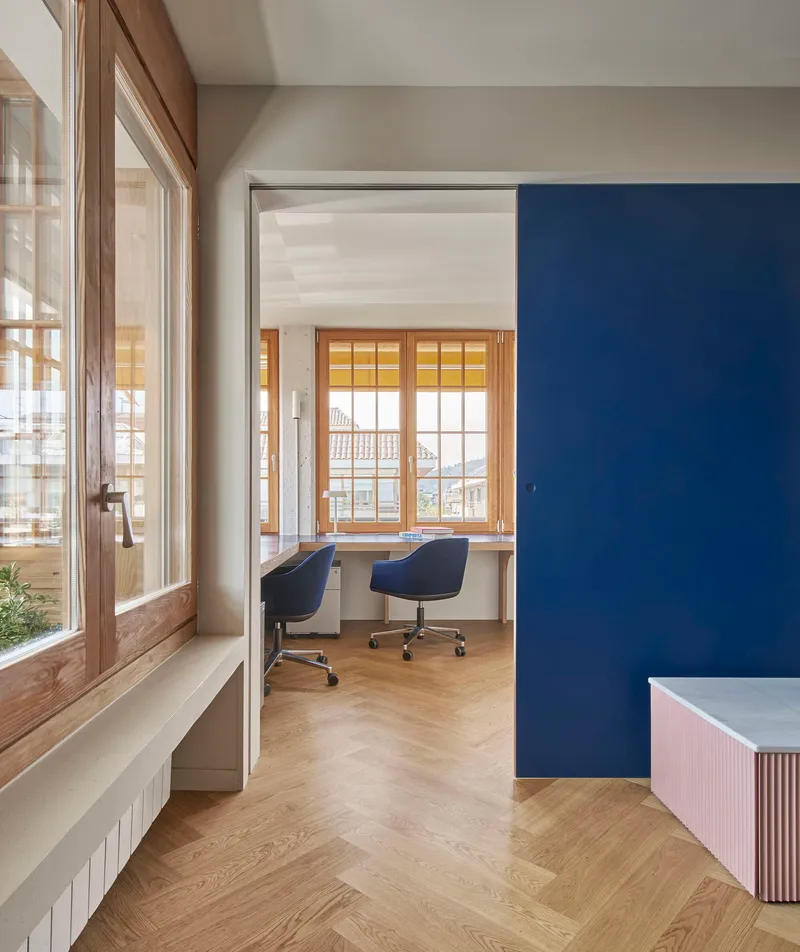
The view through the doorway into the home office reveals a navy blue accent wall, one of the few moments where color steps forward. Against the apartment's predominantly warm palette of oak, terrazzo, and marble, the blue reads as a deliberate punctuation mark, signaling that this room operates on different terms.
Bathrooms as Material Laboratories
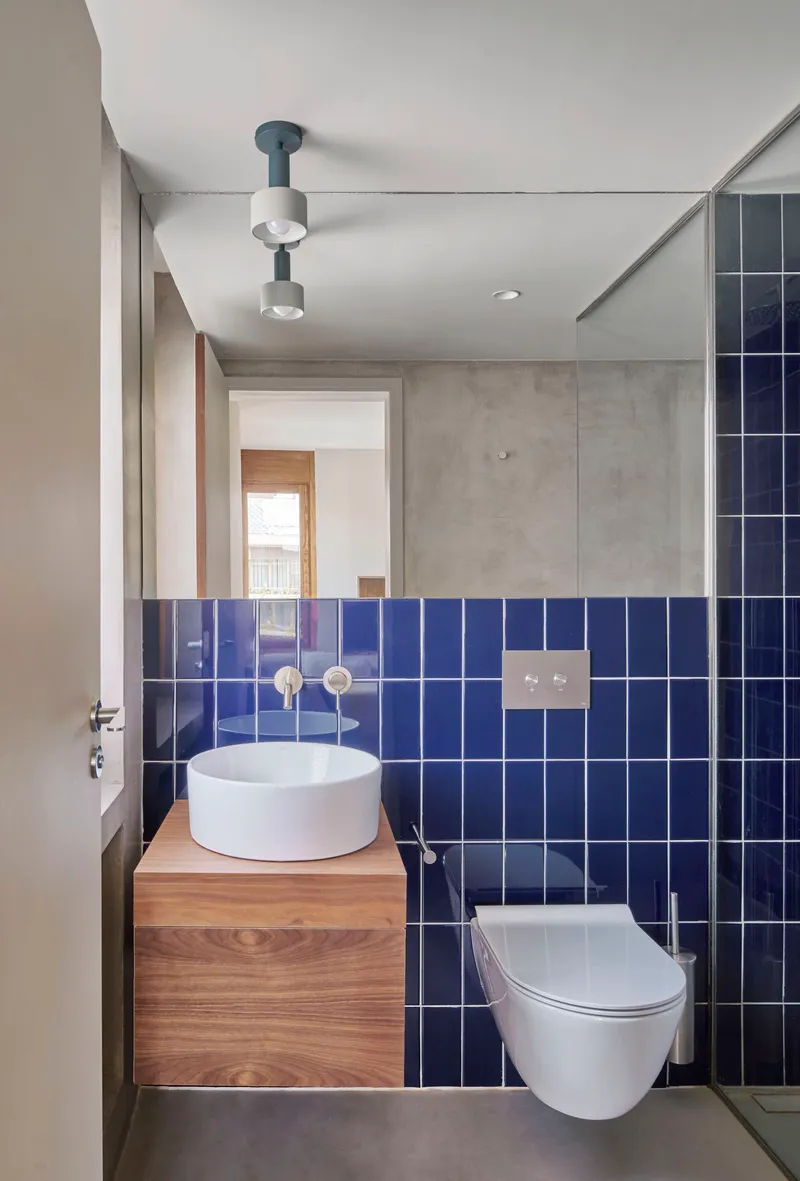
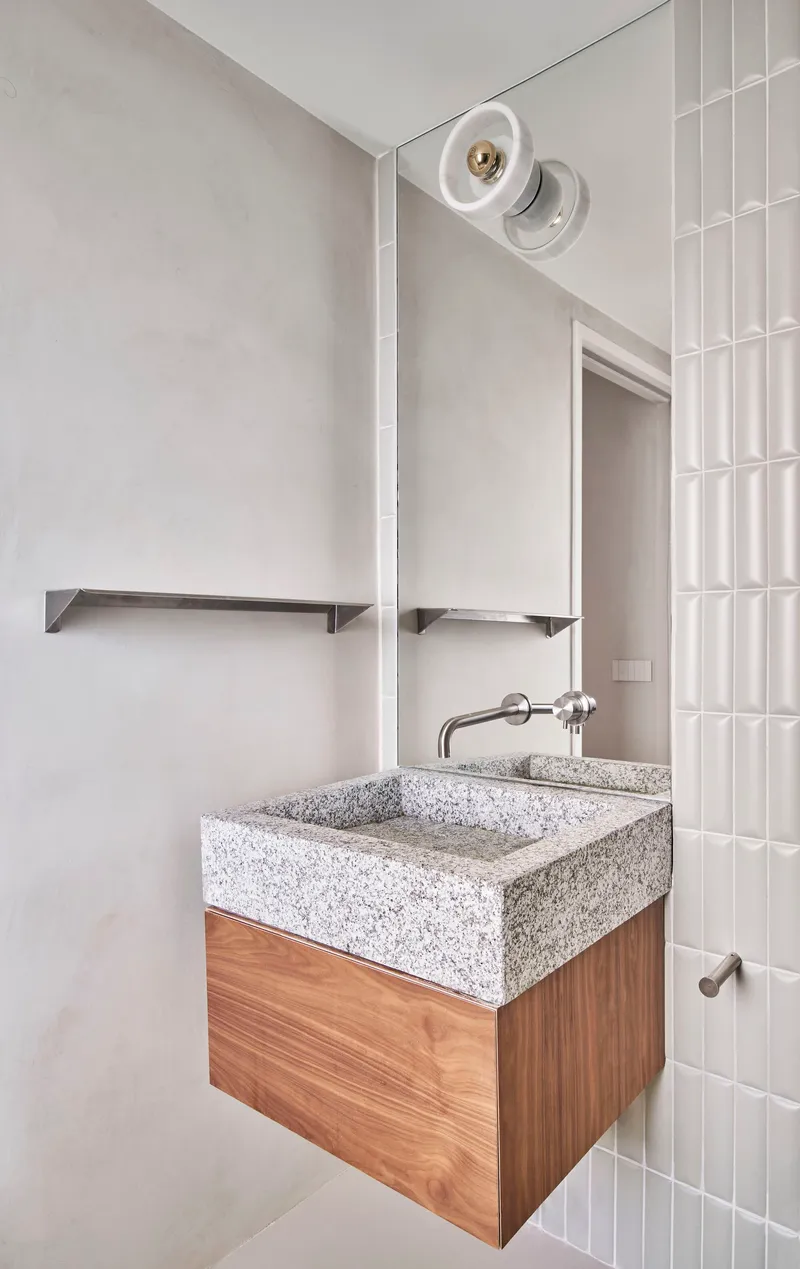
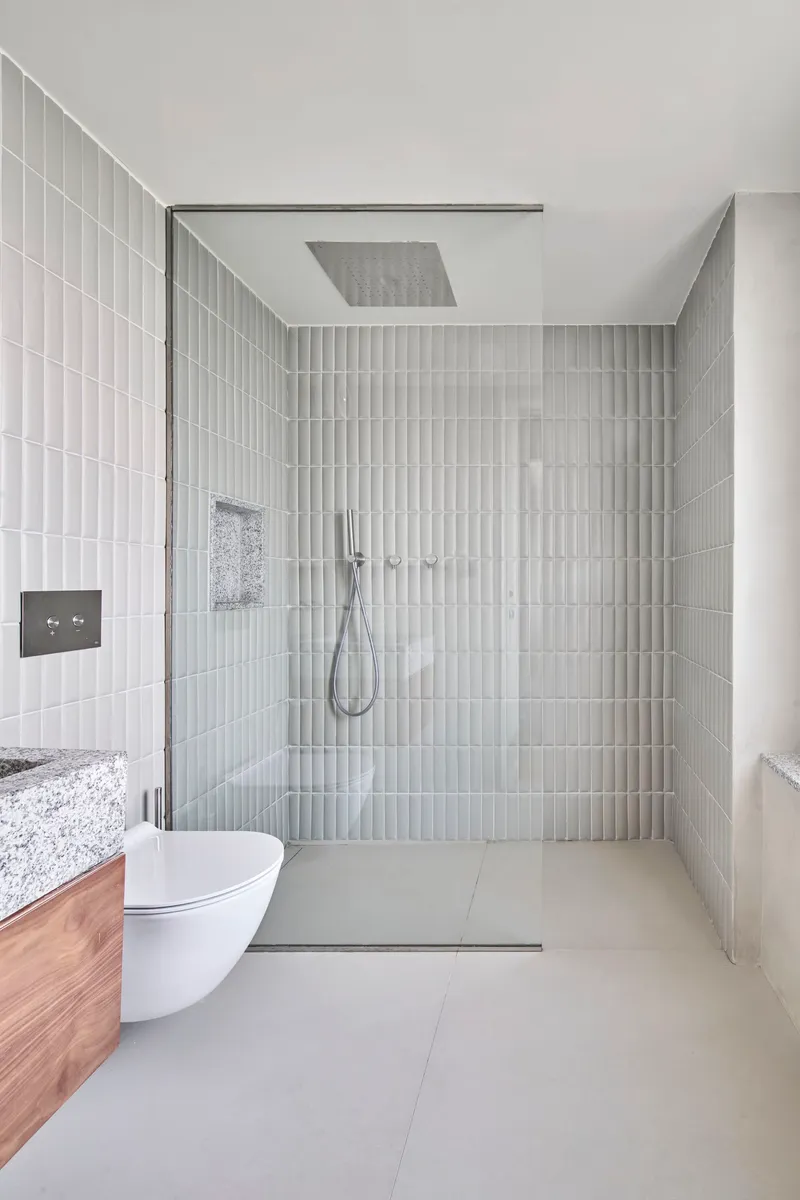
Each bathroom in the apartment has its own material identity, a strategy that avoids the monotony of cookie-cutter en-suites. The cobalt blue square-tiled bathroom is bold and compact, its round vessel sink on a timber vanity recalling mid-century European hotel design. The terrazzo sink on a timber cabinet, set beside a vertical white tile wall, takes a quieter line. The glass-enclosed shower, with its ceiling-mounted rainfall head and floor-to-ceiling white tiles, is pared back to near-monastic simplicity.
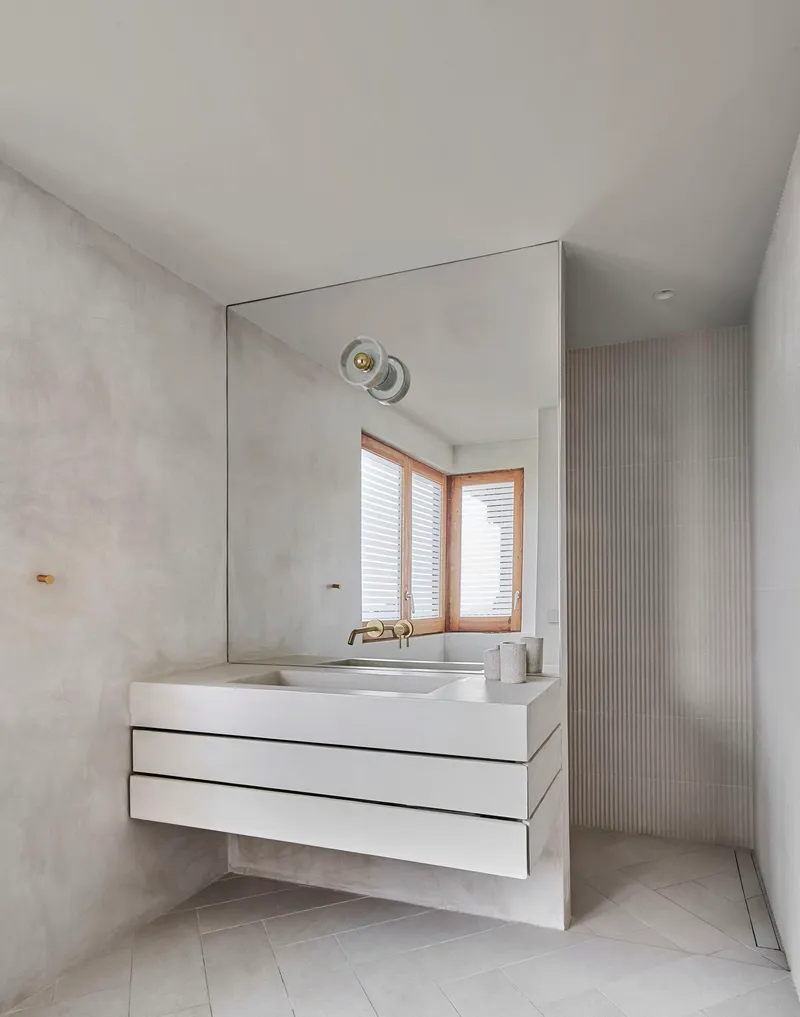
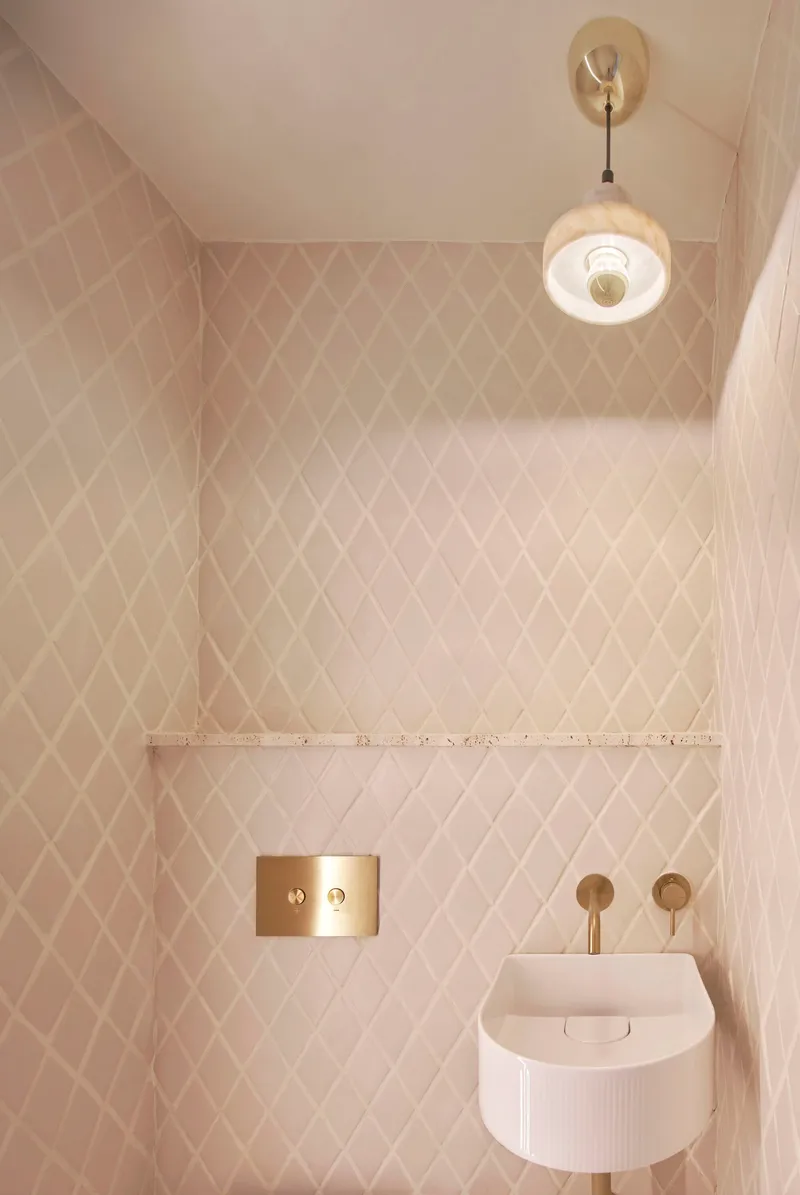
The floating white vanity with integrated sink and textured grey plaster walls belongs to a different register entirely: it is the most minimal room in the apartment. Meanwhile, the diamond-pattern tile bathroom with brass fixtures and a ribbed wall-mounted sink pushes toward something more ornamental. The variety is not arbitrary. It reflects the fact that each bedroom suite has its own character, and the bathroom finishes extend that logic to the most private rooms in the house.
Plans and Drawings
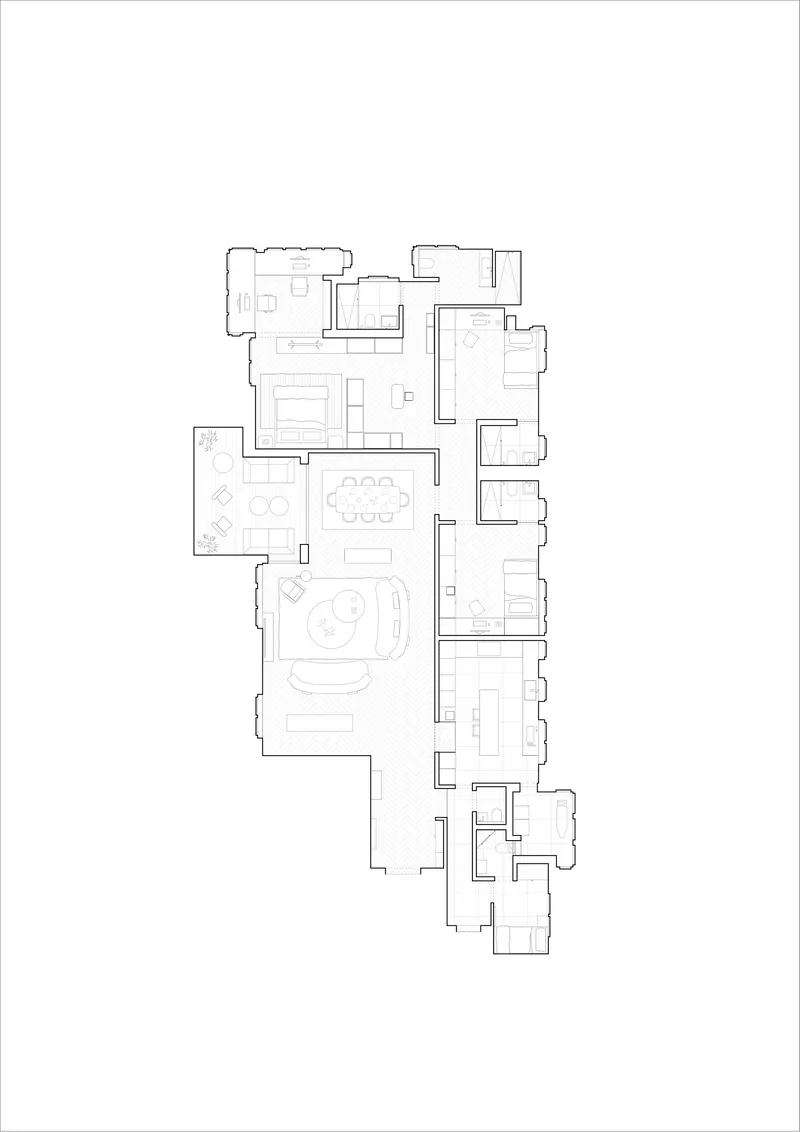
The floor plan reveals the corridor-free strategy in full. Day areas occupy one end of the elongated plan, flowing continuously from kitchen to dining to living. Private rooms line the opposite perimeter, each opening inward toward the shared space. The result is a layout that feels far larger than 240 m² because you never experience it as a sequence of boxed rooms. Instead, you move through overlapping zones of activity, each one defined by its furniture anchors rather than its walls.
Why This Project Matters
Penthouse renovations in European cities often fall into one of two traps: gutting everything in pursuit of a minimal white box, or preserving so much original fabric that the result feels like a museum with plumbing. NOMO STUDIO sidesteps both. By keeping the original wooden window frames while replacing everything else, the practice anchors the new plan in the building's history without being sentimental about it. The material palette, oak, teak, terrazzo, marble, granite, ceramic, is generous but never gratuitous. Each surface earns its place by doing spatial work: defining a zone, reflecting light, or providing the visual weight that a freestanding element needs to feel permanent.
The real lesson here is about what a corridor costs. By eliminating dedicated circulation space, the architects gained room for those desk alcoves, for the oversized dressing room, for a fireplace that stands free in the middle of the floor. The crane-and-marble-table story is dramatic, but the more important move is organizational. NOMO STUDIO proved that a 1970s plan, rigid and hierarchical by default, can be completely reimagined without adding a single square meter. All you have to do is stop thinking in hallways.
Apartment Refurbishment in Barcelona by NOMO STUDIO (Partner-in-Charge: Alicia Casals; Project Leader: Karl Johan Nyqvist). Barcelona, Spain. 240 m². Completed 2022. Photography by José Hevia.
About the Studio
Share Your Own Work on uni.xyz
If projects like this are the kind of work you want to make, uni.xyz is a place to publish your own, find collaborators, and enter design competitions.




Popular Articles
Popular articles from the community


Co-life: Sustainable Architecture for Age-Friendly Community Living
Co-life reimagines sustainable architecture for seniors through courtyards, rammed earth, shared gardens, and spaces designed for belonging.

Co-Life: Senior Housing Design That Reconnects Older Adults With the City
Co-Life reimagines senior housing design through healing gardens, shared streets, workshops, and a sustainable community across generations.

Hill & Cross Opera: Sculptural Opera House Architecture Shaped by Tallinn’s Landscape and Identity
Hill & Cross Opera reimagines opera house architecture in Tallinn through its sculptural hill, civic plaza, glass wave and a luminous cross.

Conexión: Biophilic Design Reimagines High-Rise Living in Hong Kong
Conexión reimagines high-rise living in Hong Kong through biophilic design, green facades, shared spaces, daylight, water and nature within.


Similar Reads
You might also enjoy these articles

Bao Huynh Watercolor Atelier: A Serene Art Retreat in Hội An
Bao Huynh Watercolor Atelier in Hội An blends multifunctional art spaces, sustainable design, local materials, and family-friendly living in a serene environment.

Atelier Macri Concept Store Interior Design by CASE-REAL
Atelier Macri store features a "ko" counter, walnut wood details, cork displays, blending retail, gallery, and seamless customer experiences.

Manuel Vargas Izquierdo Stadium and High-Performance Sports Center: Architectural Excellence in Jalpa de Méndez
The Manuel Vargas Izquierdo Stadium blends sustainable design, inclusive sports facilities, and cultural-inspired architecture, revitalizing Jalpa de Méndez’s public spaces.

KAKR Buluh Awar Hall: Revitalizing Community and Ecology Through Bamboo Architecture
Community built bamboo hall revitalizes Buluh Awar village, empowering youth, restoring ecology, celebrating vernacular craftsmanship through sustainable architecture and culture.


Explore Interior Design Competitions
Discover active competitions in this discipline


Challenge to design luxury tourism on rails


VR headsets Storefront design competition


Designing a staircase for a client
Comments (0)
Please login or sign up to add comments
No comments yet. Be the first to comment!