

Nova Granada Church by Estúdio HAA!: A Contemporary Sanctuary Rooted in Devotion and Architectural Symbolism
Nova Granada Church by Estúdio HAA! is a poetic elliptical chapel honoring ancestry, blending sacred symbolism, brick materiality, and public openness.


Located on a modest corner plot in Nova Granada, São Paulo, the Nova Granada Church by Estúdio HAA! is a striking architectural tribute to familial devotion and Christian heritage. Built on land once home to the client’s grandparents, the 153 m² church transforms a deeply personal story into a timeless space of community, spirituality, and symbolic materiality.


A Tribute Cast in Brick and Light
The church’s inception began not with architectural drawings, but with a vision passed down through generations. The family behind the project sought to create a sacred space that would honor their grandparents’ unwavering Christian faith. Rather than developing the land for private profit, they chose to build a non-commercial, spiritual sanctuary—a counter-narrative to the growing commodification of urban space.
Estúdio HAA! embraced this deeply rooted purpose and translated it into an architectural language that is both minimalist and symbolically rich. The design draws inspiration from primitive Christian values, biblical metaphors, and the interaction between material form and metaphysical meaning.

Elliptical Form and Urban Integration
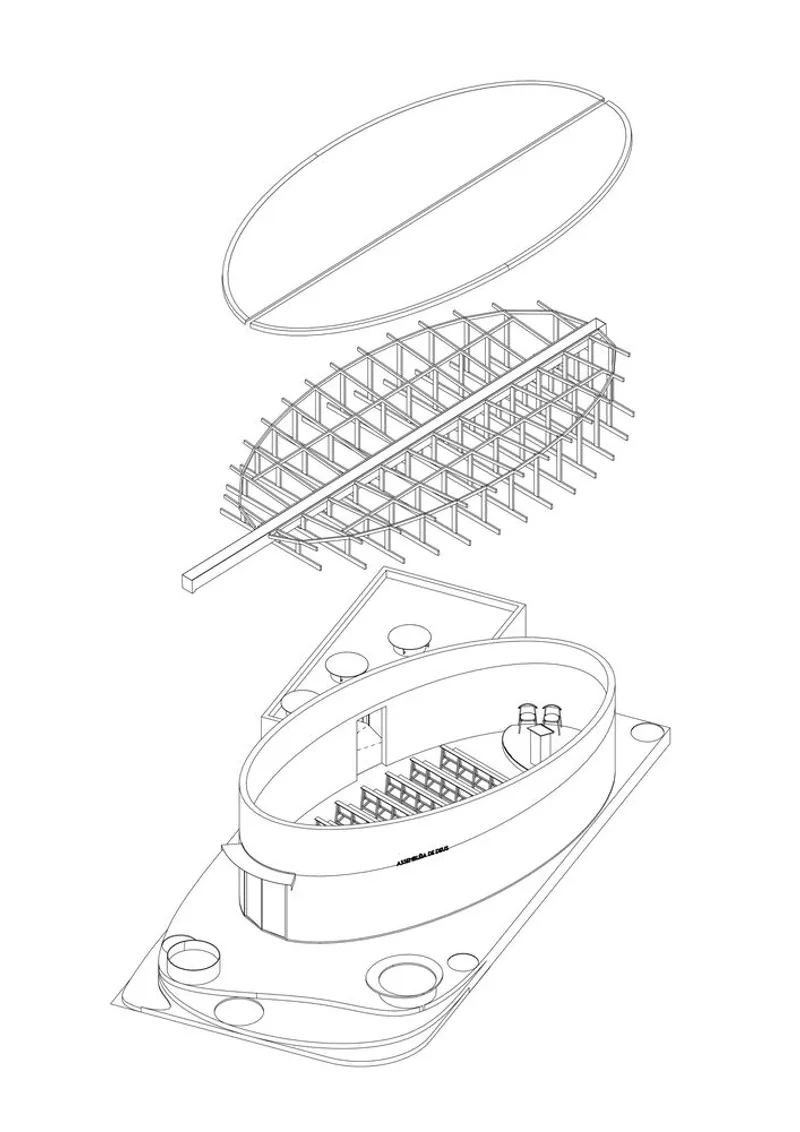
One of the church’s most defining features is its elliptical floor plan, rotated 16 degrees within its compact 8.5m x 18m site. This geometry was a strategic solution to spatial constraints, eliminating dead corners and enabling a more efficient and intimate gathering space for approximately 70 people.
Rather than imposing walls or gates, the architects extended the public realm into the church’s perimeter, allowing the building to dissolve into the urban fabric. The setback areas were designed as a mini public square, inviting both congregants and passersby to engage with the space. This approach fosters community coexistence, transforming the church into a civic as well as a sacred landmark.
Materiality as Theology
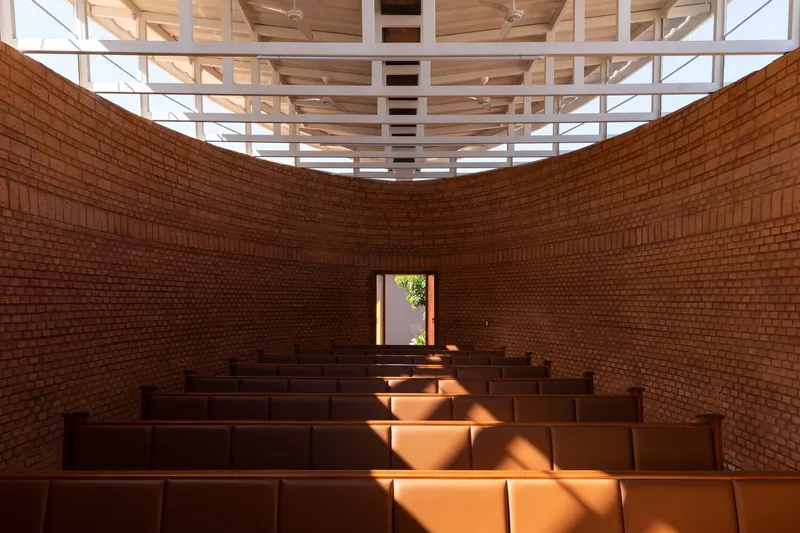
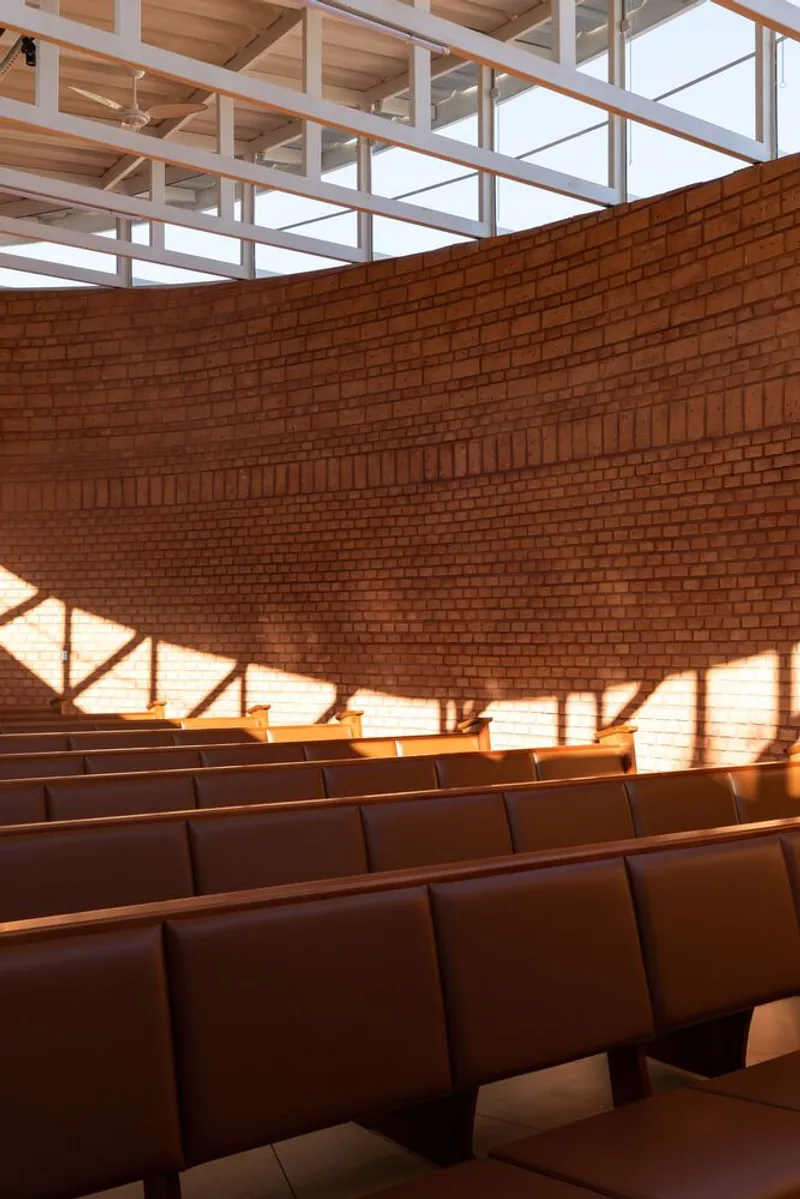
Estúdio HAA! intentionally divided the architecture into two conceptual layers: earth and sky, body and spirit, matter and light. The base of the church is constructed from exposed clay bricks, grounding the structure in a material that holds profound biblical significance:
“Then the Lord God formed a man from the dust of the ground…” – Genesis 2:7 “Yet you, Lord, are our Father. We are the clay, you are the potter…” – Isaiah 64:8
These references evoke the creation of life from earth, a narrative that is embedded in the very walls and floors of the church. The bricks not only serve a functional purpose but also connect the physical space with its spiritual intent.

A Roof That Captures Light and Spirit
In contrast, the roof is designed to express lightness and transcendence. White-painted metal trusses and isothermal panels give the ceiling a luminous, almost immaterial quality. A prominent corten steel gutter, crossing the white expanse, subtly forms an abstract cross—a symbolic gesture that speaks to the gospel’s central image without resorting to iconography.
The gutter collects rainwater and channels it into a circular corten steel tank, creating a visible and audible waterfall. Water, another elemental symbol in Christianity, becomes a sensory feature of the building:
“Whoever drinks the water I give them will never thirst.” – John 4:14
This feature not only emphasizes environmental responsiveness but also ties back to biblical imagery of rebirth and eternal life.
Interior Circulation and Community Comfort
Inside, the elliptical layout supports dual circulation paths, minimizing disruption as attendees enter or exit. Natural light filters through strategically placed openings, casting gentle illumination that enhances the spiritual atmosphere. Every material, line, and void in the space is intended to narrate a metaphysical journey—from the grounded to the divine.
The Nova Granada Church is more than an architectural project—it is a deeply emotional and cultural gesture. Estúdio HAA! has created a space where architecture becomes liturgy, where materials are metaphors, and where the sacred meets the civic. Through thoughtful spatial planning and symbolic design choices, the church serves both as a tribute to the past and an invitation for future community gatherings.
All Photographs are works of Julia Novoa




Popular Articles
Popular articles from the community


Co-life: Sustainable Architecture for Age-Friendly Community Living
Co-life reimagines sustainable architecture for seniors through courtyards, rammed earth, shared gardens, and spaces designed for belonging.
EW PARK: Sustainable Architecture Reimagines the Future of Urban Parking
EW PARK reimagines city parking as a modular wooden tower combining automation, solar energy, electric mobility, and adaptable urban design.

The Earth Pod: 3D Printed Homes for Resilient Refugee Communities
The Earth Pod reimagines refugee housing through 3D printed homes made from clay, combining resilience, self-sufficiency, and rapid shelter.

The Musturak Paradise: Senior Living Architecture for a Connected Future in Temara, Morocco
The Musturak Paradise reimagines senior living architecture in Temara via private homes, social spaces, culture, community, and shared care.

Similar Reads
You might also enjoy these articles


Hodi-Mandai Geram
Project Function: Preservation and revitalization of the Intangible heritage and socio-spatial identity of the Hodi by Housing, Cultural Memory Center, Sacred Grove, landscape, local tourism economy


Olio Towers: A Mid-Rise for Performers That Fuses Housing, Rehearsal, and Stage
Located blocks from Houston's Theater District, this modular tower stacks living units around a central performance atrium.

Oasis: Modular Green Housing Carved into Dhaka's Urban Fabric
A shortlisted Plugin Housing entry reclaims unauthorized settlements in Dhaka with stepped concrete volumes, green roofs, and ventilation-driven design.

Black Hole: A Floating Megastructure for the Post-Physical Era
Emiliano Mazzarotto envisions a spherical, self-scaling arena where e-sports, digital hotels, and holographic stadiums replace traditional public space.

Explore Cultural Architecture Competitions
Discover active competitions in this discipline



Challenge to reimagine the Iron Throne


Photograph architecture without architects


Illustrate the lost glory of Angkor Wat - Render Challenge


Bring back Drive In's
Comments (0)
Please login or sign up to add comments
No comments yet. Be the first to comment!