

Noventa Vicentina Blue Kindergarten – MD41
A blue kindergarten merging nature, light and community into a playful, sustainable learning landscape that nurtures childhood curiosity through architecture.


A Kindergarten Where Color, Light and Architecture Become Tools for Learning, Social Growth and Early Childhood Exploration
In the town of Noventa Vicentina in northern Italy, a new piece of public architecture stands out not through monumentality or size, but through clarity, color and intent. The Noventa Vicentina Blue Kindergarten by MD41 is proof that educational architecture, especially for children, does not need grandeur to be significant. Instead, it can be thoughtful, scaled to human experience, and rich with sensory qualities that nurture learning. Here, architecture does not act as a backdrop to childhood; it becomes an active participant in it.
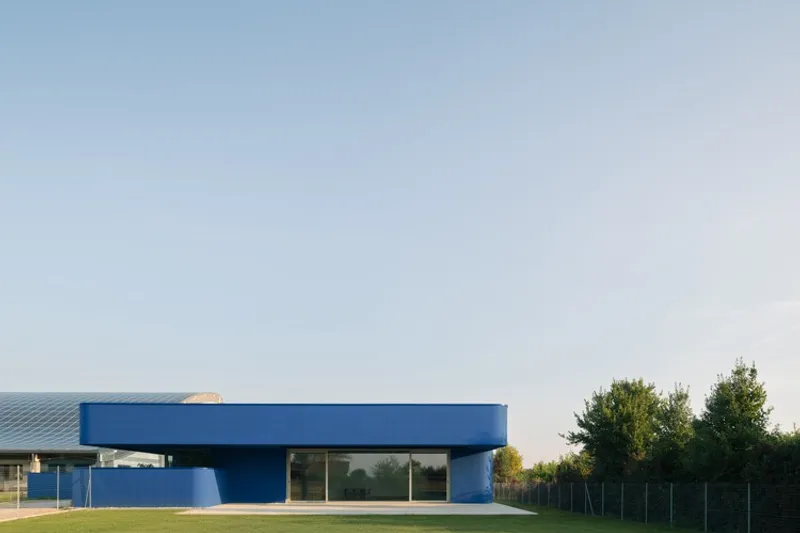
Emerging from a 2,300 m² site with a compact built surface of 750 m², the kindergarten demonstrates how a school can be designed around discovery rather than instruction, around nature rather than confinement, around daylight rather than artificial enclosure. The project, supported by PNRR public funding, is not merely a new institution—it is a civic strategy for promoting educational access, environmental awareness and social belonging from the earliest stages of life. For a community, a kindergarten is often the first place where children step away from home and into the world. Here, that world is open, luminous, playful, and connected to nature at every turn.
This is a building conceived not as a container, but as a small learning landscape.
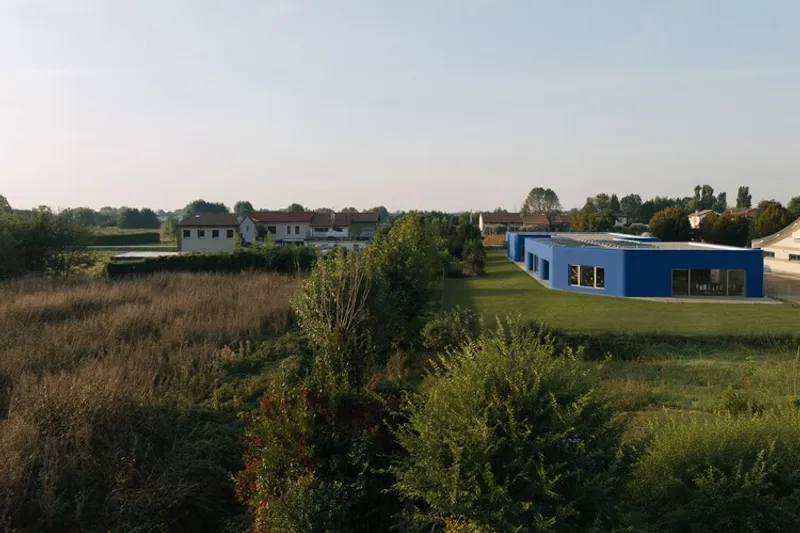
Color as Identity, Light as Architecture
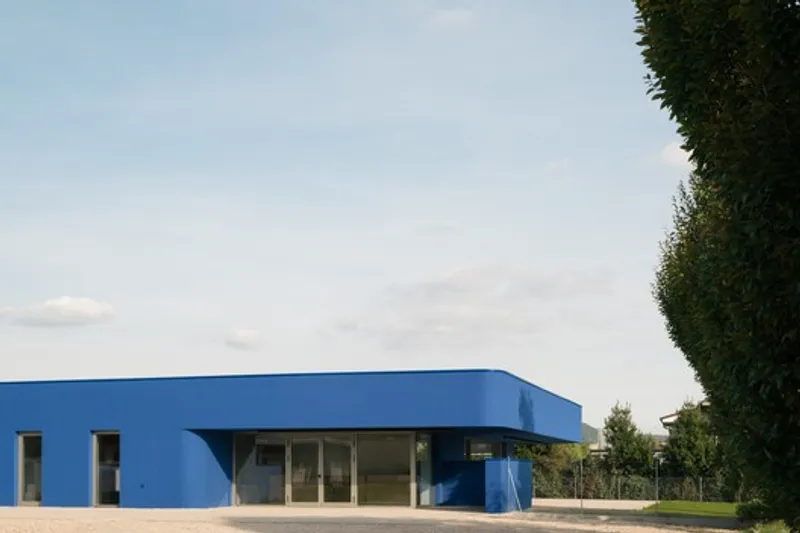
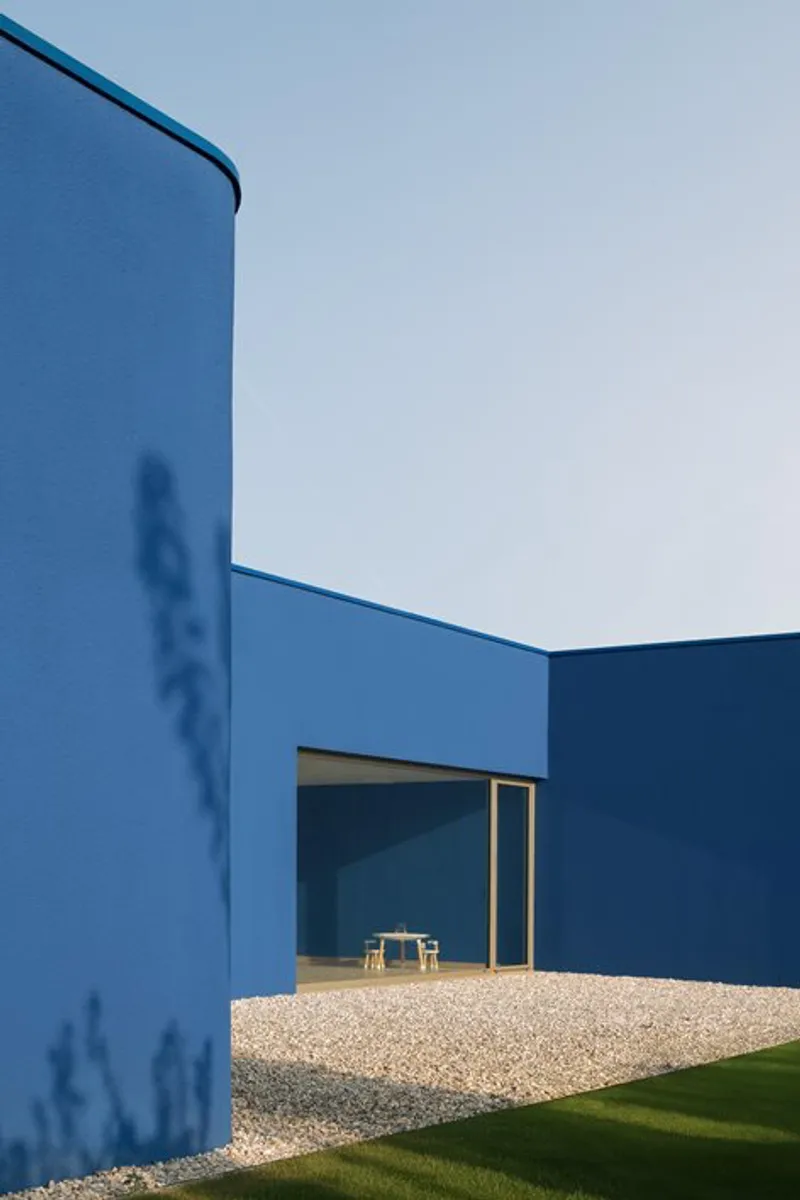
The most immediate and memorable quality of the Noventa Vicentina Blue Kindergarten is its façade—painted in a clear, luminous blue, a color that carries symbolism but also functions visually in subtle ways. Blue speaks of calmness, sky, creativity and openness. For children, it is a color of dreams, imagination and expansion. For adults, it signals trust and serenity. The building therefore presents itself not as something one must approach cautiously, but as something that welcomes, soothes and invites.
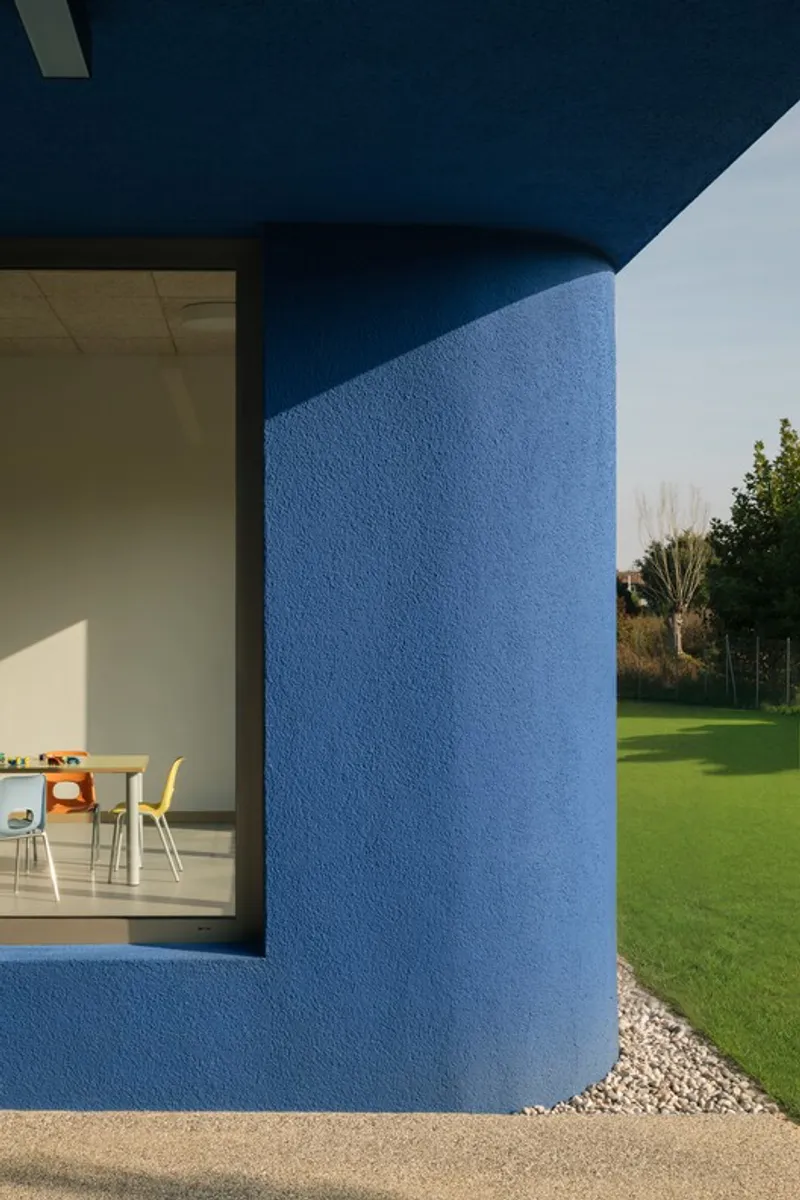
The chamfered edges along the volume are more than a formal gesture. As sunlight moves across the façade, angles soften, shadows stretch and compress, and the blue surface becomes dynamic rather than static. The building changes character depending on the moment—morning brings brightness and clarity, late afternoon introduces deeper tonal richness, while cloudy light diffuses the color into softness. For children who develop spatial awareness through visual stimulation, these subtleties of shadow and surface are not abstract—they become part of daily perception.
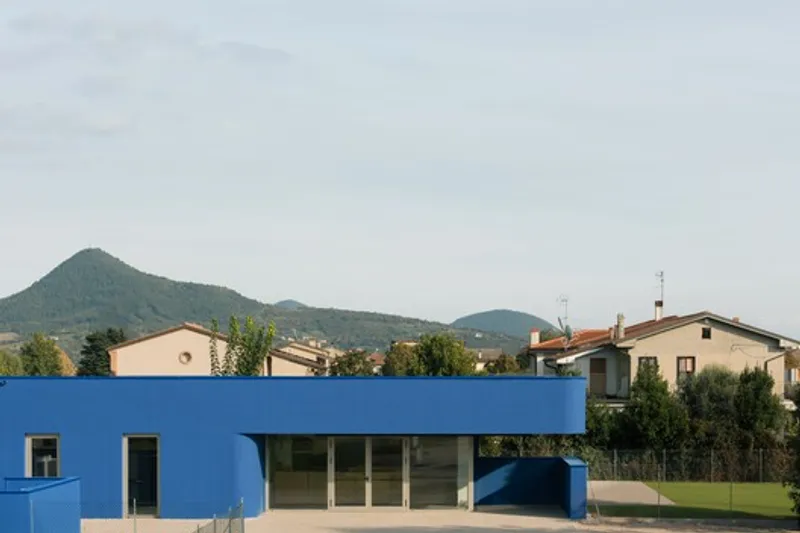
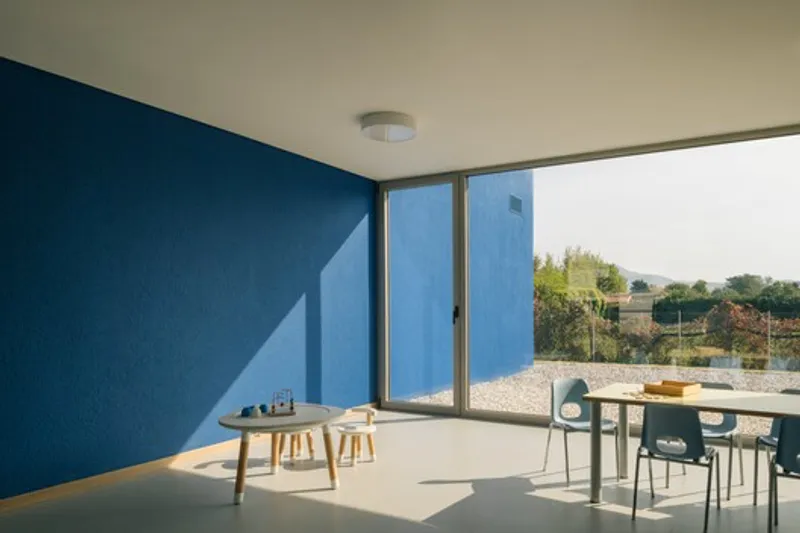
Architecture becomes an ever-changing lesson in light.
The blue façade also creates immediate orientation for young users. Wayfinding—often addressed with signage or markings—is here achieved through color memory. Children do not need to search for their school; they recognize it from afar. It becomes a visual anchor in the landscape, emotionally mapped rather than logically decoded.
A School Planned Around Daily Rhythm
Inside, the kindergarten is organized into two major operational zones. One half is open to the public—a gesture that transforms the school into a civic resource rather than a closed institution. Here, flexible workshop spaces are designed to host community events: afternoon art programs, parent gatherings, local educational initiatives, performances or seasonal celebrations. These spaces demonstrate a key conceptual shift: the kindergarten belongs not only to children, but to the town. Education is not isolated; it is shared.
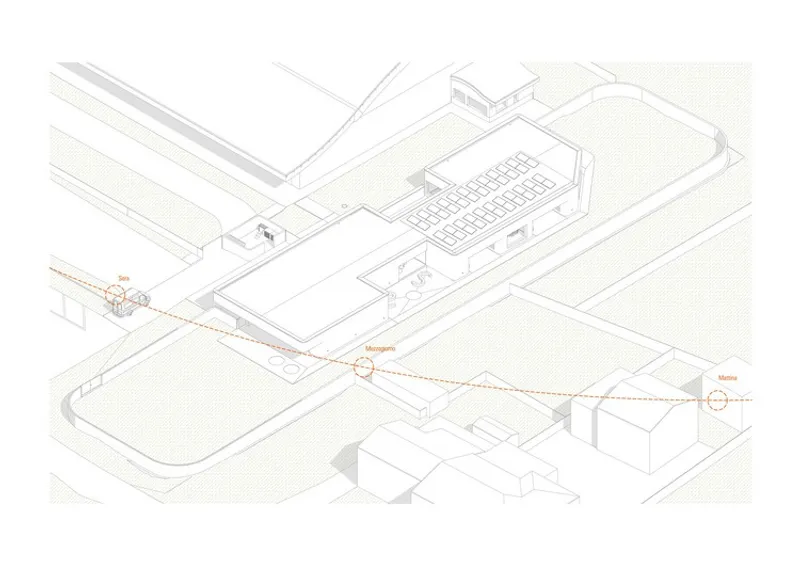
The other half accommodates the pedagogical core—two autonomous classroom clusters designed to operate independently while sharing visual connection and common outdoor areas. Each learning unit contains its own service facilities, covered exterior play space, nap rooms, storage and laundry support. This autonomy increases functional resilience. The school can adapt to variations in group size, differences among age levels, and programmatic expansion over time.
Each classroom is more than a room—it is a micro-environment that can evolve throughout the school year to reflect seasons, projects, and children's developmental needs.
Corridors That Are Not Corridors
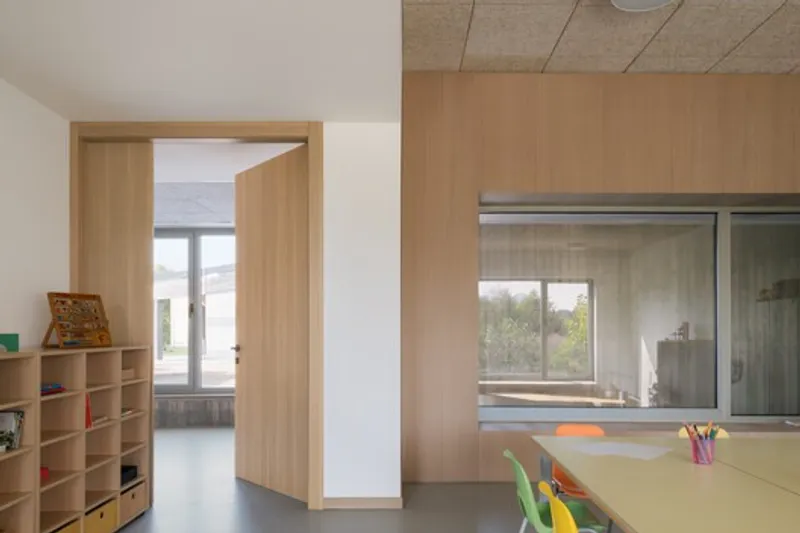
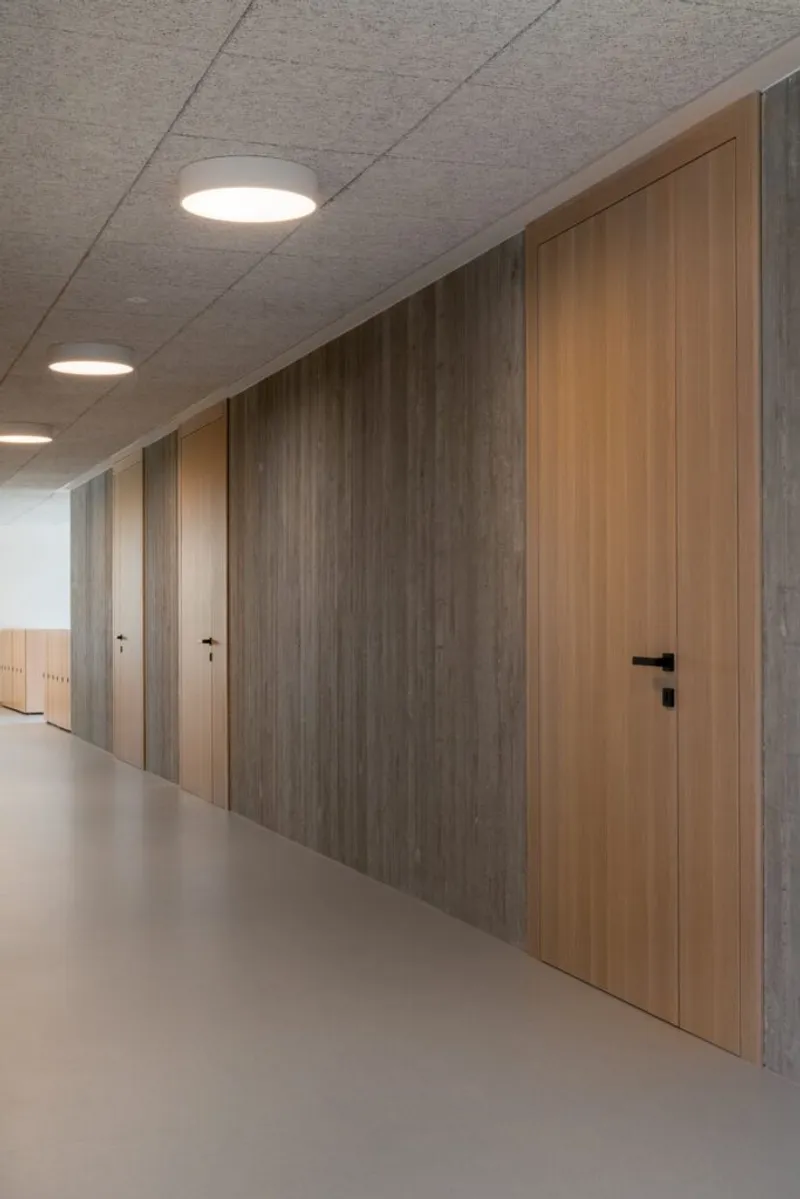
One of the most innovative spatial decisions in the project is the treatment of circulation. Instead of enclosed hallways, the architects created wide, luminous corridors that function less like transitional space and more like learning environments themselves. These passages become play areas, reading nooks, performance zones, collaborative stations, and observational corridors for watching the garden.
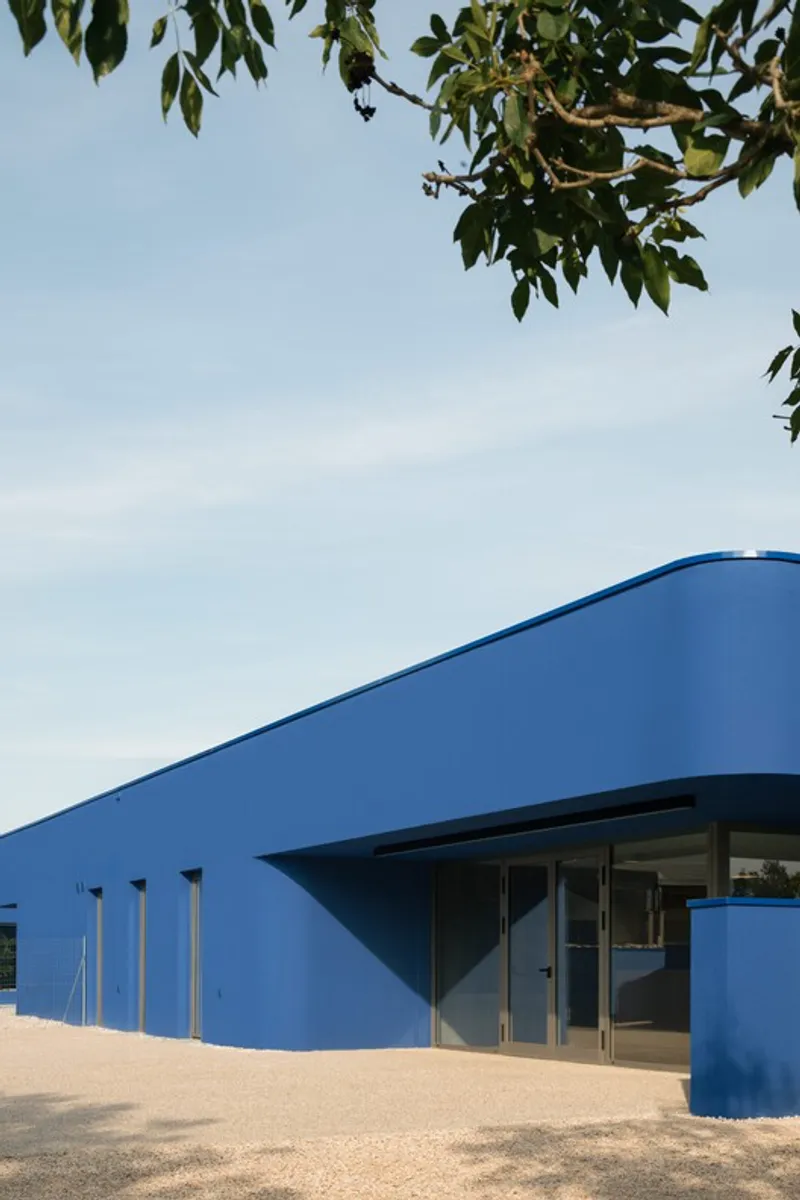
Natural light enters through generous openings, dissolving the boundary between interior and exterior. The garden is never visually distant—it is present through every window, turning movement through the school into constant awareness of nature. From the first steps inside, children see trees, grass, sunlight and clouds. The world outside is not blocked; it is invited into their field of experience.
Circulation becomes pedagogy.
A walkway becomes a place where children slow down, meet friends, pause to observe, or invent brief games between classrooms. Teachers find supervision easier because visual connection is uninterrupted. Planning efficiency is not achieved through minimization of space, but through activation of space. Nothing here is residual.
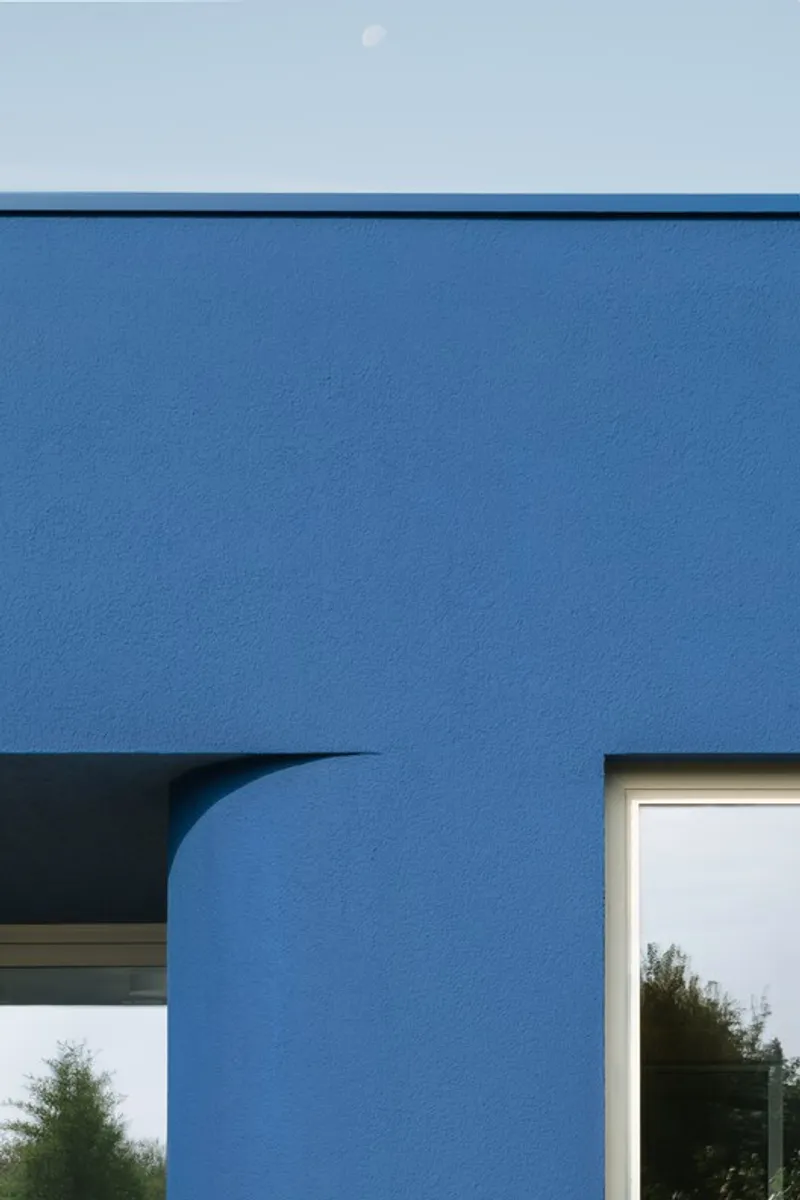
Indoor-Outdoor Continuity as Foundation of Wellbeing
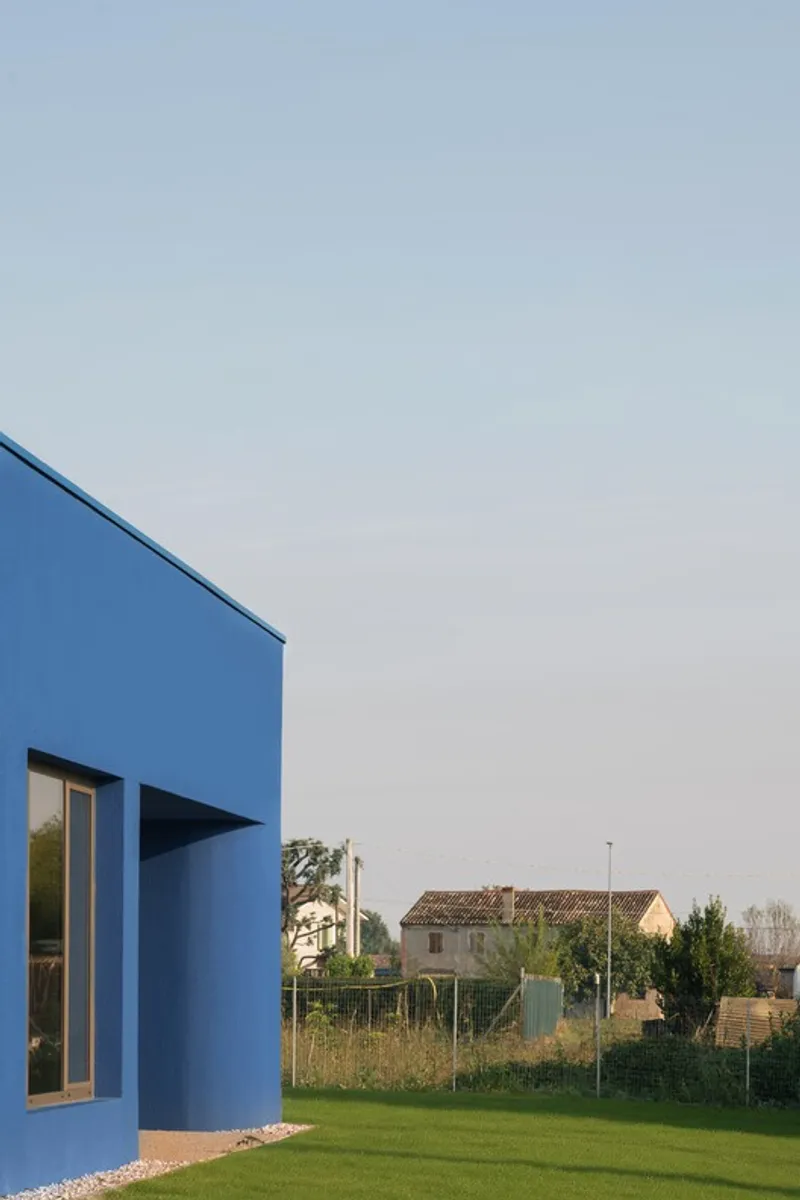
The kindergarten opens toward a large eastern garden that serves as its primary landscape and learning field. This is not ornamental green space—this is where children run, breathe, explore, and discover the natural cycles that will shape their early relationship to the environment. The building’s layout directs visual focus continuously toward this garden, creating a daily ritual of connection with nature.
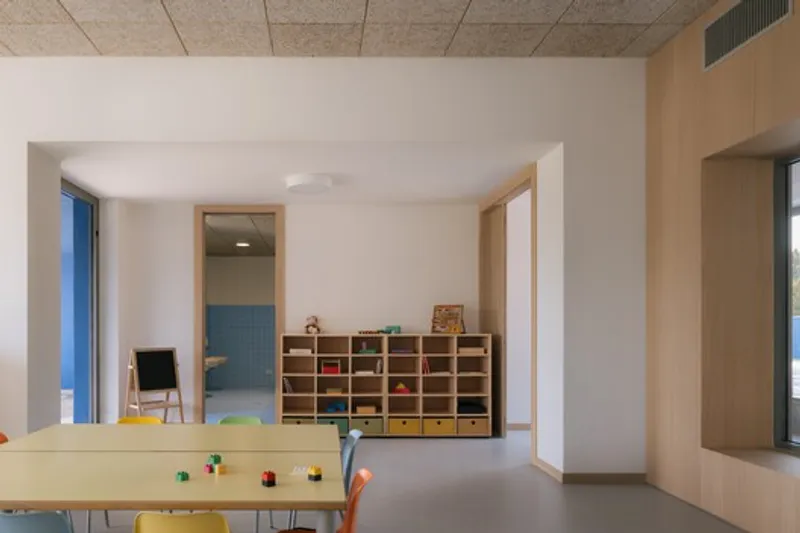
Covered outdoor zones extend the classrooms into semi-open environments. On sunny mornings, teachers can shift activities outside; on rainy days, shading structures allow play under shelter. These intermediate spaces introduce children to variations in climate while maintaining safety and comfort.
The outdoor environment becomes a classroom without walls.
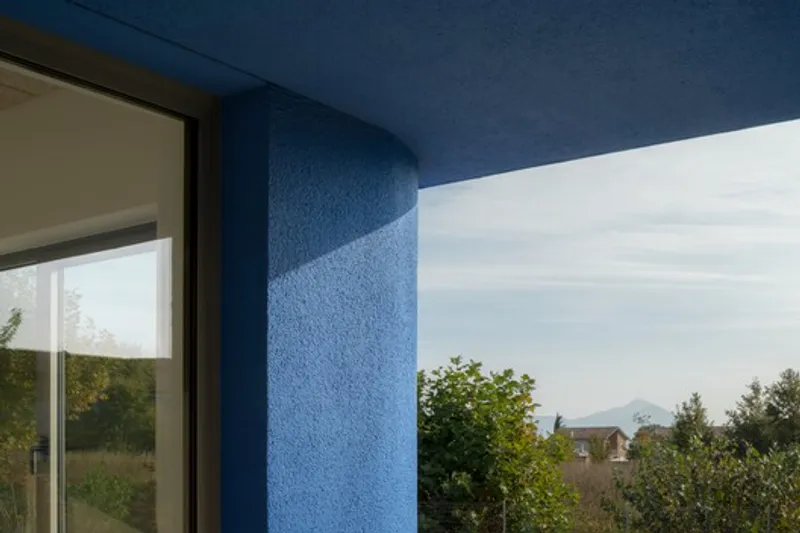
Trees become markers of seasonal change. Grass becomes sensory material. Soil becomes narrative—the difference between soft ground after rain and dry texture in summer becomes experiential literacy. Learning happens through body, temperature, light, movement.
NZEB Strategies and a Microclimate Approach
Sustainability is not treated as a technical afterthought. The kindergarten follows NZEB (Nearly Zero Energy Building) principles with integrated monitoring of indoor climate conditions. Canopies and shading fins regulate solar exposure through the year, preventing overheating during summer while allowing low winter sun to warm interior floors. Heating and cooling demand is reduced not through mechanical excess, but through passive logic.
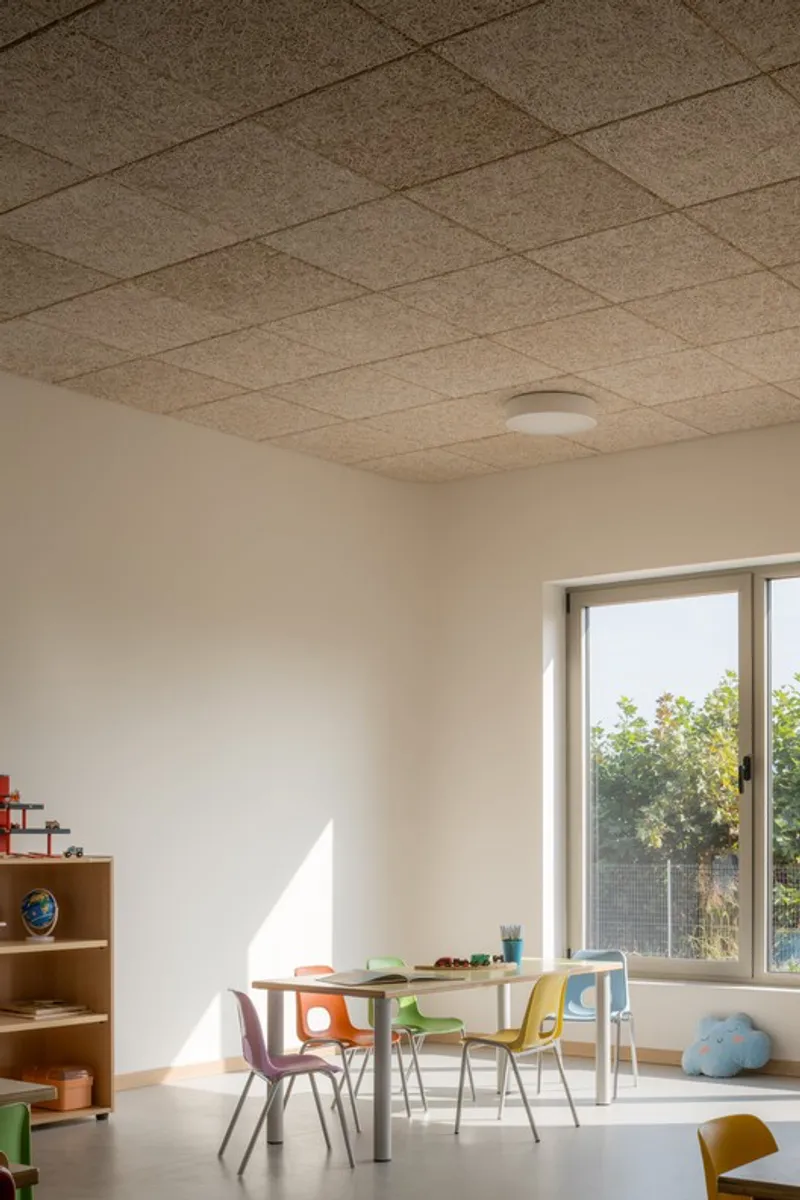
Fresh air is encouraged to circulate naturally. Openings are placed for cross-ventilation, and material choices support thermal durability and low environmental impact. The goal is comfort without reliance on constant energy consumption. In early childhood settings, indoor air quality directly affects concentration, mood and health—here, architecture itself becomes a wellness tool.
The design approach is not only ecological—it is educational. Children grow up within a spatial environment that embodies responsible energy management. Sustainability is not a lesson taught later; it is something lived daily.
A School as a Community Thread
Beyond program and construction, the most enduring contribution of the Blue Kindergarten may be its social philosophy. Public areas are intentionally designed to blur boundaries between school life and civic life. Workshops encourage parents and local residents to return to the building outside school hours. Events transform the kindergarten into a neighborhood anchor, fostering intergenerational exchange.
This is a community woven into a school.
Buildings for children often exist as islands—secure, fenced, self-contained. This kindergarten remains protected yet open, safe yet connected, structured yet porous. It acknowledges that a child is shaped not only by teachers, but by community presence, by shared environments, by social diversity.
The Blue Kindergarten therefore represents more than educational architecture. It is architectural pedagogy.


Popular Articles
Popular articles from the community


LT2A and OPEN Architectes Thread a Brick and Glass High School Through a Wooded Belgian Campus
In Braine-l'Alleud, a 3,000 m² wing for Collège Cardinal Mercier pairs pale brick with a glazed colonnade, deferring to a small chapel and a dense wood.

longwave studio Reorganizes a 112 m² Tainan Apartment Around the Daily Routines of a Family and Two Cats
In Tainan, Taiwan, birch plywood, rust-red furniture and a freestanding plaster wall link arrival, storage, work and family life in one apartment.

David Ortega Stacks a Two-Story Mexico City Penthouse Around a Steel Stair and a Pergola-Shaded Roof Terrace
In Colonia Roma, a 300 m² penthouse uses oak joinery, a planted steel stair and a slatted roof pergola to make a new-build apartment feel like a house.

Juan García Correa, John González and Claudia Rueda Sink a Circular Amphitheater into a Manizales Engineering Building
On the La Nubia campus in Manizales, Colombia, the S1 Building folds labs and offices into a hillside of ramped lawns that double as a campus route.

Similar Reads
You might also enjoy these articles


Hodi-Mandai Geram
Project Function: Preservation and revitalization of the Intangible heritage and socio-spatial identity of the Hodi by Housing, Cultural Memory Center, Sacred Grove, landscape, local tourism economy


Olio Towers: A Mid-Rise for Performers That Fuses Housing, Rehearsal, and Stage
Located blocks from Houston's Theater District, this modular tower stacks living units around a central performance atrium.

Oasis: Modular Green Housing Carved into Dhaka's Urban Fabric
A shortlisted Plugin Housing entry reclaims unauthorized settlements in Dhaka with stepped concrete volumes, green roofs, and ventilation-driven design.

Black Hole: A Floating Megastructure for the Post-Physical Era
Emiliano Mazzarotto envisions a spherical, self-scaling arena where e-sports, digital hotels, and holographic stadiums replace traditional public space.

Explore Educational Building Competitions
Discover active competitions in this discipline

Challenge to design public laboratory

Challenge to reimagine the Iron Throne

Photograph architecture without architects

Illustrate the lost glory of Angkor Wat - Render Challenge
Comments (0)
Please login or sign up to add comments
No comments yet. Be the first to comment!