

Nubé: An Adaptive Architectural Vision
Innovative Architecture: Flexible Spaces That Empower Communities and Foster Growth, Blending Design and Sustainability Seamlessly


A cloud is not a building. It has no walls, no rooms, no fixed programme. It shades. It drifts. It changes shape. Nubé, designed by Regan Bimbi, Anthony Ramirez, Ria Longo, and Yannet Mercado, takes this idea literally. The project proposes a lightweight modular canopy that hovers over a plaza in San Luis Potosí, Mexico, and adapts itself to whatever the community needs on a given day: a swimming pool, a climbing park, a performance stage, or simply shade.
Published on uni.xyz, Nubé is a morphological exploration of how a single kit of parts can be reconfigured into different civic programmes without the building ever being demolished or replaced. The structural language is stainless steel cables and telescopic steel tubes. The ground is locally sourced limestone. The roof is a cloud.
The Pool: A Cloud Over Water
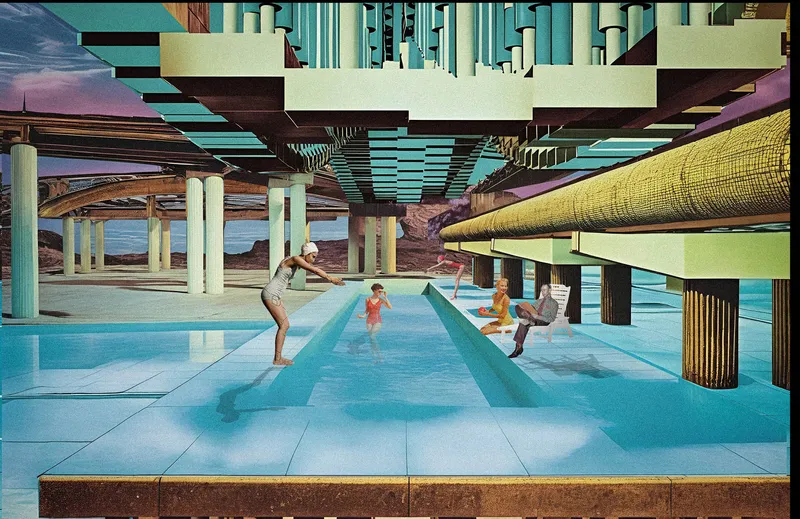
The signature collage shows the most ambitious configuration. A lap pool sits under a canopy of turquoise beams and columns. A swimmer in a red suit dives in. Others sit at the edge and wade. The desert mountains frame the horizon. The image reads half as a render, half as a painting. It argues that a public pool in the middle of a high-desert city is not a luxury but a civic necessity, and that the shade structure is what makes it viable.
The surrealism is deliberate. Nubé is not a building you can walk around and predict. It is an idea about how a single modular system can host radically different activities. The pool configuration is the hardest to imagine, so it is drawn first. Everything else the project proposes follows more easily once you accept that a cloud can hold water.
The Desert: A Catalogue of Local Flora
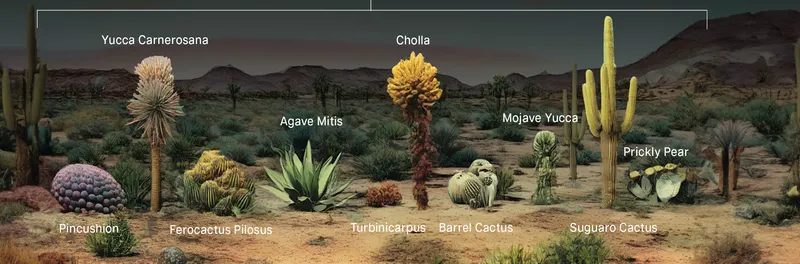
This drawing is the project's most grounded. A panoramic photograph of the desert landscape around San Luis Potosí is overlaid with labelled cactus and succulent species: Yucca Carnerosana, Cholla, Agave Mitis, Mojave Yucca, Prickly Pear, Pincushion, Ferocactus Pilosus, Turbinicarpus, Barrel Cactus, and Suguaro Cactus. These are not decorative plants in the render. They are the palette the project draws from.
The logic is simple: a public space in a high desert cannot be a lawn. It has to be a rock garden or a cactus garden. Nubé treats these species as both material and programme. The gardens between modules are planted with them. The structure provides shade so the plants survive summer and so people can stand among them comfortably. The building and the ecosystem are designed together.
The Plaza: One Frame, Many Lives
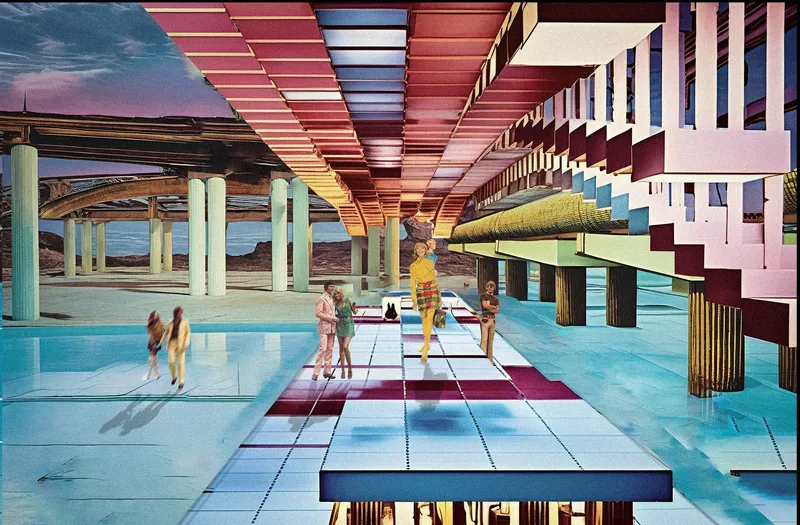
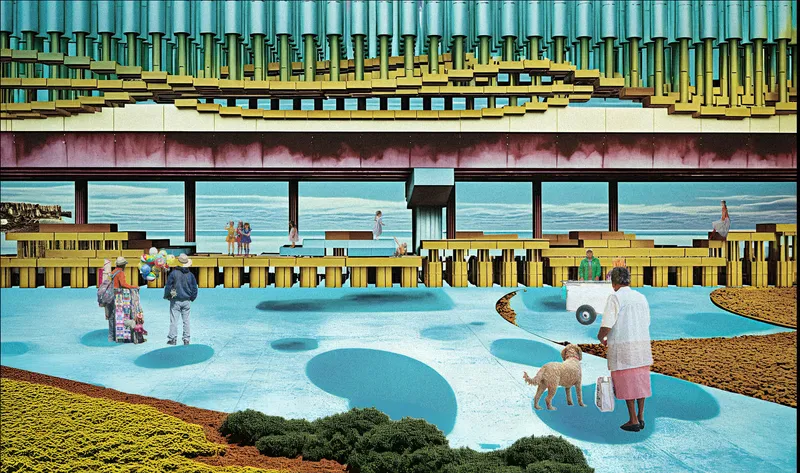
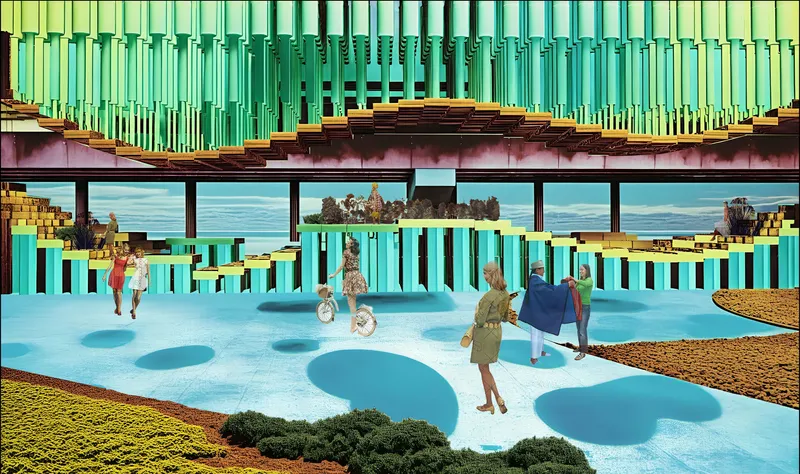
The three plaza renders show the same canopy hosting three different moments. At dawn, slender columns support the flat canopy over a tiled plaza. Women walk across a shallow reflecting pool. The atmosphere is ceremonial, quiet, almost religious. Mid-morning, the plaza fills with everyday life. An older woman walks a small dog that pulls a cart. Residents stroll between planted gardens. By midday, the plaza is active: cyclists, shoppers carrying umbrellas and garments, neighbours meeting under the shade.
The three images are the project's argument in its clearest form. The canopy does not change. The plaza does not change. Only the people and their activities change, and the building absorbs each one without modification. This is what adaptive architecture actually looks like when it works: a frame that remains constant while the life inside it rotates.
The ground pattern matters. The tiles are in high-contrast blues and whites, drawn in geometric motifs that echo Mexican plaza traditions. The floor is as designed as the roof. Between the two, the activity happens. The middle layer is left empty precisely because it must change.
The Structure: Cables, Tubes, Limestone
Nubé's material strategy is small and consistent. Stainless steel cables provide the tension. Telescopic steel tubes provide the compression and allow the canopy to be raised, lowered, or reconfigured. Locally sourced limestone forms the base and the plaza floor. That is nearly the entire palette. The restraint is deliberate.
A kit of parts this limited is what makes the adaptive claim credible. If the system had twenty materials and fifty connection types, it could not be reassembled. With three materials and a handful of standard joints, it can. Climbing holds bolt to the tubes. Stage lights hang from the cables. Pool liners clip to a secondary frame. The building does not redesign itself; it rearranges itself.
The Site: A Plaza in San Luis Potosí
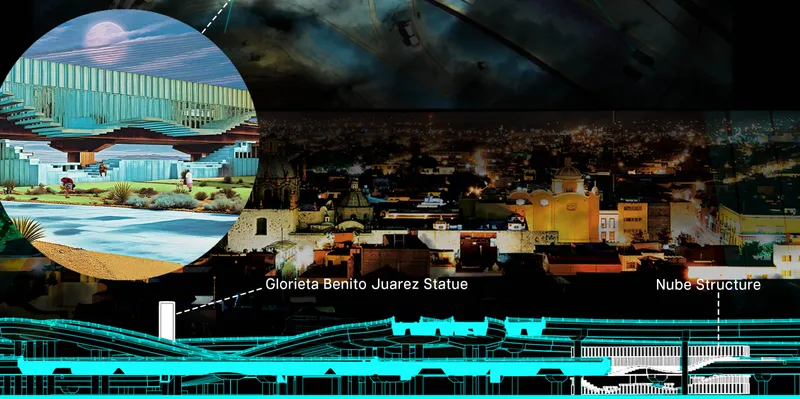
The site context collage anchors the project to a specific place. An inset render of the Nubé pavilion is set against a photograph of the Glorieta Benito Juárez Statue in San Luis Potosí, a recognisable civic landmark in the city. The collage is the only drawing in the project that steps out of the rendered world and shows the real site. It matters because it answers the obvious question: where does a cloud land?
The answer is: on an existing plaza, in a real Mexican city, next to a real public statue. Nubé is not a utopia. It is a proposal for a specific intersection in a specific city, and it takes responsibility for how it would read next to buildings and monuments that are already there. The project is adaptive inside but sited outside. That combination is what makes it more than a formal exercise.
Why This Project Matters
Most adaptive architecture promises flexibility and delivers emptiness. Nubé does the opposite. It specifies, in detail, four radically different programmes the same frame can host, and it draws each one with enough conviction that you believe the transitions would actually work. Pool. Climbing park. Stage. Shaded plaza. One structure, four civic lives.
For anyone studying modular civic architecture, climate-adaptive public space, or how small kits of parts can host multiple uses, Nubé is a useful reference. It is a morphological study that does not stop at geometry. It extends into ecology, material, and programme. The cloud is a metaphor, but the project underneath it is disciplined.
View the Full Project
About the Designers
Designers: Regan Bimbi, Anthony Ramirez, Ria Longo, Yannet Mercado
Enter a Design Competition on uni.xyz
If modular civic architecture, adaptive public space, or desert ecology is the kind of work you want to explore, uni.xyz runs competitions year-round that reward proposals with spatial conviction and site-specific intelligence.
Project credits: Nubé by Regan Bimbi, Anthony Ramirez, Ria Longo, and Yannet Mercado. Published on uni.xyz.



Popular Articles
Popular articles from the community

EW PARK: Sustainable Architecture Reimagines the Future of Urban Parking
EW PARK reimagines city parking as a modular wooden tower combining automation, solar energy, electric mobility, and adaptable urban design.

Co-Life: Senior Housing Design That Reconnects Older Adults With the City
Co-Life reimagines senior housing design through healing gardens, shared streets, workshops, and a sustainable community across generations.

The Ocean Hive: Sustainable Architecture for a Self-Sufficient Civilization at Sea
The Ocean Hive imagines sustainable architecture at sea, where modular habitats, algae, wave power and ocean waste sustain a growing colony.

Hill & Cross Opera: Sculptural Opera House Architecture Shaped by Tallinn’s Landscape and Identity
Hill & Cross Opera reimagines opera house architecture in Tallinn through its sculptural hill, civic plaza, glass wave and a luminous cross.

Similar Reads
You might also enjoy these articles

Day and Night Park: A Time-Based Urban Newsstand in Beijing
A temporary urban newsstand in Beijing blending travel, light, and reading through poetic colors, compact form, and community-focused design.

Modernist Patio Renovation in El Masnou, Barcelona by Oliver Segura Arquitectura + Cebrià Arquitectura
Modernist patio renovation blending tradition and innovation with a movable pool, leveled floors, and Catalan materials in El Masnou.

Alto Residencial Coop: Cooperative Housing Development in Santiago de Compostela by Carbajo Barrios Arquitectos
A linear cooperative housing complex blending white volumes and perforated metal façades, enhancing community living, natural light, privacy, and urban integration.
Vil Genis School by BPA ARCHITECTURE – Massy, France
Vil Genis School in Massy, France, features sustainable design, south-facing classrooms, community integration, accessible spaces, and modern educational architecture.


Comments (0)
Please login or sign up to add comments
No comments yet. Be the first to comment!