
NUC Studio Carves a Split-Level Coffee House into a Quiet Coastal Block in Qinhuangdao
SAANCI Coffee's Aranya North Bay outpost layers board-formed concrete, timber, and open-air thresholds along the Bohai Sea shoreline.


The Aranya community on Qinhuangdao's Bohai Sea coast has become a testing ground for how commercial architecture can serve both tourists and year-round residents without defaulting to spectacle. SAANCI Coffee's North Bay Store, designed by NUC Studio under lead architect Huang Changsong, takes a different tack: it buries its ambition inside 320 square meters of split-level concrete and timber, making a case that the most generous gesture a café can offer is not a signature façade but a sequence of rooms that reward lingering.
What makes the project worth studying is the way it refuses to be one thing. Folding glass storefronts dissolve the ground floor into the plaza; a suspended metal fireplace anchors an upper living room that feels more domestic than commercial; timber stair blocks stack against board-formed concrete walls like geological strata. Every level shift reframes the view, whether toward a playground, a lawn, or the waterfront beyond. The building reads as a house that happens to sell coffee, and that ambiguity is entirely intentional.
A White Volume That Knows Its Street

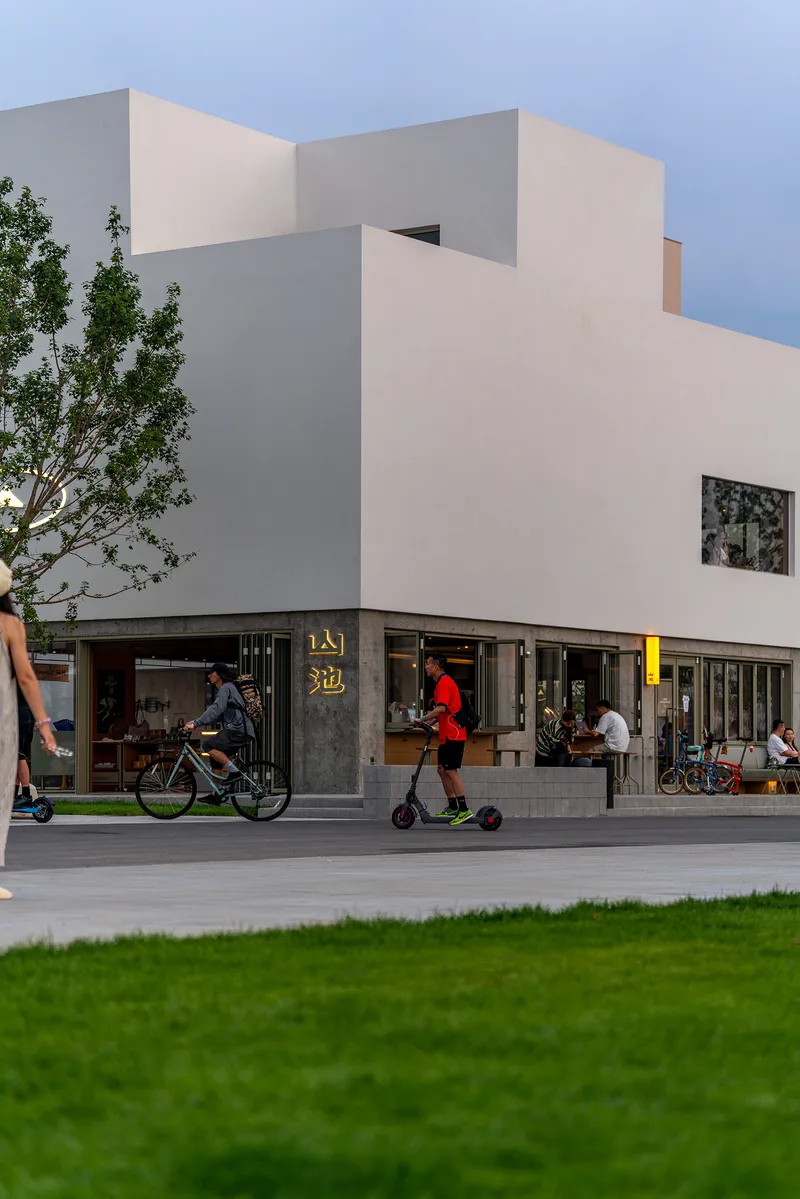

From the street, the building presents stacked white rendered volumes above an open, permeable ground floor. It sits politely within the Aranya block's vocabulary of white stucco and rectilinear geometry, neither mimicking its neighbors nor straining against them. The horizontal window openings punched into the upper mass give just enough visual weight to signal something happening above, while the ground level dissolves into folding glass and olive-green frames that pull the sidewalk inside.
Cyclists and pedestrians pass without interruption. The building does not demand your attention; it earns it through proportion and the warm glow that leaks out at dusk. That restraint is harder to achieve than drama, and it serves the project well.
The Folding Storefront as Social Contract
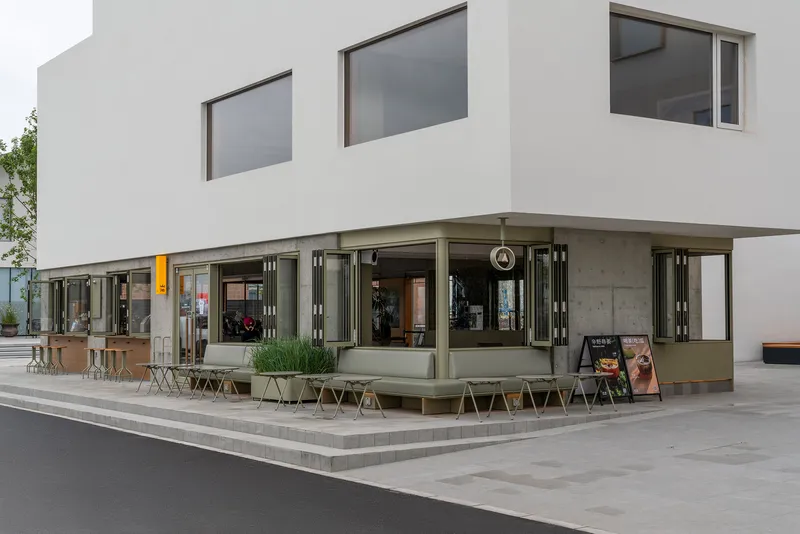


The olive-green folding storefront panels are the building's handshake with the public realm. When fully open, they erase the boundary between the café interior and the paved plaza, turning the ground floor into something closer to a covered market stall than a walled-off retail unit. Outdoor seating extends onto the stone paving, and crowds gather on sunny afternoons as if the café were a neighborhood living room that spilled outdoors.
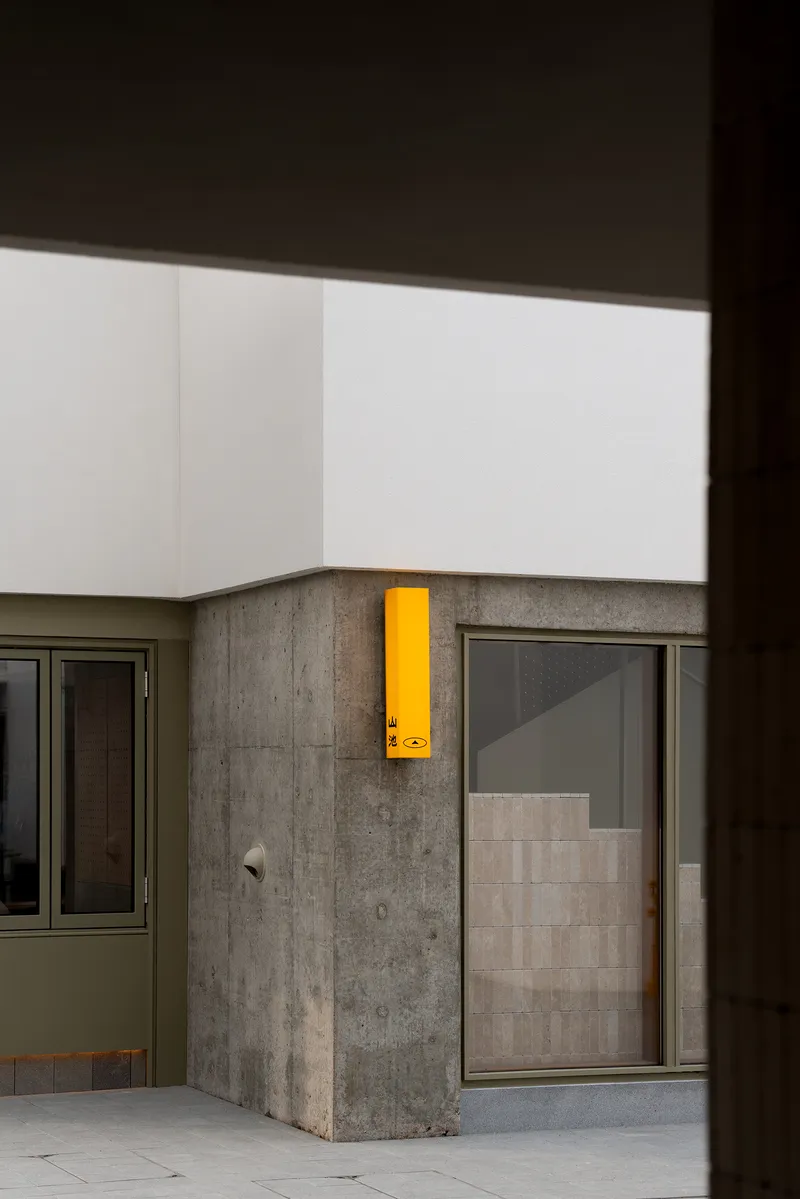
The color choice matters. Against white plaster and raw concrete, the muted green reads as deliberate and warm without tipping into brand loudness. A yellow column and a circular relief sign are the only other accents. NUC Studio trusts the architecture to do the branding, and the result is a shopfront that feels permanent rather than seasonal.
Board-Formed Concrete and the Warmth of Grain

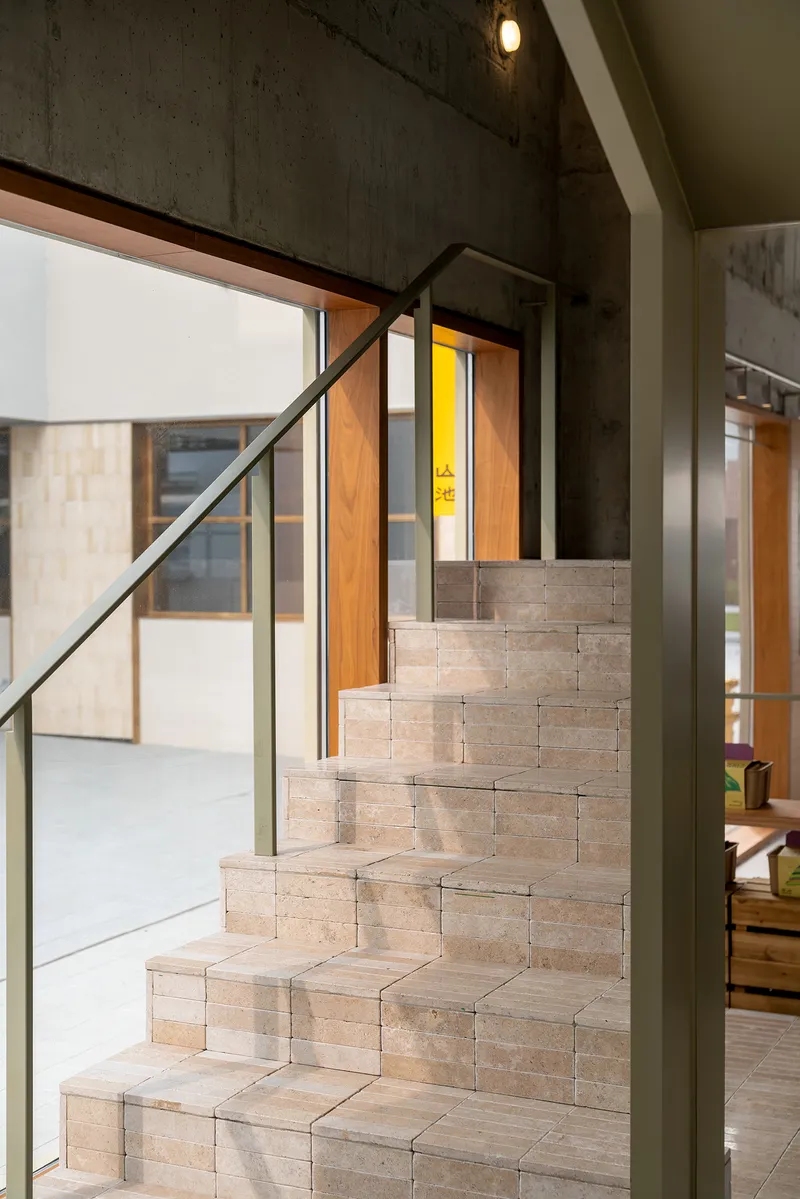

Step inside and the material palette shifts immediately. Board-formed concrete dominates the walls and ceilings, its plank grain pressed into every surface like a fossil record of construction. The effect is rough but controlled: you can see the formwork seams, the slight irregularities where wet concrete met dry timber. It grounds the interior in a tactile honesty that polished plaster never achieves.
The timber-block staircase stacking against one of these concrete walls is a particularly well-resolved detail. Steel handrails are slender enough to disappear, leaving the massive wooden treads to do the visual work. The contrast between the heavy, striated concrete and the warm blonde timber gives the circulation zone its own identity, separate from the seating areas it connects.
Split Levels and the Art of the Partial View

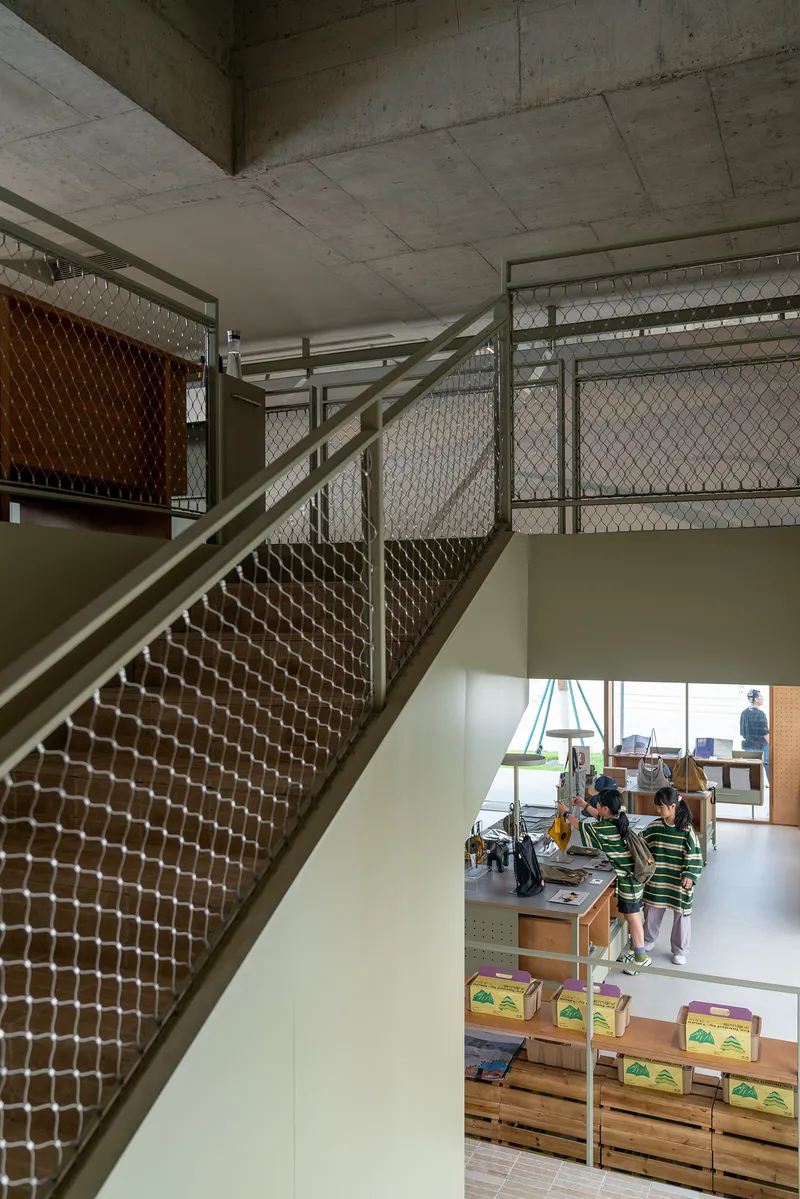
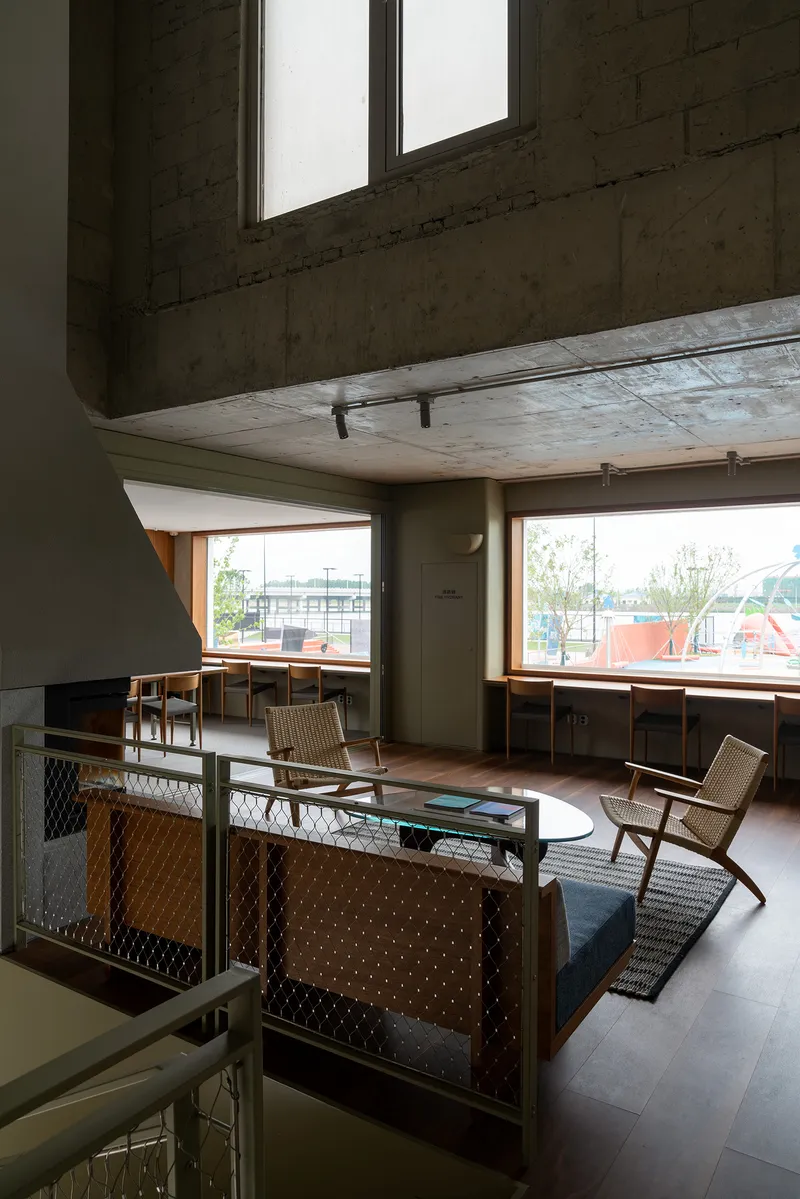
The section is the real hero here. NUC Studio uses split levels to multiply the spatial experience within a modest footprint, creating half-floor shifts that let each zone borrow light and sight lines from its neighbors without collapsing into a single open-plan loft. Concrete steps and timber floors alternate, so every transition is felt underfoot before it registers visually.
Mesh balustrades at the mezzanine level maintain transparency without introducing visual noise. From the upper stair landing you can look down over a children's play area, or across to angled windows that frame the terrace. The building keeps offering you partial views, and that incompleteness is what makes it feel larger than its 320 square meters.
The Suspended Hearth and Domestic Scale
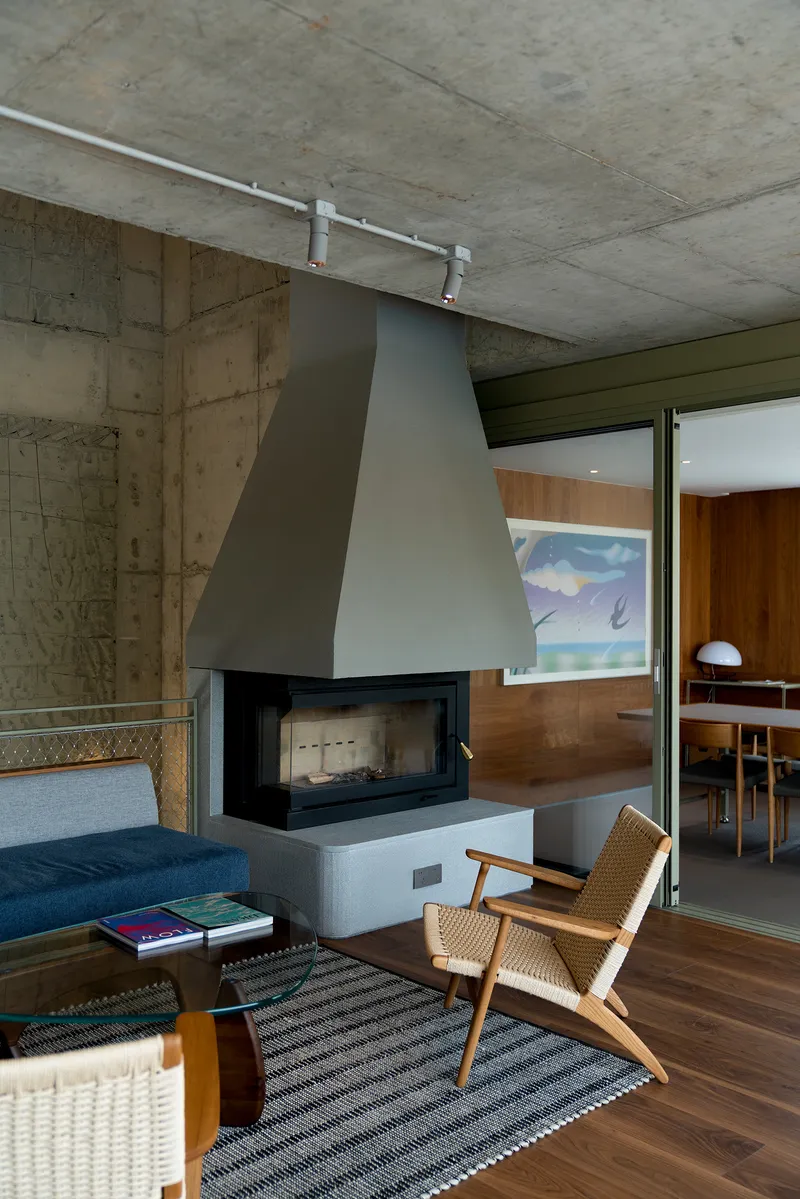

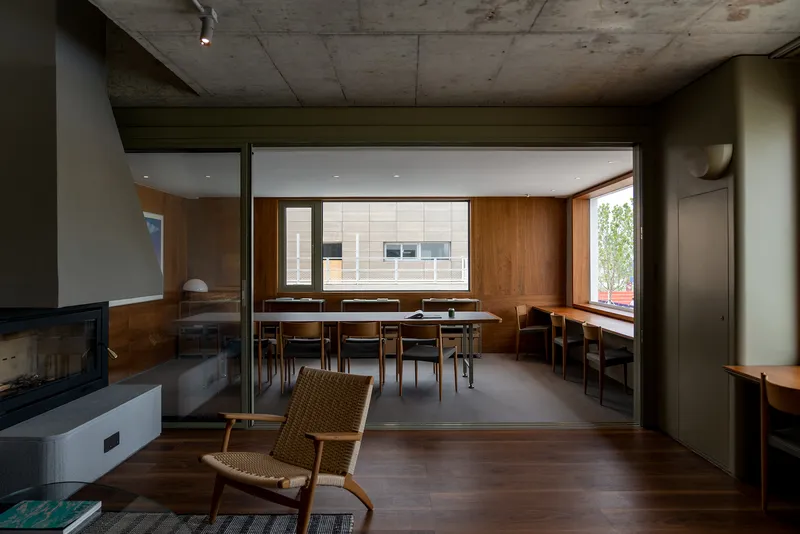
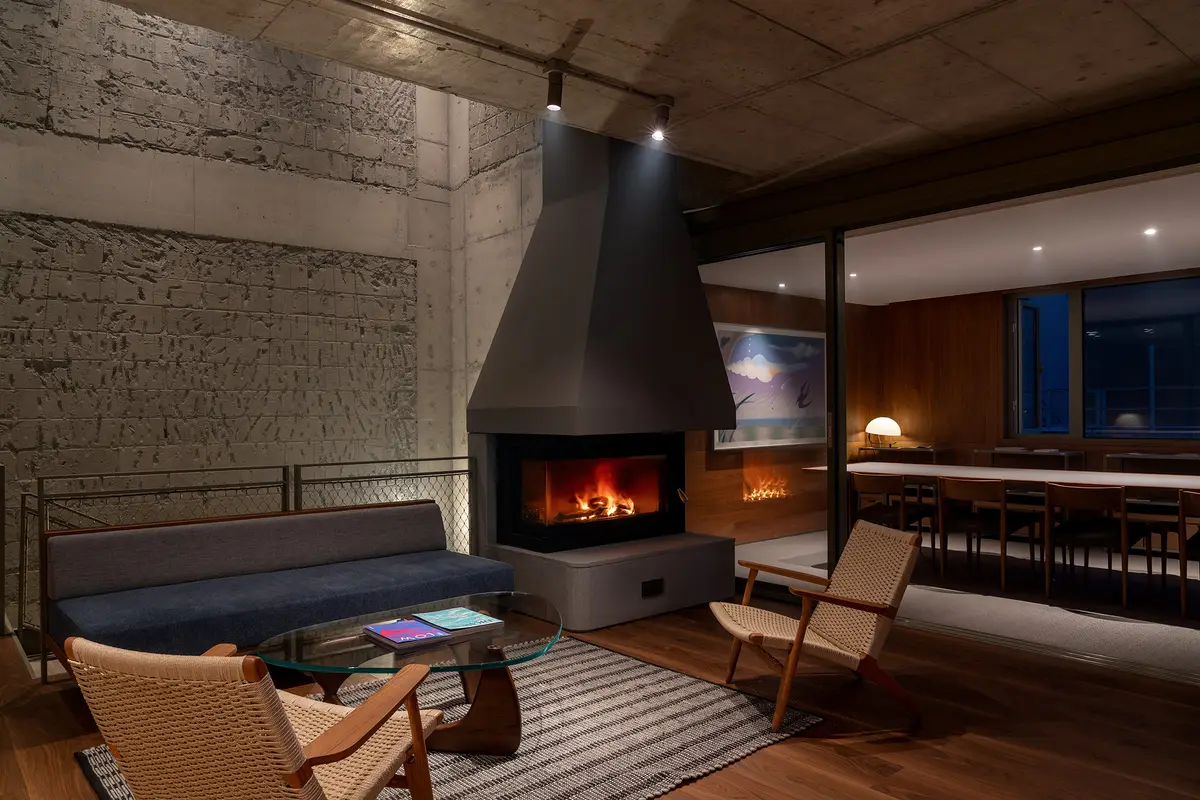
The suspended metal fireplace hood in the double-height living space is the project's boldest single gesture. Hanging from the exposed concrete ceiling like a sculptural pendant, it transforms a commercial café zone into something that reads as a domestic hearth. Woven lounge chairs and a dining area visible beyond complete the illusion: you are not in a shop, you are in someone's exceptionally well-designed living room.
The scale of the double-height volume allows afternoon light to wash down the concrete walls in long diagonal bands, animating the rough texture and turning the room into a kind of sundial. It is a space calibrated for slowness, which is exactly what a seaside coffee house should provide.
Quiet Corners and Window Seats
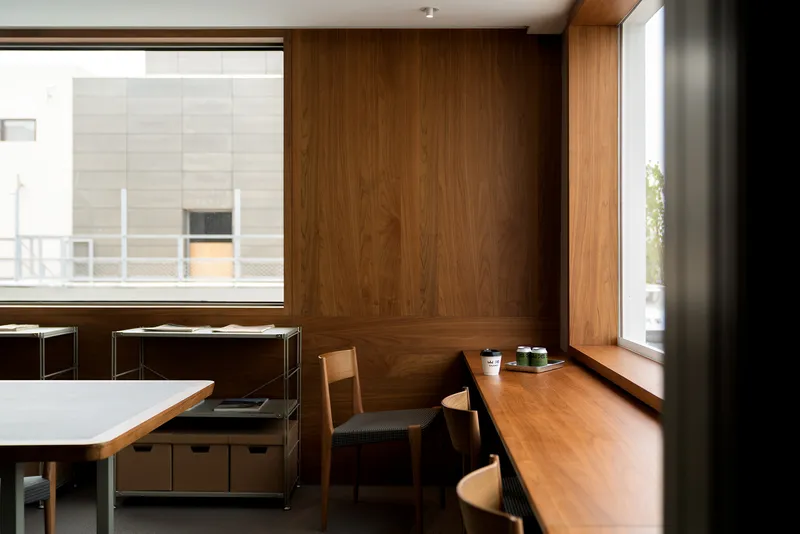
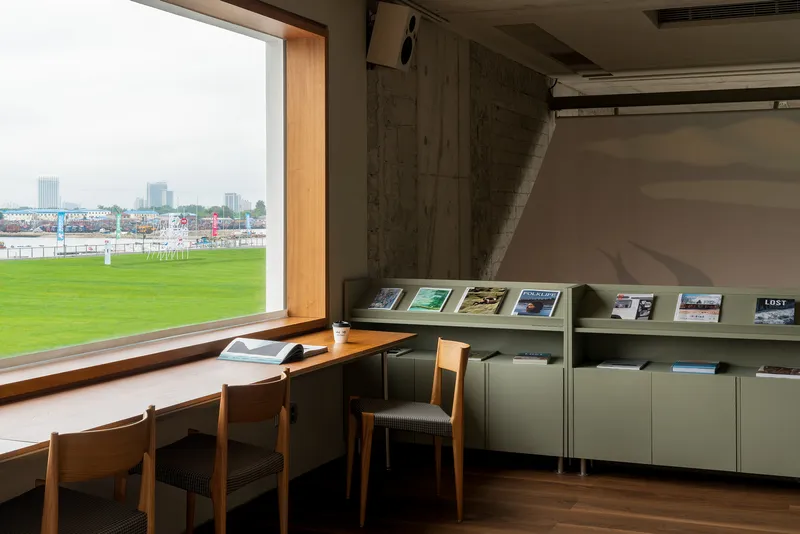

Not every moment in the building is monumental. NUC Studio distributes a series of intimate nooks throughout the plan: a corner reading seat with built-in timber benches beneath tall windows, a long table beside glass overlooking green lawn and waterfront, a banquette with ceramic cups resting on a deep sill. These are the spaces that generate return visits, the corners you mentally bookmark and come back to claim.
The timber wall paneling in these alcoves is warmer and tighter-grained than the board-formed concrete elsewhere, creating pockets of acoustic and visual softness. The architects understood that a café needs both social and solitary zones, and they distributed them vertically so that choosing your seat also means choosing your altitude and your view.
Twilight and the Lantern Effect


At blue hour, the stepped white facade becomes a lantern. Warm interior light pours through horizontal window openings, turning each volume into a glowing slot against the deep blue sky. A circular streetlight and the silhouette of a bare tree complete a composition that is almost painterly in its simplicity. The building performs equally well as a daytime social space and as an evening marker on the coastal streetscape.
The courtyard corner with its cast concrete column and yellow emergency call box reads as a minor note, but it reveals NUC Studio's attention to the edges. Even the utilitarian moments are composed, lit, and framed.
Plans and Drawings
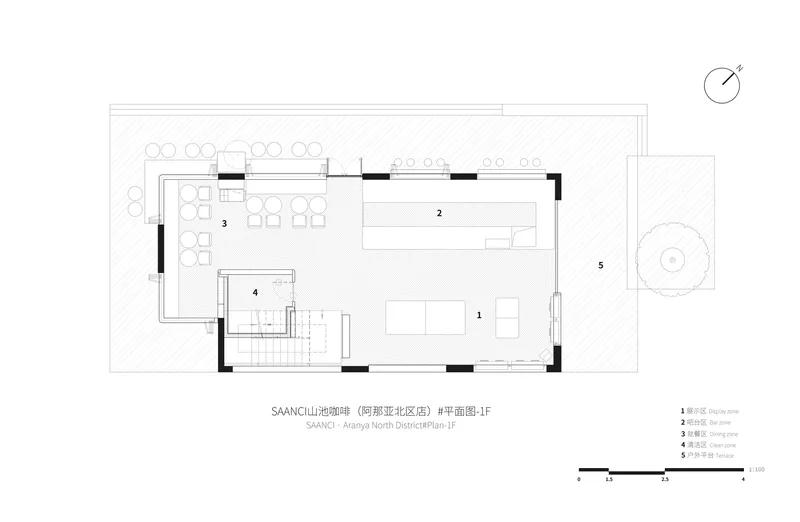
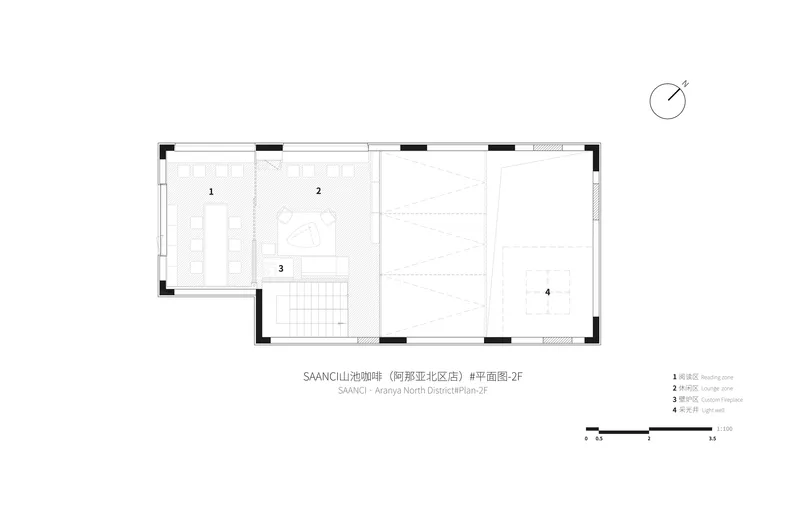

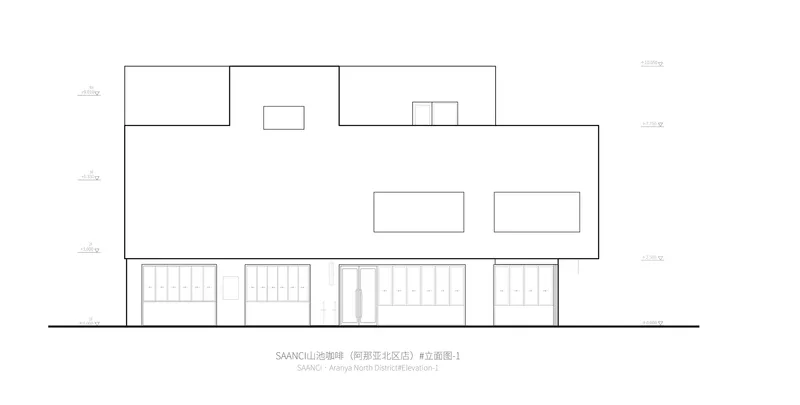
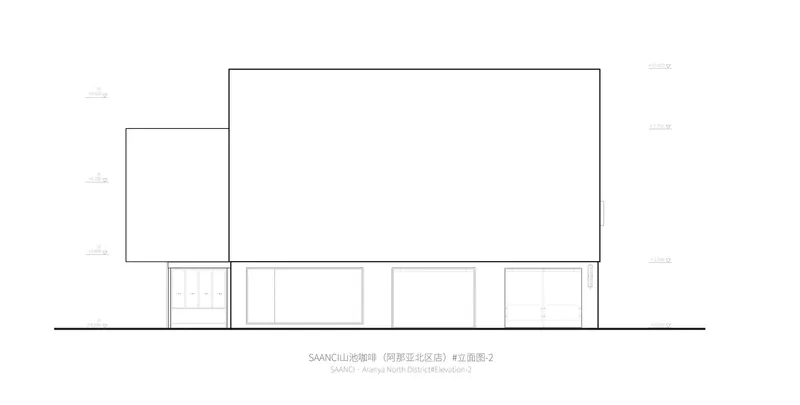
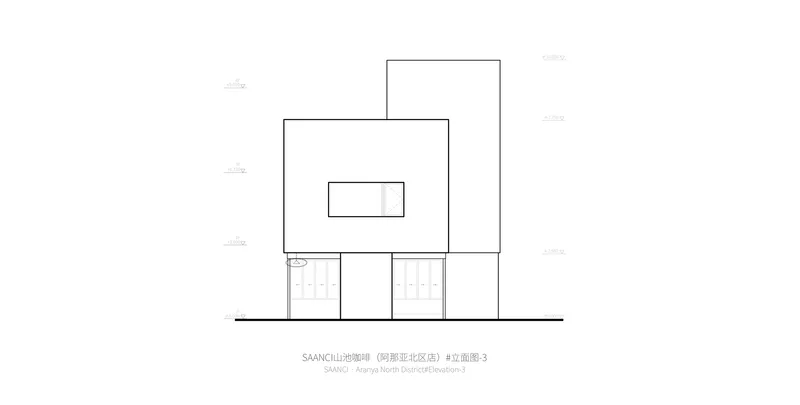
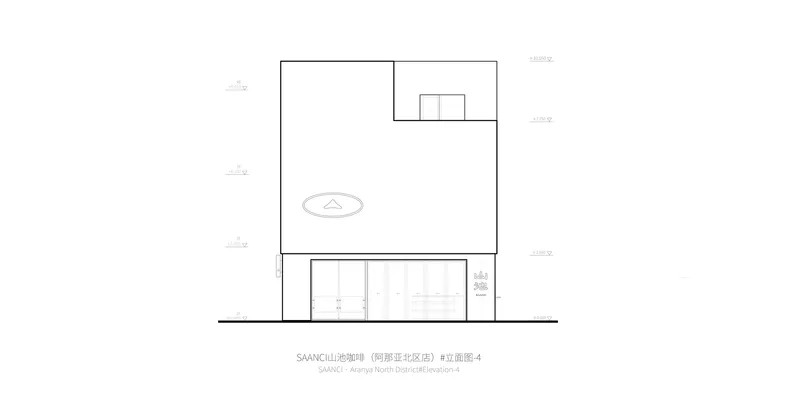

The floor plans confirm what the photographs suggest: the ground level is organized around kitchen, dining, and terrace zones that open freely to the street, while the upper level is subdivided into more cellular spaces connected by a central stair. The section drawing is revealing, showing how a rooftop aperture introduces zenithal light deep into the split-level core. Four north elevation studies show different façade conditions across the block, each calibrated to its street context.
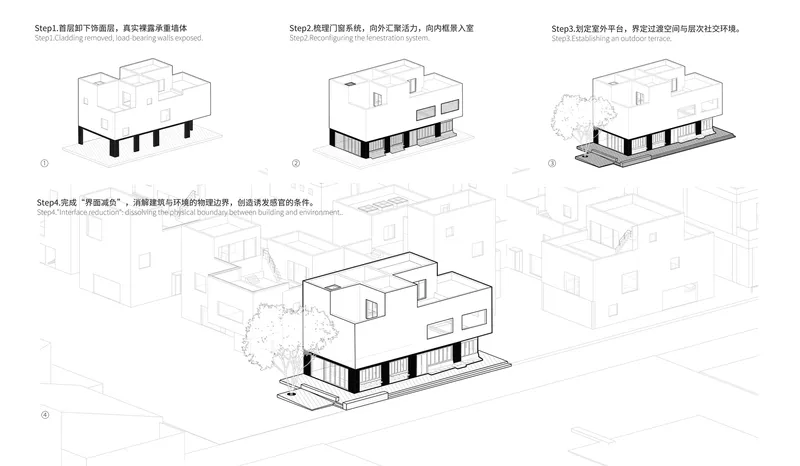
The axonometric cutaway is the most instructive drawing. It peels back the white skin to expose the interplay of concrete, timber, and void, with furniture placed to indicate intended occupation. A design development diagram in four steps traces the logic of the elevated house form with pilotis, making clear that the final massing emerged from a systematic series of volumetric lifts and carve-outs rather than intuition alone.
Why This Project Matters
SAANCI Coffee's Aranya outpost matters because it resists the two default modes of contemporary café design: the Instagram backdrop and the minimalist white box. NUC Studio instead delivers a building that behaves like a house, with rooms of different character, scales, and moods stacked into a compact coastal volume. The architecture does not flatten the experience of drinking coffee into a single photogenic moment; it unfolds it across levels, corners, and times of day.
For a southern brand planting a flag on a northern shoreline, the project also demonstrates that regional translation does not require pastiche. The board-formed concrete, the split levels, the suspended hearth, and the folding storefronts are all strategies for making a building that belongs to its place while acknowledging that its visitors come from elsewhere. That balance between rootedness and hospitality is exactly what the best commercial architecture achieves.
SAANCI Coffee (Aranya North Bay Store) by NUC Studio, lead architect Huang Changsong. Qinhuangdao, China. 320 m², completed 2024. Photography by Shaoqing Pan.
Share Your Own Work on uni.xyz
If projects like this are the kind of work you want to make, uni.xyz is a place to publish your own, find collaborators, and enter design competitions.


Popular Articles
Popular articles from the community


Aquadapt: An Underwater Habitat That Rewrites Its Rooms by the Hour
Curved modules ring the seabed while one shell shifts from breakfast room to cinema, farm and football pitch as residents' needs change.


David Ortega Stacks a Two-Story Mexico City Penthouse Around a Steel Stair and a Pergola-Shaded Roof Terrace
In Colonia Roma, a 300 m² penthouse uses oak joinery, a planted steel stair and a slatted roof pergola to make a new-build apartment feel like a house.
Manzana Morphosis: Stretching Barcelona's Grid into a Living Landscape for 2050
A radical reworking of the Eixample manzana turns density into a tool for generous public space, vertical ecology, and environmental performance.

Singing Woman: An Opera House That Performs Before the Curtain Rises
Ovidiu Cristian Pavel's conceptual opera house translates Estonia's choral identity into a sculpted waterfront landmark facing the Baltic Sea.

Similar Reads
You might also enjoy these articles

LAVA Architecten Gives Vocational Education a Sawtooth-Roofed Face on a Mechelen School Campus
In Mechelen, Belgium, a 2,053 m² STEM school on a 6×6 m grid turns workshops and classrooms into rooms that can be rearranged as teaching changes.

KEMA Studio Turns a Derelict Marvila Attic into a 60 m² Lighthouse Apartment Above Lisbon
In Lisbon's Marvila district, a rebuilt roof, four skylights and two plywood volumes turn an unlivable attic into a bright home facing the Tagus.

Pixel Gardens: One Repeated Module Stacked Into a Terraced Social Housing Tower for Famagusta
Salem Bader's shortlisted housing tower builds a vertical neighbourhood from one repeated module, offsetting units to carve terraces, light and air.

Bao Huynh Watercolor Atelier: A Serene Art Retreat in Hội An
Bao Huynh Watercolor Atelier in Hội An blends multifunctional art spaces, sustainable design, local materials, and family-friendly living in a serene environment.

Comments (0)
Please login or sign up to add comments
No comments yet. Be the first to comment!