
N.U.M.B: Geothermal Nodes Reanimate a Frozen New York
A distributed network of underground heat systems and clustered habitats transforms Two Bridges into a prototype for post-climate urban survival.


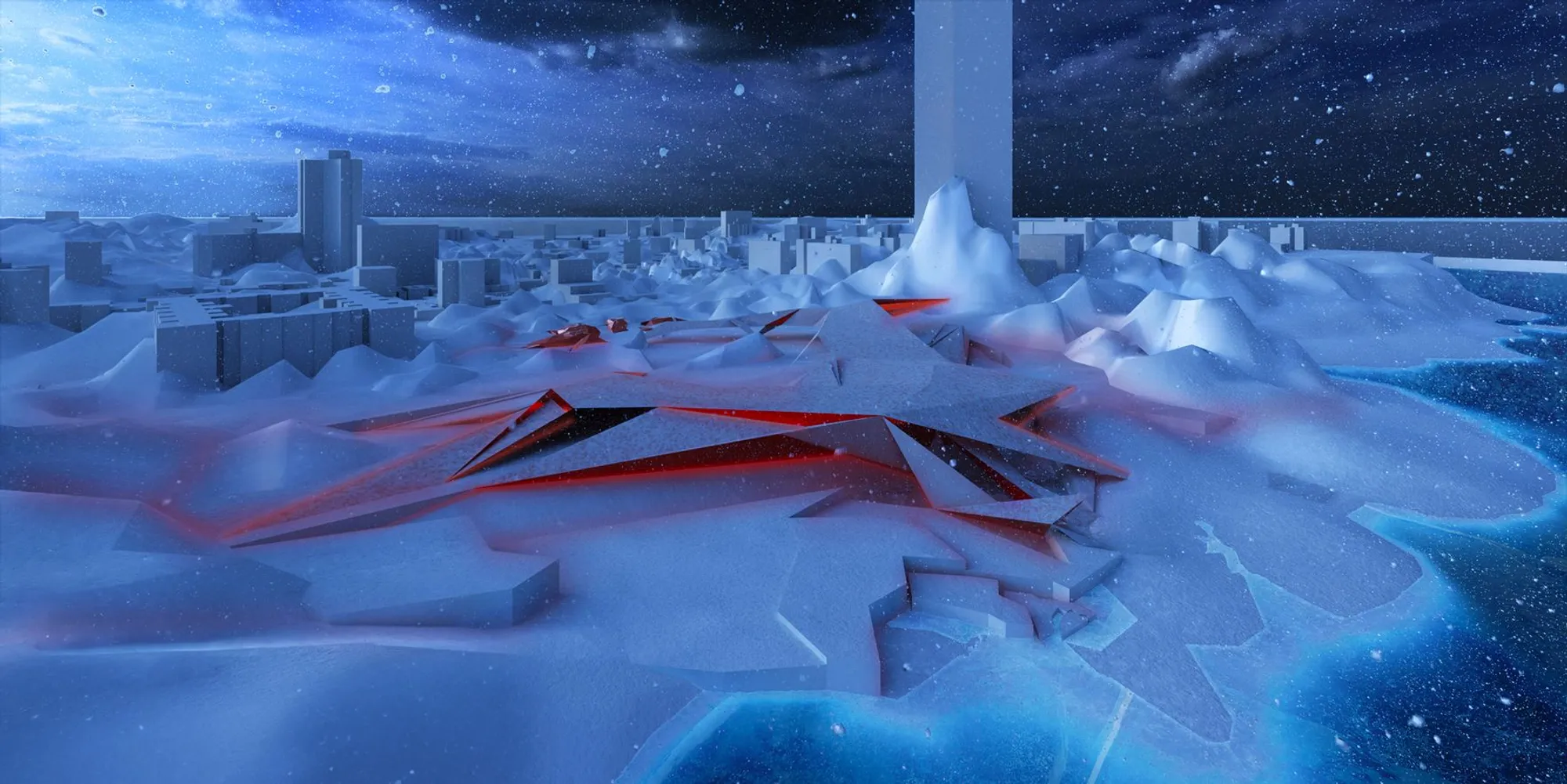
What happens when a city stops breathing? N.U.M.B, or Nodal Urban Mechanism for Breathing, starts from a grim premise: New York has flooded, then frozen solid. Energy grids have fractured, transit systems have gone silent, and streets lie buried under sheets of ice. Rather than proposing a single heroic structure to reverse the catastrophe, the project imagines a network of geothermal nodes that harvest warmth from the earth and channel it into clustered habitats above the frozen terrain. Red, angular volumes rise from the ground like organs of a new urban body, glowing against a white landscape, each one a pulse point where people gather, grow food, and reclaim social life.
Designed by Negar Zandi and Dung Nguyen, N.U.M.B was shortlisted in the Peak Competition. The project roots itself in the Two Bridges neighborhood of Lower Manhattan, a historically dense, multicultural enclave where the designers see latent resilience. From this ignition point, the network spreads outward through Chinatown, Foley Square, Wall Street, and eventually toward Harlem and Central Park, reanimating the city not through monumental reconstruction but through localized, climate-adaptive infrastructure that grows like veins through a frozen body.
Red Veins Across a White Grid
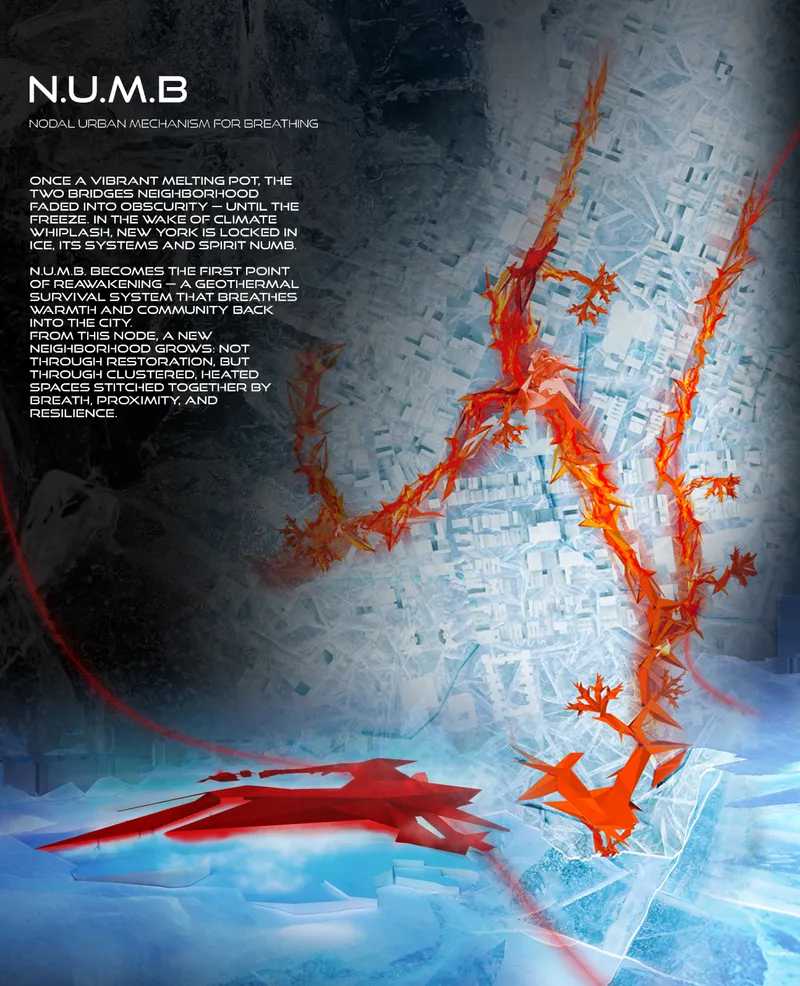
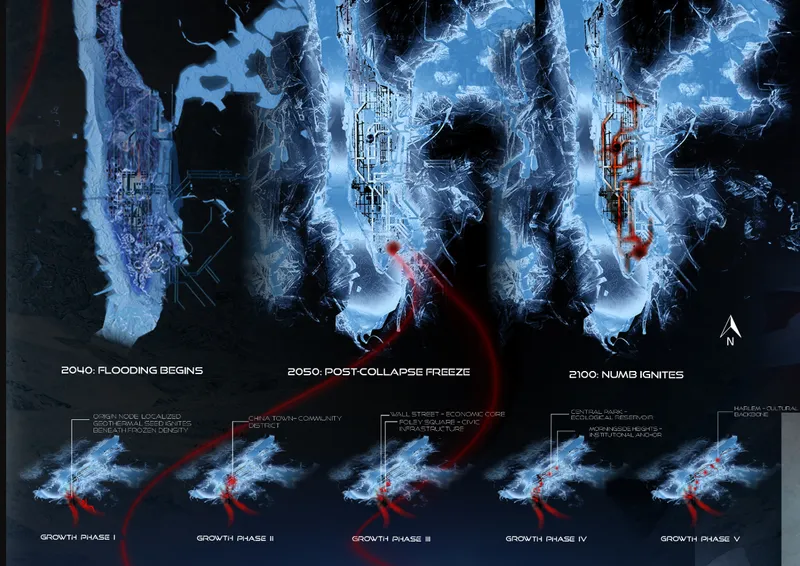
Seen from above, N.U.M.B reads as a branching circulatory system laid over the familiar Manhattan grid. The aerial rendering shows clusters of angular red structures spreading outward from Two Bridges, their forms connected by pathways that carve through the ice. The accompanying plan diagram maps three phases of growth: Phase I concentrates on Two Bridges as the ignition point, Phase II extends into Chinatown, Foley Square, and Wall Street to reconnect cultural and civic functions, and Phase III reaches toward Harlem and Central Park to integrate ecological and institutional networks. Each node operates autonomously yet shares systems of heat and communication with its neighbors, forming what the designers call a distributed urban ecology.
The phased strategy is deliberate. Rather than a centralized master plan, N.U.M.B proposes a model of resilience through redundancy. If one node fails, the others persist. The plan view makes this logic legible: red pathways extend like tendons through icy terrain, each connection reinforcing the system's collective capacity while preserving the independence of individual clusters.
Thermal Commons: Warmth as Public Space
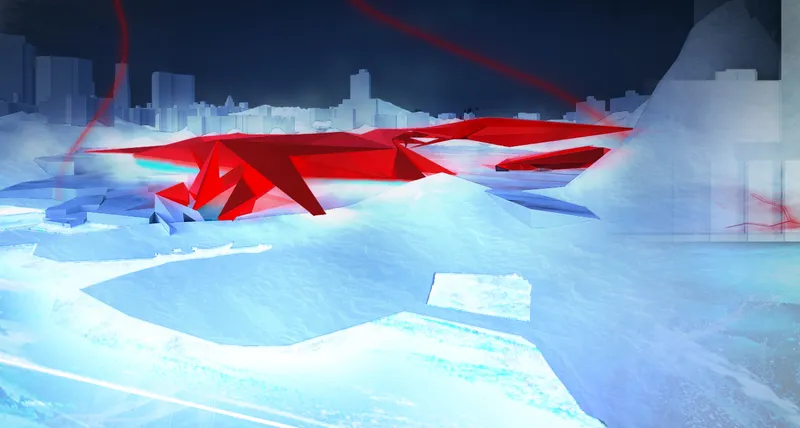
At ground level, the architecture shifts from diagram to experience. The low-angle rendering captures an angular red canopy hovering above a frozen plaza, its faceted surfaces angled to shed ice and snow while sheltering the space below. These are what the designers term thermal commons: shared environments where geothermal heat rises through transfer shafts into breathable, inhabitable zones. The structures are designed not for comfort in any conventional sense but for endurance. Heat collector chambers buried underground harvest warmth from the earth, and that energy is directed upward into spaces where people cultivate food in hydro gardens, exchange goods, and simply exist together.
The visual language is striking and intentional. The red volumes stand in stark contrast to the white and grey of the frozen city, functioning as visible reminders that survival requires collective effort. These are not icons; they are functional monuments. Their forms serve rather than symbolize, replacing the lost skyline with something more urgent.
Living Inside the Mechanism
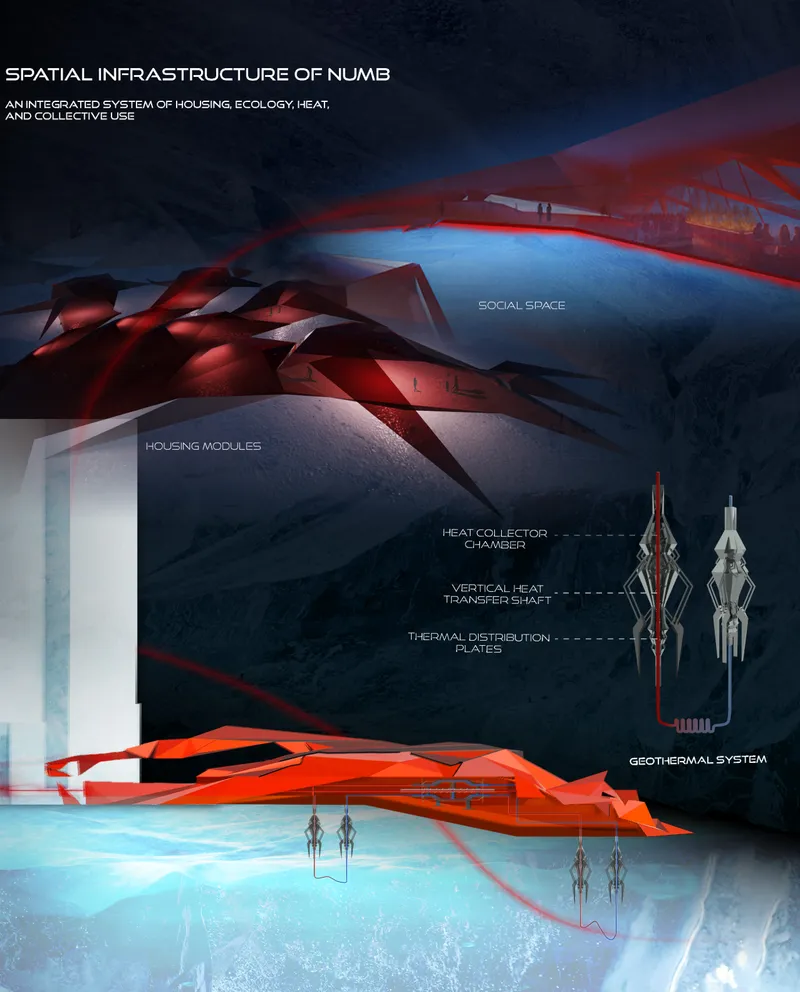
The sectional drawing reveals the interior logic of a single node. Housing modules are stacked within a faceted red enclosure, their walls constructed from adaptive materials including layered insulation gels and plant-based composites that modulate thermal gradients. Circulation corridors double as green arteries where hydro gardens thrive under artificial light. Below, the geothermal infrastructure is visible: heat collector chambers and thermal transfer shafts form the subterranean engine that makes habitation possible. Every threshold between units becomes a space of exchange, blurring the line between private dwelling and communal infrastructure.
Zandi and Nguyen envision residents not as passive inhabitants but as stewards. They monitor geothermal chambers, maintain hydro gardens, and reconfigure living modules as conditions change. The architecture is designed to be porous, layered, and mutable, absorbing the friction of proximity rather than trying to eliminate it. N.U.M.B treats coexistence as a design parameter, not a problem to be solved.
Resilience Built from Fragments, Not Fantasies
Two Bridges was never a place of uniformity. Its strength historically lay in diversity, density, and contradiction. N.U.M.B does not idealize that past but builds from its fragments, using the neighborhood's social DNA as a foundation for a new civic identity. The project amplifies the spatial complexity that once defined the area, channeling it through climate-adaptive systems that address an extreme future without abandoning the rhythms of communal life.
The choice to begin here rather than in Midtown or the Financial District is significant. Two Bridges is peripheral in the conventional urban hierarchy, yet in N.U.M.B's logic, periphery becomes origin. The network grows outward from a place that already understood density and interdependence, suggesting that the seeds of resilience were always embedded in the city's most overlooked neighborhoods.
Why This Project Matters
N.U.M.B joins a growing body of speculative work that takes climate catastrophe seriously as a design brief rather than a backdrop. What distinguishes it is the specificity of its systems thinking: geothermal extraction, phased network growth, participatory stewardship, and material strategies are all articulated in enough detail to move the project beyond pure provocation. The section drawing alone demonstrates a genuine engagement with how heat, circulation, and habitation might coexist within a single enclosure.
More importantly, Zandi and Nguyen propose a model of architecture that replaces centralized monumentality with distributed agency. In a frozen city where every centralized system has failed, N.U.M.B argues that survival depends on networks of small, autonomous, interconnected nodes. It is a compelling rebuttal to the idea that resilience must be spectacular. Sometimes it just needs to breathe.
View the Full Project
N.U.M.B: Nodal Urban Mechanism for Breathing
View the full project with all boards on uni.xyz.
uni.xyzAbout the Designers
Designers: Negar Zandi, Dung Nguyen
Enter a Design Competition on uni.xyz
uni.xyz runs architecture and design competitions year-round that reward proposals with spatial conviction and real site intelligence.
Project credits: N.U.M.B: Nodal Urban Mechanism for Breathing by Negar Zandi, Dung Nguyen Peak (uni.xyz).



Popular Articles
Popular articles from the community


The Musturak Paradise: Senior Living Architecture for a Connected Future in Temara, Morocco
The Musturak Paradise reimagines senior living architecture in Temara via private homes, social spaces, culture, community, and shared care.

Riyadh For All: Intergenerational Urban Design for Active Aging in Rabat
Riyadh For All reimagines urban design in Rabat with intergenerational co-living, adaptive courtyards, and Moroccan cultural exchange today.

The Earth Pod: 3D Printed Homes for Resilient Refugee Communities
The Earth Pod reimagines refugee housing through 3D printed homes made from clay, combining resilience, self-sufficiency, and rapid shelter.

Play: Fragments of Their World
Familiar architecture becomes modular playground design, creating safe spaces where displaced children can learn, connect, imagine and play.

Similar Reads
You might also enjoy these articles

Lunar Spiral: Space Architecture Shaped by the Mathematics of the Universe
Lunar Spiral reimagines space architecture through Fibonacci geometry, lunar regolith, levitating habitats, and self-sustaining Moon living.
The Main Dream: Modular Architecture for Play, Learning, and Community
A modular playground turns recycled plastic into adaptable spaces where refugee children can play, build, learn, and reconnect.
Play: Fragments of Their World
Familiar architecture becomes modular playground design, creating safe spaces where displaced children can learn, connect, imagine and play.

Wadi Rum Observatory: Desert Architecture Designed for the Night Sky
Wadi Rum Observatory turns desert architecture into a quiet instrument for astronomy, hiding research spaces under Jordan's starlit terrain.




Comments (0)
Please login or sign up to add comments
No comments yet. Be the first to comment!