
Nur al-Turath: An Archaeological Park That Heals Aleppo's Scarred Urban Fabric
Darby Stephens designs four interconnected zones of cultural sanctuary, turning Aleppo's ruins into spaces of renewal and community repair.


What does it mean to build in a city where every stone already carries the weight of a civilization? In Aleppo, one of the oldest continuously inhabited cities on Earth, the answer cannot simply be reconstruction. It has to be something closer to translation: taking the ruins of courtyards, souks, and citadels and converting them into spaces that hold both memory and possibility. Nur al-Turath, which translates to "Light of Heritage," proposes an archaeological park that does exactly this, weaving together heritage conservation, community healing, and economic regeneration across four distinct programmatic zones.
Designed by Darby Stephens, the project won the Revivify competition. The site sits within Aleppo's devastated urban core, a terrain scarred by the Syrian Civil War that reduced a vibrant network of historic fabric to rubble. Stephens approaches this context not with nostalgia but with a clear operational framework: the Value Proposition Triangle, which balances Education and Sustainability, Cultural and Community Healing, and Economic Regeneration. Every design decision filters through these three pillars.
A Central Courtyard That Rewrites the Threshold
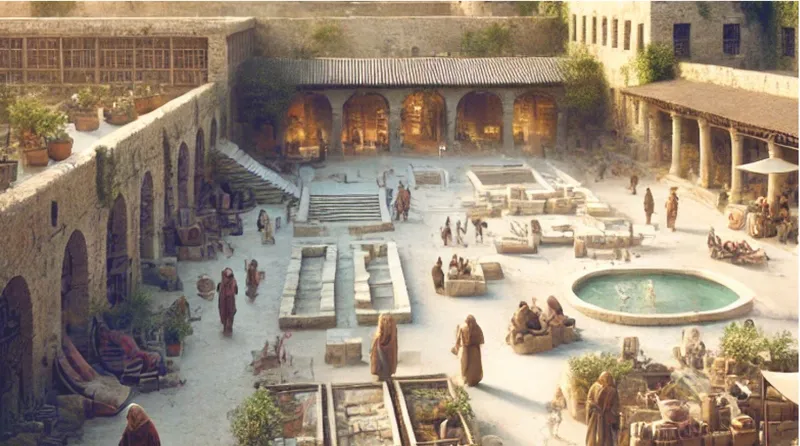
The aerial view of the Grand Entrance reveals how Stephens reinterprets Aleppo's architectural geometry at a monumental scale. Arched colonnades frame a central courtyard anchored by a circular fountain, with stepped platforms creating a topographic progression that draws visitors inward. People gather throughout the space, which reads less like a museum threshold and more like a living public square. The arches and proportions clearly reference the city's historic built environment, but they are deployed here as contemporary spatial devices rather than replicas. The result is a space that presents Aleppo's history as a living narrative, not a static relic.
Streetscape and Souk: Reviving Artisanal Infrastructure
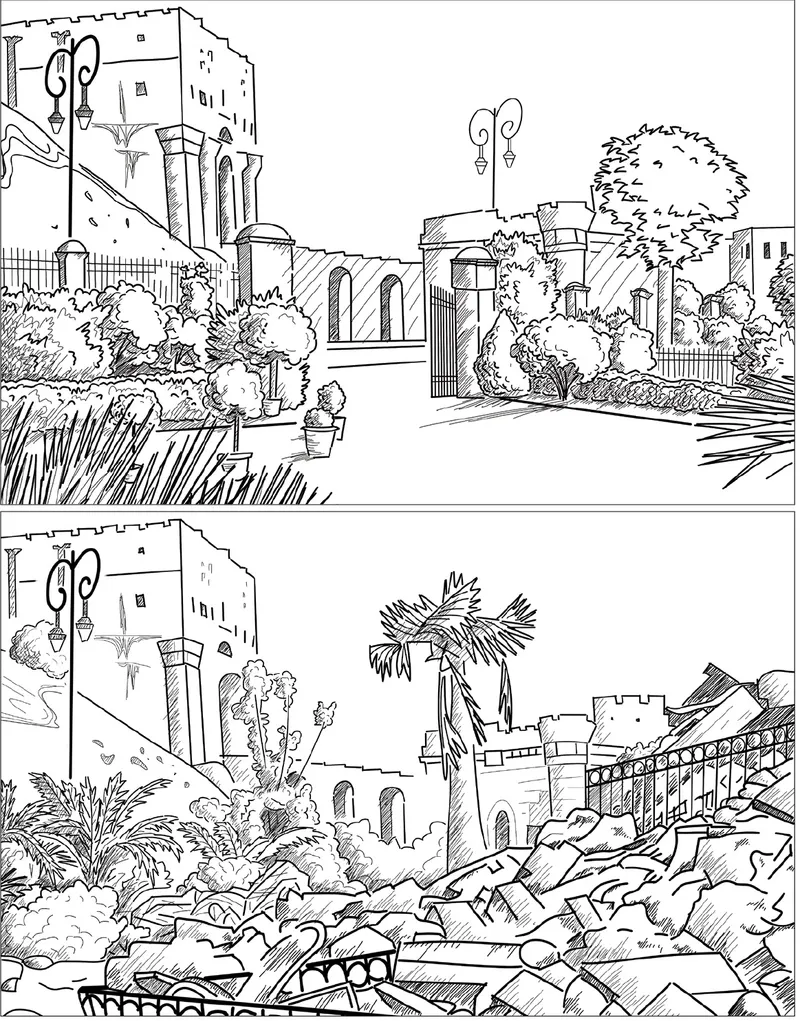
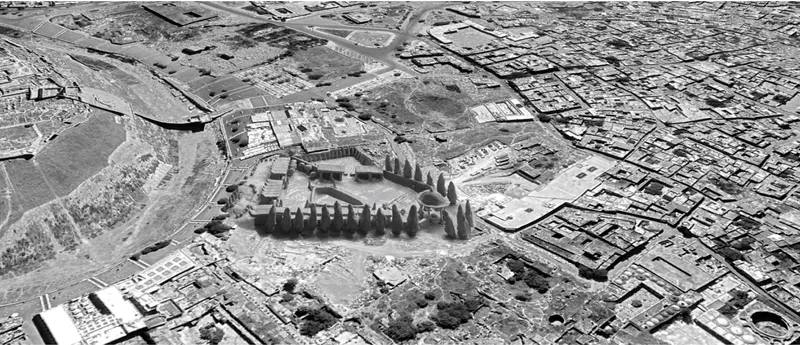
The line drawing of the landscaped street shows planted beds, lampposts, and crenellated walls forming a processional route that connects the park's zones. It is a careful piece of urban stitching, designed to re-establish pedestrian continuity across a fractured district. Adjacent to this, the aerial photograph reveals how the domed and vaulted structures of the Souk Workshops sit within a broader context of urban fabric and agricultural fields. These workshops are not merely symbolic; they host craftspeople and apprentices, directly reviving Aleppo's legacy of artisanal production. Through adaptive reuse principles, Stephens positions them as catalysts for both architectural sustainability and economic resilience.
The juxtaposition of tight urban grain and open agricultural land visible in the aerial photograph is telling. It suggests the park operates at two scales simultaneously: the intimate scale of the souk, where hands shape materials, and the territorial scale of landscape restoration, where indigenous flora stabilizes soil, restores biodiversity, and cools the microclimate.
Clay and Plaster Models as Design Instruments
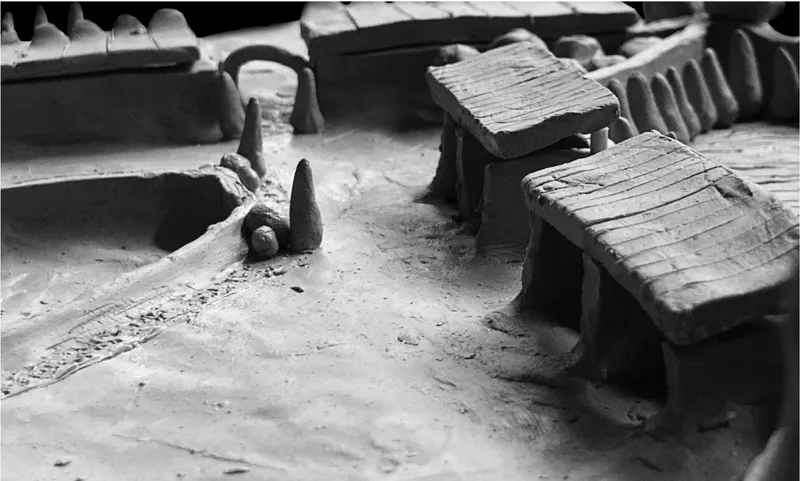
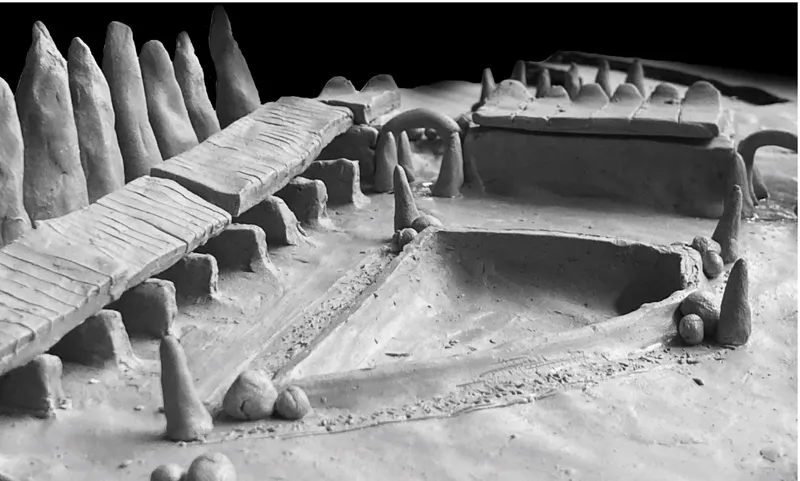
Stephens makes a deliberate methodological choice by developing the design through physical clay and plaster models rather than relying solely on digital tools. The close-up of the vaulted roofs and stepped terraces, with a miniature figure standing in shadow, demonstrates how the models test light, scale, and spatial sequence at a tactile level. Raking light across the clay surfaces in the second image exposes the interplay between courtyards, vaulted structures, and conical forms, making visible the kind of sensory experience the finished spaces would produce: filtered light, cool shadows, the geometry of repetition.
These are not presentation models made to impress. They are design instruments, used to study sectional relationships and the way Aleppo's traditional construction techniques, such as vaulting and courtyard planning, can be translated into a contemporary framework. The conical forms appear throughout the models, suggesting cypress trees or minarets, grounding the abstracted architecture in recognizable cultural markers.
The Domed Pavilion and the Reflecting Pond
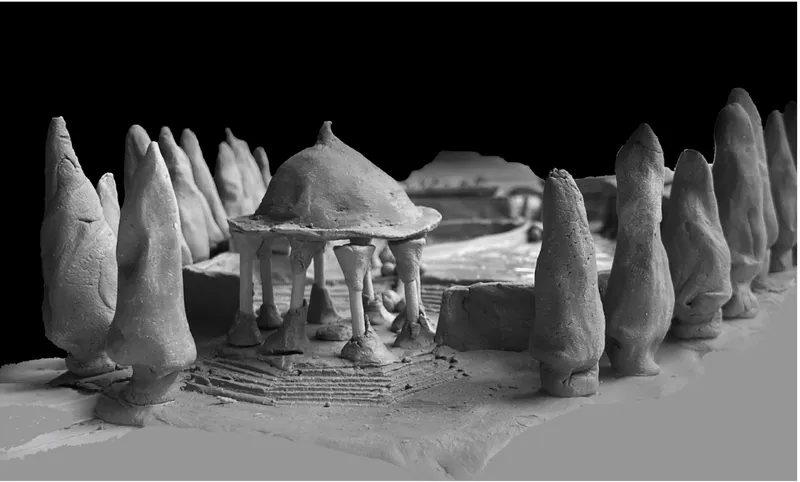
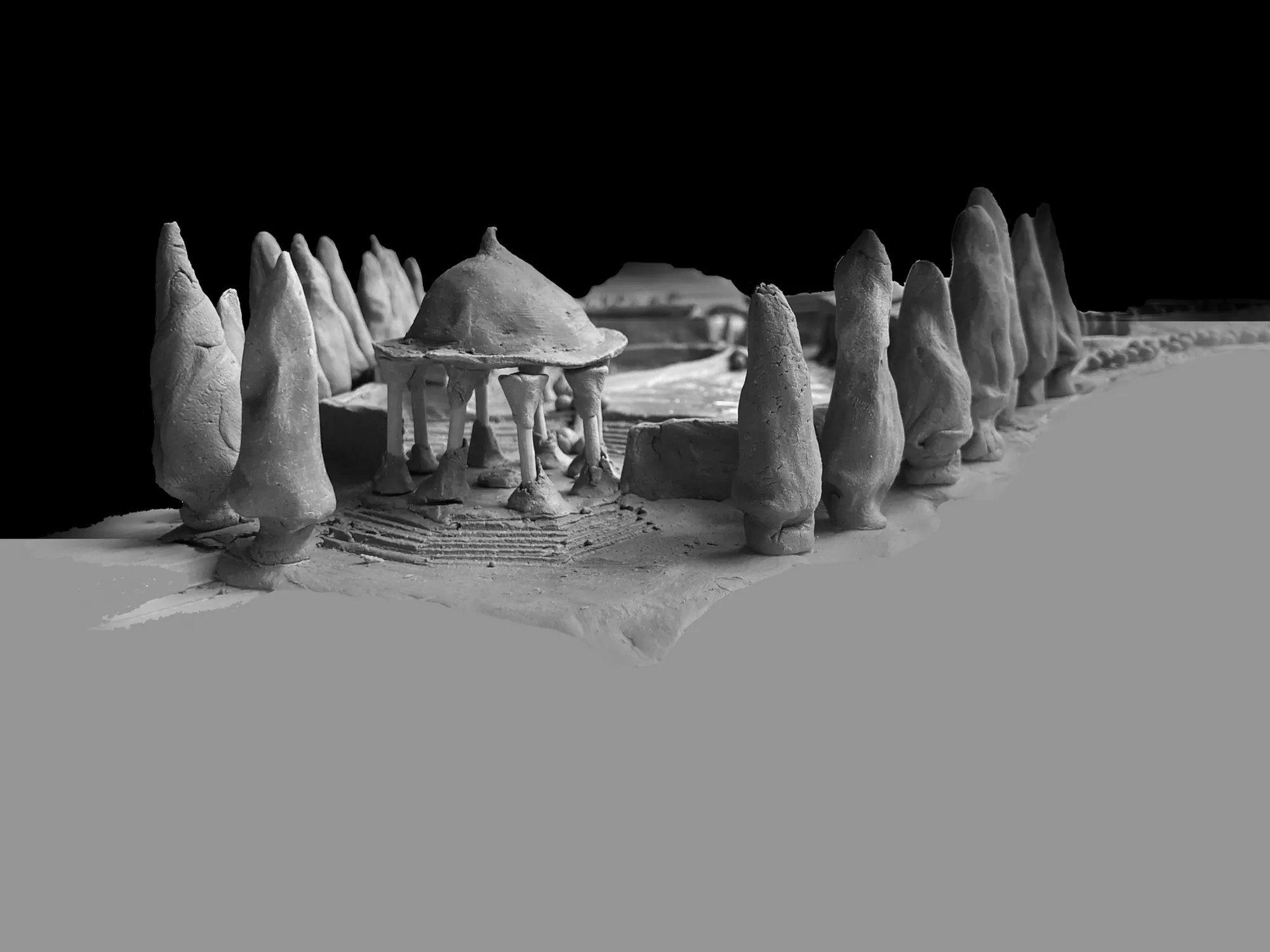
Under directional lighting, the physical model of the domed pavilion emerges as one of the park's most contemplative elements. Surrounded by cypress-like forms and stepped platforms, it corresponds to the Reflecting Pond zone, which Stephens describes as inspired by Islamic courtyard traditions of purification and contemplation. The pond's geometry and proportion offer spatial harmony, connecting the human experience to the broader landscape restoration strategy. The model makes clear that this is not a decorative water feature; it is a structured spatial event, calibrated to create pause within the park's processional sequence.
Terrain as Community Infrastructure
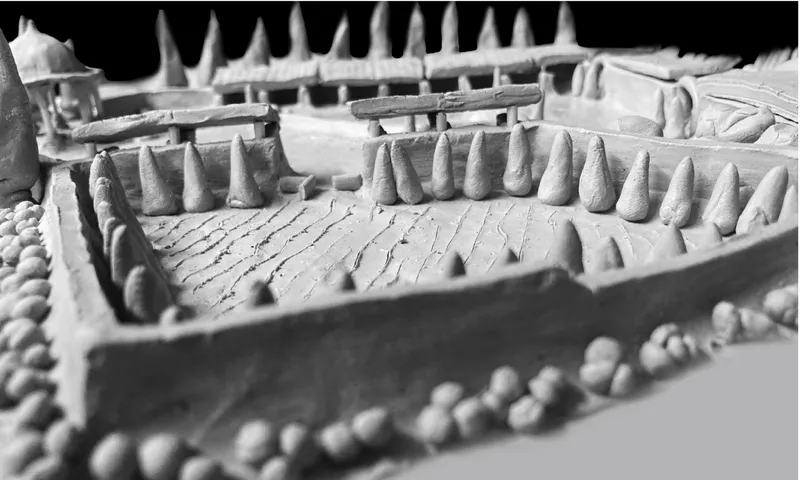
The final site model pulls back to show the full extent of the terraced platforms, conical trees, and tiled ground plane in white plaster. It reveals how the Community Garden and the park's ecological systems integrate with the architectural program. The terracing is not merely aesthetic; it manages grading, directs water, and creates distinct zones for education, agriculture, and recreation. Indigenous plant species are specified to stabilize soil and restore biodiversity, making the landscape itself a form of social infrastructure where cultural exchange and local participation cultivate a sense of belonging.
Taken as a whole, the site model communicates a clear urban thesis: healing Aleppo's fabric requires working with topography, not just building on top of it. The stepped sections create microclimates, frame views toward the existing urban context, and establish a gradient from the monumental Grand Entrance to the quieter, more intimate garden spaces.
Why This Project Matters
Nur al-Turath refuses the false choice between preservation and progress. Instead of freezing Aleppo in an idealized past or erasing its wounds with generic development, Stephens constructs a framework where ruins become active participants in a new cultural ecology. The four zones of the park, from the Grand Entrance to the Community Garden, form a coherent sequence that addresses heritage, craft, contemplation, and daily life. Each zone solves a specific problem: economic displacement, cultural erasure, ecological degradation, social fragmentation.
What distinguishes this project from many post-conflict proposals is its material intelligence. The decision to work through physical models forces a confrontation with light, shadow, and scale that digital rendering can easily flatten. Every vaulted roof, every courtyard proportion, every conical tree placement has been tested against the behavior of real light on real surfaces. For a project about recovering sensory memory in a devastated city, that methodology is not incidental. It is the argument.
View the Full Project
About the Designers
Designer: Darby Stephens
Enter a Design Competition on uni.xyz
uni.xyz runs architecture and design competitions year-round that reward proposals with spatial conviction and real site intelligence.
Project credits: Nur al-Turath – Light of Heritage by Darby Stephens Revivify (uni.xyz).




Popular Articles
Popular articles from the community


Play: Fragments of Their World
Familiar architecture becomes modular playground design, creating safe spaces where displaced children can learn, connect, imagine and play.

The Musturak Paradise: Senior Living Architecture for a Connected Future in Temara, Morocco
The Musturak Paradise reimagines senior living architecture in Temara via private homes, social spaces, culture, community, and shared care.

The Earth Pod: 3D Printed Homes for Resilient Refugee Communities
The Earth Pod reimagines refugee housing through 3D printed homes made from clay, combining resilience, self-sufficiency, and rapid shelter.

Hill & Cross Opera: Sculptural Opera House Architecture Shaped by Tallinn’s Landscape and Identity
Hill & Cross Opera reimagines opera house architecture in Tallinn through its sculptural hill, civic plaza, glass wave and a luminous cross.


Similar Reads
You might also enjoy these articles

Lunar Spiral: Space Architecture Shaped by the Mathematics of the Universe
Lunar Spiral reimagines space architecture through Fibonacci geometry, lunar regolith, levitating habitats, and self-sustaining Moon living.
The Main Dream: Modular Architecture for Play, Learning, and Community
A modular playground turns recycled plastic into adaptable spaces where refugee children can play, build, learn, and reconnect.
Play: Fragments of Their World
Familiar architecture becomes modular playground design, creating safe spaces where displaced children can learn, connect, imagine and play.

Wadi Rum Observatory: Desert Architecture Designed for the Night Sky
Wadi Rum Observatory turns desert architecture into a quiet instrument for astronomy, hiding research spaces under Jordan's starlit terrain.

Comments (0)
Please login or sign up to add comments
No comments yet. Be the first to comment!