
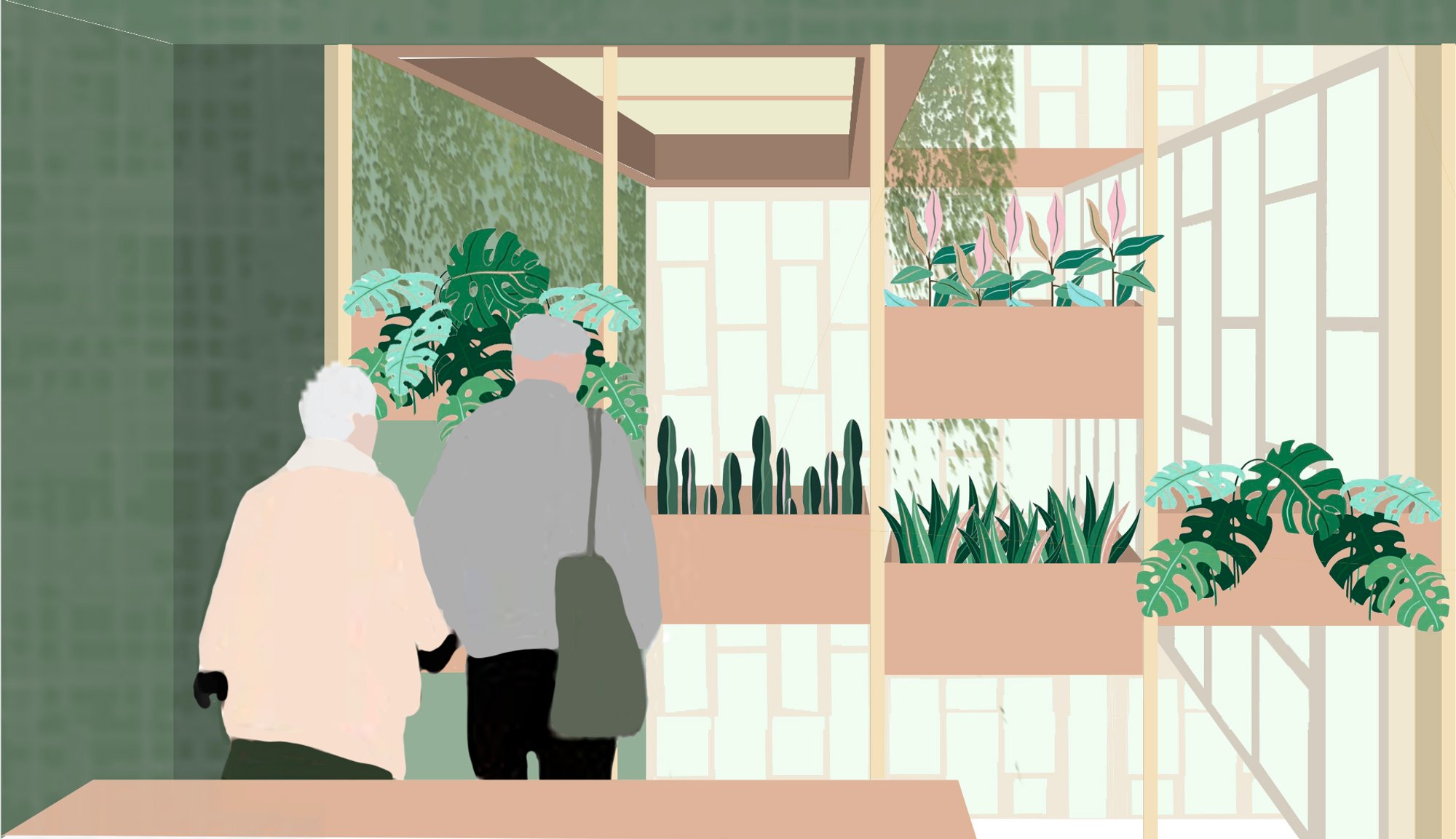
OASIS
Rethinking the meaning of Home

The concept behind the design
Home, understood since its beginning with fire, around which the first communities of hunters and collectors congregated, reflects a feeling of protection and wellbeing.
Starting from the above, our home is a feeling framed in the most intimate dimension of human beings. It generates a sense of identity, appropriation and the ability to express oneself without fear of external judgment.
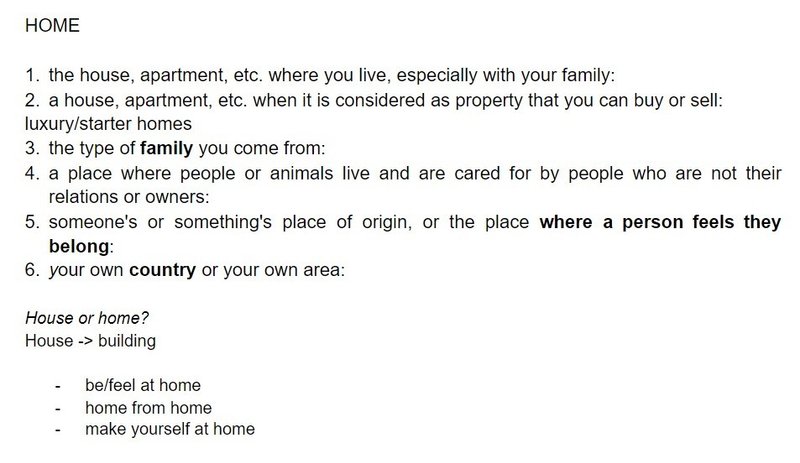 Research done by the team
Understanding the concept of home through fire, is reinterpreted in the future as the reunion around nature in response to climate change and its implications.
Nature has a collective meaning, of reunion and life, a fundamental characteristic of the oasis. Therefore, the idea of Oasis emerges from the search of a sense of identity and how this could condition a particular space. In the same way, in light of the difficulties that may rise in the future, the oasis is proposed as a space which separates us and makes us forget of all the trouble outside, through the interiorization of the concept of home.
Site and architecture
The implantation of the project in the context of latin america, allows us to comprehend a large variation of topographies and ecosystems, in this context it is of vital importance to understand the necessities of the individual. These aspects will be affected by the conditions of our surroundings in the future: climate change, droughts, deforestation, pollution, hunger, epidemics, among others.
Furthermore, with an increasing demography and a higher cost of land, the goal is to develop a space in which the individual feels at home in their oasis, with a spatial distribution in a reduced area of intervention. The incorporation of nature and the possibility to live with other members of the community, of vital importance to the concept and design, converge in a central space where the user can express their identity and separate themselves from the outside problems.
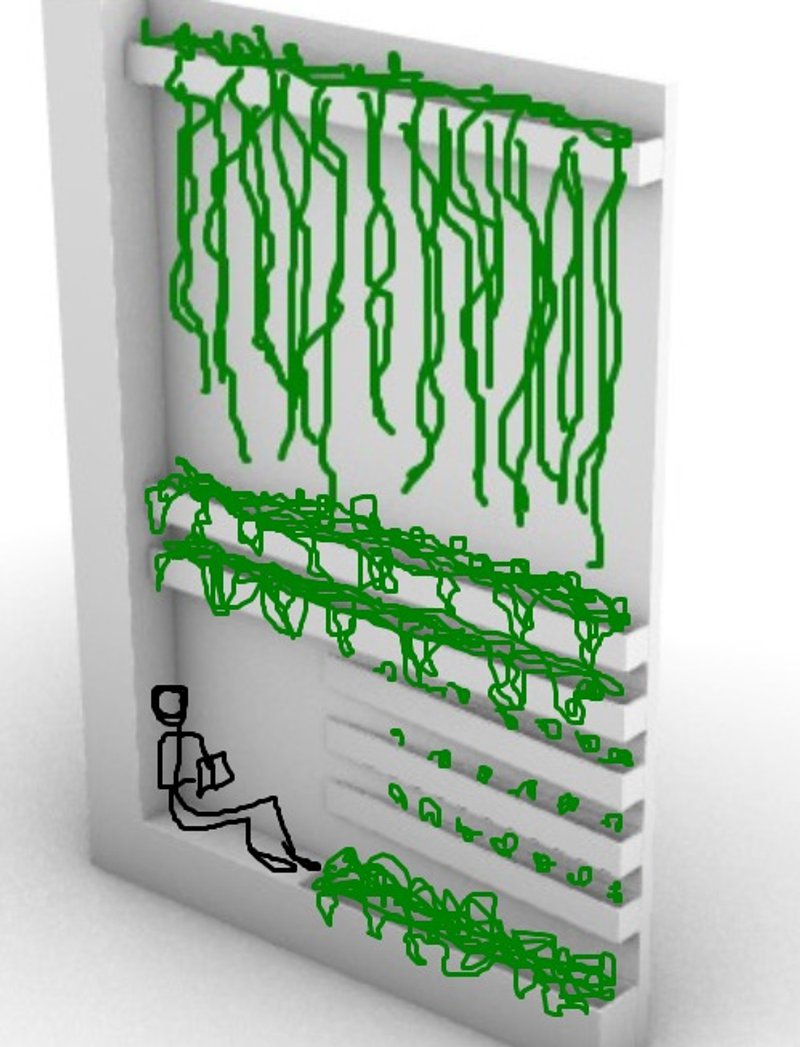 Approach to the Oasis main wall
Possibility of expansion
The uncertainty of not knowing how cities and villages will look like in the future, makes us think about the necessity of adaptability in the proposal in relation with its surroundings. Therefore, the best option is developing a simple volume on the exterior in which its true potential is on the inside. In addition, the structural solution is a frame structure that allows us an adaptability in the implantation in different topographies as well as stacking a number of modules as needed.
Process: TRY AND ERROR
Throughout the design process there were several explorations. The objective was to generate a space visually and programmatically connected to a void that would allow the development of different activities where the user feels in their own oasis, surrounded by nature, with the freedom to express themselves and without the perturbations of the outside world.
On the other hand, it was indispensable to save space without sacrificing comfort, this resulted in a clean and direct circulation in the project that won’t disturb the inside experience of the home.
The greatest challenge was to build the experience of the feeling of being at home in a few square meters, taking into account the demands of the future. The key was the disposition of three submodules with the purpose of developing the basic needs of a living space.
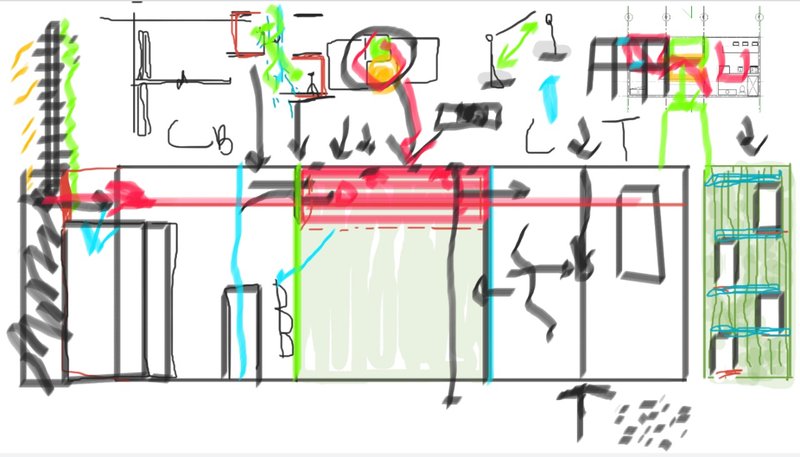 Annotations and approach to the proyect
However, our goal was to build a home, therefore, the central submodule of this sequence becomes a space for the people to develop an activity that connects them with their own idea of a home, as well as with nature. This whole experience is developed in a small space of 56 m2.
Program
The program is condensed as the minimum space without sacrificing comfort, the user is one or two people and pets. The oasis connects the rest of the programmatic elements, it has a direct relationship with the working space and the social area of the kitchen and vegetable garden.
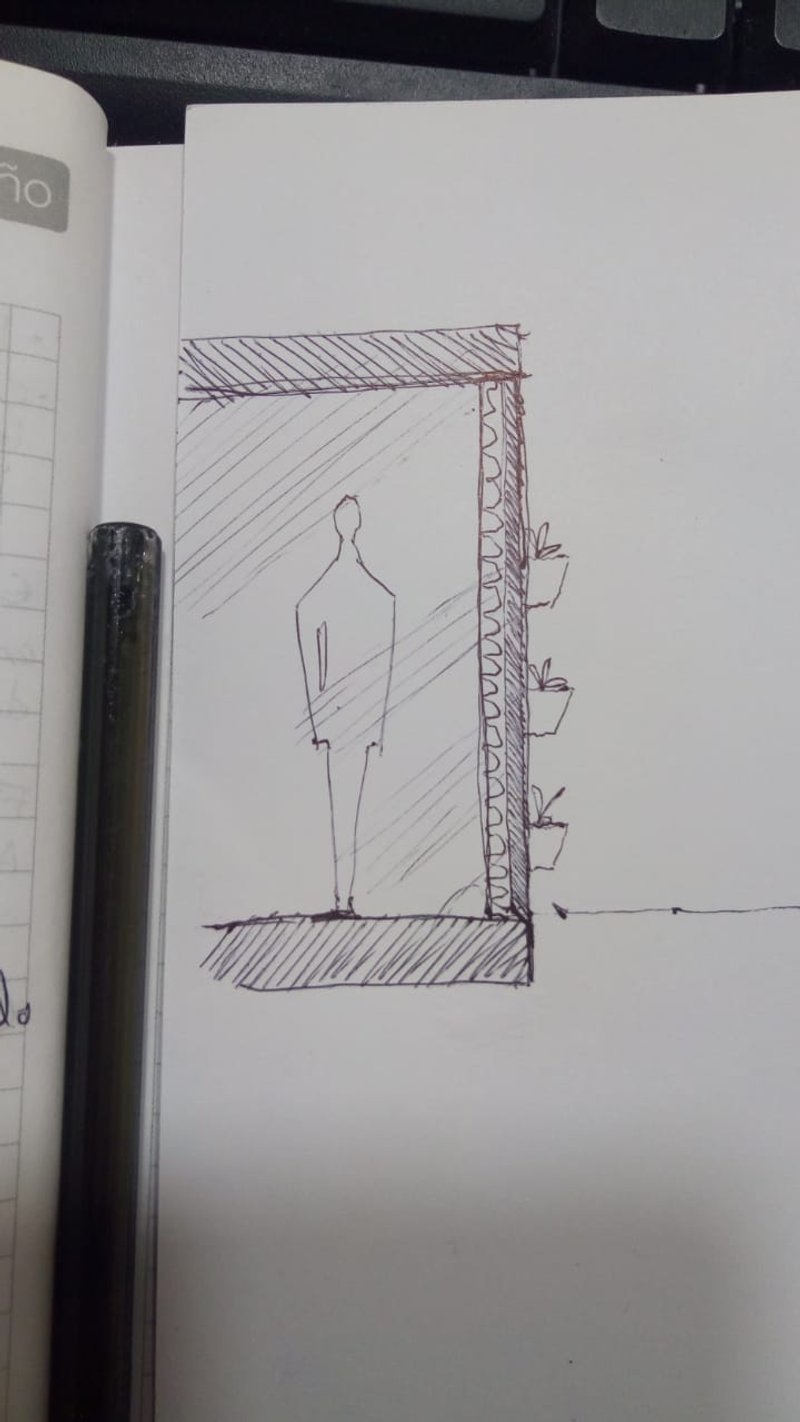 Sketch section of the kitchen garden
The complementary spaces, such as the kitchen and bathroom are adaptable spaces to fulfill different needs.
In the kitchen, the dining table unfolds from the wall, which makes it an open space to share with others in the vegetable garden or the projection room. The bathroom is also a dressing room and laundry, for instance there are furniture and a washing machine integrated in the design, these are destined so the cleaning ritual can be developed in the same place.
The premise for the program is the easy communication between spaces, the versatility of these and the conscious use of area. For the above, all the rooms in the design have stereotomic walls that can be used for storage and also contains hidden furniture.
Materials
The materials in the project were carefully selected in relation to the offer and ease of construction. Latin America is known for its use of wood in construction, for this reason the walls are made up of prefabricated pieces for easy assembly. Partitions and windows are made with tempered textiles and glass, with the purpose of maintaining the continuity of space and allowing an easy manipulation of it.
The goal is to create a cozy space with the materials but without too many colors, in other words, it’s a blank canvas that gives the user the opportunity to appropriate their own space and make it their home adapting the space to their own particular needs.



Popular Articles
Popular articles from the community

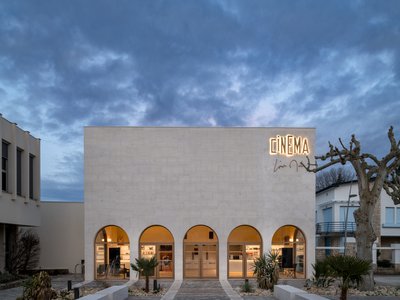
Louis Malle Cinema: A Limestone Cultural Landmark Revitalizing Community Life in Prayssac
Limestone cinema extension with public forecourt, blending heritage and modern design to create flexible cultural spaces and strengthen community interaction.
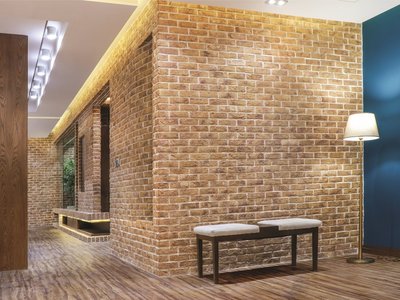
A Contemporary Take on Iranian Residential Architecture
A modern interior design in Mashhad that reinterprets brick, light, and spatial flow to create a warm, contemporary residential architecture.
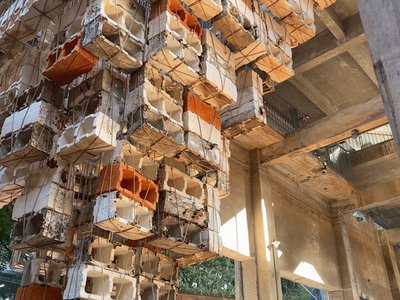
Inverted Architecture Installation by Studio Link-Arc: Exploring the Intersection of Architecture and Living Organisms
Inverted Architecture Installation by Studio Link-Arc blends mycelium, sustainability, inverted design, ecological cycles, and urban adaptive architecture in Shenzhen.
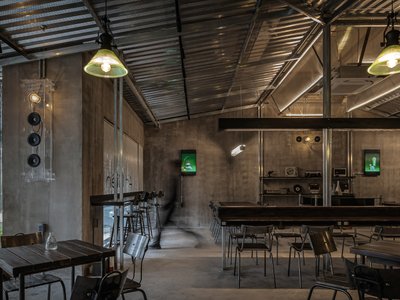
An Miên Lumière Cafe by xưởng xép, Ho Chi Minh City, Vietnam
An industrial-inspired café where layered steel and warm light create a dynamic, immersive environment shaped by reflection, depth, and perception.

Similar Reads
You might also enjoy these articles


The Ken Roberts Memorial Delineation Competition (Krob)
As the most senior architectural drawing competition currently in operation anywhere in the world, it draws hundreds of entries each year, awarding the very best submissions in a series of medium-based categories.
A Contemporary Take on Iranian Residential Architecture
A modern interior design in Mashhad that reinterprets brick, light, and spatial flow to create a warm, contemporary residential architecture.
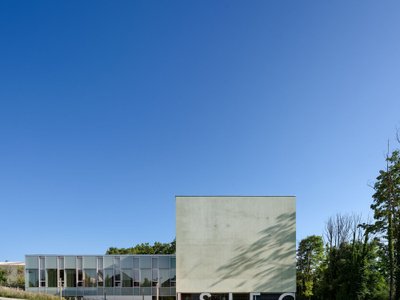
Franche-Comté Advanced School of Engineering by Dominique Coulon & associés, Besançon
A flexible engineering school immersed in woodland, combining concrete minimalism, adaptable spaces, and natural light to support evolving educational environments.


Waterfront Redevelopment and Urban Revitalization in Mumbai: Forging a New Dawn for Darukhana
A transformative waterfront redevelopment project reimagining Darukhana’s shipbreaking heritage into an inclusive urban future.

Explore Residential Building Competitions
Discover active competitions in this discipline




The Global Benchmark for Architecture Dissertation Awards

Challenge to design mud housing for contemporary communities


Design challenge to reuse E-waste
Comments (0)
Please login or sign up to add comments
No comments yet. Be the first to comment!