

Obermoser + Partner Architekten Wrap an Alpine Tourist Center in Pre-Greyed Larch Shingles
In Sölden, Austria, a monolithic timber volume blurs the line between traditional craft and modern workplace along a mountain river.


Tourist information offices in alpine towns often feel like afterthoughts, inserted into generic commercial buildings or squeezed into ground-floor retail slots. The Ötztal Tourist Center in Sölden takes the opposite approach. Designed by Obermoser + Partner Architekten, the 1,900 m² building is a standalone volume clad entirely in pre-greyed larch shingles, positioned at a deliberate distance from neighboring structures so it reads as a single, sculpted mass against the valley backdrop.
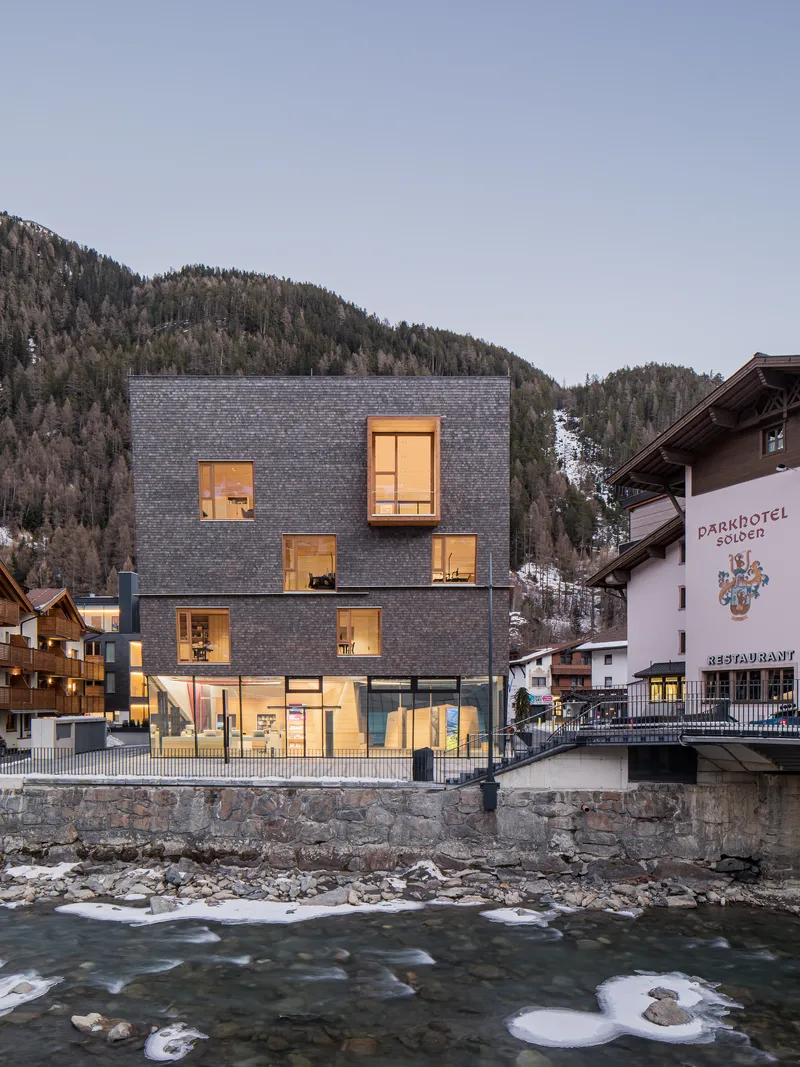
What makes the project genuinely interesting is how it reconciles two competing demands. It needs to be inviting to visitors, which typically leads architects toward transparent, glass-heavy facades. And it needs to belong in a dense alpine village where solid timber walls and steep rooflines set the visual grammar. The solution is a monolithic shell that lifts open at ground level, like a jaw hinging downward, exposing a glazed storefront that draws people in from the adjacent square and river without sacrificing the building's overall solidity. The windows punched into upper floors are deliberately arranged to prevent any reading of individual storeys, reinforcing the sense of a single carved block rather than a stacked structure.
A Monolith Among Chalets
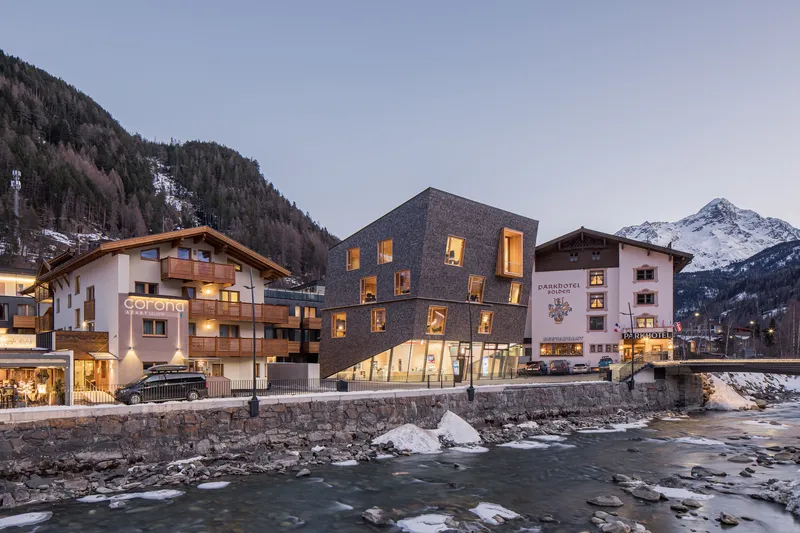
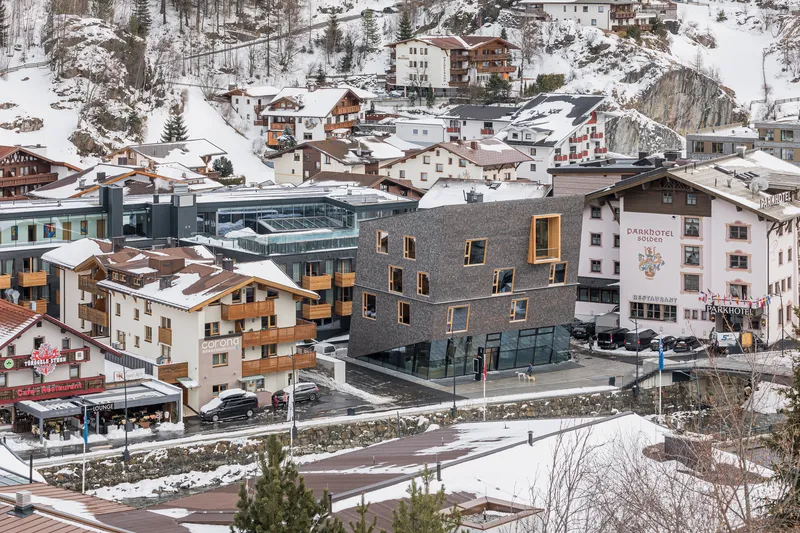
Sölden is a ski town, and ski towns tend toward visual noise: bright signage, clashing cladding materials, retrofit balconies. The tourist center opts for restraint. Its dark shingle skin absorbs light rather than competing for attention, and its cubic form sits comfortably between traditional gabled neighbors and the rushing stream that defines the site's western edge. The pre-greyed larch will continue to weather, pushing the building closer to the tones of aged barn wood found across the Ötztal valley.
Placing the building at a respectful distance from existing fabric was a conscious strategy. The resulting gaps create generous voids that allow light to reach adjacent buildings and maintain clear visual corridors to the landscape beyond. The forecourt and ground floor share a single paving material, an understated move that erases the threshold between exterior public space and interior.
The Lifted Shell
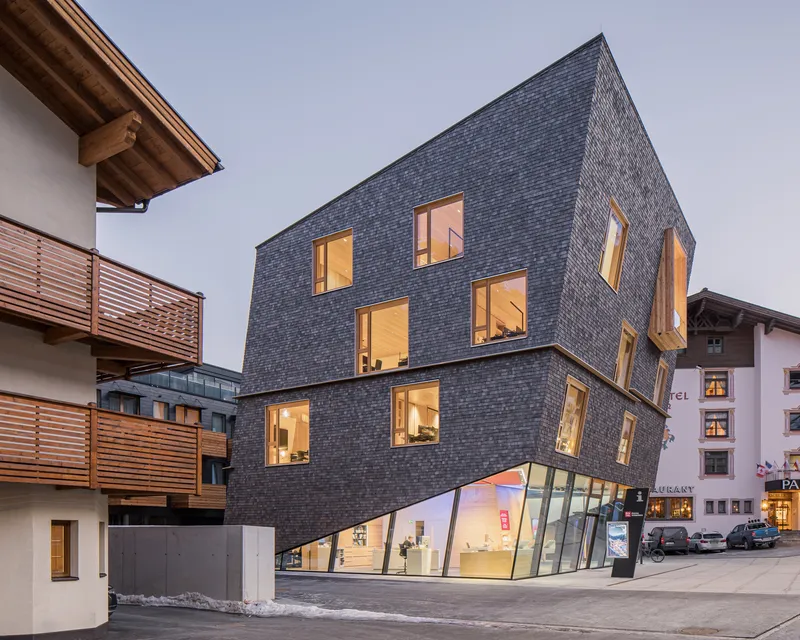
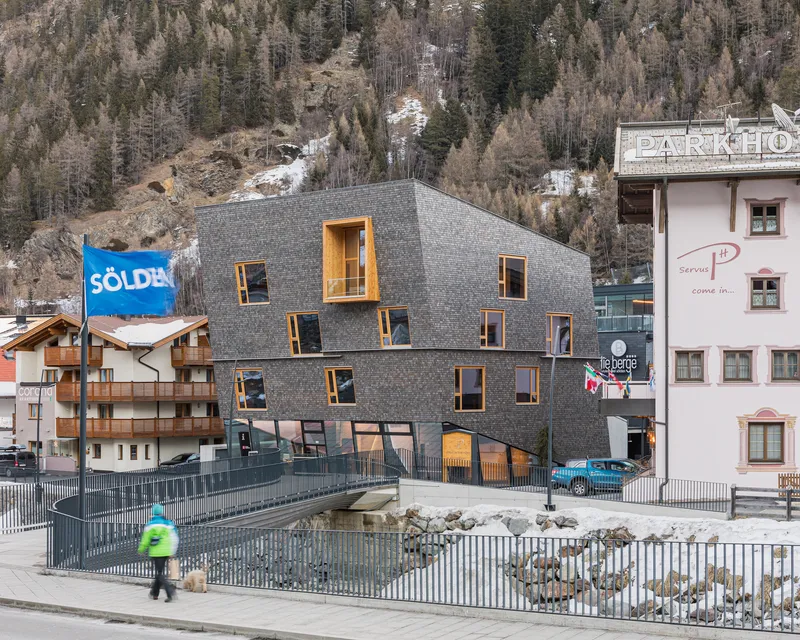
The most expressive gesture happens at street level on the west side. The shingle facade peels away from the glazed ground floor, angling outward to create a canopy-like overhang that signals entry without requiring a conventional portico. At dusk, the effect is striking: warm light spills from the interior while the dark mass above seems to float. It is an inviting gesture that resolves the transparency problem neatly. The upper floors remain opaque and protective, while the ground floor opens itself fully to visitors and the adjacent square.
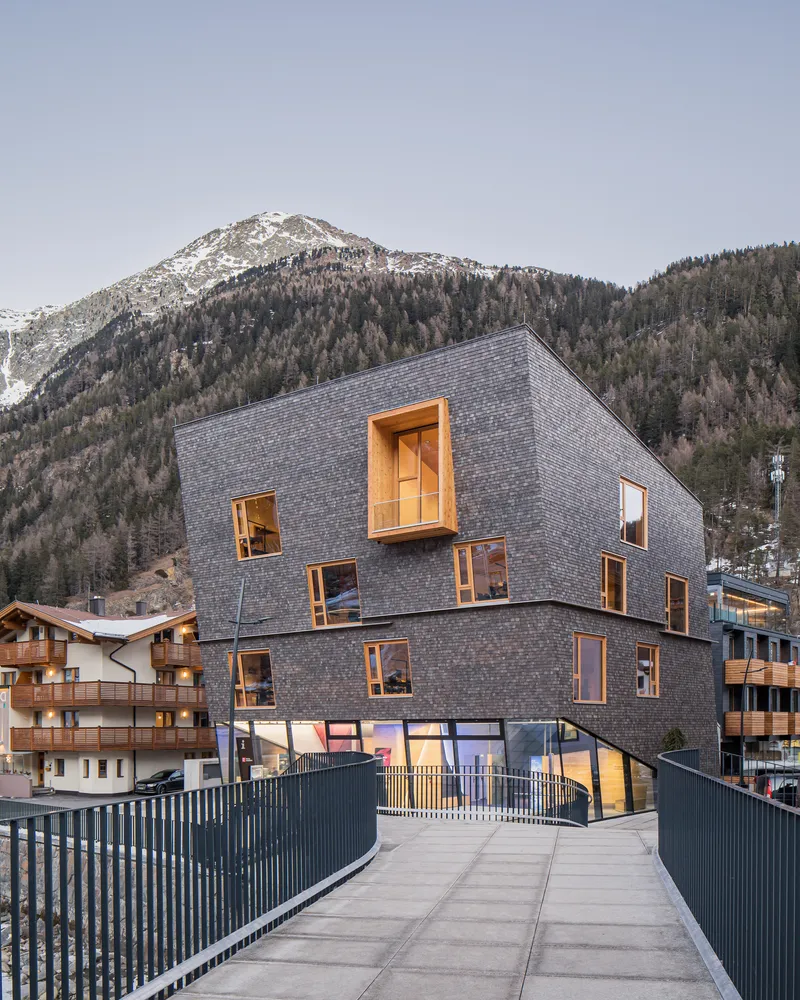
The scattered windows in the upper facade are another carefully calibrated detail. Their irregular placement resists the horizontal banding that would reveal floor plates, so the building reads as a solid volume with openings rather than a conventional office block. Each window is framed in timber and set flush with the shingle plane, maintaining the surface's monolithic quality even when the interior is illuminated.
Facade Detailing and Materiality
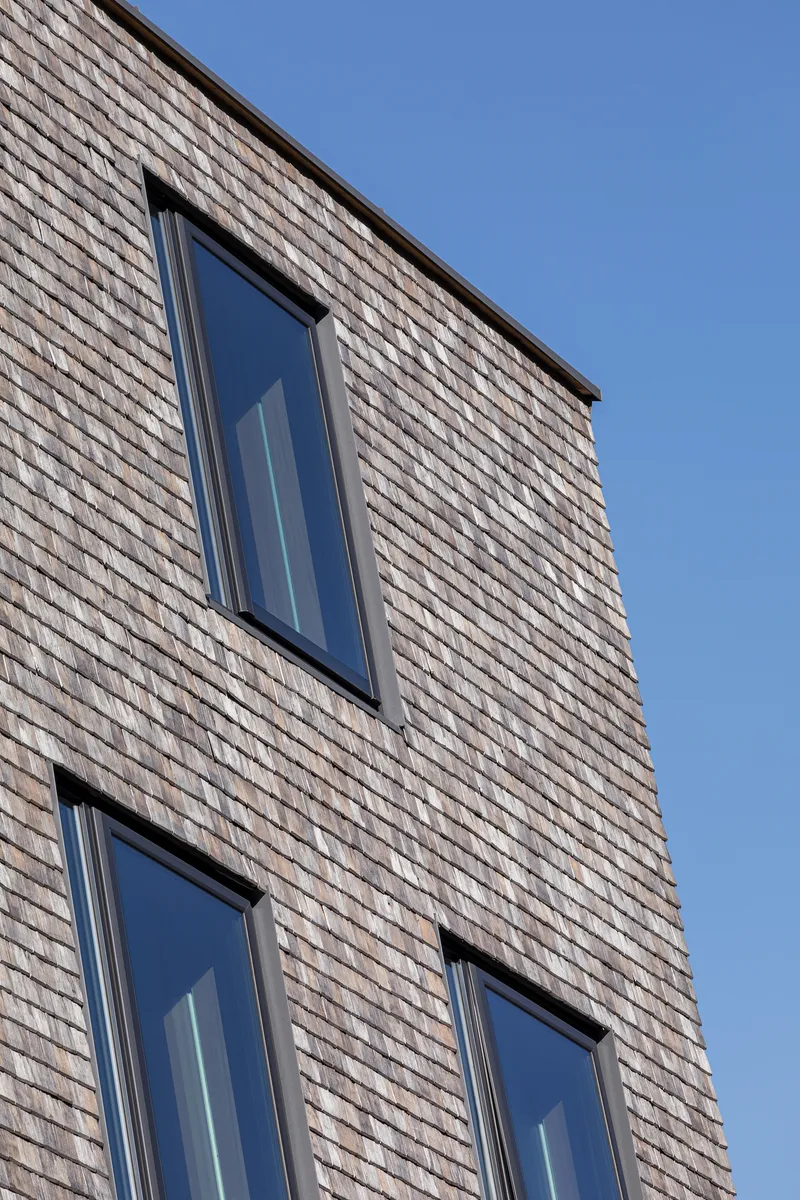
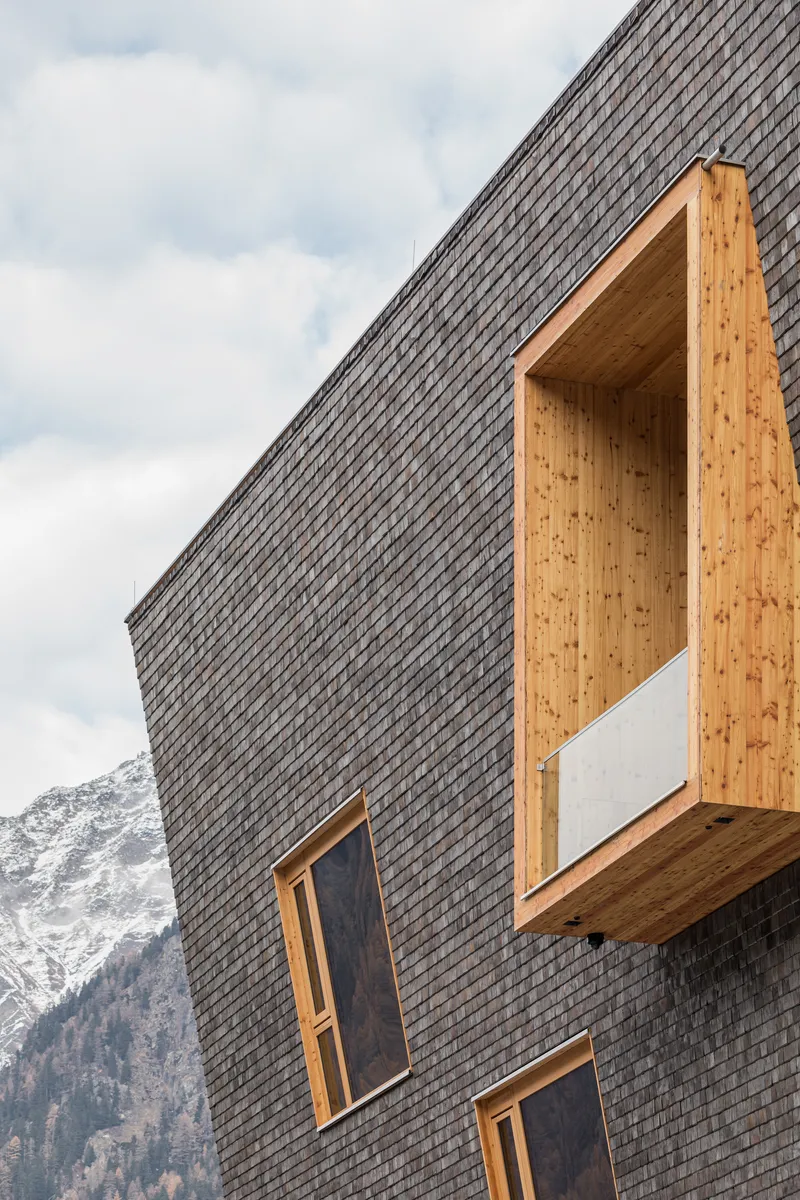
The shingle cladding is not decorative. It is a construction system rooted in centuries of alpine building tradition, applied here with a precision that gives the building its modern, honest character. The larch shingles were locally sourced and arrived on site quickly, a logistical advantage that also reduces the project's carbon footprint. The pre-greying process ensures the facade starts its life already looking settled rather than raw, sidestepping that awkward phase when new timber clashes with its weathered neighbors.
The cantilevered balcony projecting from the upper facade adds a layer of depth to what could otherwise be a flat surface. Its timber framing references the traditional Tyrolean balcony but strips away ornament, leaving only the structural logic. Against the mountain backdrop, it reads as both familiar and unfamiliar, which is precisely the tension the architects seem to be cultivating.
Timber Interiors and Flexible Workspaces
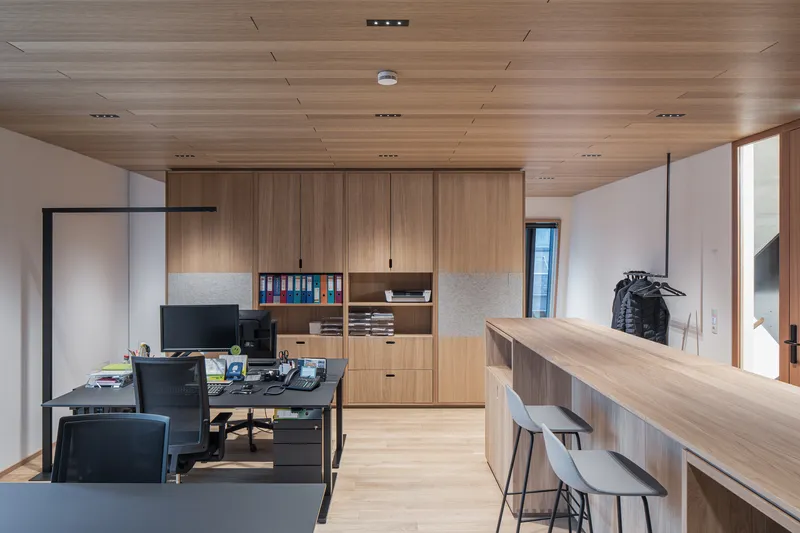
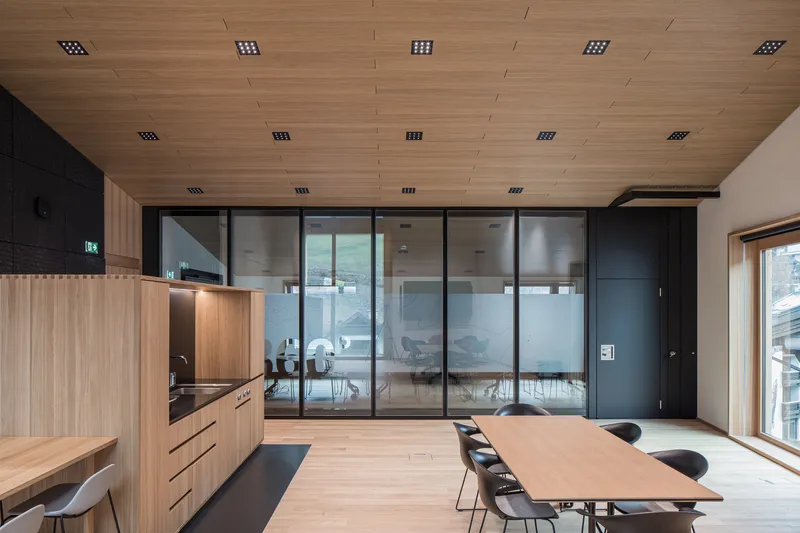
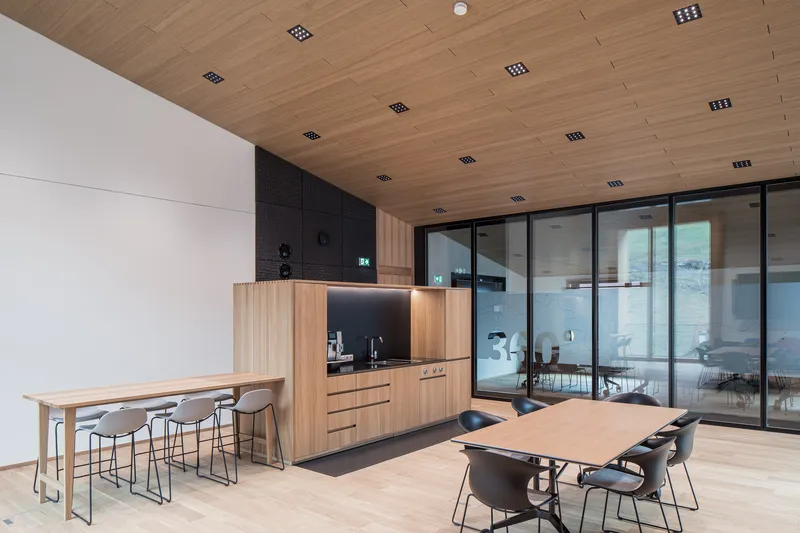
Inside, the material palette shifts from shingle to plank. Continuous timber ceiling panels run through open office areas, conference rooms, and break spaces, unifying disparate program elements under a warm, acoustically absorbent surface. The ceiling's recessed grid lighting provides even illumination without the clinical feel of exposed fluorescent fixtures, a small but meaningful detail in a building where staff work year-round.
The upper floors are organized around a central distribution core containing an open staircase and elevator. This frees the perimeter for workstations positioned near windows with valley views. Glass partitions and floor-to-ceiling cabinetry define working groups and thematic areas without building permanent walls, so the layout can be reconfigured as the tourism office's needs evolve. The constructive system was designed explicitly to allow this kind of free redistribution.
Meeting Rooms and Social Spaces
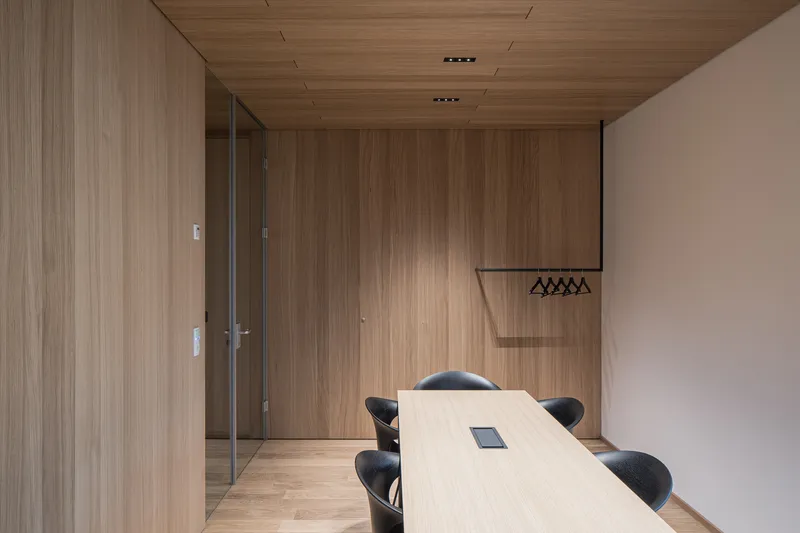
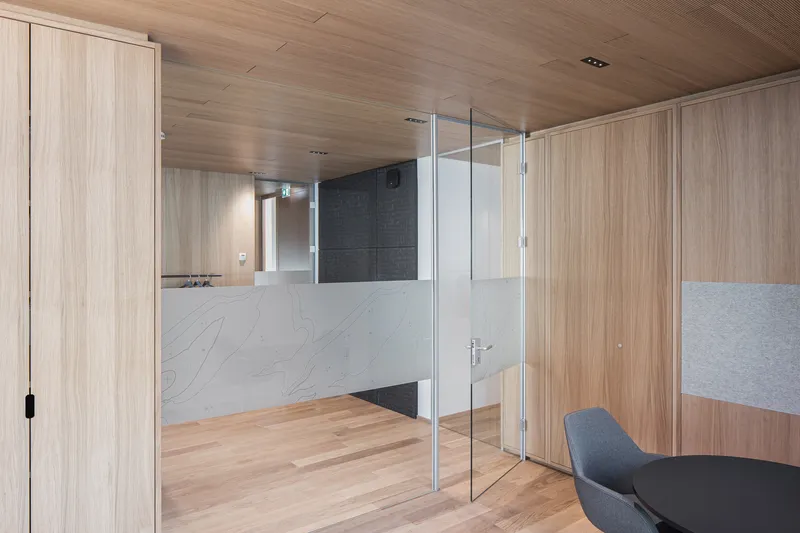
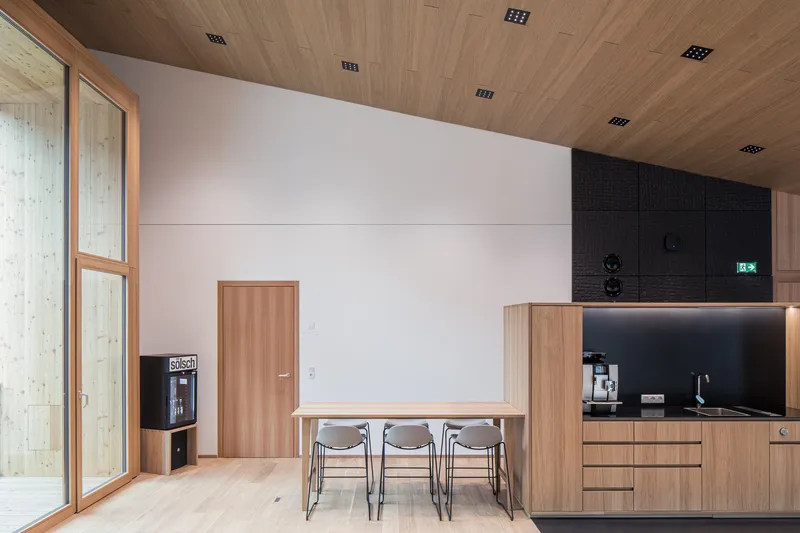
The conference rooms are lined in timber paneling from floor to ceiling, creating warm enclosures that feel more like mountain lodges than corporate meeting spaces. Glass doors and half-height marble partitions maintain visual connectivity to the surrounding office while providing acoustic separation. It is a careful balance: enclosed enough for focused discussion, transparent enough to prevent the rooms from becoming isolated silos.
A communal dining area with a kitchenette and coffee bar serves as the building's social heart. The slatted ceiling here matches the rhythm of the office ceilings but drops slightly, compressing the space and signaling a shift from work mode to break mode. These are the kinds of subtle sectional moves that distinguish a thoughtful workplace from a generic one.
Circulation and Light
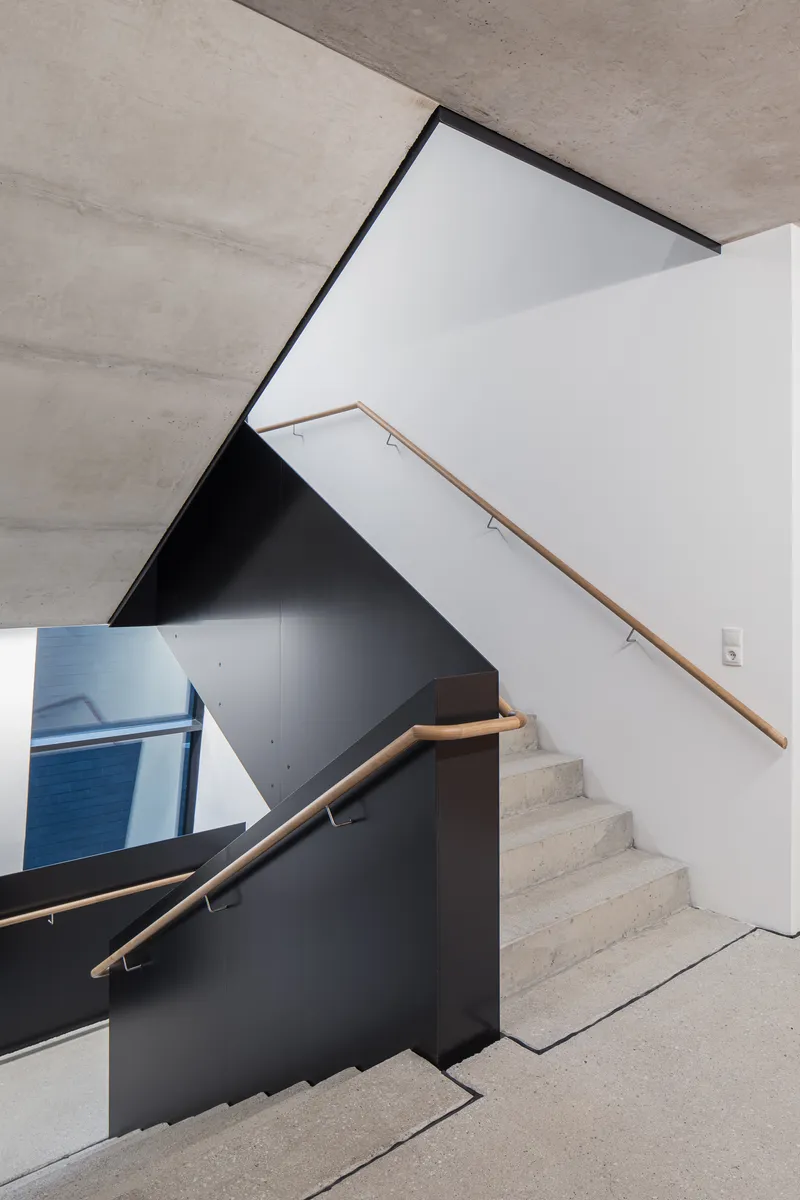
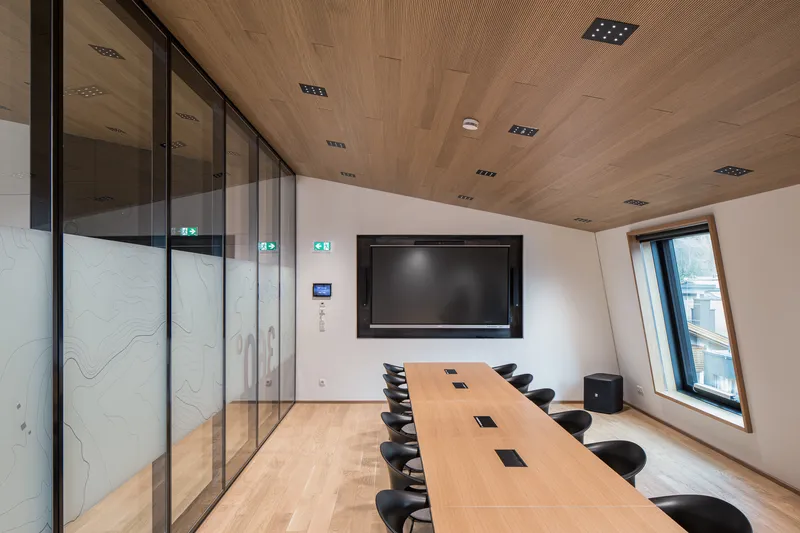
The central stairwell is the one moment where the architects allow concrete to speak. Raw concrete walls and landings contrast with warm timber handrails and black steel balustrades, creating a vertical sequence that feels deliberately different from the cocooned timber interiors it connects. An angled skylight at the top pulls daylight down through the core, so even the basement level receives some natural light. The stair doubles as the building's primary orientation device: wherever you are, the core is legible.
Below grade, waterproof reinforced concrete forms the basement, which maximizes parking capacity and connects to the underground garage of an adjacent hotel. By burying car access entirely, the architects keep the ground plane free for pedestrians, reinforcing the building's role as a civic amenity rather than a private office.
Plans and Drawings
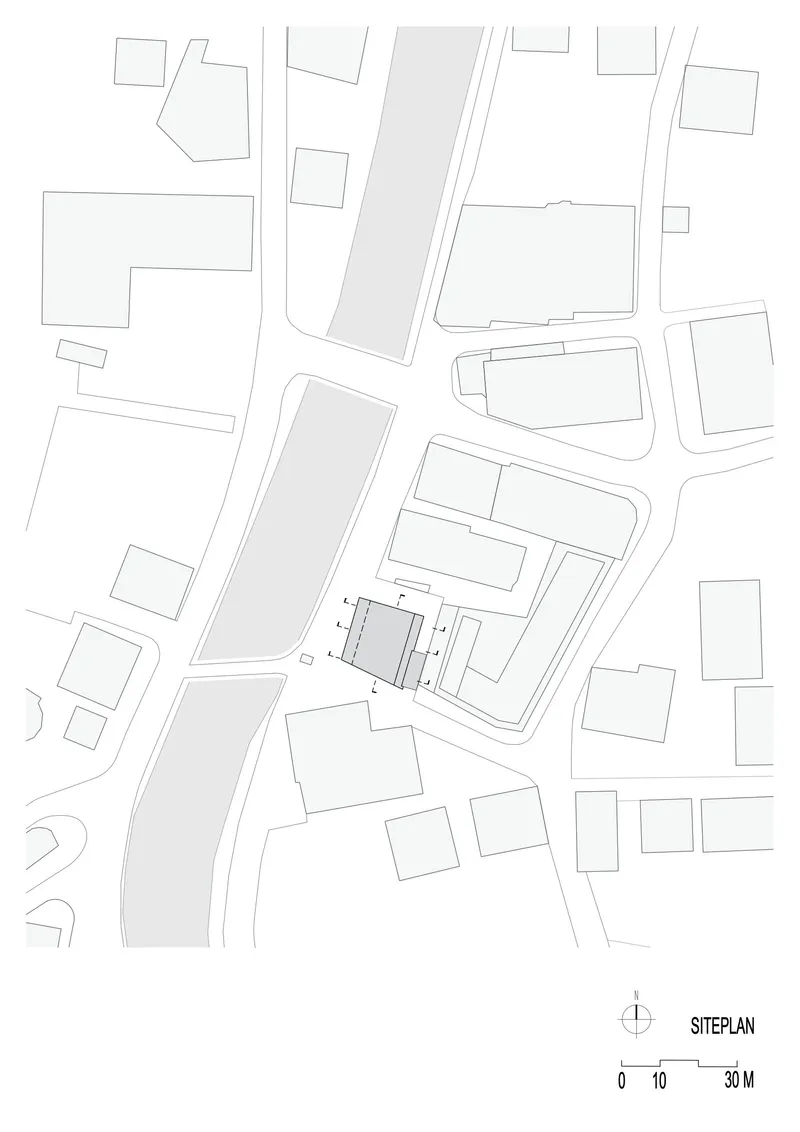
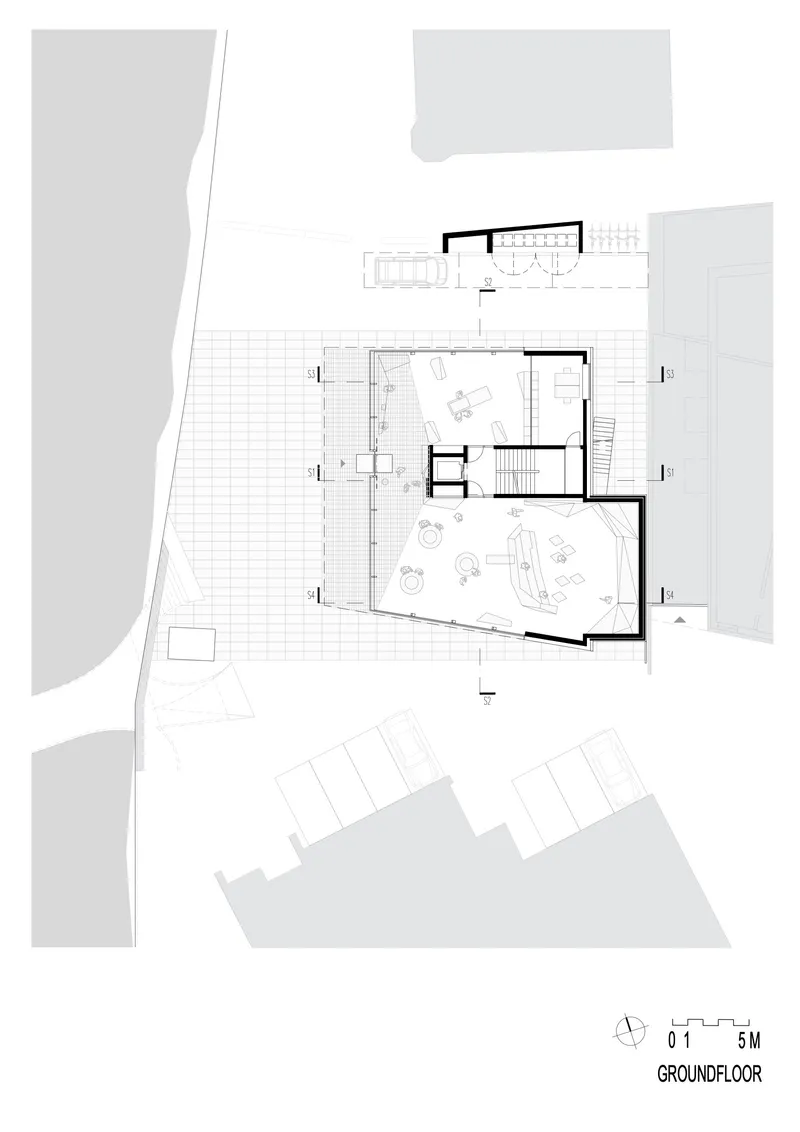
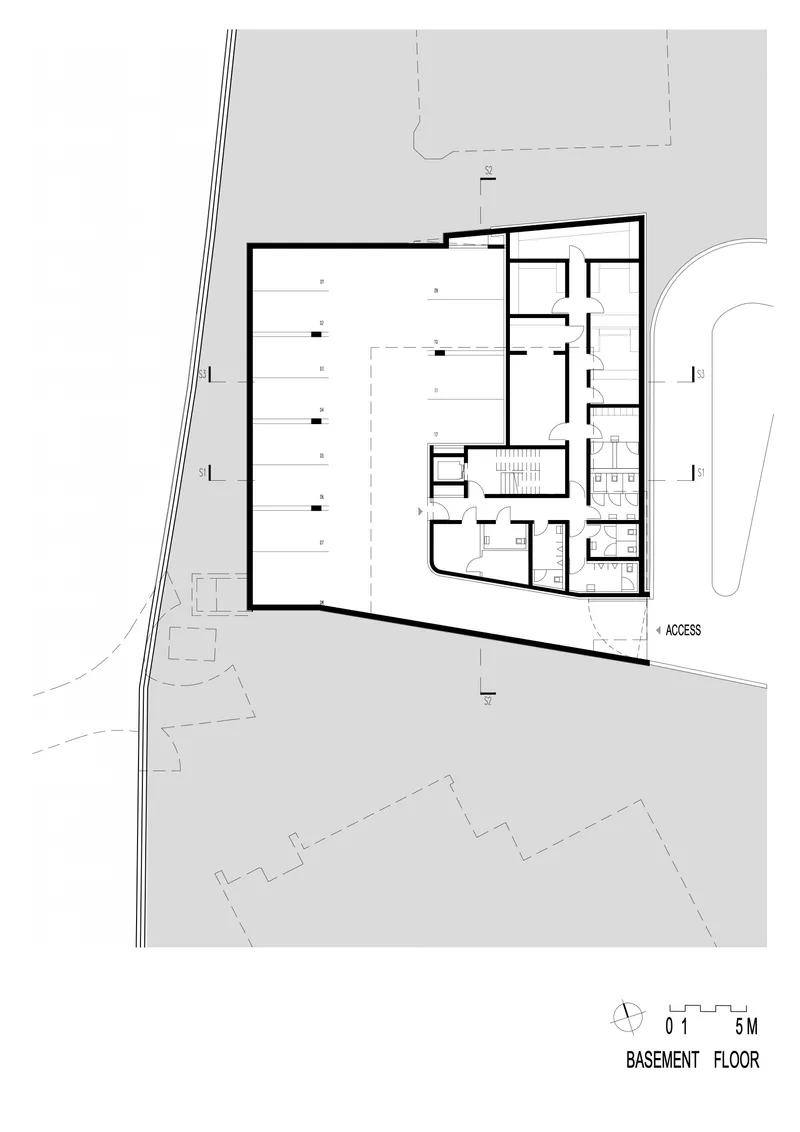
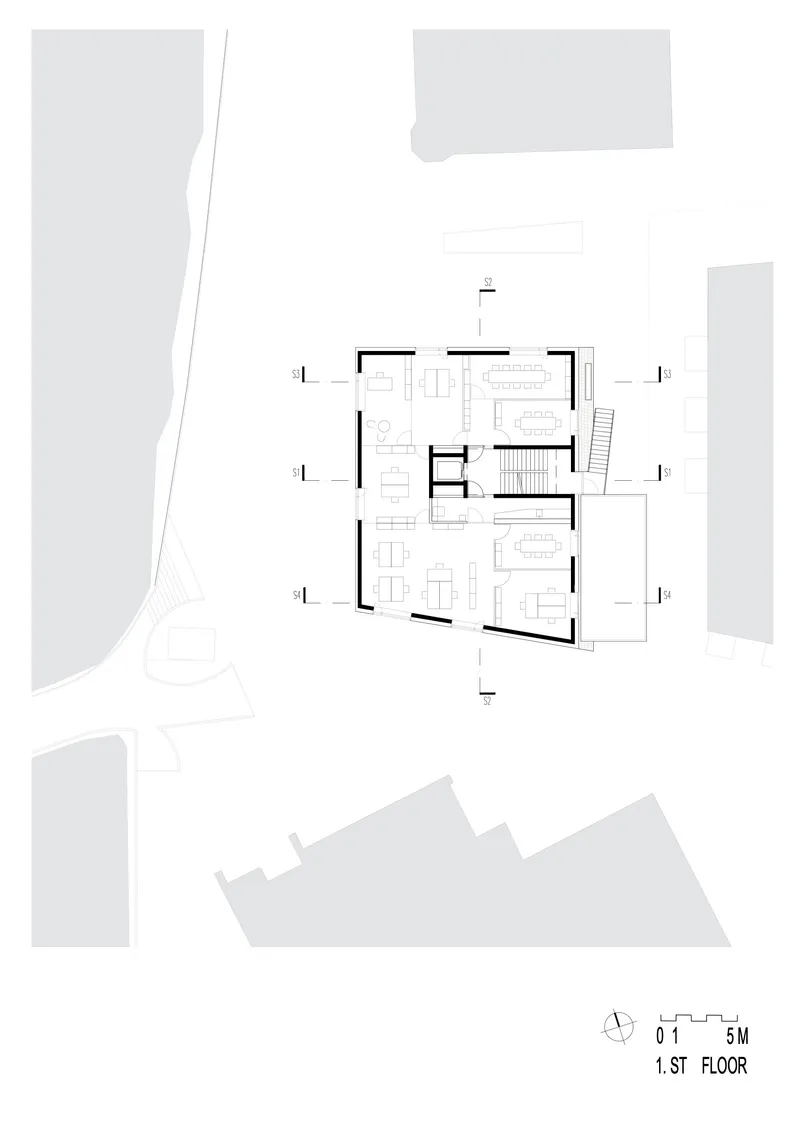
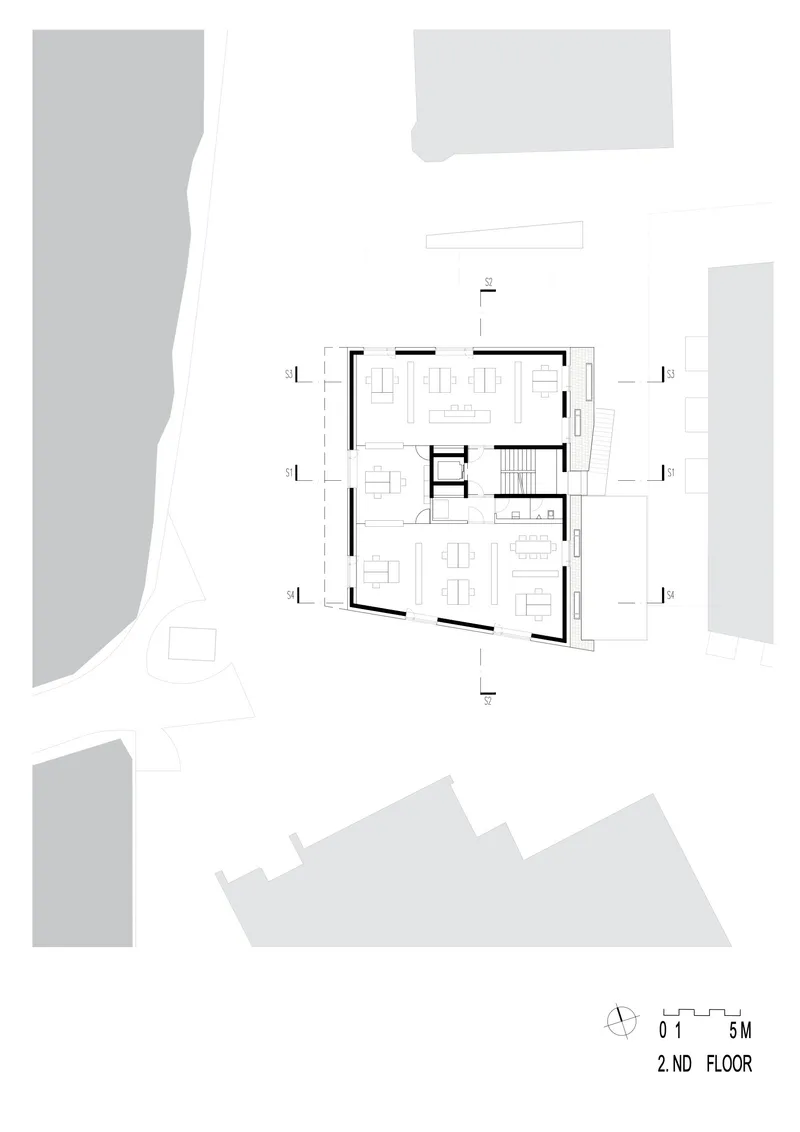
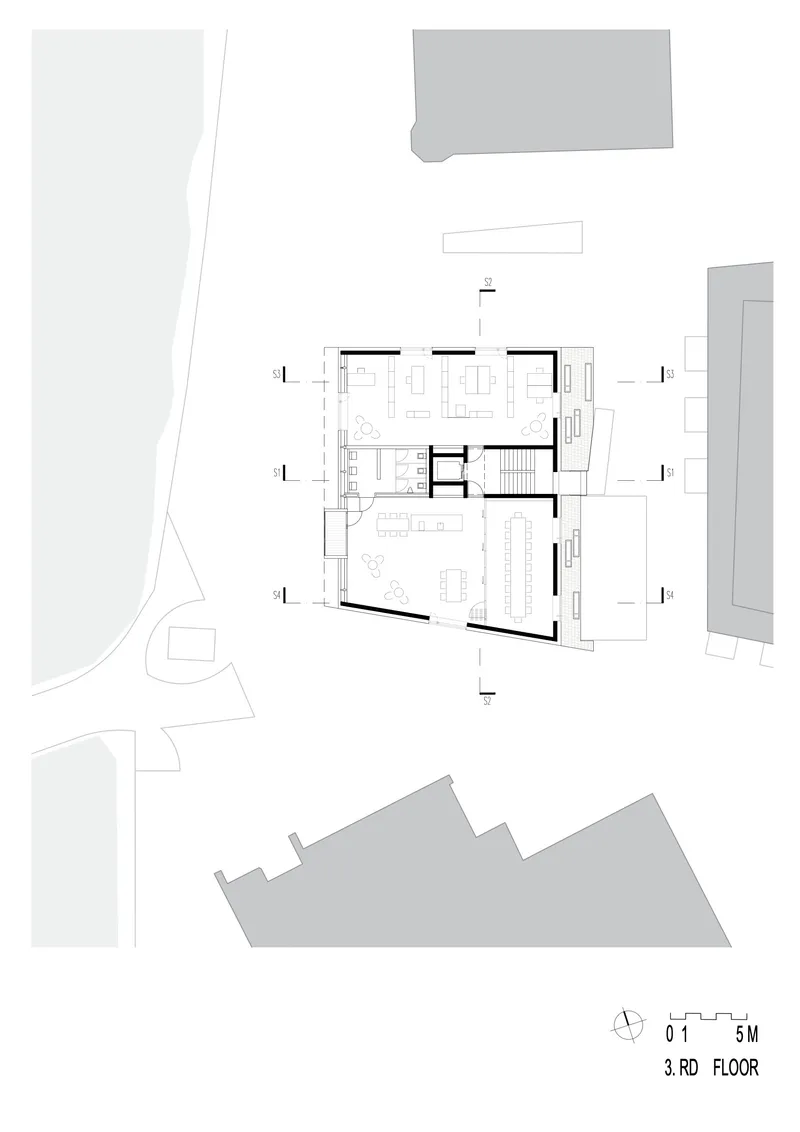
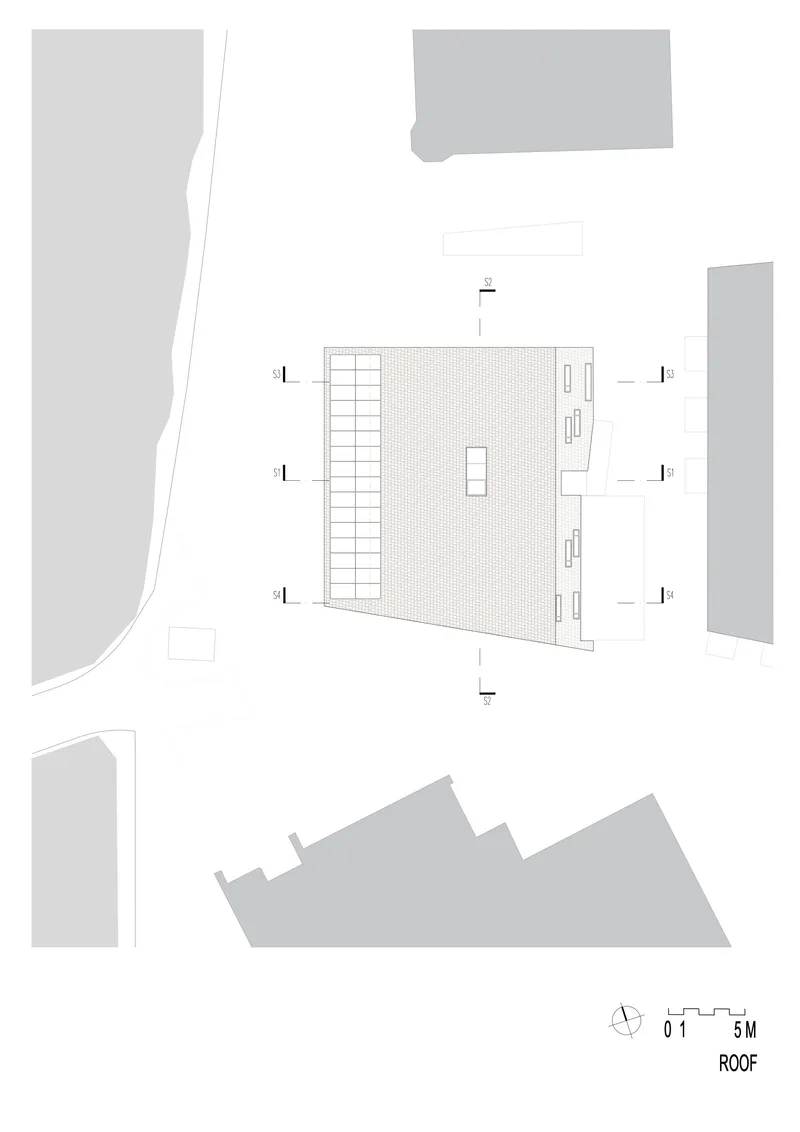
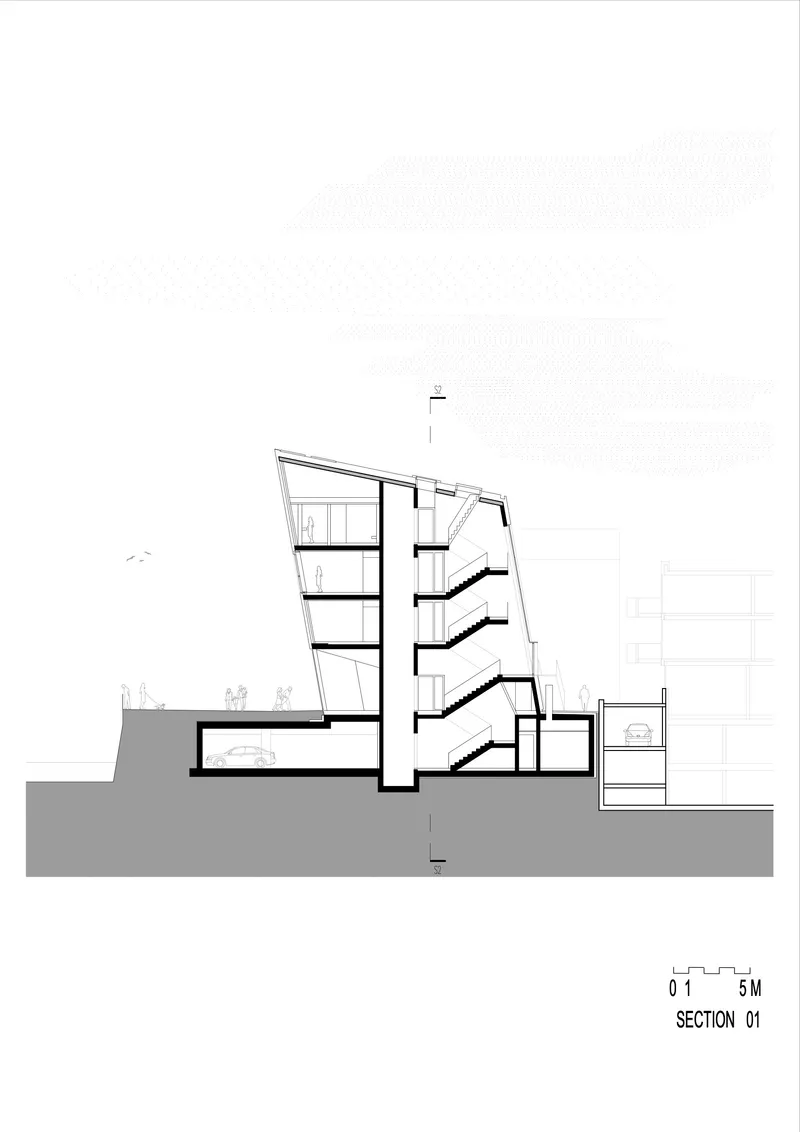
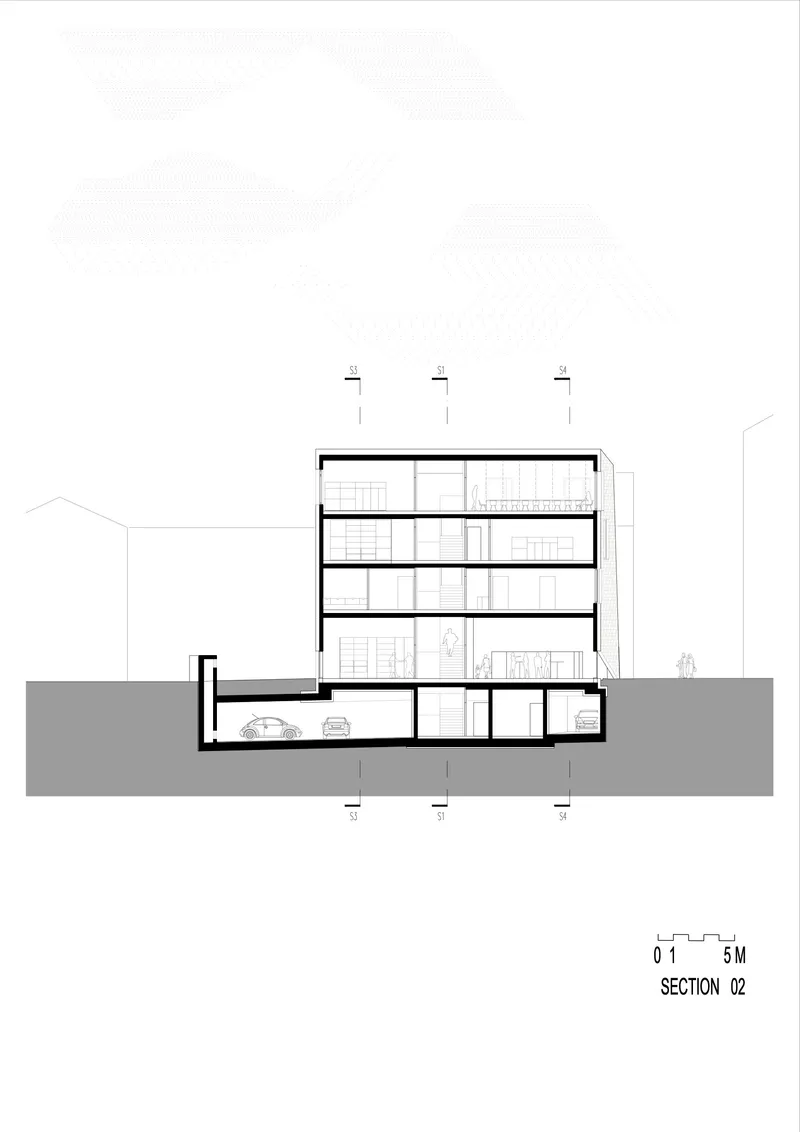
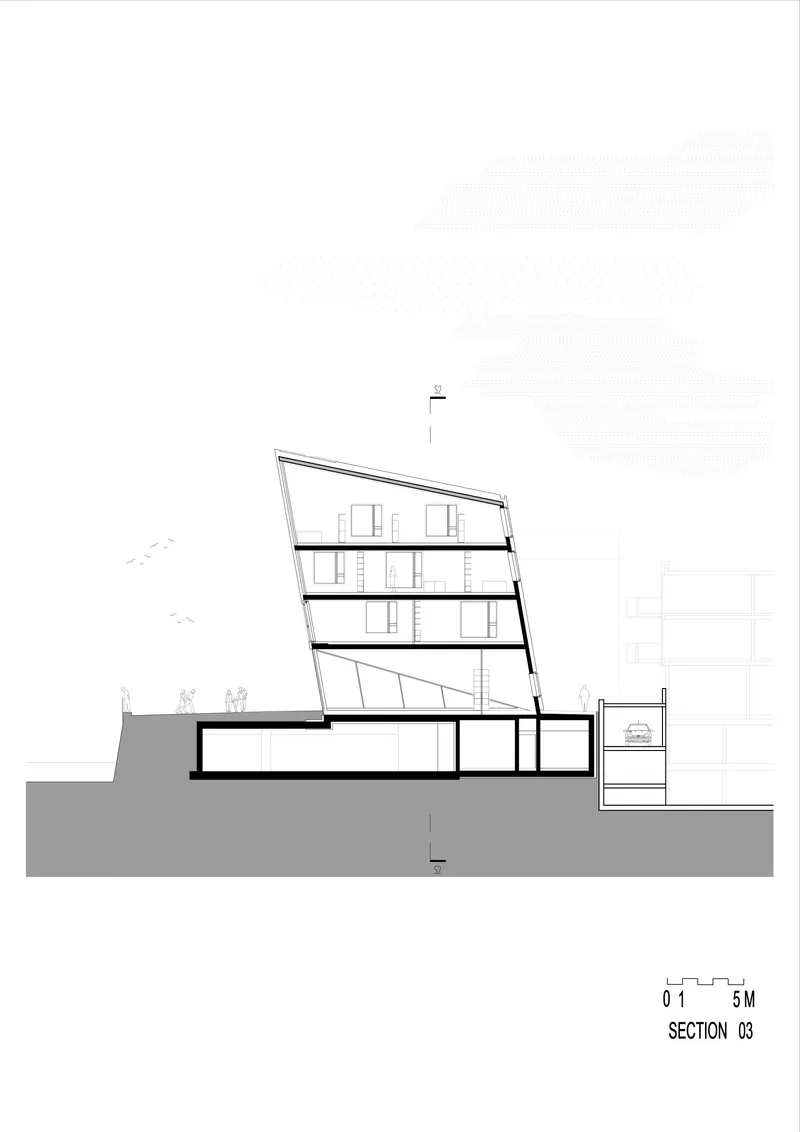
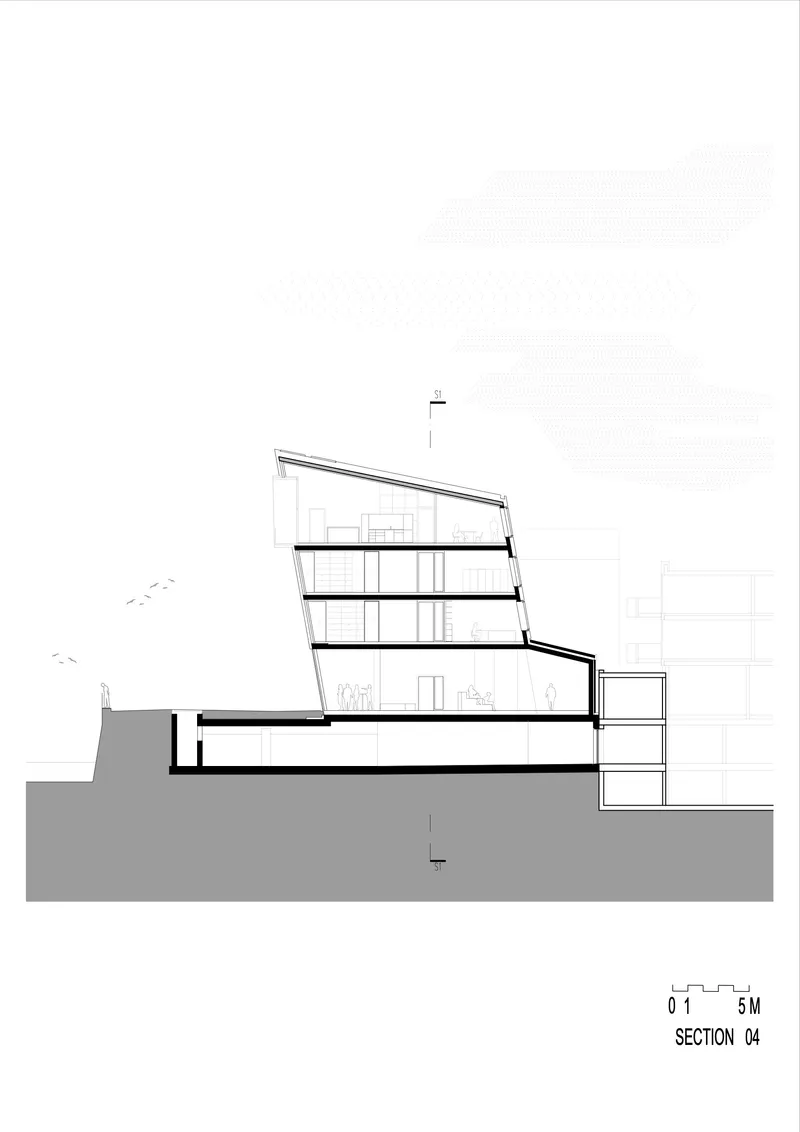
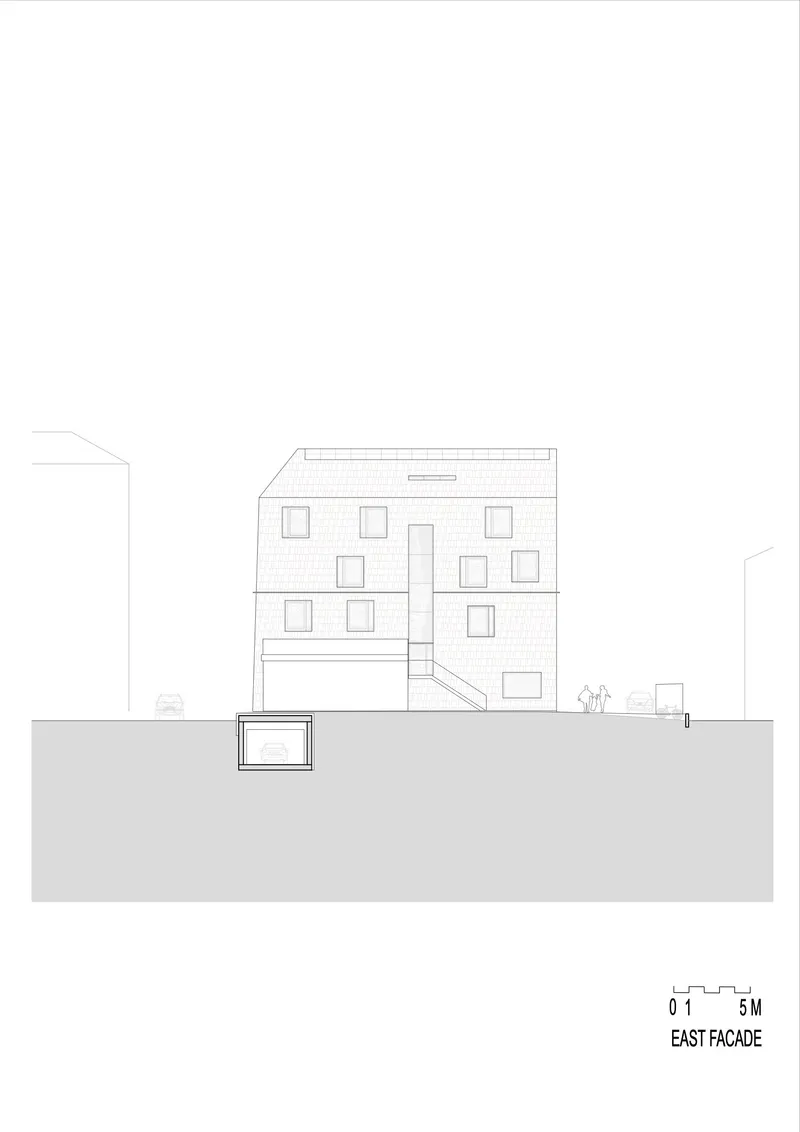
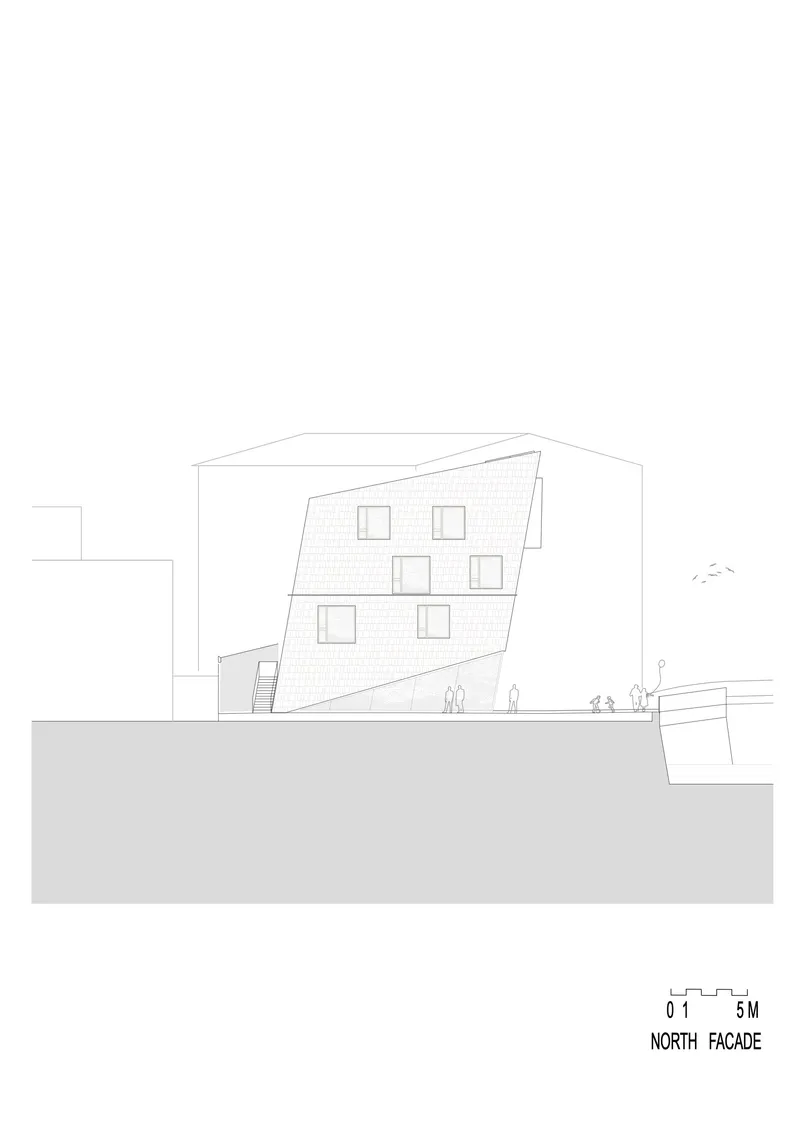
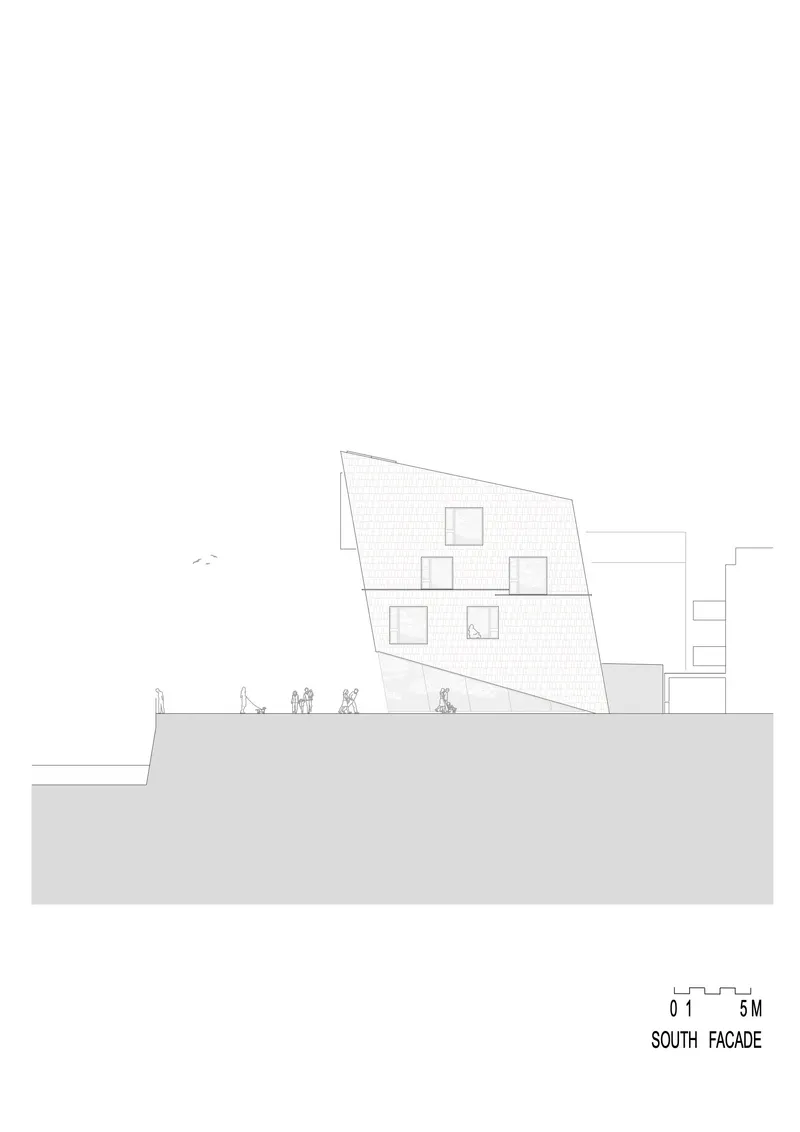
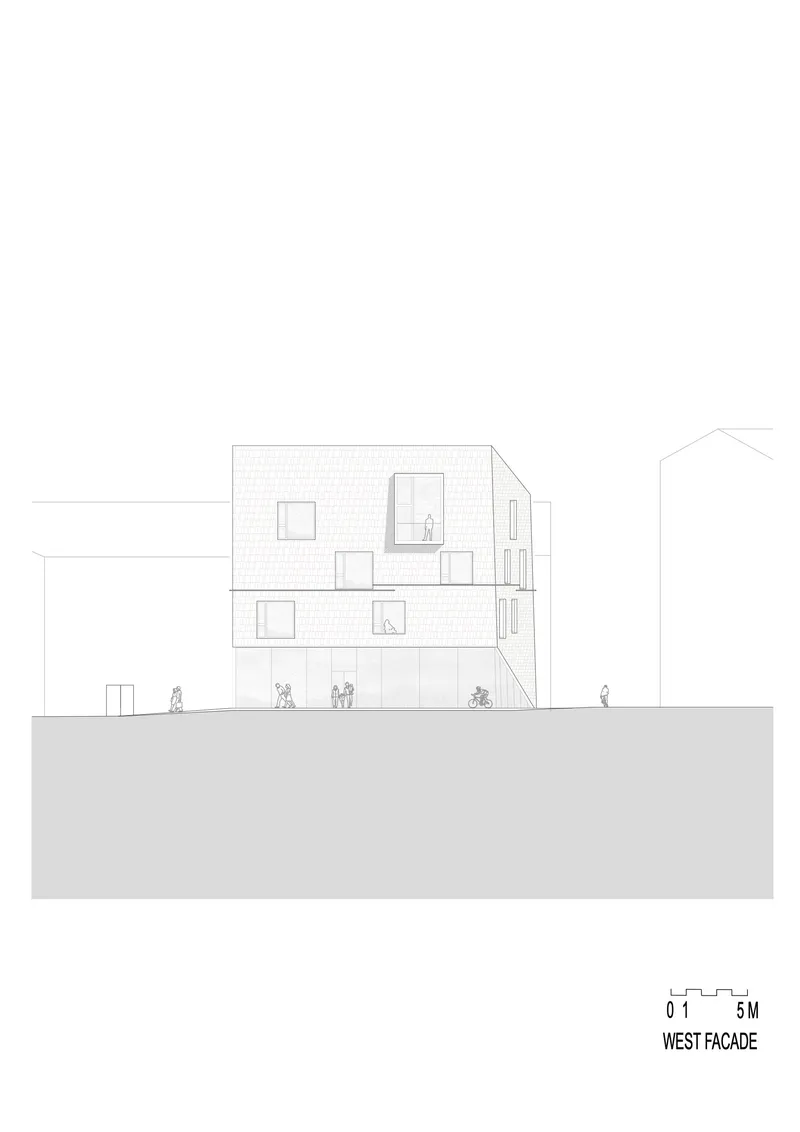
The site plan reveals the building's strategic positioning within Sölden's compact urban grain: set back from the street to create a public forecourt, oriented toward both the square and the river. Floor plans show how the central core anchors each level while allowing perimeter spaces to remain open and adaptable. The sections are particularly revealing, illustrating how the building negotiates the sloping site with staggered floor plates and how the angled western facade opens the ground floor to the public realm. Elevation drawings confirm what the photographs suggest: the scattered window pattern is calibrated to prevent any reading of individual floors, preserving the monolithic character from every approach.
Why This Project Matters
Alpine architecture sits at a crossroads. One path leads to pastiche, where new buildings mimic chalet forms with applied timber and decorative brackets. The other leads to imported modernism that ignores context entirely. The Ötztal Tourist Center walks a credible middle line. Its shingle cladding is materially authentic, its form is contemporary without being contrarian, and its ground-level transparency solves a real programmatic challenge without resorting to an all-glass box. The architects have produced a building that earns its place in the village fabric rather than demanding attention.
For a building type that rarely gets architectural ambition, this is a strong argument that civic infrastructure in tourist towns deserves better than functional anonymity. The flexible interior plan, the low-energy construction strategy, the buried parking, the deliberate blurring of indoor and outdoor at street level: these are all moves that could be replicated in similar contexts across the Alps. The project also demonstrates that two firms collaborating, obermoser and partner architekten, can produce something unified and coherent rather than a compromised hybrid. That alone is worth noting.
Ötztal Tourist Center, designed by obermoser and partner architekten. Sölden, Austria. 1,900 m². Completed 2021. Photography by Christian Flatscher.
About the Studio
Share Your Own Work on uni.xyz
If projects like this are the kind of work you want to make, uni.xyz is a place to publish your own, find collaborators, and enter design competitions.


Popular Articles
Popular articles from the community


The Amber Palace Opera: A Geological Fiction Surfaces on Tallinn's Baltic Waterfront
Pierre Brillard reimagines a Baltic legend as a public landscape, opera house, and waterfront promenade rooted in Tallinn's coastal identity.

Singing Woman: An Opera House That Performs Before the Curtain Rises
Ovidiu Cristian Pavel's conceptual opera house translates Estonia's choral identity into a sculpted waterfront landmark facing the Baltic Sea.

Faces of the Soviet Avant-Garde: Turning Moscow's Street Names into an Open-Air Museum
A network of sculptural installations across a Moscow residential district transforms forgotten architect names into spatial encounters with cultural memor

Cloaked Colonization: A Mobile Underwater Habitat That Moves Like a Fish
Micah Abaya's shortlisted EHC Pacific entry reimagines ocean settlement as a dispersed network of self-sustaining architectural organisms.

Similar Reads
You might also enjoy these articles

Pixel Gardens: One Repeated Module Stacked Into a Terraced Social Housing Tower for Famagusta
Salem Bader's shortlisted housing tower builds a vertical neighbourhood from one repeated module, offsetting units to carve terraces, light and air.

Bao Huynh Watercolor Atelier: A Serene Art Retreat in Hội An
Bao Huynh Watercolor Atelier in Hội An blends multifunctional art spaces, sustainable design, local materials, and family-friendly living in a serene environment.

Atelier Macri Concept Store Interior Design by CASE-REAL
Atelier Macri store features a "ko" counter, walnut wood details, cork displays, blending retail, gallery, and seamless customer experiences.

Manuel Vargas Izquierdo Stadium and High-Performance Sports Center: Architectural Excellence in Jalpa de Méndez
The Manuel Vargas Izquierdo Stadium blends sustainable design, inclusive sports facilities, and cultural-inspired architecture, revitalizing Jalpa de Méndez’s public spaces.
Explore Tourist Complex Competitions
Discover active competitions in this discipline

Challenge to reimagine the Iron Throne

Photograph architecture without architects

Illustrate the lost glory of Angkor Wat - Render Challenge

Design challenge to reuse E-waste
Comments (0)
Please login or sign up to add comments
No comments yet. Be the first to comment!