
OBO Estudi Wraps a Catalan Home Around a Courtyard with a Climate-Regulating Hackberry Tree
Near Montseny Natural Park, a single-story brick house turns inward to create its own microclimate and sense of place.


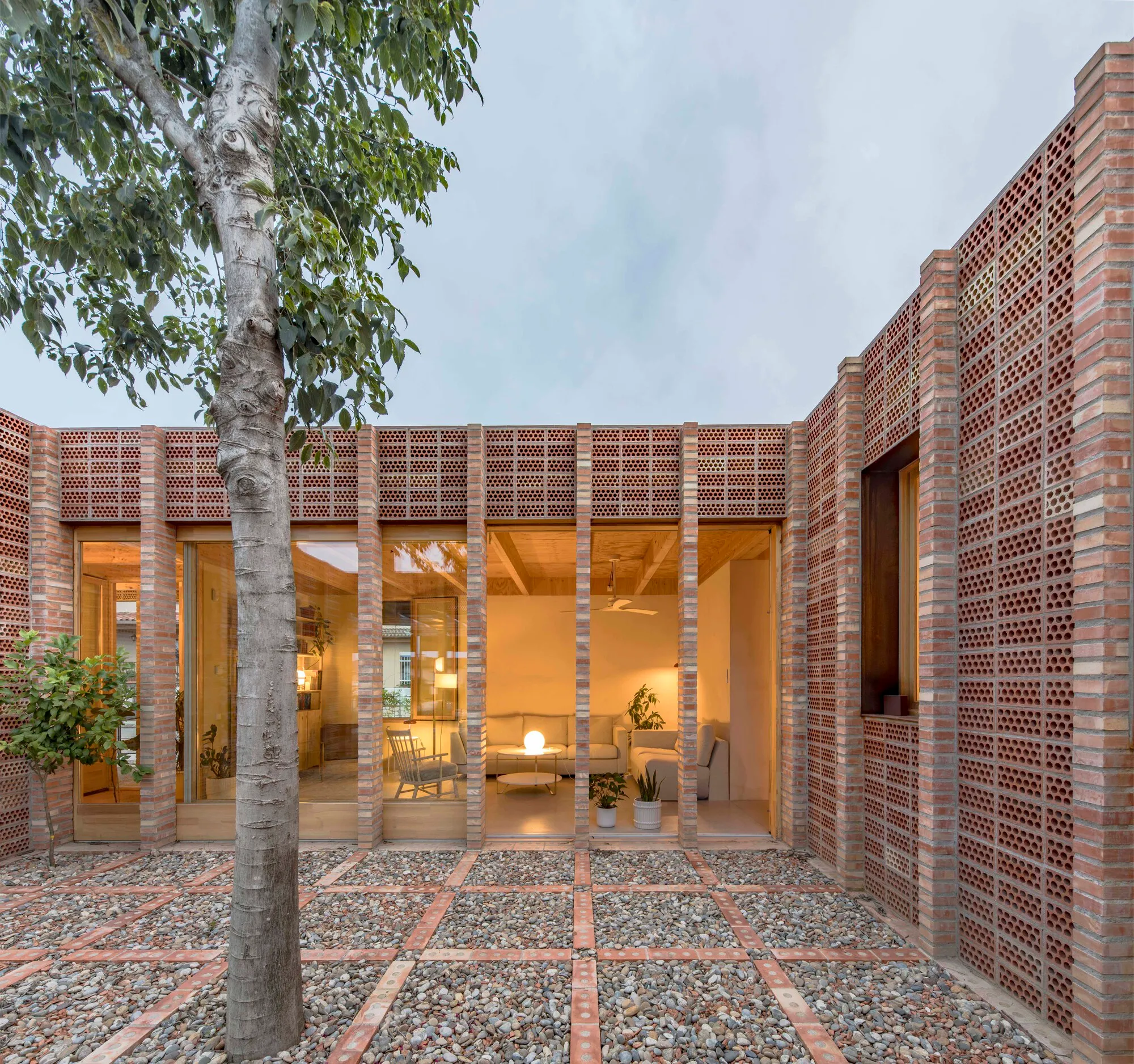
When your plot sits tight against the neighbors and long views are out of the question, the architect's job becomes less about framing what's beyond the site and more about creating a world within it. That is exactly what OBO Estudi, led by Oriol Troyano, Bernat Sancho, and Òscar Farrés, has done with La Montse and Manel's House in Sant Esteve de Palautordera, a town perched at the edge of Montseny Natural Park in Catalonia. Rather than fight the constraints of a dense urban fabric, the practice embraced them, composing four single-story naves around a central courtyard that functions as the heart, lungs, and calendar of the home.
The courtyard is no decorative afterthought. It is a contemporary reinterpretation of the Roman impluvium: a void that organizes circulation, modulates daylight, and, most critically, regulates climate. A strategically placed hackberry tree sits at its center, bare in winter to let low sun flood the rooms and leafy in summer to cast shade across the gravel floor. The house reads as an introspective refuge where Catalan constructive tradition and contemporary spatial thinking converge in a single, carefully calibrated diagram.
A Brick Mask to the Street


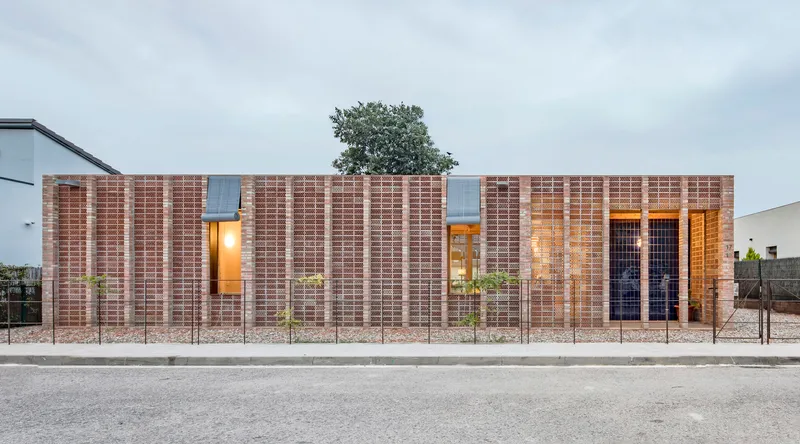
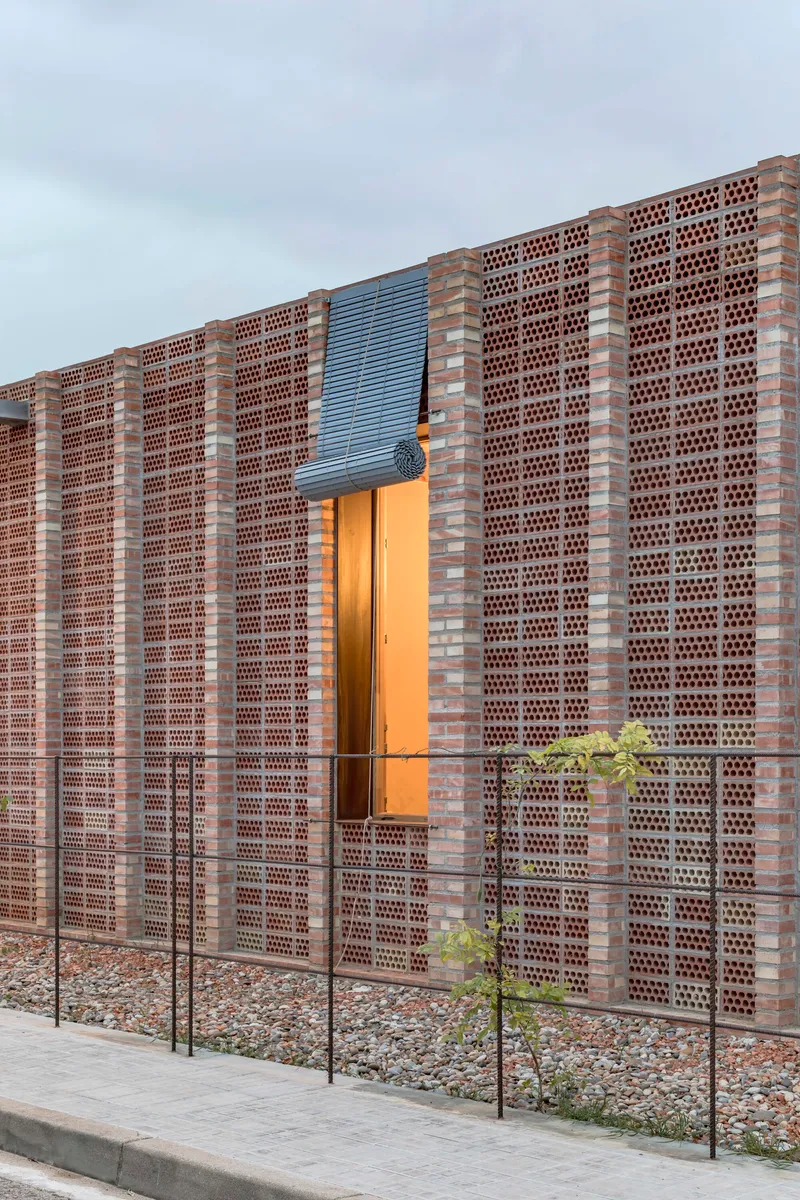
The street elevations are composed of perforated brick screens and solid piers that work together to filter the relationship between public and private life. Vertical banding gives the facade a rhythmic quality without resorting to ornament, while the perforation pattern allows glimpses inward but never full transparency. At dusk, light seeps through the openwork like a lantern, registering domestic life as a warm glow rather than an exposed interior.
A hackberry tree breaches the roofline, visible from the street as if the building were incapable of containing the landscape it has internalized. That single gesture signals the project's priorities: the architecture defers to the courtyard and the tree, not the other way around.
The Impluvium as Climate Engine
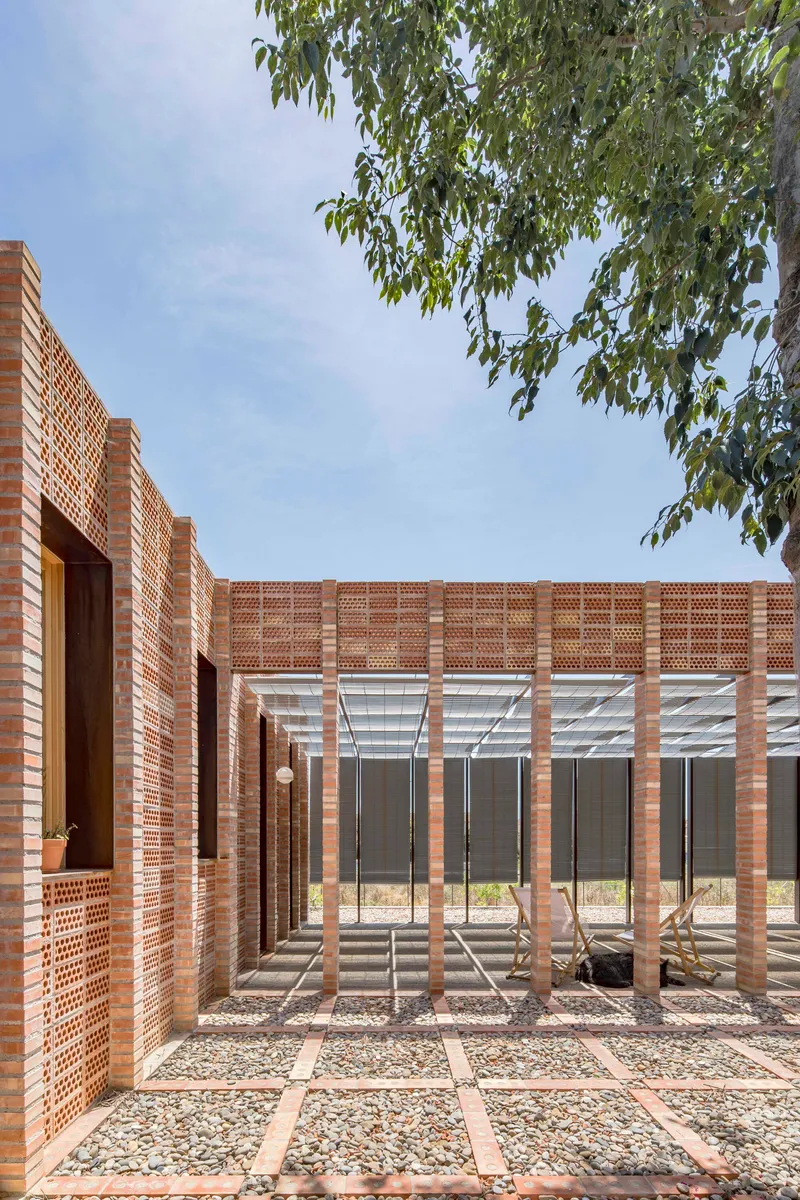
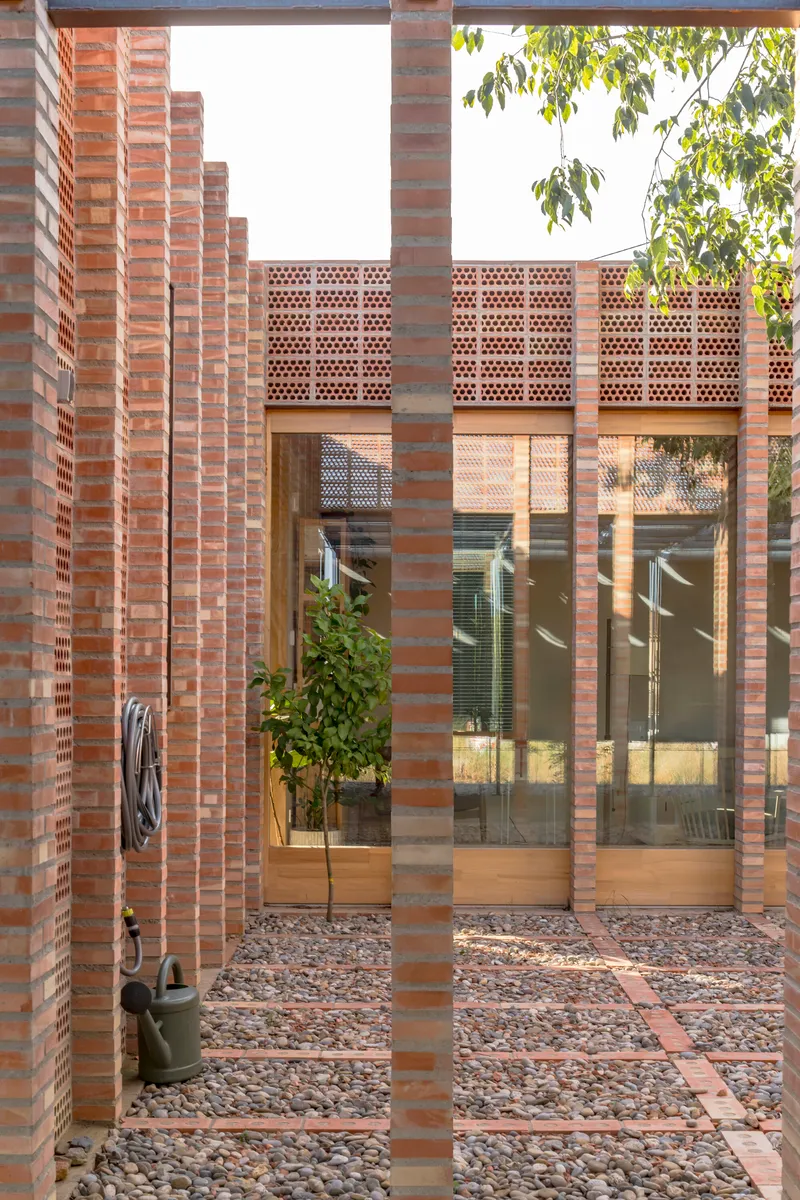

The central courtyard is the single move that makes everything else work. It connects the four naves, introduces cross-ventilation, and provides every major room with a view that is simultaneously enclosed and open to the sky. Gravel covers the ground plane, absorbing and releasing heat at a slower rate than paving would, while the hackberry's deciduous canopy acts as a biological thermostat. In winter, bare branches admit solar gain; in summer, dense foliage shades the gravel and the surrounding rooms.
The courtyard's rectangular geometry is softened at the edges by curved brick walls visible through timber-framed glazing, a detail that prevents the enclosure from feeling rigid. Brick piers double as pergola columns, extending the roof plane just enough to create transitional zones that are neither fully inside nor fully out.
Thresholds and Filtered Light
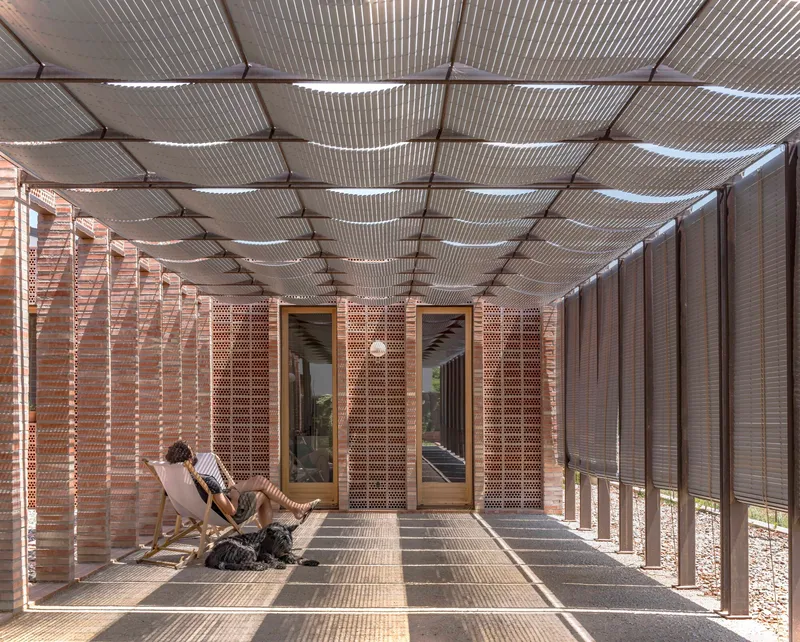


OBO Estudi treats the boundary between interior and exterior as a deep, inhabitable zone rather than a single line. Covered porches with corrugated metal ceilings and steel louvered canopies sit between the living spaces and the courtyard, creating shaded buffer areas that can be used year-round. Roller blinds with horizontal slats, drawn from local vernacular tradition, run along the perimeter and can be adjusted season by season to fine-tune light and airflow.
The effect is cumulative: sunlight passes through the perforated brick, through the louvers, through the glazing, and into the rooms. Each layer subtracts intensity and adds texture, so the interiors are never harsh. The ventilated facade assembly and plastered ceramic walls further temper humidity during the warmer months, an approach that is low-tech but precisely calibrated.
Entering on the Diagonal
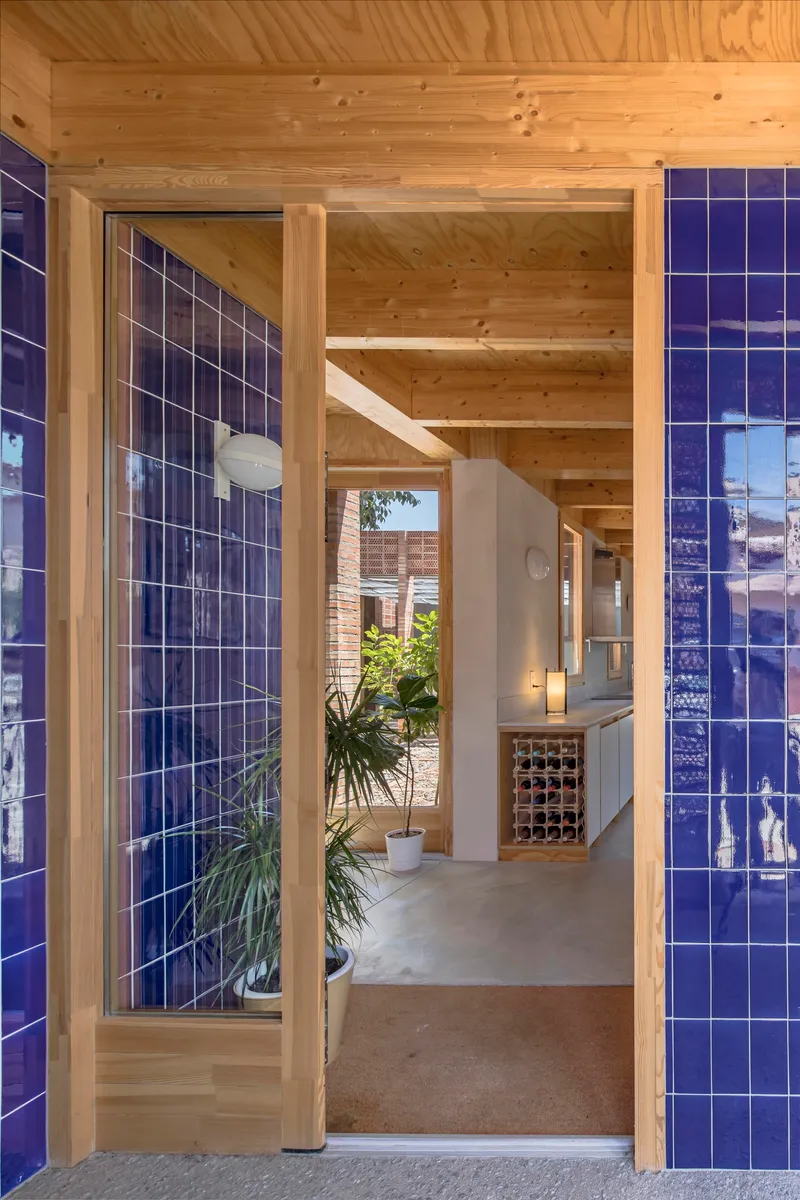
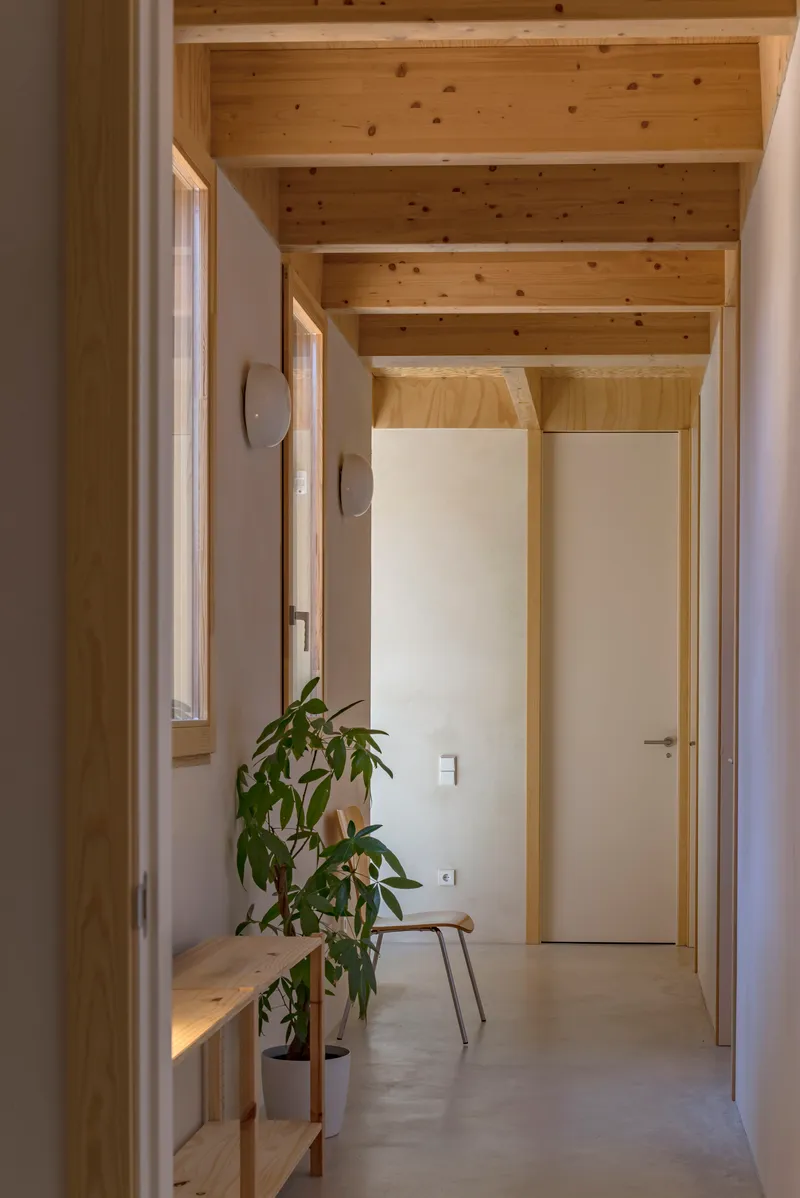
Access arrives from the north facade through a corner vestibule, a deliberate move that prevents the visitor from reading the entire plan at once. The entrance is marked by blue glazed tile walls and timber framing, a compact threshold that establishes a material vocabulary distinct from the brick perimeter. From here, the dwelling unfolds in a gradient of privacy: social spaces closest to the entrance, the main bedroom tucked into the diagonally opposite corner.
The corridor that connects these zones doubles as a gallery of sorts, its exposed timber ceiling joists lending a rhythmic cadence to what could otherwise be a utilitarian passage. A timber bench and potted plants signal that even the circulation spine is meant to be occupied, not just traversed.
Domestic Rooms Under Timber
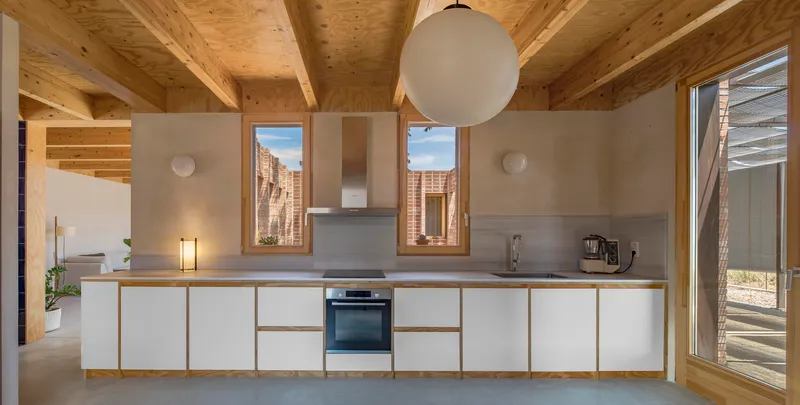
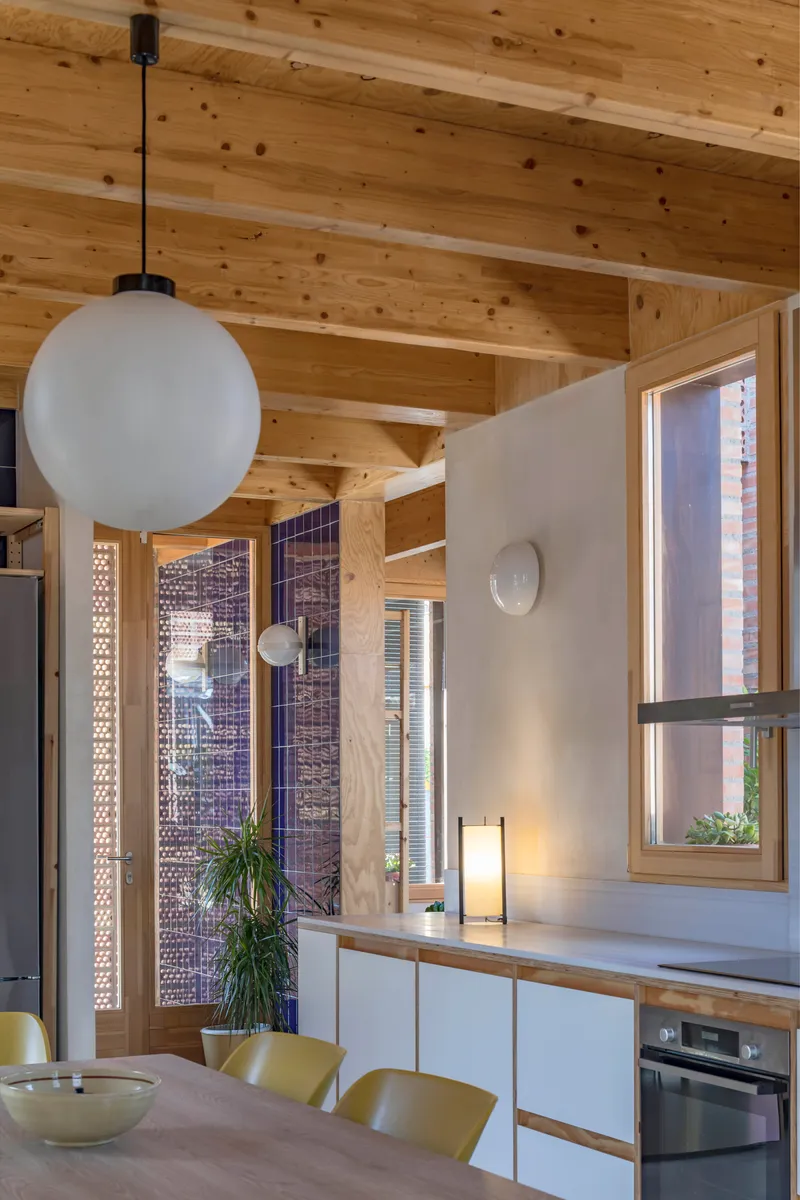

Inside the naves, exposed timber beams run overhead in parallel, supported by plastered walls that stay cool to the touch. The kitchen pairs white cabinetry with the warm grain of the ceiling, a restrained palette that lets the structure itself do the decorating. In the dining area, a spherical pendant light hangs below the joists, its form echoing the curvature of the courtyard walls and providing a soft counterpoint to the rectilinear grid.
Sliding glass doors along the courtyard edge allow rooms to open completely, collapsing the distinction between indoor and outdoor living when weather permits. The house's 112 square meters feel substantially larger than they are, precisely because the courtyard is perceived as an additional room shared by every nave.
Dusk Reveals the Logic
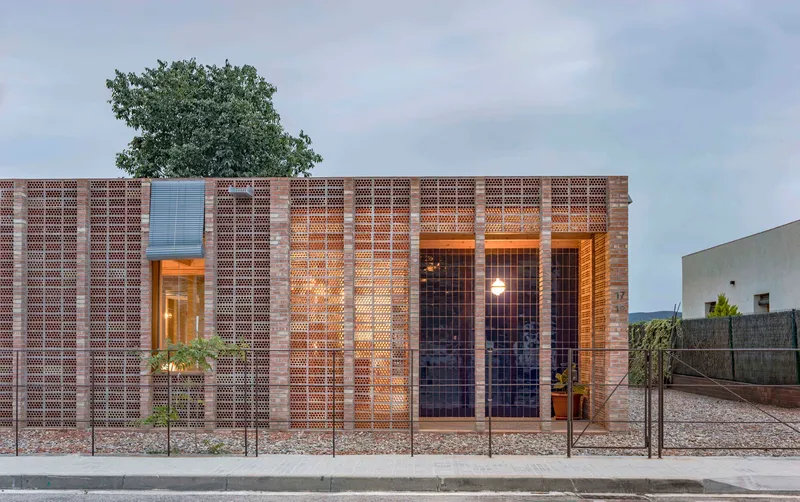
At twilight, the house inverts its daytime character. Perforated brick and steel mesh screens, opaque enough by day to shield the interior, become translucent membranes through which warm light radiates outward. The layered wall assembly reads as a series of luminous strata, each perforation a pinpoint of gold against the darkening sky. It is a reminder that the architects conceived the facade not as a static surface but as a filter whose performance changes with the clock.
Plans and Drawings


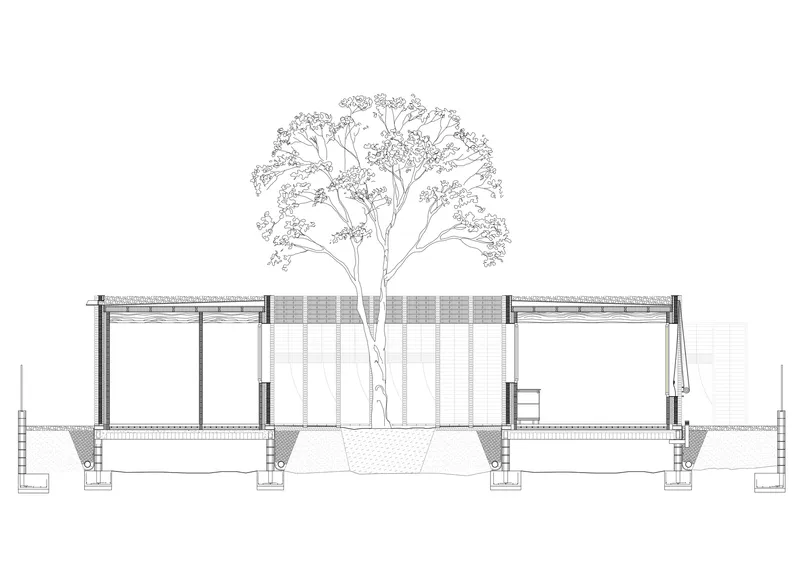
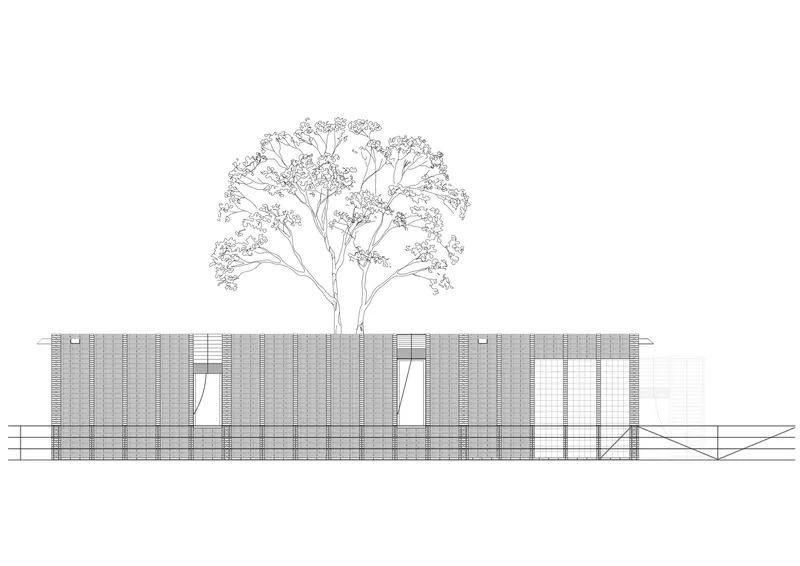
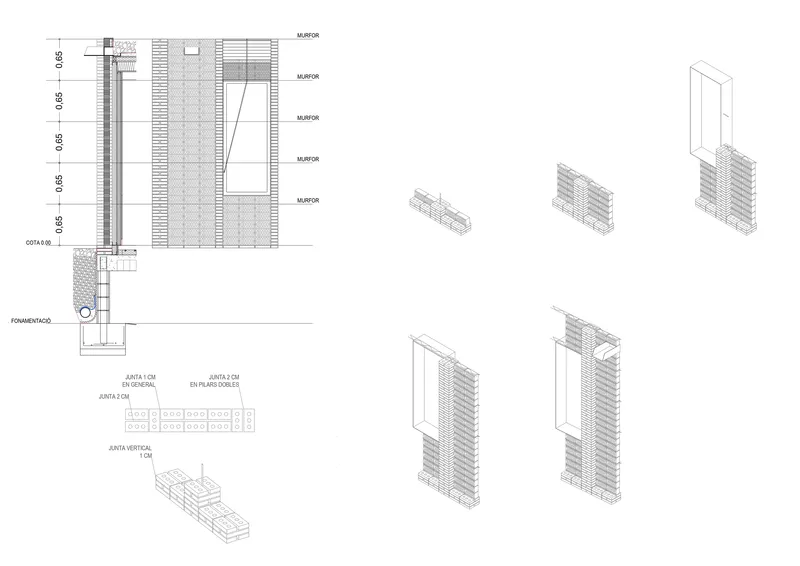
The site plan confirms how tightly the house is hemmed in by streets and neighboring buildings, making the inward-looking courtyard strategy not just a poetic choice but a pragmatic one. The floor plan shows the four naves radiating from the central void, with the tree anchoring the composition like a column that happens to be alive. The section drawing reveals how modest the building's profile really is: a single story topped by low-pitched roofs, the hackberry rising above them as the tallest element on the plot.
The construction detail and axonometric drawings are worth close study. They illustrate the layered brick wall assembly: a ventilated cavity sits between the outer perforated screen and the inner plastered ceramic wall, creating the thermal buffer that makes this passive climate strategy work. The foundation detail shows how the system meets the ground, and the axonometric pulls the entire assembly apart so you can see each component in isolation. These are not supplementary drawings; they are the project's argument laid bare.
Why This Project Matters
La Montse and Manel's House is a reminder that small residential projects remain architecture's most demanding testing ground. At 112 square meters, every decision is visible and every mistake amplified. OBO Estudi's achievement is in refusing to treat the site's constraints as limitations. The tight plot becomes the reason for the courtyard. The lack of views becomes the reason to build a landscape inside. The Mediterranean climate becomes the reason to design a facade that breathes. None of these moves are novel in isolation, but their synthesis here is unusually rigorous for a house of this scale.
The project also demonstrates that bioclimatic design need not arrive wrapped in high-tech gadgetry. A hackberry tree, perforated brick, roller blinds with horizontal slats, and a ventilated cavity wall: these are old tools, sharpened by contemporary detailing. The result is a house that is quiet on the street, generous on the inside, and thermally comfortable without mechanical overkill. In a moment when sustainability discourse gravitates toward energy dashboards and photovoltaic arrays, there is something genuinely instructive about a building whose most important piece of technology is a deciduous tree.
La Montse and Manel's House by OBO Estudi (Oriol Troyano, Bernat Sancho, Òscar Farrés). Located in Sant Esteve de Palautordera, Spain. 112 m². Completed in 2023. Photography by Andres Flajszer.
About the Studio
Share Your Own Work on uni.xyz
If projects like this are the kind of work you want to make, uni.xyz is a place to publish your own, find collaborators, and enter design competitions.




Popular Articles
Popular articles from the community

EW PARK: Sustainable Architecture Reimagines the Future of Urban Parking
EW PARK reimagines city parking as a modular wooden tower combining automation, solar energy, electric mobility, and adaptable urban design.

Co-Life: Senior Housing Design That Reconnects Older Adults With the City
Co-Life reimagines senior housing design through healing gardens, shared streets, workshops, and a sustainable community across generations.

The Musturak Paradise: Senior Living Architecture for a Connected Future in Temara, Morocco
The Musturak Paradise reimagines senior living architecture in Temara via private homes, social spaces, culture, community, and shared care.

Riyadh For All: Intergenerational Urban Design for Active Aging in Rabat
Riyadh For All reimagines urban design in Rabat with intergenerational co-living, adaptive courtyards, and Moroccan cultural exchange today.

Similar Reads
You might also enjoy these articles

Bao Huynh Watercolor Atelier: A Serene Art Retreat in Hội An
Bao Huynh Watercolor Atelier in Hội An blends multifunctional art spaces, sustainable design, local materials, and family-friendly living in a serene environment.

Atelier Macri Concept Store Interior Design by CASE-REAL
Atelier Macri store features a "ko" counter, walnut wood details, cork displays, blending retail, gallery, and seamless customer experiences.

Manuel Vargas Izquierdo Stadium and High-Performance Sports Center: Architectural Excellence in Jalpa de Méndez
The Manuel Vargas Izquierdo Stadium blends sustainable design, inclusive sports facilities, and cultural-inspired architecture, revitalizing Jalpa de Méndez’s public spaces.

KAKR Buluh Awar Hall: Revitalizing Community and Ecology Through Bamboo Architecture
Community built bamboo hall revitalizes Buluh Awar village, empowering youth, restoring ecology, celebrating vernacular craftsmanship through sustainable architecture and culture.




Comments (0)
Please login or sign up to add comments
No comments yet. Be the first to comment!