
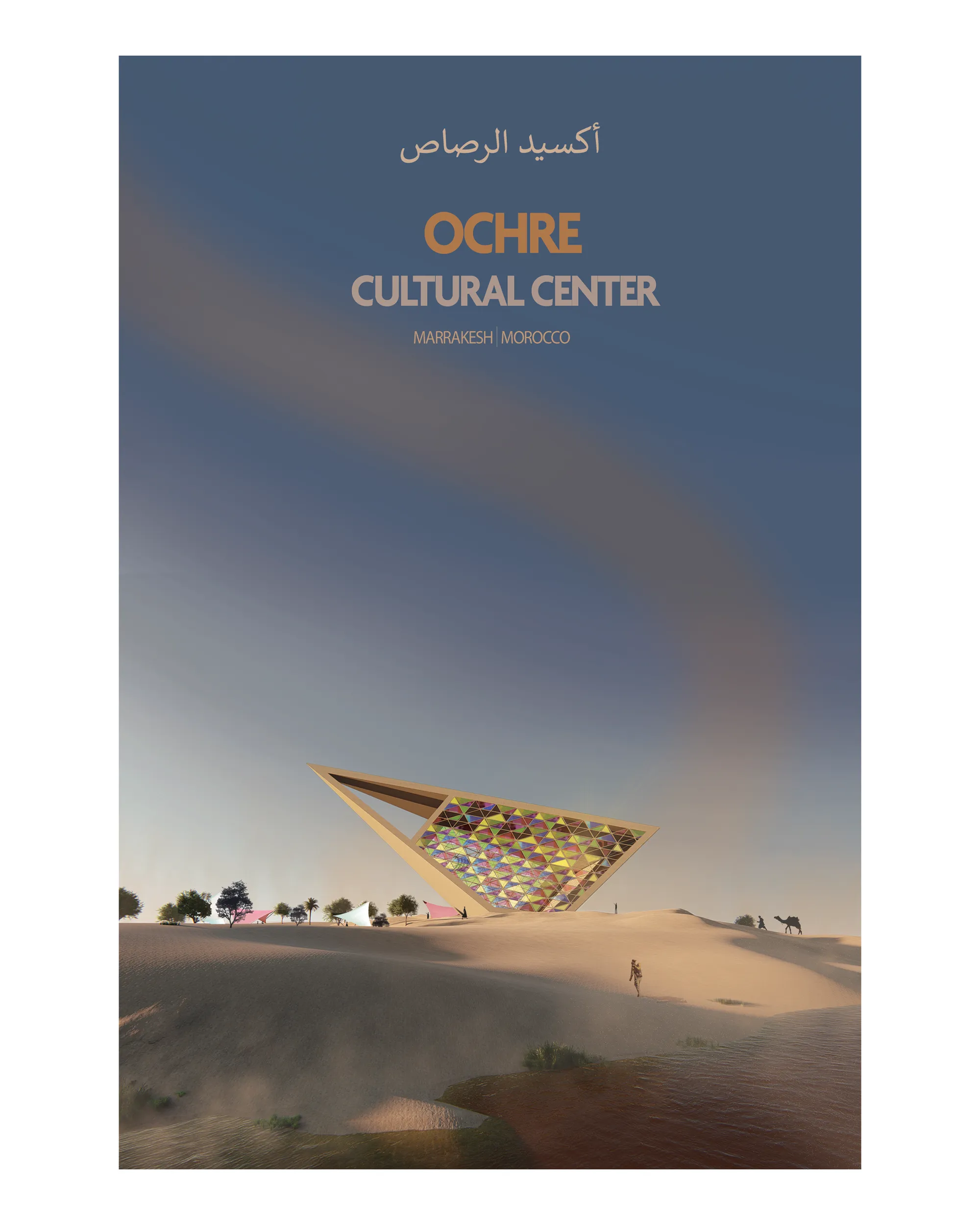
OCHRE Cultural Center
'A Place for all'

A ‘dhow,' the old traditional sailing ships that previously controlled over the coastal region, provided early inspiration for the design form. The ship's structural formation served as the basic drawing for the facility's structure and design. The primary triangulated glass frame in a variety of hues, with red being the most prevalent, highlights the history and depicts Marrakech and its traditional patterns, but the elevation gain of the acute angle towards the sky demonstrates its hierarchy and points to ancient civilization. The void is shaped in such a way that it marks the city's undetermined future and expansion direction as it approaches the acute. The signature design is to create an artistic icon that highlights the strong historic connection that the city and water share which shapes its future.
Following the concept, the dhow being an important part of the design, its basic structure stayed consistent throughout the process. The improvements were applied to the interior and exteriors of the framing in compliance with the program's level requirements. However, due to the location, the majority of the outdoor recreational activities are planned to be located near the facility's entrance in order to create stronger horizontal rather than vertical circulation for visitors. The clustered platforms have typical kite-shaped roofs that give natural ventilation and light that can be changed according to the time of day. Accounting for the surroundings, maximizing vegetation in the design was the earliest goal of the design into making a self-sustaining design.
The goal was to make the form as simple as possible, not because less is more, but because the steep plane on the roof aids in the creation of a green and solar roof, while the slope aids in the design's aerodynamics. By minimizing the build-up of dust and water above the facility, the cutting-edge planes strengthen the structure's stability against nature. The structural triangle-shaped window openings may appear similar from afar, but they contain some of the city's oldest designs. The little distinctions in placements that can be identified by the familiar, as well as the colors used being the predominant and closest hues to the region's customs.
One of the most important aspects of the design was the organization of the areas. On the bottom level, public and open interactive area, which includes room for public displays and exhibition fairs, creates a more chaotic and cool ambiance. The idea was to combine it with the clustering platforms to give the impression of fading open markets and consumer interactions. Visitors arriving on the first level are greeted by a big lobby with a back door. Visitors are kept moving by a small meeting room in the center and open exhibition space along the longer wall. It comprises a cafeteria for the indoor facility, as well as small administrative and collaboration facilities for international guests and officials. With numerous items operating at the same time, this floor acts as the main section of the design. Moving up to the top floor, the facility's largest space, a multi-purpose space that can be referred to as an auditorium, event venue, or theater. This level, which includes a performance stage, seating, and support rooms in the back, can accommodate anything from a small cultural event to a huge festival.
Furthermore, in terms of research and how it would generate a strong sense of architectural style that existed near the location, materiality for the final shape was a huge problem. The principal design style was applied over the solar integrated glass panels, through patterns and colors, but the structural cladding was kept plain and monochromatic-ochre. A notion of blending in with the surroundings while maintaining the city's and people's style. It emphasizes the disintegration of design in the ochre city.
This design would definitely serve for the reinvented visitors experience through self-sustaining features and educate through architectural aspects, each of which conveys its own tale from the past, in these changing times.


Popular Articles
Popular articles from the community


The Ocean Hive: Sustainable Architecture for a Self-Sufficient Civilization at Sea
The Ocean Hive imagines sustainable architecture at sea, where modular habitats, algae, wave power and ocean waste sustain a growing colony.

Riyadh For All: Intergenerational Urban Design for Active Aging in Rabat
Riyadh For All reimagines urban design in Rabat with intergenerational co-living, adaptive courtyards, and Moroccan cultural exchange today.

Co-life: Sustainable Architecture for Age-Friendly Community Living
Co-life reimagines sustainable architecture for seniors through courtyards, rammed earth, shared gardens, and spaces designed for belonging.

Co-Life: Senior Housing Design That Reconnects Older Adults With the City
Co-Life reimagines senior housing design through healing gardens, shared streets, workshops, and a sustainable community across generations.
Similar Reads
You might also enjoy these articles

Day and Night Park: A Time-Based Urban Newsstand in Beijing
A temporary urban newsstand in Beijing blending travel, light, and reading through poetic colors, compact form, and community-focused design.

Modernist Patio Renovation in El Masnou, Barcelona by Oliver Segura Arquitectura + Cebrià Arquitectura
Modernist patio renovation blending tradition and innovation with a movable pool, leveled floors, and Catalan materials in El Masnou.

Alto Residencial Coop: Cooperative Housing Development in Santiago de Compostela by Carbajo Barrios Arquitectos
A linear cooperative housing complex blending white volumes and perforated metal façades, enhancing community living, natural light, privacy, and urban integration.

Vil Genis School by BPA ARCHITECTURE – Massy, France
Vil Genis School in Massy, France, features sustainable design, south-facing classrooms, community integration, accessible spaces, and modern educational architecture.




Comments (0)
Please login or sign up to add comments
No comments yet. Be the first to comment!