

OctaFold: A Concentric Geometry That Unfolds into Urban Life
A modular public furniture system that transforms from sculptural planter to seating, table, and gathering space through folding geometry.


What if a planter could unfold into a café table, a bench, and a gathering space for a dozen people? OctaFold starts as a closed octagonal planter, greenery rising from its center like a quiet urban monument. Pull its panels open and the geometry reveals four seating areas with integrated table surfaces, turning a single sculptural object into a full social infrastructure node. The concentric folding system is the key move: it compresses multiple civic functions into one element that can be reconfigured on demand, making it less a piece of furniture and more a small-scale architectural intervention.
Designed by Cody Jones and Cody Kotrlik, OctaFold targets the persistent urban problem of public spaces that are underserved by rigid, single-purpose furniture. The project proposes a modular unit that can be deployed alone or linked with others in linear, circular, or theater-style configurations across pavements, plazas, and intersections. It is a direct response to cities that need more seating, more greenery, and more adaptable social infrastructure without dedicating separate square footage to each.
Folding Open: From Sculptural Planter to Social Hub

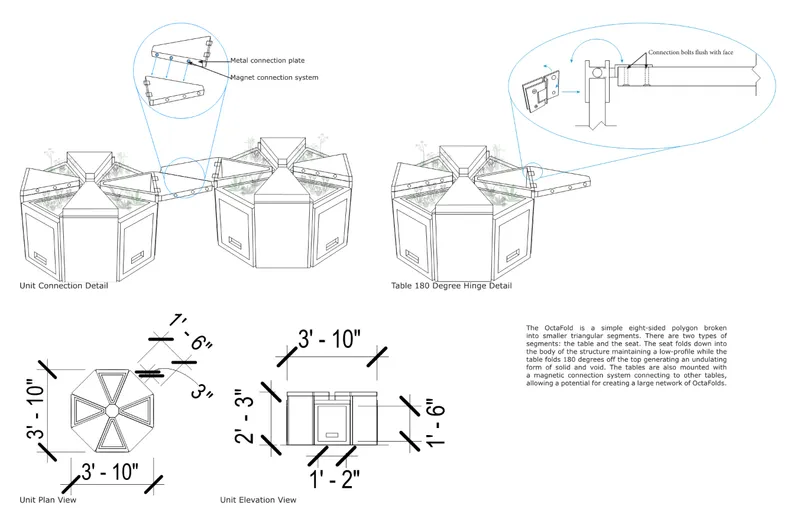
The axonometric drawings reveal OctaFold's core logic. In its closed state, the octagonal form reads as a singular planter with vegetation at its heart. As panels fold outward, benches emerge and table surfaces lock into position, creating four distinct seating zones arranged around the central greenery. The technical drawings show how the connection details work at the joint level: each folding panel is structurally integrated so that the transition from closed to open is not just formal but functional, with surfaces that can bear the loads of leaning, sitting, and placing objects.
What makes this compelling is the simultaneity of the program. Users do not choose between sitting near a planter or working at a table. They get both, mediated by the same geometric move. The plan view confirms that the octagonal footprint remains efficient even when fully deployed, occupying a controlled area of pavement while delivering a disproportionate amount of usable social surface.
Modular Configurations: Dual, Triple, and Theater

The assembly diagram lays out OctaFold's real scalability. Dual units handle intimate interactions between two or three people. Triple units form linear sequences suited to long plazas or promenades. Theater orientations arrange units in semi-circular formations that create gathering hubs for performances, community meetings, or informal events. Each configuration preserves access to the central planters, so greenery is never sacrificed for density.
The adaptability here is not abstract. A quiet residential street might need a single unit functioning primarily as a planter with occasional seating. A busy civic plaza could deploy six or eight units in a theater arrangement for a weekend market. The geometry allows this range without redesign; the same module simply connects differently. That kind of flexibility is rare in public furniture, which tends to be either fixed or so generic that it fails to create any spatial identity.
Placing OctaFold in the Urban Field

Seeing a public plaza alive with visitors and framed by high-rise towers reminds us what OctaFold is ultimately for: activating the space between buildings. Dense urban environments suffer from a well-documented deficit of comfortable, green, multifunctional gathering points at ground level. OctaFold addresses this gap not by proposing a landscape overhaul but by inserting a compact, repeatable unit that brings ecological value through its planters, social value through its seating and table surfaces, and visual identity through its distinctive octagonal form.
Why This Project Matters
OctaFold makes a persuasive argument that architecture does not need to be monumental to reshape urban experience. A single folding module that combines planter, bench, and table into one concentric system can do more for a streetscape than a building lobby ever will. Jones and Kotrlik have identified the right problem: cities need infrastructure that is simultaneously green, social, and spatially flexible, and they have proposed a solution grounded in geometric rigor rather than formal novelty.
The project's strongest contribution is its insistence on modularity as a design ethic, not just an engineering convenience. By allowing units to link into linear, circular, and theater configurations, OctaFold scales from the intimate to the communal without losing coherence. It is a reminder that the small interventions, the ones people actually sit on, eat lunch at, and gather around, are often the most consequential acts of public architecture.
View the Full Project
About the Designers
Designers: Cody Jones, Cody Kotrlik
Enter a Design Competition on uni.xyz
uni.xyz runs architecture and design competitions year-round that reward proposals with spatial conviction and real site intelligence.
Project credits: OctaFold by Cody Jones, Cody Kotrlik.




Popular Articles
Popular articles from the community


Lunar Spiral: Space Architecture Shaped by the Mathematics of the Universe
Lunar Spiral reimagines space architecture through Fibonacci geometry, lunar regolith, levitating habitats, and self-sustaining Moon living.

Conexión: Biophilic Design Reimagines High-Rise Living in Hong Kong
Conexión reimagines high-rise living in Hong Kong through biophilic design, green facades, shared spaces, daylight, water and nature within.

The Musturak Paradise: Senior Living Architecture for a Connected Future in Temara, Morocco
The Musturak Paradise reimagines senior living architecture in Temara via private homes, social spaces, culture, community, and shared care.

Co-life: Sustainable Architecture for Age-Friendly Community Living
Co-life reimagines sustainable architecture for seniors through courtyards, rammed earth, shared gardens, and spaces designed for belonging.


Similar Reads
You might also enjoy these articles
Lunar Spiral: Space Architecture Shaped by the Mathematics of the Universe
Lunar Spiral reimagines space architecture through Fibonacci geometry, lunar regolith, levitating habitats, and self-sustaining Moon living.
The Main Dream: Modular Architecture for Play, Learning, and Community
A modular playground turns recycled plastic into adaptable spaces where refugee children can play, build, learn, and reconnect.

Play: Fragments of Their World
Familiar architecture becomes modular playground design, creating safe spaces where displaced children can learn, connect, imagine and play.

Wadi Rum Observatory: Desert Architecture Designed for the Night Sky
Wadi Rum Observatory turns desert architecture into a quiet instrument for astronomy, hiding research spaces under Jordan's starlit terrain.


Explore Urban Furniture Competitions
Discover active competitions in this discipline



Challenge to merge furniture with learning


Design challenge to equip cities with modern furniture

Competition to design a workstation for architects


Packaging challenge - Design meets sustainability
Comments (0)
Please login or sign up to add comments
No comments yet. Be the first to comment!