
ondaseren
Architecture of Silence, Sound, and Creative Retreat

Contemporary cities continuously demand productivity, speed, and constant social engagement from individuals. Within this overwhelming urban rhythm, creative people — especially musicians — often lose the mental stillness necessary for artistic production. Music, although deeply emotional and human-centered, is increasingly consumed within commercialized and overstimulated environments. The initial idea behind OndaSeren emerged from questioning this condition: What kind of architecture could emotionally support musicians instead of exhausting them? How can space itself become part of the creative healing process?
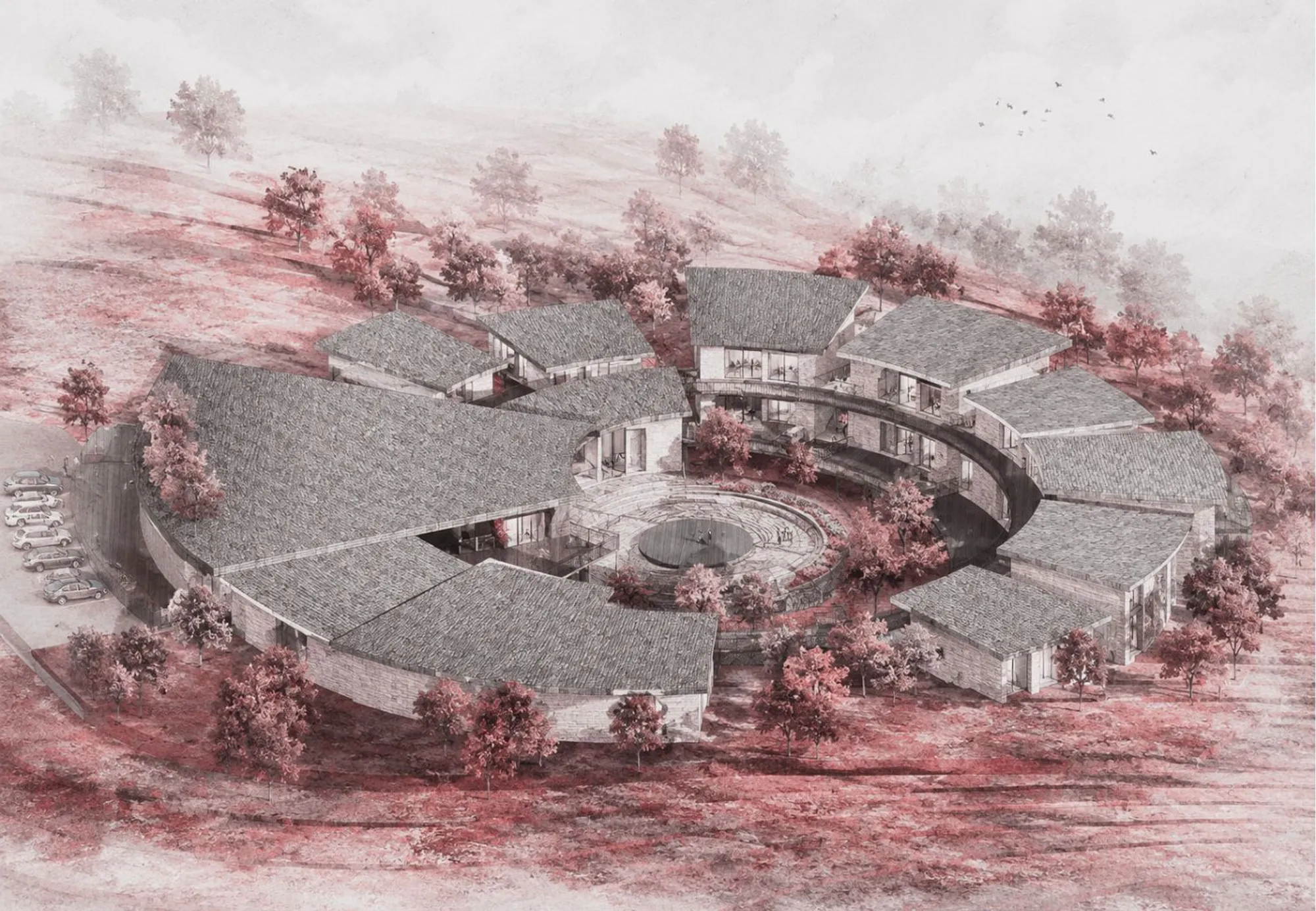
OndaSeren was envisioned as more than a building or a performance venue. From the beginning, the project was imagined as a retreat landscape where music, silence, nature, and architecture could coexist within a unified sensory experience. The aim was not simply to provide accommodation or rehearsal spaces for musicians, but to create an environment that allows emotional recovery, self-reflection, and spontaneous artistic interaction. The project therefore positions architecture as an active emotional medium rather than a passive physical shell.
The conceptual foundation of the project was largely inspired by the rhythm of sound waves and the calming movement of ocean currents. The name “OndaSeren” itself combines the ideas of waves, serenity, and emotional continuity. Early conceptual sketches explored how invisible phenomena such as sound, vibration, rhythm, and resonance could be translated into spatial form. Instead of approaching architecture through rigid geometries, the design process focused on fluidity, gradual transitions, and layered atmospheres. The intention was to create a spatial language that feels composed rather than constructed — almost like a musical composition unfolding over time.
The design process began with a strong investigation into emotional zoning. Rather than organizing spaces purely according to function, the project grouped areas according to psychological and sensory intensity. This approach became one of the most defining design methods throughout the process. Spaces dedicated to solitude, meditation, and personal music production were positioned away from collective social zones. Meanwhile, shared rehearsal areas, open performance platforms, and gathering terraces were arranged to encourage natural encounters between artists. This balance between isolation and interaction became central to the identity of OndaSeren.
Several iterations were explored before arriving at the final form. Initial schemes tested more compact and centralized configurations, but these approaches felt too rigid and disconnected from the natural landscape. Later studies experimented with fragmented masses dispersed across the site, allowing architecture to dissolve more naturally into the terrain. Through this iterative process, the project gradually evolved into a fluid composition where circulation paths behave almost like streams flowing through the landscape. The final organization intentionally avoids monumental gestures; instead, it prioritizes experiential continuity and sensory calmness.
Site responsiveness played a crucial role in shaping the architecture. Rather than imposing an artificial order onto the land, the project sought to learn from the site’s natural characteristics. Topography, prevailing wind directions, daylight conditions, and existing vegetation patterns were carefully analyzed during the design process. These environmental investigations directly informed both the spatial organization and material decisions. Buildings were positioned to maximize natural ventilation and visual connection with the landscape while minimizing environmental disruption. The architecture attempts to feel embedded within nature instead of sitting above it.
Material selection was approached as both an environmental and emotional decision. The project intentionally avoids overly polished or technologically aggressive aesthetics. Instead, tactile and timeless materials were prioritized to create a calming sensory atmosphere. Andesite stone became one of the key materials due to its connection with the geological identity of the region and its strong textural character. Natural wood surfaces were introduced to soften the spatial experience and enhance warmth within retreat spaces. Water surfaces and shaded courtyards were integrated not only as climatic elements, but also as atmospheric tools that amplify silence, reflection, and acoustic sensitivity.
Acoustic considerations were also deeply embedded into the architectural process. Since the project is fundamentally centered around musicians, sound could not be treated as a secondary technical problem. Instead, acoustics became a spatial generator. The arrangement of walls, openings, courtyards, and circulation paths was carefully considered to create varying levels of sonic intimacy. Some spaces were designed to absorb and isolate sound, allowing focused production and meditation, while others intentionally allow sound to travel softly across shared social areas. This layered acoustic experience transforms music into part of the architecture itself.
One of the project’s main objectives was to redefine the relationship between architecture and mental well-being. In many contemporary creative environments, productivity is prioritized over emotional sustainability. OndaSeren challenges this condition by proposing that rest, silence, and emotional balance are not interruptions to creativity, but essential components of it. Therefore, the project introduces slow architecture — an architecture that encourages users to pause, breathe, observe, and reconnect with themselves. Transitional pathways, filtered daylight, framed landscape views, and gradual spatial sequences were all designed to slow down perception and heighten sensory awareness.
The project also investigates the idea of collective creativity. While solitude is important for artistic reflection, music simultaneously thrives through collaboration and shared experience. OndaSeren therefore attempts to create subtle moments of encounter throughout the site. Shared terraces, open-air performance spaces, and communal courtyards allow spontaneous interactions between musicians without forcing social engagement. The architecture creates opportunities for connection while still respecting privacy and emotional boundaries.
Sustainability within OndaSeren was approached through passive and contextual strategies rather than purely technological solutions. Natural ventilation systems, daylight optimization, shaded transitional areas, and permeable surfaces reduce environmental impact while improving user comfort. Local materials were prioritized to strengthen the project’s connection with place and reduce construction-related environmental costs. The goal was to create a project that ages naturally over time and becomes more integrated with its environment rather than visually deteriorating.
Transformation over time became another important layer of the project. OndaSeren was never imagined as a static architectural object. Instead, it was conceived as a living environment capable of evolving alongside its users and landscape. Vegetation growth, weathering materials, changing artistic communities, and seasonal atmospheres will continuously reshape the identity of the project. This temporal transformation is embraced as part of the architectural narrative rather than something to resist.
Ultimately, OndaSeren is an exploration of how architecture can support emotional and creative healing through space, sound, and nature. It proposes an alternative understanding of creative environments — one that values silence as much as performance, reflection as much as production, and atmosphere as much as form. The project argues that architecture has the potential not only to shelter artistic activity, but also to nurture the emotional conditions necessary for creativity to emerge.
In this sense, OndaSeren is not simply a retreat center for musicians. It is an architectural interpretation of rhythm, calmness, and human connection — a place where music is not only heard, but spatially experienced.
References (1)
atmospheres
Publisher: Birkhäuser Architecture
ISBN: 9783764374952 | Vol. N/A
This reference explores the emotional and atmospheric qualities of architecture through materiality, light, sound, and sensory experience. It strongly relates to OndaSeren’s concept of creating a calming and immersive retreat environment for musicians.




Popular Articles
Popular articles from the community


Hill & Cross Opera: Sculptural Opera House Architecture Shaped by Tallinn’s Landscape and Identity
Hill & Cross Opera reimagines opera house architecture in Tallinn through its sculptural hill, civic plaza, glass wave and a luminous cross.

Lunar Spiral: Space Architecture Shaped by the Mathematics of the Universe
Lunar Spiral reimagines space architecture through Fibonacci geometry, lunar regolith, levitating habitats, and self-sustaining Moon living.

Play: Fragments of Their World
Familiar architecture becomes modular playground design, creating safe spaces where displaced children can learn, connect, imagine and play.

The Ocean Hive: Sustainable Architecture for a Self-Sufficient Civilization at Sea
The Ocean Hive imagines sustainable architecture at sea, where modular habitats, algae, wave power and ocean waste sustain a growing colony.


Similar Reads
You might also enjoy these articles

Day and Night Park: A Time-Based Urban Newsstand in Beijing
A temporary urban newsstand in Beijing blending travel, light, and reading through poetic colors, compact form, and community-focused design.

Modernist Patio Renovation in El Masnou, Barcelona by Oliver Segura Arquitectura + Cebrià Arquitectura
Modernist patio renovation blending tradition and innovation with a movable pool, leveled floors, and Catalan materials in El Masnou.

Alto Residencial Coop: Cooperative Housing Development in Santiago de Compostela by Carbajo Barrios Arquitectos
A linear cooperative housing complex blending white volumes and perforated metal façades, enhancing community living, natural light, privacy, and urban integration.

Vil Genis School by BPA ARCHITECTURE – Massy, France
Vil Genis School in Massy, France, features sustainable design, south-facing classrooms, community integration, accessible spaces, and modern educational architecture.


Explore Architecture Competitions
Discover active competitions in this discipline




Challenge to reimagine the Iron Throne


Photograph architecture without architects


Illustrate the lost glory of Angkor Wat - Render Challenge


Design challenge to reuse E-waste
Comments (0)
Please login or sign up to add comments
No comments yet. Be the first to comment!