
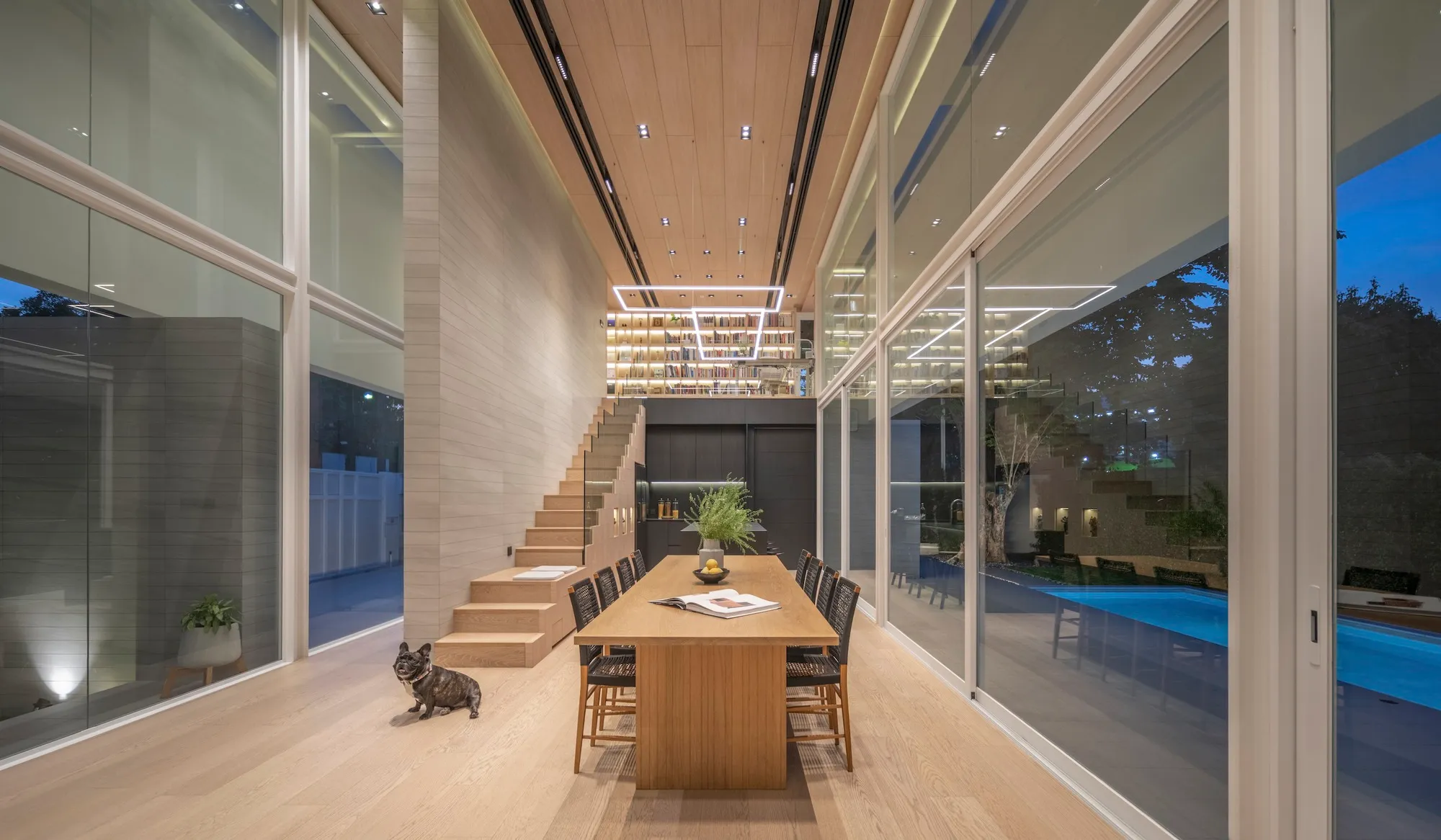
One and a Half Architects Center a Bangkok Home Around a Double-Height Living Room That Breathes
TJ House in Chatuchak uses courtyards, a pillar-free structure, and an air-circulating wall gap to keep a 530 m² family home cool and connected.


In a dense urban pocket of Bangkok's Chatuchak district, One and a Half Architects built a 530 m² house that treats the living room not as one room among many but as the gravitational center of the entire plan. TJ House, led by architect Wichan Kongnok, organizes every private and communal function around a double-height open core, pulling the family toward shared space rather than letting them drift into separate wings. The move is deliberate and, frankly, structural: the main volume was designed without a central pillar, giving the living and dining area an uninterrupted sightline that runs from the entry court through the interior and out to the swimming pool on the north side.
What makes the project worth studying is the way it stacks two problems on top of each other and solves them with one strategy. Bangkok's heat is relentless, and so is the desire for visual openness. Rather than choosing between floor-to-ceiling glass and thermal comfort, the architects set the main load-bearing wall at a deliberate distance from the glass enclosures, creating an air-circulated insulation layer in the tall hall. The house is oriented on an east-west axis for minimum solar gain, and the pool to the north acts as a passive cooling surface. Courtyards punctuate the plan wherever a bathroom, corridor, or secondary room might otherwise feel landlocked, delivering ventilation and daylight without ever compromising privacy.
A Facade of Horizontal Lines
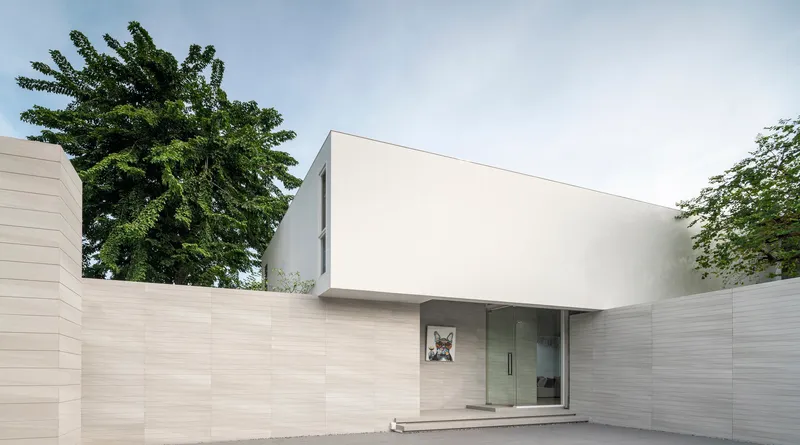
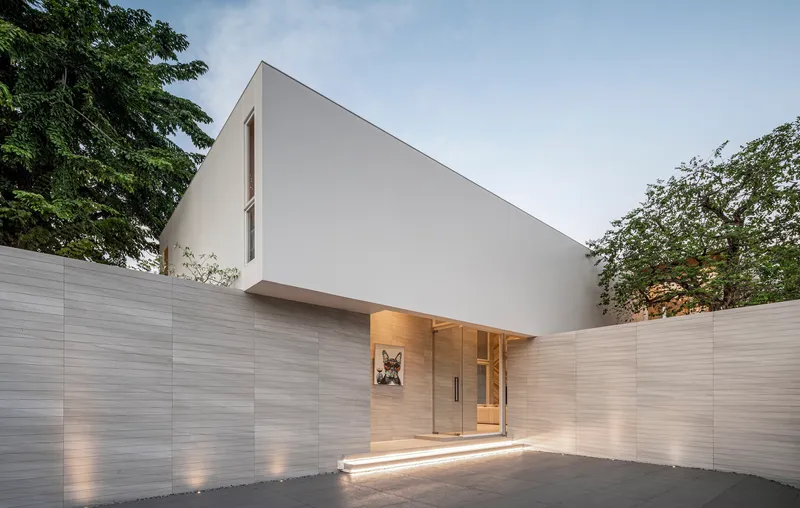
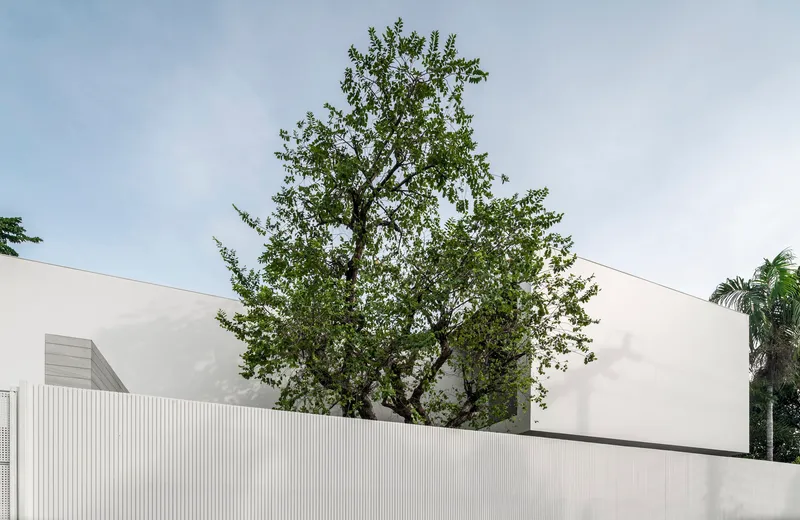
From the street, TJ House reads as a white upper volume floating above a base of horizontal ribbed stone. The horizontal lines are not decorative filler. They serve a specific perceptual purpose: by breaking large material surfaces into narrower bands, the architects make the building appear longer and lower than it actually is, diminishing its mass relative to the surrounding residential fabric. The mature Padauk tree at the corner of the original lot was retained, its canopy now rising above the stucco facade like a counterweight to the crisp geometry.
At the entry, a flat concrete canopy shelters a recessed courtyard finished in the same horizontal tile, establishing the rhythm that will carry through the interior. The palette stays tight: white, gray, wood, and the occasional dark accent. Nothing competes with the greenery that spills over the perimeter wall.
The Double-Height Core
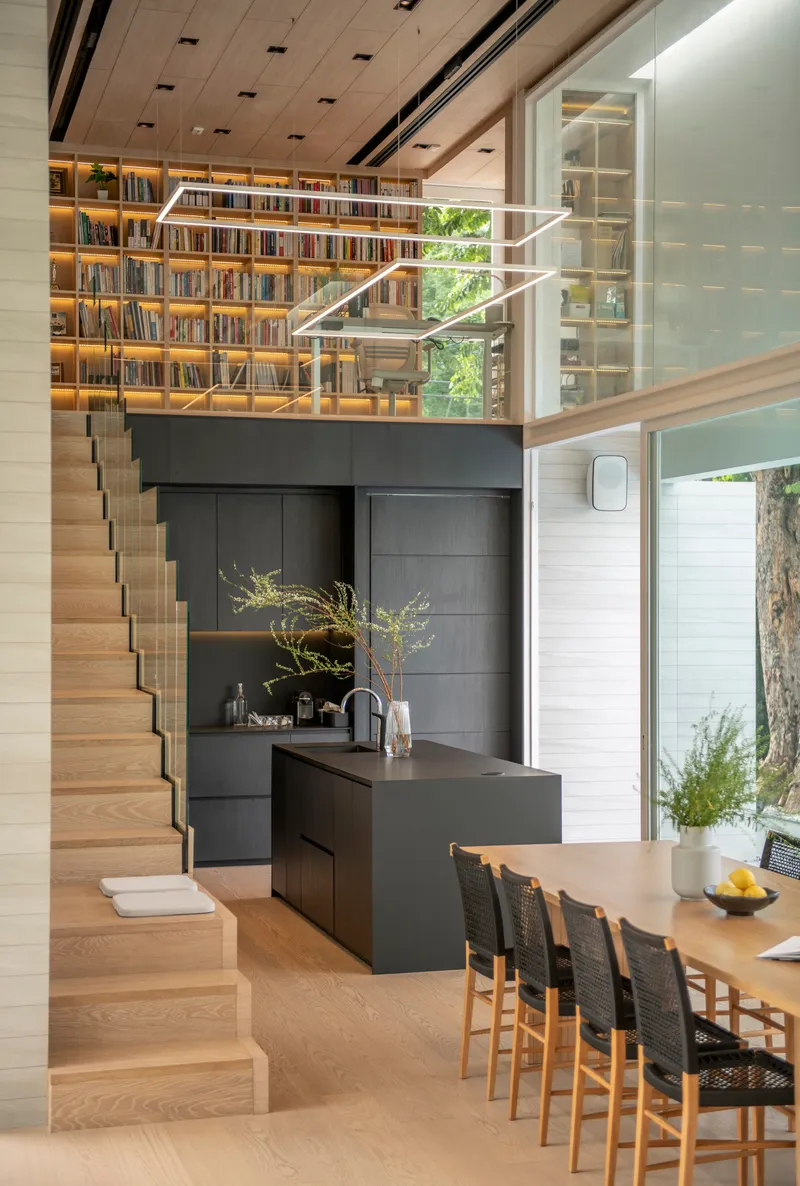
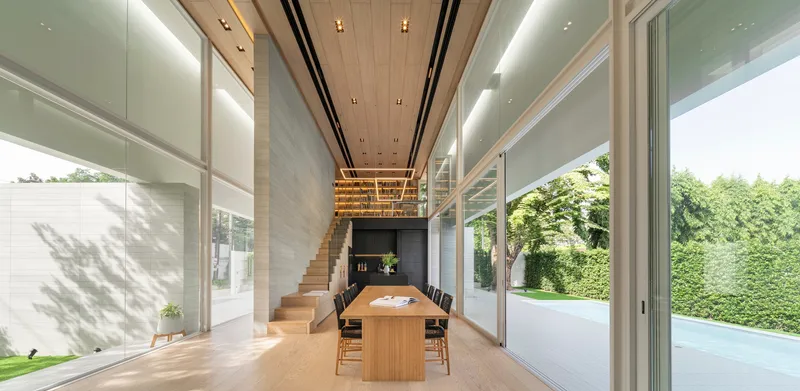
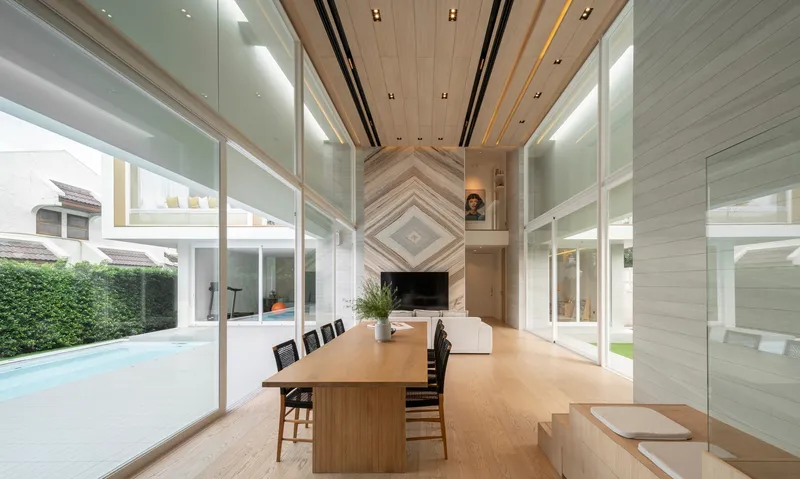
Step inside and the ceiling lifts immediately. The double-height dining and living space is defined by a timber-slatted ceiling that warms what would otherwise be a stark white volume. A floating timber staircase climbs the far wall to reach a mezzanine level where the working rooms and library sit behind glass balustrades, looking down into the communal core. The concept of separating privacy by levels rather than walls is visible here: the family gathers below, and individual retreat happens above, with both zones in constant visual contact.
A chevron-patterned fireplace wall anchors the dining end, while the opposite side opens through floor-to-ceiling glazing onto the lawn. At dusk, indirect light from ceiling gaps washes the walls with a soft glow, replacing the need for heavy fixture arrays. The effect is a room that feels generous without being cavernous, intimate without being tight.
Kitchen as Social Threshold


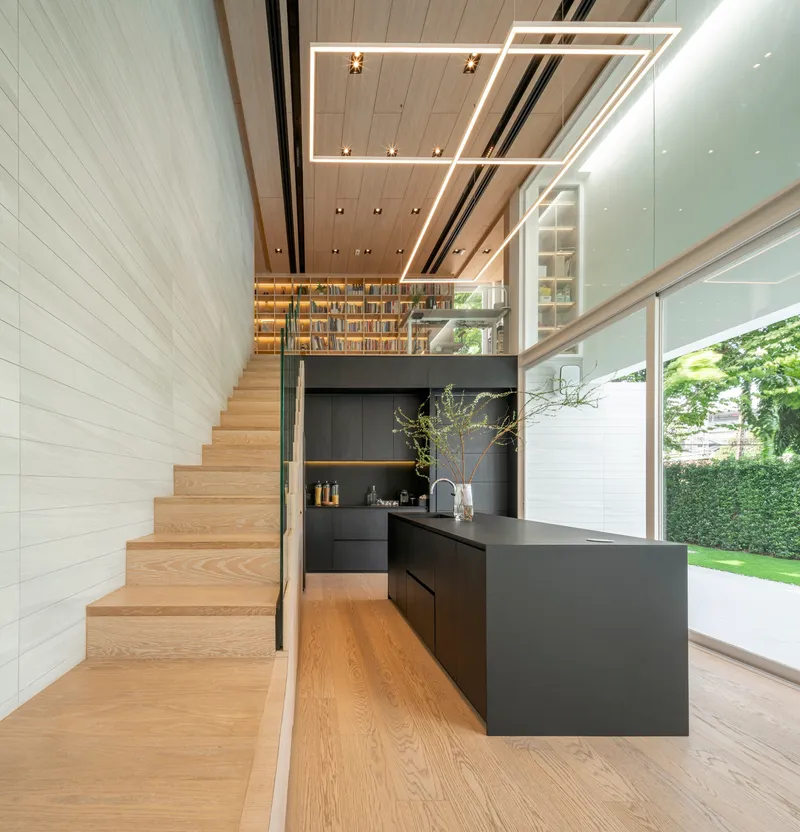
The kitchen occupies a position directly beneath the mezzanine library, its black island and cabinetry standing in sharp contrast to the surrounding white and timber surfaces. The material shift is intentional: it signals a functional zone change without resorting to walls or doors. Bar stools line the island, turning meal preparation into a social act rather than a task quarantined behind a partition.
Sliding glass doors behind the counter open directly onto the pool terrace, collapsing the boundary between cooking, eating, and outdoor leisure. A backlit bookshelf wall visible from the kitchen reinforces the sense that every space in TJ House is connected by sightline, even when separated by floor level. Geometric linear light fixtures above the island provide focused task lighting that reads as sculptural from the mezzanine above.
Pool, Lawn, and Passive Cooling

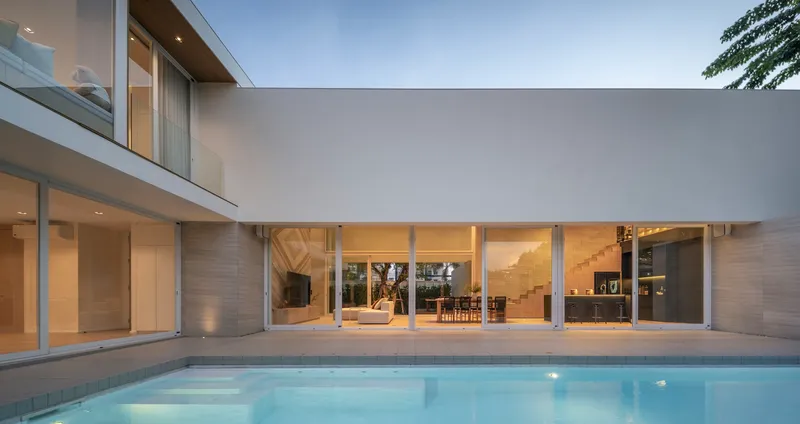
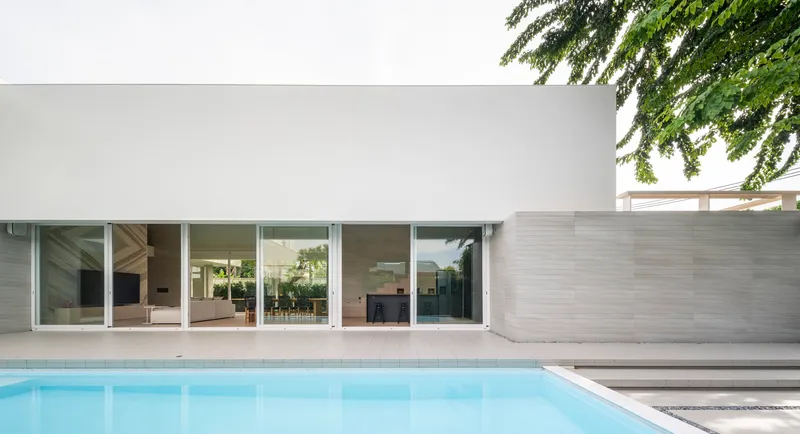
The rectangular pool runs parallel to the building's full length on the north side, a decision rooted in climate strategy as much as lifestyle. By placing a large body of water on the cooler face of the house, the architects leverage evaporative cooling and reduce heat gain through the adjacent glass walls. A trimmed hedge wall defines the pool terrace's outer edge, screening the yard from neighbors without blocking air movement.
At night, the pool terrace becomes a luminous corridor. The glass-walled interiors glow outward, and the water reflects the lit volumes back, doubling the perceived depth of the house. Overhanging tree branches soften the composition, preventing the scene from tipping into sterile minimalism. The lawn between pool and building is deliberate in its simplicity: no ornamental planting beds, no layered landscaping, just grass and the original mature trees.
Courtyards and Light Gaps
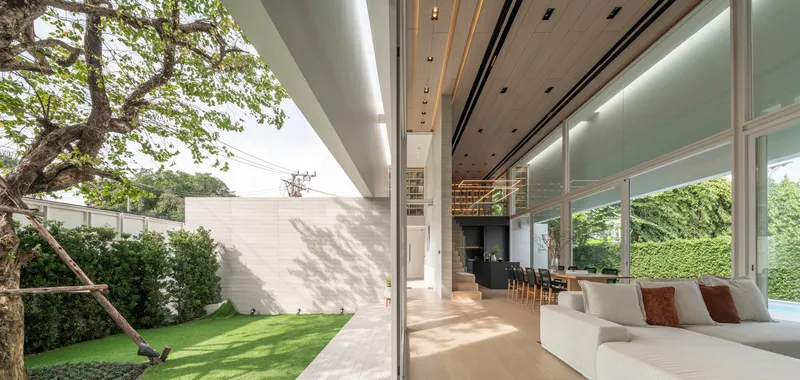
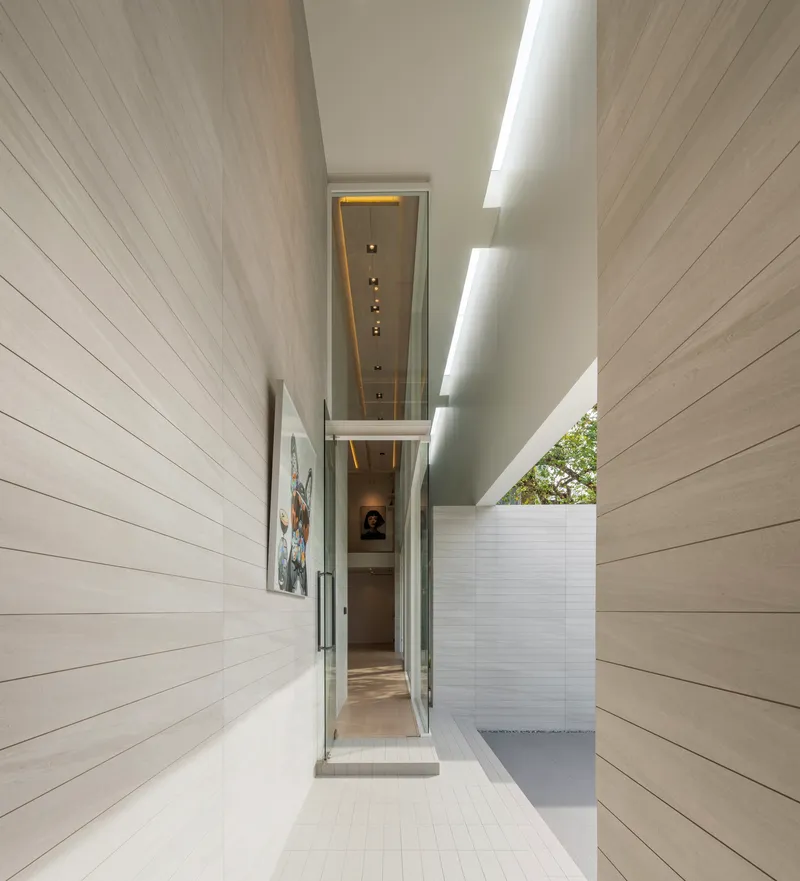

The plan is punctured by small courtyards that serve triple duty: they bring daylight into rooms that would otherwise rely entirely on artificial sources, they introduce cross-ventilation into enclosed spaces like guest bathrooms, and they give every major room a private relationship with greenery. A narrow outdoor corridor between two horizontal-tiled walls demonstrates how even residual gaps can be weaponized for light: a glazed ceiling slot throws a blade of sun onto the stone, turning a circulation path into something worth pausing in.
The architects used light gaps at the top of certain walls not just for illumination but to support planting. Vines and small trees grow up through these openings, reaching toward the mezzanine floor's roof. The result is a house where landscape is not applied to the exterior but threaded through the section, blurring the line between built and grown.
Private Rooms and Material Warmth
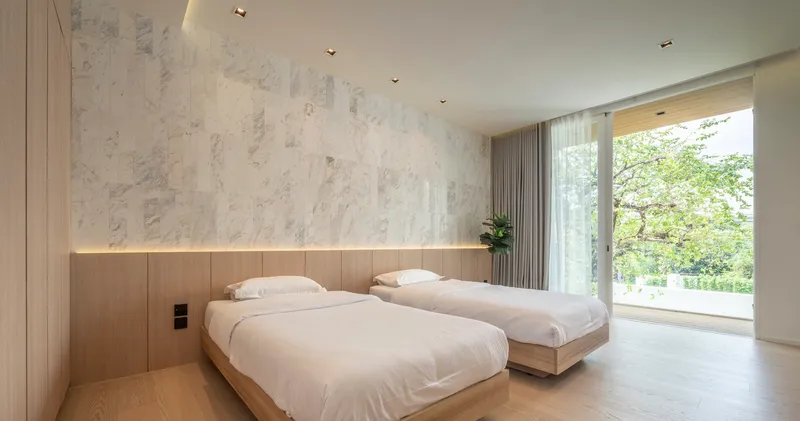
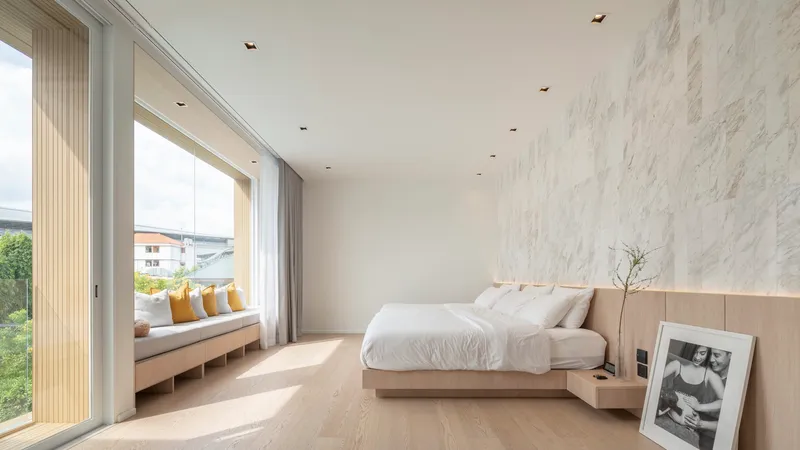
The bedrooms on the upper level step back from the spectacle of the double-height core and settle into quieter material territory. Timber-clad bed platforms sit against pale marble accent walls, and garden views fill the windows without the drama of floor-to-ceiling glass. Morning sunlight enters obliquely, warming surfaces that are designed to absorb it rather than bounce it around. A window seat in one bedroom suggests that stillness is built into the program, not just movement.
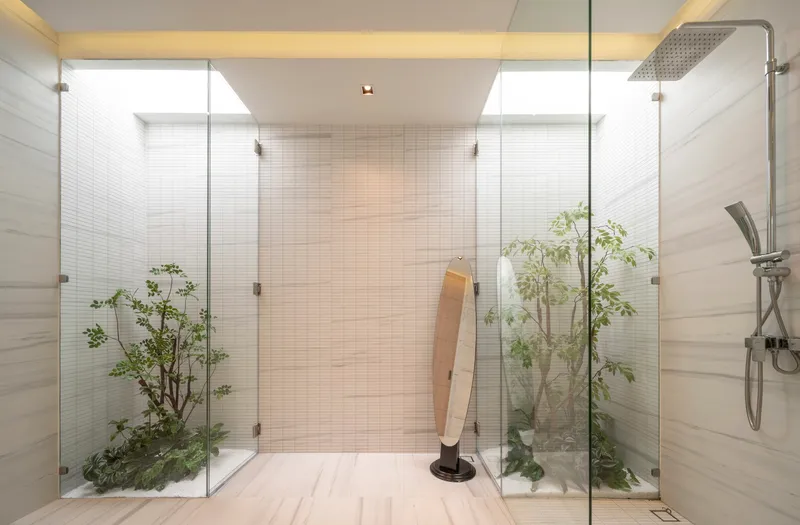
The bathrooms are among the most carefully considered rooms in the house. Glass-enclosed planting beds flank a timber bench beneath an overhead rain shower, turning a utilitarian space into something approaching a garden pavilion. Even the guest restrooms get their own small courtyard, a detail that would be extravagant in a smaller house but feels proportionate here, given the 530 m² footprint.
Mezzanine Library and Working Rooms
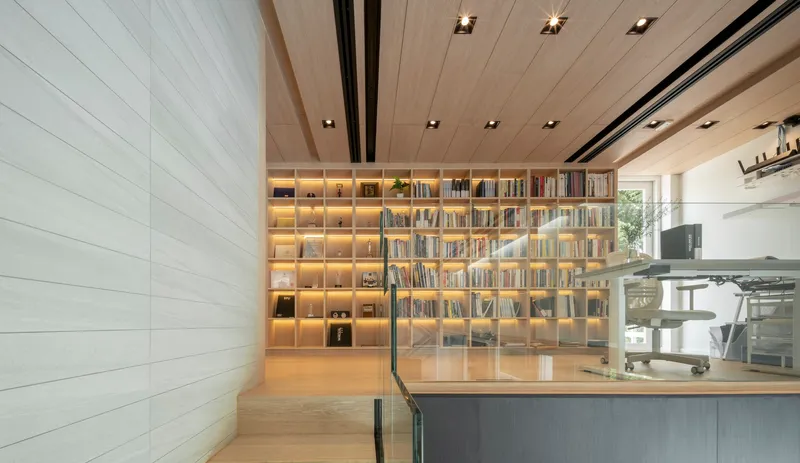
The mezzanine level wraps around the void above the living space, positioning the library and working rooms where they can borrow the double-height volume's air and light without occupying its floor area. A backlit bookshelf wall becomes the most visible interior feature from below, its amber glow serving as a beacon that draws the eye upward. The glass balustrade keeps the mezzanine visually open, maintaining the sense that the house is one connected volume rather than a stack of separate floors.
The privacy-by-level concept works because the mezzanine is elevated enough to feel removed from the kitchen and dining chatter but not so enclosed that it becomes an isolated box. You can look down and see the family, or you can turn toward the bookshelves and disappear into concentration. It is a simple gradient, achieved through section rather than plan.
Dusk and the Glass Edge
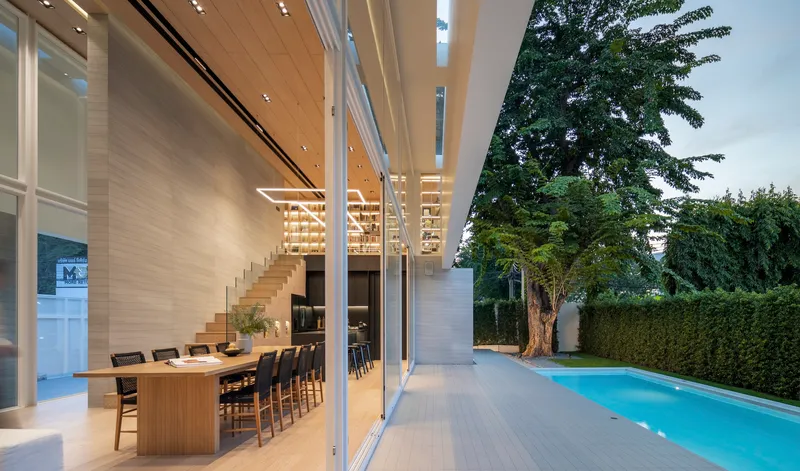
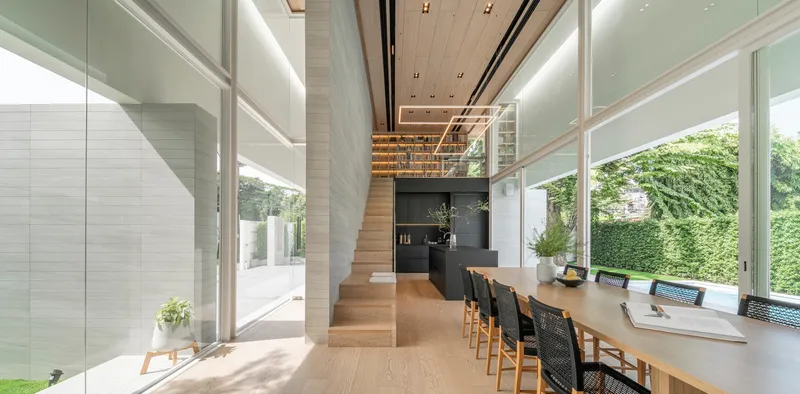
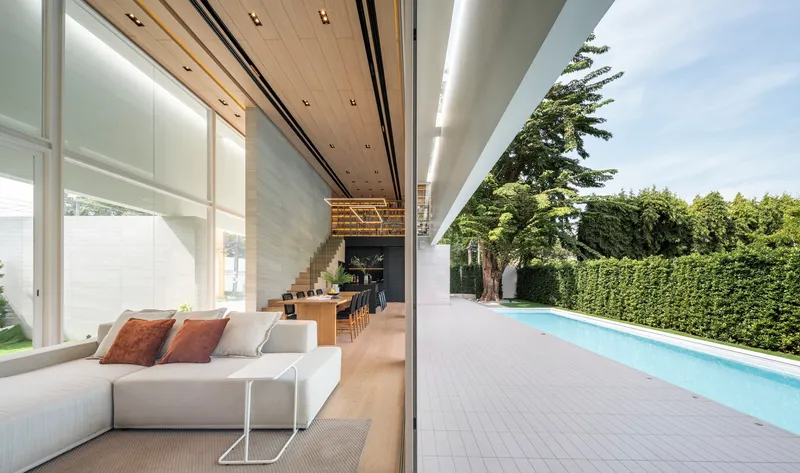
Several images reveal how the house transforms as daylight fades. The timber-lined dining space, seen through floor-to-ceiling glass doors from the pool deck, glows with warm indirect light while the sky deepens. The hedge-bordered lawn beyond the living room dissolves into silhouette. These transitions are not accidental; the architects calibrated the lighting gaps and fixture placement to ensure that the house reads as a lantern at dusk, its interior life visible to occupants moving through the garden or pool terrace.
During the day, the full-height glazing frames bright garden views and floods the open plan with reflected green light. After dark, the relationship inverts: the interior becomes the spectacle, and the landscape becomes the frame. Few houses handle both modes this gracefully.
Plans and Drawings
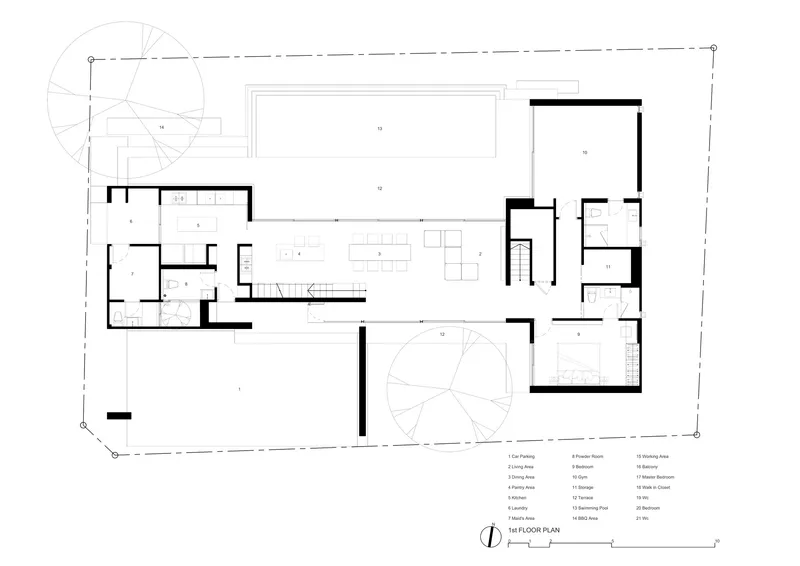
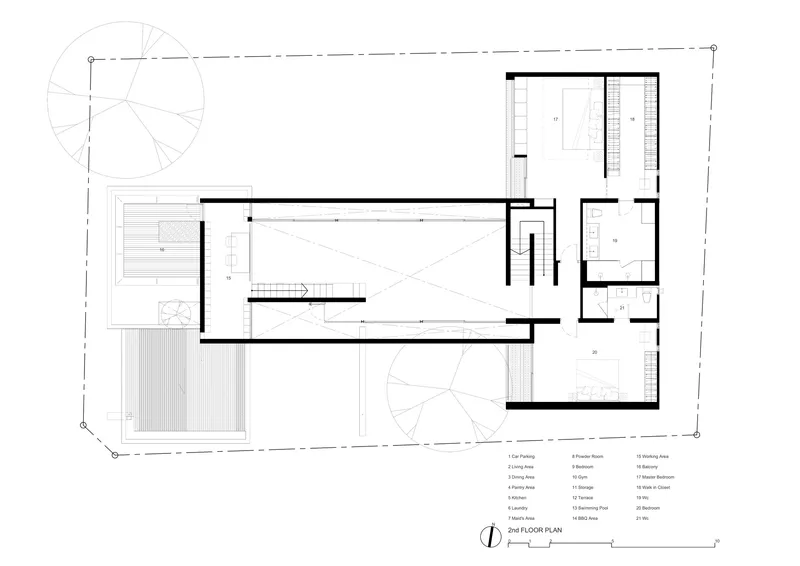
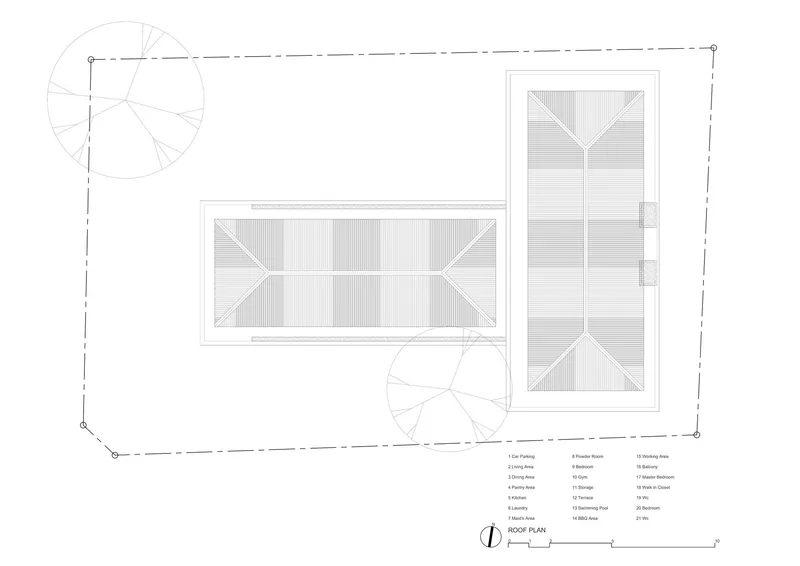
The first floor plan confirms what the photographs suggest: the living, dining, and kitchen zone occupies the center of the plan as a single continuous space, flanked by the pool to the north and entry courtyards to the south. Two circular tree canopies mark where the retained Padauk and added specimen trees anchor the landscape strategy. The second floor plan shows the bedroom wing extending over one end of the ground floor while the central living space remains open as a double-height void. The roof plan, with its diagonal hatching indicating the two main volumes, reveals how compact the building footprint actually is relative to the generous perception of space inside.
Why This Project Matters
TJ House is a convincing argument that passive climate strategy and spatial generosity are not competing ambitions. In a city where air conditioning is the default response to heat, One and a Half Architects demonstrate that orientation, material layering, water placement, and courtyard ventilation can do substantial work before any mechanical system kicks in. The pillar-free main volume proves that structural ambition does not have to announce itself; it can simply result in a cleaner room.
More broadly, the house challenges the tendency in contemporary residential design to treat openness as an end in itself. Here, openness serves a specific social thesis: that a family stays connected when the center of the house is genuinely the best place to be. The mezzanine work areas, the pool terrace, the courtyards, and the bedrooms all orbit around that double-height living core, borrowing its light and its life. It is a plan organized by desire rather than by corridor, and in a 530 m² house, that restraint is worth more than spectacle.
TJ House by One and a Half Architects (lead architect: Wichan Kongnok; interior design: Jarupong Ng-sirisakul), located in Khet Chatuchak, Bangkok, Thailand. 530 m², completed 2022. Photography by DOF Sky|Ground.
About the Studio
Share Your Own Work on uni.xyz
If projects like this are the kind of work you want to make, uni.xyz is a place to publish your own, find collaborators, and enter design competitions.




Popular Articles
Popular articles from the community

EW PARK: Sustainable Architecture Reimagines the Future of Urban Parking
EW PARK reimagines city parking as a modular wooden tower combining automation, solar energy, electric mobility, and adaptable urban design.

Co-life: Sustainable Architecture for Age-Friendly Community Living
Co-life reimagines sustainable architecture for seniors through courtyards, rammed earth, shared gardens, and spaces designed for belonging.

Riyadh For All: Intergenerational Urban Design for Active Aging in Rabat
Riyadh For All reimagines urban design in Rabat with intergenerational co-living, adaptive courtyards, and Moroccan cultural exchange today.

Co-Life: Senior Housing Design That Reconnects Older Adults With the City
Co-Life reimagines senior housing design through healing gardens, shared streets, workshops, and a sustainable community across generations.


Similar Reads
You might also enjoy these articles

Bao Huynh Watercolor Atelier: A Serene Art Retreat in Hội An
Bao Huynh Watercolor Atelier in Hội An blends multifunctional art spaces, sustainable design, local materials, and family-friendly living in a serene environment.

Atelier Macri Concept Store Interior Design by CASE-REAL
Atelier Macri store features a "ko" counter, walnut wood details, cork displays, blending retail, gallery, and seamless customer experiences.

Manuel Vargas Izquierdo Stadium and High-Performance Sports Center: Architectural Excellence in Jalpa de Méndez
The Manuel Vargas Izquierdo Stadium blends sustainable design, inclusive sports facilities, and cultural-inspired architecture, revitalizing Jalpa de Méndez’s public spaces.

KAKR Buluh Awar Hall: Revitalizing Community and Ecology Through Bamboo Architecture
Community built bamboo hall revitalizes Buluh Awar village, empowering youth, restoring ecology, celebrating vernacular craftsmanship through sustainable architecture and culture.




Comments (0)
Please login or sign up to add comments
No comments yet. Be the first to comment!