

Narrative Architects Build a Courtyard House Around 570 Years of Korean Memory in Andong
A 172-square-meter residence in rural Gyeongsangbuk-do channels the spatial logic of a nearby ancestral hanok into a concrete and timber home for an aging


A few steps from a nationally listed ancestral house built around 1454, a 1974 farmhouse stood for half a century as the home of a single elderly woman. When her family commissioned Narrative Architects to replace it, lead architects Sihong Kim and Namin Hwang faced a problem that no amount of parametric software can solve: how do you honor a place that carries both a 570-year collective history and one person's 50-year private one? Their answer, completed in 2023, is the Onhyeri Jung Youngja House, a 172-square-meter courtyard residence in Andong that absorbs the spatial DNA of the Jinsung Lee Clan's ㅁ-shaped ancestral compound and recasts it in board-formed concrete, local stone, and timber screens.
What makes the project genuinely interesting is not the cultural citation itself but the confidence with which it is deployed. The house does not mimic hanok form. It extracts the organizational principles (central courtyard, encircling roof, maru terrace, deep eaves) and runs them through a contemporary material vocabulary so restrained that the building reads as both ancient and inevitable. The result is a home where a mother can dry peppers in the courtyard, host her family for tea during Chuseok, and look out over rice paddies toward the river, all within a spatial sequence that would have made sense to the 15th-century builders next door.
Sitting in the Village, Not Above It
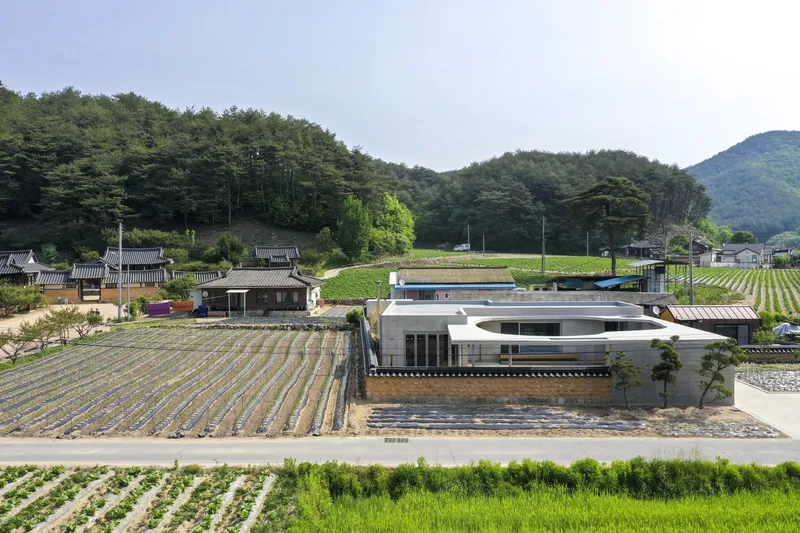
Seen from above, the house's white roof nestles among traditional tile-roofed neighbors and agricultural plots without asserting itself. The scale is village scale. The footprint roughly matches the parcels around it, and the boundary wall, a two-meter-high stone perimeter, echoes the earthen-and-tile enclosures that have defined property lines here for centuries. This is a deliberate move: the house participates in the village's grain rather than disrupting it.
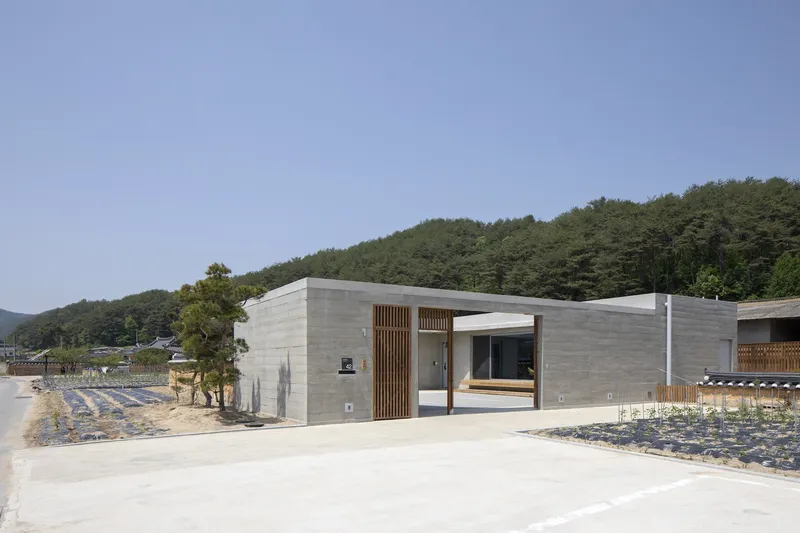
At ground level, the board-formed concrete entrance volume sits flush with an adjacent planted field, its vertical timber slats acting as a permeable membrane between agriculture and domesticity. There is no grand arrival sequence. You walk up to a wall, pass through it, and discover the courtyard. The modesty of the approach is the point.
The Courtyard as Protagonist
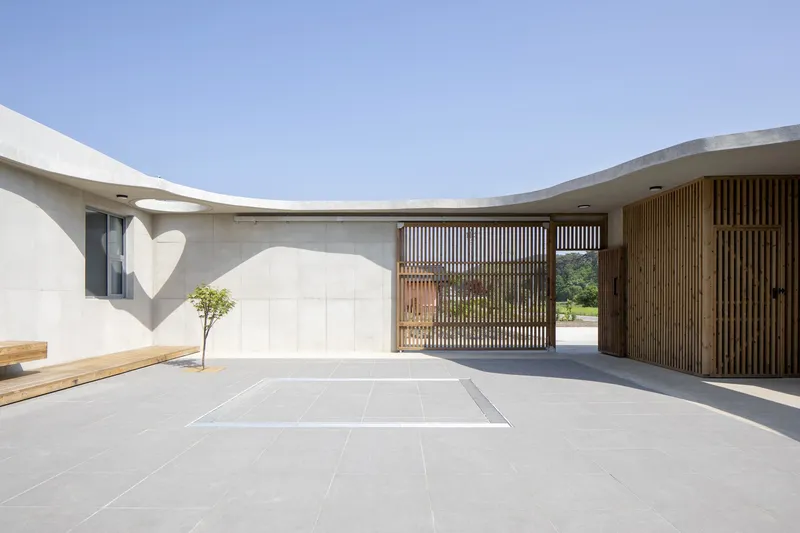
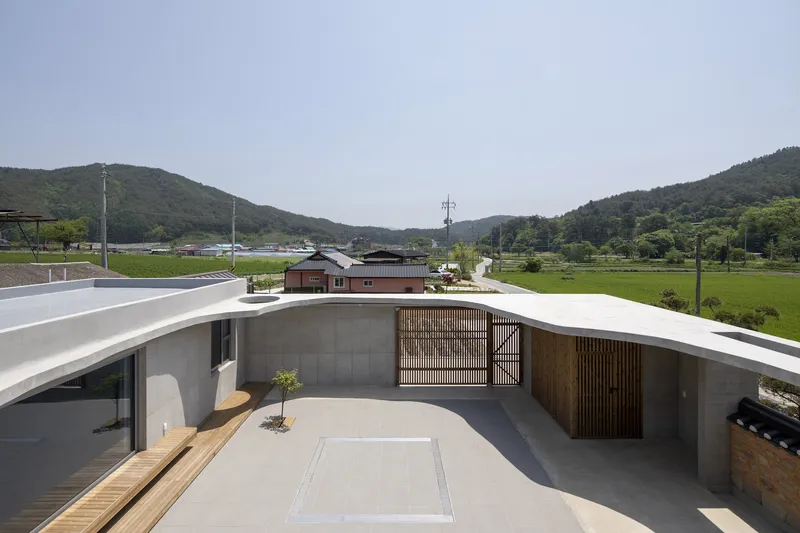
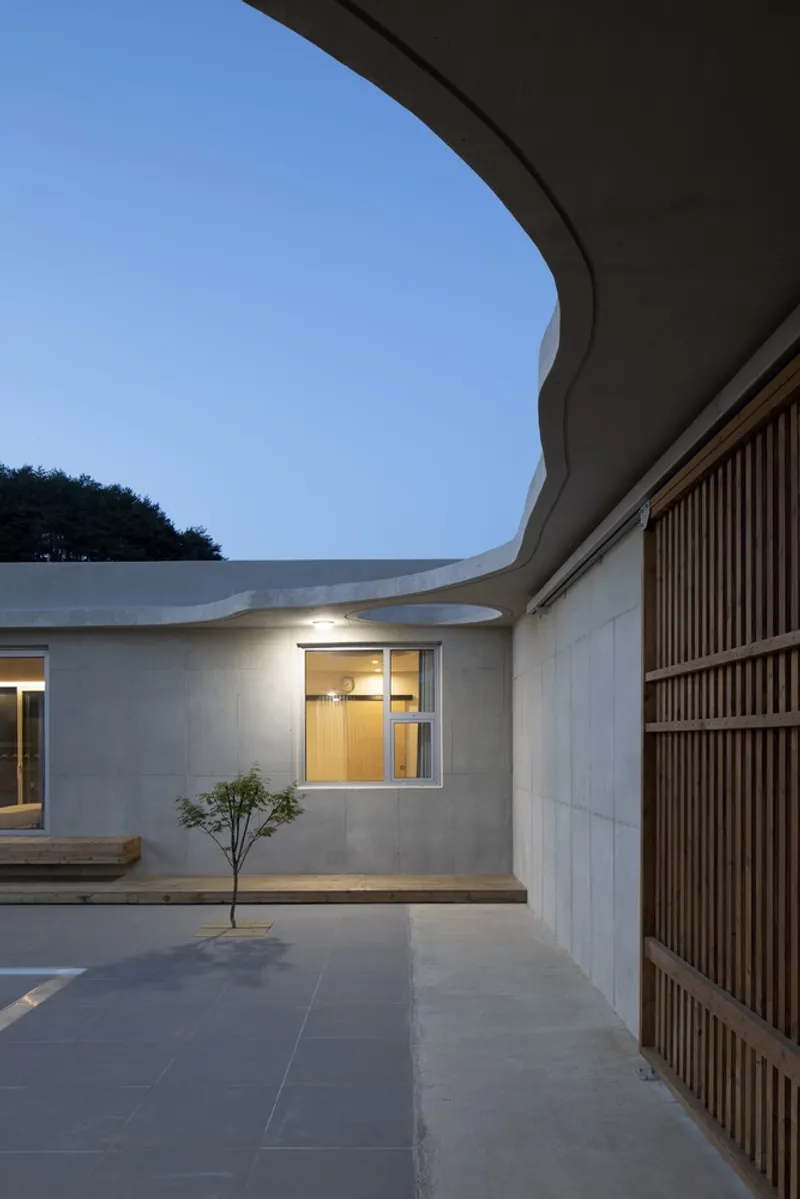
The square courtyard is the spatial engine of the entire house. Concrete walls rise on all sides, punctuated by timber screen panels whose vertical slats control views, filter light, and frame small cinematic moments. In one photograph, sunlight passing through the gate panels casts a heart-shaped shadow on the opposite wall, an accidental emblem of the domestic tenderness embedded in the program. A single tree planted in the pale stone paving occupies the center of this outdoor room, its canopy the only soft element among hard surfaces.
The courtyard performs the same role it does in a traditional hanok: it brings sky, weather, and seasonal change into the center of the home. But Narrative Architects calibrate the enclosure carefully. The walls are high enough to create a sense of interiority yet low enough, in combination with the slatted screens, to let the surrounding landscape leak in at the edges. Light and darkness shift across the concrete throughout the day, a passive spectacle that requires no electricity.
The Floating Roof and Misaligned Columns
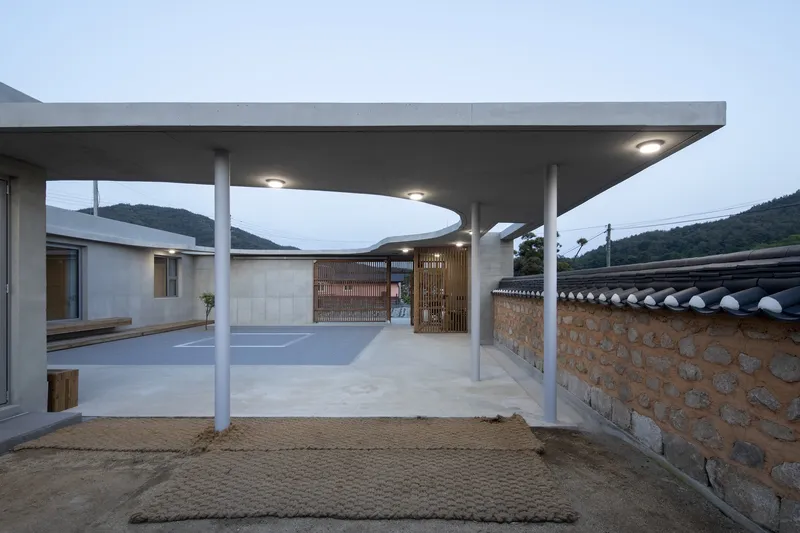
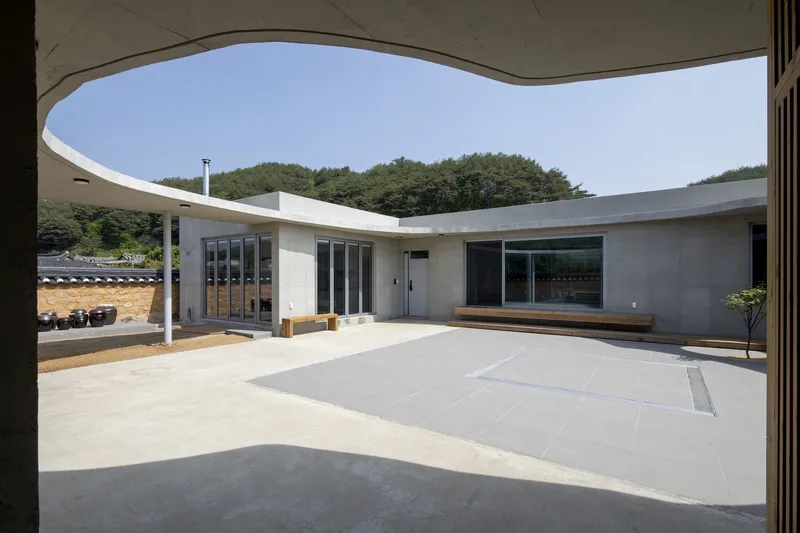
The roof is the building's most overtly contemporary gesture. It encircles the courtyard in a continuous sweep, supported by slender white columns that deliberately slip past one another rather than lining up in a conventional grid. The effect, visible at dusk under the entry canopy, is of a plane hovering above the walls, neither firmly attached nor entirely free. Recessed lighting at the soffit reinforces the levitation.
Looking through the curved canopy opening toward the courtyard, you can read the full spatial choreography: concrete volumes anchor the ground plane, timber benches define resting points, and the roof arcs overhead to frame a controlled aperture of sky. The misaligned columns do more than provide structural support. They establish a rhythm of near-misses that keeps the eye moving and the space feeling open, even when the plan is essentially a walled enclosure. This is the architects' reinterpretation of the hanok's flexible column spacing, where structural regularity yields to the social demands of the room.
Landscape as Living Room
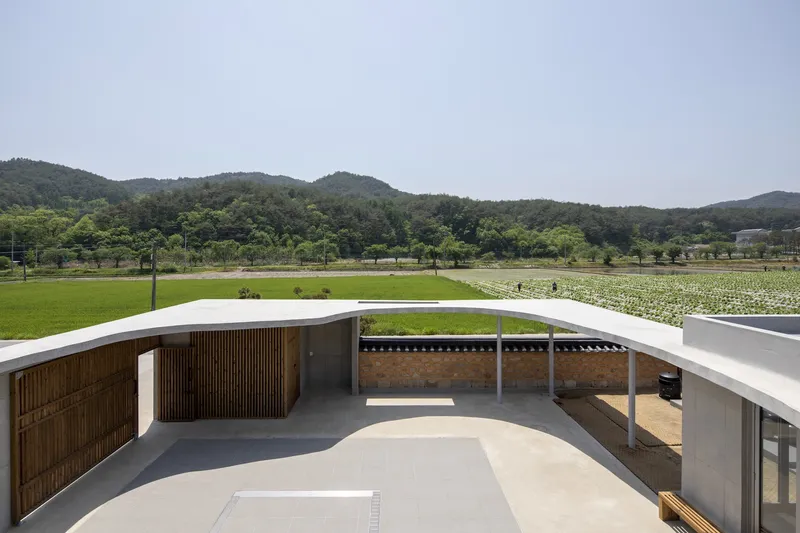
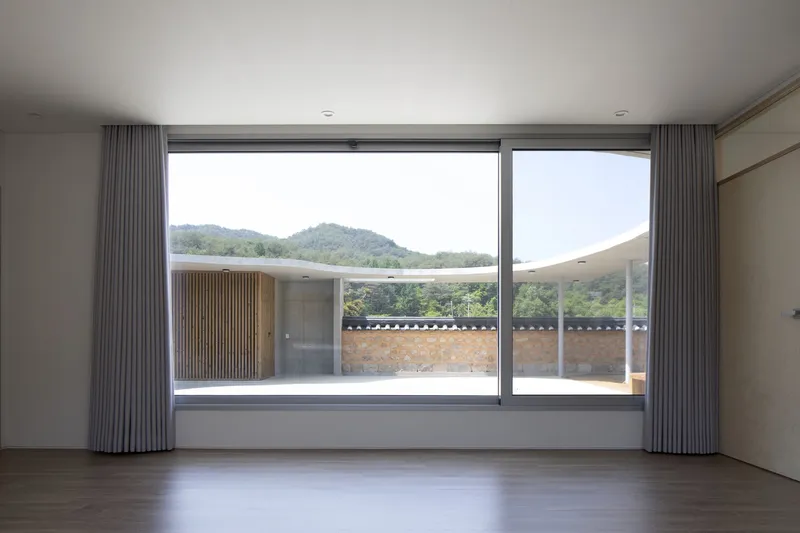
The curved courtyard terrace extends the domestic threshold outward toward rice paddies and forested hills. Under overcast skies, the muted greens of the agricultural landscape merge with the grey concrete to produce a color palette that feels neither warm nor cold but simply elemental. This is the maru, the traditional wooden-floored terrace, reconceived as a wide viewing platform for rural life.
Inside, full-height glazing in the living spaces frames the distant hills as a continuous scroll painting. Grey curtains soften the boundary without blocking it. The program was specific: a living room and tea room large enough for family gatherings during holidays, a wide courtyard for drying crops and outdoor work, and an overall atmosphere of comfort for an elderly resident. Every window placement, every bench, every eave depth serves that brief. There is no spatial excess.
Material Restraint as Cultural Statement
The material palette, board-formed concrete, local stone, timber slats, pale paving, is almost austere. Yet that austerity is itself a cultural position. Traditional hanok construction relied on a limited set of locally available materials deployed with extreme care. Narrative Architects translate that ethic into a contemporary idiom. The board marks in the concrete recall the grain of timber framing. The stone wall references the earthen boundaries of the ancestral compound. The timber screens carry forward the lattice patterns of hanok doors without replicating them.
There is no applied ornament, no cladding pretending to be something it is not. The surfaces age, weather, and absorb light in ways that change by the hour. This is architecture that gains value over time rather than losing it, a quality it shares with the 15th-century house next door.
Why This Project Matters
Heritage-adjacent residential projects often fall into two traps: slavish replication or willful contrast. The Onhyeri Jung Youngja House avoids both by identifying the organizational and experiential principles of the hanok (courtyard, encircling roof, deep eaves, maru, boundary wall) and translating them into a construction language that a contemporary builder can execute honestly. The result is a house that feels rooted in its village without pretending to be old, and modern without pretending its context does not exist.
More importantly, the project is a reminder that architectural innovation does not require formal spectacle. A misaligned column grid, a two-meter stone wall, a single tree in a courtyard: these are small moves with outsized spatial consequences. Narrative Architects have produced a home that honors a mother's half-century of rural life, a village's half-millennium of collective memory, and the discipline's ongoing struggle to reconcile tradition with the present. That is a lot of work for 172 square meters.
Onhyeri Jung Youngja House by Narrative Architects (Sihong Kim, Namin Hwang). Location: Onhye-ri, Dosan-myeon, Andong, Gyeongsangbuk-do, South Korea. Area: 172 sqm. Year: 2023. Photography by Jae Kyeong Kim.
About the Studio
Share Your Own Work on uni.xyz
If projects like this are the kind of work you want to make, uni.xyz is a place to publish your own, find collaborators, and enter design competitions.




Popular Articles
Popular articles from the community


The Musturak Paradise: Senior Living Architecture for a Connected Future in Temara, Morocco
The Musturak Paradise reimagines senior living architecture in Temara via private homes, social spaces, culture, community, and shared care.

AL-JANNAH: Sustainable Architecture and Permaculture for Afghan Widows
AL-JANNAH uses sustainable architecture and permaculture to create resilient oasis of housing, learning, work and renewal for Afghan widows.

Co-life: Sustainable Architecture for Age-Friendly Community Living
Co-life reimagines sustainable architecture for seniors through courtyards, rammed earth, shared gardens, and spaces designed for belonging.

The Ocean Hive: Sustainable Architecture for a Self-Sufficient Civilization at Sea
The Ocean Hive imagines sustainable architecture at sea, where modular habitats, algae, wave power and ocean waste sustain a growing colony.


Similar Reads
You might also enjoy these articles


Hodi-Mandai Geram
Project Function: Preservation and revitalization of the Intangible heritage and socio-spatial identity of the Hodi by Housing, Cultural Memory Center, Sacred Grove, landscape, local tourism economy


Olio Towers: A Mid-Rise for Performers That Fuses Housing, Rehearsal, and Stage
Located blocks from Houston's Theater District, this modular tower stacks living units around a central performance atrium.

Oasis: Modular Green Housing Carved into Dhaka's Urban Fabric
A shortlisted Plugin Housing entry reclaims unauthorized settlements in Dhaka with stepped concrete volumes, green roofs, and ventilation-driven design.

Black Hole: A Floating Megastructure for the Post-Physical Era
Emiliano Mazzarotto envisions a spherical, self-scaling arena where e-sports, digital hotels, and holographic stadiums replace traditional public space.


Explore Architecture Competitions
Discover active competitions in this discipline



Challenge to reimagine the Iron Throne


Photograph architecture without architects


Illustrate the lost glory of Angkor Wat - Render Challenge


Design challenge to reuse E-waste
Comments (0)
Please login or sign up to add comments
No comments yet. Be the first to comment!