
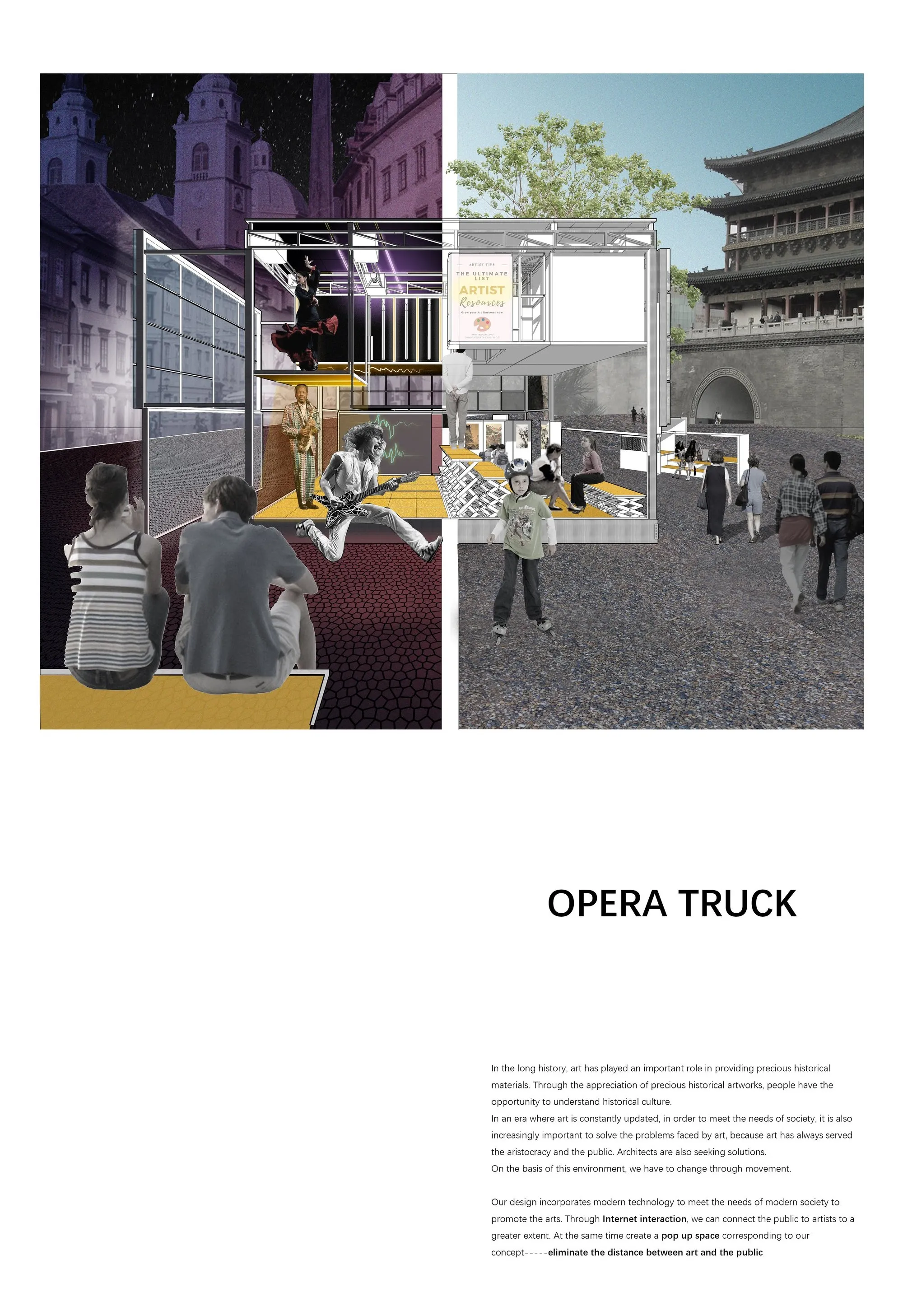
OPERA TRUCK – Endless Possibilities
A mobile architecture concept transforming urban public spaces into interactive cultural hubs for art, performance, and community engagement.


Winner Entry of Opera Truck
Project by Yizhuo Chen
In contemporary cities, art often exists behind the walls of museums, galleries, and opera houses, separated from the rhythm of everyday urban life. While public spaces continue to evolve through technology and infrastructure, cultural engagement remains inaccessible to many communities. OPERA TRUCK – Endless Possibilities challenges this condition through an innovative approach to mobile architecture and adaptive urban design.
Designed by Yizhuo Chen, the project proposes a flexible mobile performance platform that transforms streets, plazas, parks, and urban voids into temporary cultural destinations. By combining modular architecture, digital interaction, and public participation, the project removes the traditional barriers between art and the public while reactivating underused urban spaces.
The proposal responds directly to the growing need for accessible cultural infrastructure within dense urban environments. Instead of asking people to travel to institutions, the architecture itself travels to the people.


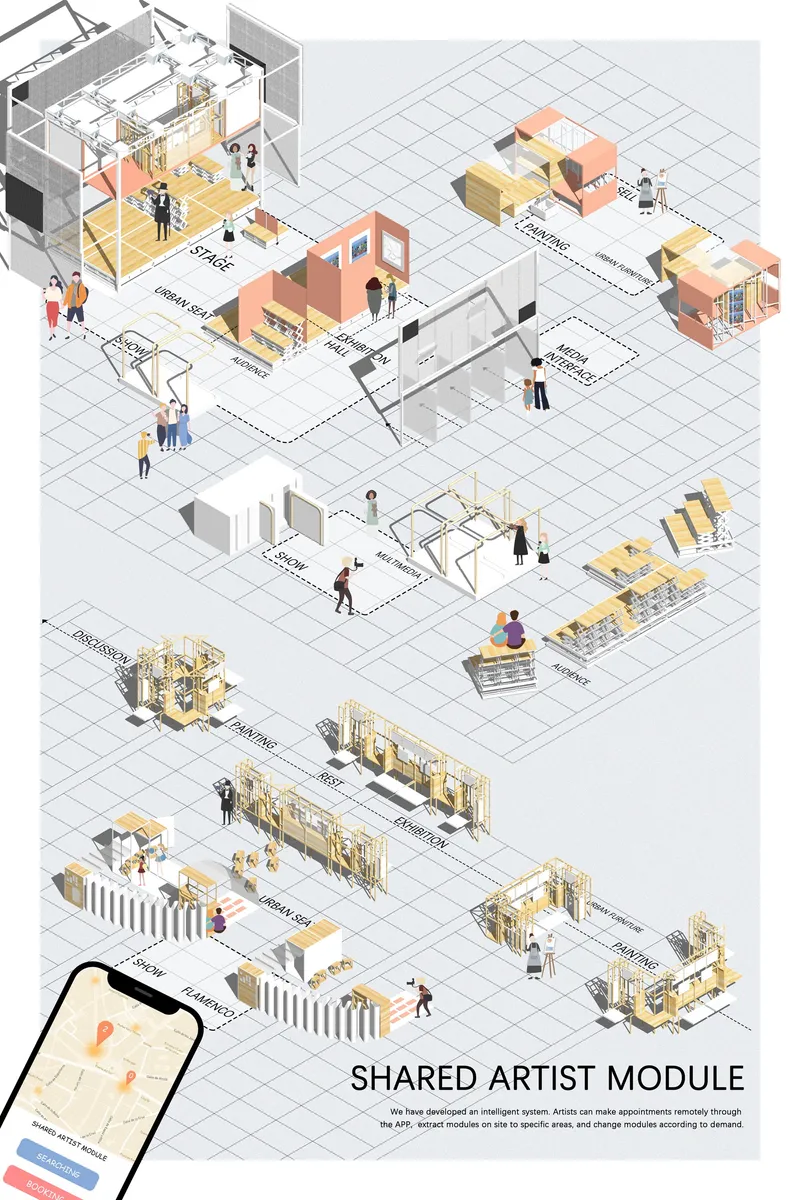
At the center of the concept is a modular mobile truck system capable of adapting into multiple public functions including opera stages, exhibition halls, mobile museums, performance spaces, and interactive urban installations. The project embraces flexibility as both an architectural strategy and a social tool. Each module can be assembled, expanded, or transformed depending on the scale of the event, the location, and the artistic requirements.
This adaptable system introduces a new understanding of temporary architecture. Rather than functioning as a static object, the architecture behaves as an evolving urban framework capable of responding to changing public needs.
The project carefully studies the relationship between art, technology, and urban life. Historically, art has often been experienced through formal institutions and controlled environments. Opera Truck proposes an alternative future where culture becomes integrated into daily movement through streets and public squares. Through digital platforms and mobile infrastructure, artists can directly interact with audiences in real-time urban settings.
One of the strongest aspects of the proposal is its emphasis on interaction. The architecture does not merely host performances. Instead, it creates participatory environments where audiences become active contributors to cultural experiences. Public engagement is amplified through digital applications that allow artists to reserve modules, organize activities, and communicate with audiences across the city.
This integration of technology transforms the project into more than a transportable stage. It becomes an intelligent urban network connecting artists, communities, and public space.
The architectural language of the project reflects clarity, modularity, and adaptability. The system is composed of lightweight structural elements, expandable platforms, media interfaces, LED screens, and transformable seating systems. These components allow the architecture to continuously evolve into different spatial arrangements while maintaining mobility and operational efficiency.
The proposal’s structural strategy also addresses sustainability and practicality. Solar panels integrated into the upper structure help power the installation, while modular construction enables efficient transportation and assembly. The design demonstrates how temporary architecture can remain technologically advanced without becoming environmentally excessive.
The project’s urban analysis highlights another important issue facing contemporary cities: the decline of meaningful public interaction. Many public spaces today function primarily as circulation corridors rather than social environments. Opera Truck reactivates these overlooked urban zones by introducing cultural programming directly into everyday public life.
Through performances, exhibitions, dance, music, painting, and multimedia experiences, the proposal generates moments of collective participation that reconnect communities with public space. The architecture becomes a catalyst for urban vitality.
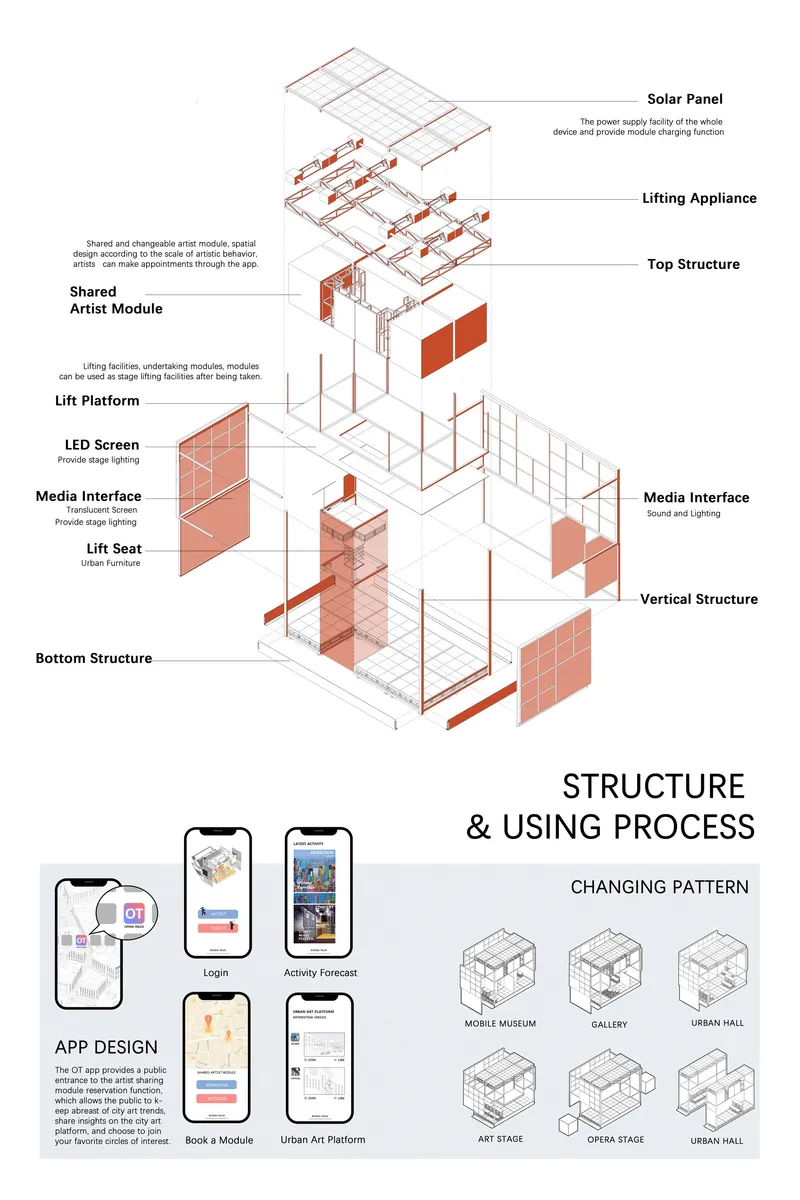
The flexibility of the modules allows the system to support various scales of artistic expression. Small installations can activate intimate streets and alleys, while larger configurations can transform major public plazas into temporary cultural venues. This scalability gives the project exceptional versatility within different urban conditions.
The proposal also explores the emotional relationship between people and architecture. By bringing art into familiar public environments, Opera Truck creates more approachable and human-centered cultural experiences. Audiences no longer experience art as something distant or exclusive. Instead, culture becomes embedded within everyday urban routines.
The visual diagrams and spatial studies demonstrate a sophisticated understanding of adaptive architecture and urban systems. The project carefully balances functionality with experiential quality, producing environments that are both practical and socially engaging.
Beyond its architectural qualities, Opera Truck raises larger questions about the future of cities. How can architecture create stronger public engagement? How can urban infrastructure support cultural accessibility? And how can temporary architecture generate long-term social impact?
Yizhuo Chen’s proposal answers these questions through a visionary yet realistic framework that merges mobility, public participation, and cultural infrastructure into one coherent system.
As cities continue to search for more inclusive and dynamic forms of urban development, projects like Opera Truck demonstrate the growing importance of mobile architecture and adaptive public design. The proposal reimagines cultural infrastructure not as permanent monumental buildings, but as flexible systems capable of moving, evolving, and connecting directly with people.
Opera Truck ultimately presents architecture as a living urban medium. It is not only a stage for performance, but a platform for communication, interaction, and collective experience. Through its modular flexibility and public-centered vision, the project proposes a future where art once again becomes inseparable from everyday life.


Popular Articles
Popular articles from the community


Riyadh For All: Intergenerational Urban Design for Active Aging in Rabat
Riyadh For All reimagines urban design in Rabat with intergenerational co-living, adaptive courtyards, and Moroccan cultural exchange today.

The Ocean Hive: Sustainable Architecture for a Self-Sufficient Civilization at Sea
The Ocean Hive imagines sustainable architecture at sea, where modular habitats, algae, wave power and ocean waste sustain a growing colony.

Conexión: Biophilic Design Reimagines High-Rise Living in Hong Kong
Conexión reimagines high-rise living in Hong Kong through biophilic design, green facades, shared spaces, daylight, water and nature within.

Co-life: Sustainable Architecture for Age-Friendly Community Living
Co-life reimagines sustainable architecture for seniors through courtyards, rammed earth, shared gardens, and spaces designed for belonging.

Similar Reads
You might also enjoy these articles

Eco Chapel: A Green Architecture Pavilion Designed in Symbiosis with the Forest
Eco Chapel uses green architecture to weave prayer, learning and reuse into a forest pavilion shaped by modular hexagonal canopies for life.
Kaffeebühnen: Coffee Shop Architecture Designed as a Civic Stage Between Vienna’s City and Park
Kaffeebühnen turns coffee shop architecture into a civic stage, linking Vienna’s park edge, urban life, warm timber yards, and coffee craft.
Healing Façade: Sustainable Architecture for Reforestation, Community, and Sacred Ecology in Ethiopia
Healing Façade reimagines sustainable architecture as a living wall that restores soil, catches water and renews Ethiopia's forest churches.


Urban Forest: A Vertical Ecosystem for 5,000 Workers in Singapore's Changi Business Park
Radially stacked pods and layered green decks turn a 7-acre plot into 47 acres of ecological workspace projected for 2040.
Explore Architecture Competitions
Discover active competitions in this discipline



Challenge to reimagine the Iron Throne


Photograph architecture without architects


Illustrate the lost glory of Angkor Wat - Render Challenge


Design challenge to reuse E-waste
Comments (0)
Please login or sign up to add comments
No comments yet. Be the first to comment!