
Oppenheim Architecture Carves a 60-Key Resort into Saudi Arabia's Hejaz Mountains
Desert Rock Resort embeds villas, suites, and spas within ancient sandstone formations along the Red Sea coast, building with the land rather than on it.


There is a long history of carving architecture from living rock. The Nabataeans did it at Petra. Ethiopian kings did it at Lalibela. But those precedents were acts of devotion, monuments meant to endure as symbols of divine power. Desert Rock Resort, completed in 2025 by Oppenheim Architecture, borrows the technique for a different purpose: immersive luxury tourism in Saudi Arabia's western highlands. The resort sprawls across 30,000 square meters of the Hejaz Mountains near the Red Sea coast, threading 60 keys, spas, restaurants, and a triangular pool pavilion through a landscape of eroded sandstone and volcanic outcrops. It is, by any measure, one of the most topographically committed hospitality projects built this decade.
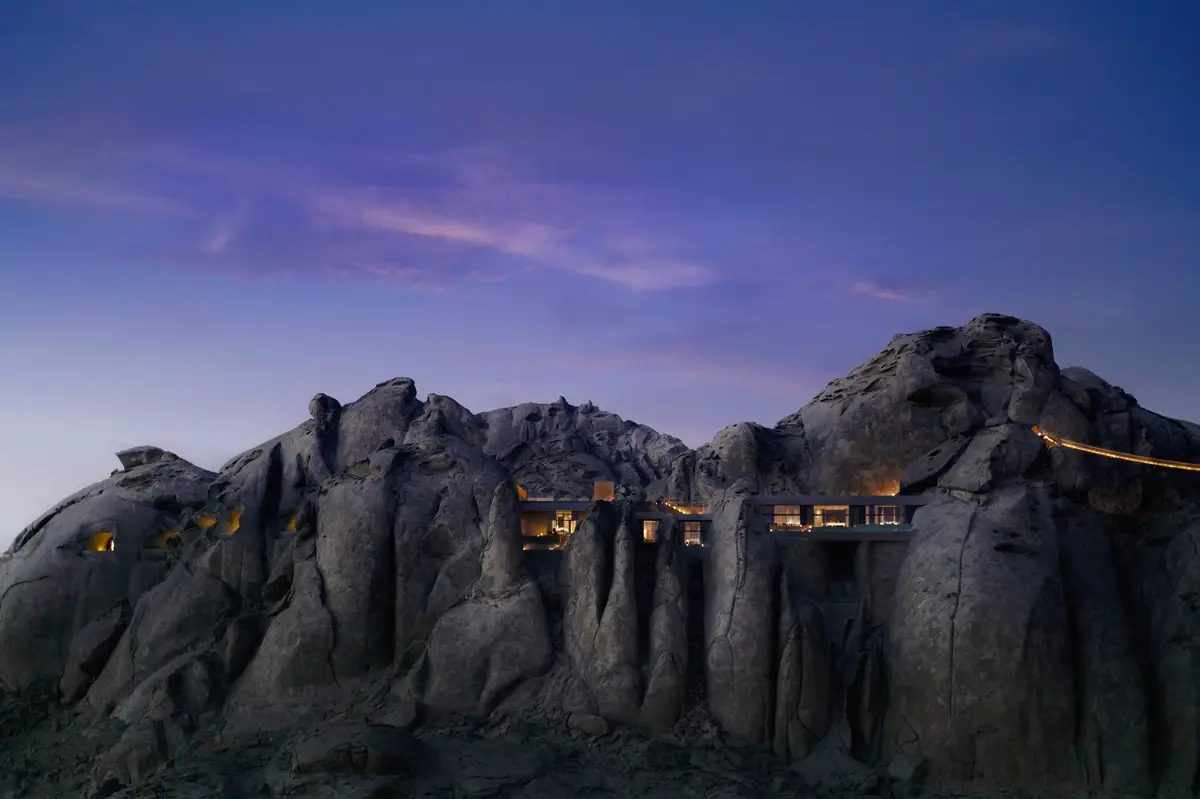
What makes the project genuinely interesting, beyond its spectacular setting, is the rigor with which it refuses to sit on top of the terrain. The firm's guiding philosophy, to build with the land rather than on it, plays out in four distinct accommodation typologies: wadi villas on the valley floor, cliff-hanging villas built into the rock face, mountain cave suites carved into the heights, and crevice villas spanning clefts and ridges. Roads are pushed to the edges, hidden behind landscape mounds. Excavated stone is ground into aggregate and poured back as concrete. At night the suites glow like small lanterns in the cliff face; by day they nearly vanish. The result is a resort that reads less as a building dropped onto a site and more as a geological event that happens to contain beds.
Terrain as Architecture


The defining gesture at Desert Rock is the refusal to distinguish between building and landscape. Concrete volumes emerge from eroded sandstone as if they had always been there, their mass calibrated to match the heft and grain of the surrounding rock. Vertical openings are cut directly into hillsides, creating facades that read as geological fractures rather than architectural compositions. The hand-troweled plaster and honed limestone interiors reinforce the continuity: you move from raw cliff face to finished room without ever feeling like you have crossed a threshold.
The material loop is unusually tight. Most construction materials were recycled from the site itself, with ground stone and sand mixed to form the concrete aggregate. Local stone lines both interior and exterior surfaces. It is a closed system that keeps the color palette locked to the terrain's own ochres and greys, eliminating the visual friction that imported materials would introduce.
The Valley Floor
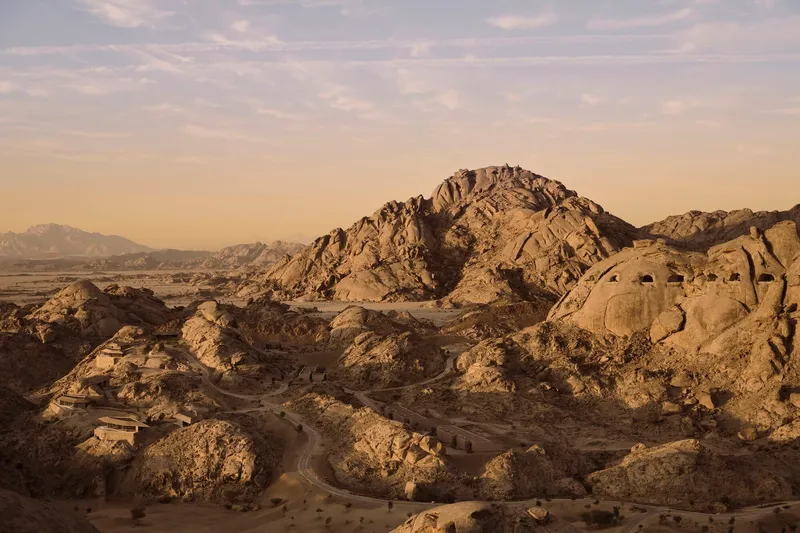

From altitude, the resort's dispersed planning becomes legible. Low-rise structures nestle among eroded formations in the main wadi, connected by winding pathways that follow the natural drainage patterns of the valley. The decision to scatter facilities rather than concentrate them serves two goals: it minimizes the project's physical footprint and it turns circulation into an experience, inviting guests to explore the wider site on foot.
Access to the resort comes through a tunnel, an act of deliberate compression that makes the first glimpse of the hidden valley feel genuinely revelatory. Roads are pushed to the periphery and concealed behind landscape berms, reducing both sound and light pollution. Native plantings are threaded into rocky crevices, softening the hardscape without contradicting it.
Cliff and Crevice Suites


The hotel suites, positioned midway up the mountain, are the project's most dramatic accommodation type. Glazed arched openings are carved into the cliff face, creating rooms that borrow their ceilings from the raw stone above. At twilight the effect is remarkable: warm light spills through vertical slots in the volcanic rock, turning the entire hillside into a lantern. The crevice villas, which span the gaps between rock formations, take the integration further, using the cleft itself as the organizing spatial element.
Large window openings mimic cave mouths, admitting natural light deep into the rooms while framing views of the wadi below. The passive cooling strategy relies on the thermal mass of the surrounding stone to moderate interior temperatures, reducing mechanical loads in a climate where summer heat is relentless. It is a logical extension of the same principle that made rock-carved architecture attractive to the Nabataeans two millennia ago.
Cantilevered Terraces and Bridges

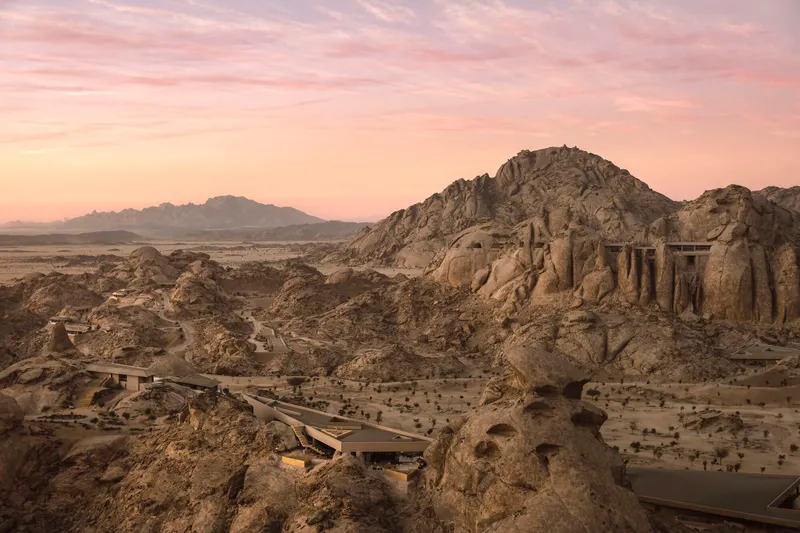
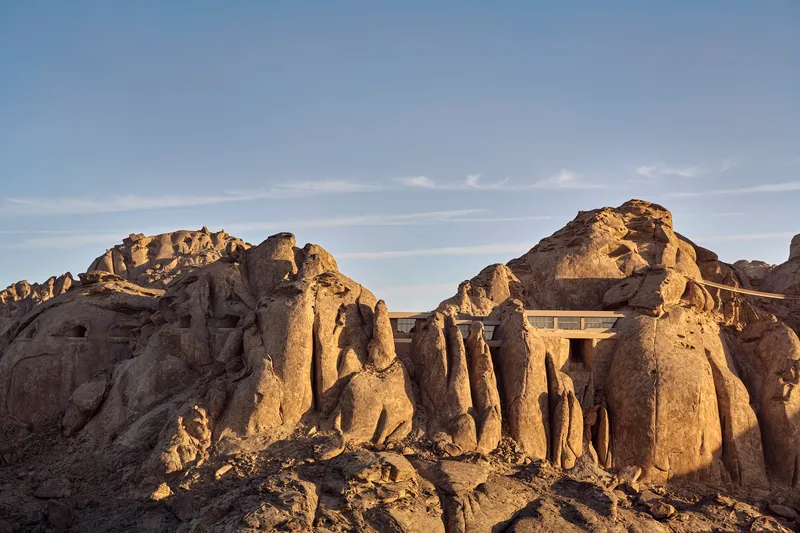
Where the architecture cannot burrow into the rock, it reaches across it. Cantilevered concrete terraces project from boulder formations, their glass walls creating the illusion that guests are floating above the desert floor. An elevated concrete bridge extends across the terrain toward a carved stone outcrop, connecting dispersed clusters without cutting through the landscape at grade. These moments of structural bravado are handled with restraint: the concrete is raw, unadorned, colored to match the stone, so the cantilevers read as geological extensions rather than engineering showpieces.
The tension between carved and cast, between subtracting rock and adding concrete, gives the project its formal vocabulary. Neither approach dominates. The architecture oscillates between the two, sometimes within a single building, creating a productive ambiguity about where the mountain ends and the resort begins.
The Spa and Pool Pavilion


The triangular pool pavilion is the resort's most legible architectural object, and it benefits from that clarity. Set among boulder formations, its cantilevered roof shelters a pool deck flanked by terraces that step down into the rock. The geometry is simple and assertive, a counterpoint to the organic irregularity of everything around it. It functions as a gathering point in a resort that otherwise encourages solitude and dispersion.
The aerial view reveals how carefully the pavilion is sited: it occupies a natural clearing between boulders, its triangular plan rotated to avoid the largest formations. The pool water reflects the surrounding rock and sky, extending the landscape visually while providing the amenity that luxury hospitality demands. It is one of the few moments where the architecture announces itself, and the restraint elsewhere makes it land.
Interior Life Inside the Rock


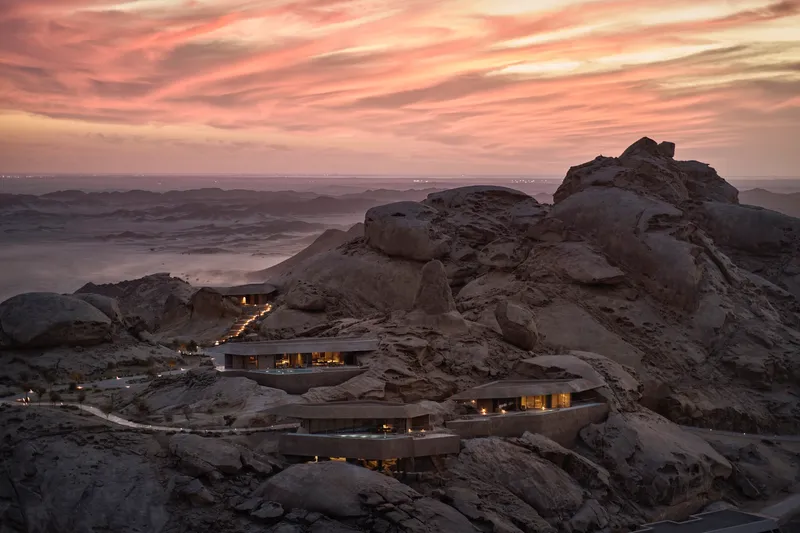
Inside the suites, arched sandstone ceilings give way to glazed openings that frame private pool terraces. The material palette is deliberately restrained: raw concrete, hand-troweled plaster, patinated bronze, and wood in both charred and sandblasted finishes. All 200 furnishings and light fixtures were custom designed for the project, including sand-cast hardware that echoes the resort's geological vocabulary. The interiors feel specific to this place in a way that branded hotel rooms rarely achieve.
The outdoor terraces at twilight, with their low seating, lanterns, and pavilion structures, offer a softer register. These are the resort's social spaces, designed for the desert's most hospitable hours. The lighting is kept deliberately low, consistent with the project's commitment to minimizing light pollution in a landscape that depends on darkness for much of its power.
Why This Project Matters
Desert Rock Resort matters because it tests a proposition that most luxury hospitality projects only gesture toward: that a building can genuinely defer to its site without sacrificing comfort or ambition. The four accommodation typologies, each calibrated to a different geological condition, demonstrate that site-specific design is not a single technique but a family of responses. The closed material loop, the passive cooling, the hidden infrastructure, and the dispersed planning all serve the same thesis. When the architecture disappears into the mountain, it is not a failure of nerve. It is the point.
The project also raises questions worth asking. Building inside a mountain is not inherently sustainable; the excavation, the concrete, and the infrastructure required to support a resort of this caliber carry significant embodied energy. The LEED certification the project targets will measure operational performance, but the full environmental accounting of carving 60 keys from living rock in a water-scarce region is more complex. Still, as a demonstration of what committed site integration looks like at scale, Desert Rock sets a benchmark that will be difficult to match and impossible to ignore.
Desert Rock Resort by Oppenheim Architecture. Located in the Hejaz Mountains, Saudi Arabia. 30,000 square meters. Completed 2025. Photography by John Athimaritis, Courtesy of Red Sea Global.
About the Studio
Share Your Own Work on uni.xyz
If projects like this are the kind of work you want to make, uni.xyz is a place to publish your own, find collaborators, and enter design competitions.


Popular Articles
Popular articles from the community

Opera by the Sea Estonia: Three Shells Dissolving Architecture into Tallinn's Coastline
A winning opera house proposal replaces monumental form with interconnected shells that blur the boundary between building, park and Baltic Sea.

The Amber Palace Opera: A Geological Fiction Surfaces on Tallinn's Baltic Waterfront
Pierre Brillard reimagines a Baltic legend as a public landscape, opera house, and waterfront promenade rooted in Tallinn's coastal identity.

Temporary Home for Dogs: A Reversed Zoo Rethinks Animal Shelter Architecture
In Bucharest, a sinuous corridor and freed landscape flip the logic of containment, designing a shelter that works to make itself unnecessary.

Manzana Morphosis: Stretching Barcelona's Grid into a Living Landscape for 2050
A radical reworking of the Eixample manzana turns density into a tool for generous public space, vertical ecology, and environmental performance.

Similar Reads
You might also enjoy these articles

Bao Huynh Watercolor Atelier: A Serene Art Retreat in Hội An
Bao Huynh Watercolor Atelier in Hội An blends multifunctional art spaces, sustainable design, local materials, and family-friendly living in a serene environment.

Atelier Macri Concept Store Interior Design by CASE-REAL
Atelier Macri store features a "ko" counter, walnut wood details, cork displays, blending retail, gallery, and seamless customer experiences.

Manuel Vargas Izquierdo Stadium and High-Performance Sports Center: Architectural Excellence in Jalpa de Méndez
The Manuel Vargas Izquierdo Stadium blends sustainable design, inclusive sports facilities, and cultural-inspired architecture, revitalizing Jalpa de Méndez’s public spaces.

KAKR Buluh Awar Hall: Revitalizing Community and Ecology Through Bamboo Architecture
Community built bamboo hall revitalizes Buluh Awar village, empowering youth, restoring ecology, celebrating vernacular craftsmanship through sustainable architecture and culture.

Explore Desert Design Competitions
Discover active competitions in this discipline

Challenge to design a portable theatre

Challenge to design a portable music platform

Challenge to design an open learning module for the elderly
Comments (0)
Please login or sign up to add comments
No comments yet. Be the first to comment!