

Opposign: A Signage Pole That Lets Citizens Vote on the Street
Ashish Sanwal reimagines the humble wayfinding pole as a biometric civic interface built from eco-friendly plastic wood and modular metal inserts.


What if the most ignored piece of urban furniture on your street could double as a polling booth? Opposign takes the signage pole, a structure most designers treat as a necessary afterthought, and turns it into a biometric civic interface. Pedestrians scan a fingerprint, press a button, and register their opinion on a public question displayed on an integrated digital screen. The result is a piece of infrastructure that does triple duty: wayfinding, real-time communication, and democratic participation, all housed in a single modular post.
The project is the work of Ashish Sanwal, published on uni.xyz. Opposign sits at the intersection of smart city technology and street-level architecture, proposing that the smallest elements in the built environment can carry outsized social impact when rethought from scratch.
A Fingerprint Scan Instead of a Ballot Box
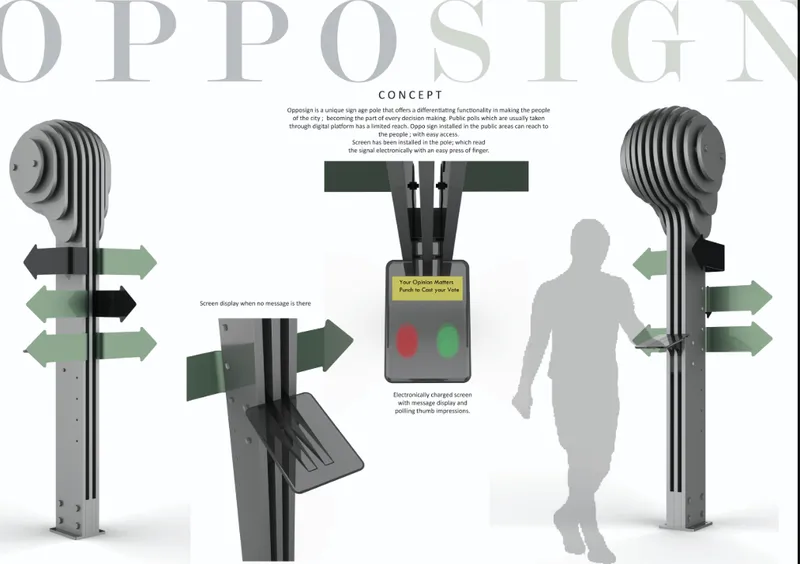
The concept diagram lays out the core interaction clearly. At the top of the post, a digitally charged screen displays real-time messages and public poll questions. Below it, rotating directional fingers provide standard wayfinding. But the key innovation is the biometric scanner embedded in the structure: a simple fingerprint scan authenticates the user, and a button press registers their vote. Traditional public polls are often confined to digital platforms, excluding people without reliable internet access. Opposign brings the poll to the sidewalk, turning a passive marker into what Sanwal calls a "civic interface."
The ambition here is worth noting. Merging governance tools with street furniture is a provocative proposition. It forces a conversation about who gets to participate in urban decision-making and whether physical presence in a city space should count for something in the feedback loop between citizens and administrators.
Four Configurations from One Modular Kit
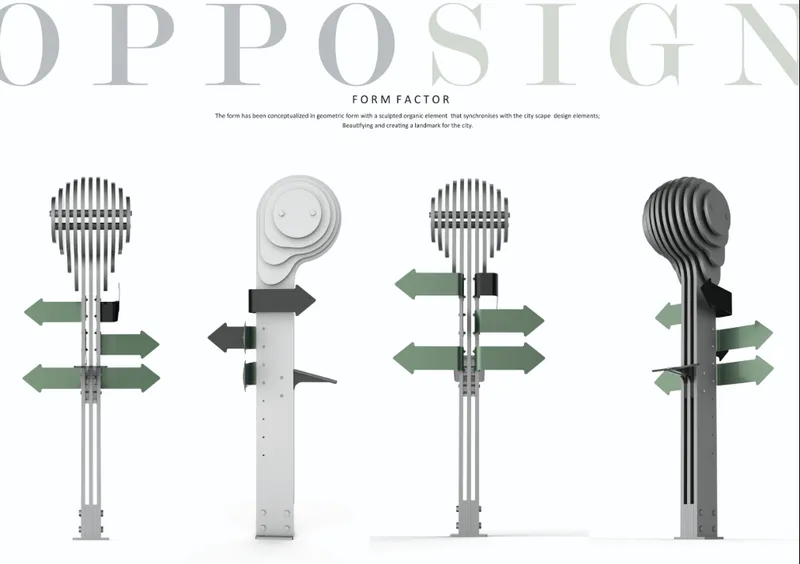
The orthographic views reveal the system's modularity. Four distinct configurations are shown, each assembled from the same kit of parts: striped and solid finger assemblies, a central post, and the digital screen housing at the crown. The knock-down design allows flat-pack transportation, while screw-based connections let city crews add or remove directional elements as signage needs change. Scalability is baked into the geometry rather than bolted on as an afterthought.
The form factor itself acts as a landmark. A layered, circular top structure integrates with the directional arrows to create an iconic silhouette that could serve as a city branding element. Rather than blending invisibly into the streetscape, the pole announces itself, which is precisely the point when the goal is to attract passersby toward a public poll.
Eco-Friendly Plastic Wood and Metal Sheet Inserts
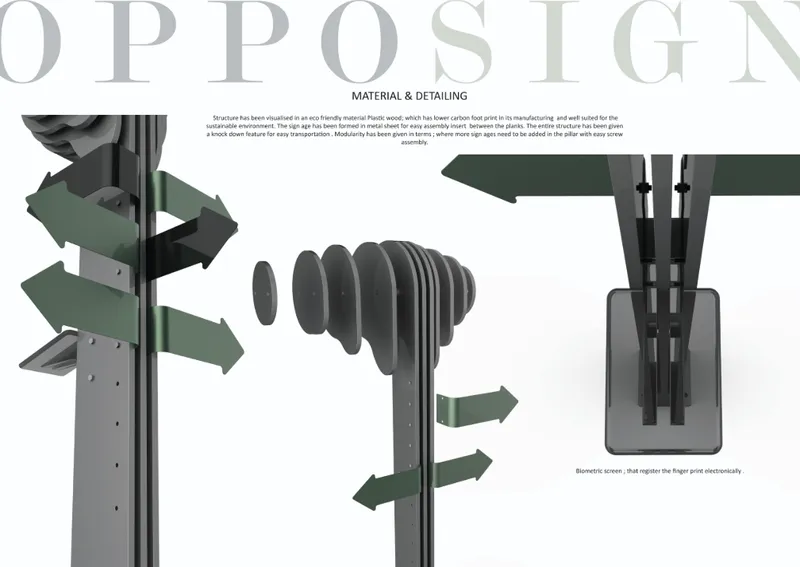
The detail views expose the material logic. The primary structure is visualized in eco-friendly plastic wood, a composite that reduces the carbon footprint during manufacturing compared to conventional materials and supports long-term durability outdoors. Metal sheet inserts reinforce the joints and enable the easy-assembly, easy-disassembly cycle that keeps maintenance costs down. The layered finger mechanism visible in the close-ups shows how each directional element slots into the post, confirming that no specialized tools or welding are required for reconfiguration.
Material innovation in urban furniture often gets overshadowed by flashier architectural projects, but it arguably matters more here. These poles would be manufactured in the hundreds or thousands for a single city. A lower-carbon composite scaled across that volume translates into a measurable environmental benefit, not just a conceptual one.
Why This Project Matters
Opposign makes a compelling case that smart city design does not have to begin with massive infrastructure investments. A single pole, repeated across a transit network or pedestrian district, could create a distributed mesh of civic touchpoints. The biometric polling feature is the headline, but the quieter innovations, the modular assembly, the sustainable composite material, the scalable form system, are what make the concept viable beyond a rendering.
Ashish Sanwal's project reminds us that the smallest elements in a city carry latent potential. When a wayfinding pole becomes a site for democratic participation, it reframes who urban design serves and how it serves them. That shift in perspective, from signage as object to signage as platform, is the kind of rethinking that smarter cities will increasingly demand.
View the Full Project
About the Designers
Designer: Ashish Sanwal
Enter a Design Competition on uni.xyz
uni.xyz runs architecture and design competitions year-round that reward proposals with spatial conviction and real site intelligence.
Project credits: Opposign by Ashish Sanwal.


Popular Articles
Popular articles from the community


Manzana Morphosis: Stretching Barcelona's Grid into a Living Landscape for 2050
A radical reworking of the Eixample manzana turns density into a tool for generous public space, vertical ecology, and environmental performance.

Opera on the Sea: Driftwood Logic Shapes a Timber Opera House on Estonia's Coast
Trevor Orgill's opera house translates the entangled drift of floating timber into a civic building where wood, water, and music converge.
Temporary Home for Dogs: A Reversed Zoo Rethinks Animal Shelter Architecture
In Bucharest, a sinuous corridor and freed landscape flip the logic of containment, designing a shelter that works to make itself unnecessary.
Faces of the Soviet Avant-Garde: Turning Moscow's Street Names into an Open-Air Museum
A network of sculptural installations across a Moscow residential district transforms forgotten architect names into spatial encounters with cultural memor

Similar Reads
You might also enjoy these articles

The Amber Palace Opera: A Geological Fiction Surfaces on Tallinn's Baltic Waterfront
Pierre Brillard reimagines a Baltic legend as a public landscape, opera house, and waterfront promenade rooted in Tallinn's coastal identity.
Dynamic Modules Shelter: A Telescopic Ring for Mountain Pilgrimage
A circular modular framework of steel, bamboo, and fabric grows vertically with demand, wrapping communal ground in adaptable shelter.

Singing Woman: Contemporary Architecture Inspired by Estonia’s Voice and the Sea
Singing Woman turns Estonia’s song culture into flowing opera house architecture, blending public life, landscape, sea, and national memory.

HYPERBLOCK: Flexible Urban Design for Barcelona’s Future City
HYPERBLOCK reimagines Barcelona as flexible urban design, layering density, daylight, public space and adaptable housing above Cerdà’s grid.

Explore Signage Competitions
Discover active competitions in this discipline

Design challenge to equip cities with modern furniture

Packaging challenge - Design meets sustainability
Comments (0)
Please login or sign up to add comments
No comments yet. Be the first to comment!