
Mind Manifestation Design Revives Maharashtra's Wada Courtyard Tradition in a Vaulted Family Retreat
In Amravati, a ferro-concrete vaulted residence for three generations reinterprets the traditional Wada house with lime, brick, and steel.

Six hundred kilometers from their Pune office, principals Anand Deshmukh and Chetan Lahoti of Mind Manifestation Design built a holiday home that refuses to treat tradition as decoration. The Osari Residence in Amravati takes the spatial DNA of the Maharashtrian Wada, the region's vernacular courtyard house, and reconstructs it with ferro-concrete barrel vaults, steel bridges, and lime-finished walls. The result is a 241-square-meter house for six family members across three generations that feels simultaneously ancestral and invented.
What makes the project worth studying is not the stylistic reference but the rigor with which each traditional room type has been rethought. The Osari (verandah), Chowk (central courtyard), Devadi (guard room), Dalan (living hall), Devghar (worship space), and Swayampak Ghar (kitchen) all appear in the plan, but none of them behaves exactly the way it would have a century ago. The courtyard still anchors a Tulsi Vrundavan, yet its upper edges are calibrated so that bedrooms overhead cast shade precisely when Amravati's afternoon sun is most punishing. That kind of climate-driven section design is what separates homage from architecture.
Street Presence and the Threshold Sequence
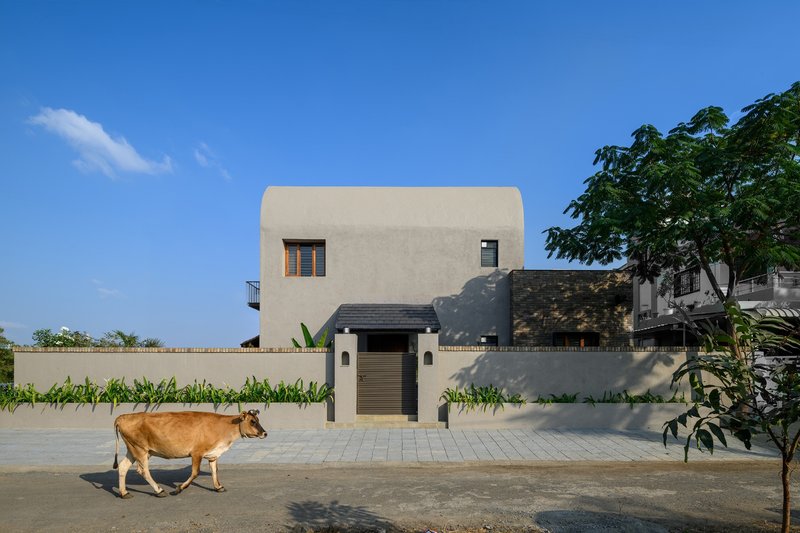
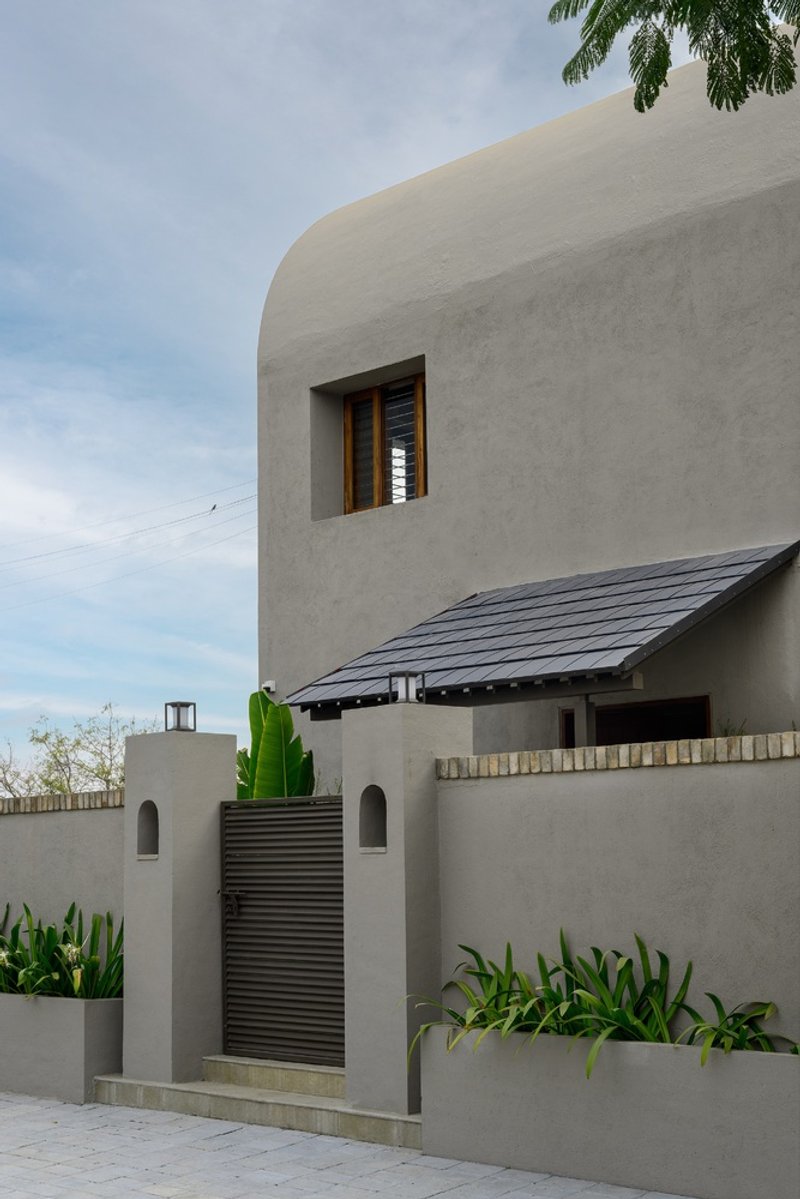
From the street the house reads as a quiet compound wall punctuated by a timber-slat gate and a pair of arched niches. There is no billboard facade. The curved stucco volumes of the barrel vaults only announce themselves as you step back and catch the roofline through the trees. It is a deliberate posture for a city where domestic architecture tends toward gated ostentation: the Osari Residence saves its spatial drama for the inside.
The entry sequence compresses and releases in a way that any Wada builder would recognize. You move from the street through a narrow portico flanked by planted beds into the semi-covered Osari, and then finally into the open Chowk. Each threshold lowers the temperature and raises the light, a gradient that makes the courtyard feel earned rather than simply arrived at.
Facade Materiality: Brick, Stucco, and the Vault
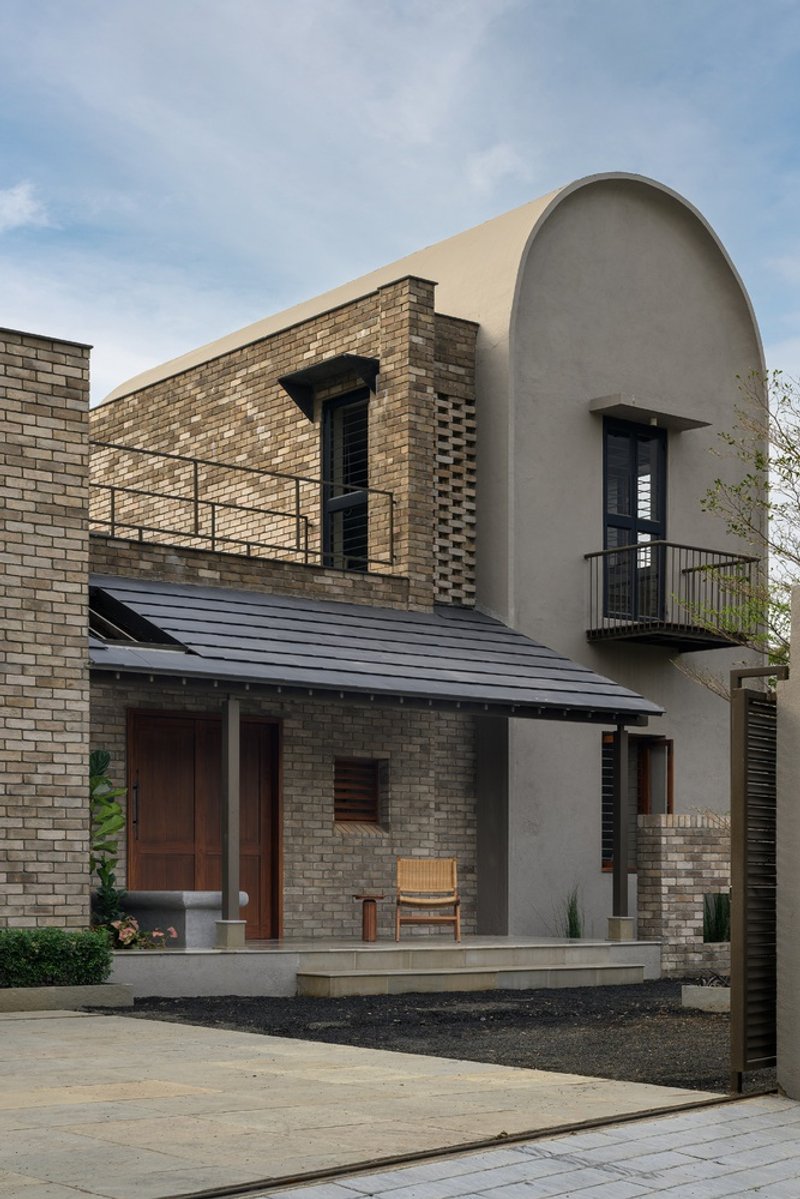
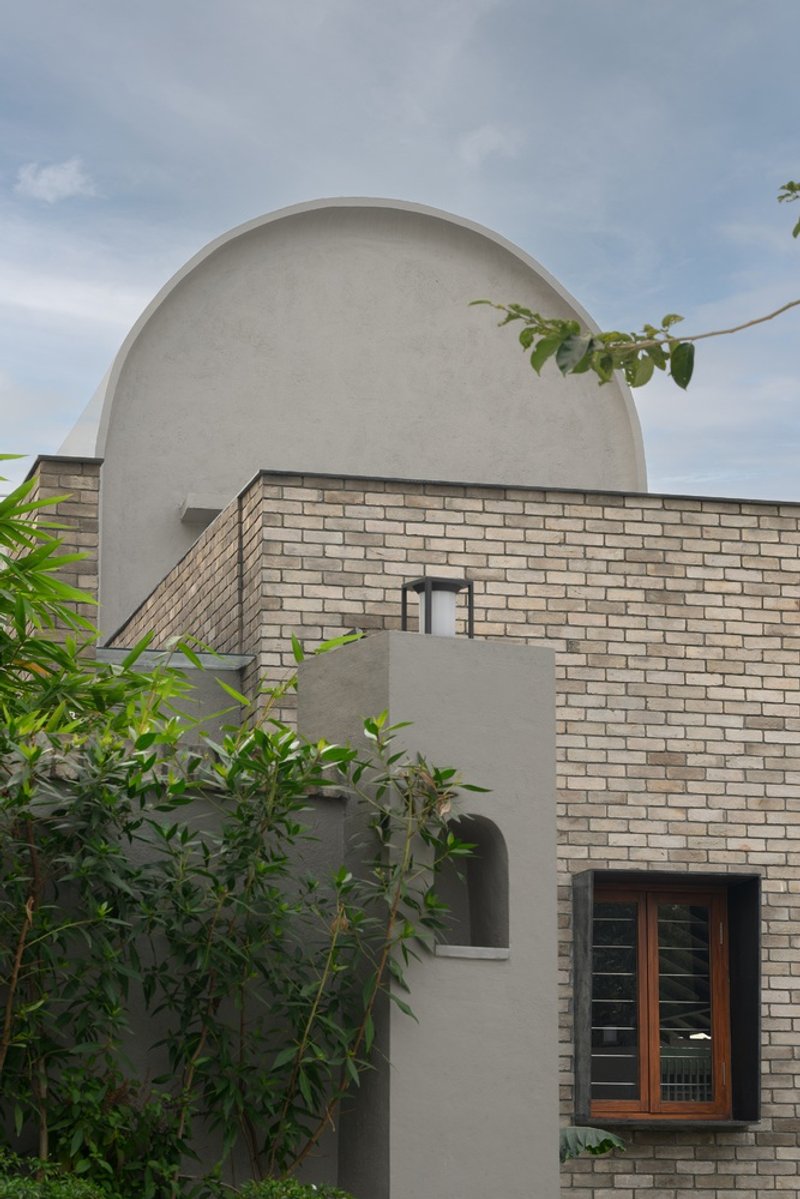
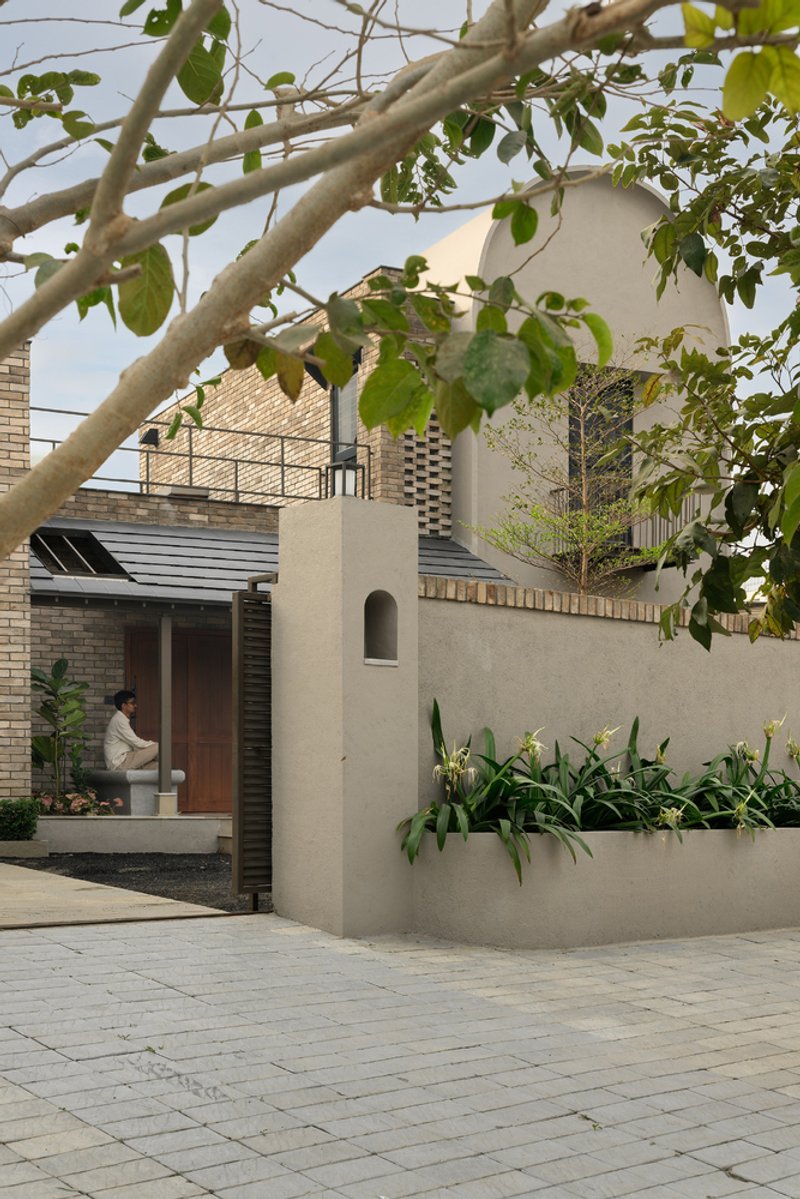
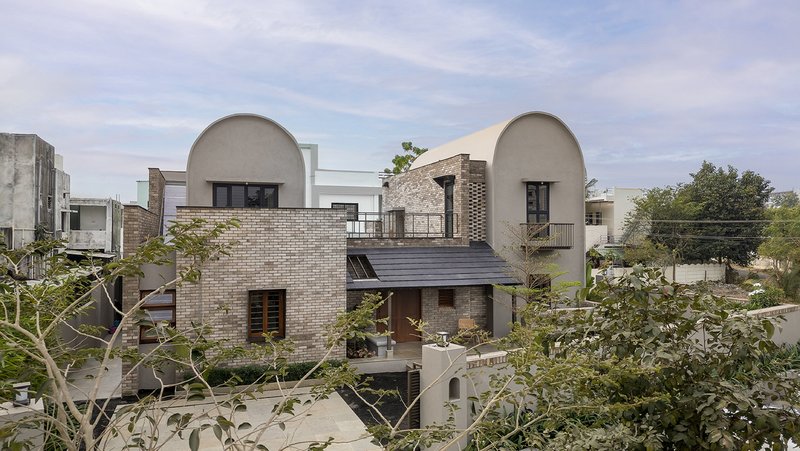
The exterior palette is reduced to three moves: exposed brick, muted lime-toned plaster, and the smooth stucco skin of the ferro-concrete vaults. Where brick meets plaster the joint is left blunt, no trim, no reveal, so the two materials read as tectonic layers rather than decorative choices. Metal railings and balconies add a finer grain at the upper level, their dark profiles drawing a crisp line between solid wall and open sky.
The semi-circular vault is the signature form. Built from just three inches of ferro-concrete, it is structurally thin yet visually commanding. From the aerial view it registers as a pair of parallel lozenges sitting above the surrounding flat-roof neighborhood. The choice of form is not arbitrary: a vault sheds rainwater quickly, spans without interior columns, and creates an internal surface that radiates less heat downward than a flat slab would. In a city swinging between scorching summers and cold winters, that matters.
The Central Courtyard as Climate Machine
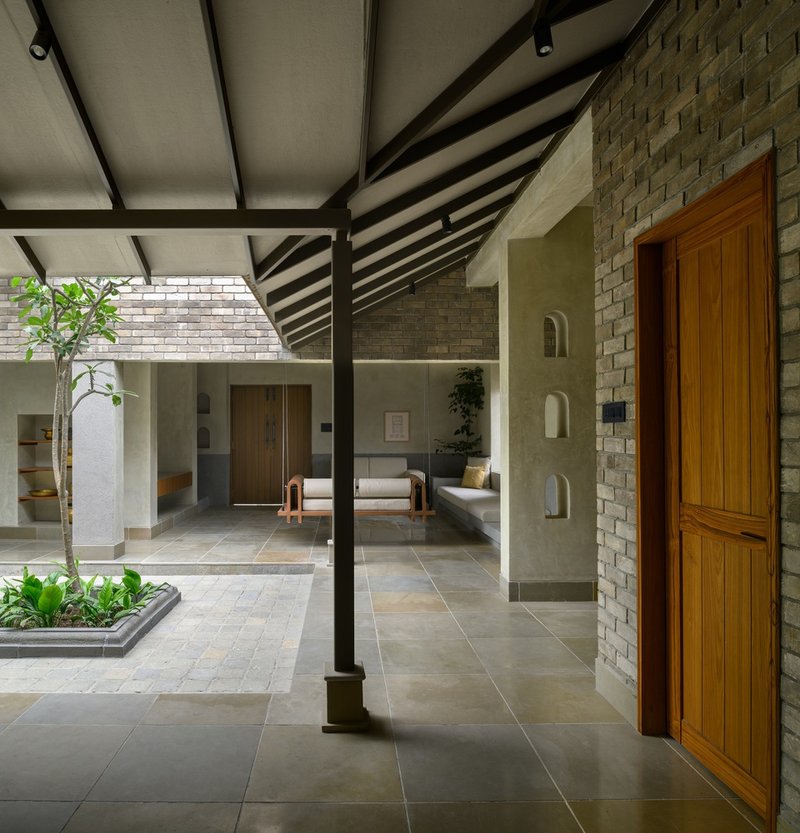
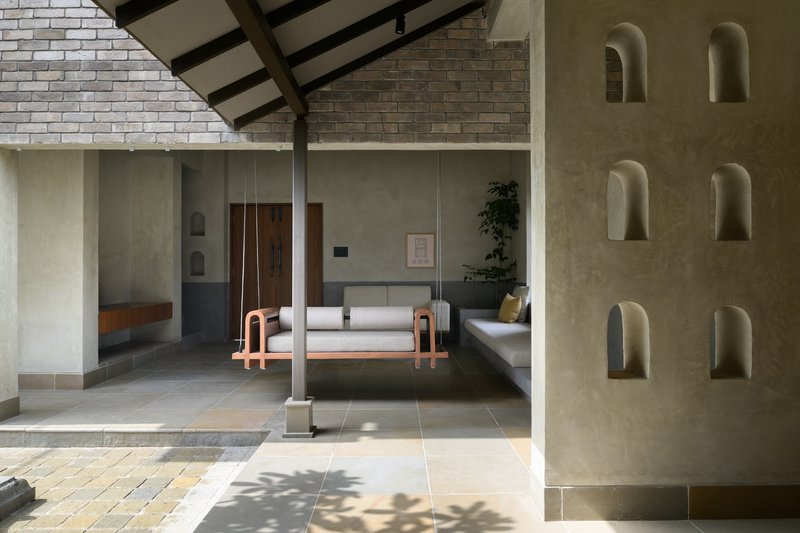
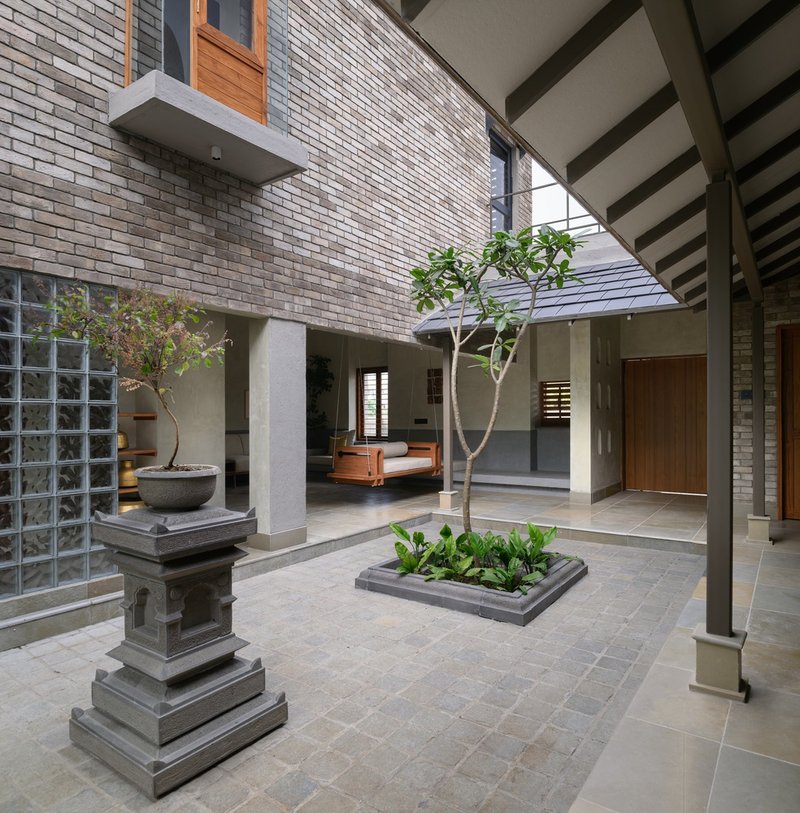
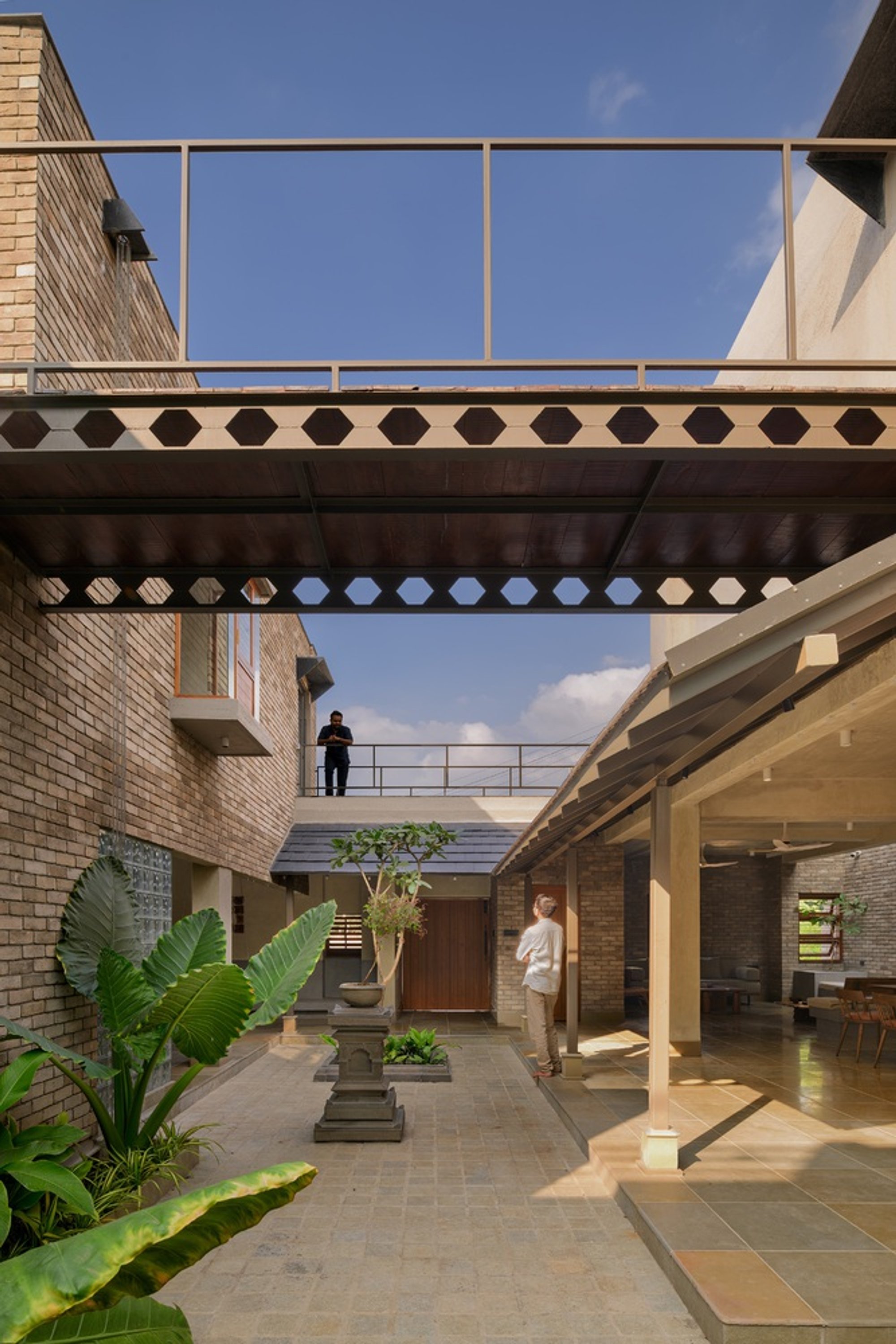
The Chowk is the heart of the plan and the engine of the building's passive cooling strategy. Stone pavers absorb heat slowly, a young tree filters light and adds humidity, and the upper-level bedrooms on two sides cast a shadow diagram that keeps the courtyard shaded from early afternoon onward. Cool air pools here at night and is drawn through the ground-floor living rooms via large openings, a stack-ventilation loop that eliminates the need for air conditioning during most of the year.
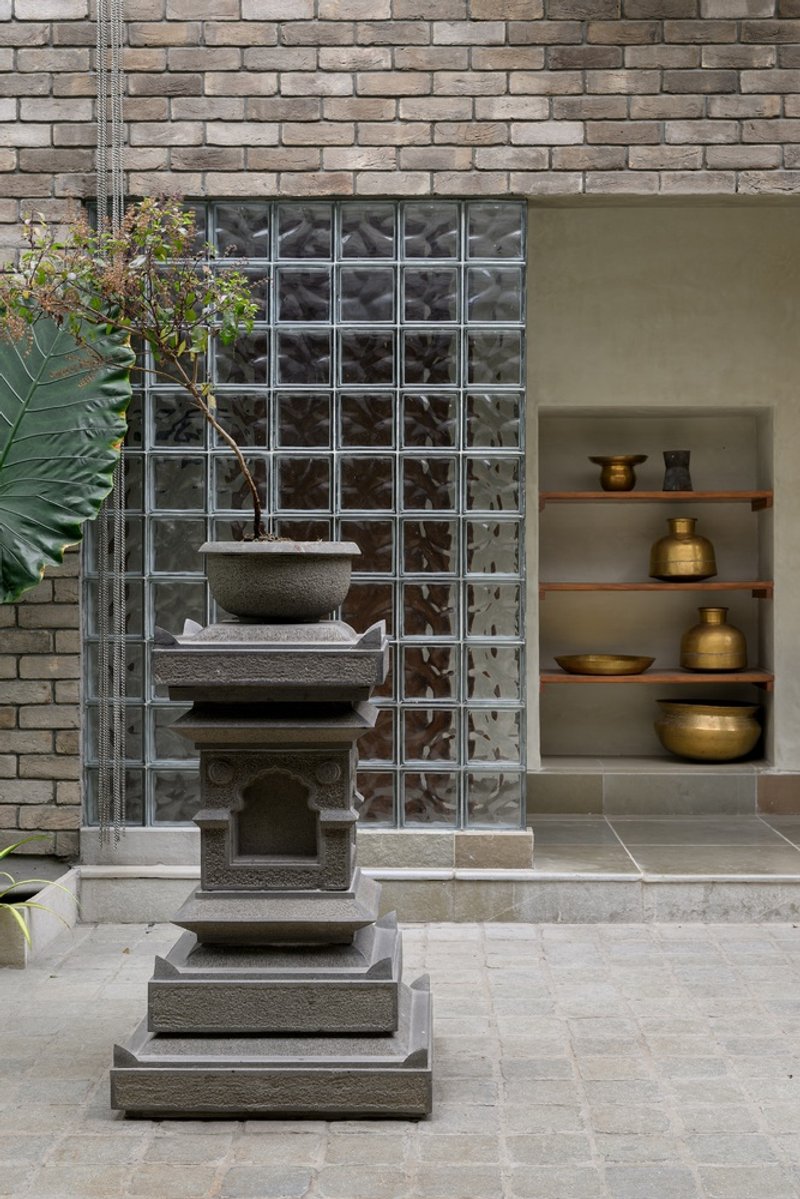
Architecturally the courtyard also works as a social switchboard. Glass block screens and arched plaster niches line its walls, filtering views between the kitchen, the worship alcove, and the living hall. You can occupy any room on the ground floor and still sense who is in the courtyard. For a multi-generational family that gathers here during festivals and holidays, that ambient awareness is precisely the point.
Bridges, Jharokhas, and Vertical Connection
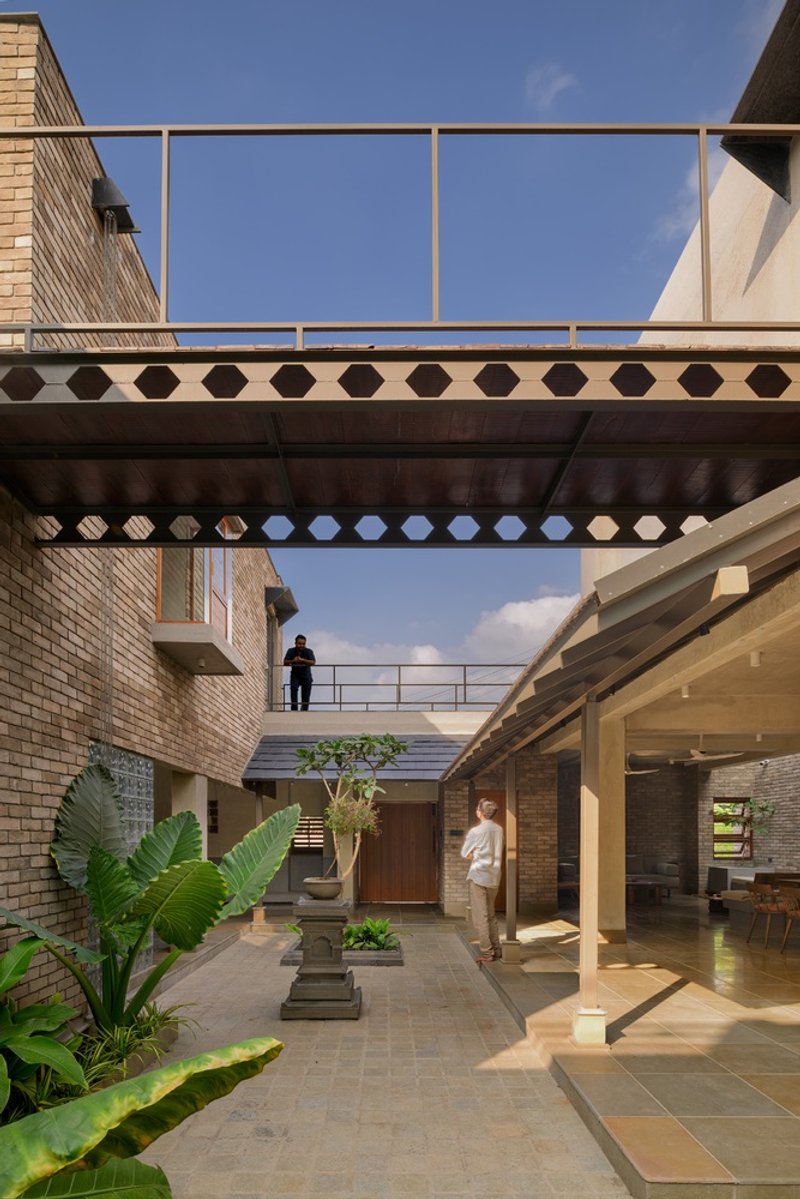
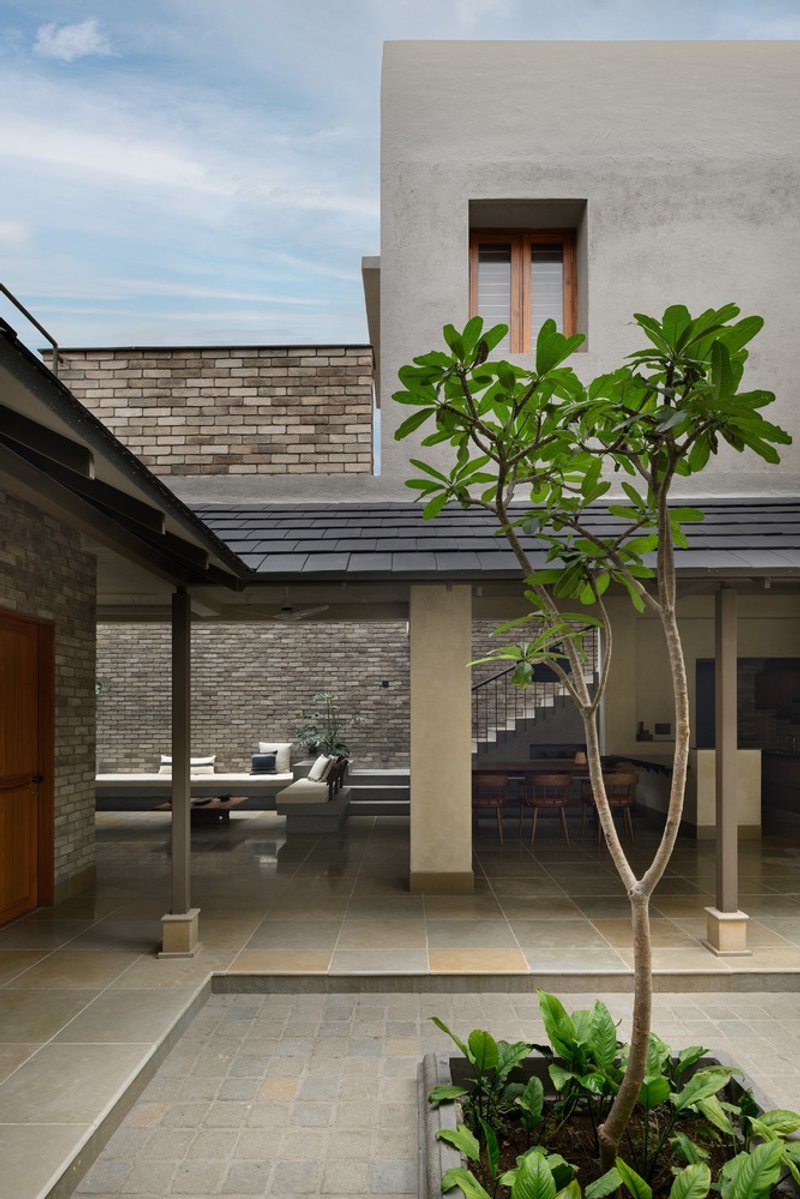
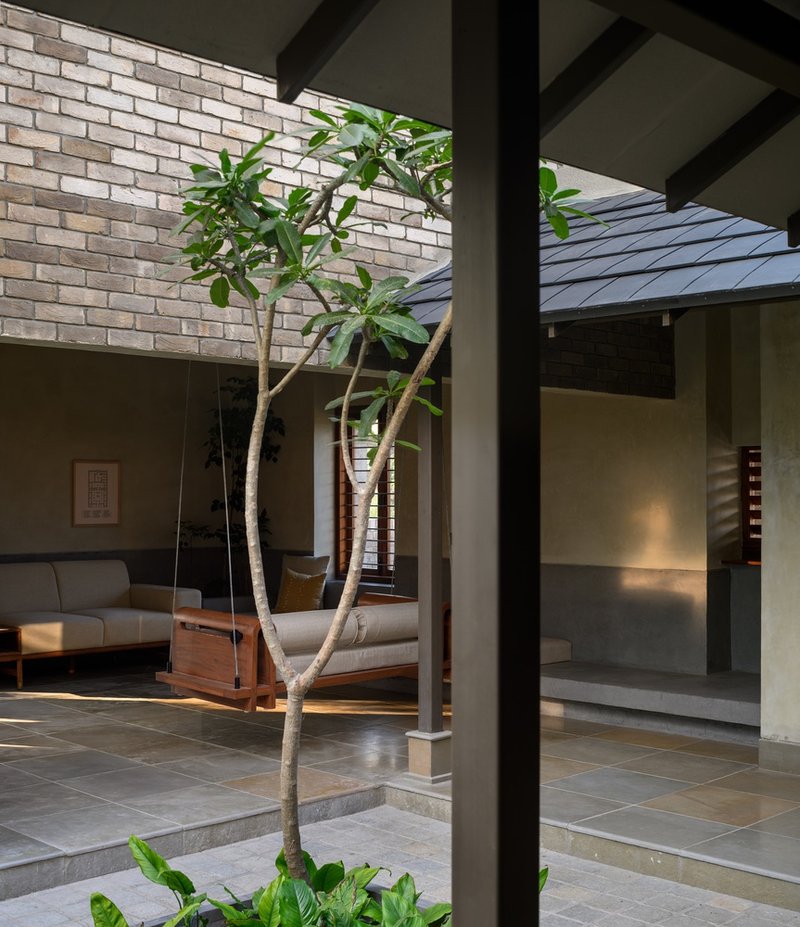
Steel bridges span the courtyard at the upper level, connecting the bedroom wing to the terrace side. They are open-grate walkways braced by patterned metal screens, visually light enough to read as furniture rather than structure. The traditional Jharokha, the projecting bay window found in Rajasthani and Maharashtrian havelis, reappears here not in carved stone but in a cantilevered metal frame. It gives the upper corridor a place to pause, look down, and participate in courtyard life without descending.
These elements solve a practical problem that plagues courtyard houses: vertical circulation eats floor area. By pulling movement onto bridges, the architects free the ground floor for generous communal seating and keep the staircase to a single compact run. The strategy also means every trip between rooms passes over the courtyard, reinforcing the family's daily engagement with the central void.
Interior Surfaces: Lime, Timber, and Controlled Light
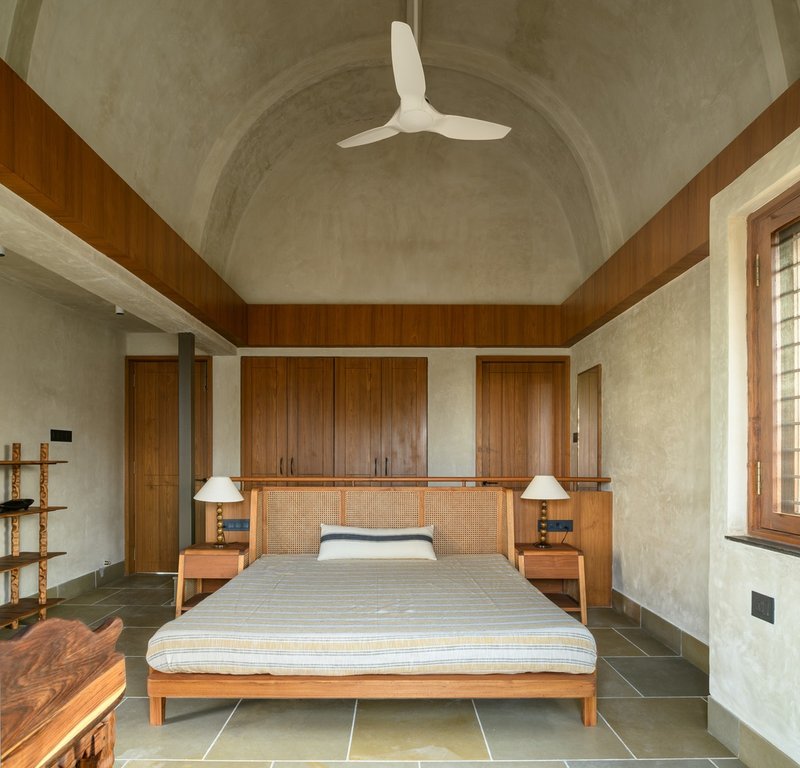
Inside the barrel-vaulted bedrooms, the lime putty walls glow with a soft warmth that changes through the day as light enters through carefully sized openings. Lime plaster is hygroscopic: it absorbs moisture when indoor humidity rises and releases it when the air dries out, creating a self-regulating microclimate. In Amravati's extreme swings between dry summer heat and damp monsoon nights, that material behavior translates directly into comfort.
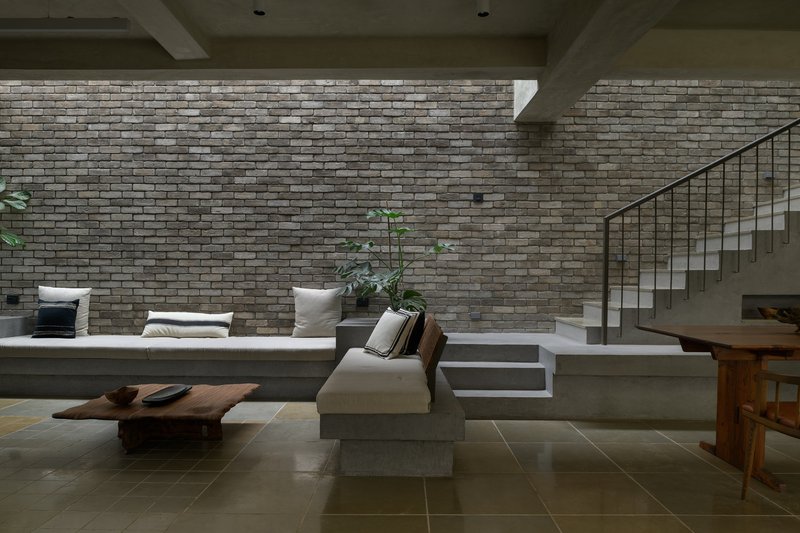
The ground-floor living areas lean toward heavier textures: exposed brick walls, a sunken seating zone with built-in benches, and polished concrete stairs. Brass vessels and a stone sculpture sit in alcoves that recall the niches of a traditional Devghar but are stripped of ornament. The overall palette is warm without being sentimental, an interior that invites the patina of brass darkening and lime weathering rather than resisting it.
Staircases and Sectional Play
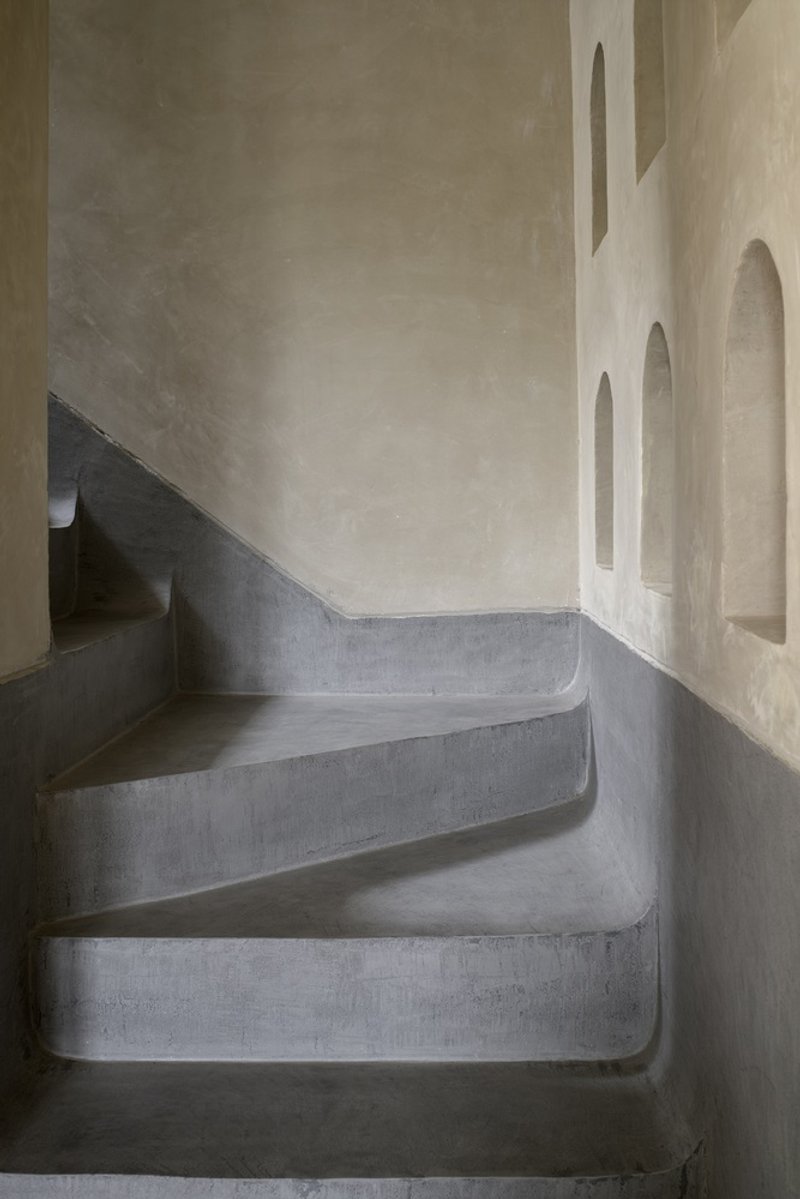
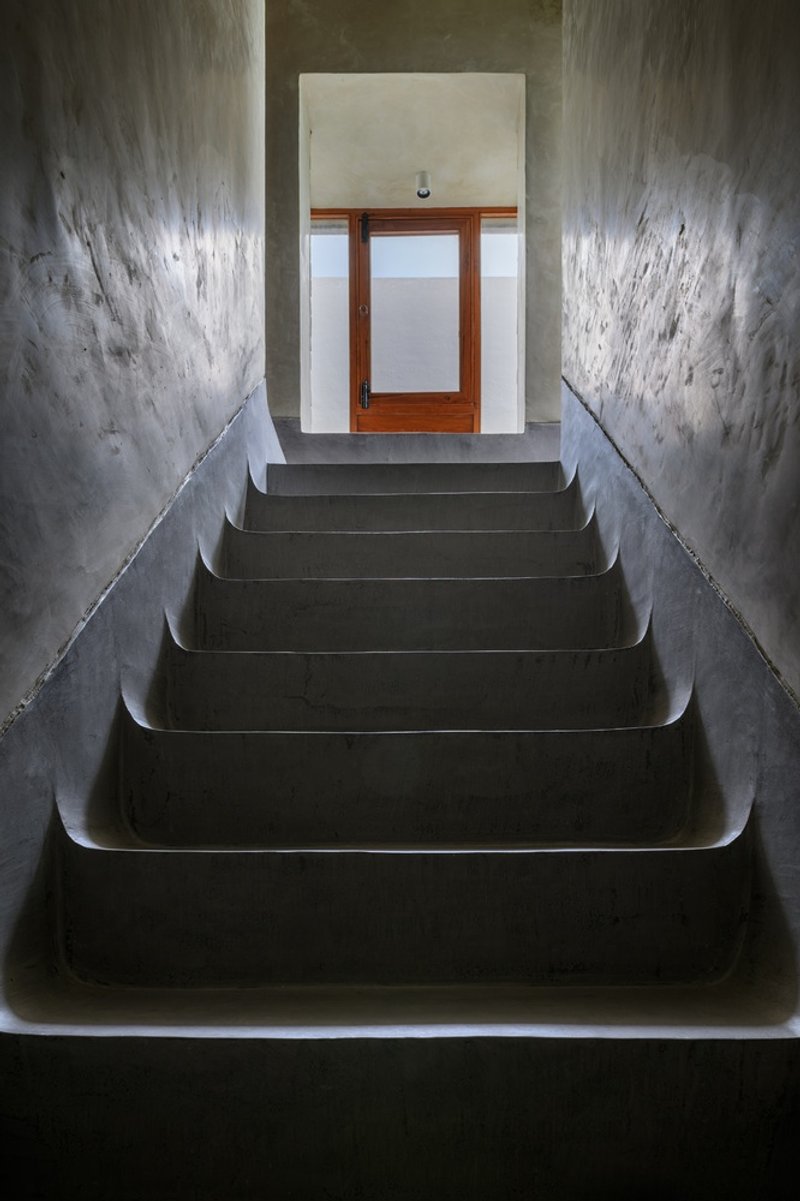
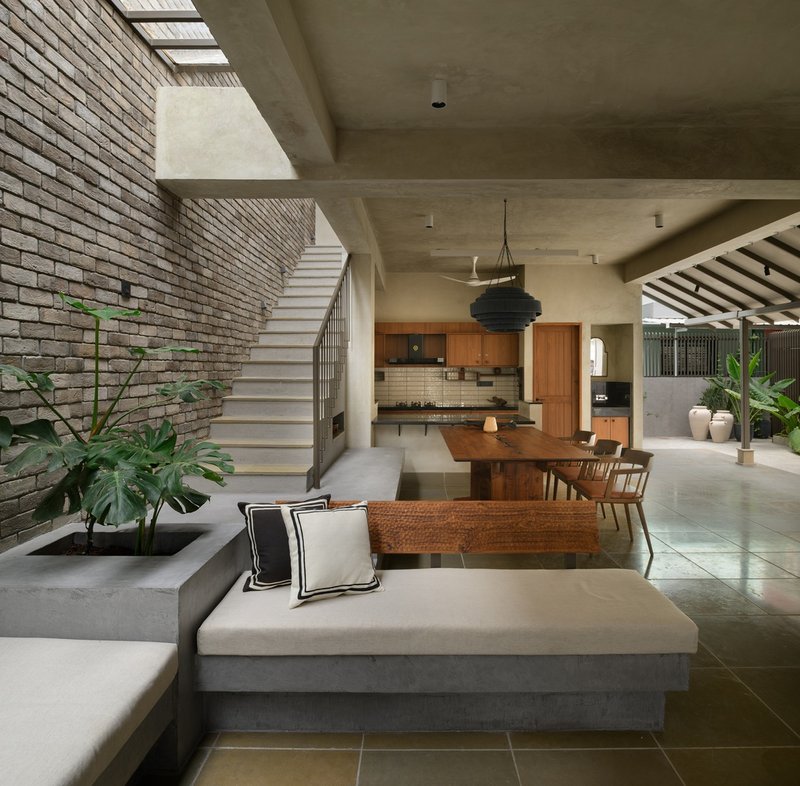
The staircase is the one element that most clearly declares the building's contemporary ambitions. Its curved concrete treads spiral upward past a wall of arched niches that catch afternoon light, turning a utilitarian climb into a cinematic moment. At the top, a timber door set in rough plaster completes the sequence. The skylit stairwell punches through both floors and acts as a secondary light well, supplementing the courtyard and reducing the depth of any room that might otherwise be too far from a natural light source.
Terraces and the Dusk Silhouette
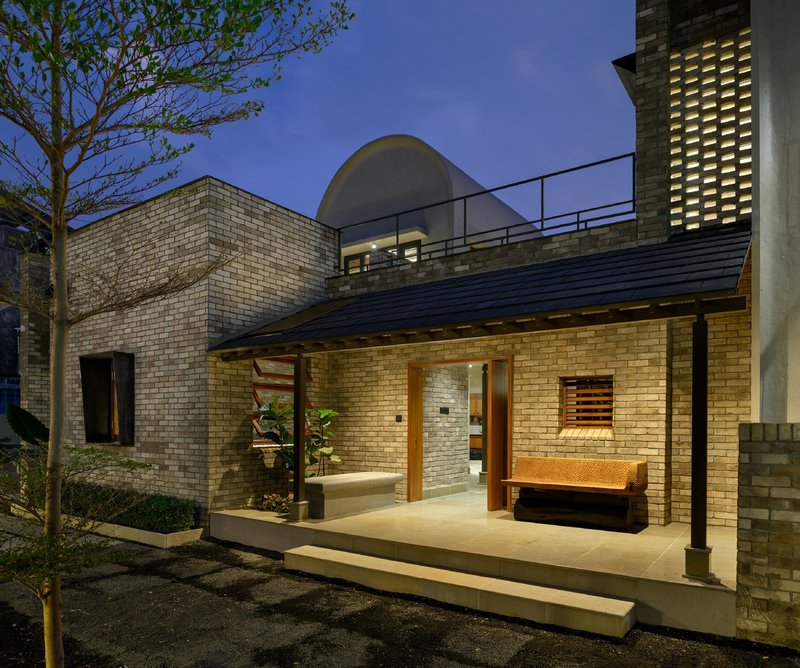
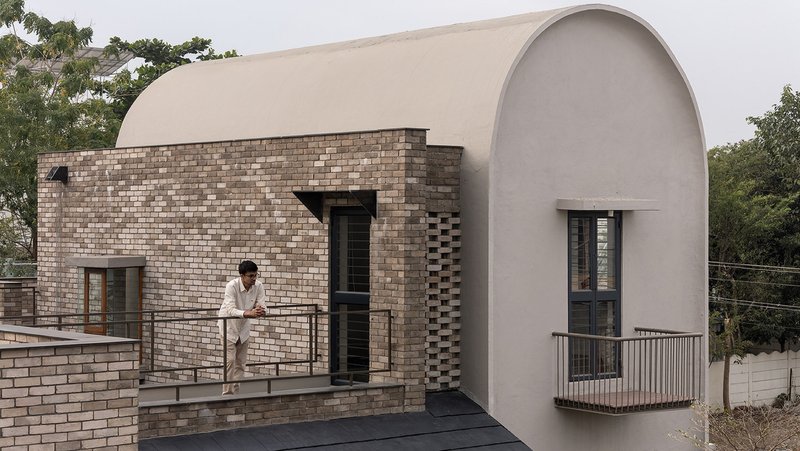
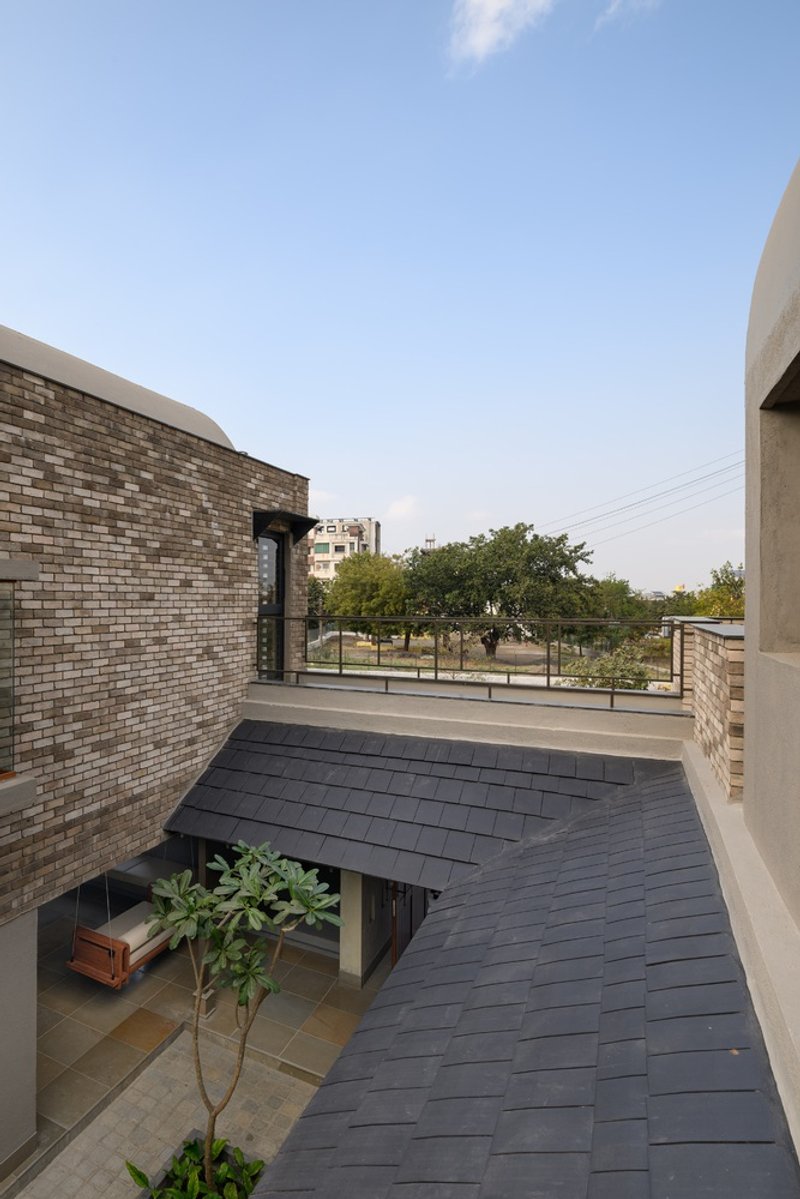
At dusk the barrel vaults become lanterns. Light escaping through the upper-level openings silhouettes the curved profiles against the Amravati skyline, and the brick volumes below take on a warm orange cast. The rooftop terrace, overlooking a park to the west, is sheltered by a sloped shingle canopy that extends the habitable outdoor area into the cooler evening hours. It is where the house opens outward after spending most of its plan energy turning inward.
The contrast between the introverted courtyard and the extroverted terrace is one of the project's best spatial moves. During the day the family gravitates down and in; at night it drifts up and out. That rhythm mirrors the thermal logic of the house and gives the compact plan a range of atmospheres that a building twice its size might struggle to match.
Plans and Drawings
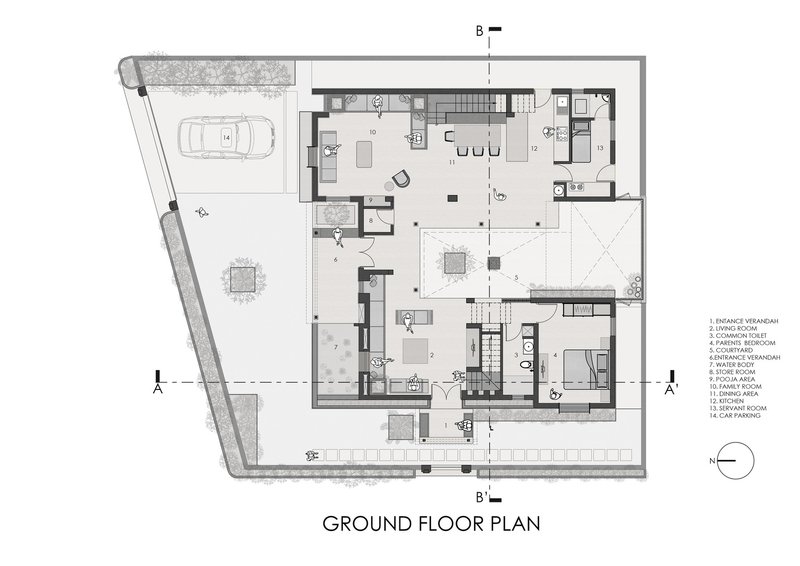
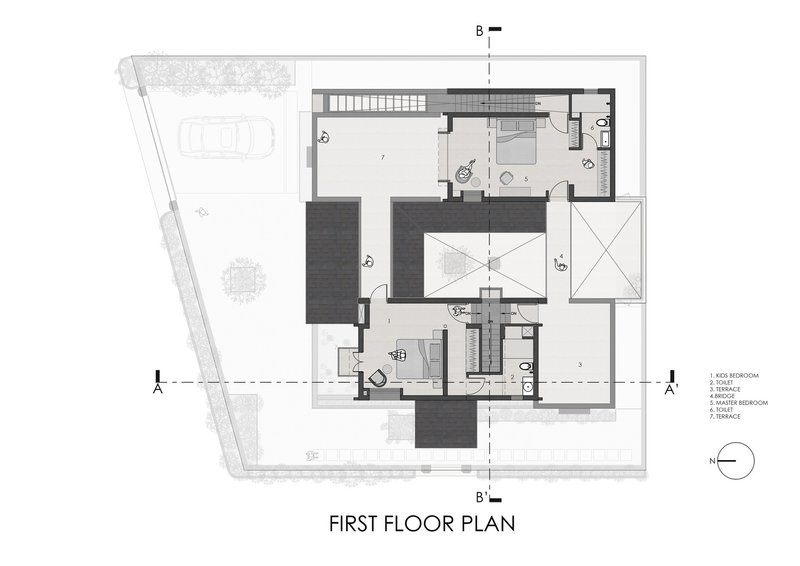
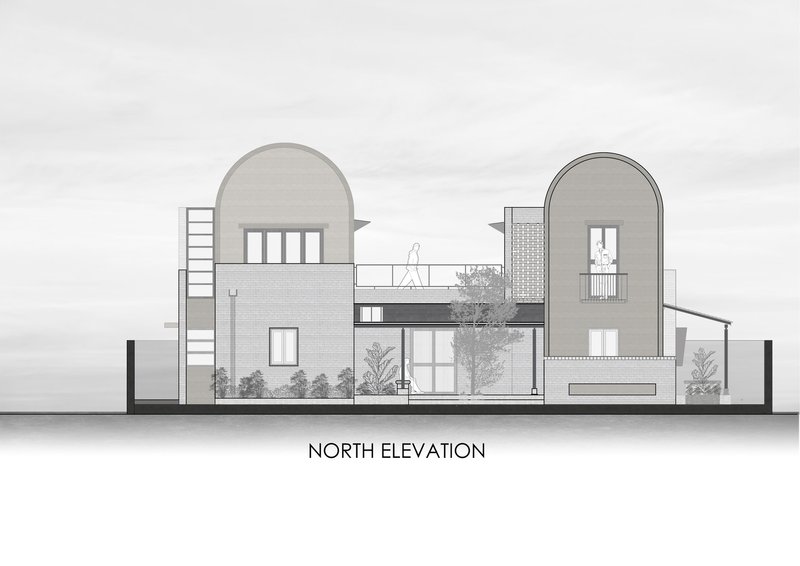
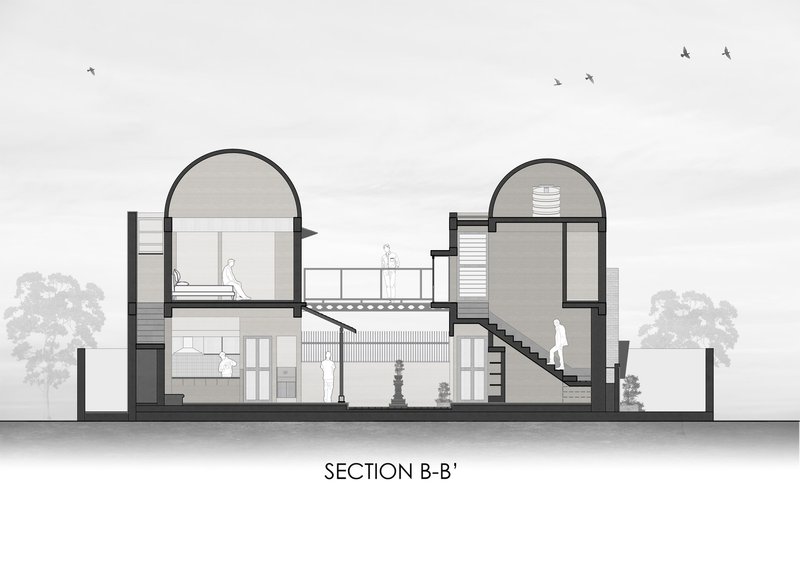
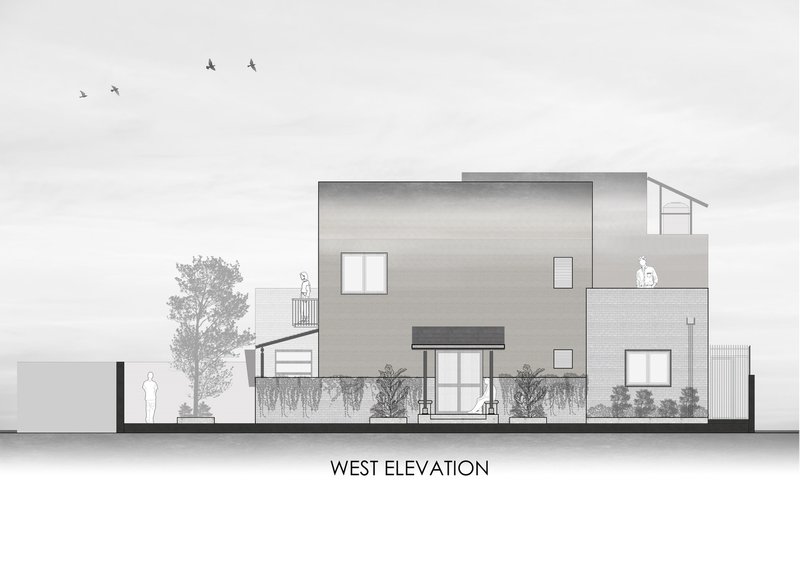
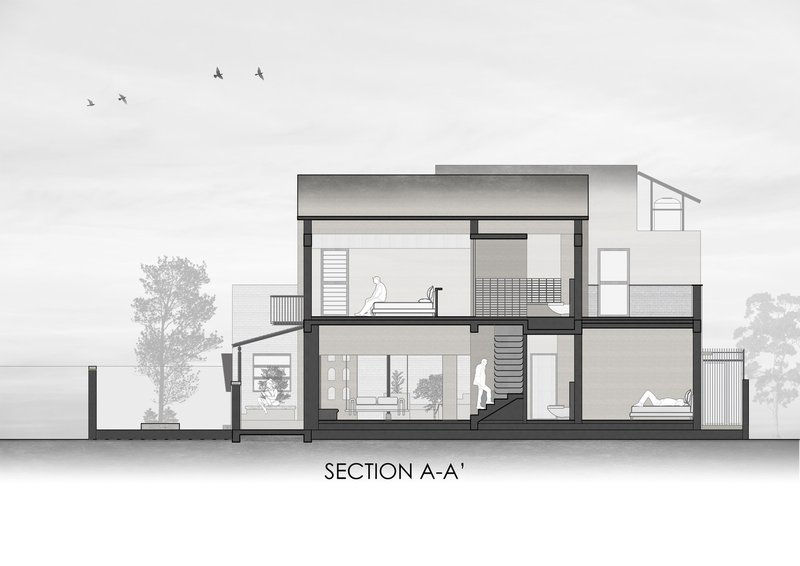
The ground floor plan reveals how the irregular perimeter wraps around the central stair and courtyard void, distributing the living hall, kitchen, worship space, and a senior-accessible bedroom suite along its edges. The first floor stacks two bedrooms and a generous terrace above, with the central void preserved to maintain the courtyard's double-height presence. Sections show the vaults at full scale and confirm how tightly the architects controlled ceiling height: the living zones are generous, while service corridors compress to push volume where it is felt.
The north and west elevations demonstrate the project's restrained street posture: solid masonry walls punctuated by small openings below, with the vaulted forms rising behind like a second horizon. Landscaped trees along the property line are drawn into the composition, softening the boundary between plot and street in a way that the built facade alone could not achieve.
Why This Project Matters
The Osari Residence matters because it treats the Wada not as a nostalgic image to be quoted but as a spatial system to be tested. Every traditional room type is present, yet each has been recalibrated for a contemporary family that arrives seasonally, spans three generations, and expects thermal comfort without heavy mechanical systems. The ferro-concrete vault, the steel bridge, and the lime-putty wall are not stylistic choices layered onto a conventional plan; they are structural and environmental responses that happen to align with a regional building culture. That alignment is the project's real achievement.
For architects working in India's smaller cities, where extreme climates and deep vernacular traditions coexist with tight budgets and limited construction expertise, the Osari Residence offers a useful precedent. It proves that you can build a courtyard house at 241 square meters, shade it with its own section, cool it with lime and stone, and still produce something spatially generous enough to host a festival. That is not nostalgia. That is design intelligence applied to the oldest problem in domestic architecture: how to make a house that belongs to its place.
Osari Residence by Mind Manifestation Design (principals Anand Deshmukh and Chetan Lahoti, project architect Rushikesh Dhotre). Amravati, India. 241 m² / 2,594 sq ft. Completed 2024. Photography by Hemant Patil.
About the Studio
Share Your Own Work on uni.xyz
If projects like this are the kind of work you want to make, uni.xyz is a place to publish your own, find collaborators, and enter design competitions.




Popular Articles
Popular articles from the community

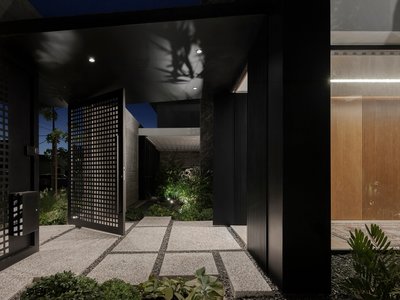
Constanti Architects Builds a Fortress of Privacy in Nicosia with House 345
A concrete and timber residence in Cyprus reinterprets the traditional introverted courtyard house for a new urban landscape.
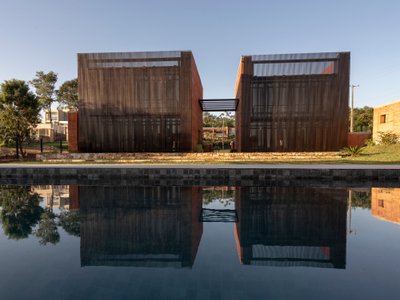
BAUEN Builds Two Rammed Earth Volumes in Paraguay Inspired by the Ovenbird's Nest
In San Bernardino, a house of compacted earth channels the instinct of a constructive bird to shelter life from the Paraguayan summer.

VEIVE Architects Builds a Mountain Hostel That Disappears into a Hangzhou Hillside
On the Huihang Ancient Trail in Xiangjian Village, a shelter of wood, steel, and rammed earth roots itself in the rural landscape.
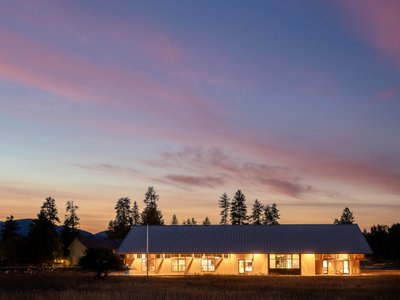
Johnston Architects Reimagines the Methow Valley Hay Barn as a Small-Town Library in Winthrop
A 7,300-square-foot timber library channels the region's agrarian vernacular to serve a rural Washington community of 400 year-round residents.


Similar Reads
You might also enjoy these articles

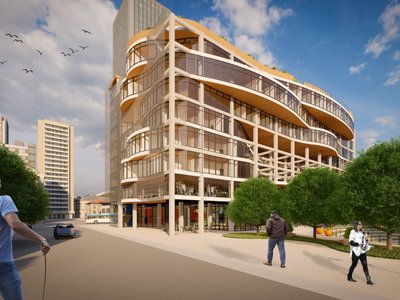
Olio Towers: A Mid-Rise for Performers That Fuses Housing, Rehearsal, and Stage
Located blocks from Houston's Theater District, this modular tower stacks living units around a central performance atrium.
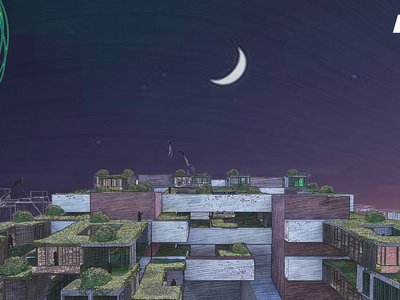
Oasis: Modular Green Housing Carved into Dhaka's Urban Fabric
A shortlisted Plugin Housing entry reclaims unauthorized settlements in Dhaka with stepped concrete volumes, green roofs, and ventilation-driven design.

Black Hole: A Floating Megastructure for the Post-Physical Era
Emiliano Mazzarotto envisions a spherical, self-scaling arena where e-sports, digital hotels, and holographic stadiums replace traditional public space.
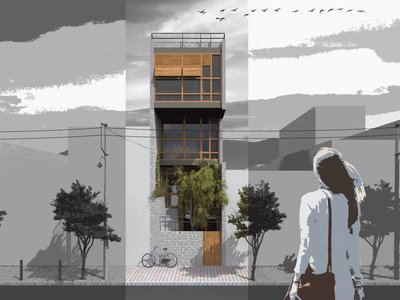
Compact & Sustainable Living in Piraeus: A Four-Level Family Home Built Around Light and Air
A narrow townhouse in one of Greece's densest port cities uses a central atrium and passive strategies to house three generations under one roof.


Explore Architecture Competitions
Discover active competitions in this discipline




The International Standard for Design Portfolios


The Global Benchmark for Architecture Dissertation Awards


The Global Benchmark for Graduation Excellence


Challenge to reimagine the Iron Throne
Comments (0)
Please login or sign up to add comments
No comments yet. Be the first to comment!