
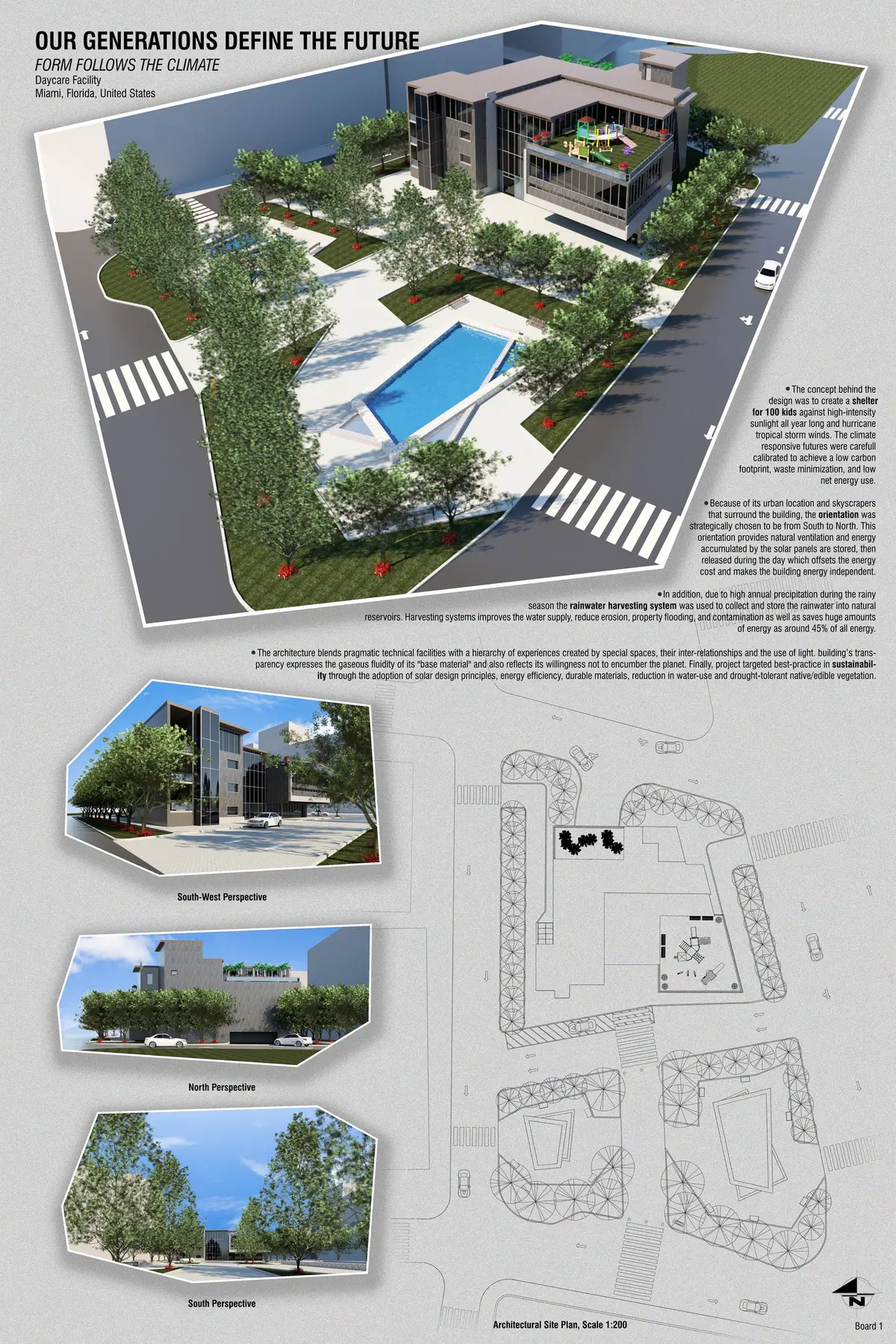
Our Generations Define the Future: A Climate-Resilient Daycare in Miami
A four-storey daycare for 100 children uses geopolymer cement, photovoltaic curtain walls, and passive cooling to answer Miami's tropical monsoon climate.


Designing a building for 100 children aged zero to seven in a city that faces hurricane-force winds, relentless UV exposure, and punishing humidity is not a gentle brief. It demands that every architectural decision, from the orientation of a corridor to the chemistry of the cement, carry real climatic weight. "Our Generations Define the Future" takes that demand seriously, proposing a daycare facility in Miami, Florida, where the building itself becomes a lesson in sustainability: solar exposure diagrams shape the envelope, recycled steel frames the structure, and rainwater harvesting feeds the landscape.
Designed by Valeriu Gorobei, this project was shortlisted in the Form Follows Climate 2020 competition. The scheme stretches across four floors, each calibrated to a specific stage of childhood development, while the building's south-to-north siting maximizes natural ventilation and minimizes cooling loads. It is, at once, a shelter for early learning and a working prototype of climate-responsive architecture in the tropics.
A Ground Floor That Welcomes, Then Teaches

The ground floor plan reveals a reception sequence designed to orient families into a bright, naturally lit interior. Office spaces, restrooms, staff facilities, an eatery, and a kitchen anchor the building at grade level. The rendering of the reception area shows generous ceiling heights and abundant daylight, establishing the environmental tone for the entire building before a child even reaches the stairs. What matters here is the implied promise: this is not a sealed box with fluorescent lighting, but a space that breathes.
Stacking Care, Play, and Learning Floor by Floor
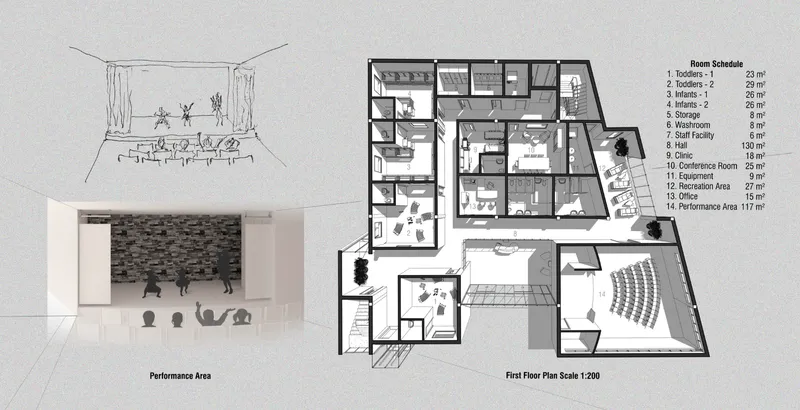

The first floor concentrates on early childcare: toddler rooms, infant rooms, washrooms, recreation spaces, and a dedicated performance area with tiered seating visible in the rendering. It is a clear programmatic signal that even the youngest occupants deserve spatial generosity and purpose-built environments for creative expression. Staff and conference rooms sit adjacent, ensuring caregiver visibility without crowding the children's zones.
One floor up, the programme shifts to early education. Kindergarten and Pre-K classrooms share the second level with a multipurpose room, a library wrapped in glazed walls, and activity spaces. The library rendering is particularly striking: floor-to-ceiling glass frames the surrounding landscape, pulling daylight deep into the reading area while connecting children visually to the outdoors. The plan suggests a spatial strategy of interconnected rooms rather than isolated cells, promoting fluid circulation and casual supervision.
A Rooftop Terrace as Outdoor Classroom
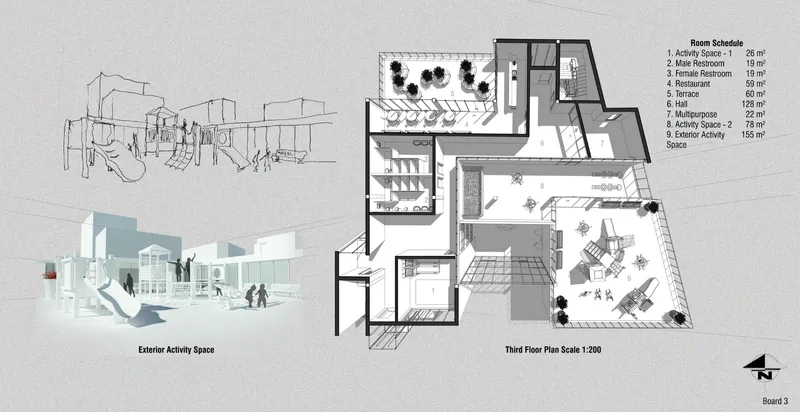
The third floor breaks the interior sequence open. A terrace, exterior play areas, activity rooms, and a restaurant occupy the top level, promoting outdoor learning and direct interaction with nature. The rendering shows children moving between shaded and exposed zones on the terrace, a spatial arrangement that acknowledges Miami's intense sunlight while refusing to retreat from it entirely. Overhangs and shading fins, shaped by solar exposure analysis, control UV penetration so that outdoor time remains safe and comfortable rather than punishing.
Material Intelligence Against Wind and Heat

The exploded axonometric drawing is where the project's engineering logic comes into focus. A concrete structural frame provides the wind resistance Miami demands, with contraction joints allowing thermal expansion without cracking. Recycled steel, described as the most recycled material in the world, reduces the embodied carbon of the structural system. Geopolymer cement replaces traditional Portland cement, significantly cutting CO₂ emissions during production. And the Faswall ICF block system, composed of 85% mineralized wood and 15% cement, delivers both thermal comfort and hurricane resilience in a single carbon-smart assembly.
Layered on top of this material palette are active systems: photovoltaic curtain walls generate clean energy, cool-roof technology reflects solar radiation, and rainwater collected from the roof filters into underground reservoirs for landscape irrigation. The building's south-to-north orientation was not arbitrary; it was derived from solar diagrams that also determined façade projections and overhang depths. Each decision feeds the next, forming a coherent environmental logic rather than a checklist of green features.
Sections That Reveal Spatial Generosity

The longitudinal and cross sections expose the vertical relationships between floors and confirm what the plans suggest: a building designed for visual connectivity and safe circulation. Trees frame the structure on both sides, contributing to passive cooling and anchoring the building within its landscape. The sections also reveal the proportional logic of the interior, where ceiling heights shift to accommodate the different scales of infant care, classroom learning, and open-air play. It is an architecture that changes register as you move through it, responding to the needs of its smallest occupants at every level.
Why This Project Matters
Daycare facilities are often afterthoughts in architectural discourse, treated as functional containers rather than opportunities for serious environmental design. Gorobei's proposal rejects that premise entirely. By threading climate-responsive strategies through every layer of the building, from geopolymer cement to photovoltaic curtain walls to rainwater reservoirs, the project argues that the places where children spend their earliest years should also be the places where sustainable architecture is most visible and most legible.
The title is not hyperbole. If a generation of children grows up inside a building that harvests its own water, generates its own energy, and resists hurricanes through intelligent material selection, the lessons of sustainability become embodied rather than abstract. That is the real ambition here: not just to build a resilient structure in a tropical monsoon climate, but to make the act of building itself pedagogical. The architecture teaches by existing.
View the Full Project
About the Designers
Designer: Valeriu Gorobei
Enter a Design Competition on uni.xyz
uni.xyz runs architecture and design competitions year-round that reward proposals with spatial conviction and real site intelligence.
Project credits: OUR GENERATIONS DEFINE THE FUTURE" by Valeriu Gorobei Form Follows Climate 2020 (uni.xyz).


Popular Articles
Popular articles from the community


LT2A and OPEN Architectes Thread a Brick and Glass High School Through a Wooded Belgian Campus
In Braine-l'Alleud, a 3,000 m² wing for Collège Cardinal Mercier pairs pale brick with a glazed colonnade, deferring to a small chapel and a dense wood.

U.GA Architects Wraps an Oval Rooftop Pool in Curved Board-Formed Concrete on Busan's Jeollidan-gil
In Busan's Jeonpo-dong, a 454 m² mixed-use block stacks a neighborhood facility, guest rooms and an oval rooftop pool inside spiraling concrete walls.

Cube Design Draws an Ecological Corridor Between Two Shenzhen Hills with the Nankai Building
Beside Shenzhen's container docks, the Nankai Building pairs stacked balconies with a climbing green screen to connect two hillsides across its height.

Architekt Andreas Gruber Scatters 23 Dark Timber Chalets Across a South Tyrolean Forest Edge
In Molini di Tures, Amonti Chalets breaks a resort into a hamlet of gabled timber houses, with parking, storage and services pushed into the slope.

Similar Reads
You might also enjoy these articles


Aquadapt: An Underwater Habitat That Rewrites Its Rooms by the Hour
Curved modules ring the seabed while one shell shifts from breakfast room to cinema, farm and football pitch as residents' needs change.

Play: Fragments of Their World: Remembered Architecture Rebuilt as a Modular Playground for Refugee Camps
Tom Gardner abstracts domes, arches and towers from the homelands of displaced families into a kit of child-scaled play parts for camp settlements.
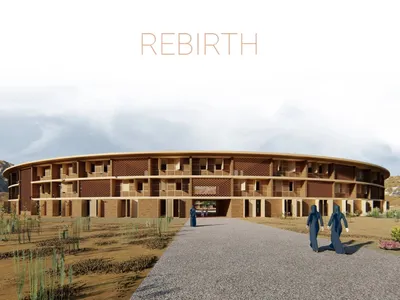
REBIRTH: A Circular Settlement Where Afghan Widows and Their Children Rebuild Life Together
A shortlisted Resile entry turns the circle into a protective ring of timber and brick, gathering homes, classrooms and gardens around a shared landscape.
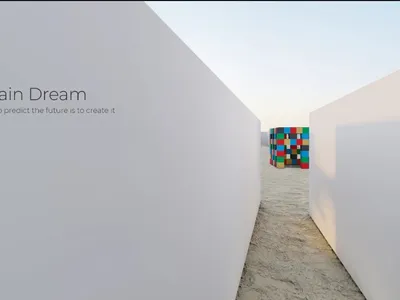
The Main Dream: A Recycled Plastic Kit That Lets Refugee Children Build Their Own Playground
Thirty-centimetre interlocking cubes that connect on three axes turn play into construction, letting children author the spaces they occupy.

Explore Climate Responsive Competitions
Discover active competitions in this discipline

Challenge to design luxury tourism on rails

VR headsets Storefront design competition

Designing a staircase for a client
Comments (0)
Please login or sign up to add comments
No comments yet. Be the first to comment!