

Ovaland Bridge: A Timber Organism That Breathes Above Copenhagen's Canals
Two designers reimagine the urban bridge as a living hybrid timber structure with triple circulation tracks, cafés, and a central piazza.


What if a bridge behaved less like infrastructure and more like a living organism? Ovaland Bridge takes that provocation seriously, proposing a laminated timber exoskeleton that swells into three bulbous volumes over Copenhagen's canal network. Organized around two spatial "cores" modeled on the logic of biological cells, the structure communicates through visual transparency, spatial permeability, and continuous movement. It is simultaneously a crossing, a public square, a gallery, a café, and a reading room: a single architectural system that refuses to accept the bridge as a transitional afterthought.
Designed by Hanan Jewhar and Emily Pearce, the Ovaland Bridge is conceived as Copenhagen's first modern timber hybrid bridge. The project responds directly to the city's deep cycling culture, environmental commitments, and appetite for progressive urban design. Rather than adding another flat slab across the water, the designers propose a curvaceous rib structure that twists and flows along its length, admitting light, air, and canal views while stacking public programme across multiple levels.
Three Bulbous Volumes Over the Water


From the waterfront, the bridge reads as three swollen timber shells connected by a continuous exoskeleton, their organic silhouette softening the hard canal edge. Boats pass beneath the structure, and the opening mechanism reinforces the idea of the bridge as an adaptable organism rather than a fixed object. The laminated timber ribs define the enclosure while keeping it porous: gaps between members let the sky in and allow occupants to track weather, water, and boat traffic from the interior.
Inside, the spatial logic becomes immediately legible. A yellow-coded ramp sweeps cyclists and pedestrians through the structure beneath the curved timber ceiling. Three distinct circulation tracks, fast, slow, and high, separate users by speed and intention. The fast track offers a direct crossing for commuters. The slow track meanders through interior public spaces, inviting pauses and exploration. The high track ascends to an elevated lookout with panoramic views of the canal and city skyline. Separating these flows ensures both safety and the freedom to choose your own experience of the bridge.
Spiraling Ramps and Bicycle Parking Below the Ribs


At ground level, the programme thickens. A spiraling red ramp connects the canal-side approach to the upper circulation levels, while bicycle parking and planted beds occupy the sheltered zone beneath the timber structure. The ramp geometry keeps vertical movement fluid and uninterrupted, avoiding the stair-and-landing model that tends to stall foot traffic. Planted beds soften the base and begin to blur the boundary between architecture and landscape, reinforcing the biological analogy at the project's conceptual core.
The riverside elevation, seen under a heavy Copenhagen sky, reveals the full drama of the exoskeleton. Laminated timber arches span between the solid base cores that anchor the structure on either bank, their rib spacing tightening and loosening to modulate light and enclosure. The effect is less engineered truss and more whale skeleton: a structural expression that feels grown rather than assembled. By making the primary material do both structural and spatial work, the designers compress the typical layering of structure, cladding, and interior finish into a single legible system.
A Café and a Library Inside a Bridge


The most unexpected moments happen when the bridge stops behaving like a bridge altogether. A café occupies one of the interior volumes, its curved service counter and yellow seating nestled beneath angled timber framing. Light filters through the rib gaps, casting shifting patterns across surfaces throughout the day. The space feels genuinely hospitable, not like a concession stand bolted onto infrastructure, but like a destination in its own right.
Deeper into the structure, a reading room lines its walls with curved bookshelves beneath intersecting timber arches. Reading tables follow the organic geometry, and the overall atmosphere suggests a contemplative pocket carved into the body of the bridge. These programmatic insertions, along with galleries and a central piazza described as a green inhabitable void, transform everyday movement across the canal into a shared urban experience. Visual permeability between levels means occupants are always aware of other activities happening above, below, and across the structure, fostering the kind of casual social connection that most bridges simply cannot provide.
Why This Project Matters
Ovaland Bridge matters because it takes a piece of infrastructure that cities rarely question and asks it to do significantly more. Copenhagen already leads in cycling infrastructure and sustainable urban policy. The provocation here is that the bridge itself can be a site of public life, not merely a conduit between two points. By stacking café, gallery, library, piazza, bike storage, and three distinct circulation tracks into a single timber shell, Jewhar and Pearce demonstrate that density of programme and clarity of movement are not mutually exclusive.
The commitment to timber as the primary structural and spatial material also carries weight. Proposing Copenhagen's first modern timber hybrid bridge is a bold claim, but the design backs it up with a coherent logic: the rib framework simultaneously carries load, defines enclosure, and filters light, eliminating redundant material layers. If cities are serious about decarbonizing infrastructure, projects like Ovaland Bridge suggest that the timber bridge is not a nostalgic gesture but a forward-looking structural proposition with genuine urban potential.
View the Full Project
About the Designers
Designers: Hanan Jewhar, Emily Pearce
Enter a Design Competition on uni.xyz
uni.xyz runs architecture and design competitions year-round that reward proposals with spatial conviction and real site intelligence.
Project credits: Ovaland Bridge by Hanan Jewhar, Emily Pearce.


Popular Articles
Popular articles from the community


GROUP A Strips a 1969 Rotterdam Harbor Headquarters to Its Frame and Wraps It in Timber Louvers
In Rotterdam's M4H harbor district, Ferro Offices reuses a 1969 frame, adds one timber storey and reaches BREEAM-NL Outstanding.

Architekt Andreas Gruber Scatters 23 Dark Timber Chalets Across a South Tyrolean Forest Edge
In Molini di Tures, Amonti Chalets breaks a resort into a hamlet of gabled timber houses, with parking, storage and services pushed into the slope.

longwave studio Reorganizes a 112 m² Tainan Apartment Around the Daily Routines of a Family and Two Cats
In Tainan, Taiwan, birch plywood, rust-red furniture and a freestanding plaster wall link arrival, storage, work and family life in one apartment.

LT2A and OPEN Architectes Thread a Brick and Glass High School Through a Wooded Belgian Campus
In Braine-l'Alleud, a 3,000 m² wing for Collège Cardinal Mercier pairs pale brick with a glazed colonnade, deferring to a small chapel and a dense wood.

Similar Reads
You might also enjoy these articles


Aquadapt: An Underwater Habitat That Rewrites Its Rooms by the Hour
Curved modules ring the seabed while one shell shifts from breakfast room to cinema, farm and football pitch as residents' needs change.

Play: Fragments of Their World: Remembered Architecture Rebuilt as a Modular Playground for Refugee Camps
Tom Gardner abstracts domes, arches and towers from the homelands of displaced families into a kit of child-scaled play parts for camp settlements.
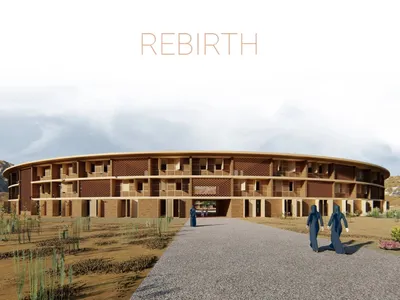
REBIRTH: A Circular Settlement Where Afghan Widows and Their Children Rebuild Life Together
A shortlisted Resile entry turns the circle into a protective ring of timber and brick, gathering homes, classrooms and gardens around a shared landscape.
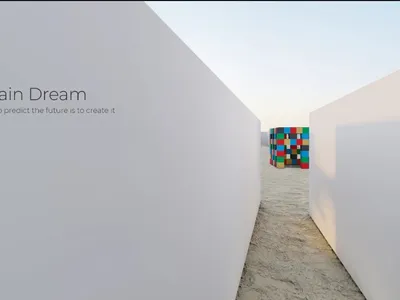
The Main Dream: A Recycled Plastic Kit That Lets Refugee Children Build Their Own Playground
Thirty-centimetre interlocking cubes that connect on three axes turn play into construction, letting children author the spaces they occupy.


Comments (0)
Please login or sign up to add comments
No comments yet. Be the first to comment!