

Pablo Senmartin Stacks Two Concrete Volumes on a Hillside to Fuse Home and Office in Córdoba
A 450-square-meter residence and law office in La Calera, Argentina, negotiates a seven-meter grade change with raw concrete and native trees.


Suburban gated communities in the hills west of Córdoba tend to produce polite, inward-looking houses. Pablo Senmartin went the other direction. House in the Rodeo, completed in 2022 in the El Rodeo neighborhood of La Calera, Argentina, takes a 20-by-30-meter plot with a full seven meters of grade change and turns the slope into the project's primary architectural resource. Two reinforced concrete blocks, offset from one another, stack and cantilever to produce a house that feels both monolithic and open, carved through with terraces, galleries, and balconies that blur any clean line between inside and out.
What makes the project genuinely interesting is its refusal to be a single-use object. The building houses both a family residence and a law office, distributing dual programs across three levels that step down the hillside. A semi-buried wine cellar and parking area sit at street level, the main living and working spaces occupy the middle, and bedrooms claim the upper volume. The staggering of the two volumes generates a series of intermediate spaces, covered terraces, and deep overhangs that do real climatic work while giving the occupants, a blended family whose members come and go, a gradient of privacy rather than a binary of indoor versus outdoor.
Approaching the Hillside


From the street, the house presents as a heavy concrete box sitting atop a semi-basement garage, its mass mediated by a vertical timber screen that runs along the facade. The entry sequence is theatrical: a floating concrete staircase projects out from the main volume over a planted bed, its individual treads casting sharp shadows as you ascend toward an upper terrace. Two figures caught mid-stride on the stairs in one image give a sense of scale and movement. The staircase is not just access; it is the building's calling card, a cantilevered concrete ribbon that announces the structural ambition of the entire project.
Arriving at the top of the stairs, you pass through a threshold defined by timber brise-soleil and board-formed concrete overhead. The sequence is deliberate: compression under the canopy, then release into the terrace. Senmartin uses the grade change to make you earn the view, delaying the panorama toward Córdoba city until you are fully inside the building's spatial logic.
Concrete as Local Material


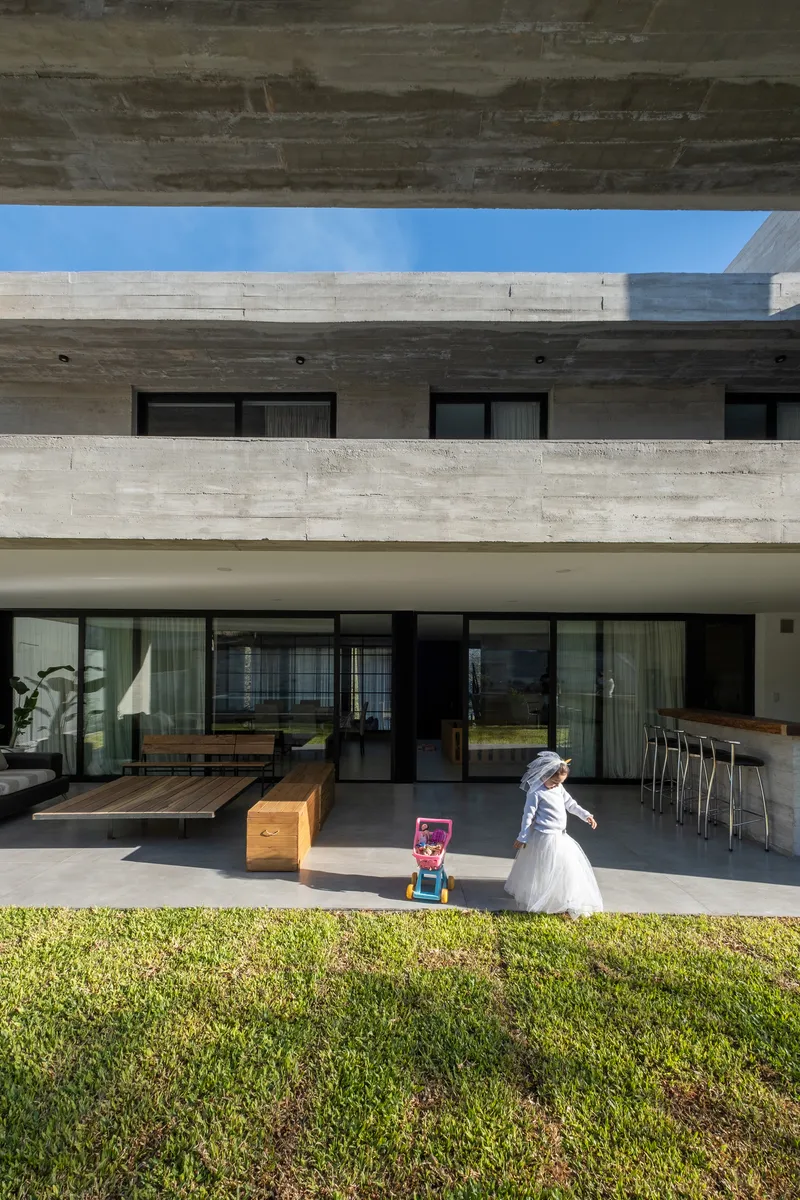
La Calera's name literally means "the limestone quarry." The region has been a producer of lime and cement for generations, so Senmartin's choice of reinforced concrete is not merely an aesthetic preference but a material argument rooted in local production. The board-formed finish is left exposed everywhere: ceilings, beams, the deep cantilevers that shade the rear terrace. Each surface records the grain of the formwork, giving the heavy volumes a tactile quality that photographs capture well but that must be even more powerful in person.
The enclosing walls use a composite assembly: five-centimeter reinforced concrete plates sandwiching a ceramic brick core. The combination provides thermal mass appropriate for La Calera's continental climate, hot summers and cool winters, without the need for extensive insulation systems. It is a low-tech solution that performs well and keeps the material palette honest.
Living with the Slope


The rear elevation is where the building's relationship with the slope becomes most legible. The upper volume cantilevers dramatically over a swimming pool and a sloped lawn that drops away toward the back of the site. Board-formed beams frame deep overhangs, creating covered outdoor rooms at multiple levels. A child playing on the lawn under the canopy in one image suggests how the family actually inhabits these in-between zones: casually, as extensions of the interior.
Senmartin preserved several native trees in the front portion of the site, using them as a seasonal filter for solar radiation and wind. In summer they shade the facades; in winter, with leaves dropped, they let sunlight penetrate deeper into the living spaces. It is a passive strategy that costs nothing to maintain and improves with age as the trees grow.
Interior Gradient


Inside, the dual volumes are "emptied out" to produce fluid, integrated spaces with varying ceiling heights. A steel-framed glass partition wall separates the hallway from a sunlit living room without severing the visual connection between them. Curtains provide the soft adjustment that glass alone cannot. The material palette stays restrained: concrete, timber, steel, glass. Nothing competes.
A bathroom clad in timber slats, with a floating vanity and a steel-framed glass shower enclosure, shows the same rigor applied at a smaller scale. The vertical timber screen that appears on the exterior reappears here, creating continuity between the public facade and the most private rooms in the house. Photographed at dusk, the warm light through the slats suggests a building that performs as well at night as during the day.
The Cantilever at Dusk

The most striking image of the project captures the branching cantilevered stairs at dusk, two figures standing on the upper terrace as the sky fades. The inverted reinforced concrete beams that make these large projections possible are visible in profile, their depth honest about the structural effort required. There is nothing dematerialized about this house; it is heavy, present, and grounded, even as its pieces reach outward into the air.
Plans and Drawings
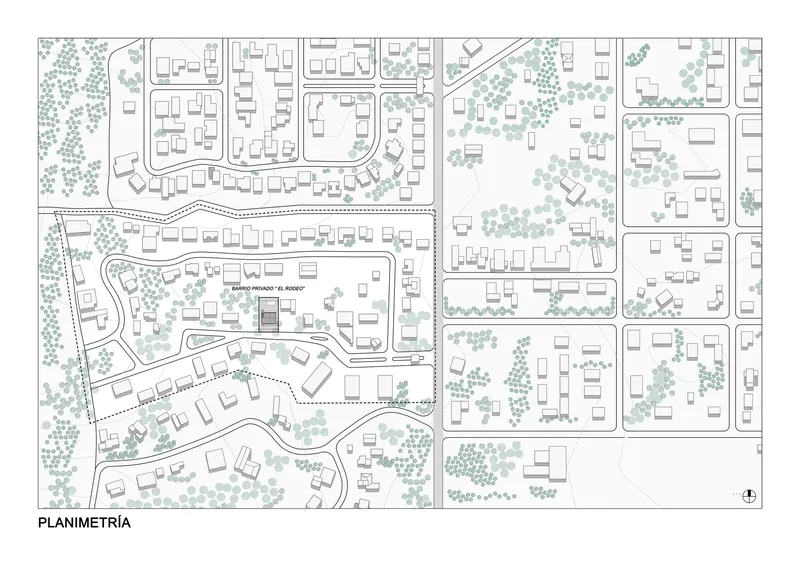
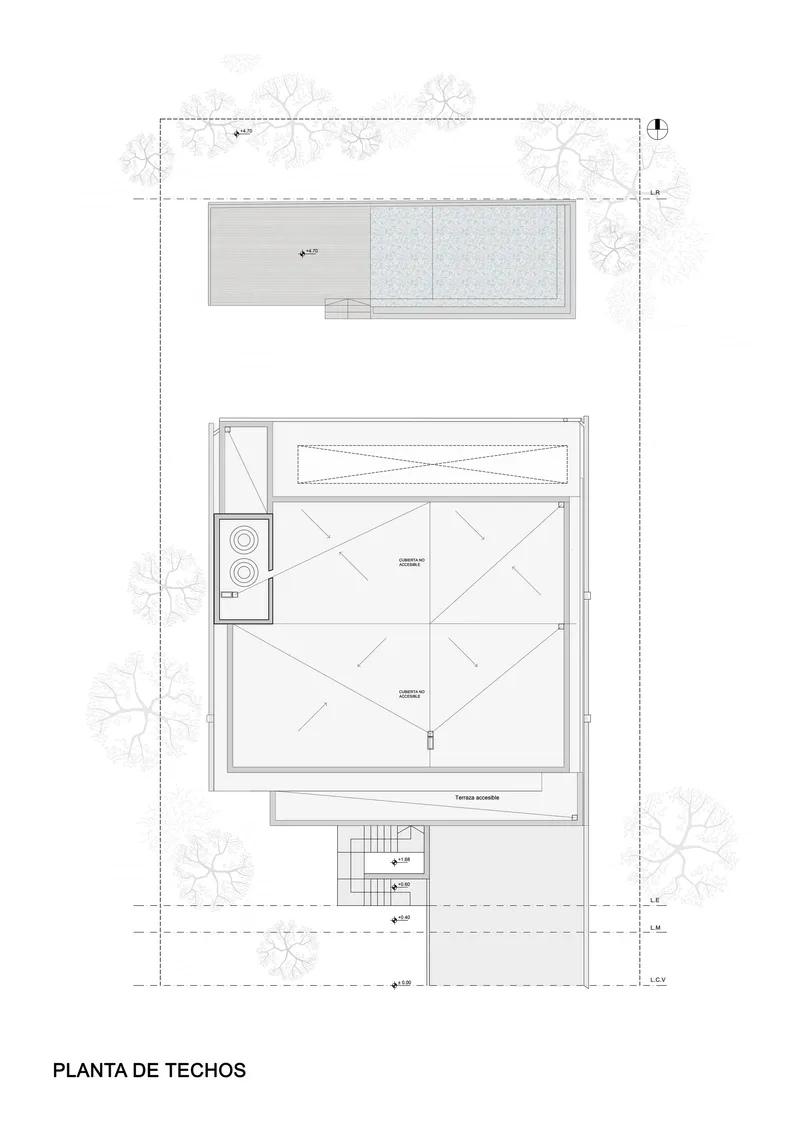
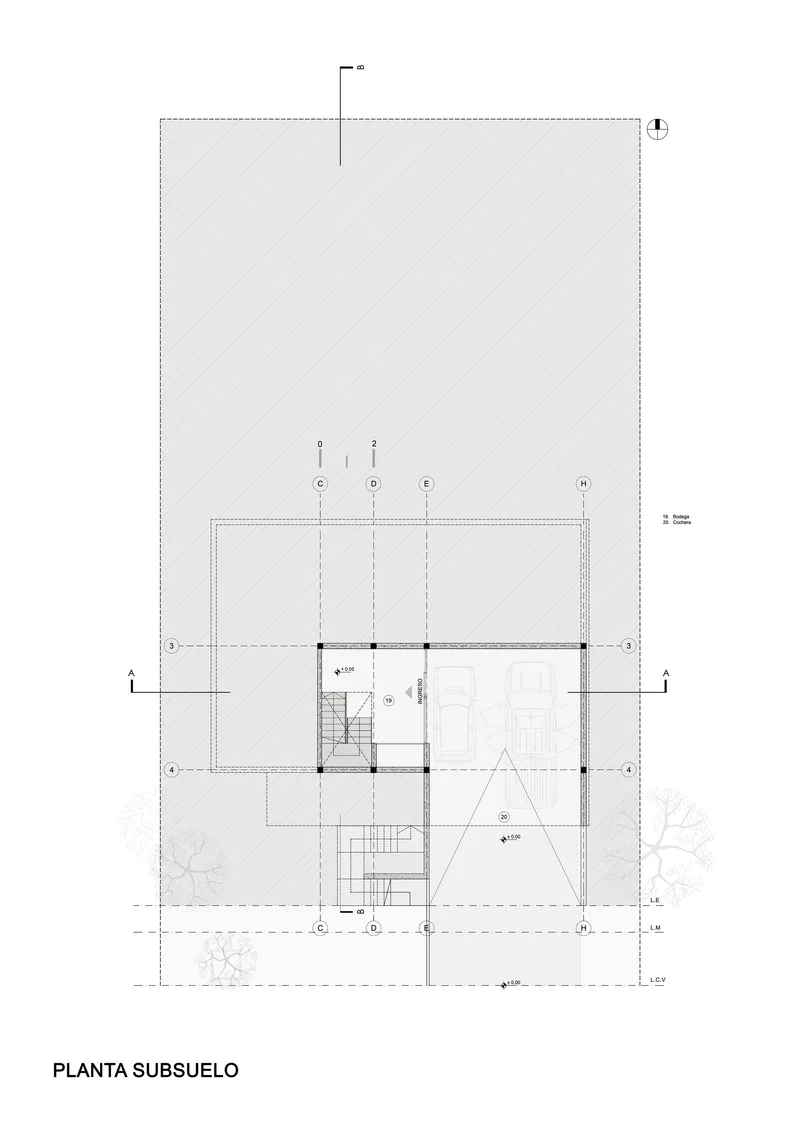
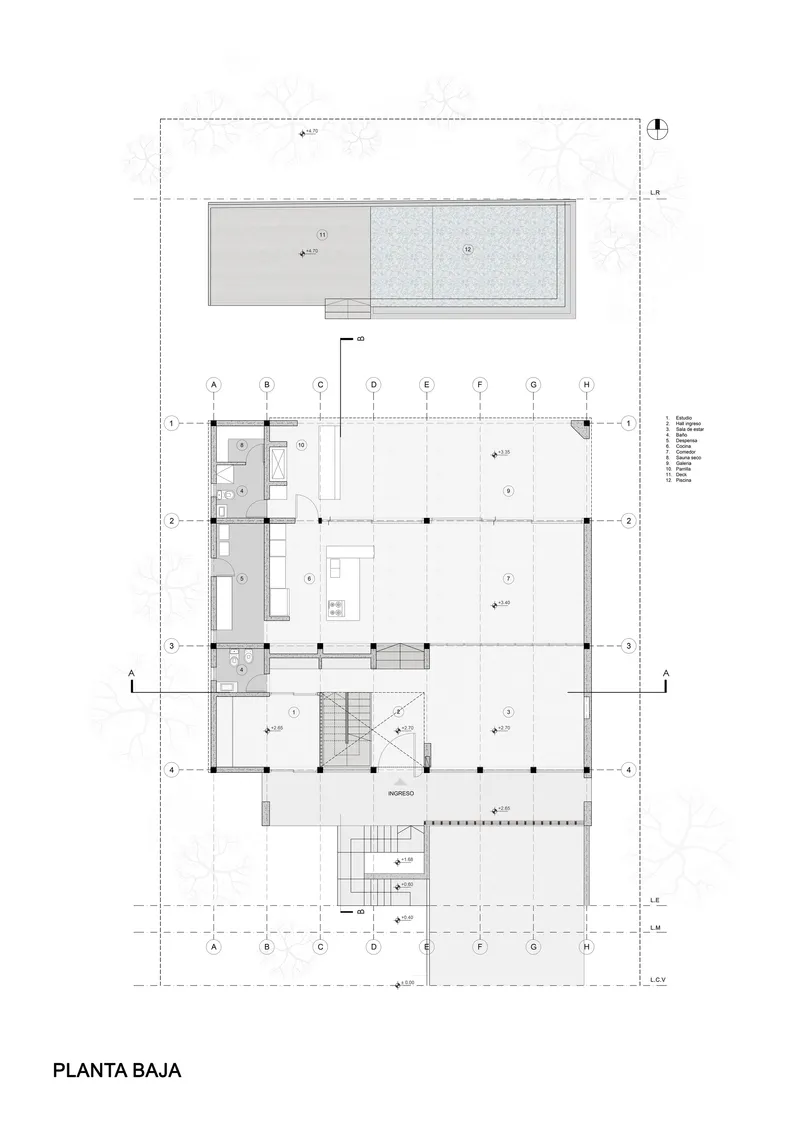


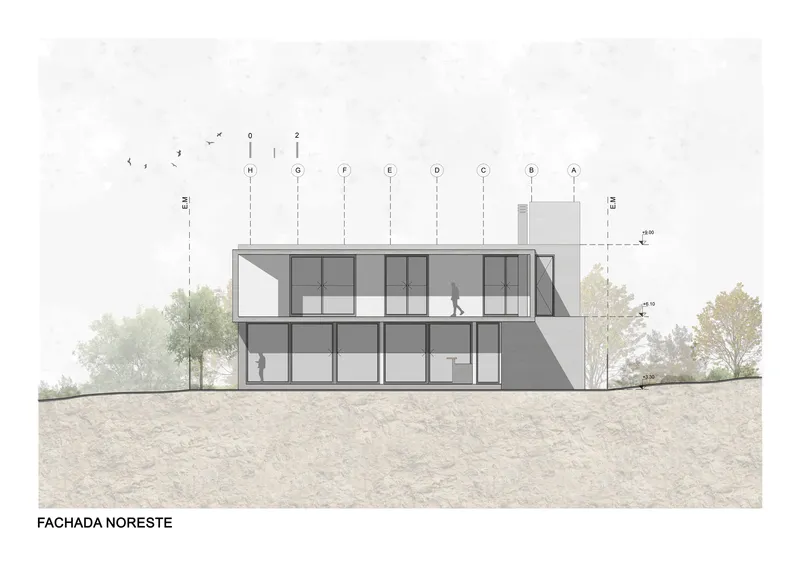
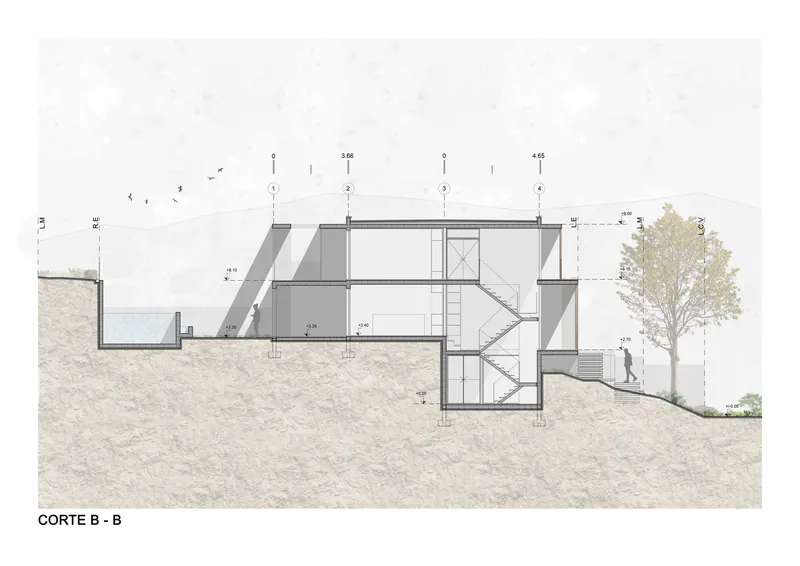



The site plan reveals El Rodeo's curving suburban street pattern and the density of tree cover Senmartin was working within. The floor plans across three levels show how the central staircase acts as a vertical spine, connecting the basement parking and wine cellar through the main living floor up to the bedroom level. Each plan is rotated slightly against the one below, generating those offset intermediate spaces visible in the sections.
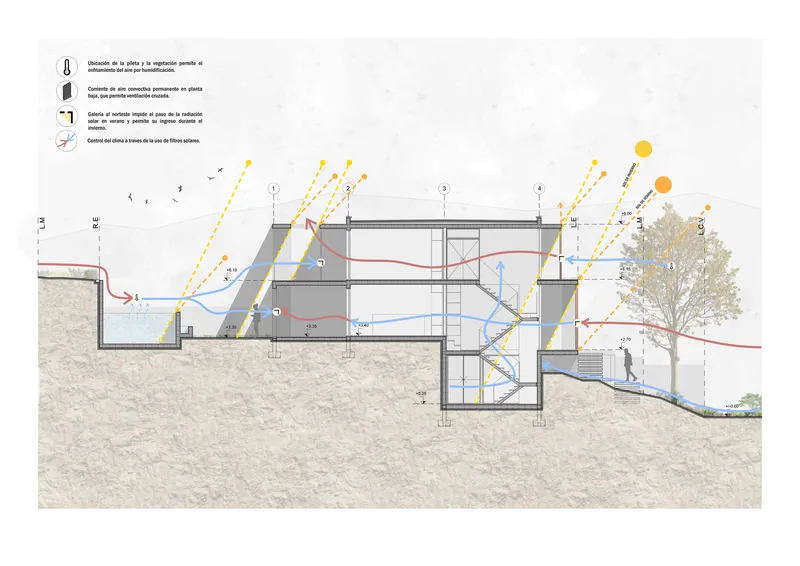
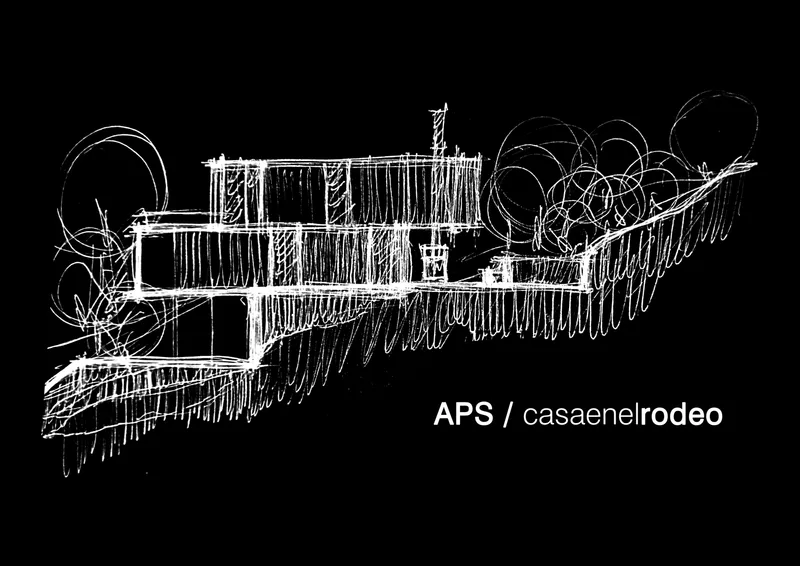
The section drawings are the most informative documents in the set. They show how the building steps down the hillside in a terraced configuration, embedding itself into the slope rather than sitting on top of it. The environmental section, with overlaid arrows indicating solar angles and ventilation paths, demonstrates that the cantilevers and deep overhangs are precisely calibrated to the sun's trajectory. The construction phasing diagram, rendered as five isometric steps from foundation to completed stacked volumes, offers a clear reading of the building's tectonic logic: foundation, lower box, upper box, pool terrace, landscape.
The wall assembly detail section confirms the composite concrete-and-brick construction system and shows how the exterior steps connect to the main structure. It is the kind of drawing that separates a designed building from a rendered one.
Why This Project Matters
House in the Rodeo works because it takes constraints seriously. A steep site, a dual program, a local material tradition, and a family that does not fit neatly into conventional domestic typologies: each of these is treated as a design driver rather than a problem to neutralize. The result is a house that feels specific to its place and its people, not a generic concrete box parachuted onto a hillside.
Senmartin's decision to use the seven-meter grade change as the generator of the section, rather than fighting it with retaining walls and flat pads, produces a building with genuine spatial richness. The intermediate zones between the two stacked volumes are the project's best spaces, neither fully inside nor fully outside, shaded but open, domestic but generous. In a residential market that often rewards sameness, this house makes a quiet case for topographic honesty and material directness.
House in the Rodeo by Pablo Senmartin. La Calera, Argentina. 450 m². Completed 2022. Photography by Andrés Domínguez.
About the Studio
Share Your Own Work on uni.xyz
If projects like this are the kind of work you want to make, uni.xyz is a place to publish your own, find collaborators, and enter design competitions.


Popular Articles
Popular articles from the community


Architekt Andreas Gruber Scatters 23 Dark Timber Chalets Across a South Tyrolean Forest Edge
In Molini di Tures, Amonti Chalets breaks a resort into a hamlet of gabled timber houses, with parking, storage and services pushed into the slope.

Jaramillo Van Sluys Arquitectura and Urbanismo Turn a Demolished Registry Lot in Quito into an Orchard Plaza
In Quito's Centro Histórico, a 2,800 m² plaza exposes the San Agustín convent wall and redraws its lost Augustinian orchard in volcanic stone.

U.GA Architects Wraps an Oval Rooftop Pool in Curved Board-Formed Concrete on Busan's Jeollidan-gil
In Busan's Jeonpo-dong, a 454 m² mixed-use block stacks a neighborhood facility, guest rooms and an oval rooftop pool inside spiraling concrete walls.

GROUP A Strips a 1969 Rotterdam Harbor Headquarters to Its Frame and Wraps It in Timber Louvers
In Rotterdam's M4H harbor district, Ferro Offices reuses a 1969 frame, adds one timber storey and reaches BREEAM-NL Outstanding.

Similar Reads
You might also enjoy these articles


LAVA Architecten Gives Vocational Education a Sawtooth-Roofed Face on a Mechelen School Campus
In Mechelen, Belgium, a 2,053 m² STEM school on a 6×6 m grid turns workshops and classrooms into rooms that can be rearranged as teaching changes.

KEMA Studio Turns a Derelict Marvila Attic into a 60 m² Lighthouse Apartment Above Lisbon
In Lisbon's Marvila district, a rebuilt roof, four skylights and two plywood volumes turn an unlivable attic into a bright home facing the Tagus.

Pixel Gardens: One Repeated Module Stacked Into a Terraced Social Housing Tower for Famagusta
Salem Bader's shortlisted housing tower builds a vertical neighbourhood from one repeated module, offsetting units to carve terraces, light and air.

Bao Huynh Watercolor Atelier: A Serene Art Retreat in Hội An
Bao Huynh Watercolor Atelier in Hội An blends multifunctional art spaces, sustainable design, local materials, and family-friendly living in a serene environment.

Explore Plug-In House Competitions
Discover active competitions in this discipline

Challenge to design mud housing for contemporary communities

Challenge to reimagine the Iron Throne

Photograph architecture without architects

Illustrate the lost glory of Angkor Wat - Render Challenge
Comments (0)
Please login or sign up to add comments
No comments yet. Be the first to comment!