
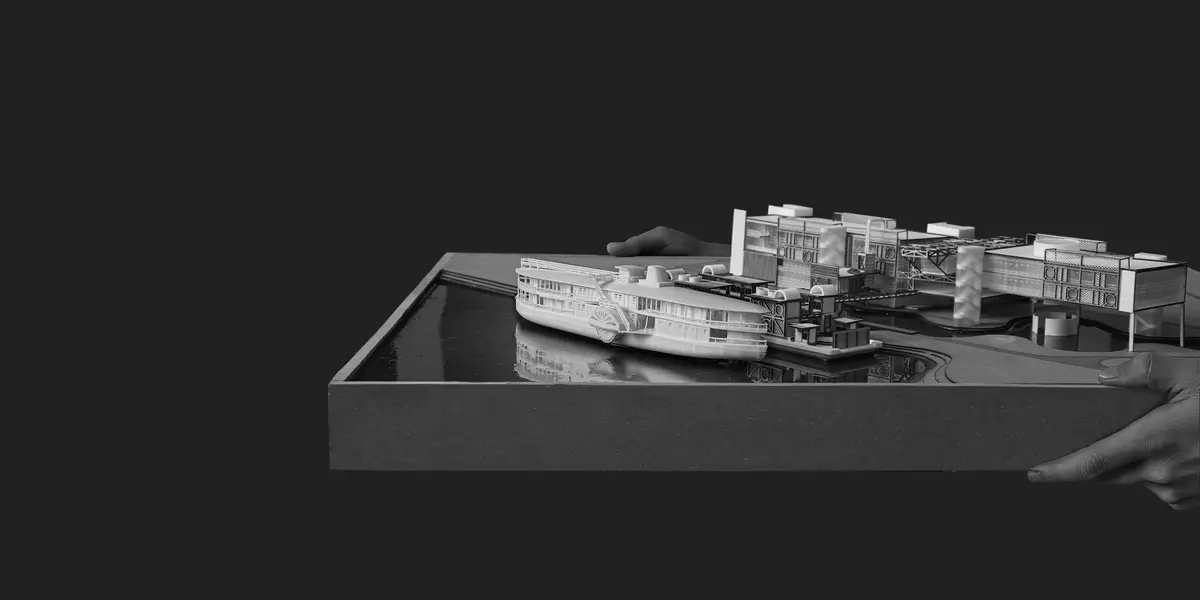
Paddles of the Past: Adaptive Reuse of Decommissioned River Vessels for the Ecological and Cultural Restoration of Dhaka
"From the heartbeat of Dhaka, the Buriganga has now become a symbol of its own neglect. The project 'Paddles of the Past' restores this past, transforming the derelict steamers and boats into living documents of riverside history and using their hulls to restore ecological balance. There is no waste anywhere: history turns into habitat and memory turns into monitoring, with the healing of a river forgotten until now beginning with each and every current."

Abstract
The once renowned Buriganga River, referred to as the lifeblood of Dhaka, has today turned out to be one of the most contaminated water bodies in South Asia, with its old paddle steamers and ferries now being neglected, just like the river itself. The design thesis is entitled "Paddles of the Past," and it aims to transform the obsolete paddle steamer PS Masud along with several decommissioned ferries into a museum and water research center at Basilla, Dhaka.
Introduction
Since the days of the Mughal dynasty, the river has defined the economic transactions and civic life of the city of Dhaka. Due to industrialization, unchecked effluents, and the decline of long-distance steamships after the construction of the Padma Bridge, the river ecosystem and its fleet of ships have been degraded and rendered obsolete. Ships like PS Masud, which were constructed way back in 1923, can now be seen rotting away along with several other ships near Sadarghat and its ghats. Instead of viewing the obsolescence of these ships as a hindrance, the project seeks to find ways to make this obsolescence into an asset, where the ship serves as the support structure of architectural and scientific programs, and the process of reusing the ships is in itself an act of environmental rehabilitation.
Background and Precedent
This project views adaptive reuse as a process of extending the lifespan of a building by giving it a new purpose and significance, rather than as a mere act of preservation. Literature identifies various forms of adaptive reuse such as preservation, renovation, integration, facadism, and infrastructure adaptation (King, 2004; Bullen & Love, 2010), all of which lower the ecological burden of demolition and allow for cultural continuity (Bullen, 2007; Pendlebury, 2009). Such precedent cases as the transformation of a decommissioned power station into the Tate Modern gallery (Smith, 2015), integration of new construction into existing urban landscape in the case of the Pompidou Centre (Richards, 2014), and the transformation of the abandoned railway into the High Line in New York (Salingaros, 2011) show that obsolete buildings may gain a completely new civic purpose without sacrificing their architectural identity. "Paddles of the Past" applies similar ideas to the design of marine structures, recognizing the hull of a steamer as equally valid heritage fabric as masonry architecture.
Project Site and Strategy
The site is located within the 3.5 acre area of Basilla, on the boundary line of Mohammadpur–Keraniganj. This is a threshold site, where the dense urban context of Dhaka city meets the agricultural river bank landscape of Keraniganj. The site has been selected due to its location near the historic riverside, but not as intense as Sadarghat, to create opportunities of large scale reuse and restoration. The development of the project has involved following a process of planning through a series of statutory and physical restrictions – 100m setback from the navigation channel, 50m setback from the river bank by the Detailed Area Plan regulation, and positioning the ferry and steamer according to their depths to avoid erosion and turbulence created by their wakes. Thus, the master plan is read as an axis starting from public entry point to the research center, ferry mounted civic facilities and finally the steamer-museum moored on the waterfront.
The Museum, the Fleet, and the Research Centre
PS Masud is transformed with minimum structural intervention in a series of museums starting from the linear museum series, followed by an audio-visual introduction, 'Pulse of the River', 'Art and Cultural Heritage', 'River's Legacy', 'Fishermen's Story', 'Echoes of Trade', and 'History of Paddle Steamers' around the original engine and boiler of the ship making it the main exhibit. Another decommissioned ferry boat is reconstructed with modular structural grid system inside the load-bearing hull of the ship that includes civic functions like workshops, shops, and a control office without interfering in the original loading of the ship. On the land, the Water and Environment Research Centre is designed with hydrology and ecology laboratories along with the water column with sensors to measure dissolved oxygen, turbidity, and pollutants. The historic Rocket Ghat is hung inside the research building as the circulation spine with the use of material like timber panels, steel pipes, and Jali screens.
Discussion
The main significance of the project is more methodological than formal. Through incorporating water quality studies and phytoremediation structures into a reused ship itself, the design uses adaptive reuse not only as a way of preservation but as an ecological tool. In this way, architecture becomes part of the restoration process as opposed to its mere observation, which has become particularly important for cities facing both heritage and environmental problems on the same river.
Conclusion
By transforming outdated river craft into a functional museum and research facility, "Paddles of the Past" illustrates the idea that history and ecology do not necessarily have to be rivals when it comes to the space of a particular river. The re-use approach that was applied by the Basilla Project may become an example for other heritage-ridden polluted rivers in the Global South.
References (7)
Adaptive reuse and sustainability of commercial buildings
Publisher: Emerald Publishing (journal: Facilities)
Vol. Volume 25, Issue 1/2
Argues that adaptive reuse conserves resources and reduces the environmental impact of demolition and new construction.
The rhetoric of adaptive reuse or reality of demolition: views from the field
Publisher: Elsevier (journal: Cities)
Vol. Volume: 27, Issue 4
Argues that adaptive reuse conserves resources and reduces the environmental impact of demolition and new construction.
Defining the role of adaptive reuse in the architectural profession
Publisher: Taylor & Francis (journal: Journal of Architectural Education)
Vol. Volume: 58, Issue 2
Positions adaptive reuse as a distinct professional practice within architecture, particularly for culturally significant buildings.
Conservation in the Age of Consensus
Publisher: Routledge
ISBN: 9780415249843 | Vol. Volume: N/A
Examines how conservation of the historic environment is shaped by societal and political consensus, using UK practice as its core case.
Cultural tourism: A review of recent research and trends
Publisher: Elsevier (journal: Journal of Hospitality and Tourism Management)
Vol. Volume: 21
Surveys recent scholarship on cultural tourism, relevant to heritage sites repurposed for public and civic use.
The Nature of Order: The Phenomenon of Life (Book 1 of 4)
Publisher: Center for Environmental Structure
Foundational text proposing that living structures share measurable, universal patterns across scales in architecture.
Adaptive reuse of industrial buildings: Challenges and strategies
Discusses structural and regulatory challenges in converting industrial buildings, citing Tate Modern as a key case.

Popular Articles
Popular articles from the community


Play: Fragments of Their World
Familiar architecture becomes modular playground design, creating safe spaces where displaced children can learn, connect, imagine and play.

The Ocean Hive: Sustainable Architecture for a Self-Sufficient Civilization at Sea
The Ocean Hive imagines sustainable architecture at sea, where modular habitats, algae, wave power and ocean waste sustain a growing colony.

Co-life: Sustainable Architecture for Age-Friendly Community Living
Co-life reimagines sustainable architecture for seniors through courtyards, rammed earth, shared gardens, and spaces designed for belonging.

Conexión: Biophilic Design Reimagines High-Rise Living in Hong Kong
Conexión reimagines high-rise living in Hong Kong through biophilic design, green facades, shared spaces, daylight, water and nature within.

Similar Reads
You might also enjoy these articles

Day and Night Park: A Time-Based Urban Newsstand in Beijing
A temporary urban newsstand in Beijing blending travel, light, and reading through poetic colors, compact form, and community-focused design.

Modernist Patio Renovation in El Masnou, Barcelona by Oliver Segura Arquitectura + Cebrià Arquitectura
Modernist patio renovation blending tradition and innovation with a movable pool, leveled floors, and Catalan materials in El Masnou.

Alto Residencial Coop: Cooperative Housing Development in Santiago de Compostela by Carbajo Barrios Arquitectos
A linear cooperative housing complex blending white volumes and perforated metal façades, enhancing community living, natural light, privacy, and urban integration.
Vil Genis School by BPA ARCHITECTURE – Massy, France
Vil Genis School in Massy, France, features sustainable design, south-facing classrooms, community integration, accessible spaces, and modern educational architecture.

Explore Conservation Architecture Competitions
Discover active competitions in this discipline


Challenge to reimagine the Iron Throne

Photograph architecture without architects

Illustrate the lost glory of Angkor Wat - Render Challenge

Design challenge to reuse E-waste
Comments (0)
Please login or sign up to add comments
No comments yet. Be the first to comment!