

PARINESS: Turning a Paris Railway Corridor into an Adaptive Linear Commons for Social Connection
A People's Choice entry for Salut Paris that keeps the old tracks as spatial guides, threading kiosks, pods and greenery into an adaptive public spine.


Most proposals for disused rail lines start by erasing the rail. PARINESS does the opposite: it keeps the tracks and treats them as the organizing line of a new public realm. The project's premise is direct. Cities should do more than function efficiently; they should help people feel less alone. In a period when screens increasingly stand in for shared physical experience, the scheme argues that a well-programmed strip of urban ground can restore some of what digital life has worn away.
Designed by Surbhi Ghoghari for the Salut Paris competition, where it received the People's Choice Award, the project occupies an underutilized linear site along the historic railway infrastructure of Paris. Ghoghari frames the intervention around three aims, happiness, peace and oneness, and pursues them by combining heritage elements with contemporary landscape. The result reads less as a park laid over infrastructure and more as a negotiation between the city's past and a greener future.
A Timber Pavilion That Behaves Like Furniture
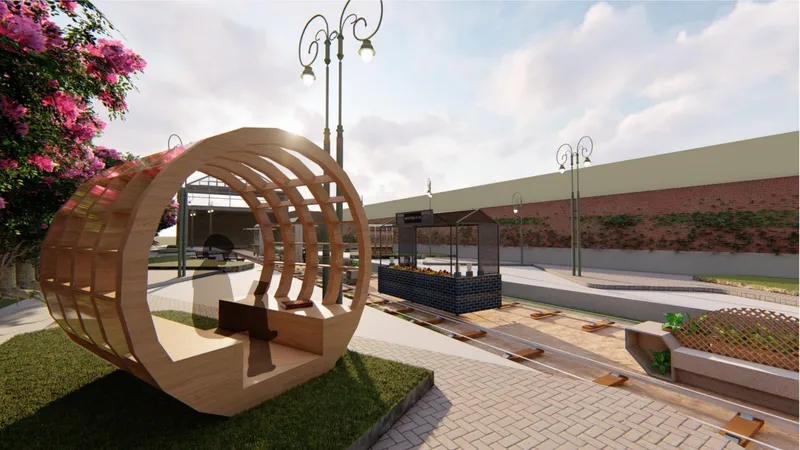
The circular timber lattice pavilion, with its bench set into the curve, captures the project's most persuasive idea: the line between furniture and architecture should blur. It is small enough to be read as a seat and enclosed enough to feel like a room. Placed on the lawn beside the rail track path, it gives people a reason to stop rather than pass through. Ghoghari describes the kiosks, seating modules and library pods as micro-architectural interventions, and this pavilion shows why that framing works. At this scale, a single object can set the social tone of an entire stretch of corridor.
These pieces are also designed to be modular and movable. That matters because the scheme does not fix its spatial arrangement in advance. Users' habits are expected to rearrange the corridor over time, and the furniture is built to follow them.
Cast Iron, Brick and Lamplight as Urban Memory
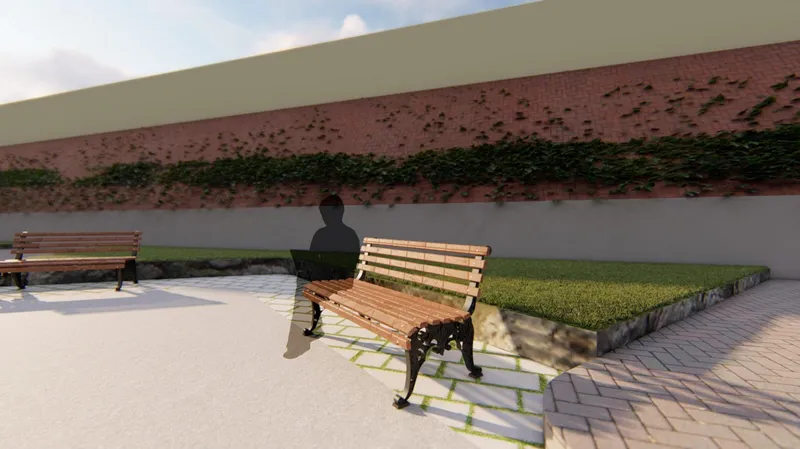
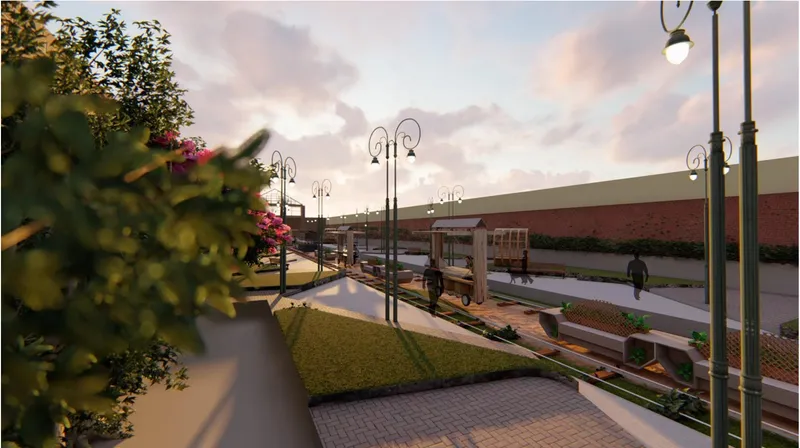
Material familiarity does much of the work here. Cast iron and timber benches sit against a brick retaining wall trailing ivy, and the promenade is lined with lamp posts and planters that recall the Parisian street. The project deliberately draws its street lighting, furniture and kiosks from the city's historical vocabulary, so the new landscape feels inherited rather than imported. A visitor recognizes the place as Paris before they register it as an intervention.
Greenery then shifts the tone toward the future. Planting softens the hard edges of the infrastructure, and flowering branches frame the track at dusk. The pairing of traditional forms with ecological thinking produces a hybrid language that is nostalgic without being sentimental. The rail lines remain visible throughout, carrying the site's memory along the full length of the promenade.
Wedges of Paving and Grass Along a Central Spine
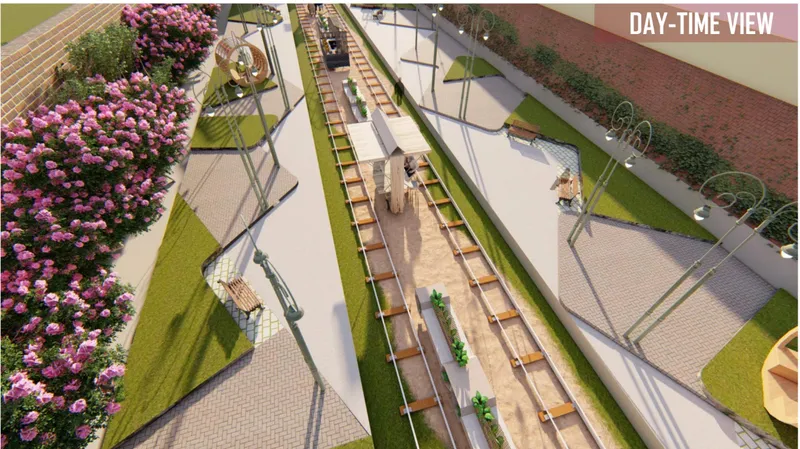
Seen from above, the strategy is clearer. Angular wedges of paving and lawn flank a central strip of track, so the linearity of the railway becomes a spine along which different activities attach. The circulation runs parallel to the activity zones, which lets people move between walking, resting and engaging without abrupt thresholds. The scheme avoids monumentality; its kiosks, seating modules and shaded structures are sized to encourage lingering and conversation.
Ghoghari organizes the programming in three phases. Visualisation establishes the circulation and activity framework. Manifestation inserts the programmatic elements that shape how people occupy the site. Adaptation lets the system shift as needs change. This is a sensible way to design a long public landscape: set the structure firmly, then leave its contents open to revision.
The Promenade After Dark and Under Snow
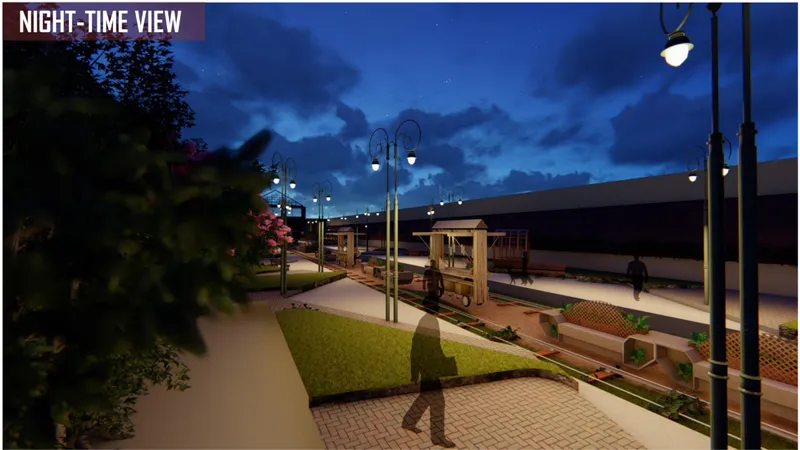
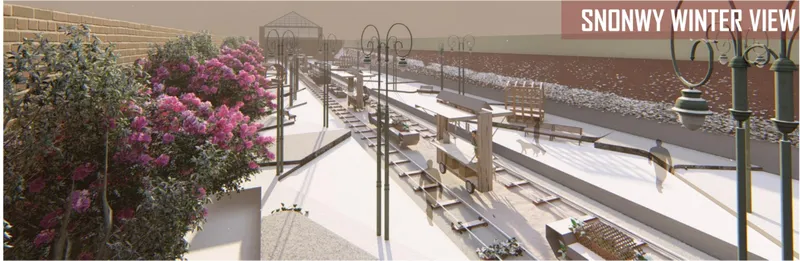
The final pair of views tests the corridor against time. At night, the lamp-lit promenade and timber kiosks keep the path legible, and a lone walker on the paving suggests that the space stays safe and usable after dusk. Lighting is central to the project's temporal strategy because it extends the hours the corridor can serve and holds its visual continuity together across the site.
Under snow, the same kiosks, benches and lamp posts still define the route, even when the planting goes quiet. Showing the scheme across seasons is a useful discipline. Public spaces are often imagined only in spring light, and this one is shown to keep its structure when the weather turns.
Why This Project Matters
PARINESS shows that reusing infrastructure does not require spectacle. Its strongest move is restraint: it keeps the tracks, borrows the city's familiar furniture, and adds small, movable architecture at a scale people can claim. The social agenda comes through in how the design invites people to stop, sit and stay, rather than in grand formal gestures.
The phased logic of visualisation, manifestation and adaptation also gives the proposal staying power. By treating the corridor as a system meant to evolve with its users, Ghoghari offers a model for linear sites in any dense city: anchor memory in what already exists, add elements that can change, and let everyday use finish the design.
View the Full Project
About the Designers
Designer: Surbhi Ghoghari
Enter a Design Competition on uni.xyz
uni.xyz runs architecture and design competitions year-round that reward proposals with spatial conviction and real site intelligence.
Project credits: PARINESS by Surbhi Ghoghari Salut Paris (uni.xyz).


Popular Articles
Popular articles from the community


Temporary Home for Dogs: A Reversed Zoo Rethinks Animal Shelter Architecture
In Bucharest, a sinuous corridor and freed landscape flip the logic of containment, designing a shelter that works to make itself unnecessary.
Faces of the Soviet Avant-Garde: Turning Moscow's Street Names into an Open-Air Museum
A network of sculptural installations across a Moscow residential district transforms forgotten architect names into spatial encounters with cultural memor

Opera by the Sea Estonia: Three Shells Dissolving Architecture into Tallinn's Coastline
A winning opera house proposal replaces monumental form with interconnected shells that blur the boundary between building, park and Baltic Sea.

Singing Woman: An Opera House That Performs Before the Curtain Rises
Ovidiu Cristian Pavel's conceptual opera house translates Estonia's choral identity into a sculpted waterfront landmark facing the Baltic Sea.

Similar Reads
You might also enjoy these articles

Healing Façade: A Modular Chapel System That Restores Ethiopia's Sacred Forests
Winner of the Eco-Chapel competition, this circular timber façade collects water from air to rebuild soil and reforest degraded Ethiopian landscapes.
Kaffeebühnen: Where Coffee Shop Architecture Becomes a Civic Stage in Vienna
A linear sequence of timber boxes, transparent shells, and open yards turns the Viennese café tradition into a public performance space.
Eco Chapel: A Modular Forest Pavilion That Grows Like the Landscape It Protects
Hexagonal timber modules weave through existing trees, turning a chapel into a living system for prayer, education, and reforestation.


Urban Forest: A Vertical Ecosystem for 5,000 Workers in Singapore's Changi Business Park
Radially stacked pods and layered green decks turn a 7-acre plot into 47 acres of ecological workspace projected for 2040.

Explore Furniture Design Competitions
Discover active competitions in this discipline

Challenge to design luxury tourism on rails

VR headsets Storefront design competition

Competition to design a workstation for architects

Designing a staircase for a client
Comments (0)
Please login or sign up to add comments
No comments yet. Be the first to comment!