
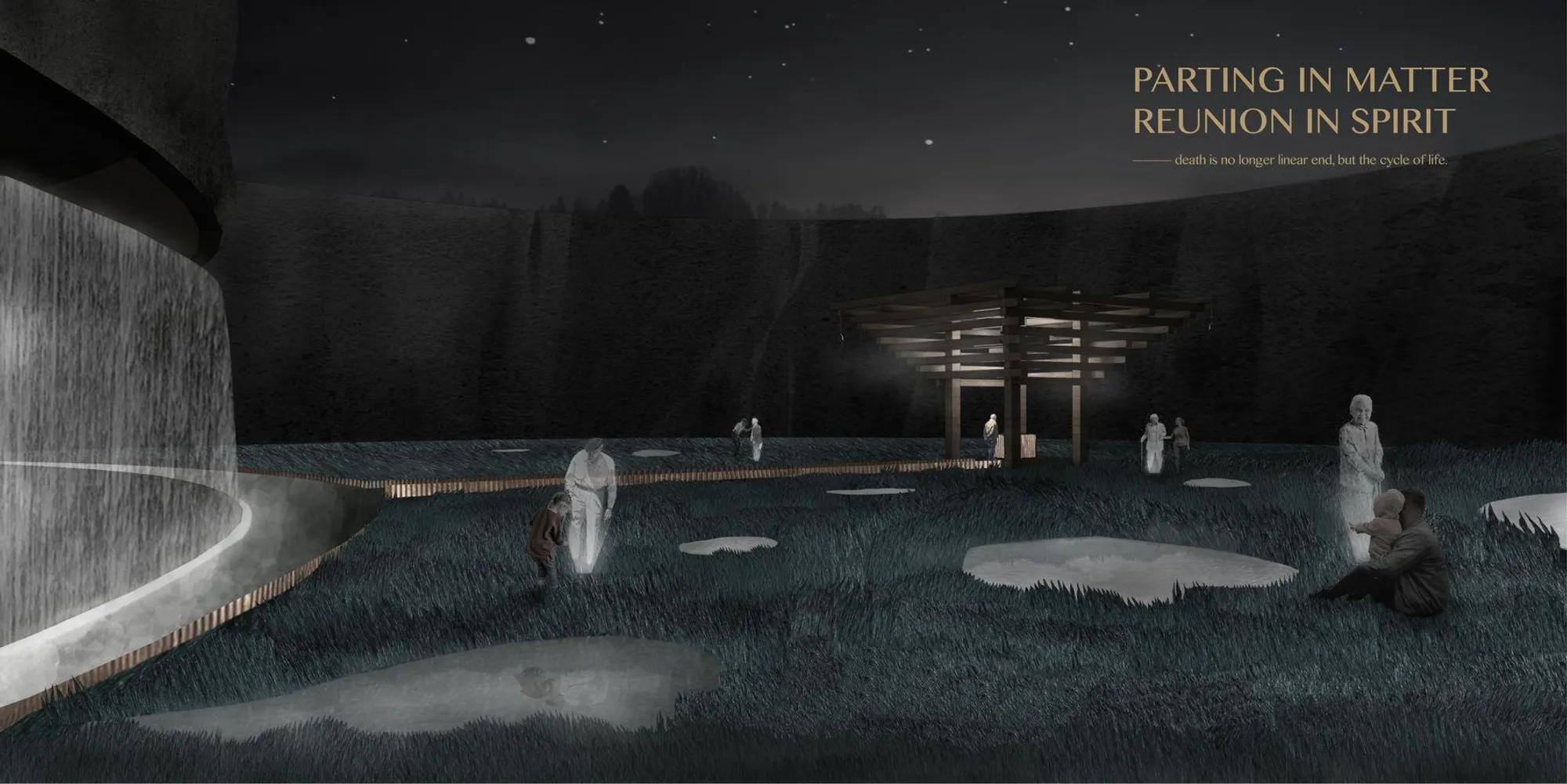
Parting in Matter, Reunion in Spirit: A Memorial Where Ashes Return to Water
A circular memorial architecture dissolves the boundary between mourning and renewal through water, light, and projected memory.


What happens to grief when it meets flowing water? In this memorial design, ashes are released into a clear spring, carried downstream through a cascading waterfall, and returned to the earth through a garden. The act of letting go becomes literal, material, and strangely comforting. Rather than fixing the dead in stone, the architecture proposes that remembrance is a fluid process, one that moves through nature and circles back to the living.
Mingjie Guo, Mou Ziyong, and 刘 丛 designed this project as an entry to the Circle of Life competition, where it received an Honorable Mention. The scheme replaces the conventional cemetery with an experiential sanctuary built around water, light, and projected imagery. Its circular form is not merely symbolic; it structures the visitor's journey through farewell, reflection, and eventual reunion with memory.
A Colonnade of Threshold: Entering Between Trees and Mist
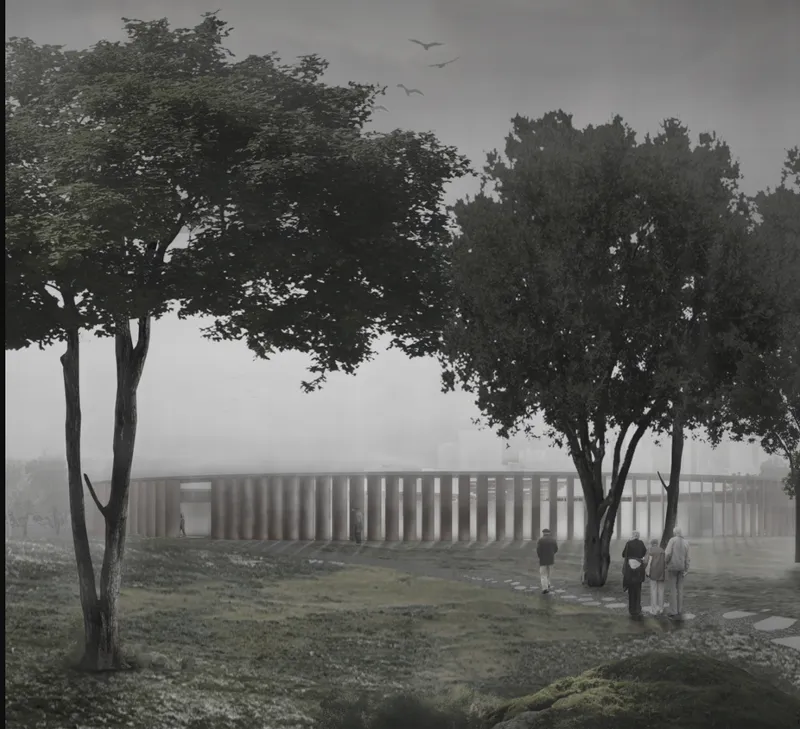
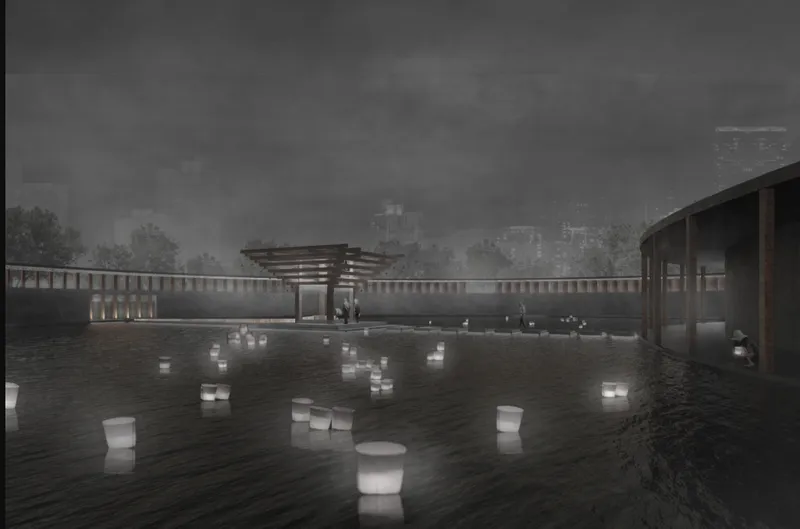
The arrival sequence sets a deliberate emotional tempo. A long colonnade of vertical fins stretches through a grove of trees, its rhythm dissolving figures into silhouettes against morning mist. The effect is one of gradual compression and release: the world outside narrows, and the memorial world begins. By dusk, the mood shifts entirely. A courtyard reflecting pool holds floating lanterns, their light doubling in the water beneath a covered pavilion. The transition from daylight procession to evening vigil is built into the architecture itself, not applied as decoration.
These two conditions, the misty colonnade and the lantern-lit courtyard, represent the project's core duality: matter and spirit, departure and return. The colonnade is stone and structure; the courtyard is water and flame. Visitors pass through one to reach the other, and the passage is the point.
Circular Logic: How the Site Plan Encodes the Cycle of Life
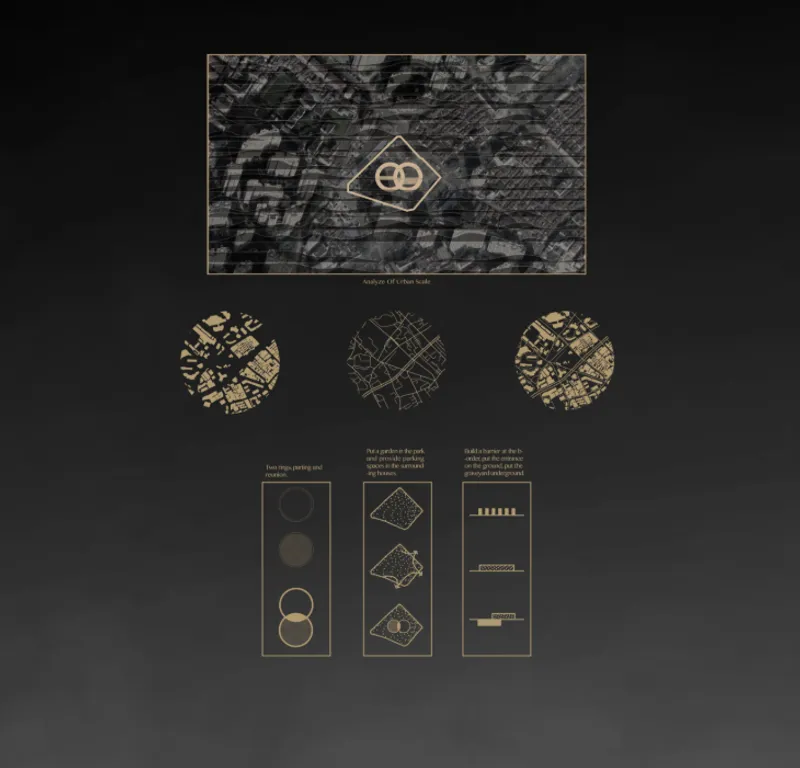
The site plan and concept diagrams reveal the spatial organization behind the emotional narrative. The memorial's circular form is legible in plan as both a symbolic gesture and a practical routing device. Water flows from a central spring outward through channels that feed the surrounding garden, physically enacting the idea that the departed nourish the landscape. The urban context diagrams show the project situated within a broader site, suggesting that this is not an isolated sanctuary but a place woven into the fabric of daily life.
What the diagrams make clear is that every spatial decision serves double duty. The circular plan embodies the endless cycle of existence while simultaneously organizing distinct programmatic zones: arrival, ceremony, reflection, and departure. The water infrastructure is both symbolic medium and landscape irrigation system. Nothing here is purely metaphorical; the symbolism is engineered.
Stone, Water, Solitude: The Horizontal Memorial Walk
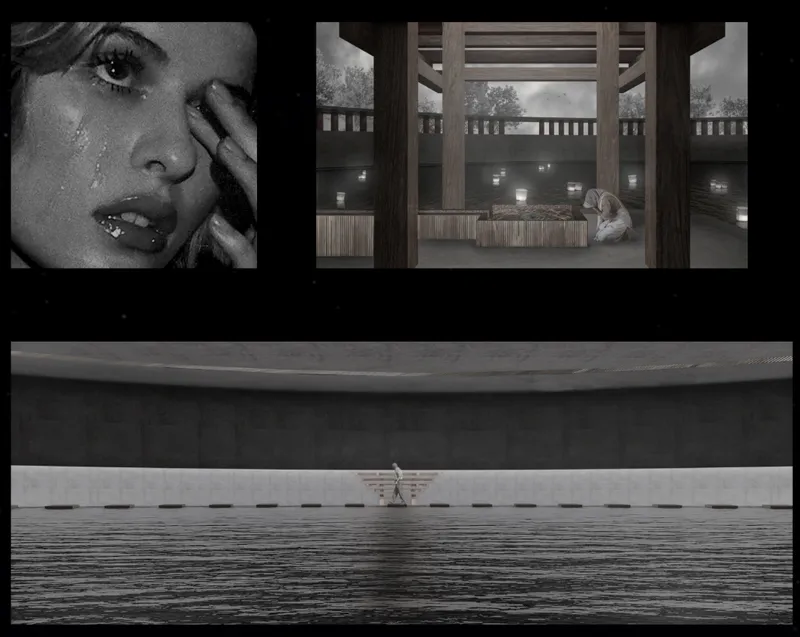
One of the most striking images captures a solitary figure walking along a horizontal stone colonnade that runs parallel to a body of water. The proportions are emphatic: low, long, and pressed close to the surface. There is no monumentality in the vertical sense, no towering gesture demanding awe. Instead, the architecture is ground-hugging, asking visitors to look across rather than up. The purity of the materials, stone and water meeting at a precise edge, strips the experience down to its essentials. Mourning here is a slow, lateral movement, not a sudden confrontation.
Projected Memory: Light as a Medium for the Immaterial
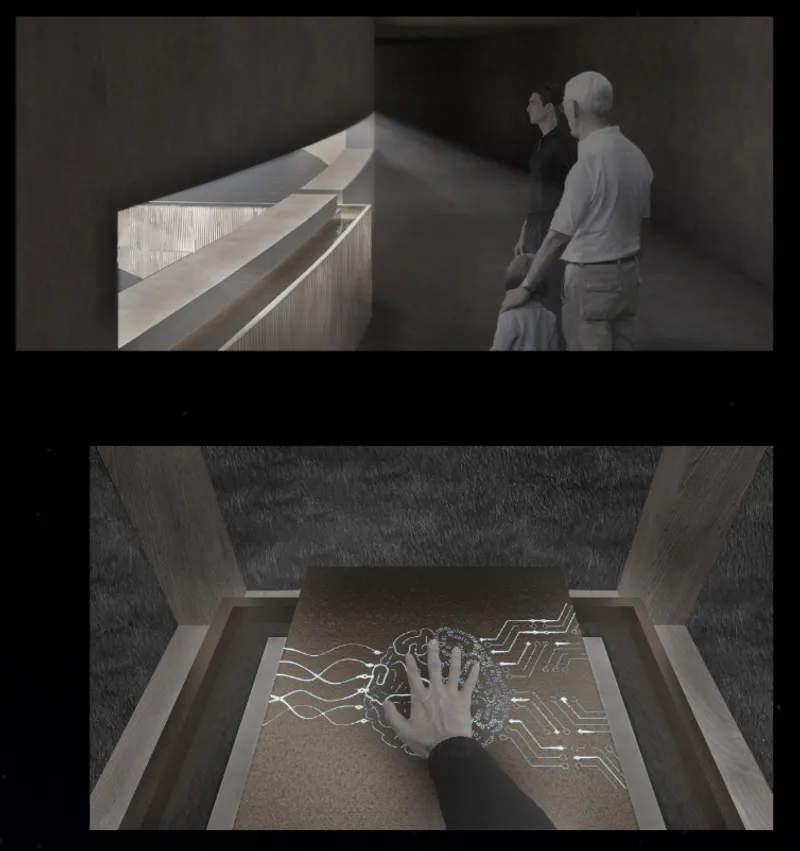
Inside the memorial, the design shifts from landscape to interiority. An exhibition space houses a lit display alcove and an interactive floor panel, where visitors view projected imagery that forms what the designers describe as an ethereal connection between the past and the present. The projections transform the interior into a space where memories are not stored in objects but activated through light. Figures gather around the floor panel, their attention directed downward, mirroring the act of looking into water.
The interior functions as the spiritual counterpart to the exterior's material journey. Outside, ashes dissolve into the spring and flow into the garden. Inside, memories are illuminated and held, temporarily visible before fading again. The two processes are parallel: matter returns to the earth, while spirit lingers in the sanctuary. The architecture does not ask visitors to choose between grief and hope; it holds both simultaneously.
Why This Project Matters
Memorial architecture often defaults to permanence: granite walls, engraved names, fixed locations where the dead are kept. Guo, Mou, and 刘's project challenges that instinct by proposing impermanence as the primary material. Ashes become water. Water becomes garden. Projections flicker and fade. The memorial does not try to stop time; it moves with it. In doing so, it offers a more honest relationship with loss, one that acknowledges the living need spaces that breathe, change, and eventually let go.
The Honorable Mention in the Circle of Life competition is well earned. The project takes a competition brief about death and transforms it into an argument about continuity. The circular plan, the flowing water, the projected light: each element reinforces a single conviction that parting is not an end but a transition. For a design by emerging practitioners, the clarity of that conviction, and the rigor with which it is spatially expressed, is genuinely impressive.
View the Full Project
About the Designers
Designers: Mingjie Guo, Mou Ziyong, 刘 丛
Enter a Design Competition on uni.xyz
uni.xyz runs architecture and design competitions year-round that reward proposals with spatial conviction and real site intelligence.
Project credits: Parting in Matter, Reunion in Spirit by Mingjie Guo, Mou Ziyong, 刘 丛 Circle of Life (uni.xyz).



Popular Articles
Popular articles from the community


Co-life: Sustainable Architecture for Age-Friendly Community Living
Co-life reimagines sustainable architecture for seniors through courtyards, rammed earth, shared gardens, and spaces designed for belonging.

Riyadh For All: Intergenerational Urban Design for Active Aging in Rabat
Riyadh For All reimagines urban design in Rabat with intergenerational co-living, adaptive courtyards, and Moroccan cultural exchange today.

Lunar Spiral: Space Architecture Shaped by the Mathematics of the Universe
Lunar Spiral reimagines space architecture through Fibonacci geometry, lunar regolith, levitating habitats, and self-sustaining Moon living.

Conexión: Biophilic Design Reimagines High-Rise Living in Hong Kong
Conexión reimagines high-rise living in Hong Kong through biophilic design, green facades, shared spaces, daylight, water and nature within.

Similar Reads
You might also enjoy these articles

Bao Huynh Watercolor Atelier: A Serene Art Retreat in Hội An
Bao Huynh Watercolor Atelier in Hội An blends multifunctional art spaces, sustainable design, local materials, and family-friendly living in a serene environment.

Atelier Macri Concept Store Interior Design by CASE-REAL
Atelier Macri store features a "ko" counter, walnut wood details, cork displays, blending retail, gallery, and seamless customer experiences.

Manuel Vargas Izquierdo Stadium and High-Performance Sports Center: Architectural Excellence in Jalpa de Méndez
The Manuel Vargas Izquierdo Stadium blends sustainable design, inclusive sports facilities, and cultural-inspired architecture, revitalizing Jalpa de Méndez’s public spaces.

KAKR Buluh Awar Hall: Revitalizing Community and Ecology Through Bamboo Architecture
Community built bamboo hall revitalizes Buluh Awar village, empowering youth, restoring ecology, celebrating vernacular craftsmanship through sustainable architecture and culture.

Explore Memorial Design Competitions
Discover active competitions in this discipline


Design Challenge - Contemporary interpretation of a religious complex


Challenge to design locus for the upliftment of human rights


Design challenge to reuse E-waste
Comments (0)
Please login or sign up to add comments
No comments yet. Be the first to comment!