
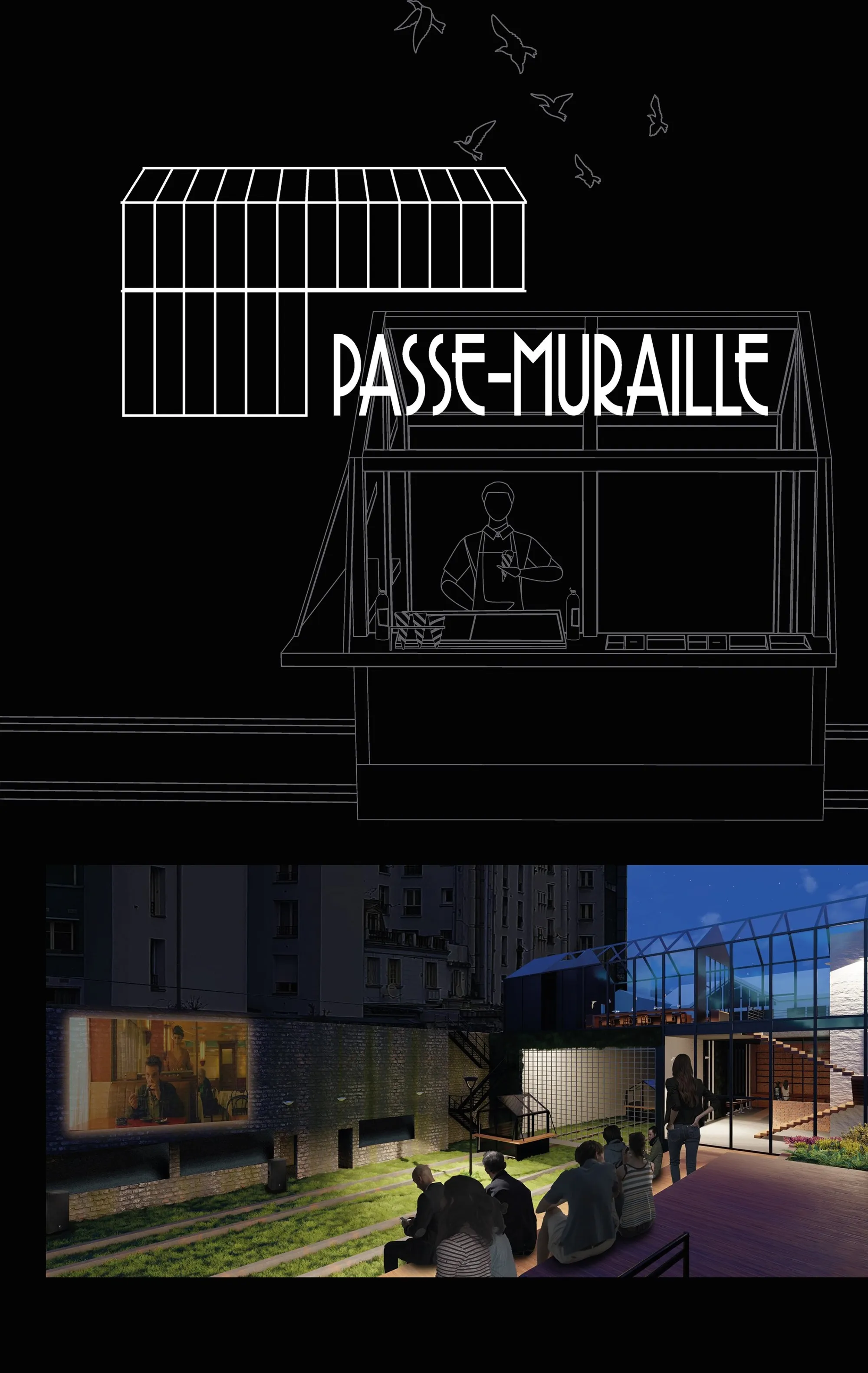
Passe-Muraille: A Model for Urban Regeneration Architecture in Paris
Transforming forgotten railway infrastructure into a dynamic urban regeneration architecture hub for culture, community, and adaptive public life in Paris.


Passe-Muraille, a project by Nassim Barkaoui, reimagines the underutilized remnants of Paris’s Petite Ceinture through the lens of urban regeneration architecture. Positioned within a historically industrial corridor, the proposal transforms a linear and fragmented site into a cohesive, multi-layered public environment that fosters social interaction, cultural programming, and economic activity.
At its core, the project addresses a recurring challenge in contemporary urban design: how to reactivate obsolete infrastructure while maintaining contextual sensitivity and programmatic flexibility. Passe-Muraille responds by introducing a hybrid architectural system that merges public space, modular commerce, and cultural infrastructure into a unified spatial strategy.
Urban Regeneration Architecture and Context
The Petite Ceinture, once a vital railway loop encircling Paris, has gradually transitioned into a fragmented urban void. Today, it exists as a layered condition, partly abandoned yet intermittently activated by informal uses and cultural initiatives such as La Recyclerie. Passe-Muraille positions itself within this evolving narrative by reinforcing and expanding the site's existing social and ecological potential.
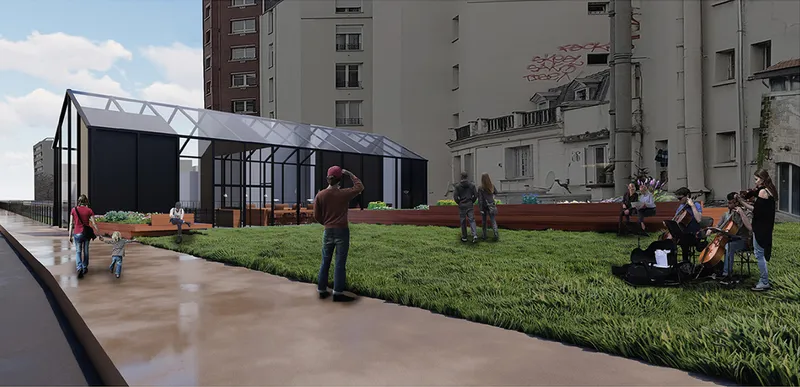
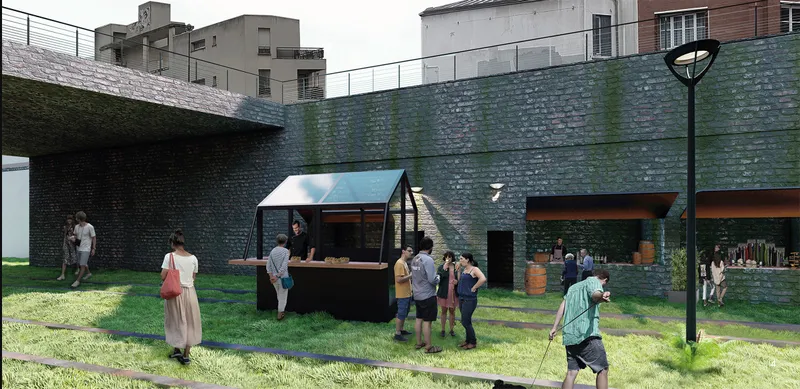
The project adopts a lightweight architectural language composed of metal and glass, evoking the typology of a greenhouse. This formal choice is not merely aesthetic but symbolic, referencing the collaborative gardens that have organically emerged along the railway. The transparency and permeability of the structure allow it to operate as both a built intervention and an extension of the surrounding landscape.
Breaking Linearity: A Spatial Strategy
A defining feature of the project is its deliberate disruption of the site’s inherent linearity. Rather than reinforcing the elongated geometry of the railway, Passe-Muraille introduces a sequence of intermediate spaces that segment and diversify the user experience.
The integration of the main building along the site generates two distinct yet interconnected zones:
- Upper Square: A landscaped, open public area that serves as a calm, accessible entry point.
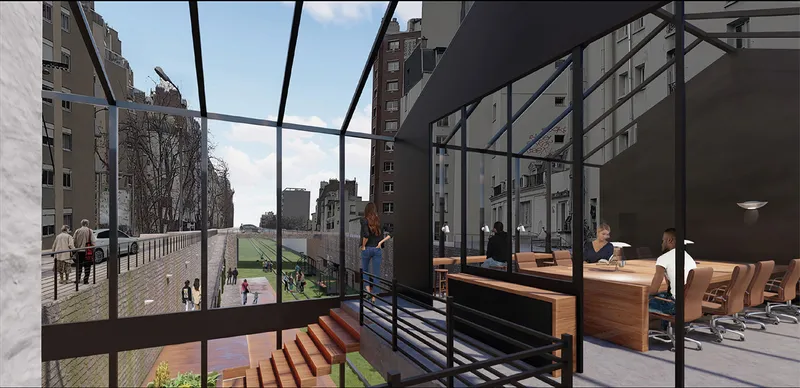
- Lower Square: A more dynamic, program-driven space embedded within the existing railway trench.
This dual-level approach enhances spatial complexity while maintaining continuity. Vertical circulation elements such as stairs and terraces act as connectors, ensuring fluid movement between levels and reinforcing the project's role as an urban interface.
Programmatic Diversity and Public Engagement
Passe-Muraille operates as a multi-functional platform that accommodates a wide spectrum of activities. The architectural program is intentionally flexible, enabling both temporary and permanent uses.
Key programmatic components include:
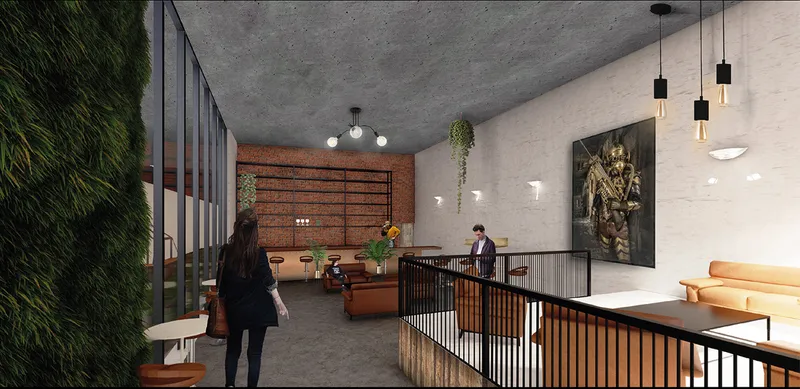
- A collaborative workspace on the ground floor, adaptable for workshops, meetings, and co-working environments
- A basement bar that leverages the industrial character of the site to create an immersive social atmosphere
- A series of modular retail units positioned along the former railway tracks
- Bleacher seating integrated into the lower level for public events, screenings, and informal gatherings
The modular units are particularly significant in the context of urban regeneration architecture. Designed to slide along the existing rails, they introduce a dynamic layer of adaptability, allowing the space to continuously evolve in response to changing needs.
Three primary typologies define these units:
- Ice cream kiosks
- Fruit and vegetable stands
- Prepared food vendors
This system encourages local entrepreneurship while activating the site throughout the day and evening.
Material Strategy and Cost Efficiency
The project emphasizes economical and sustainable construction methods. By prioritizing reusable and low-impact materials, Passe-Muraille aligns with contemporary principles of sustainable architecture.
The primary structure employs steel reinforcement, minimizing reliance on concrete and reducing both environmental impact and construction costs. The repetitive grid system further enhances efficiency, enabling prefabrication and streamlined assembly.
Wood is extensively used across terraces, seating areas, and public interfaces, contributing to a warm and accessible user experience while maintaining affordability.
Social Inclusivity and Urban Integration
A critical strength of Passe-Muraille lies in its inclusivity. The project is designed to accommodate diverse user groups, including local residents, tourists, and transient populations.
The open and layered configuration ensures that the space remains accessible from multiple entry points. Activities are distributed across different levels and zones, allowing users to engage with the site in varied ways depending on time, purpose, and social context.
From daytime markets to evening cultural events, the project establishes itself as a continuously active urban node. The integration with La Recyclerie further amplifies its impact, creating a larger ecosystem of community-oriented programming.
Cultural Infrastructure and Identity
Beyond its functional attributes, Passe-Muraille contributes to the cultural identity of the area. By incorporating elements inspired by Parisian traditions, such as the bouquinistes along the Seine, the project anchors itself within a broader cultural narrative.
These references are not superficial but embedded within the spatial and programmatic logic of the design. The result is an architecture that is both contemporary and contextually grounded.
Reclaiming the Urban Void
The transformation of the Petite Ceinture through Passe-Muraille exemplifies the potential of urban regeneration architecture to reclaim neglected spaces. By introducing a cohesive framework that integrates architecture, landscape, and program, the project redefines the role of infrastructure in the contemporary city.
The newly created ground-level square becomes a vital meeting point, addressing the scarcity of open public spaces in dense urban environments. Simultaneously, the lower level reactivates the forgotten railway corridor, turning it into a vibrant cultural and economic platform.
Passe-Muraille demonstrates how strategic architectural interventions can unlock the latent potential of urban voids. Through a combination of modular systems, adaptive programming, and contextual sensitivity, the project establishes a new paradigm for urban regeneration architecture in Paris.
By breaking linearity, embracing flexibility, and prioritizing community engagement, it transforms a neglected site into a dynamic public realm that responds to the complexities of contemporary urban life.



Popular Articles
Popular articles from the community


Co-Life: Senior Housing Design That Reconnects Older Adults With the City
Co-Life reimagines senior housing design through healing gardens, shared streets, workshops, and a sustainable community across generations.

The Earth Pod: 3D Printed Homes for Resilient Refugee Communities
The Earth Pod reimagines refugee housing through 3D printed homes made from clay, combining resilience, self-sufficiency, and rapid shelter.

The Musturak Paradise: Senior Living Architecture for a Connected Future in Temara, Morocco
The Musturak Paradise reimagines senior living architecture in Temara via private homes, social spaces, culture, community, and shared care.

Conexión: Biophilic Design Reimagines High-Rise Living in Hong Kong
Conexión reimagines high-rise living in Hong Kong through biophilic design, green facades, shared spaces, daylight, water and nature within.

Similar Reads
You might also enjoy these articles

Eco Chapel: A Green Architecture Pavilion Designed in Symbiosis with the Forest
Eco Chapel uses green architecture to weave prayer, learning and reuse into a forest pavilion shaped by modular hexagonal canopies for life.
Kaffeebühnen: Coffee Shop Architecture Designed as a Civic Stage Between Vienna’s City and Park
Kaffeebühnen turns coffee shop architecture into a civic stage, linking Vienna’s park edge, urban life, warm timber yards, and coffee craft.
Healing Façade: Sustainable Architecture for Reforestation, Community, and Sacred Ecology in Ethiopia
Healing Façade reimagines sustainable architecture as a living wall that restores soil, catches water and renews Ethiopia's forest churches.


Urban Forest: A Vertical Ecosystem for 5,000 Workers in Singapore's Changi Business Park
Radially stacked pods and layered green decks turn a 7-acre plot into 47 acres of ecological workspace projected for 2040.

Explore Architecture Competitions
Discover active competitions in this discipline



Challenge to reimagine the Iron Throne


Photograph architecture without architects


Illustrate the lost glory of Angkor Wat - Render Challenge


Design challenge to reuse E-waste
Comments (0)
Please login or sign up to add comments
No comments yet. Be the first to comment!