

People Pavilion Elevated Ground in Bangkok: A Temporary Urban Space for Community Interaction
The People Pavilion in Bangkok creates an elevated landscape canopy, transforming a city hall garden into a flexible public space for gatherings.


The People Pavilion Elevated Ground is an innovative temporary architectural installation designed by nerd studio and sp/n in Khet Phra Nakhon, Bangkok, Thailand. Completed in 2024, the pavilion covers an area of 310 square meters and was developed as part of Bangkok Design Week 2024. The project reimagines how underutilized urban green spaces can transform into vibrant public environments that encourage community interaction, social engagement, and cultural exchange.
Located within the garden space of Bangkok City Hall, the pavilion explores the concept of a “Livable Scape.” This approach rethinks how urban landscapes can support human activity beyond their typical operational hours. By introducing a temporary pavilion structure, the architects created a flexible public environment where people can gather, meet, converse, and participate in various community activities.
The design highlights how small-scale architectural interventions can activate public spaces and strengthen the relationship between people and the city.
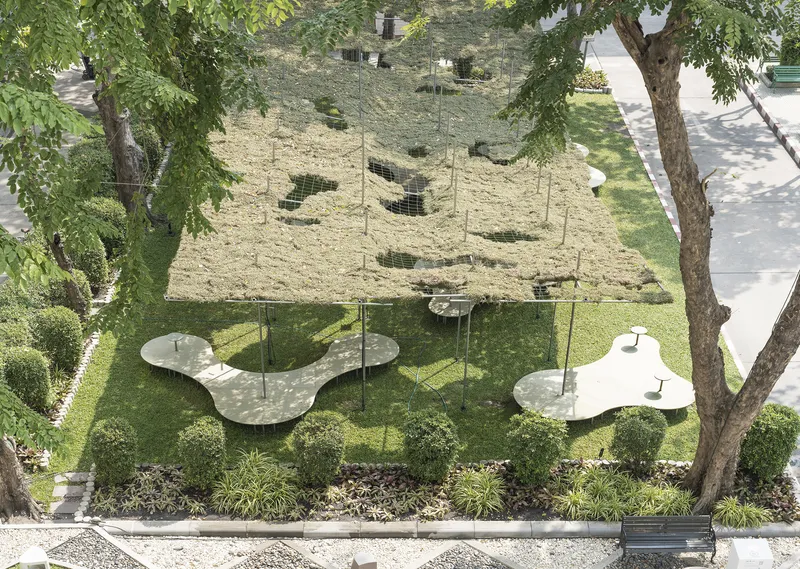
Transforming Urban Green Spaces into Public Meeting Grounds
The core idea behind the People Pavilion Elevated Ground is to dissolve the boundaries between the surrounding urban context and the enclosed green areas within government buildings. Traditionally, these spaces remain inaccessible or underused after working hours. The pavilion challenges this condition by temporarily transforming the garden into an inclusive public meeting place.
Through careful spatial planning and adaptable programming, the pavilion provides a welcoming platform for community activities. It supports a variety of functions, including:
Community gatherings Cultural events Educational workshops Public discussions Relaxation and social interaction
The project acts as a social catalyst, encouraging interaction between individuals from diverse backgrounds while fostering a stronger sense of community within the historic Phra Nakhon district.
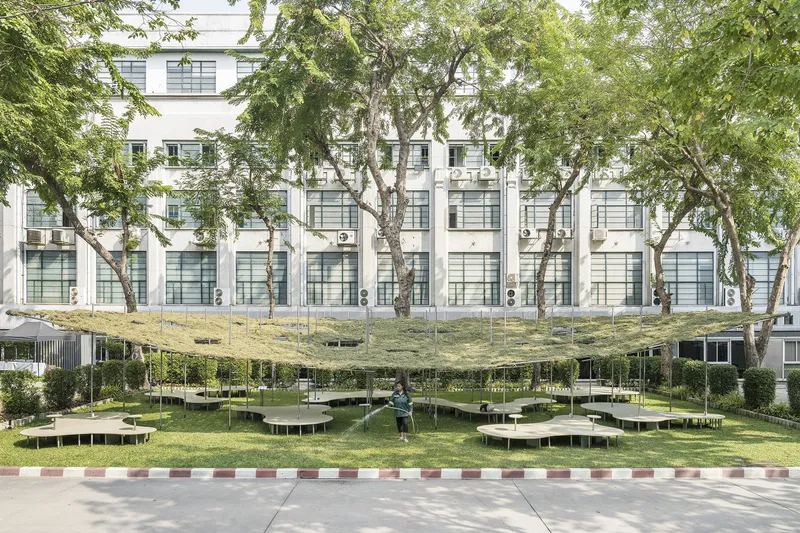
Architectural Design Inspired by the Idea of Elevated Ground
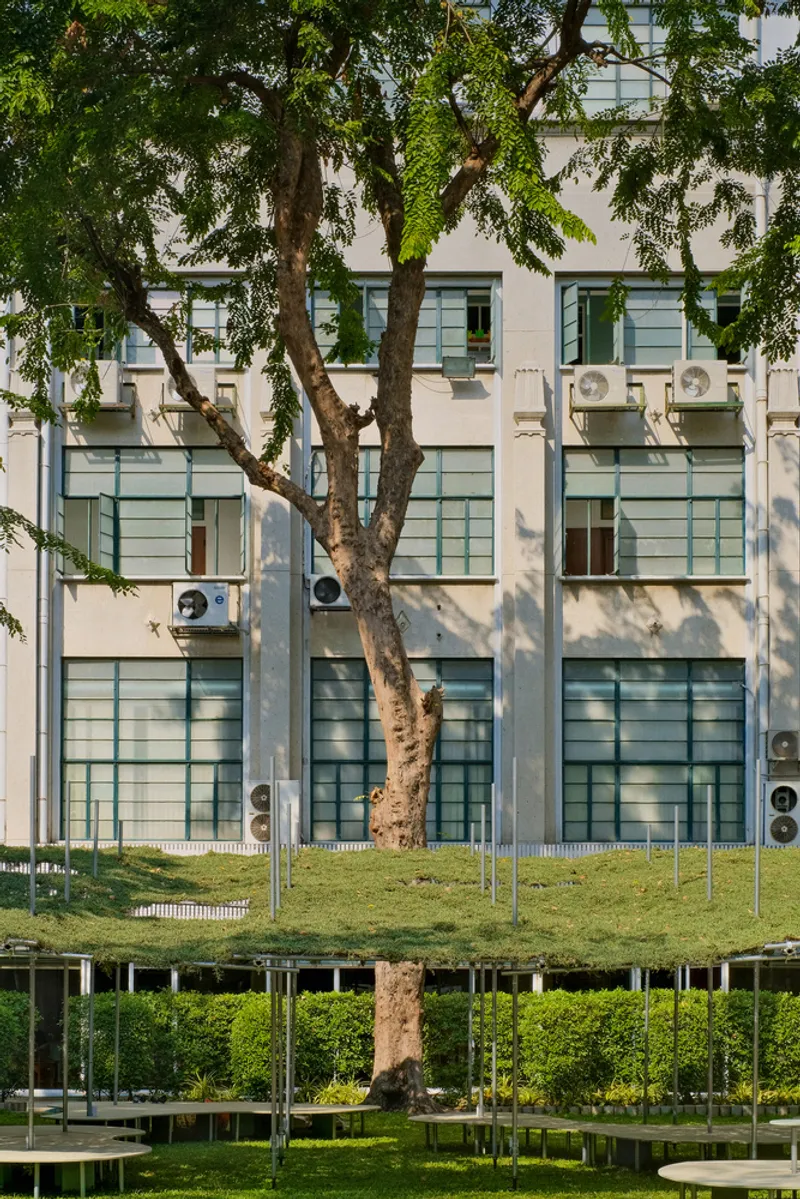
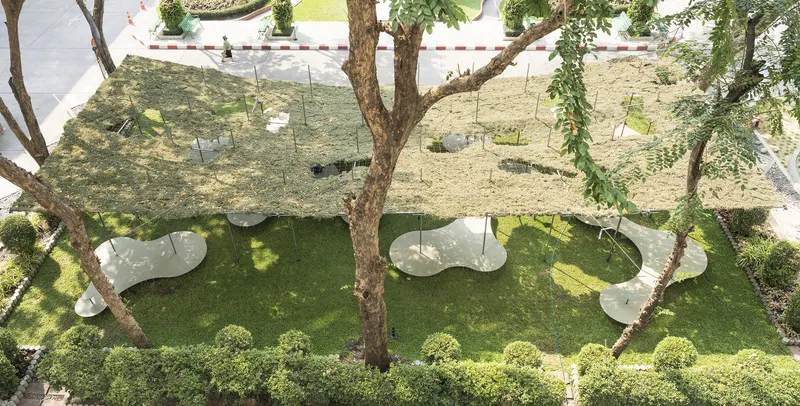
One of the pavilion’s most distinctive architectural features is its elevated roof structure, which reinterprets the concept of the ground plane. The roof appears as a lifted landscape element, visually resembling a continuation of the surrounding lawn.
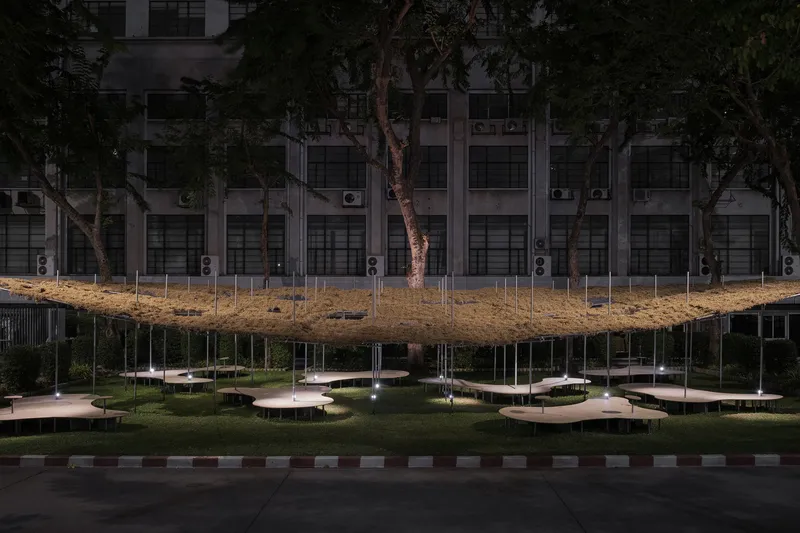
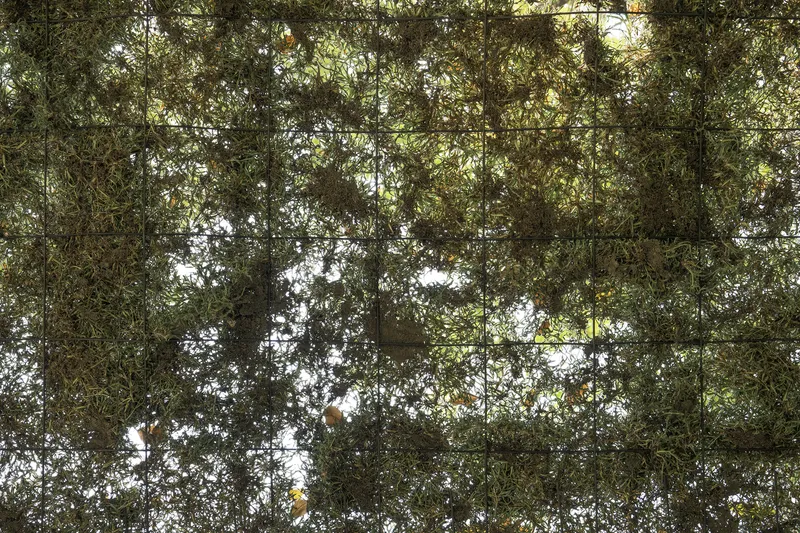
The architects experimented with a patch of natural grass installed on the roof surface. This grass uses the same species found in the existing lawn of the site, reinforcing the pavilion’s connection to its environment. As the grass dries and decomposes over time, natural openings form within the surface. These gaps allow sunlight and artificial lighting to filter through the structure, creating dynamic lighting effects throughout the day and during evening events.
From a distance, visitors first perceive the structure as an elevated piece of landscape. As they approach the pavilion, the form gradually transforms into a recognizable architectural canopy. This subtle transition blurs the line between landscape and architecture.
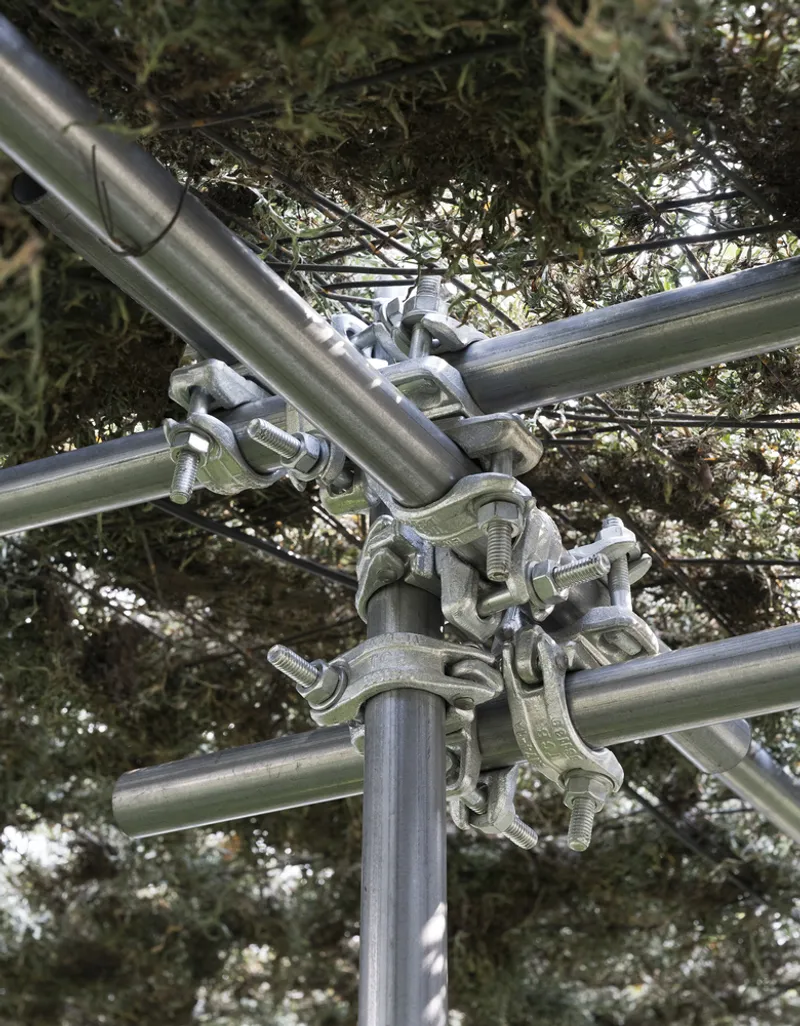
Flexible Spatial Design and Lightweight Structure
The pavilion is constructed using lightweight modular structural systems that define a series of spatial zones. These zones are designed based on proxemic principles, which consider how people naturally interact and organize themselves within space.
Circular seating arrangements are placed throughout the pavilion in varying sizes and distances. These seating elements create a balance of positive and negative spaces, allowing groups to gather or disperse depending on the scale and nature of their activities.
This flexible layout enables the pavilion to support different social conditions, from small informal conversations to larger collective events. The open structure encourages movement, exploration, and spontaneous engagement among visitors.
A Platform for Bangkok Design Week 2024
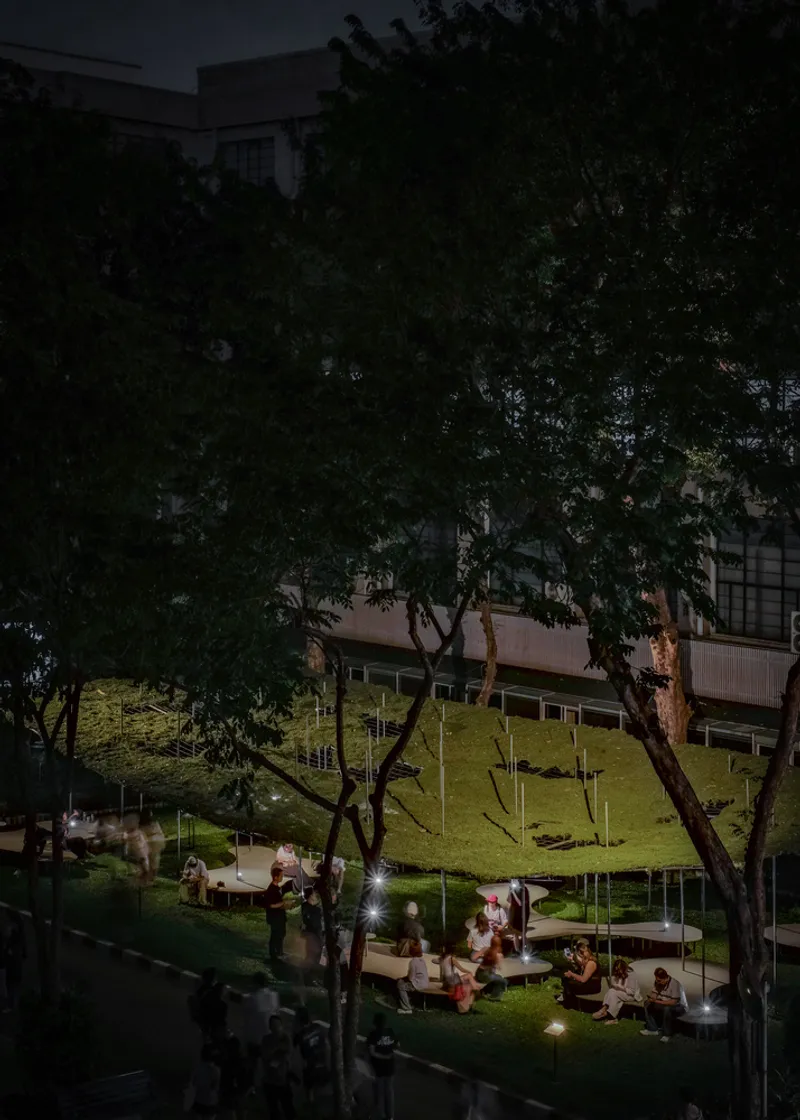
The People Pavilion served as a central venue during Bangkok Design Week 2024, curated by Urban Ally. Throughout the event, the pavilion hosted a wide range of activities that reflected the diversity and energy of the local creative community.
Programs included:
Opening ceremonies Urban podcast discussions Student workshops Interactive performances Music shows Live DJ sessions Relaxation and social gathering spaces
In addition to the scheduled activities, the pavilion naturally attracted spontaneous interactions and informal gatherings. Visitors used the space as a place to meet, relax, or engage in creative dialogue.
Architecture as a Medium for Urban Conversation
Beyond its physical structure, the pavilion functions as a platform for dialogue between people, architecture, and the city. It demonstrates how temporary installations can reshape public perception of urban spaces while promoting civic participation.
By activating the garden area of Bangkok City Hall, the project encourages residents and visitors to reconsider how urban environments can support everyday social life. The pavilion highlights the potential of temporary architecture and public design as tools for community building and cultural expression.
The People Pavilion Elevated Ground by nerd studio and sp/n illustrates how thoughtful architectural design can transform overlooked spaces into dynamic social environments. Through its elevated landscape concept, lightweight structure, and flexible spatial arrangement, the pavilion creates a welcoming platform for community engagement and cultural exchange.
As part of Bangkok Design Week 2024, the pavilion successfully bridged the gap between urban infrastructure and public life, demonstrating how temporary architectural interventions can generate lasting social impact within cities.
All photographs are works of
Atelier247, spin


Popular Articles
Popular articles from the community


Cambra Buró Sets a Kuwaiti Coastal Villa on a Sculpted Travertine Plinth and Lets the Upper House Float
In Abu Al Hasaniya, Kuwait, a 3,000 sqm seaside villa pairs a heavy stone base with clay, cork and walnut to work with the Gulf climate.

Bokey Grant Wedges a Brick Lookout Tower into a Flame Zone Escarpment in the Southern Highlands
A double brick family home in New South Wales's Southern Highlands, reached by an 18 metre bridge and built to read as both watchtower and bunker.

3XN, B+H and ZHUBO Design Shape the Shenzhen Natural History Museum as a Walkable Geological Landscape
Beside Yanzi Lake in Shenzhen's Pingshan District, a 105,300 m² museum folds its galleries under a public roof that behaves like a river-carved hillside.

Fiechter Salzmann Extends Werner Künzi's Listed Mösli School in Ostermundigen with Concrete, Spruce and Red Steel
In Ostermundigen near Bern, a kindergarten and day school wing lengthens a heritage-listed complex using precast concrete, regional spruce and red steel.

Similar Reads
You might also enjoy these articles

Diogo Aguiar Studio Strings Eight Identical Timber Modules Across a Hillside Above Porto
In the Serras do Porto, a prefabricated timber house of identical sloping modules reads as a small mountain range and lets its program grow.

Luis Canepa Arquitetos Renovates a Praia Preta Beach House Without Erasing Its Stone, Brick and Timber
A 281 m² L-shaped refurbishment in Praia Preta, Brazil, keeps the old house's rubble stone and whitewashed brick while turning it toward sea and sand.

Paraa Raises a Perforated Brick Platform for Shared Community Life on an Open Ground in Dhaka's Korail Settlement
A 332 m² brick lattice building at Ershad Maidan, shaped through more than 60 workshops, turns an open ground in Korail, Dhaka, into a shared stage.

REAL Architects and Challenge Design Plant a Timber Gridshell Seed at the Heart of Shanghai's West Bund
On Shanghai's Xuhui Waterfront, a 230 m² glazed timber lattice dome anchors a terraced garden and lets its structure do all the talking.

Explore Public Plaza Competitions
Discover active competitions in this discipline

The International Standard for Design Portfolios

The Global Benchmark for Architecture Dissertation Awards

The Global Benchmark for Graduation Excellence

Challenge to design a portable theatre
Comments (0)
Please login or sign up to add comments
No comments yet. Be the first to comment!