
Perdu Trouvé: Learning to Inhabit the Urban Void Instead of Filling It
A shortlisted Salut Paris entry that turns a residual rail corridor into a folded civic spine of frames, hard enclosures and soft enclosures.


Most regeneration schemes treat an empty lot or a disused rail cut as a problem awaiting a building. Perdu Trouvé refuses that reflex. Its title, "lost, found," sets out the whole argument: the void is a resource. The project asks whether the city should fill its leftover spaces at all, or whether it should learn to occupy them as they are, with as little imposed form as possible.
Designed by llLab Architects and shortlisted in the Salut Paris competition, the proposal works in the interstitial conditions of the city: rail tracks, residual corridors and fragmented urban edges that planning usually writes off. Instead of a single masterplan, the designers propose a distributed sequence of insertions that respond to context, scale and human activity. The drawings even question the planner's role with a blunt caption: "Another plan?"
A Rail Corridor Read as a Spine, Not a Barrier

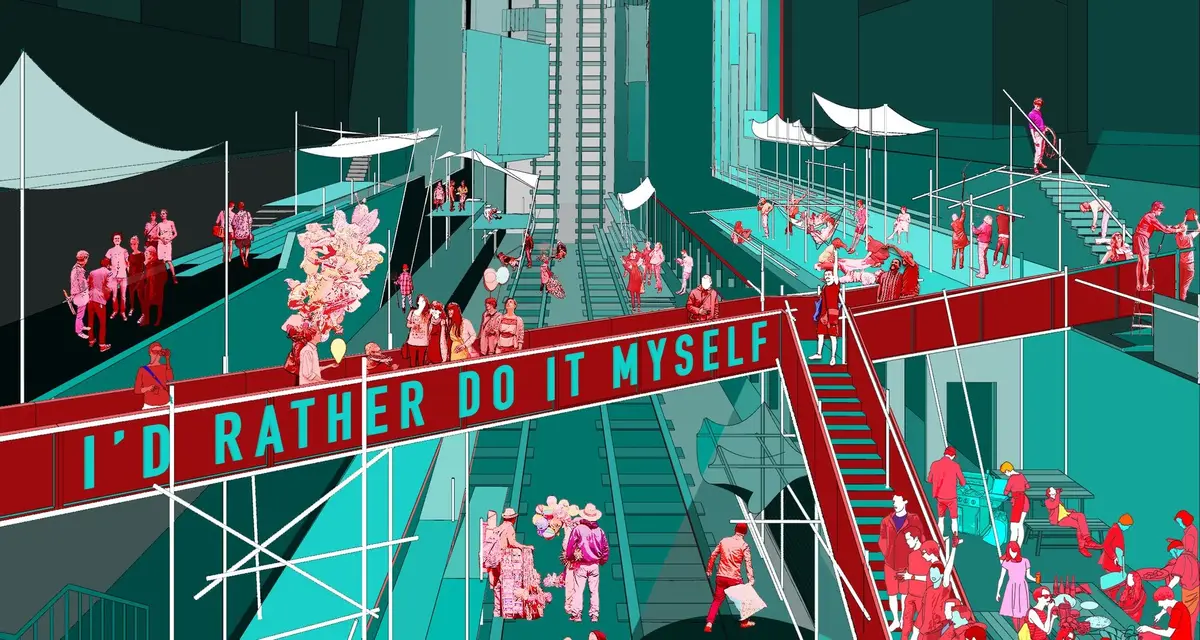
The section-elevation sets out the site as a cross-cut of the city. Apartment blocks and stairs rise on either side, and the rail corridor, picked out in red, runs between them, while a steam train and teal-toned trees fill the foreground. The drawing reads less like a technical survey and more like a narrative strip, in keeping with the project's insistence that forgotten infrastructure carries a story worth keeping.
That framing matters. In most urban plans a railway corridor is a seam that divides neighbourhoods. Here it becomes the primary spine of interaction, the line along which disconnected fragments of the city are stitched back together. The red line is the protagonist of the drawing, not the leftover space behind it.
Folded Ground and Routes That Weave Across the Tracks
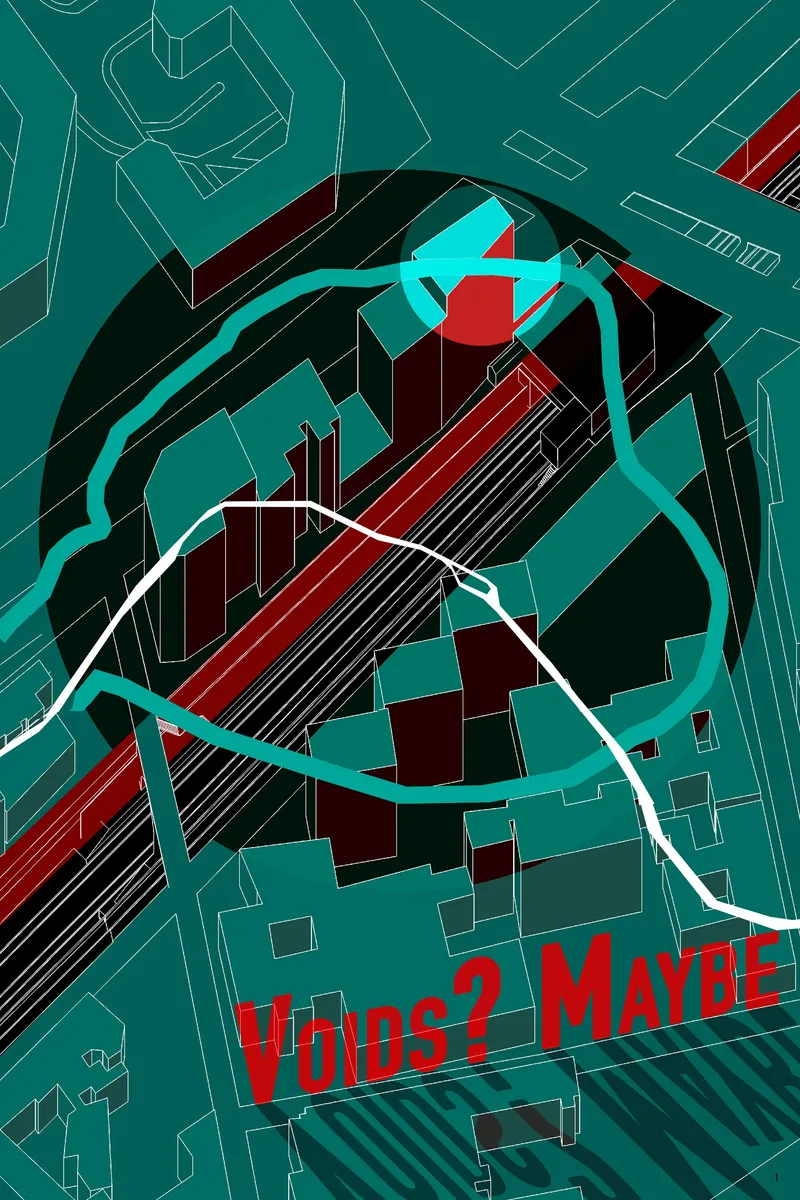
The defining spatial move is the folding of the ground plane. Elevated walkways, bridges and platforms cross the railway corridor and create interaction on several levels, so the line between infrastructure and public space starts to dissolve. Read together, the two drawings explain the strategy. The section shows the vertical layering of stairs and edges, and the aerial axonometric traces teal and white routes across the city blocks on either side of the diagonal red cut.
Circulation is the architecture here. The routes are meant to be experienced, not just to get people from one place to another, and they offer different intensities of engagement, from quiet observation decks to active communal zones. Markets, performances and informal gatherings are the programme the designers picture, carried by fabric canopies, temporary structures and lightweight frameworks that people can take over as their needs change.
A Dark Void Held at the Centre of the Plan
The most telling detail in the axonometric is what the designers chose not to draw. The route lines circle a dark void without filling it. The empty space stays empty and becomes the thing that organises movement around it. This is the project's thesis in graphic form: absence as an active condition, not a gap waiting to be built over.
The construction logic follows the same restraint. The proposal acknowledges that modular building is efficient but rejects rigid spatial modules. In their place it offers a hybrid kit of structural frameworks, hard enclosures and soft enclosures, which users can assemble, modify and personalise. Working with what already exists also cuts material consumption, so the minimal-intervention stance has an ecological argument as well as an aesthetic one.
Why This Project Matters
Perdu Trouvé puts a hard question to the profession. When every competition brief invites a new object, it takes discipline to propose a framework that deliberately stays unfinished. The entry trades the authority of the masterplan for participation, temporality and incremental growth, and it makes that trade legible in drawings that leave the void visibly untouched.
The open-ended approach has its own risk: an architecture that resists finality has to trust that people will actually take it up. Still, the combination of a reclaimed rail spine, a folded multi-level ground and a flexible kit of hard and soft enclosures offers a credible model for cities full of residual land. It suggests that the most useful act of regeneration may be to notice what is already there and give people the means to occupy it.
View the Full Project
About the Designers
Designer: llLab Architects
Enter a Design Competition on uni.xyz
uni.xyz runs architecture and design competitions year-round that reward proposals with spatial conviction and real site intelligence.
Project credits: Perdu Trouvé by llLab Architects Salut Paris (uni.xyz).


Popular Articles
Popular articles from the community


GROUP A Strips a 1969 Rotterdam Harbor Headquarters to Its Frame and Wraps It in Timber Louvers
In Rotterdam's M4H harbor district, Ferro Offices reuses a 1969 frame, adds one timber storey and reaches BREEAM-NL Outstanding.

Architekt Andreas Gruber Scatters 23 Dark Timber Chalets Across a South Tyrolean Forest Edge
In Molini di Tures, Amonti Chalets breaks a resort into a hamlet of gabled timber houses, with parking, storage and services pushed into the slope.

longwave studio Reorganizes a 112 m² Tainan Apartment Around the Daily Routines of a Family and Two Cats
In Tainan, Taiwan, birch plywood, rust-red furniture and a freestanding plaster wall link arrival, storage, work and family life in one apartment.

Cube Design Draws an Ecological Corridor Between Two Shenzhen Hills with the Nankai Building
Beside Shenzhen's container docks, the Nankai Building pairs stacked balconies with a climbing green screen to connect two hillsides across its height.

Similar Reads
You might also enjoy these articles
Healing Façade: A Modular Chapel System That Restores Ethiopia's Sacred Forests
Winner of the Eco-Chapel competition, this circular timber façade collects water from air to rebuild soil and reforest degraded Ethiopian landscapes.
Kaffeebühnen: Where Coffee Shop Architecture Becomes a Civic Stage in Vienna
A linear sequence of timber boxes, transparent shells, and open yards turns the Viennese café tradition into a public performance space.
Eco Chapel: A Modular Forest Pavilion That Grows Like the Landscape It Protects
Hexagonal timber modules weave through existing trees, turning a chapel into a living system for prayer, education, and reforestation.

Urban Forest: A Vertical Ecosystem for 5,000 Workers in Singapore's Changi Business Park
Radially stacked pods and layered green decks turn a 7-acre plot into 47 acres of ecological workspace projected for 2040.

Comments (0)
Please login or sign up to add comments
No comments yet. Be the first to comment!