
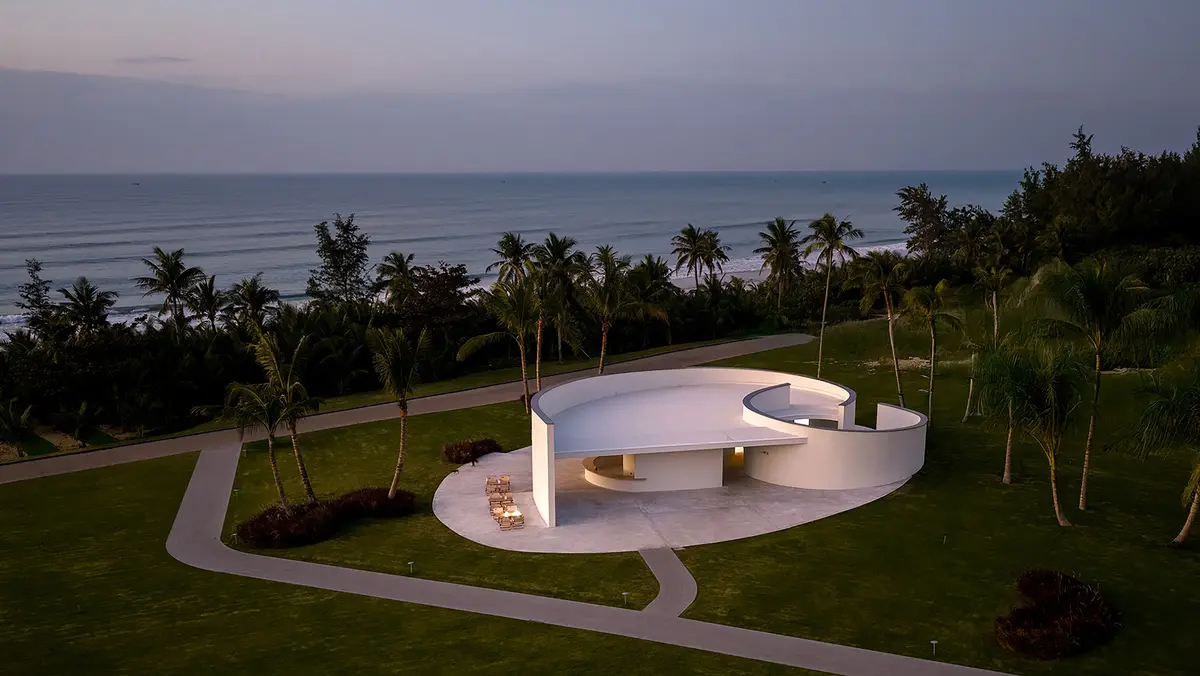
Perform Design Studio Spirals a Rest Station into the Coastline of Hainan's Shenzhou Peninsula
A 235-square-meter conch-shaped pavilion in Wanning dissolves the boundary between public infrastructure and tropical landscape.


Public restrooms rarely get their own design narrative. They are typically afterthoughts, tucked behind hedges or buried in the back of a parking lot. Perform Design Studio decided to treat the brief differently on the coast of Hainan's Shenzhou Peninsula, wrapping a 235-square-meter rest station into a spiraling form that borrows its geometry from a conch shell. The result is a building that doesn't hide from the landscape but coils into it, becoming a destination rather than a detour.
Sited in Letao Bay in Wanning, the Conch Station is part of a broader coastline improvement initiative for the peninsula. The building sits among coconut palms and manicured lawns, just steps from the beach. Two curved white walls rise from the ground and spiral inward, sheltering the station's functional program between their surfaces and a hovering roof. The real achievement here is tonal: the project elevates a utilitarian program to something visitors actually want to approach, photograph, and sit beside at sunset.
A Shell in the Palm Grove

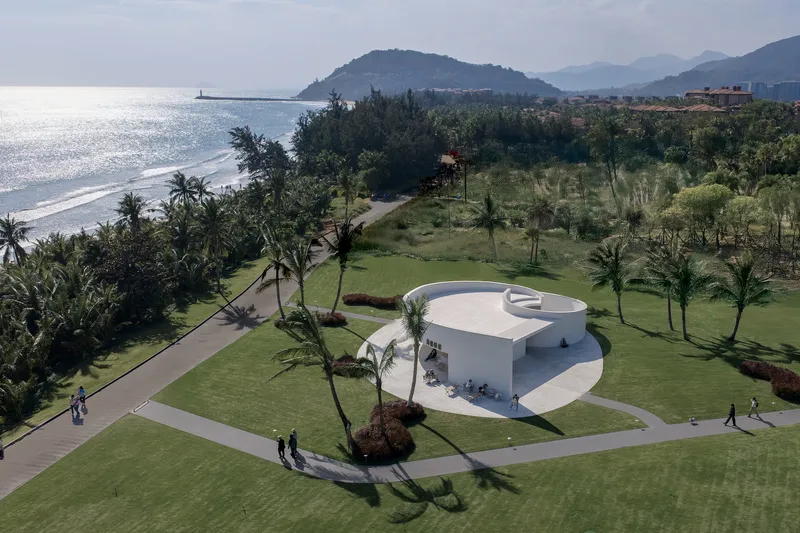
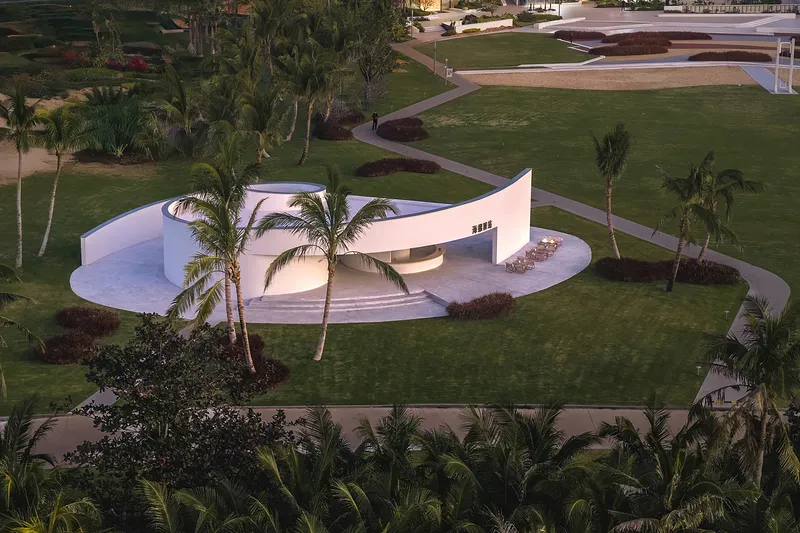
From above, the spiral geometry reads clearly. The building's white walls wind outward from a central point, creating a plan that is unmistakably organic yet precise. The form is not mimetic in a literal, kitschy way. It abstracts the logarithmic curve of a conch into architectural gestures: sweeping walls, a circular oculus, a rooftop terrace where a palm tree emerges through a gap in the parapet as if it were always meant to be there.
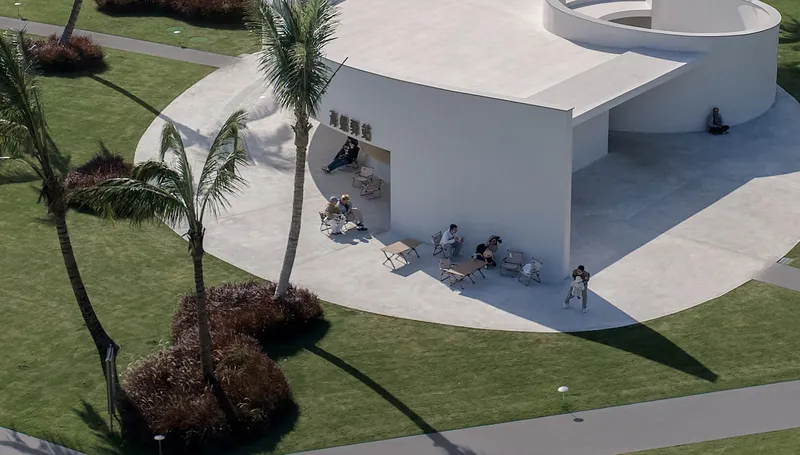
The aerial views reveal how comfortably the building sits within its site. Pathways radiate outward through the lawn, connecting the station to the shoreline and to pedestrian routes threading through the palm grove. Visitors gather on terraces and along the curved perimeter, treating the building less like a service block and more like a piece of landscape furniture.
Curved Walls and Cantilevered Planes
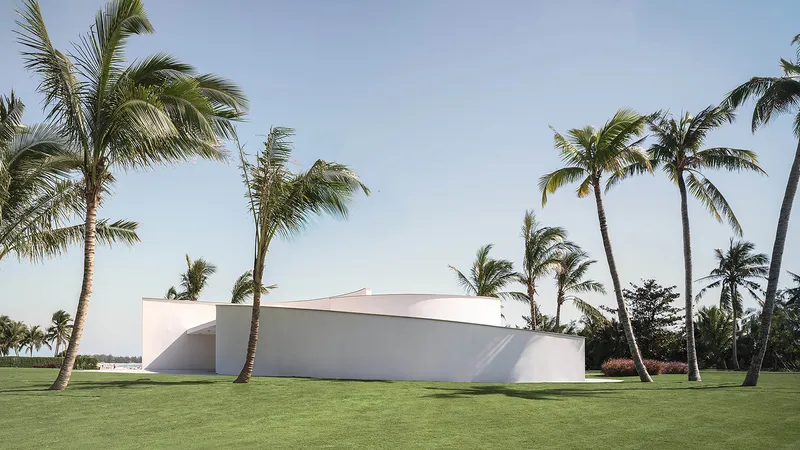
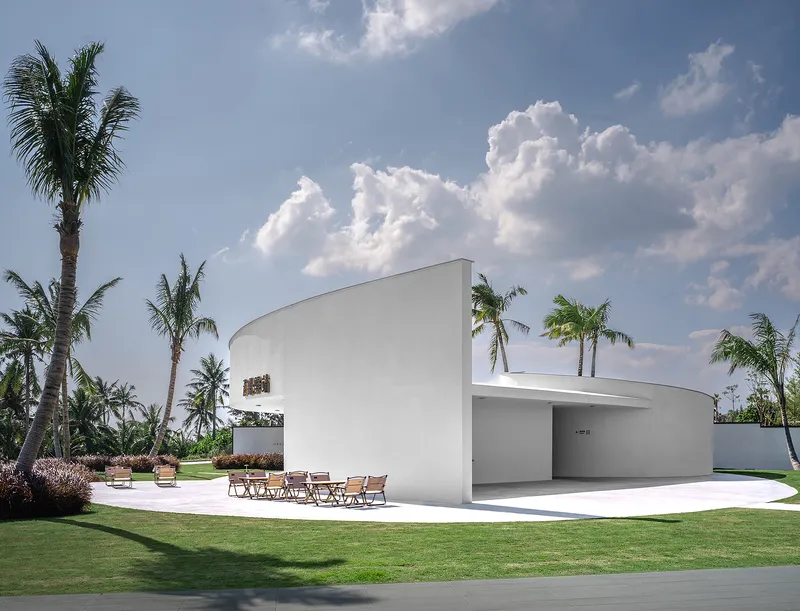
At ground level the spiral unwinds into something gentler. The concrete-coated walls are finished in a clean white that catches the tropical light without competing with the greens and blues around it. Generous overhangs and cantilevered roof planes extend the building's footprint into shaded thresholds, blurring the line between interior and exterior. An arched opening punched through one of the curved volumes acts as a threshold, drawing the eye through to the palms beyond.
There is a deliberate restraint in the material palette. White walls, smooth concrete coating, and nothing else fighting for attention. The building lets the palm canopy and the ocean horizon do the decorative work. It is a smart call: any applied texture or color would have competed with a setting that is already visually rich.
The Interior Spiral
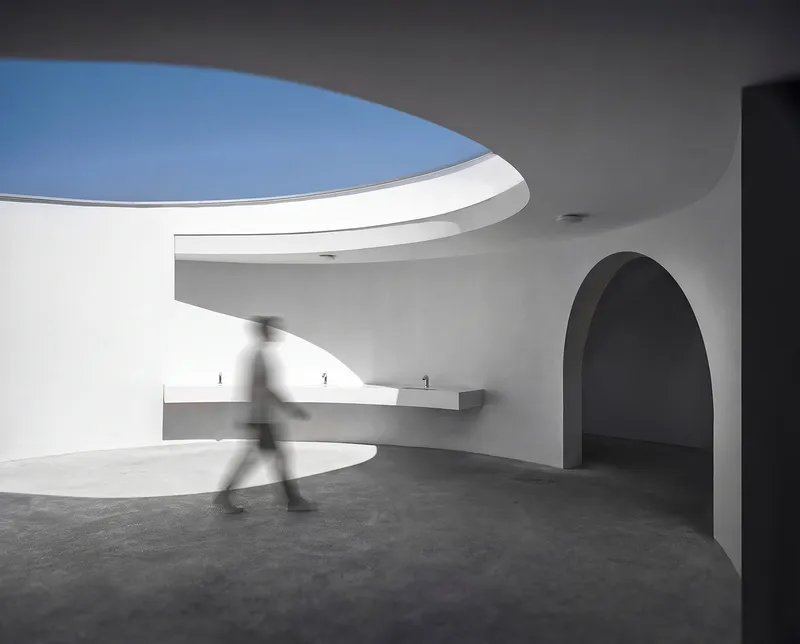

Inside, the spiral geometry translates into circulation that feels intuitive rather than disorienting. Corridors curve gently, lit by recessed ceiling fixtures that wash the white walls in even light. A circular oculus at the apex of the spiral pulls daylight deep into the plan, creating a moment of spatial release at what would otherwise be the most compressed point of the building.
The interior shot with a figure in motion blur is telling. People move through the station quickly, as they would through any rest stop, but the architecture gives them something worth noticing on the way. The counter beneath the oculus spirals outward, echoing the plan. It is a small gesture, but it reinforces the formal logic at every scale.
Dusk on the Terrace
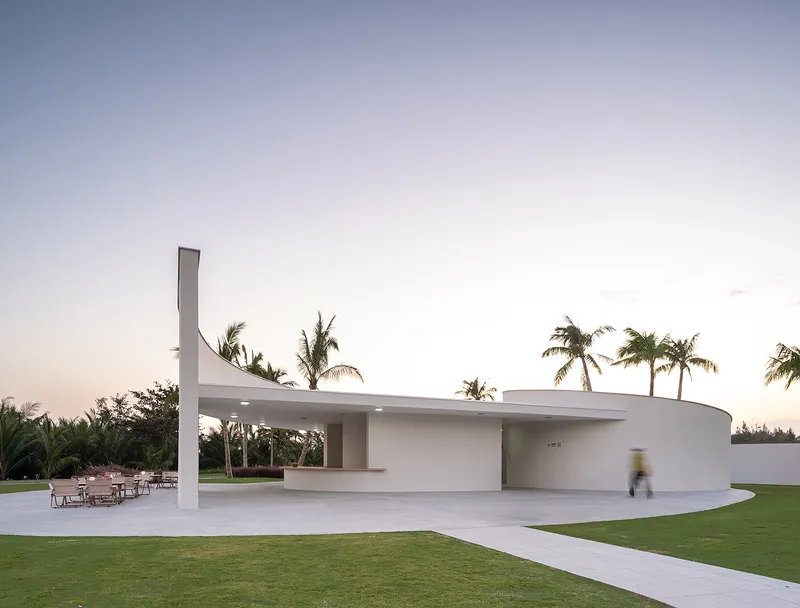
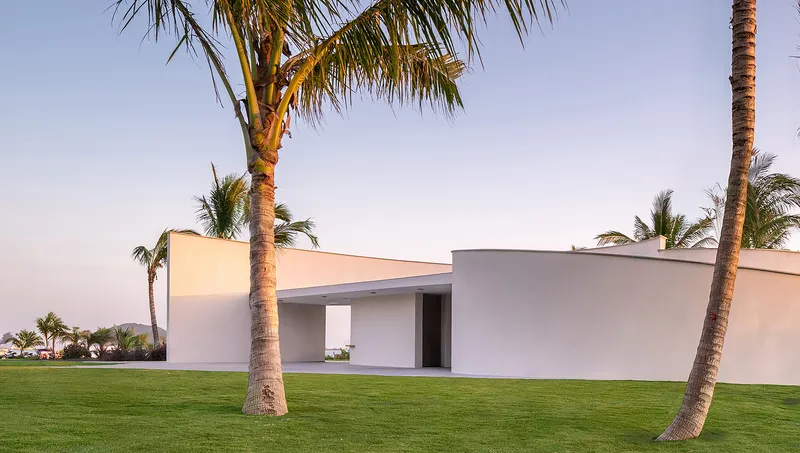

The building transforms at twilight. A vertical chimney element on the entrance facade becomes a lantern, its illuminated surface marking the station's presence against the darkening sky. The covered terrace, furnished with minimal stools, invites visitors to linger. Warm light spills from glazed openings, turning the station into a glowing volume set against the silhouettes of palms.
The dusk photography captures a quality that few rest areas achieve: a sense of occasion. The low horizontal volumes with overhanging roof planes frame views of the ocean and the surrounding grove, and the glazed pavilion adjacent to the main form offers a social space where visitors sit and watch the sunset. Infrastructure this is, but grudging it is not.
Landscape as Partner
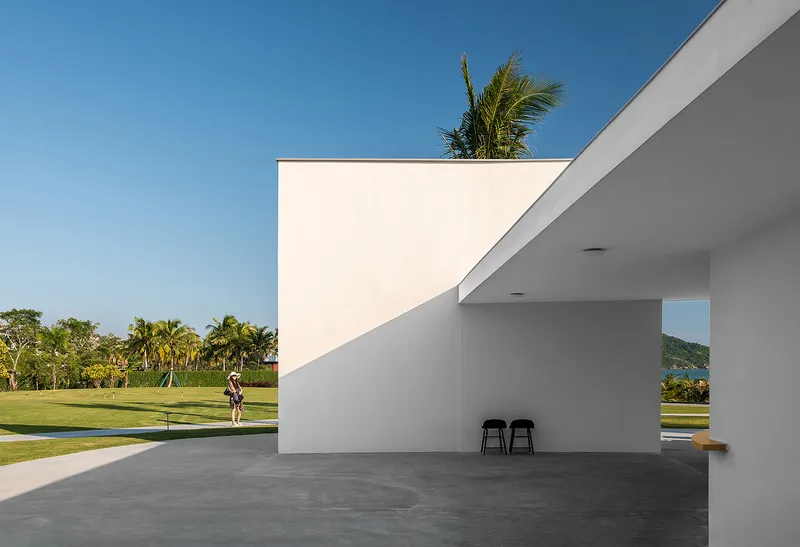

The rooftop terrace is a quiet revelation. A single palm tree rises through an opening in the white parapet, framed against the sky. Two stools sit on the covered terrace below, oriented toward the ocean. The image suggests a building that was designed around the existing vegetation rather than despite it, carving openings in its roof to accommodate what was already growing.
From the ocean side, the station reads as a low horizontal bar set into the mowed lawn, its recessed openings catching the last light of sunset. The building barely rises above the palm canopy. Its modesty in section is critical: any taller and it would have interrupted the visual continuity between lawn, shore, and sea. The curving white form, seen from the aerial dusk shot, sits comfortably within the landscape, neither dominating nor disappearing.
Plans and Drawings
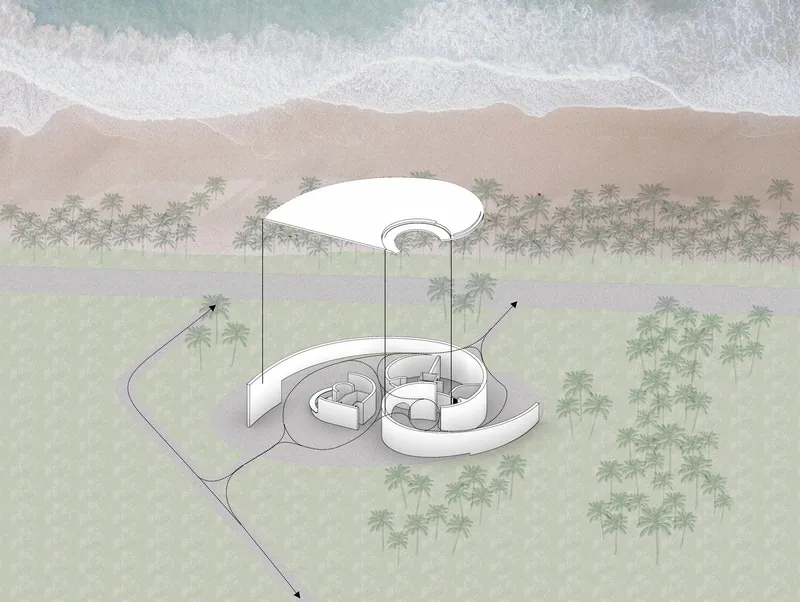
The axonometric drawing confirms what the photographs suggest: the curved roof canopy is a single continuous surface that spirals outward from the central oculus, sheltering circular interior volumes beneath. The plan is organized around two primary spaces that nestle between the curved walls, with the beach and pedestrian paths immediately adjacent.
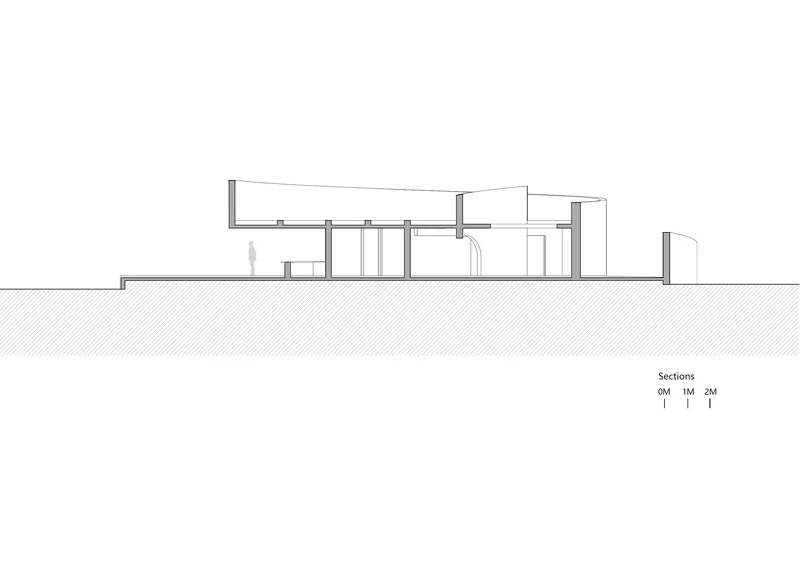
The section drawing is more revealing. It shows interior spaces that step partially below grade, keeping the roofline low while gaining usable height within. Structural elements are concealed within the walls, maintaining the clean, monolithic read of the exterior. The section also clarifies the relationship between the covered terrace, the enclosed program, and the rooftop, layering public, semi-public, and private zones vertically within a compact footprint.
Why This Project Matters
The Conch Station is an argument for taking small programs seriously. At 235 square meters, it is barely larger than a generous apartment, and its primary function is one that most architects would consider beneath their attention. Perform Design Studio chose to treat it as an opportunity to shape a public experience, and the result is a building that improves the entire coastline around it. Rest areas, bus shelters, public toilets: these are the most democratic typologies in architecture, encountered by everyone regardless of income or taste. When they are designed with care, the signal they send is that public space itself is worth investing in.
The formal strategy is confident without being extravagant. The conch spiral gives the building a memorable identity, but it also organizes circulation, structures views, and manages the relationship between interior and landscape in ways that a conventional box never could. China's coastal development boom has produced plenty of flashy resort architecture. The Conch Station suggests a quieter, more generous model: buildings that serve everyone passing through, not just the guests who booked a room.
Conch Station by Perform Design Studio, Wanning, Hainan, China. 235 m², completed 2025. Photography by Shein Atlas.
About the Studio
Share Your Own Work on uni.xyz
If projects like this are the kind of work you want to make, uni.xyz is a place to publish your own, find collaborators, and enter design competitions.


Popular Articles
Popular articles from the community


Aquadapt: An Underwater Habitat That Rewrites Its Rooms by the Hour
Curved modules ring the seabed while one shell shifts from breakfast room to cinema, farm and football pitch as residents' needs change.

Manzana Morphosis: Stretching Barcelona's Grid into a Living Landscape for 2050
A radical reworking of the Eixample manzana turns density into a tool for generous public space, vertical ecology, and environmental performance.


graciastudio Turns a Viewless Tijuana Lot Inward Around a Courtyard of Concrete, Timber and Trees
In Tijuana, Jorge Gracia's GA2 House stacks a timber-clad private floor over exposed concrete and replaces a missing view with a planted interior patio.

Cube Design Draws an Ecological Corridor Between Two Shenzhen Hills with the Nankai Building
Beside Shenzhen's container docks, the Nankai Building pairs stacked balconies with a climbing green screen to connect two hillsides across its height.

Similar Reads
You might also enjoy these articles

LAVA Architecten Gives Vocational Education a Sawtooth-Roofed Face on a Mechelen School Campus
In Mechelen, Belgium, a 2,053 m² STEM school on a 6×6 m grid turns workshops and classrooms into rooms that can be rearranged as teaching changes.

KEMA Studio Turns a Derelict Marvila Attic into a 60 m² Lighthouse Apartment Above Lisbon
In Lisbon's Marvila district, a rebuilt roof, four skylights and two plywood volumes turn an unlivable attic into a bright home facing the Tagus.

Pixel Gardens: One Repeated Module Stacked Into a Terraced Social Housing Tower for Famagusta
Salem Bader's shortlisted housing tower builds a vertical neighbourhood from one repeated module, offsetting units to carve terraces, light and air.

Bao Huynh Watercolor Atelier: A Serene Art Retreat in Hội An
Bao Huynh Watercolor Atelier in Hội An blends multifunctional art spaces, sustainable design, local materials, and family-friendly living in a serene environment.

Explore Power Station Competitions
Discover active competitions in this discipline

Design Challenge - Contemporary interpretation of a religious complex

Challenge to reimagine the Iron Throne

Photograph architecture without architects

Illustrate the lost glory of Angkor Wat - Render Challenge
Comments (0)
Please login or sign up to add comments
No comments yet. Be the first to comment!