

Pergola by Takayuki Kuzushima and Associates – A Harmonious Retreat in Nature
Pergola by Takayuki Kuzushima and Associates blends architecture with satoyama landscape, reusing materials to create sustainable rural spaces harmonizing with nature.


Located in Shizuoka, Japan, the Pergola designed by Takayuki Kuzushima and Associates is a poetic architectural intervention that blurs the boundaries between built form and natural landscape. Surrounded by the undulating slopes of the mountain terrain, the site is enriched by plum, maple, and sarsaparilla trees, offering a seasonal rhythm that deeply influenced the design approach.


The project was conceived for a client who envisioned a lifestyle close to nature—spending weekends in the countryside, with future plans of farming and full-time living. Rather than imposing a dominant structure, the architects sought to enhance the existing rural character by making subtle improvements to the main house, removing dilapidated shacks, and constructing a new agricultural warehouse and pergola.


Integration with the Landscape
The new hut was strategically placed along the road, avoiding the precarious cliffside where previous shacks once stood. Careful consideration was given to tree preservation—the height and geometry of the roof were designed to weave seamlessly around branches, while independent foundation legs minimized disturbance to roots. The post-and-beam framework supports rafters arranged in a rhythmic louvered pattern, echoing the organic growth of the surrounding forest.
The roof itself becomes a sculptural element, gently rising and dipping in dialogue with the mountain horizon. Floating lightly among the trees, it creates five interconnected spatial zones: an entry approach, storage for farming equipment, a shaded bench, a versatile workspace, and an open area for drying harvests under the sun. These spaces are not rigidly defined but encourage movement and interaction, making the architecture feel like an extension of the forest.


Sustainability and Reuse
Sustainability was embedded into the design through adaptive reuse of salvaged materials. Elements from dismantled shacks—flooring, joists, columns, and roof tiles—were reimagined as partitions, benches, and paving. This not only reduced construction waste but also helped the new structure blend with the existing satoyama landscape, giving it the appearance of timeless continuity.
The project was partially realized through a collaborative DIY process between the architects and the client, ensuring that the construction remained flexible and open-ended, adaptable to evolving needs over time.


A Life in Harmony with Nature
More than just a rural shelter, the Pergola is an architectural expression of coexistence. It affirms the presence of the natural environment—the mountain ranges, the satoyama ecosystem, and the garden trees—while creating a framework for human activity that nurtures both life and land. It is not simply about building in nature, but about living with nature, where architecture becomes an inseparable part of the ecological and cultural landscape.

All Photographs are works of Shingo Kanagawa


Popular Articles
Popular articles from the community

Opera by the Sea Estonia: Three Shells Dissolving Architecture into Tallinn's Coastline
A winning opera house proposal replaces monumental form with interconnected shells that blur the boundary between building, park and Baltic Sea.
The Amber Palace Opera: A Geological Fiction Surfaces on Tallinn's Baltic Waterfront
Pierre Brillard reimagines a Baltic legend as a public landscape, opera house, and waterfront promenade rooted in Tallinn's coastal identity.
Manzana Morphosis: Stretching Barcelona's Grid into a Living Landscape for 2050
A radical reworking of the Eixample manzana turns density into a tool for generous public space, vertical ecology, and environmental performance.

Singing Woman: Contemporary Architecture Inspired by Estonia’s Voice and the Sea
Singing Woman turns Estonia’s song culture into flowing opera house architecture, blending public life, landscape, sea, and national memory.

Similar Reads
You might also enjoy these articles

Hodi-Mandai Geram
Project Function: Preservation and revitalization of the Intangible heritage and socio-spatial identity of the Hodi by Housing, Cultural Memory Center, Sacred Grove, landscape, local tourism economy

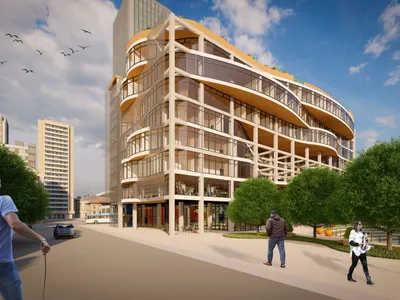
Olio Towers: A Mid-Rise for Performers That Fuses Housing, Rehearsal, and Stage
Located blocks from Houston's Theater District, this modular tower stacks living units around a central performance atrium.
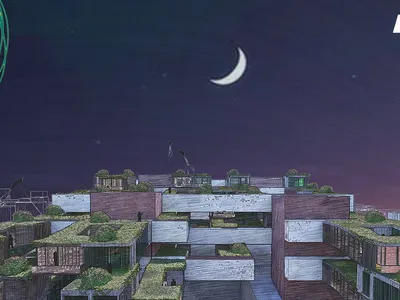
Oasis: Modular Green Housing Carved into Dhaka's Urban Fabric
A shortlisted Plugin Housing entry reclaims unauthorized settlements in Dhaka with stepped concrete volumes, green roofs, and ventilation-driven design.

Black Hole: A Floating Megastructure for the Post-Physical Era
Emiliano Mazzarotto envisions a spherical, self-scaling arena where e-sports, digital hotels, and holographic stadiums replace traditional public space.

Explore Architecture Competitions
Discover active competitions in this discipline

Challenge to reimagine the Iron Throne

Photograph architecture without architects

Illustrate the lost glory of Angkor Wat - Render Challenge

Design challenge to reuse E-waste
Comments (0)
Please login or sign up to add comments
No comments yet. Be the first to comment!