

Atelier RZLBD Turns a Toronto Bungalow into a Periscope of Light and Double-Height Voids
A pandemic-era budget cut became a spatial gift in this East York renovation that builds less to achieve more.


What happens when you lose half your second floor? If you're Atelier RZLBD, you turn the absence into the best feature of the house. Periscope House in East York, Toronto, began as a straightforward bungalow renovation for a young family: add a second storey, gain bedrooms, move on. Then the pandemic doubled and tripled material costs, and the architects were forced to cut the upper level in half. Instead of mourning the lost square footage, they carved the deleted area into a series of double-height voids that cascade through the ground floor, creating three distinct ceiling heights under a single stepped roof. The result is a 122-square-metre home that feels twice its size.
The name comes from the house's silhouette. Seen from the street, the black-clad upper volume rises and steps back like a periscope peering over its brick neighbours, or the accordion bellows of an antique camera. New zoning bylaws forced a wider side setback, narrowing the plan but allowing it to stretch rearward into a cantilevered extension over the yard. Two bay windows, one at the front ground level and one at the rear second level, frame views in opposite directions, reinforcing the telescopic metaphor. It is a project defined not by what was added but by what was strategically removed, and it offers a persuasive argument that restraint can be the most radical design move of all.
A Silhouette That Earns Its Neighbourhood

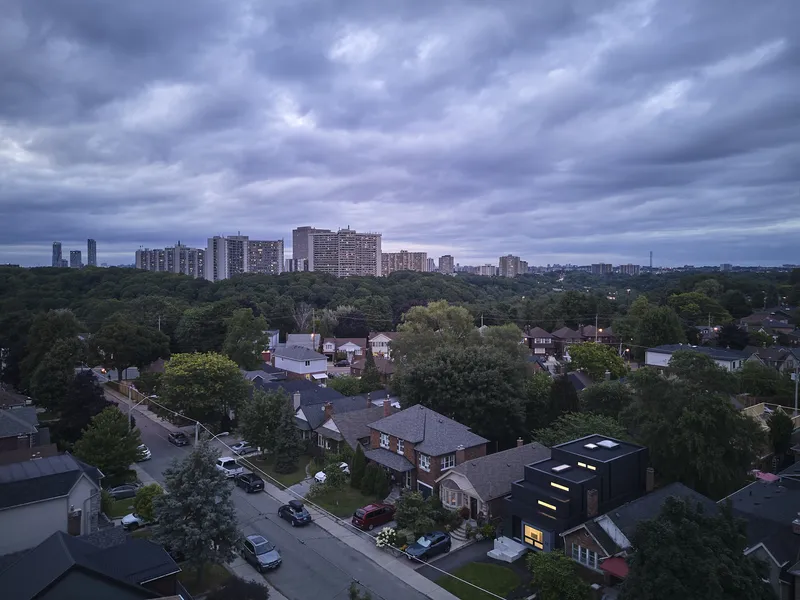
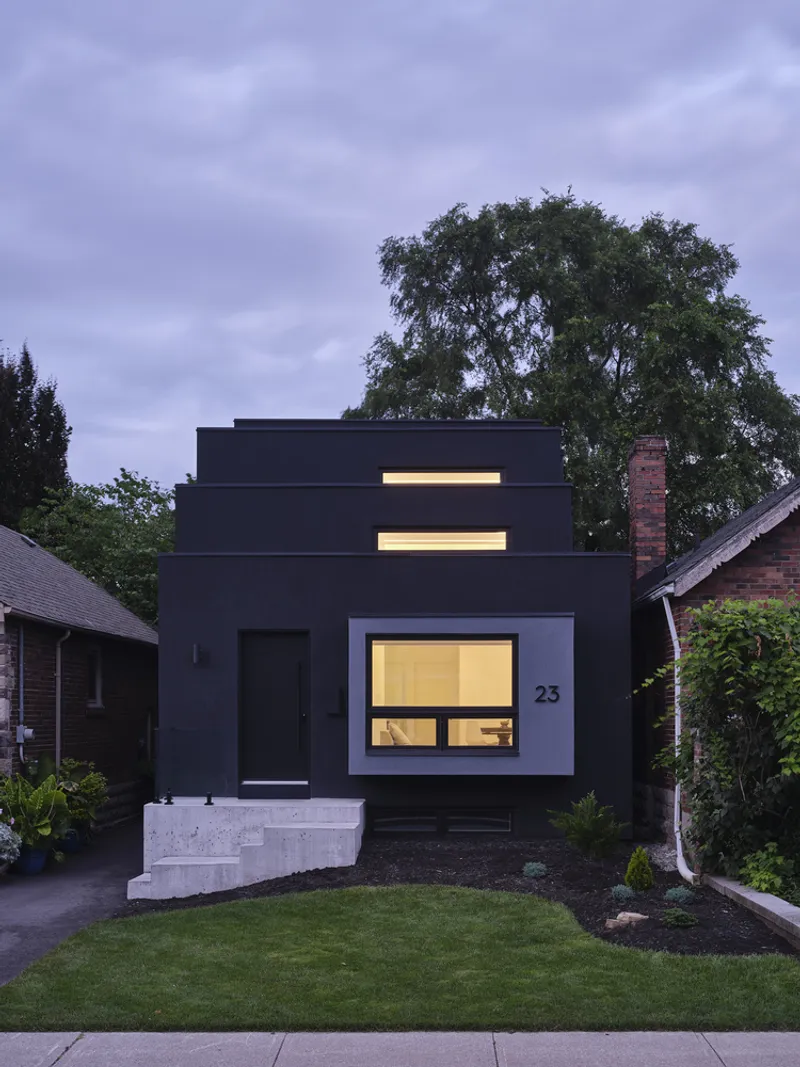
From above and at street level, the stepped black volume reads as a deliberate counterpoint to the surrounding low-rise fabric. The gabled profile nods to the bungalows on either side, but the dark cladding and clerestory slots announce something more assertive. At dusk, those slots glow like horizontal eyes, giving the house a lantern quality that belies its compact footprint.
The aerial perspective is telling: Periscope House occupies roughly the same lot coverage as its neighbours yet registers as a distinct object in the urban grain. The elongated plan, a direct consequence of the narrower width imposed by zoning, pushes the building deeper into the site and produces the rear cantilever that hovers over the backyard deck. It is a case study in treating regulatory constraints as generative forces rather than obstacles.
The Stepped Ceiling and Three Scales of Space

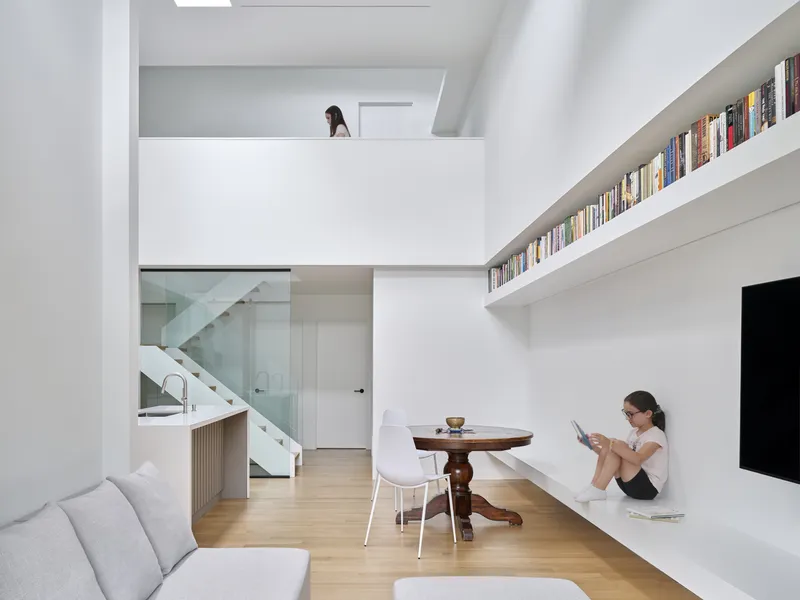
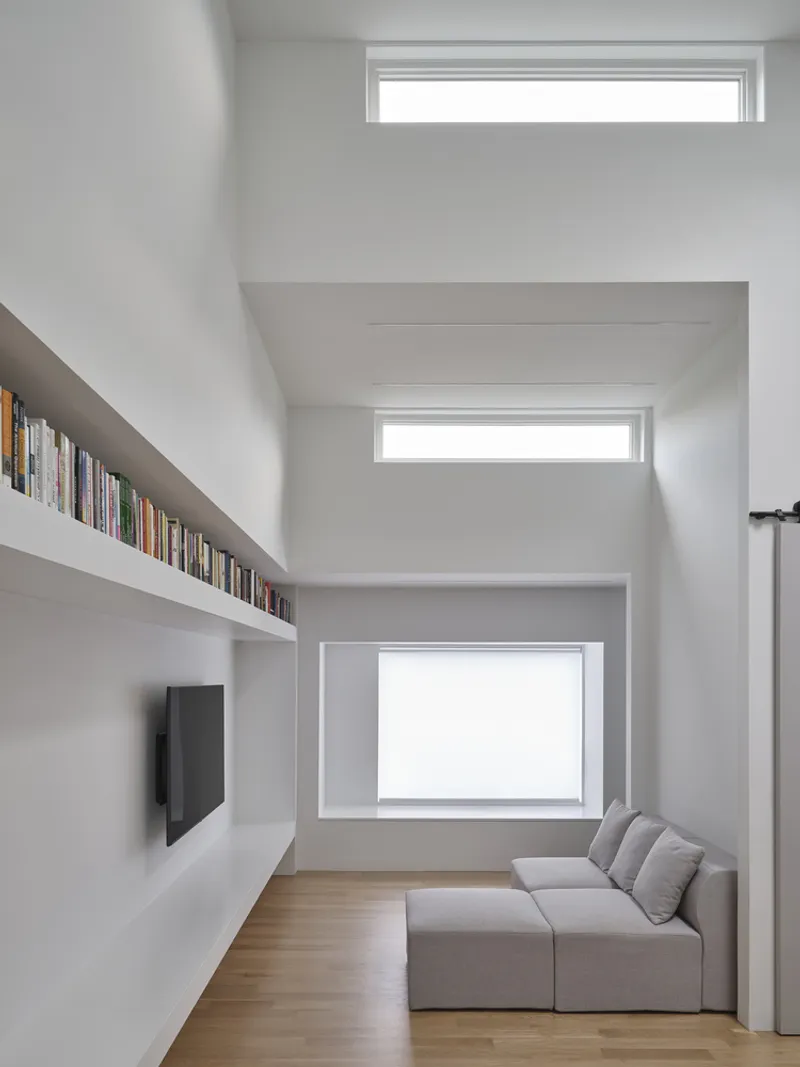
The partially built second floor creates a descending sequence of ceiling heights across the ground-floor plan. The kitchen and dining room sit beneath the tallest void. The mud room and living room occupy a middle register. The foyer and sitting room compress to the lowest height. Walking from front to back, the spatial experience shifts from intimate enclosure to soaring openness, a gradient that gives each zone a distinct character without the need for walls.
A continuous built-in bookshelf runs along the wall at the floor line of the mezzanine above, stitching the living room, dining area, and sitting room into one long, legible datum. Below it, a linear bench niche does the same at seated height, dissolving the programmatic divisions between rooms. When the family wants one grand space for entertaining, the open plan delivers. When they want quiet corners, the ceiling steps provide psychological separation. It is smart domestic planning that avoids the false choice between open concept and compartmentalized rooms.
Light as Material
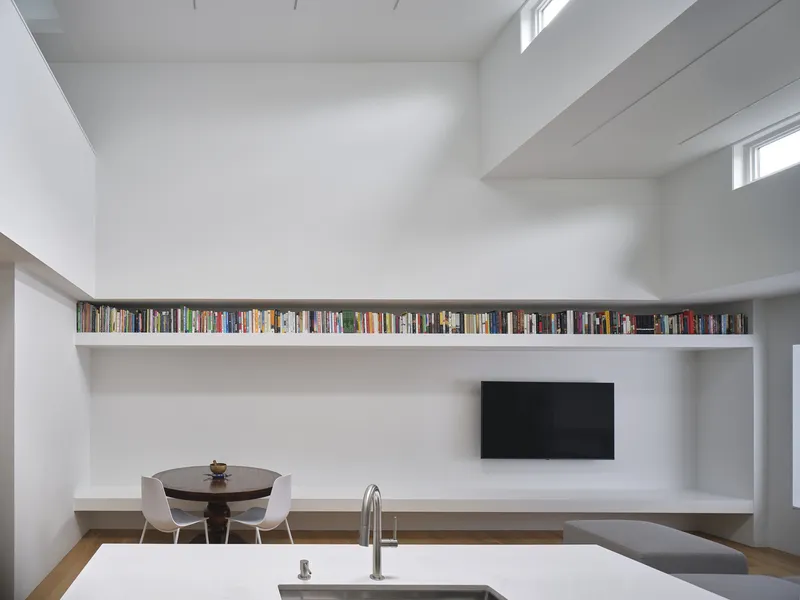
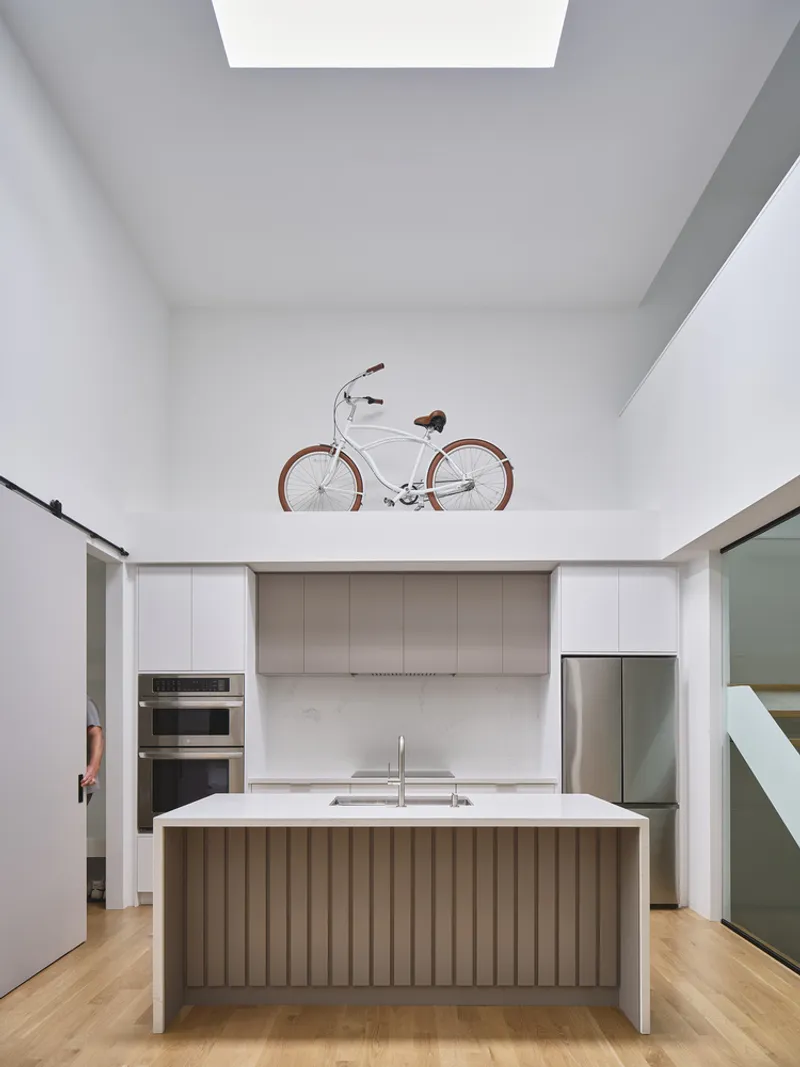
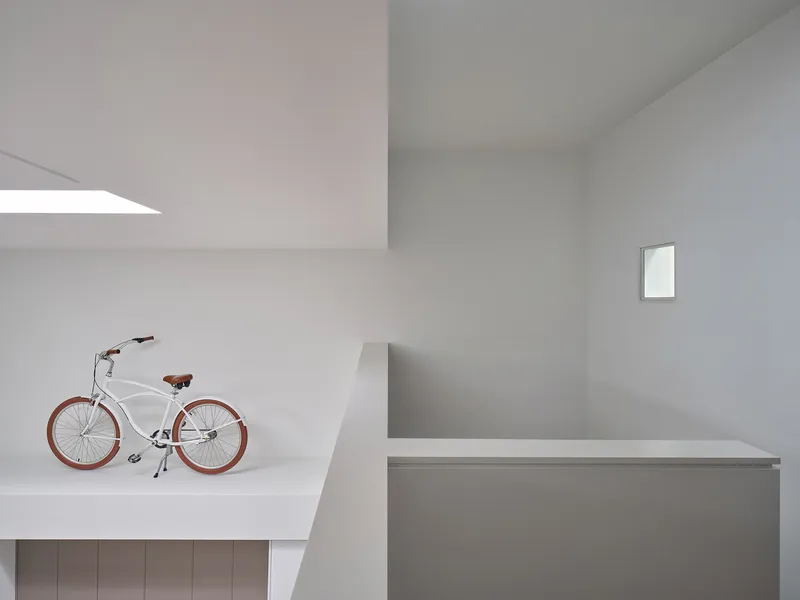
Clerestory windows punctuate each step of the ceiling, positioned to introduce light at varying heights and angles throughout the day. The effect is cinematic: morning sun rakes across the kitchen island from one slot while afternoon light drops through a skylight onto the mezzanine landing. A continuous book ledge above the dining area catches horizontal light from the front bay window and bounces it deeper into the plan, turning a simple shelf into a reflective surface.
On the mezzanine, a recessed skylight and a small square window puncture the wall beside a casually parked bicycle, a detail that captures the house's relaxed domesticity. The openings are calibrated not just for illumination but for visual rhythm: each one repeats the horizontal proportions of the clerestories below, establishing a language of slots and apertures that unifies the interior.
Back Yard, Front Stage
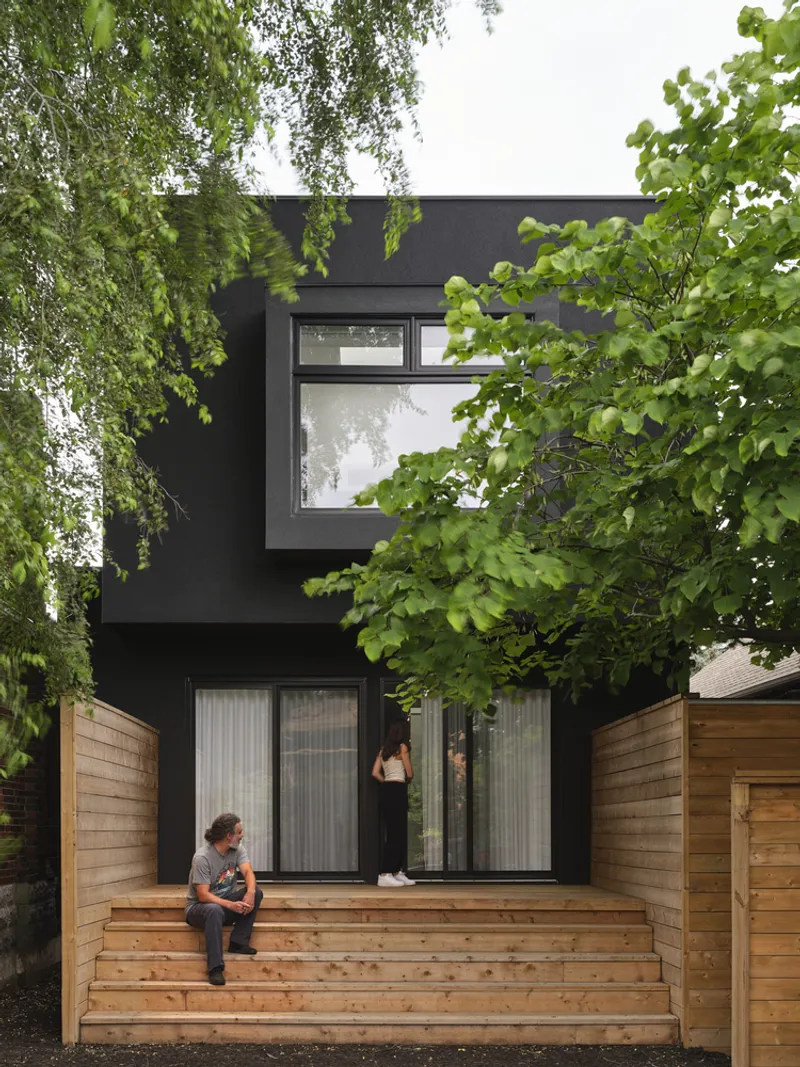

The rear elevation is where the periscope metaphor becomes literal. A timber stair descends from the cantilevered upper volume to a deck framed by wood fencing and mature deciduous trees. The black cladding recedes into shadow beneath the canopy, foregrounding the warm tones of the deck and the greenery beyond. It is a small backyard that punches well above its weight as outdoor living space.
The physical model reveals how the stepped slabs extend from a solid central core, each offset to create the terraced profile. Seeing the structural logic stripped of surface makes it clear how tightly the cantilever, the setback, and the voids are interrelated. Nothing here is decorative; the form is a direct trace of budget, bylaw, and ambition negotiating with one another.
The Concept in Your Hands
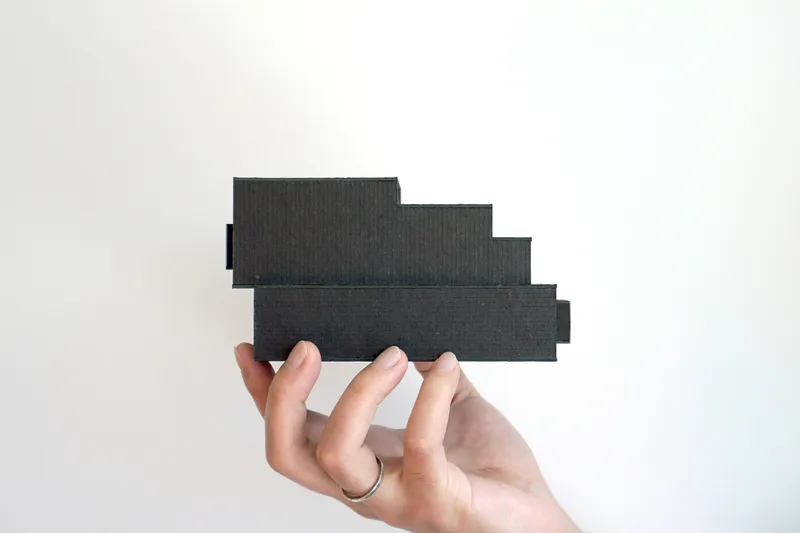
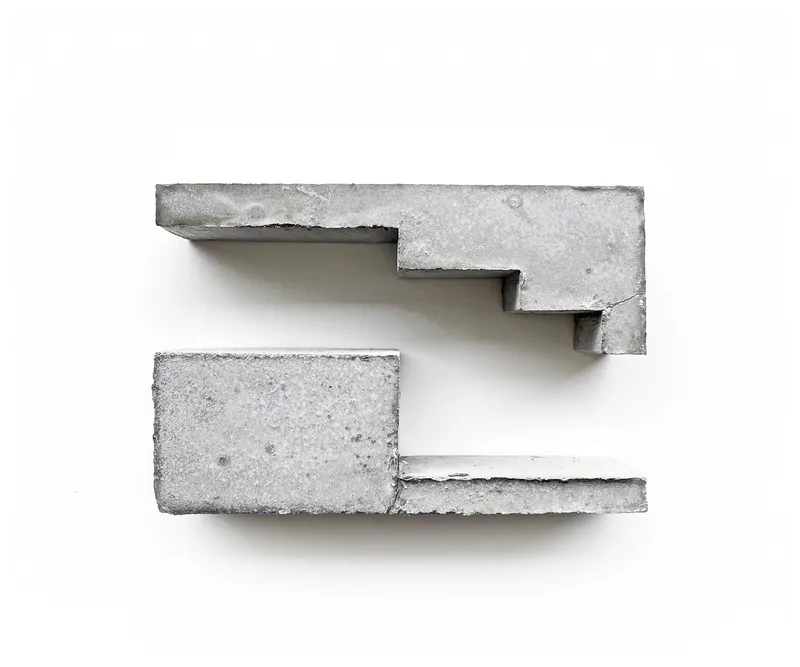
Two study objects round out the design narrative. A hand-held black cardboard model captures the stepped facade profile as a pure silhouette, the kind of thing you could mistake for a miniature stage set. Alongside it, a pair of interlocking concrete components demonstrates the stepped joint detail of the assembly system. These artifacts suggest that the architects developed the project through physical making as much as digital modelling, testing proportions and connections at the scale of the hand before committing them to the scale of the house.
Plans and Drawings
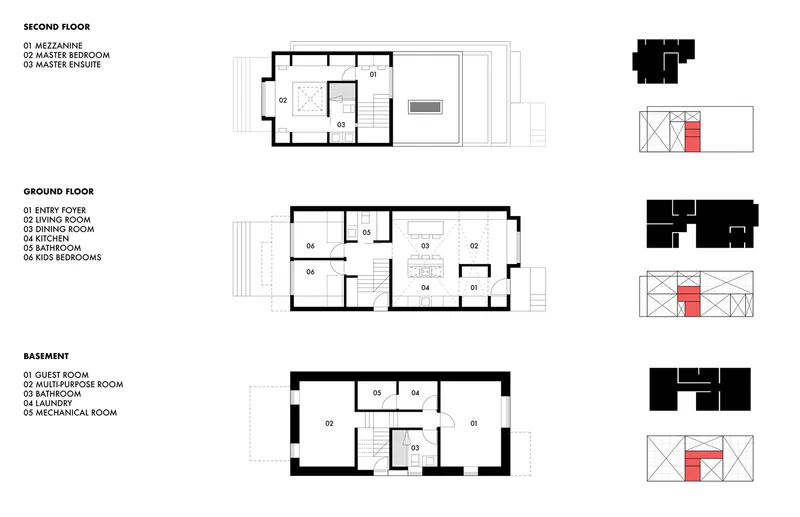
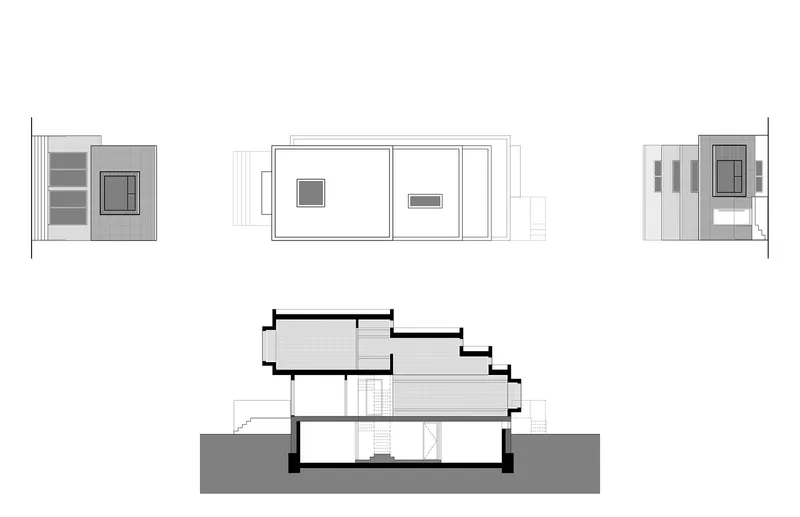
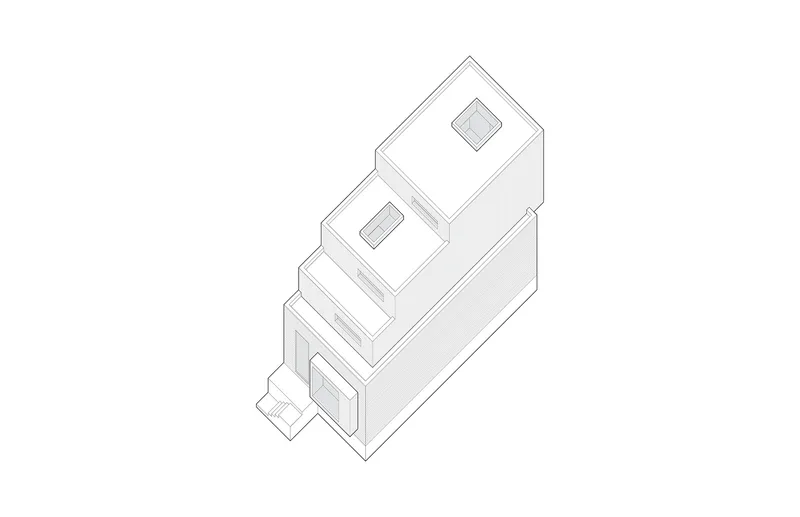
The floor plan drawing shows the tripartite organization clearly: basement services below, the open ground floor with children's bedrooms tucked to the rear, and the partial second storey containing the primary suite and mezzanine. The staircase sits dead centre, acting as both a circulation spine and a spatial divider between public and private zones. Elevation and section drawings confirm how each ceiling step corresponds to a programmatic shift, while the axonometric explodes the stacked volumes to reveal the offset terraces and the courtyard relationship. Together, these drawings make the case that the house's sculptural exterior is entirely a product of interior logic, not an imposed gesture.
Why This Project Matters
Periscope House matters because it reframes austerity as opportunity. The pandemic inflated costs and the city tightened setbacks, and instead of scaling back ambition to match the smaller envelope, Atelier RZLBD scaled back material and let spatial generosity fill the gap. Removing half a floor to gain double-height voids is a counterintuitive move that most clients would resist, but the proof is in the living: three distinct ceiling heights, abundant daylight from slots that would not exist in a conventional two-storey plan, and a ground floor that reads as a single flowing landscape rather than a stack of rooms.
For Toronto's vast stock of postwar bungalows, this project sets a credible precedent. It demonstrates that a second-storey addition does not have to be a blunt extrusion of the existing footprint. By selectively subtracting from the new volume, the architects created a home that is more spatially rich, more energy-conscious, and frankly more interesting than a full buildout would have been. In a housing market obsessed with maximizing square footage, Periscope House makes a compelling argument for maximizing experience instead.
Periscope House by Atelier RZLBD. East York, Toronto, Canada. 122 m². Completed 2024. Builder: Maxamin Homes. Photography by Riley Snelling.
About the Studio
Share Your Own Work on uni.xyz
If projects like this are the kind of work you want to make, uni.xyz is a place to publish your own, find collaborators, and enter design competitions.


Popular Articles
Popular articles from the community


Cube Design Draws an Ecological Corridor Between Two Shenzhen Hills with the Nankai Building
Beside Shenzhen's container docks, the Nankai Building pairs stacked balconies with a climbing green screen to connect two hillsides across its height.

GROUP A Strips a 1969 Rotterdam Harbor Headquarters to Its Frame and Wraps It in Timber Louvers
In Rotterdam's M4H harbor district, Ferro Offices reuses a 1969 frame, adds one timber storey and reaches BREEAM-NL Outstanding.

U.GA Architects Wraps an Oval Rooftop Pool in Curved Board-Formed Concrete on Busan's Jeollidan-gil
In Busan's Jeonpo-dong, a 454 m² mixed-use block stacks a neighborhood facility, guest rooms and an oval rooftop pool inside spiraling concrete walls.

Juan García Correa, John González and Claudia Rueda Sink a Circular Amphitheater into a Manizales Engineering Building
On the La Nubia campus in Manizales, Colombia, the S1 Building folds labs and offices into a hillside of ramped lawns that double as a campus route.

Similar Reads
You might also enjoy these articles


Hodi-Mandai Geram
Project Function: Preservation and revitalization of the Intangible heritage and socio-spatial identity of the Hodi by Housing, Cultural Memory Center, Sacred Grove, landscape, local tourism economy


Olio Towers: A Mid-Rise for Performers That Fuses Housing, Rehearsal, and Stage
Located blocks from Houston's Theater District, this modular tower stacks living units around a central performance atrium.

Oasis: Modular Green Housing Carved into Dhaka's Urban Fabric
A shortlisted Plugin Housing entry reclaims unauthorized settlements in Dhaka with stepped concrete volumes, green roofs, and ventilation-driven design.

Black Hole: A Floating Megastructure for the Post-Physical Era
Emiliano Mazzarotto envisions a spherical, self-scaling arena where e-sports, digital hotels, and holographic stadiums replace traditional public space.

Explore Housing Competitions
Discover active competitions in this discipline

Challenge to reimagine the Iron Throne

Photograph architecture without architects

Illustrate the lost glory of Angkor Wat - Render Challenge

Design challenge to reuse E-waste
Comments (0)
Please login or sign up to add comments
No comments yet. Be the first to comment!