

Perspective: Ways of Seeing
A public architectural sculpture that frames time, place, and perspective through shadow, structure, and vertical exploration.


Winner entry of Sculpt|r| by Imagenary S
“My destination is no longer a place, rather a new way of seeing.” — Marcel Proust
This project proposes a transformative model of architectural sculpture that redefines the interaction between people and public spaces. Rather than simply serving as a visual focal point, this sculpture, named Perspective, functions as an experiential environment—one that engages the body and mind through motion, atmosphere, and the shifting dynamics of natural and built surroundings. The work responds to the contemporary need for architectural interventions that are not only symbolic, but participatory.
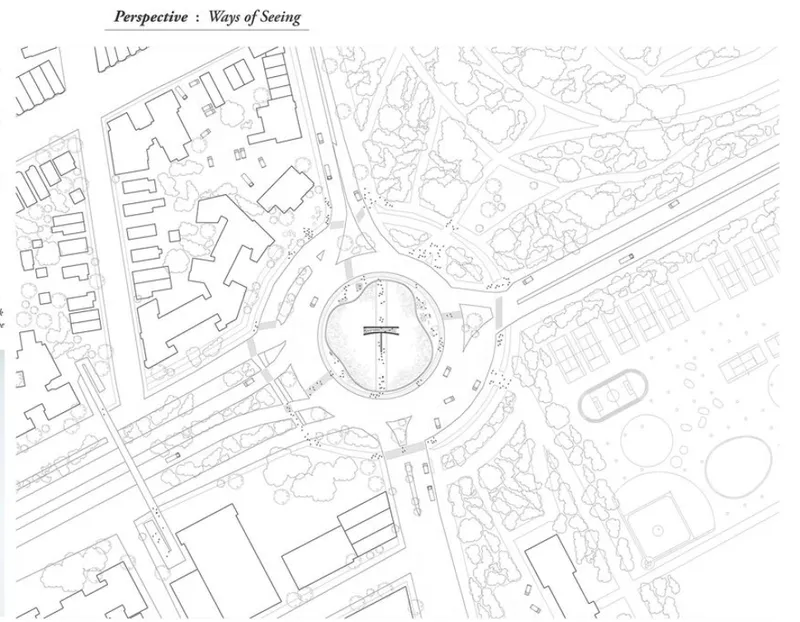
1. Time through Light and Shadow
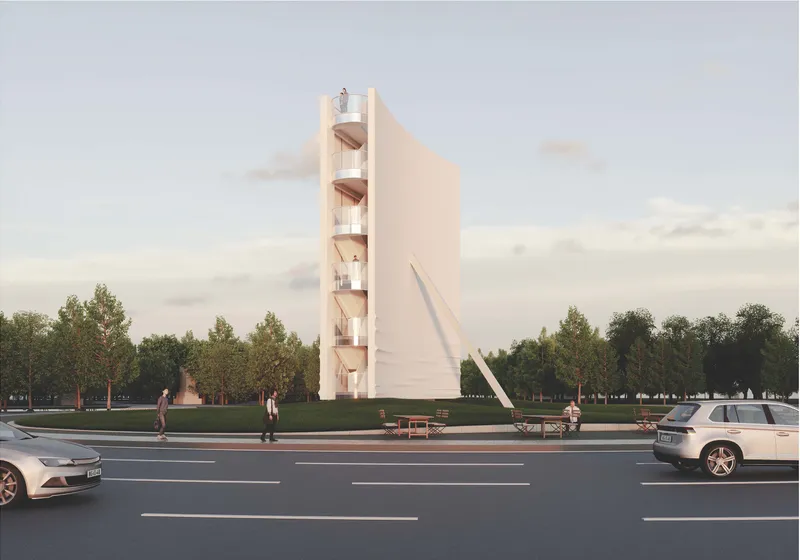
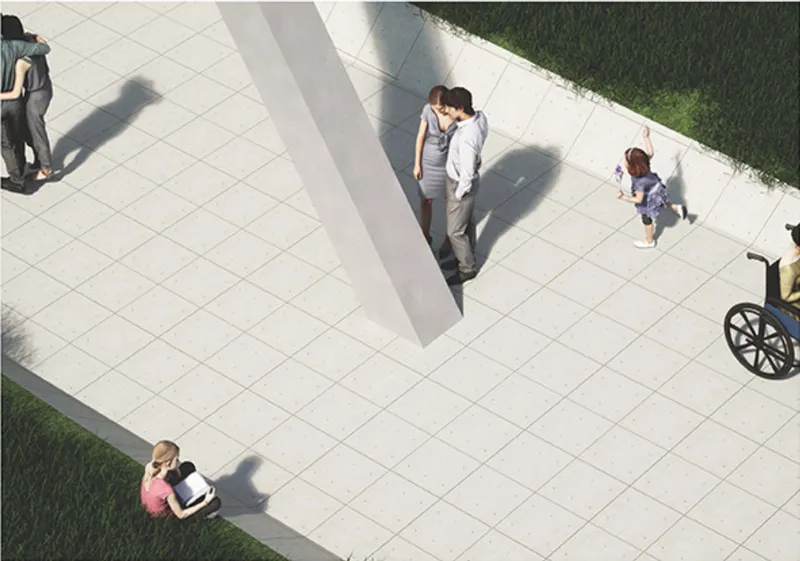
One of the core spatial narratives of Perspective is the embodiment of time through the interplay of light and shadow. A striking 16-meter by 21-meter vertical plane interacts with a diagonally positioned column, producing a sundial-like effect throughout the day. As sunlight shifts, so do the shadows, offering visitors a constantly changing visual marker of time's passage. The surface folds along the base amplify this effect, creating nuanced textures of light and dark that evolve hour by hour. These ephemeral elements remind observers of their own temporal presence in space, connecting them to natural rhythms.
2. Movement through Public Programming
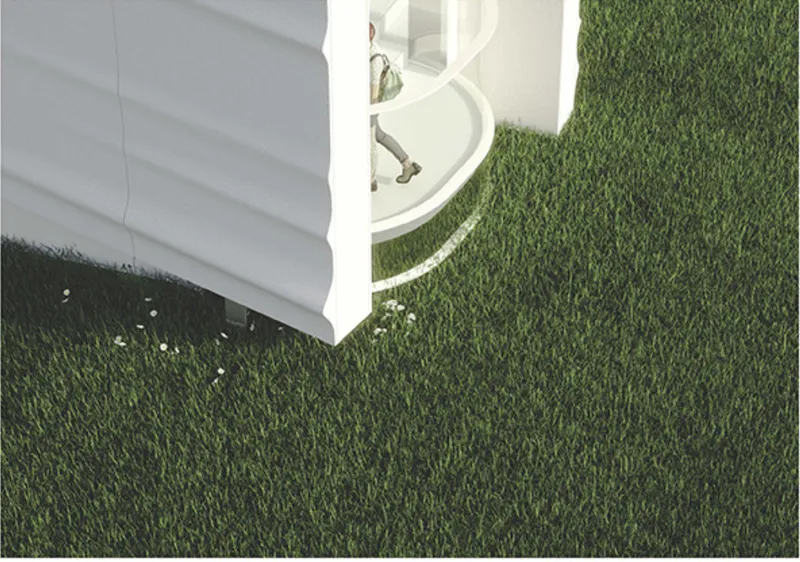
At ground level, the design reframes the traditional notion of a sculpture pedestal. Rather than lifting the piece above human scale, the pedestal in Perspective is landscaped and activated as a site for civic life. It acts as a connective tissue between pedestrian routes, crosswalks, and recreational spaces. This integration of walkways, event platforms, and transitional slopes ensures that users are not just viewers, but participants in the life of the sculpture. By traversing the levels—walking beneath the elevated mass or gathering within sunken plazas—visitors access a continuously unfolding spatial experience.
3. Vertical Exploration and Visual Connection
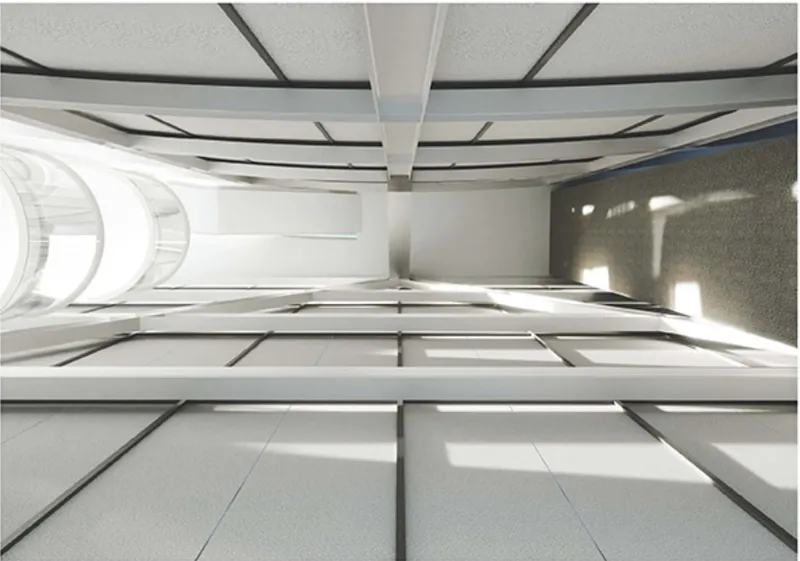
Ascending through Perspective provides a new relationship with the city. The tower houses both an elevator and a stairway, enabling layered access to a rooftop observatory. From this elevated platform, visitors can engage in panoramic views of Prospect Park, nearby neighborhoods, and even the distant New York City skyline. The upward movement becomes a ritual in itself—an act of framing one's position in the cityscape. Each level of ascent adds to the experiential narrative, inviting reflection, orientation, and discovery.
Material Expression and Structure
Crafted as a synthesis of curvature and flatness, Perspective utilizes a robust steel framework clad in GFRC (Glass Fiber Reinforced Concrete). The material choice merges the durability of concrete with the finesse of fabric, thanks to digital fabrication techniques. The facade is composed of modular elements, prefabricated off-site and assembled with precision. The resulting surface is both tactile and monolithic—appearing soft despite its structural strength. This material language reinforces the dual identity of the piece as both sculptural form and architectural infrastructure.
Urban Integration and Site Strategy
Strategically placed within a roundabout that connects surrounding green spaces, sports fields, and urban streetscapes, Perspective becomes a landmark of flow and convergence. Its design encourages multiple entry points and interactions, whether one is walking, cycling, or driving past. The elevated main structure hovers above a sunken pathway, symbolizing separation from the mundane and reconnection through descent and rise. The diagonal support is not only a feat of engineering, but a visual cue guiding the eye upward and inward.
A New Role for Architectural Sculpture
In this project, sculpture and architecture are inseparable. The form does not exist solely to be seen, but to be moved through, lingered within, and contemplated from multiple vantage points. Perspective challenges the conventional boundaries of public art and urban form, redefining architectural sculpture as a spatial interface rather than a decorative installation. It invites us to reconsider the act of seeing—not as passive consumption, but as embodied participation.
Ultimately, Perspective is more than a physical structure. It is a spatial narrative, a cultural catalyst, and a temporal instrument. Through its nuanced orchestration of movement, light, materials, and urban context, it cultivates a deeper awareness of place—offering new ways of seeing not just the sculpture, but the world beyond it.


Popular Articles
Popular articles from the community


Extended Shell: Retrofitting Kolkata's Balconies as Living Urban Thresholds
A modular retrofit system recovers the social and environmental intelligence of Kolkata's historic verandas for contemporary Park Street residents.

Singing Woman: An Opera House That Performs Before the Curtain Rises
Ovidiu Cristian Pavel's conceptual opera house translates Estonia's choral identity into a sculpted waterfront landmark facing the Baltic Sea.

Cloaked Colonization: A Mobile Underwater Habitat That Moves Like a Fish
Micah Abaya's shortlisted EHC Pacific entry reimagines ocean settlement as a dispersed network of self-sustaining architectural organisms.

Manzana Morphosis: Stretching Barcelona's Grid into a Living Landscape for 2050
A radical reworking of the Eixample manzana turns density into a tool for generous public space, vertical ecology, and environmental performance.

Similar Reads
You might also enjoy these articles


Hodi-Mandai Geram
Project Function: Preservation and revitalization of the Intangible heritage and socio-spatial identity of the Hodi by Housing, Cultural Memory Center, Sacred Grove, landscape, local tourism economy


Olio Towers: A Mid-Rise for Performers That Fuses Housing, Rehearsal, and Stage
Located blocks from Houston's Theater District, this modular tower stacks living units around a central performance atrium.

Oasis: Modular Green Housing Carved into Dhaka's Urban Fabric
A shortlisted Plugin Housing entry reclaims unauthorized settlements in Dhaka with stepped concrete volumes, green roofs, and ventilation-driven design.

Black Hole: A Floating Megastructure for the Post-Physical Era
Emiliano Mazzarotto envisions a spherical, self-scaling arena where e-sports, digital hotels, and holographic stadiums replace traditional public space.

Explore Architecture Of Time Competitions
Discover active competitions in this discipline

Challenge to design a portable theatre

Challenge to design a portable music platform

Challenge to design an open learning module for the elderly

Bring back Drive In's
Comments (0)
Please login or sign up to add comments
No comments yet. Be the first to comment!